

You've approved a campaign concept, selected a photographer, and received a gallery of technically flawless images. Yet the work feels strangely empty. The product is visible, the lighting is clean, and the retouching is polished, but nothing in the frame gives the audience a reason to care or act.
That gap explains why the question what is advertising photography needs a more useful answer than “photographs used in advertisements.” The discipline combines visual craft with persuasion, audience psychology, production planning, and commercial decision-making. In 2026, the strongest campaigns don't rely on one beautiful hero image. They build a flexible library of credible, purposeful visuals that can work across placements, buyer journeys, and changing creative requirements.
What Is Advertising Photography Really About
A campaign brief might ask for “premium,” “approachable,” or “high impact.” Those words sound clear until they reach the set. A photographer then has to translate them into choices about distance, gesture, surface, color, lighting direction, negative space, and the amount of information visible in the frame. If those decisions aren't connected to a defined audience and action, the final images can look attractive while communicating very little.
Advertising photography is commercial image-making created specifically to promote a product, service, idea, or brand. It appears in print advertisements, billboards, digital banners, landing pages, and social placements. The purpose is persuasive. The image must communicate a message quickly, create an emotional response, support brand recall, and help the viewer understand why the offer matters. Falmouth University's explanation of commercial photography makes the same practical distinction between recording a subject and creating imagery for a commercial purpose.
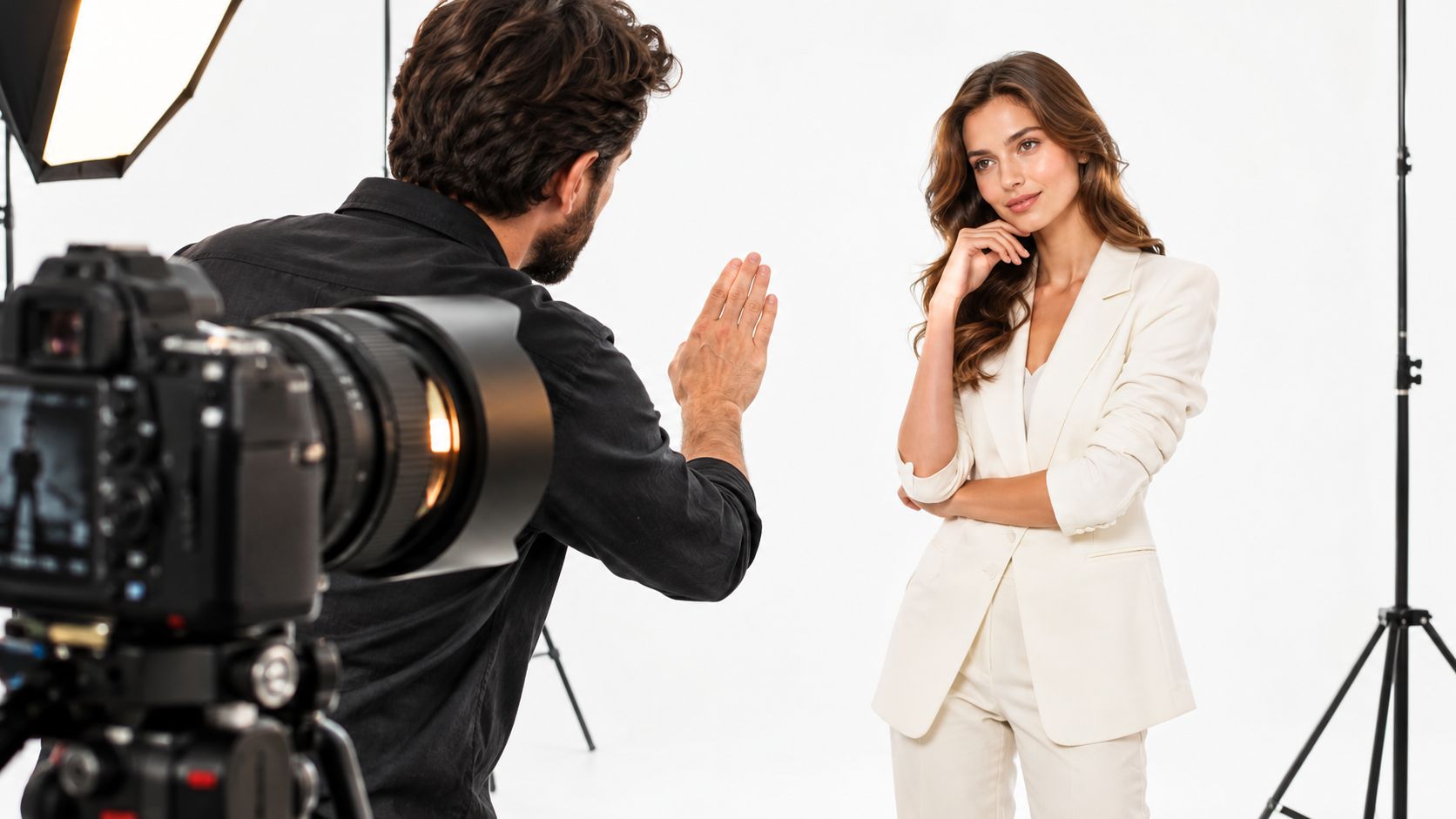
The frame has a job to do
A photographer working on an advertisement isn't just asking whether an image looks good. They're asking whether the viewer will recognize the subject, understand the intended feeling, notice the product benefit, and remember the brand after a brief glance.
That changes the creative process. A close crop may emphasize texture and quality. A wider composition may establish scale or show how a product fits into a real environment. Controlled retouching can remove distractions, but excessive manipulation may erase the signs of use that make an image believable. The best decision depends on the promise the campaign makes.
Practical rule: If a visual choice doesn't support the message, audience, placement, or action, it probably belongs in the edit rather than the final campaign.
Advertising photography therefore sits between commerce and creative expression. It needs visual judgment, but it also needs discipline. The photographer must protect the subject's appeal while leaving room for copy, adapting compositions to multiple formats, and delivering files that production teams can use.
Why polish alone fails
Polish can establish quality, but it can't substitute for relevance. A flawless portrait with no recognizable attitude may feel interchangeable. A pristine product shot with no context may show what something is without showing why it belongs in the buyer's life.
Performance-first creative starts earlier, at the brief. The team defines the audience's concern, the proof needed to address it, and the visual evidence that can make the promise credible. That approach still values beauty. It gives beauty a responsibility.
How Advertising Photography Evolved Into a Distinct Discipline
Advertising photography became its own discipline because brands needed images that did more than show a product clearly. By the early 20th century, it had already become a recognizable commercial form. By the 1930s, photography had become the medium of choice for most print advertising, according to the historical account summarized by Frame and Focal's photography timeline reference.
That shift tracked with the rise of mass print media and consumer marketing. As magazines, catalogs, billboards, and other channels reached wider audiences, a photograph had to do the persuasive work that text alone could not carry. It had to make a product feel desirable, trustworthy, modern, useful, or aspirational. The image no longer just recorded an object. It shaped the meaning around that object.
Recognition changed the photographer's role
A milestone arrived in 1934, when a New York exhibition presented advertising and industrial photographs in a fine-art setting. That exhibition signaled growing professional recognition. Commercial images were no longer treated as side material. They could show composition, design judgment, technical control, and cultural relevance.
That recognition also clarified the genre's split identity. Advertising photography carried commercial demands, yet it could still use the visual language associated with modernist design and editorial composition. Strong work had to satisfy a client's business goal without becoming visually forgettable. In practice, that meant balancing clarity, style, and intent on every frame.
From a single image to a visual system
Early print campaigns often centered on one finished ad or one dominant hero image. Digital distribution changed the production logic. A single shoot may now need vertical crops, detail views, contextual scenes, product evidence, portraits, textures, and files with different amounts of copy space.
That shift has changed how the work gets planned. A photographer now has to think in systems, not isolated frames. The best modern campaigns are built so one shoot can feed multiple placements without losing consistency or credibility. That matters even more now that digital platforms reward images that feel immediate and believable, while also giving brands room to test variations across formats.
The discipline has grown with its media. Its core still rests on persuasion through visual language, but the method now includes modular planning, faster adaptation, and tighter alignment between creative choices and campaign performance.
How Advertising Photography Differs From Related Genres
Clients often use “commercial photography” and “advertising photography” as though they mean the same thing. They overlap, but the distinction matters. Commercial photography is the wider category of paid image-making for business purposes. Advertising photography is a more specific branch in which the image is designed to persuade an audience on behalf of a campaign.
| Genre | Primary purpose | Typical creative control | Common output |
|---|---|---|---|
| Advertising | Persuade, position, and support action | High control over setting, styling, lighting, talent, and retouching | Campaign images, banners, billboards, landing-page assets |
| Editorial | Inform, interpret, or tell a story | Shaped by publication context and editorial direction | Features, profiles, essays, visual reporting |
| Commercial | Present a business, product, service, or organization | Varies by assignment and client need | Brand libraries, corporate imagery, marketing content |
| Fine art | Explore an idea or personal visual language | Primarily controlled by the artist | Exhibitions, collections, publications |
| Documentary | Record people, places, or events with observational intent | Limited intervention is generally central to the approach | Reports, archives, social or historical records |
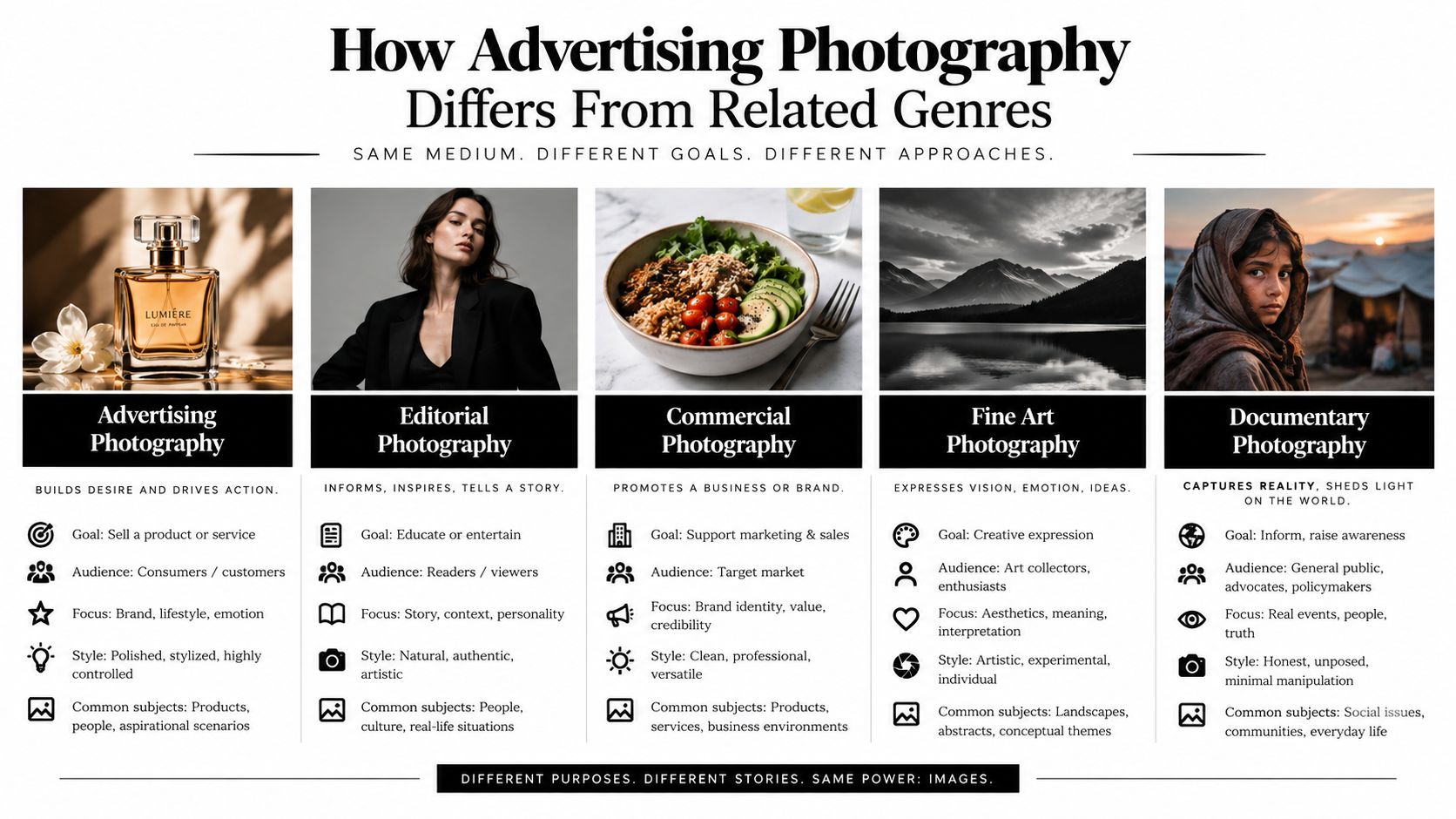
Purpose determines the approach
Editorial photography may support a story without needing to sell a specific offer. Documentary photography prioritizes observation and evidence. Fine art photography may deliberately resist a clear commercial message. Advertising photography can borrow techniques from all three, but its decisions remain accountable to campaign intent.
Product photography is often narrower still. It may show an item against a clean background, with careful control over shape, color, scale, and detail. Advertising photography can include that kind of image, but it may also place the item in a lived environment, connect it to a person, or build a visual scene around a benefit.
Fashion photography usually prioritizes the presentation of garments, styling, silhouette, and mood. Advertising photography for a fashion campaign must also serve the brand's position, audience, and commercial message. The clothing may be central, but it isn't the only subject.
For a broader overview of adjacent assignments, this guide to commercial photography types offers useful category-level context.
Output requirements expose the difference
A genre can also be identified by what the client needs after the shoot. An editorial commission may require a small set of images selected for a particular story. An advertising assignment often requires alternate crops, clean backgrounds, negative space for copy, retouched masters, and usage-ready exports.
Advertising also demands closer coordination with art direction. The photographer may need to preserve a logo area, match an established color system, show a material accurately, or create enough variation for testing. A visually impressive frame that can't accommodate the layout isn't a successful advertising asset.
Technical Workflow From Brief to Final Delivery
Professional advertising photography begins with the final use, not the camera. A campaign intended for an online store, paid social placement, magazine spread, or large-format print may require different crops, color handling, resolution, and file formats. The photographer, art director, and production manager should resolve those requirements before lighting is designed.
Start with the delivery map
The brief should identify the subject, audience, message, channels, dimensions, required variations, schedule, and approval process. It should also state whether the team needs isolated product views, lifestyle scenes, portrait orientation, room for copy, or images that can be adapted into motion.
Industry guidance commonly prepares web assets around 2000 pixels on the long edge, while print assets are commonly delivered as 300 DPI TIFF or high-quality JPEG at final print size, according to brand photography guideline guidance from Image Studio. These are production reference points, not universal rules. The publisher or platform specification should always take priority.
Build the capture around the channel
Lighting affects more than mood. It controls highlight detail, surface texture, color separation, reflections, and the amount of flexibility available during retouching. A product intended for an e-commerce page may need clean edges and consistent views. A brand campaign may need dimensional light, human interaction, and several compositions that leave room for headlines.
An HDR approach can help when a product contains difficult reflective surfaces or a scene needs controlled tonal range. For teams working on product advertising, this HDR workflow for ecommerce ads provides relevant technical context without replacing careful capture and art direction.
Protect color through post-production
Color management keeps a photographed object from changing character as files move between devices and publications. The International Color Consortium's white papers describe ICC profiles as data that enables unambiguous interpretation and conversion of color content between device-specific and device-independent spaces.
A practical workflow profiles the monitor and other relevant devices, preserves embedded profiles, and chooses a working space suited to the output. The ASMP digital photography guide recommends profiling monitors, printers, and scanners while embedding appropriate spaces such as Adobe RGB, sRGB, and SWOP CMYK.
Production insight: A reshoot caused by an ignored crop, incorrect color space, or missing release costs more than a careful pre-production conversation.
Client review also needs structure. A clear proofing process should explain what the client is approving, how many revision rounds are included, and which changes affect the original creative direction. Guidance on managing client visual expectations can help teams establish that shared vocabulary before files reach final delivery.
Market Realities and Authenticity Demands in Modern Campaigns
Advertising photography now serves a commercial imaging economy shaped by digital distribution, brand performance, and rising expectations for credibility. One market analysis estimated the global commercial photography market at $5.2 billion in 2022, projecting $6.5 billion by 2032 at a 2.2% compound annual growth rate, according to Fact.MR's commercial photography market analysis. The same analysis identified product photography as 45% of the global commercial photography space and North America as holding a 41% share in 2021.
A separate industry estimate placed the U.S. photography market at approximately $16.2 billion in 2026. These figures cover photography more broadly than advertising alone, yet they show the scale of the business around product, corporate, brand, and editorial commissions. Advertising photography is a creative service, but it also has to support measurable commercial work.
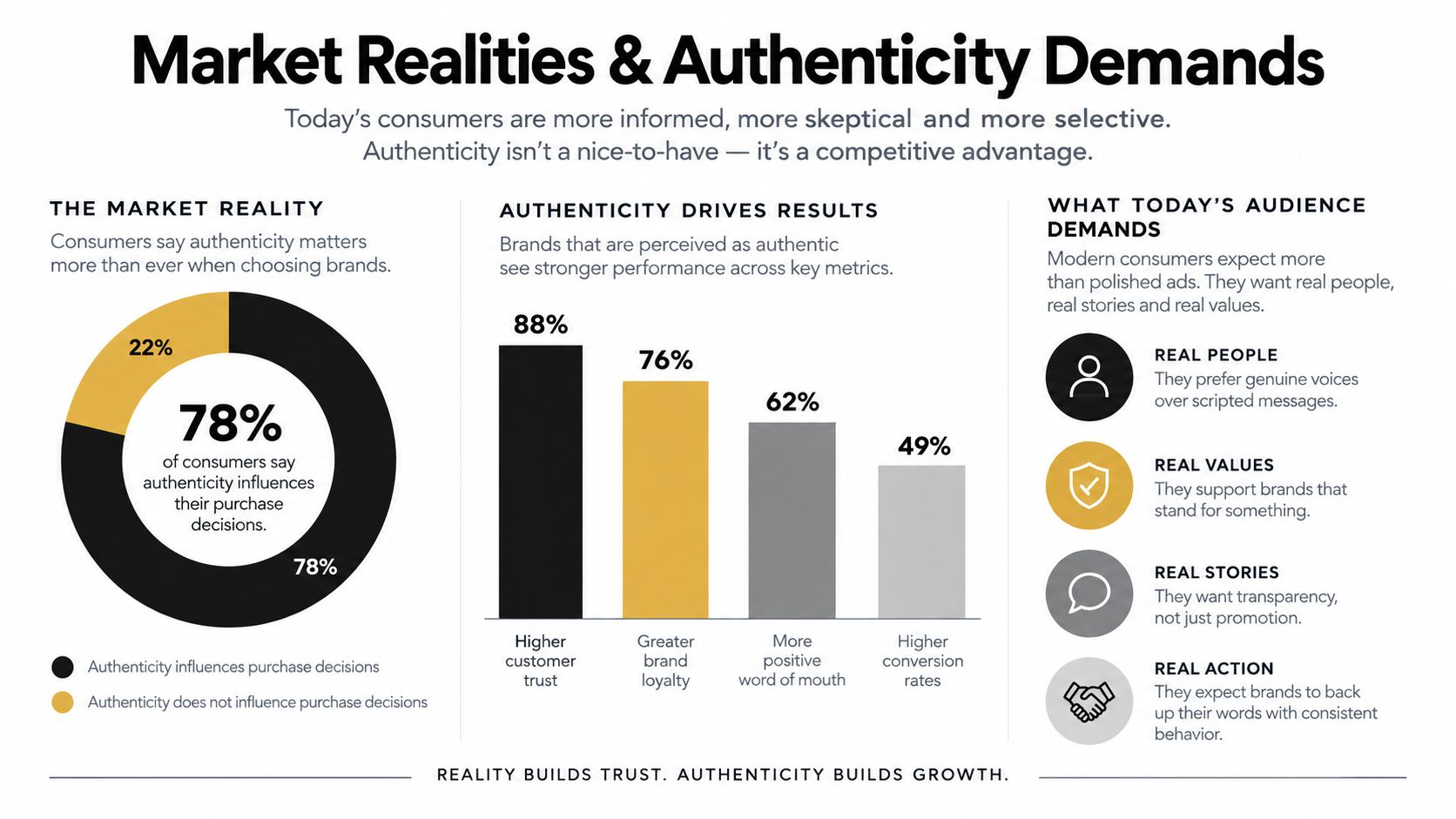
Digital distribution changed the production model
Online platforms accounted for 63.67% of the photography services market in 2025, while commercial and advertising agencies held 31.74% of revenue share, according to Mordor Intelligence's photographic services market analysis. The production consequence is clear. Teams need adaptable visual assets for multiple placements, not one finished image designed for a single print execution.
A modular shoot addresses that demand. For one product, the photographer may capture the complete object, a functional detail, a person using it, a scale reference, material texture, and compositions with varied negative space. Those assets can support paid social, product pages, marketplaces, editorial placements, and email while preserving a coherent visual system.
The strongest teams plan the image set around use cases before the shoot. A vertical crop, a square composition, and a wide frame may require different subject placement and lighting decisions at capture, not improvised cropping after delivery.
Trust requires controlled realism
Highly polished imagery can lose credibility when the audience needs evidence of how a product, place, or service exists in real life. Accurate textures, natural gestures, visible surroundings, and human-centered moments can show practical use. Direction still matters. The photographer shapes the scene so it feels observed rather than manufactured.
Corporate and industrial applications are identified as the fastest-growing end-user segment, reaching a 7.1% compound annual growth rate through 2031, according to Fact.MR's commercial photography market analysis. Those assignments often need to communicate process, scale, expertise, and working culture. Aspirational polish remains useful, but the image must withstand close inspection.
AI-assisted workflows speed up variations and retouching. They also increase the need for clear boundaries. Retouching should clarify the intended message, not create evidence that the product or environment cannot support. The photographer must decide what stays real, what can be refined, and what would make the image feel misleading.
Licensing follows the same commercial logic. Getty Images' licensing FAQ distinguishes royalty-free pricing by file size from rights-managed editorial pricing by usage, and notes that model and property releases can affect permitted use. Treat rights as part of production planning, before publication rather than after it.
How to Choose and Commission the Right Advertising Photographer
Choose a photographer for the assignment's decisions, not only for the portfolio's surface style. A strong portfolio should show control of light, composition, people, products, spaces, and retouching, but it should also reveal whether the photographer can solve different communication problems. Ask how they'd adapt the work for mobile crops, print, landing pages, and marketplace listings.
Evaluate the working method
A useful conversation should cover:
- Creative interpretation: Can the photographer turn an abstract positioning statement into specific visual choices?
- Production planning: Do they ask about locations, talent, styling, props, access, schedule, and approval responsibilities?
- Technical delivery: Will they plan for color profiles, file formats, crop variants, naming, retouching, and archive requirements?
- Collaboration: Can they work productively with an art director, brand team, designer, and production manager?
- Licensing: Does the estimate state where, how long, and in which media the client may use the images?
The last point protects both sides. Advertising photography commonly requires a model release when a recognizable person's image promotes a product, service, or idea. The release grants consent to publish, republish, or transmit the image in any medium and anywhere in the world, as described in this model release guide. Property permissions may also matter when a location or distinctive private asset is central to the image.
Match expertise to the visual problem
A photographer focused on architecture may be the right choice for built environments, while a product specialist may be better suited to reflective surfaces, complex tabletop sets, or high-volume catalog work. Corporate teams may need someone who can direct people without making portraits feel rigid. A studio such as Jimmy Clemmons Photographer combines commercial imagery for products, people, and spaces with location scouting, lighting design, on-set direction, and professional editing.
Before commissioning, request a written scope with the shot list, deliverables, retouching expectations, usage rights, model and property release responsibilities, review process, and delivery schedule. The right photographer will not merely promise polished images. They'll show how the images will carry the campaign from first impression to credible decision.
Jimmy Clemmons Photographer creates purpose-driven images for architectural spaces, commercial brands, products, people, and corporate teams, with production support covering location scouting, lighting, direction, and editing. If your campaign needs advertising photography that balances design quality with clarity and trust, visit Jimmy Clemmons Photographer to discuss the assignment.