
Your website looks polished, your proposal is carefully written, and your brand guidelines are clear. Then a prospect opens your Instagram account and sees a mix of dated headshots, generic stock interiors, phone snapshots, and product images with different color temperatures. Nothing is technically disastrous, but the collection doesn't feel like one company.
That inconsistency creates friction. A potential client may not be able to explain why the brand feels less credible, yet the visual gap is there before anyone reads a headline or books a call. Commercial brand photography closes that gap by giving your marketing team a deliberate, reusable image system for the website, social channels, proposals, advertising, editorial submissions, and internal communications.

Purposeful visuals build trust faster than words alone because they let people see the quality, people, process, and place behind a promise.
A strong image library doesn't mean photographing everything that moves. It means deciding what your audience needs to understand, then producing those visuals with consistent direction, light, composition, and editing. The right photograph can show how a firm thinks, how a hotel feels, how a school welcomes families, or how carefully a contractor builds.
This guide starts with the definition, then moves through the business case, production workflow, choices between custom and synthetic visuals, commissioning, pricing, and practical outcomes. The aim is simple: help your team treat photography as a repeatable performance system rather than a one-time website expense.
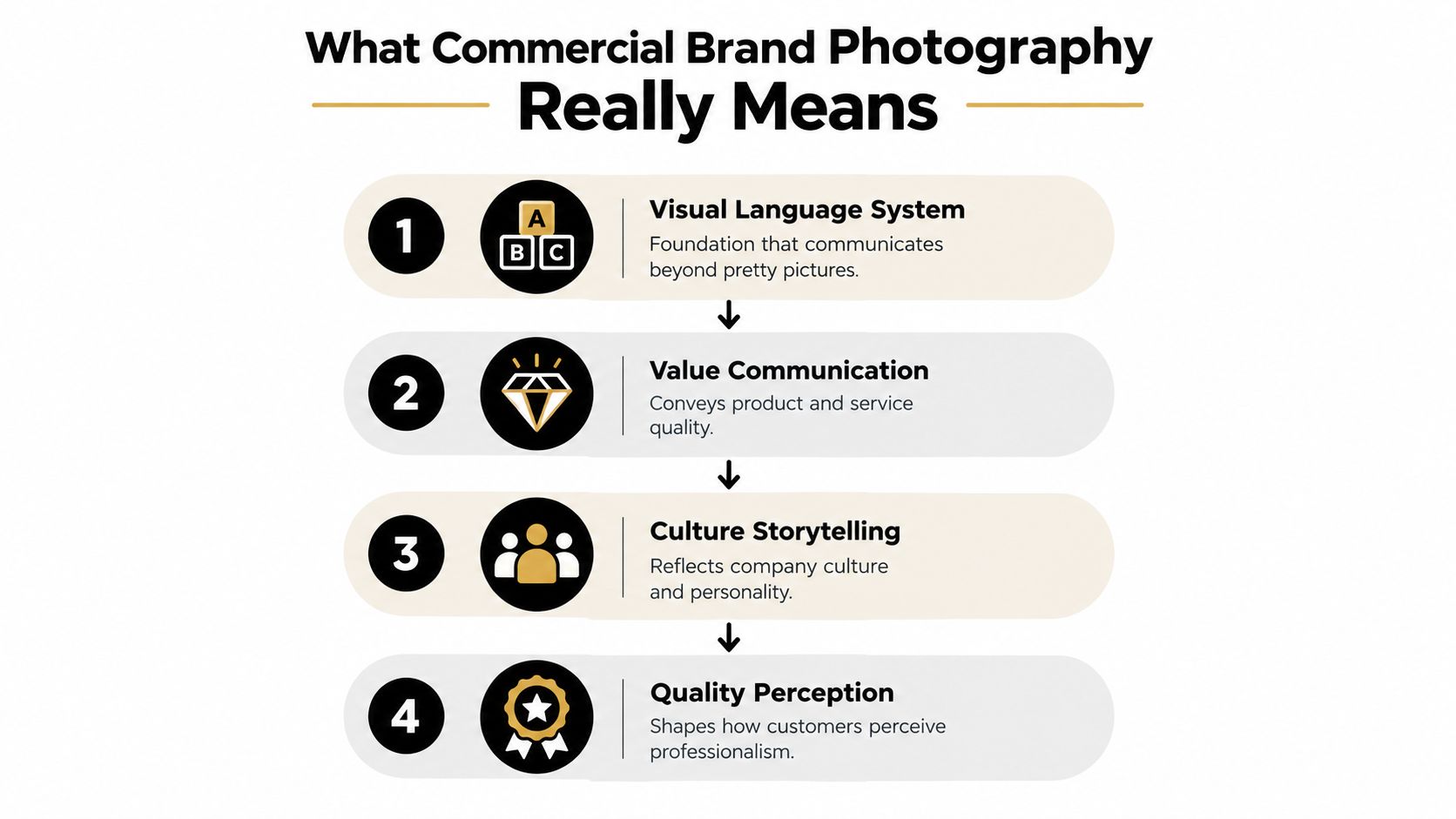
What Commercial Brand Photography Really Means
Commercial brand photography is a visual language system. Think of your written brand as a vocabulary and your photography as the tone, rhythm, and visual grammar that make those words believable.
A logo identifies a company. Photography shows what that identity feels like in practice. A clean architectural frame can communicate precision. A relaxed team interaction can suggest approachability. A carefully lit product can make materials, finish, and construction easier to evaluate. None of these images should be decorative accidents. Each one should support a message your audience needs to receive.
The difference between coverage and a system
A headshot answers, “Who is this person?” Event coverage records what happened. Stock imagery fills a space when a team needs something quickly. Commercial brand photography asks a broader set of questions:
- What do you want people to understand about your value?
- Which people, places, materials, and processes prove that value?
- How should those subjects look across different channels?
- What visual choices make the brand recognizable without placing a logo in every frame?
For an architecture practice, the system may include exterior form, interior transitions, detail work, team collaboration, and the relationship between a building and its neighborhood. For a hospitality group, it might combine arrival, service, atmosphere, food, guest experience, and the texture of the property. A corporate marketing team may need leadership portraits, working sessions, workplace culture, recruiting content, and customer-facing proof.
The system works when the images share a point of view. That doesn't mean every frame looks identical. It means exposure, color, composition, human direction, and subject choice feel related.
Why editorial discipline matters
A photographer with an editorial eye looks for the detail that makes an organization specific. In a commercial interior, that might be the line where daylight meets a stone surface. In a team portrait, it might be the natural gesture that reveals how people work together.
Composition also protects usefulness. A vertical frame can support a mobile story, while a wider image may leave room for website copy or a proposal headline. Editing should preserve material character and skin tone rather than forcing every image into an artificial visual effect.
For product teams, technical execution matters just as much. This guide to e-commerce image quality offers useful context on preparing product visuals for digital use. The same principle applies to broader brand libraries: an image must remain clear, consistent, and practical wherever your team publishes it.
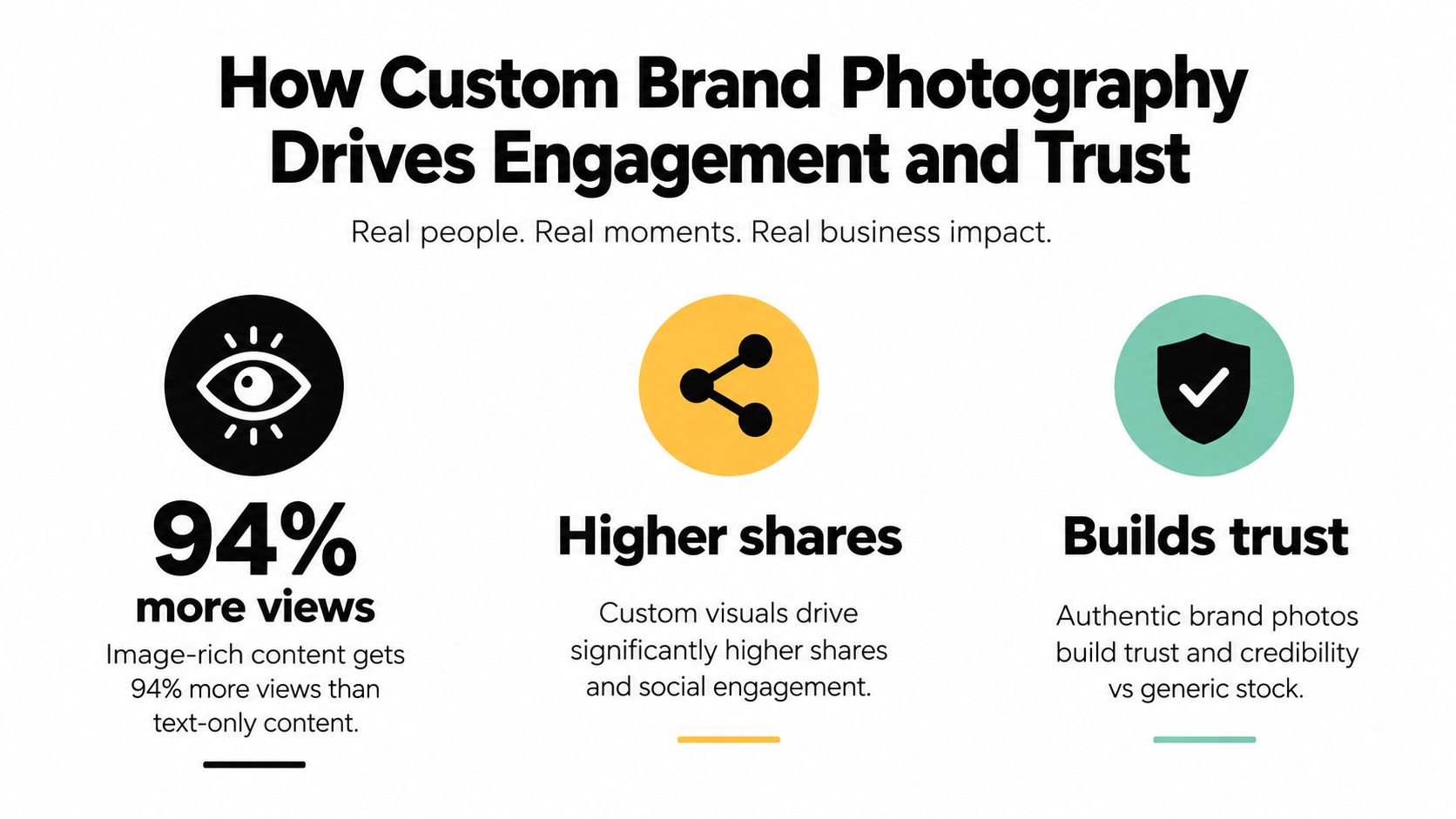
How Custom Brand Photography Drives Engagement and Trust
The business case begins with attention. In a 2025 visual-content study, 85% of marketers said visual content was a core part of their strategy, compared with 72% in 2019, and more than 70% of brand content shared online included images or videos, according to visual-content marketing data from Zebracat. Those figures describe a marketing environment where photography isn't an accessory to communication. It sits inside the communication itself.
The same data set reported that video campaigns generated 60% higher engagement than text-only campaigns, while image-based campaigns produced a 35% engagement lift. These results don't mean every photograph will perform equally. They show why teams invest in visual assets that make a message easier to notice, understand, and remember across Instagram, LinkedIn, Facebook, TikTok, YouTube, websites, and paid campaigns.
Attention is only the first result
Independent visual-marketing summaries report that articles with images receive 94% more views than text-only articles, while posts with images can generate 150% more engagement, as outlined in visual content marketing statistics from Marketful. These figures help explain why a strong photograph can change the first stage of a buyer's journey, but the deeper value comes from relevance.
A generic office image may attract a glance. A photograph of your actual studio, construction process, faculty, property, or finished space gives the viewer something to evaluate. It turns an abstract claim into evidence. That distinction matters when a client is comparing architecture firms, when a developer is presenting a property, when a school is speaking to families, or when a company is recruiting people who want to understand its culture.
Original imagery also gives a brand memory cues. A consistent treatment of light, space, color, and human presence can make a series recognizable even without a logo. Stock may be technically attractive, but it often asks the audience to accept a scene that doesn't belong to your organization.
Engagement needs a useful destination
Photography can't repair an unclear offer, a slow website, or a weak landing page. It can, however, make a strong offer easier to enter. A well-composed project image can lead to a case study. A working portrait can support a leadership page. A sequence of process photographs can help a buyer understand what happens after an inquiry.
Your guide to brand storytelling can help connect those individual frames to a larger narrative. The photograph supplies evidence, while the surrounding copy explains the significance.
For teams building a dependable publishing rhythm, this practical social media photography playbook by SendPhoto provides additional ideas for adapting images to social channels. The important discipline is to plan for a library, not a hero image. One assignment should produce a range of horizontal, vertical, detail, environmental, and human-centered frames that support different messages without losing visual continuity.
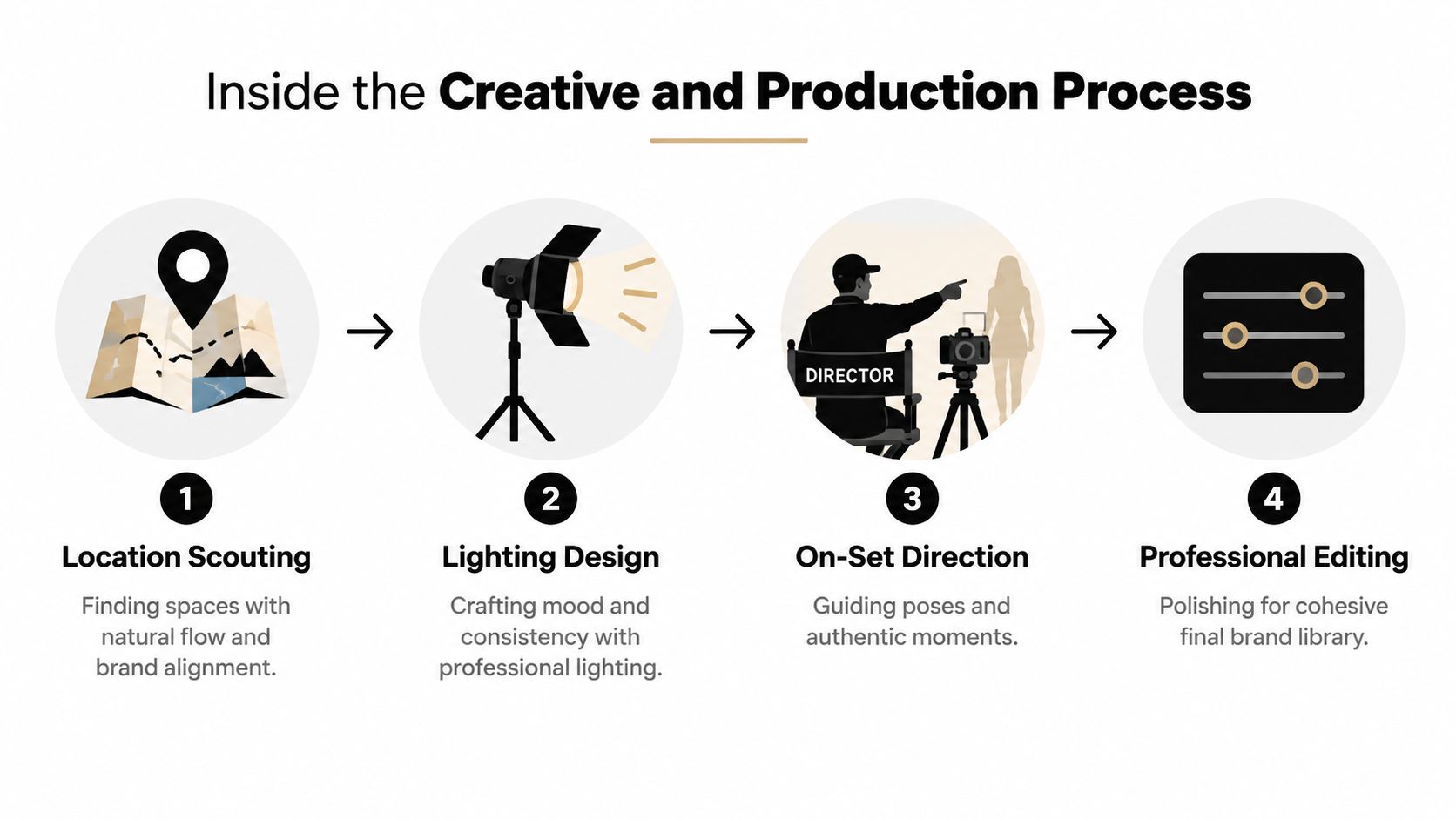
Inside the Creative and Production Process
A professional shoot feels less mysterious when you see it as a connected chain. Location decisions affect composition. Composition affects lighting. Lighting affects how people and materials appear. Editing then brings the complete set into one visual family.
Scouting finds the story before the camera arrives
A location scout isn't checking whether a room looks attractive. The scout looks for movement, light direction, background distractions, useful transitions, and the relationship between people and place.
At an Atlanta office, for example, a conference room may be ideal for a formal leadership portrait but poor for a candid working scene if the table blocks movement. A corridor might look ordinary in person yet create a strong visual connection between a team member and the architecture. In a residential interior, the most valuable frame may come from the way a person moves through the space rather than from a static view of the room.
The scout also identifies practical issues, including access, timing, noise, furniture, reflective surfaces, and room preparation. Solving those questions before the shoot gives the team more time to make images instead of improvising around avoidable obstacles.
Lighting controls mood and consistency
A standard commercial lighting baseline uses a key light, fill light, and backlight. The key is commonly placed at roughly 45 degrees to the subject. The fill sits opposite it at about 50% to 70% of the key's brightness, while the backlight separates the subject from the background. A 2:1 key-to-fill ratio is a common starting point, with 3:1 or 4:1 creating more visible texture and dimensionality, as explained in this technical guide to product photography lighting.
The ratio isn't a rule for its own sake. It determines how much shadow remains. Lower contrast can suit a clean catalog look. More contrast can reveal the grain of wood, the relief of masonry, or the shape of a finished product.
Reflective subjects need another adjustment. The more reflective the surface, the broader and more diffuse the source should be, according to this product photography guide from British Muses. Large softboxes, diffusion, or carefully controlled window light can reduce hotspots on glass, metal, varnish, and packaging.
Practical rule: Keep color temperature consistent, move reflective subjects away from uncontrolled spill, and adjust light power before changing exposure settings.
For repeatable series, manual settings around ISO 100 and f/8 on a tripod are often used as a baseline, with light power adjusted to maintain consistency. The technical choice supports the creative goal: every image in a campaign should feel as though it belongs to the same brand.
Direction captures behavior, not performance
People often stiffen when someone points a camera at them. Direction should give them an activity, relationship, or task to respond to. Ask a project team to review a drawing together. Have a designer walk through a material sample. Let a hospitality employee prepare a space rather than stand beside it.
The photographer watches for the moment when the task becomes natural. That may be a glance, a hand movement, or a brief exchange that communicates more than a posed smile. A useful models photo shoot guide for e-commerce from MerchLoom offers related planning considerations for working with people in commercial imagery.
Editing completes the process. It should align color, contrast, cropping, skin tone, and material detail across the set. Professional editing isn't an excuse to flatten reality. It protects the consistency that lets your team use the library across web, print, proposals, and campaigns.
Choosing Between Custom Photography Stock and AI Visuals
Marketing teams now have more image sources than ever. That choice can create speed, but it can also create uncertainty. The right question isn't whether stock or AI is always wrong. It's whether the image needs to prove something only your organization can show.
Recent industry coverage describes a shift toward mobile-first, vertical-first, and proof-driven imagery, because audiences encounter brands in compact placements and increasingly look for evidence rather than polish, as discussed in commercial photography trends for 2026. For high-trust categories, a real place, real person, or real process usually carries more credibility than a flawless but uncheckable scene.
| Use Case | Custom Photography | Stock / AI Visuals |
|---|---|---|
| Corporate culture | Shows actual teams, workplace behavior, leadership, and working environment | Useful for general concepts, placeholders, or low-stakes editorial filler |
| Architecture and real estate | Documents the actual building, materials, context, and finished condition | Cannot reliably prove a specific property or project |
| Hospitality | Captures the real guest experience, service details, atmosphere, and local setting | Can suggest a mood, but may not represent the property or neighborhood |
| Product campaigns | Controls packaging, finish, usage, models, and campaign continuity | Useful for concepts, background elements, or fast exploratory work |
| Local or regional storytelling | Preserves local architecture, culture, people, and geography | May feel generic or culturally inaccurate without careful review |
| Rapid content needs | Requires planning and production time | Can provide quick filler when authenticity isn't central |
AI-assisted and stock imagery can support a content calendar. They may work for an abstract blog illustration, internal presentation, or temporary social post. They become risky when the viewer expects proof, such as a school campus, a construction result, a hotel room, or a leadership team.
Trend coverage also notes that AI-generated images now represent a meaningful share of stock uploads while global brands invest more in location-specific imagery reflecting local culture and architecture, as covered by stock photography trends from GreenStock Media. That tension is useful guidance. Use synthetic visuals where invention is acceptable. Use custom photography where trust depends on reality.
How to Commission Your Brand Photography Shoot and Plan Pricing
A productive commission begins before anyone selects a lens. Write the business question first. Are you trying to explain a new facility, strengthen proposals, support recruiting, present a property, refresh a leadership page, or build a campaign library?
Then create a shot list that connects each image to a destination. Include the page, platform, format, subject, orientation, and intended message. A corporate team might need a wide collaboration frame for a website banner, vertical portraits for social posts, detail images for recruiting, and environmental photographs for a proposal.
What to include in the brief
- Business objective: State what the images should help people understand or do.
- Audience: Identify whether the viewer is a client, tenant, buyer, student, employee, editor, or partner.
- Visual references: Share examples of composition, light, color, and tone you want to approach.
- Required subjects: List spaces, people, products, details, processes, and relationships.
- Deliverables: Request the formats and crops your channels require.
- Usage rights: Confirm where the images can appear, for how long, and whether advertising or editorial use is included.
A photographer's portfolio should show consistency across a complete assignment, not only isolated hero images. Look for controlled vertical lines in architecture, natural expression in portraits, careful handling of reflective surfaces, and editing that leaves a coherent impression from frame to frame.
What shapes the price
Pricing reflects the work required to create and finish the images. Location scouting, crew, assistants, lighting equipment, travel, models, permits, set preparation, production time, retouching, and licensing can all affect a proposal. A simple portrait session and a multi-location campaign may both be called “brand photography,” but they carry very different production demands.
Ask how the photographer plans the day, what the estimate includes, how revisions work, and when you receive final files. You can also compare the scope against this brand photography pricing guide to frame a more useful conversation about deliverables rather than focusing only on a session fee.
Before the shoot, assign one decision-maker, prepare the location, confirm access, brief participants, and remove visual clutter that doesn't support the story. The more clearly your team prepares, the more time the photographer can spend finding honest, distinctive moments.
Real World Examples and Outcomes That Elevate Brands
Consider a campus expansion. A wide exterior can establish scale, but it won't explain how students move through the building or how the new structure relates to the existing campus. A stronger library pairs the architectural frame with circulation, material details, faculty interaction, and the small visual cues that make the place feel lived in. Those images can give a proposal more substance and help an editorial audience understand the project beyond its footprint.
A residential interior needs a similar balance. Clean lines and refined styling matter, yet a sequence becomes more persuasive when it shows texture, daylight, transitions between rooms, and the experience of occupying the space. The resulting set can support a listing, designer portfolio, press submission, or project story without asking one photograph to carry every message.
A corporate assignment can move from formal leadership portraits to a team reviewing work, a close view of tools or materials, and a quiet environmental frame. That range helps a company present competence without making every image feel staged. It also gives the marketing team options for proposals, recruiting pages, social posts, and campaign layouts.
You can see how different assignments translate brand strategy into visual decisions in these commercial brand photography examples. The common thread isn't a particular style. It's the connection between the subject, the audience, the channel, and the proof the image provides.
Photography becomes more valuable when your team plans to refresh and reuse it. Treat each commission as an evolving library with a clear point of view, not a folder of disconnected files. Start by listing the claims your brand makes, then identify the people, places, details, and processes that can make those claims visible.
Jimmy Clemmons Photographer creates architectural imagery, commercial brand content, and professional portraits with location scouting, lighting design, on-set direction, and professional editing. Visit Jimmy Clemmons Photographer to discuss a purposeful image library for your Atlanta-area brand, project, team, or campaign.