
You know the scenario. The shoot went smoothly. The lines are clean, the exposure is precise, the retouching is restrained, and the final gallery is objectively strong. Then the client says, “These look good, but they’re not quite what we had in mind.”
That moment usually has very little to do with camera skill.
In architectural and commercial photography, disappointment often comes from an invisible gap between the brief that was spoken aloud and the picture the client built privately in their head. A developer says, “Make it feel premium.” An architect says, “Show the flow.” A marketing team asks for “more energy.” Those phrases sound useful until you try to turn them into framing, lighting, timing, styling, and a deliverable set with a budget attached.
Managing Client Visual Expectations is the part of the job that keeps good work from being judged as the wrong work. It’s not soft. It’s operational. It affects revisions, margins, trust, and whether a project ends with momentum or fatigue.
The Unspoken Contract of Visual Expectations
A client rarely hires a visual professional for files alone. They hire for interpretation.
That’s the unspoken contract. They bring ambition, references, internal politics, and often a vague emotional target. You bring craft, process, and the responsibility to translate abstract goals into images that can survive scrutiny from partners, principals, marketers, and sometimes the public.
When that translation fails, both sides feel blindsided. The client thinks the vision was obvious. The photographer thinks the brief was followed. Both can be right.
A survey of over 100 digital marketing professionals found that 41.1% struggle with client expectations, a useful reminder that this problem isn't isolated to photography and shows up across visual service work (client expectation survey summary). Architectural photography feels this sharply because clients often look at published editorial work and assume that same finish can happen under any site condition, any access limitation, and any schedule.
Why strong images still miss the mark
The failure point is often upstream. The images can be technically excellent and still feel wrong to the client because the client was evaluating something other than sharpness, dynamic range, or composition. They were evaluating mood, status, scale, brand fit, or whether the work resembled a reference they never fully articulated.
That’s why expectation management belongs next to exposure, perspective control, and post-production in your skill set. If you treat it like administrative overhead, you’ll keep solving the wrong problem very efficiently.
Practical rule: If a client uses emotional language, answer with visual language. “Grander” has to become lens choice, camera height, time of day, lighting approach, and scene selection.
This matters commercially too. A project that starts with ambiguity usually ends with avoidable revision pressure. A project that starts with shared definitions tends to move faster because every later decision has something to refer back to.
What clients are really asking for
In built-environment work, clients often ask for one of four things even when they don’t name them directly:
- Status: They want the project to look expensive, established, or editorial.
- Scale: They want rooms, facades, or amenities to feel generous without looking distorted.
- Narrative: They want the images to explain how the building is used, not just how it looks.
- Assurance: They need confidence that internal stakeholders will approve what’s delivered.
That last one is easy to miss. Many clients aren’t only reacting as individuals. They’re trying to carry images back to a board, a design director, a leasing team, or a publication.
That’s one reason professional imagery has a business role beyond aesthetics. A strong visual set can help a firm communicate value more clearly, which is part of the broader ROI of professional photography. But none of that value lands if the client expected one story and received another.
The Blueprint Crafting Clarity Before the Camera Clicks
Pre-production is where most expectation problems are either solved or planted for later.
A loose kickoff creates expensive confusion. A disciplined kickoff creates options. The difference usually isn't a longer meeting. It's a better set of tools and better questions.

A PMI study found that strong expectation alignment improves outcomes by reducing goal changes, and that clients cause 70% of changes due to unstable expectations. The same study reports 25-35% higher success rates for aligned projects (PMI research on client expectation alignment). In visual work, that alignment starts before location scouting and long before the first frame.
Start with an intake that exposes ambiguity
A client intake form shouldn't feel like bureaucracy. It should feel like diagnosis.
Ask questions that force specificity:
What are these images expected to do?
Leasing deck, award submission, website refresh, editorial feature, investor presentation, recruiting campaign, or portfolio archive all require different emphasis.Who approves the work?
One decision-maker and five reviewers is very different from a committee with shared authority.What must be true when this project is finished?
This question often reveals the hidden standard. You may hear “the lobby must feel brighter,” “the building must read as human-scaled,” or “the interiors can’t feel staged.”Which spaces matter most?
The hero images and the support images shouldn't compete for equal production effort.What can’t be controlled on shoot day?
Site access, occupants, weather exposure, unfinished punch items, landscaping, and neighboring construction all affect the look.What references already exist?
Previous campaigns, a firm website, editorial features, competitor work, or internal decks tell you what the client already considers “right.”
Turn intake answers into a real creative brief
A useful brief has fewer adjectives and more decisions.
Include these elements:
- Project objective: one sentence that defines the assignment in business terms.
- Narrative priority: what story the images should tell.
- Visual priorities: scale, warmth, material detail, occupancy, lighting mood, exterior drama, interior calm, and so on.
- Constraints: timing, access, weather dependency, room readiness, legal limits, branding requirements.
- Approval structure: who comments, who consolidates feedback, who signs off.
- Shot categories: hero, detail, process, portrait, and supporting documentation.
If the client says, “We want the building to feel grand but welcoming,” the brief should translate that into something operational. Camera height may stay lower for selected exteriors to emphasize presence. Interior frames may preserve negative space and clean leading lines while using practical lights to keep the space from feeling sterile.
A brief is working when it tells you what to do differently on set, not when it merely repeats the client's adjectives in cleaner prose.
Build a moodboard that acts like a shared dictionary
Moodboards solve a common problem in built-environment photography. Clients and photographers often use the same words to mean different things.
“Editorial” might mean sparse and restrained to you. To the client it might mean glossy, bright, and people-forward. “Minimal” might mean uncluttered composition. To an interior designer it might mean muted styling and soft tonal contrast.
Use a curated board, not a dumping ground. A small set of references with annotations works better than a giant collage.
Include notes like:
- Frame A: strong sense of arrival, low camera position, verticals disciplined
- Frame B: warm practical glow, late-afternoon feel, hospitality tone
- Frame C: more environmental context, less detail density
- Frame D: too wide for this project, avoid this level of spatial exaggeration
When possible, pair references with disqualifiers. Clients often discover what they don't want faster than what they do want.
For teams preparing active sites, the pre-shoot process also benefits from a practical operations checklist. A guide to preparing your project site for a professional photoshoot can help align the visual plan with what the site can realistically support.
What works and what doesn't
| Approach | What happens |
|---|---|
| Vague kickoff call | Everyone leaves feeling aligned, but each person imagines a different outcome |
| Written brief with named priorities | Shoot decisions stay anchored when conditions shift |
| Large unedited inspiration folder | Clients reference different images later and claim different expectations |
| Curated moodboard with annotations | Visual language becomes specific enough to execute |
| No approval hierarchy | Feedback arrives in fragments and conflicts with itself |
The pre-production standard is simple. If a phrase can't guide composition, lighting, timing, or retouching, it isn't clear enough yet.
On-Set Collaboration Directing the Vision in Real Time
On set, expectation management stops being theoretical.
The room is moving, the schedule is shrinking, the sun is doing what it wants, and the client is trying to decide whether the images on screen match the idea they approved three weeks ago. From this point, photographers either become a black box or a collaborative partner.

The most effective shoots use tethered capture or immediate monitor review as a communication tool, not just a technical one. A client looking at a larger screen can respond to line tension, reflections, furniture spacing, practical light balance, and body language in a way they cannot from the back of the room.
A better way to walk a client through a frame
Instead of asking, “Do you like this?” walk them through what the frame is doing.
Say something closer to this:
- The lower camera position gives the entry sequence more presence.
- I kept the verticals disciplined so the facade feels premium, not distorted.
- The brighter window balance preserves the outside context, but the room still carries warmth.
- This crop favors circulation and flow over furniture detail. That matches the brief we approved.
That changes the review from instinctive approval to informed decision-making. It also makes feedback more useful. The client can say, “Keep the sense of arrival, but give me more of the reception desk,” which is actionable.
Real-time confirmation beats retrospective surprise
A strong on-set collaboration has a rhythm. You capture a promising frame. You review it with the client. You compare it against the brief or moodboard. You adjust one variable at a time.
Common variables include:
- Camera height
- Lens width
- Practical lights on or off
- Shade position
- Furniture spacing
- Human presence
- Reflections in glass and polished surfaces
Don't invite open-ended commentary too early. If the client sees an unfinished setup and reacts to everything at once, you get scattered direction. Guide attention.
Ask questions like:
- “Is the sense of scale landing for you here?”
- “Do you want this to feel more editorial or more usable?”
- “Should this image prioritize architecture or occupancy?”
- “Is this closer to the moodboard frame we tagged as refined, or do you want more drama?”
A quick visual example can help teams understand how light direction changes mood and spatial read. This reference on choosing the best light for a site shoot is useful when clients need to see why “bright” and “flat” aren't the same thing.
After the first sequence is locked, a short behind-the-scenes example is often enough to reinforce what real-time review can solve before post-production starts.
When clients see the image evolve in stages, they stop treating photography like a magic trick and start judging it like a process.
What doesn't work on set
A few habits create avoidable trouble:
- Shooting in silence: The client fills the silence with private assumptions.
- Promising fixes in post: That phrase encourages unrealistic rescue expectations.
- Letting every stakeholder art direct simultaneously: The image loses priority and the schedule fractures.
- Reviewing only at wrap: By then, disagreement is expensive.
The best on-set direction feels calm and specific. You don't need constant conversation. You need timely conversation tied to visible choices.
The Proofing Process A Framework for Constructive Feedback
The proofing stage is where many strong projects start to wobble.
A photographer sends a polished gallery. The client forwards it internally. Comments arrive from five directions. One person dislikes the crop, another wants a warmer tone, someone else asks for a completely different frame that was never selected, and now the job feels less like finishing and more like reopening.
A structured proofing system prevents that drift.
Expert-level proofing guidance recommends tiered proofing rounds, including delivery of 20 low-res JPEGs at 72dpi within 48 hours for initial selection. That early review approach can prevent up to 30% of post-production disputes by logging feedback before clients reject heavily refined finals (tiered proofing guidance).
Use stages that match the kind of feedback you need
The mistake is asking for every kind of feedback at once.
Composition, image selection, retouching, tone, and final export requirements should not all be open in the same round. Separate them.
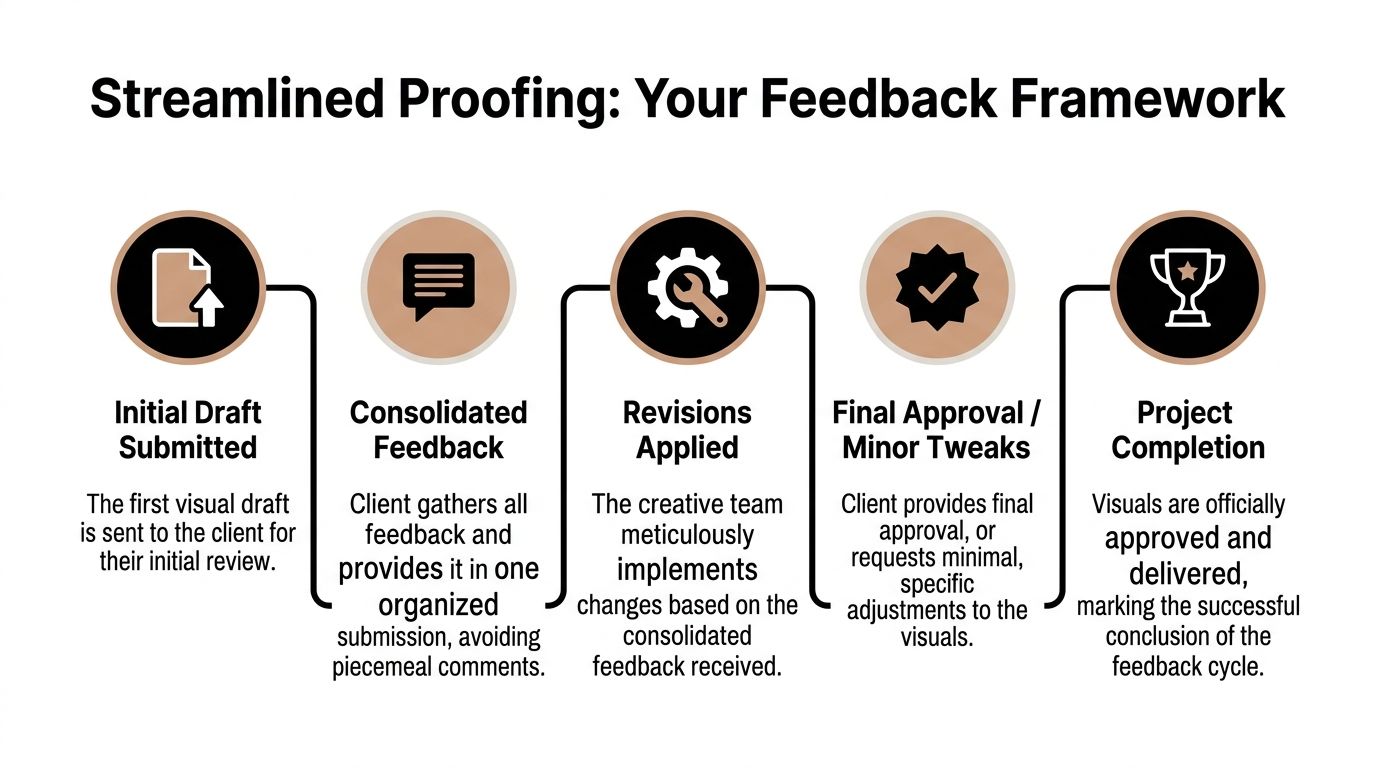
A practical three-round model
Round one for selects and composition
Deliver lightly processed proofs. Keep them clean enough to evaluate, but not so polished that the client mistakes them for finals.
At this stage, ask for feedback on:
- Which images move forward
- Whether the correct spaces and moments are represented
- Broad composition preferences
- Any missing narrative needs
Do not invite deep retouching requests yet. The client should decide what deserves finishing before discussing how it should be finished.
Round two for image refinement
Once selects are approved, present more developed versions of the chosen images.
Now invite comments on:
- Brightness and color direction
- Perspective feel
- Window balance preference
- Small distractions
- Brand consistency across the set
Comments become valuable if they're attached to specific regions of the image. Online proofing galleries with markup or pin comments are much better than scattered email chains.
Round three for minor tweaks only
Final review should be exactly that. Final.
The client can confirm delivery readiness or request narrowly defined adjustments such as a small crop change, one distracting object removal, or a restrained tonal correction. If composition or image selection is still being debated here, the process wasn't staged clearly enough.
How to ask for feedback that can actually be used
General dissatisfaction needs translation. Prompt the client with questions that force precision.
Try these:
- “Which area of the frame feels off?”
- “Is the issue composition, light, styling, or retouching?”
- “Does another proof from this set feel closer to the intended mood?”
- “Should this image feel more polished, more natural, or more editorial?”
- “Is this note coming from the final approver or from internal review?”
Review rule: Ask for one consolidated response from the client team. Ten smart comments in one document are easier to execute than ten separate threads with overlapping authority.
Keep proofing organized or expect chaos
A simple proofing workflow often works better than a complicated one, as long as everyone uses the same lane.
| Stage | What the client reviews | What stays off-limits |
|---|---|---|
| Initial proofs | Selection and broad direction | Fine retouching and export specs |
| Refined selects | Tone, cleanup, consistency | New image requests outside the agreed set |
| Final review | Minor adjustments | Reopening concept decisions |
This protects both quality and momentum. It also changes the emotional tone of revisions. Clients stop feeling like they have to say everything immediately, and photographers stop feeling ambushed by late-stage preferences.
Language that keeps the process constructive
Use language that narrows feedback without sounding defensive.
Examples:
- “Please consolidate comments into one reviewed list before I begin revisions.”
- “At this round, I’m looking for image selection and broad direction rather than retouching notes.”
- “If something feels off, point to the specific area first. I’ll translate that into the right edit.”
- “If two stakeholders disagree, please resolve internally and send one final instruction.”
That last line matters. The photographer should interpret images, not mediate internal indecision forever.
Final Delivery and Guarding Your Scope
Final delivery is not just file transfer. It's the closeout of expectations.
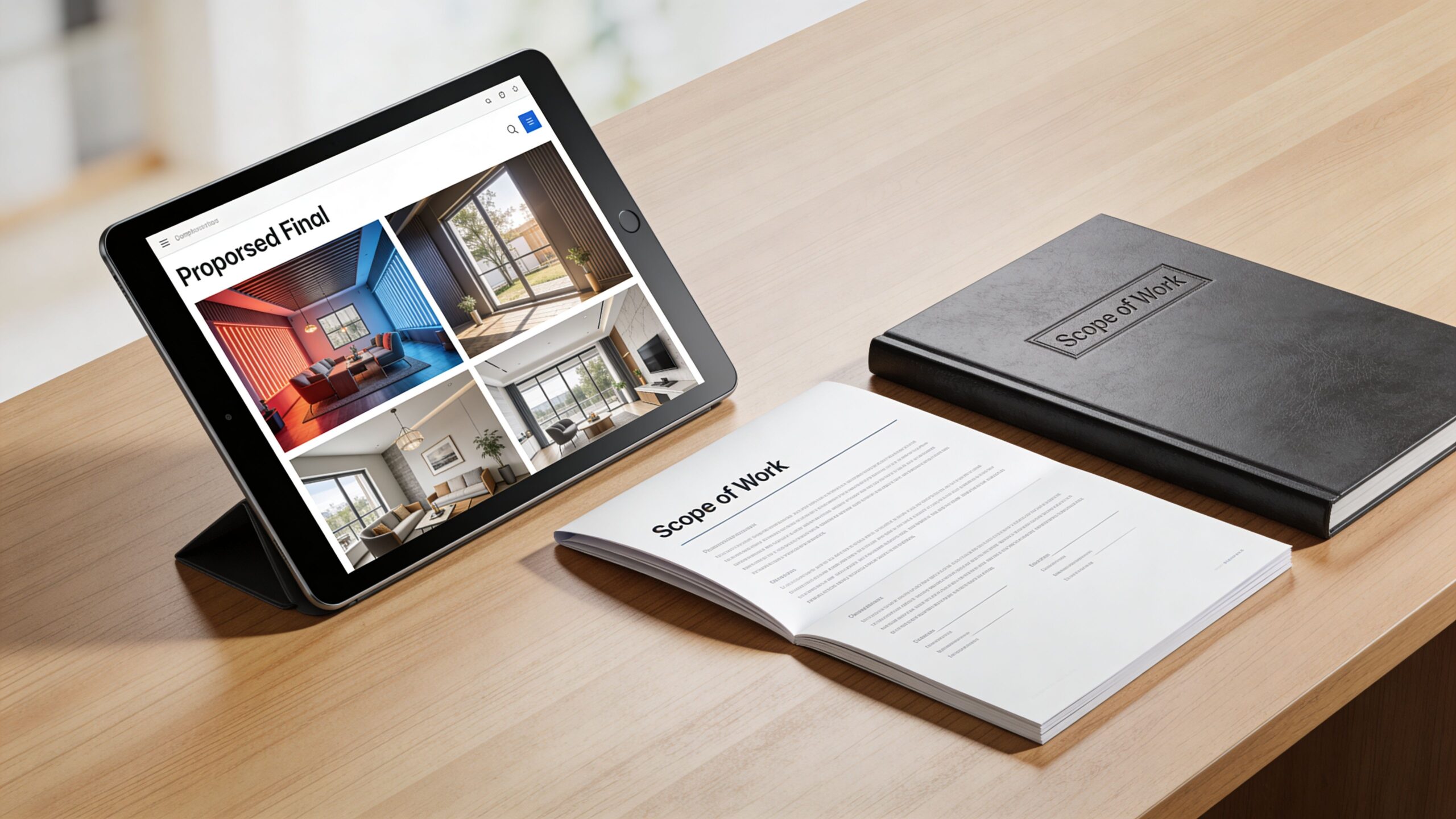
A rushed handoff can undo a smooth project. So can a loose contract. If you want fewer revision spirals and fewer awkward billing conversations, the delivery process and the statement of work have to support each other.
Clients usually don't resent boundaries. They resent surprises. A clear scope protects their budget as much as it protects your time.
Deliver the work like a finished product
A professional handoff does a few things well:
- Files are organized clearly: hero images, supporting images, web exports, print-ready versions, and usage notes if needed.
- Naming is consistent: no client wants to decode your internal sequence logic.
- The final email is concise: what’s included, what was approved, and what happens if additional edits are requested later.
- Access is simple: one polished delivery link beats a maze of folders and attachments.
This is also the right time to restate what was completed. Not in a defensive way. In a documentary way. If the scope included a defined image count, a certain number of revision rounds, and specified formats, name them.
Scope language prevents emotional negotiations
Most scope problems happen because the creative professional relies on goodwill where wording was needed.
You need contract language around:
- revision rounds
- what counts as a revision
- what counts as a new request
- response timelines
- consequences of delayed approvals
- rates for additional editing or rework
- reshoot conditions
When those terms are missing, every late request arrives disguised as a small favor.
Clear scope doesn't make you look rigid. It makes you look prepared.
Sample Scope-Control Clauses for Your Contract
| Clause Type | Example Wording |
|---|---|
| Revision rounds | “The project includes two rounds of revisions on selected images. Additional revision rounds will be billed separately.” |
| Feedback format | “Client will provide one consolidated set of comments per review round through the designated proofing platform or in a single written document.” |
| Selection approval | “Only images selected during the proofing phase will move to final retouching and export.” |
| Scope change | “Requests for additional compositions, alternate edits, or expanded retouching beyond the approved shot list constitute a change in scope and will require written approval before work begins.” |
| Timeline responsibility | “Project timelines assume client feedback is delivered within the agreed review window. Delays in feedback may shift final delivery dates.” |
| Final tweak limit | “Final review includes minor adjustments only. New creative direction after final approval will be treated as additional work.” |
| Reshoot terms | “Reshoots requested due to revised client preferences, site changes, or newly identified shot needs are not included unless explicitly stated in writing.” |
The trade-off most creatives avoid naming
If you leave room for endless flexibility, you'll often get endless flexibility. That sounds client-friendly at first. In practice, it blurs the line between service and rework.
The better position is collaborative firmness. You can absolutely be accommodating. But accommodation should happen inside a visible framework.
That sounds like this:
- “Happy to make that adjustment. Since it changes the approved direction, I’ll treat it as an added edit and send the updated cost before proceeding.”
- “I can add those alternate crops. They weren’t part of the original deliverables, so I’ll separate them as an additional item.”
- “That request is best handled as a reshoot rather than a retouch, because the issue is viewpoint rather than finishing.”
That kind of clarity usually improves the relationship. Clients know where they stand. You know what you're being asked to do. Nobody has to pretend a significant change is a minor one.
Navigating Subjectivity and Difficult Conversations
“The client is always right” is bad guidance for visual work.
Clients are always entitled to their preferences. They are not always using language that can be executed cleanly. If you accept vague feedback at face value and try to satisfy it through guesswork, you usually create more rounds, not better work.
Aesthetic confusion isn't a fringe issue; a 2025 survey of 500 creative professionals found that 68% report aesthetic misalignment as the top cause of scope creep in visual projects, while only 12% use pre-shoot mood boards calibrated to industry-specific references. The same report says photographers who use visual expectation contracts with pre-approved style guides and annotated comps reduce revisions by 42% (ManyRequests reporting on expectation management). The lesson is straightforward. Subjective feedback needs structure before and after the shoot.
Translate vague comments into visual decisions
When a client says, “Make it pop,” don't answer with software. Answer with diagnosis.
That phrase could point to several different problems:
- the image lacks tonal separation
- the composition feels static
- the materials aren't reading clearly
- the room feels flatter than the actual experience
- the client expected more contrast, warmth, or editorial stylization
You need to find out which one.
Use questions like these:
- “What part of the image feels too quiet?”
- “Do you want more contrast, more depth, or more emphasis on a certain feature?”
- “Is the issue the light, the crop, or the overall mood?”
- “Which approved reference feels closer to what you're after?”
- “Should this image feel more luxurious, more lived-in, or more dramatic?”
Those questions rescue the conversation from taste language and move it back into production language.
Common phrases and what they often mean
| Client says | What they may mean | Better follow-up |
|---|---|---|
| “Make it grander” | The current perspective feels ordinary or compressed | “Do you want a stronger sense of scale, a lower vantage point, or more architectural context?” |
| “It needs more energy” | The image feels static, empty, or too formal | “Would adding people, gesture, or a more active composition solve that?” |
| “This doesn’t feel premium” | Materials, light, or styling aren't reading as refined | “Is the issue tonal polish, clutter, reflections, or how the finishes are showing up?” |
| “I don’t like it” | The client hasn't isolated the problem yet | “Can you point to the part of the frame that feels off first?” |
Use a visual expectation contract before taste becomes conflict
A visual expectation contract doesn't need to be a legal monster. It can be a practical style appendix attached to the brief or estimate.
Include:
- a small set of approved references
- annotated comps with notes about what is being approved
- clear exclusions such as “avoid ultra-wide distortion” or “no heavy HDR look”
- language about what the final images are intended to prioritize
- approval of the overall finishing approach before full edit production starts
This is especially useful in architecture and real estate because the work sits between documentation and interpretation. Some clients want exacting neutrality. Others want a magazine feel. Many want both at once, which is where conflict starts.
“Show me which approved image is closest to what you want” is often a more productive sentence than “Tell me more.”
How to say no without turning the room cold
Some requests are unrealistic. The problem is usually not the request itself. It's whether you answer it defensively or professionally.
Bad response: “That’s impossible.”
Better response: “I can help with that, but not through retouching alone. To achieve that look, we’d need a different capture approach, added time on site, or a reshoot.”
Another common one:
Client: “Can you make the room look much larger?”
I can open the frame slightly or adjust the crop, but if I push the lens too far the room will stop feeling credible. I’d rather preserve the design and emphasize flow through angle and styling.
That answer protects the image and educates the client.
Scripts for difficult moments
When feedback is too broad
Try:
- “I’m hearing that the image isn't landing yet. Can you point to one specific area that feels wrong so I can address the right issue first?”
- “Let’s separate composition from finishing. Which one is the real concern here?”
When multiple stakeholders disagree
Try:
- “I’m getting different directions on the same frame. Please align internally and send one final instruction so I can revise efficiently.”
- “If it helps, I can show two controlled options, but I’ll need one decision-maker to approve the route.”
When the request exceeds scope
Try:
- “I’m happy to do that. Since it adds a new deliverable beyond the approved set, I’ll price it separately and proceed once you confirm.”
- “That change affects more than the final tweak stage, so I want to document it as added work rather than fold it into the original scope.”
When the client wants a style that conflicts with the approved brief
Try:
- “That direction differs from the references we approved at kickoff. I can pivot, but it will change the look of the set. If you'd like, I can prepare a revised approach for approval before I apply it across the gallery.”
The hard truth about being collaborative
Being collaborative doesn't mean accepting every comment as equally valid or equally actionable.
Good collaboration means helping the client make better visual decisions. Sometimes that means clarifying. Sometimes it means narrowing choices. Sometimes it means telling them that the answer they want lives in production, not in post.
In built-environment work, that honesty matters because the subject carries factual weight. An architect, developer, designer, or brand team doesn't just need pretty pictures. They need images that represent the project well, support the intended story, and hold up under scrutiny from people who understand space.
So when a client says, “Make it feel grander,” your job isn't to nod and guess. Your job is to translate that sentence into a billable, visible, agreed-upon action. That is Managing Client Visual Expectations in practice.
If your team needs architectural photography, commercial brand content, or professional portraits handled with a clear process and a strong editorial eye, Jimmy Clemmons Photographer brings that balance of craft, planning, and on-set collaboration to every assignment. For architecture firms, developers, design teams, and marketing departments that want polished visuals without the usual friction, it’s worth starting the conversation early.