

You're probably starting where most families start. You know you want photos that feel better than a hurried phone snapshot, but once you begin searching, every photographer seems to promise “natural,” “timeless,” and “authentic” images. The hard part isn't deciding whether professional photographer family photos are worth doing. It's figuring out what you're buying, how the process should work, and what separates polished results from a stressful afternoon with a camera.
Good family portraiture isn't accidental. It comes from the same things that shape strong editorial work: clear pre-production, controlled light, confident direction, and a photographer who can read people in real time. Families don't need a complicated production. They do need a professional who can simplify the experience without making the results feel generic.
Finding Your Family's Visual Storyteller
The first decision isn't budget. It's style.
Most family photography falls into three broad approaches, and knowing which one fits your family will make the rest of the search much easier.
Posed, lifestyle, or documentary
Traditional posed portraiture is structured. The photographer directs body position, head angle, spacing, and eye line. This style works well when you want classic wall portraits, multi-generation groupings, or a polished holiday-card image where everyone looks camera-ready.
Lifestyle family photography keeps some direction but softens the formality. You'll still get composed images, but the photographer is usually prompting interaction instead of locking everyone into stiff posture. Such interaction often involves walking, hugging, laughing, and movement as part of the frame.
Documentary family photography is the least posed. The photographer observes more than arranges. These sessions often feel intimate and honest, but they also require trust, because the beauty comes from real moments rather than controlled perfection.
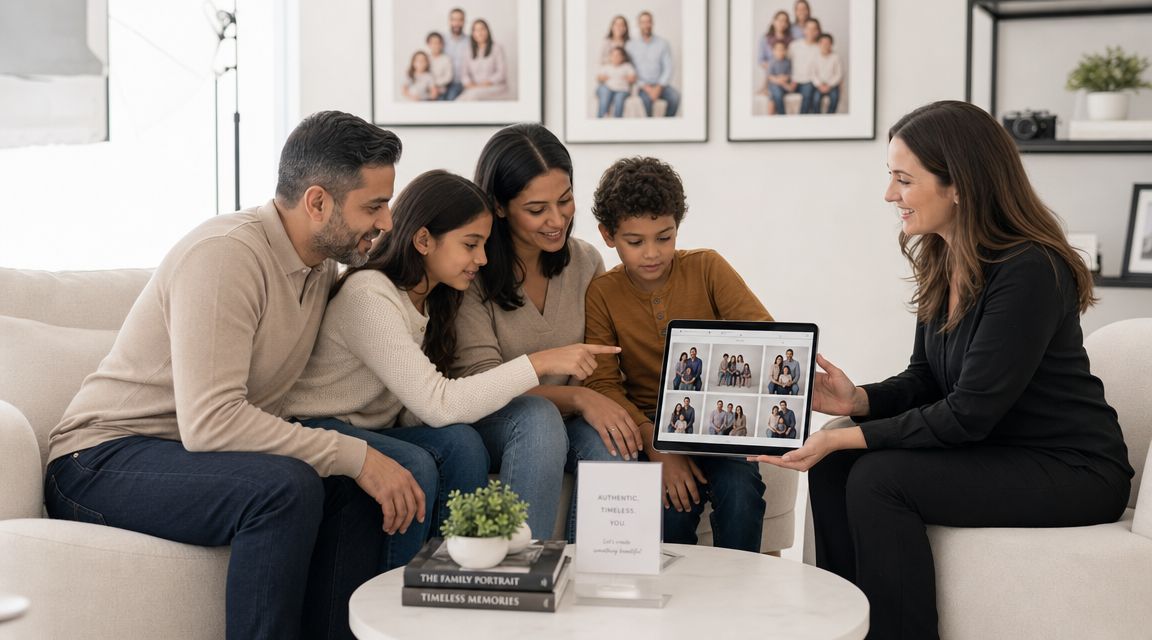
How to read a portfolio like a professional
A strong portfolio isn't just a gallery of smiling children in good weather. It should show consistency across different families, ages, skin tones, and locations.
Look for these signals:
- Lighting control: Are faces evenly lit, or do some people fall into deep shadow while others are blown out?
- Compositional discipline: Does the photographer place people cleanly in the frame, or do backgrounds feel cluttered and distracting?
- Editing restraint: Are colors stable and skin tones believable from one session to the next?
- Emotional range: Can the photographer show tenderness, play, quiet attention, and not just big smiles?
If every image in a portfolio was clearly made in one ideal park at one ideal time of day, be cautious. That may show taste, but not breadth. Families need a photographer who can produce quality when conditions aren't perfect.
Practical rule: Don't hire based on a photographer's best image. Hire based on whether their twentieth image is still good.
The other thing to examine is whether the photographer's offer matches your expectations. Family pricing often varies because photographers package different combinations of session time, retouching, digital files, prints, and usage. One publicly listed example shows $600 for 15 to 25 retouched images plus group variations and candids, which is a useful reminder that you're not comparing simple hourly rates when you compare providers (family session pricing example with retouched image count and deliverables).
Personality fit matters more than people admit
A family photographer is part director, part technician, part host. If their work looks beautiful but their communication feels cold, rushed, or vague, the session may never relax enough to create authentic images.
That's why visual alignment and expectation-setting should happen together. A useful way to think about it is the same way commercial clients do: define the look first, then confirm the process. This is also where a piece on managing client visual expectations becomes relevant. The best results happen when everyone shares the same definition of polished, natural, and worth paying for.
The Conversation Before the Contract
A polished portfolio can hide a weak process. The pre-booking conversation usually tells you more about professionalism than the highlight reel ever will.
Experienced photographers answer practical questions directly. Hobbyists often answer with enthusiasm but not with systems. That difference matters when weather shifts, a child arrives overstimulated, or a file needs to be recovered after the shoot.
What a real professional should be able to explain
Ask how the session works from inquiry to delivery. Listen for specifics, not charm.
A strong answer usually covers the following:
- Preparation: What guidance do they send before the session on wardrobe, timing, and expectations?
- Contingencies: What happens if weather changes, a child needs breaks, or the planned location stops working?
- Equipment and file safety: Do they carry backup gear and maintain a clear file-handling workflow?
- Delivery standards: How are images selected, edited, and delivered?
- Session direction: Do they rely on rigid posing, or do they guide interactions based on the family's energy?
If a photographer can't explain those points clearly, the experience may feel improvised on the day of the shoot.
Why process drives the final result
The strongest family sessions are built before anyone steps in front of the camera. A professional case-study-style paper based on more than 120 family photo sessions reported that 70% of clients returned for repeat sessions and 40% of new clients came through referrals. The same paper argues that a session organized around process, not just product, strengthens emotional association and client satisfaction (family photography retention and referral findings).
That tracks with what experienced photographers see in practice. Families do better when they know what to wear, how long the session will feel, whether children can move freely, and what kind of interaction the photographer will encourage. Good preparation lowers friction. Lower friction creates calmer expressions, better body language, and less resistance from everyone involved.
A family session should feel guided, not improvised.
Questions worth asking before you sign
Use the call or consultation to hear how the photographer thinks.
- How do you prepare families before the session?
- How do you handle children who need time to warm up?
- What does your backup plan look like for weather or location changes?
- What is included in the quoted price, and what costs extra?
- How much direction do you give during the session?
- What happens after the shoot, from selection to delivery?
The best answers are calm and procedural. They don't sound defensive. They sound practiced. That's what you want when you're investing in professional photographer family photos, because experience shows up less in marketing language than in how someone manages uncertainty.
Planning for Unforgettable Moments
Strong family portraits are usually won in pre-production. Three variables matter most: timing, location, and wardrobe. When those are handled well, the session has room to breathe. When they're ignored, even a talented photographer spends half the shoot solving preventable problems.
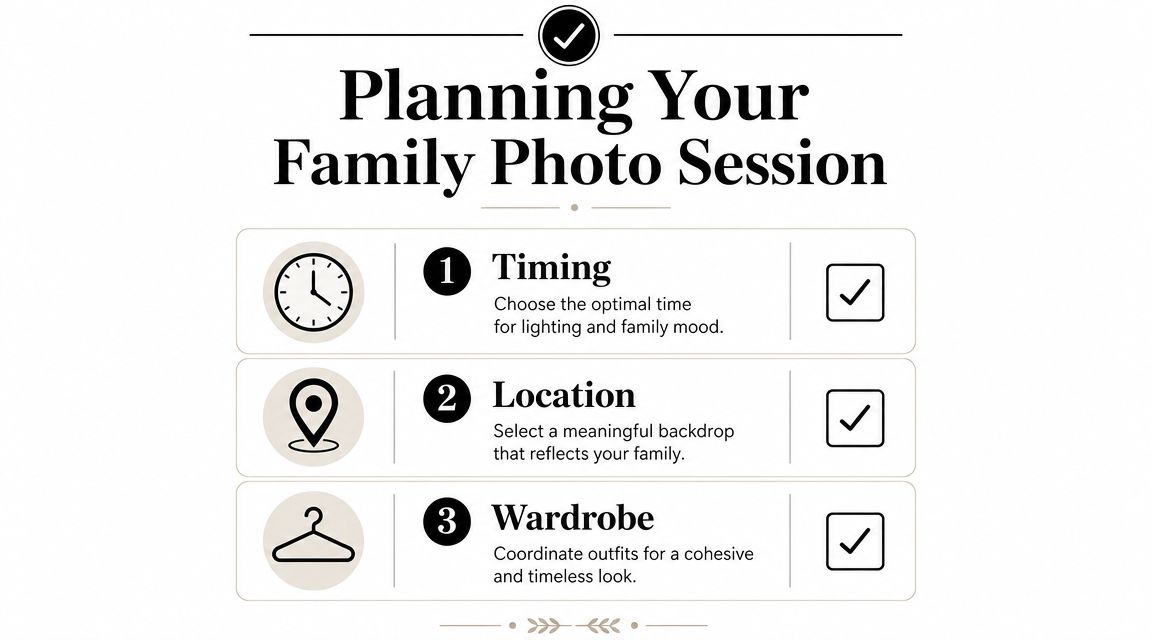
Timing shapes mood as much as light
Outdoor sessions usually work best when the light is soft and directional, not harsh and overhead. For families with young children, the best time on paper isn't always the best time in reality. A beautiful sunset slot won't help if it collides with a toddler's worst hour of the day.
For babies in the first year, timing also matters on a larger calendar. Many photographers recommend 2 to 5 photo shoots during that first year, often around 3 months, 6 months, 9 months, and a 1-year cake smash, while one photographer described newborn, 6 months, and 1 year as a personal sweet spot because of how quickly babies change (first-year milestone session timing).
That milestone cadence makes sense because each age photographs differently. Newborn sessions are about closeness and scale. Midyear sessions often introduce sitting, expression, and curiosity. The first birthday has a different energy entirely.
Location should support the people, not compete with them
Families often overvalue “pretty” locations and undervalue usable backgrounds. The most reliable method is simple: choose a clean setting first, then place the family where the light is even.
Digital Photography School recommends starting with a simple, non-distracting background, then making sure the family is lit uniformly and avoiding direct midday sun, because harsh overhead light causes squinting, uneven exposure, and distracting bright and dark patches across the frame (family portrait lighting and background fundamentals).
That advice is practical, not stylistic. A technically strong family portrait begins with these basics:
- Background first: Busy playground equipment, parked cars, bright signage, and random clutter pull attention away from faces.
- Even light second: If one parent is in shade and a child is in direct sun, the frame starts fighting itself.
- Interaction third: Once placement is solved, the photographer can focus on expression and connection.
The location is there to hold the portrait together. It shouldn't audition for attention.
A living room with good window light can outperform a famous park at noon. A plain wall can be stronger than a dramatic scenery if the family becomes the clear subject.
Wardrobe works best when it coordinates, not matches
Matching white shirts and identical jeans flatten a family visually. Good wardrobe creates relationship without uniformity.
A better approach is to build around a restrained palette, then vary texture and shape. Think knits, linen, denim, soft cotton, or simple dresses and shirts that move well. Avoid loud logos, high-contrast graphics, and anything that needs constant adjustment.
A quick planning table helps:
| Priority | Works well | Usually works poorly |
|---|---|---|
| Color | Coordinated tones | Perfect matching |
| Fit | Comfortable, easy movement | Tight, stiff, fussy pieces |
| Pattern | Subtle texture | Busy prints and large logos |
| Shoes | Clean, simple footwear | Distracting athletic colors |
Wardrobe should let the family move, sit, carry children, and relax. If someone keeps tugging at sleeves, straps, waistbands, or hemlines, the camera will see that tension immediately.
What to Expect on the Day of the Shoot
A well-run family session rarely feels like a series of commands. It feels more like a guided rhythm. People are placed with intention, the light is adjusted, and then the photographer starts shaping interaction instead of chasing a perfect frozen smile.
That difference is what keeps modern family work from looking stiff.
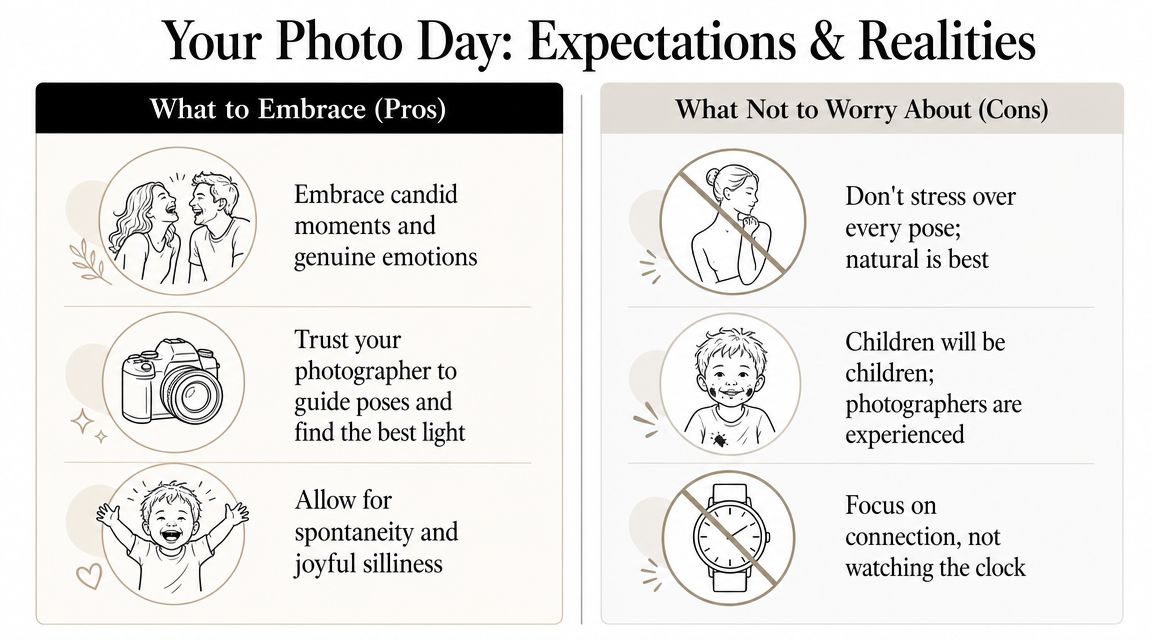
The first few minutes matter
The beginning often looks less cinematic than families expect. A photographer may move you a few feet to simplify the background. They may rotate shoulders, change spacing, or ask one person to take half a step forward so faces sit on a cleaner plane. None of that is wasted time. It's what makes the rest of the gallery coherent.
Once that foundation is set, the session should loosen. Children don't need to stand perfectly still for the entire shoot. In fact, they usually photograph better when they're allowed to interact naturally within a controlled setup.
Prompts beat rigid poses
A family photographer article points out that repeated poses don't look the same across families because every family brings a different energy. The recommendation is to use prompts that trigger reactions rather than forcing rigid posing, reflecting a broader move toward less formal family imagery that feels real rather than staged (prompt-based family photography approach).
That's exactly why “everyone look here and smile” has limited value. It can produce one useful frame, but it rarely produces a full gallery with life in it.
A stronger prompt sequence might sound like this:
- For parents with small children: “Pull them in close and whisper something that makes them laugh.”
- For siblings: “Walk together and see who can make the other break first.”
- For a reluctant parent: “Ignore me for a second and focus on your kid.”
- For the whole group: “Everybody squeeze in like you're trying to fit into one seat.”
These aren't tricks. They're structured cues designed to produce expression, movement, and body language that looks believable.
If a child looks away, laughs too hard, or buries their face in a parent's shoulder, that often becomes the frame people keep.
What families should and shouldn't worry about
The strongest sessions usually include a little mess. A child may need a snack break. Someone's hair may shift in the wind. A teenager may give you two excellent minutes and then retreat emotionally. That doesn't mean the session failed.
What helps most is knowing where to place your attention:
| Focus on this | Let this go |
|---|---|
| Connection | Perfect eye contact in every frame |
| Movement | Keeping clothes untouched every second |
| Trusting direction | Monitoring every image mentally |
| The family's real dynamic | Forcing one mood for the full session |
A good photographer is watching dozens of small variables at once: chin angle, hand placement, stray distractions, exposure, the child who is about to lose interest, the parent who's over-correcting, and the moment that's just about to happen. Your job is simpler. Stay engaged with each other and let the photographer steer.
Decoding Photography Pricing and Packages
Family photography pricing often feels opaque because clients are comparing packages that look similar on the surface but are built on different business models underneath.

One photographer may include planning, the session, editing, and digital delivery in a single number. Another may charge a session fee first, then sell files, prints, or albums separately after the gallery is ready. Both can be legitimate. The confusion starts when families assume every quote covers the same things.
According to one family photography pricing discussion, professional family photography can range from hundreds of dollars to around $1,000 or more per session at the higher end, with that spread reflecting differences in business model, editing workload, product delivery, and client volume (family photography cost breakdown and market range).
What you're usually paying for
A professional quote generally contains several layers, whether they're itemized or bundled:
- Pre-production: consultation, planning, scheduling, wardrobe guidance, and sometimes location scouting
- Shoot time: the actual session and on-site direction
- Post-production: culling, color correction, retouching, export, and gallery preparation
- Deliverables: digital files, prints, albums, or framed artwork
- Business overhead: insurance, equipment, software, travel, assistant labor, studio costs
This is why comparing rates without comparing deliverables leads to bad decisions. One package may look expensive until you realize it includes retouched files and print-ready images. Another may look affordable until you learn that almost everything is purchased afterward.
Editing versus retouching
These terms get used loosely, but they're not the same.
Editing usually refers to global adjustments across the image. Exposure, white balance, contrast, color, and cropping all fall into this category. Retouching is more specific and selective. It may involve refining temporary blemishes, removing distractions, or cleaning up small details that pull attention from the portrait.
Before booking, ask what level of finishing is included. That's one of the clearest ways to compare value. A detailed look at professional portrait photography cost can help frame those differences in practical terms.
For a quick visual primer on how photographers think about package structure, this overview is useful:
A better way to compare quotes
Ask each photographer the same three questions:
- What exactly is included in the quoted price?
- How many finished images or products does that include?
- What purchases are optional, and what are required later?
If you do that, pricing becomes much easier to read. You stop shopping for a number and start shopping for a complete experience with clearly defined results.
Your Pre-Session Checklist for a Stress-Free Day
The best family sessions feel relaxed long before the first frame is made. Most of that calm comes from handling small logistics early so they don't pile up at the last minute.
One week before
Use this stage to remove uncertainty.
- Confirm the plan: Recheck the time, meeting point, parking details, and weather backup with your photographer.
- Finalize wardrobe: Try everything on, including shoes and accessories, so nothing surprises you on the day.
- Check comfort: Make sure children can move, sit, and be carried in what they're wearing.
- Review the setting: If the session is at home or on private property, think through what should be cleared, cleaned, or simplified. A guide on how to prepare a site for a photoshoot is useful because the same principle applies to family work. Visual clutter steals attention.
The day before
Momentum matters here.
Lay out every outfit completely. Steam or press what wrinkles easily. Pack backup items for children if the session involves travel, grass, sand, or snacks. If props are part of the plan, keep them minimal and intentional.
A short prep list helps:
- Clothing ready: No last-minute searching for missing socks, belts, or hair ties
- Snacks chosen: Simple, low-mess options that won't stain clothes or hands
- Bags packed: Wipes, water, touch-up items, and one calm activity for waiting moments
- Schedule protected: Avoid stacking the evening with other demanding plans if possible
Arriving unhurried does more for a family gallery than one more outfit option.
The morning of the shoot
Don't treat the session like a performance. Treat it like an event that needs good energy.
Feed everyone well. Keep the pace steady. Give children room to stay regulated instead of over-explaining how they must behave for the camera. Parents often create more tension by trying to force enthusiasm before the session even starts.
A simple morning rhythm works best:
| Do this | Skip this |
|---|---|
| Eat before leaving | Relying on hunger-proof optimism |
| Leave early | Racing the clock |
| Dress with enough time | Last-minute outfit changes |
| Stay matter-of-fact | Threatening or bribing kids for smiles |
The final ingredient is trust. You've already chosen the photographer, aligned on style, and prepared the practical details. Let the session breathe. Families look most like themselves when they don't feel managed by panic.
If you want family portraits handled with the same discipline, lighting control, and story-driven direction that enhances editorial and commercial work, Jimmy Clemmons Photographer brings that precision to people-focused imagery with a polished, design-aware approach.