
A single professional headshot in 2026 typically falls between $250 and $850, and a small corporate team shoot often starts around $1,500 to $3,500. That's the right baseline, but it's only useful if you understand what's included, what drives the number up or down, and where the actual value sits.
If you're a marketing director, brand lead, or operations owner trying to refresh company portraits, you're probably balancing two pressures at once. You need images that look polished enough to match the brand, and you need a budget that survives procurement.
That tension is normal. The mistake is treating professional portrait photography cost like a commodity purchase. A cheap portrait session and a well-produced portrait assignment may both result in JPEGs, but they don't create the same perception, consistency, or long-term usability.
Beyond the Headshot Why Your Budget Needs a Strategy
A common scenario goes like this. The website is being redesigned, LinkedIn profiles look inconsistent, the leadership page feels dated, and someone finally says, “We need new portraits.” Then the estimates come in, and the conversation narrows too quickly to one question: why does one photographer charge so much more than another?
The short answer is that they may not be selling the same thing.
In the U.S., national medians for a professional headshot session cluster around $250 to $350 per session, while major metro markets can push much higher. In cities like New York, standard sessions can average $450 or more, according to Capturely's 2026 headshot cost guide. That spread tells you something important right away. There is no single national price that reliably predicts what your project should cost.
A leadership portrait session for a law firm, architecture practice, or real estate developer isn't just a calendar booking. It's a brand exercise. The photographer has to shape lighting around faces, wardrobe, and environment. They have to direct people who are often uncomfortable on camera. They have to deliver images that still feel cohesive when one executive is photographed this quarter and another is photographed six months later.
Practical rule: If your portraits need to work across a website, pitch deck, press release, recruiting page, and investor materials, you're not buying headshots. You're commissioning a visual system.
That's why budget strategy matters more than price shopping in isolation. A low fee can become expensive if the images feel generic, require reshoots, or don't hold up across multiple uses. A higher fee can be efficient if the photographer creates a repeatable look, handles production cleanly, and delivers files your team can use for years.
The better question isn't “What do portraits cost?” It's “What level of consistency, polish, and usage does our brand need?”
Decoding Photography Pricing Models
A corporate marketing director might receive three portrait proposals for the same leadership team and see three very different totals. One quotes a day rate. One prices by final image. One offers a package that bundles planning, production, retouching, and limited usage. The confusion usually starts because each model answers a different business need.
The pricing model matters because it shapes behavior. It affects how many people can be photographed, how carefully images are selected, how much retouching is included, and whether your team can use the work across recruiting, PR, investor communications, and the website without licensing friction later.
Per image pricing
Per-image pricing fits assignments where the final selects carry the value. That usually means executive portraits, founder imagery, speaker photos, or portraits intended for high-visibility brand use.
This model keeps the conversation focused on output, not volume.
It also tends to work well when internal stakeholders want to review proofs before approving retouching. A company may photograph ten executives, narrow the set to one or two strong options per person, and invest post-production time only where it matters. For organizations building a polished visual identity, that selective approach often aligns well with broader brand photography services for corporate teams.
Per-image pricing often makes sense when:
- The deliverable list is tight: You need a controlled number of polished files.
- Retouching standards are high: Skin, wardrobe, flyaways, background cleanup, and color consistency need careful work.
- Usage value is concentrated: A small set of portraits will appear repeatedly in visible brand channels.
The trade-off is simple. If a team starts asking for many finals, the total can climb quickly.
Time-based pricing
Hourly and day rates are common when logistics drive the assignment. That includes office installations, multi-floor setups, busy executive calendars, and portrait days where efficiency matters as much as aesthetics.
A time-based quote is often the right structure for production-heavy shoots because it accounts for setup, transitions, lighting changes, file handling, and the stop-and-start rhythm of corporate schedules. It also gives the client a clearer framework for adding people or locations without rewriting the entire estimate.
Time-based pricing still needs detail. Two photographers can quote the same half-day and deliver very different value depending on pre-production, assistant support, tethered review, retouching volume, and licensing terms. The day rate alone does not tell you whether the proposal supports brand consistency or just covers camera time.
Package-based pricing
Package pricing is common in corporate portrait work because it matches how marketing teams buy. The company is usually not purchasing isolated minutes or a random set of files. It is commissioning a defined outcome with a schedule, a visual standard, and clear usage terms.
A strong package usually bundles:
- Pre-production: scheduling, creative alignment, wardrobe guidance, and shot planning
- Production: photographer time, lighting, direction, and on-site workflow
- Post-production: proofing, retouching, file prep, and delivery
- Licensing: stated permissions for the channels and time period the brand needs
Quality differences become visible here. One package may look more expensive at first glance but include enough retouching, production support, and internal marketing usage to prevent add-on fees later. Another may look efficient until the client learns that each extra final image, round of retouching, or extended usage term increases the cost.
Many of the best proposals use a hybrid structure. A half-day or full-day creative fee sets the production baseline, then final retouched selects and licensing are scoped with precision. For corporate buyers, that usually creates the clearest connection between cost, brand standards, and return on the investment.
What Your Photography Fee Actually Covers
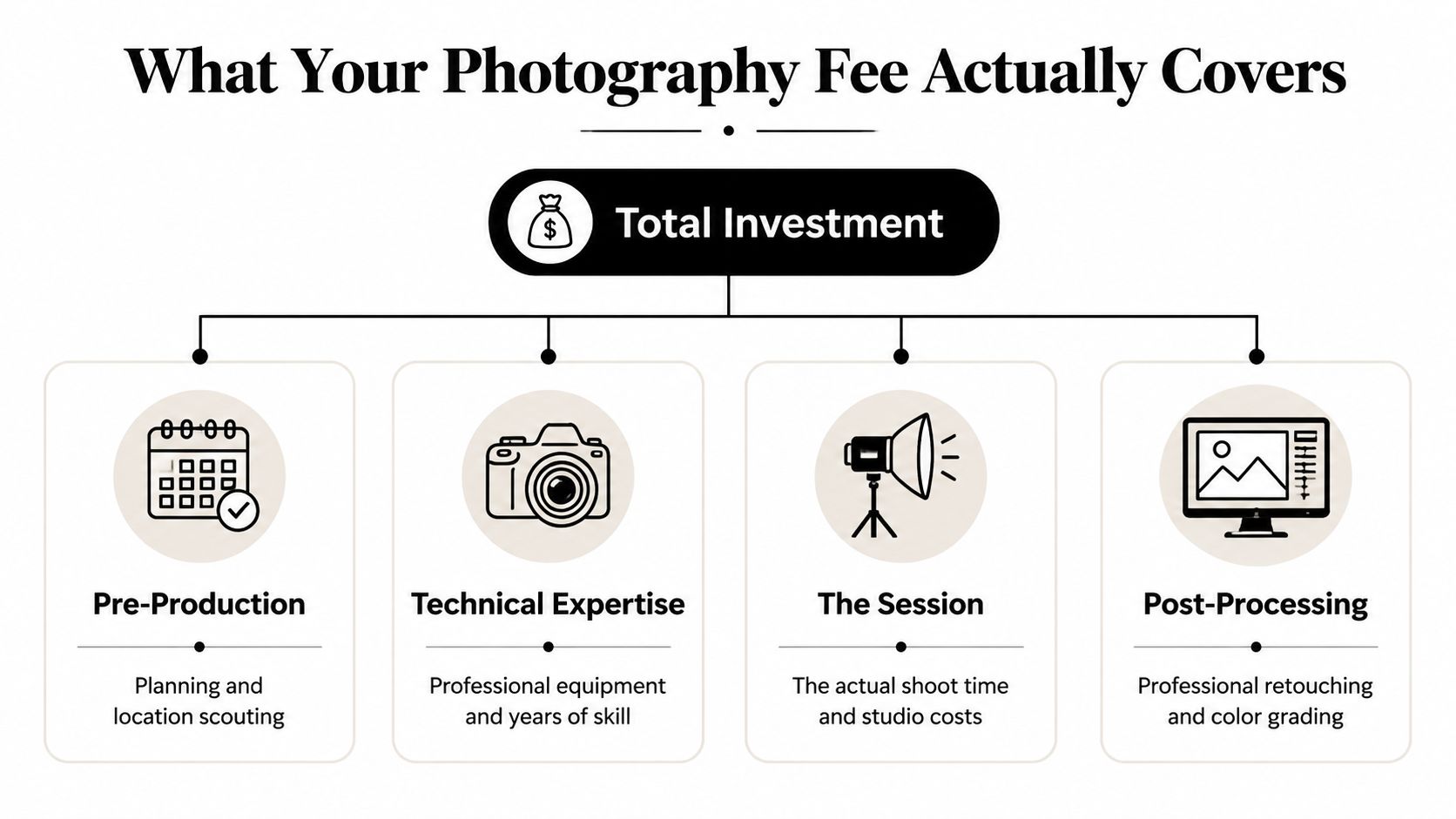
Most buyers still overestimate the value of the camera time and underestimate everything around it. The shoot may be the visible part of the assignment, but it's often only one slice of the total job.
Before the camera comes out
Strong portrait work starts before anyone steps onto set. For corporate clients, that prep often includes reviewing wardrobe guidance, deciding whether the portraits should feel editorial or cleanly corporate, planning background options, confirming where the images will live, and building a schedule that doesn't derail the workday.
That pre-production is what prevents expensive chaos. It keeps the session from turning into a rushed queue of people walking in with mismatched jackets, uneven expectations, and no clear visual target.
For companies building a broader visual identity, that planning often overlaps with larger brand photography services rather than standing alone as a one-off headshot appointment.
The session itself
Production includes more than a person with a camera. Lighting gear, backup gear, tethering, file handling, setup time, breakdown time, and subject direction all affect the quality of the final result.
A corporate portrait session also demands pace control. The photographer has to work efficiently without making people feel processed. That balance matters because rushed subjects look tense, and overlong sessions create scheduling friction with your team.
Here's the part buyers miss most often: the more consistency you need across multiple people, the more technical discipline the photographer has to bring. Matching light shape, lens perspective, camera height, expression coaching, and background tone is careful work.
Post-production is where polish happens
The final image is usually built in post, not captured in-camera alone. According to Trent Ogilvie's portrait pricing analysis, professional editing often exceeds shooting time by 3 to 6 times, and 66% of studio packages deliver three images or fewer. The same source notes that polished corporate portraits can command $200+ per image because of the retouching intensity.
That aligns with real production experience. Good retouching doesn't mean plastic skin or artificial perfection. It means distraction control. Flyaway hairs, under-eye shadows, lint, uneven color, temporary blemishes, and minor wardrobe issues all need attention. So does consistency across a set.
A portrait starts to look expensive when the retouching is visible. It starts to look professional when the retouching disappears.
Licensing is the quiet line item that matters most
The hidden cost in many portrait quotes is usage rights. A client may assume they're buying unrestricted use, while the photographer may be licensing only narrow internal or web usage.
That difference matters if the same portrait ends up on:
- Corporate websites and team pages
- Recruiting campaigns
- Press kits and earned media
- Conference signage
- Printed collateral
- Paid advertising
If the quote doesn't state the license clearly, ask. The file delivery is not the same thing as the usage permission.
Key Factors That Influence Portrait Photography Cost
Two portrait projects can sound nearly identical and price very differently. That's normal because the fee reflects a cluster of variables, not a single market rate.
Geography changes the baseline
Location is one of the clearest cost drivers. Major metro markets carry more overhead, and photographers price accordingly. 415 Headshots' market-tier review notes that a half-day corporate session in a Tier 1 market like NYC or San Francisco runs $1,500 to $3,500, while Tier 2 and Tier 3 cities can be significantly less.
That doesn't mean one market is overcharging and another is undercharging. It means studio rent, labor costs, travel friction, and market expectations shape the floor.
A procurement team should always evaluate portrait quotes in local context. Comparing a San Francisco estimate against one from a regional market without adjusting for geography usually produces the wrong conclusion.
Photographer specialization changes the value
Some photographers are good at getting a pleasant likeness. Fewer are good at producing a repeatable corporate look that feels confident, current, and aligned with a premium brand.
That distinction affects cost because specialization reduces risk. An experienced commercial portrait photographer usually brings:
- Consistent lighting design: So one person's image doesn't look unrelated to the next
- On-set direction: So non-professional subjects look natural faster
- Editorial judgment: So the image feels intentional, not generic
- Production reliability: So the day stays on schedule
What works for a family portrait or entry-level actor headshot often doesn't work for a leadership team, developer profile, or architecture firm website.
Scope is where budgets expand fast
A single executive portrait can be straightforward. A multi-department roster rarely is. Once the project includes many people, multiple looks, or ongoing onboarding sessions, the fee reflects complexity more than camera time.
The main scope drivers are usually:
- Number of people: More subjects require more coordination, pacing, and often more file management
- Number of final selects: The retouching load rises with every approved image
- Visual variety: Environmental portraits, multiple backdrops, and different crops take more setup
- Scheduling constraints: Tight executive calendars can force production efficiency and extra planning
This quick video does a good job illustrating how portrait choices affect the feel of the final image and, by extension, the production approach behind the quote.
Production extras can move the number quickly
The biggest jumps in professional portrait photography cost often come from choices that buyers treat as minor. Hair and makeup, a rented studio, multiple locations, advanced retouching, and tighter delivery timelines all add meaningful work.
A simple way to think about it is this:
| Factor | Lower-complexity version | Higher-complexity version |
|---|---|---|
| Setting | One controlled setup | Multiple locations or environmental scenes |
| Talent flow | One person at a time | Team coordination across departments |
| Editing | Light polish | Consistent premium retouching across many files |
| Usage | Internal profile use | Broader campaign and print use |
The quote usually rises when the brand asks the images to do more work.
Sample Corporate Packages and Ballpark Numbers
Abstract pricing talk only gets you so far. Most corporate buyers need examples that map to real business scenarios.
The numbers below are ballpark ranges based on the verified market bands already discussed. They're not universal menu prices, and they don't replace a written estimate with clear scope, retouching details, and licensing terms. They do show how the same category of portrait work can price differently depending on intent.
Three common use cases
Some companies only need polished executive portraits for a leadership page. Others need a repeatable system for onboarding, recruiting, media use, and full team visibility. The package should follow the operational need, not the other way around.
For broader context on regional planning and service approach, a useful reference point is this page on corporate headshots in Atlanta, especially if your team is balancing on-site efficiency with brand consistency.
2026 Sample Corporate Portrait Packages
| Package Name | Best For | Includes | Ballpark Cost |
|---|---|---|---|
| Executive Leadership Session | Leadership teams, founders, partners | Individual portraits for a small group, directed session, polished retouching, consistent look across the team | $1,500 to $3,500 |
| Ongoing New Hire Portrait Program | Companies with regular onboarding | Scheduled portrait sessions for new staff, repeatable lighting setup, standardized editing for website and internal consistency | Often aligns with individual session pricing in the $250 to $850 range, depending on market and scope |
| Full Company Roster Day | Larger organizations needing broad team coverage | On-site setup, high-throughput scheduling, standardized portraits for many employees, bundled day pricing | In major markets, team pricing commonly lands in the $125 to $275 per person band, with full-day sessions often priced between $2,500 and $6,000, based on Wolf Studio's corporate headshot cost analysis |
How to read these numbers correctly
The first package usually carries a higher per-person cost because the production is slower and more refined. Leadership portraits often need more time per subject, more stakeholder review, and more exacting retouching.
The second package is less about a single shoot and more about system design. The value comes from continuity. If every new employee portrait feels like it came from a different vendor, the company page starts to look fragmented even if each image is acceptable on its own.
The third package benefits from scale. A high-volume team day can bring the per-person rate down because the setup is shared, the pace is structured, and the visual treatment is standardized. That's where per-head costs often compress, especially when the assignment is designed for speed and consistency rather than individualized art direction.
A package is efficient when it matches the business problem. It becomes wasteful when the scope includes refinements your team won't use, or leaves out production support your brand actually needs.
What to confirm before approving a quote
Before signing off on any package, get clarity on the parts that most often create surprises:
- Final image count: Ask how many retouched selects are included for each person or for the team.
- Retouching level: Clarify whether the work is light cleanup or premium polish.
- Usage terms: Confirm where the portraits can appear and for how long.
- Reshoots and makeups: Ask what happens when an executive misses the shoot day.
- Consistency plan: For multi-session projects, ask how the visual standard will be matched over time.
That last point matters more than many buyers expect. The strongest portrait programs aren't just affordable. They're repeatable.
Budgeting for Brand Impact Questions to Ask and ROI
A common scenario. Marketing approves a portrait shoot for the leadership team, the files look good on delivery, and six months later the same company is paying again to match that look for new hires, regional executives, and a media request that falls outside the original usage terms. The problem was not the camera work. The budget was built around a shoot day instead of a brand system.
For high-end corporate clients, portrait budgeting works best when it starts with use, shelf life, and brand visibility. A profile image on LinkedIn has one job. A portrait set that needs to work across investor materials, executive bios, press outreach, recruitment campaigns, office signage, and future team expansion has a very different value. The right question is not how little the shoot can cost. It is how well the assignment supports the brand over time without forcing expensive fixes later.
Questions worth asking before you hire
Ask questions that show whether the photographer can support a corporate program, not just a single session:
- How will you build a portrait standard our team can repeat next quarter or next year?
- What level of retouching is included, and what gets billed separately?
- How do you direct executives or subject matter experts who are uncomfortable on camera?
- Which usage rights are included, and where do those rights stop?
- Can you match this look across different offices, backgrounds, or production days?
- What prep, scheduling, and on-site coordination do you need from our team?
- How do you handle missed sessions, leadership changes, or add-on portraits after the main shoot?
These questions reveal the difference between a vendor who delivers files and a photographer who understands brand operations.
Licensing deserves procurement-level attention
Licensing often explains why two portrait quotes that look similar at first glance are priced very differently. One proposal may cover internal use, web profiles, and company-owned marketing channels. Another may limit use by duration, geography, campaign type, or audience size. If those terms are vague, the low quote is not a bargain. It is an unfinished agreement.
I advise clients to review licensing the same way they review scope. Ask where the images can appear, how long the rights last, whether paid advertising is included, and whether future subsidiaries, offices, or business units can use the files. Those details affect total cost more than many teams expect, especially when portraits are intended to support PR, recruitment, and executive visibility.
For a broader business case, this perspective on the ROI of professional photography is useful because it frames images as working business assets, not decorative deliverables.
The return comes from repeated use, brand consistency, and fewer production resets, not just from getting one strong image on shoot day.
Good portraits reduce friction across the organization. Sales gets approved headshots for proposals. HR gets a consistent visual standard for recruiting. Communications gets press-ready executive imagery. Design teams stop patching together mismatched photos from different years and different vendors.
That return does not always fit neatly into one spreadsheet cell, but experienced marketing directors see it quickly. Strong portraits make a company look established, coordinated, and trustworthy. Weak or inconsistent portraits create doubt at exactly the moments when a brand needs confidence.
If the portraits need to represent a serious company, budget for quality in the places that affect long-term value. Art direction. Production planning. Retouching standards. Licensing. Repeatability. Those are the line items that protect the brand long after the shoot is over.
If you need portraits, architectural imagery, or brand photography that feels precise, modern, and aligned with the way your company presents itself, Jimmy Clemmons Photographer offers a thoughtful, editorial approach built for corporate and design-focused clients.