
You've already paid for the shoot. The building was lit correctly, the products were styled, the executive team gave you a narrow window, and the photographer delivered strong captures. But when the files hit your inbox, something still feels unfinished. The images are competent, yet they don't carry the level of polish your website, pitch deck, brochure, or editorial placement demands.
That gap is where professional photo editing services matter. Not as rescue work, and not as cosmetic gloss, but as the stage where visual assets become consistent, publication-ready business tools. In architecture, branding, hospitality, and corporate communications, the difference between “good enough” and “worth publishing” usually comes down to disciplined post-production.
Beyond the Shutter The Strategic Role of Photo Editing
A camera records information. An editor shapes perception.
That's the distinction many business teams miss. They assume the shoot is the main event and editing is a minor clean-up pass afterward. In practice, post-production is where tone, hierarchy, color discipline, and consistency are locked in. It's where a bright lobby can feel calm instead of washed out, where a glass tower reads crisp instead of distorted, and where a leadership portrait feels authoritative without becoming artificial.
Good capture is the starting point
In commercial work, the raw capture is rarely the final asset. Even well-exposed files can have small issues that weaken the brand impression. Vertical lines may lean. Mixed lighting may shift white balance. Reflections may pull attention from the product or the room. Skin tones may vary from frame to frame. None of these problems look dramatic in isolation, but together they make a campaign feel less controlled.
Professional photo editing services solve that problem by turning individual photos into a coherent visual system.
Practical rule: Editing should protect the intent of the photograph, not overpower it.
For B2B buyers, that matters because brand trust is often built through visual precision. A developer wants an exterior image that feels credible. A design firm wants interior finishes to read accurately. A corporate marketing team wants image sets that look unified across web pages, proposals, signage, and media kits.
Editing has become an operating function
This isn't a fringe service anymore. The broader global photo editing software market was valued at USD 1,149.06 million in 2024 and is projected to reach USD 1,818.90 million by 2034, with a projected CAGR of 4.70% from 2025 to 2034. That growth tells you something important. Businesses increasingly treat image refinement, color correction, and high-volume delivery as part of normal operations, not occasional finishing work.
A useful analogy is food styling in a top restaurant. The ingredients may be excellent, and the cooking may be exact, but the final plating determines how the dish is perceived. Photo editing does the same thing for visual communication. It refines emphasis. It removes friction. It gives the viewer a cleaner read of what matters.
Where strategy shows up in the final frame
The strongest editing doesn't announce itself. It creates confidence.
That usually shows up in a few ways:
- Brand alignment: The image feels like it belongs with the rest of your materials.
- Consistency across sets: A gallery of interiors, products, or portraits reads as one body of work.
- Controlled realism: The subject looks its best without crossing into implausibility.
- Usability: Files are delivered in forms your team can use across channels.
Teams don't hire professional photo editing services just to make pictures prettier. They hire them because polished visuals shorten approval cycles, raise perceived quality, and let every image carry more of the brand load.
Editing Specialties Architectural Commercial and Portrait
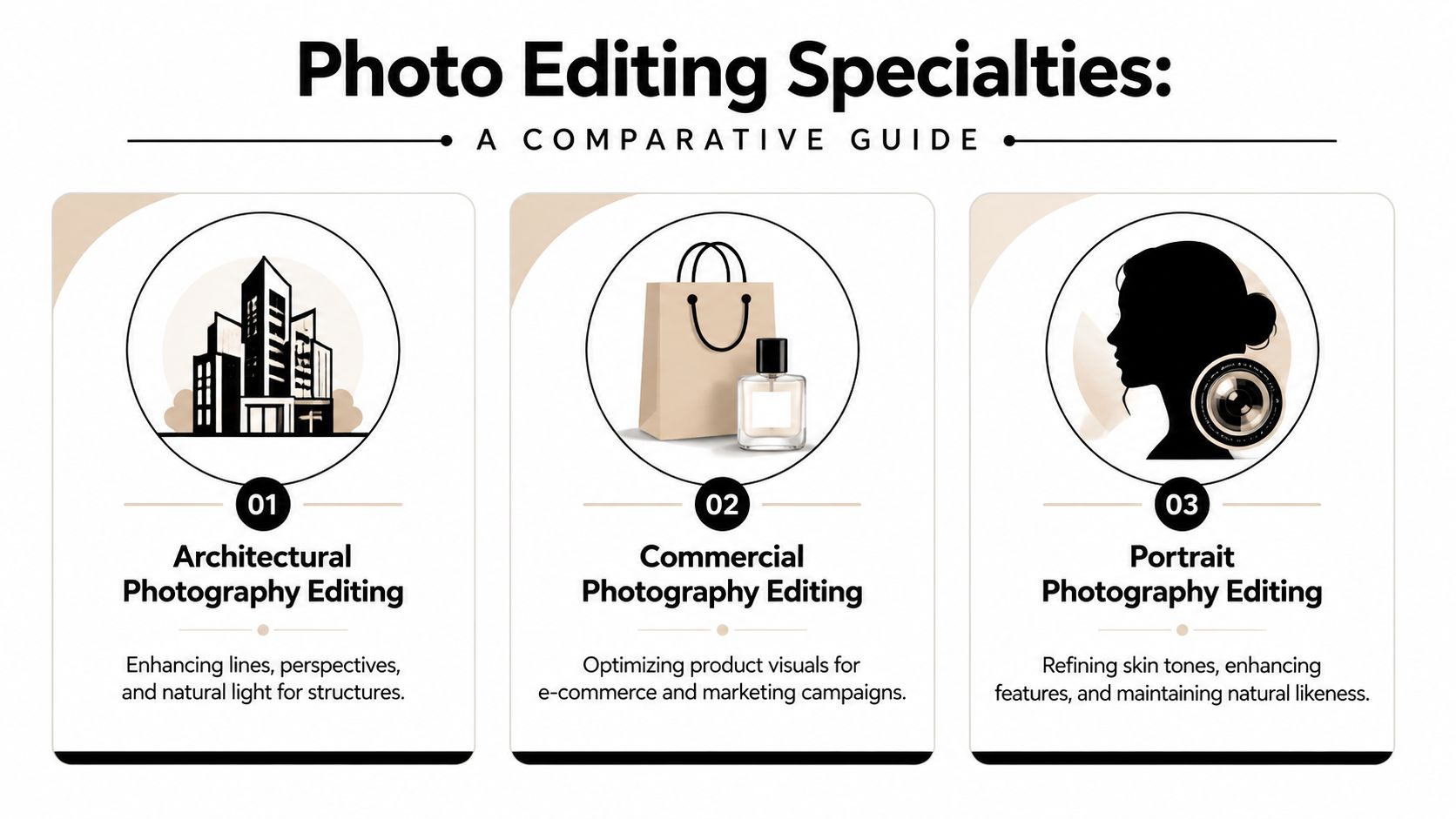
Much of the visible discussion around editing services is still generic or aimed at photographers. That leaves a real gap for commercial buyers who need work specific to architecture, branded campaigns, and corporate portraiture. As noted in industry commentary on commercial client needs, common concerns include perspective correction, large-volume consistency, and compliance with property-marketing requirements.
Architectural editing demands restraint
Architectural photography lives or dies on geometry and light. If verticals drift, window detail clips out, or material colors shift, the image stops serving the architect, designer, or developer. It starts looking like a stylized approximation of the space.
That's why architectural editing usually focuses on a tight set of priorities:
- Perspective correction: Buildings and interiors need clean, believable verticals.
- Lens distortion control: Wide-angle work often needs careful correction so spaces feel accurate, not stretched.
- Exposure balancing: Windows, shadow detail, and interior fixtures must coexist without the room feeling fake.
- Color fidelity: Stone, wood, fabrics, metals, and wall finishes need to read as designed.
When structural lines or room geometry need careful refinement, it helps to understand how specialists approach post-production for structural photos.
A weak editor often pushes architecture too far. Floors become unnaturally bright. Skies turn theatrical. Surfaces lose their real texture. The better approach is correction with restraint. The building should still feel buildable, occupiable, and true to life.
The best architectural retouching protects credibility first and atmosphere second.
Commercial editing is built around consistency
Commercial work covers a wide range, from product-on-white images to campaign composites and hospitality imagery. What unites it is repeatability. Buyers aren't looking at one hero frame. They're evaluating a set.
A one-size-fits-all workflow fails here because commercial editing often has to balance competing requirements. E-commerce may need strict color control and clean background extractions. Lifestyle campaign work may need object cleanup, compositing, shadow consistency, and output versions for multiple placements. Hospitality and corporate branding may need a polished look that still feels lived-in and believable.
A practical comparison helps:
| Specialty | Primary editing priority | Common failure |
|---|---|---|
| Architectural | Spatial accuracy and tonal balance | Overprocessed realism |
| Commercial | Set-wide consistency and brand alignment | Inconsistent color or clipping |
| Portrait | Natural likeness and polished presentation | Plastic skin and loss of character |
Portrait editing is about judgment
Portrait retouching is where many vendors reveal whether they understand brand work or only beauty filters. A business portrait isn't a fashion cover, and it shouldn't be edited like one.
The goal is usually straightforward. Clean distractions, even out minor inconsistencies, control color, and preserve identity. Skin should retain texture. Hair should look intentional, not helmeted. Clothing wrinkles, lint, flyaways, and background distractions should be handled without making the person look synthetic.
Good portrait editing asks a different question than social media editing. Not “How flawless can this face become?” but “How credible, confident, and consistent can this subject look across an entire team gallery?”
That distinction matters for law firms, healthcare groups, universities, developers, and any company presenting real people as part of the brand.
The Professional Workflow From RAW File to Final Asset
A reliable editing process should never feel mysterious. If you're handing over valuable visual assets, you should know what enters the pipeline, how decisions are made, and what comes back.
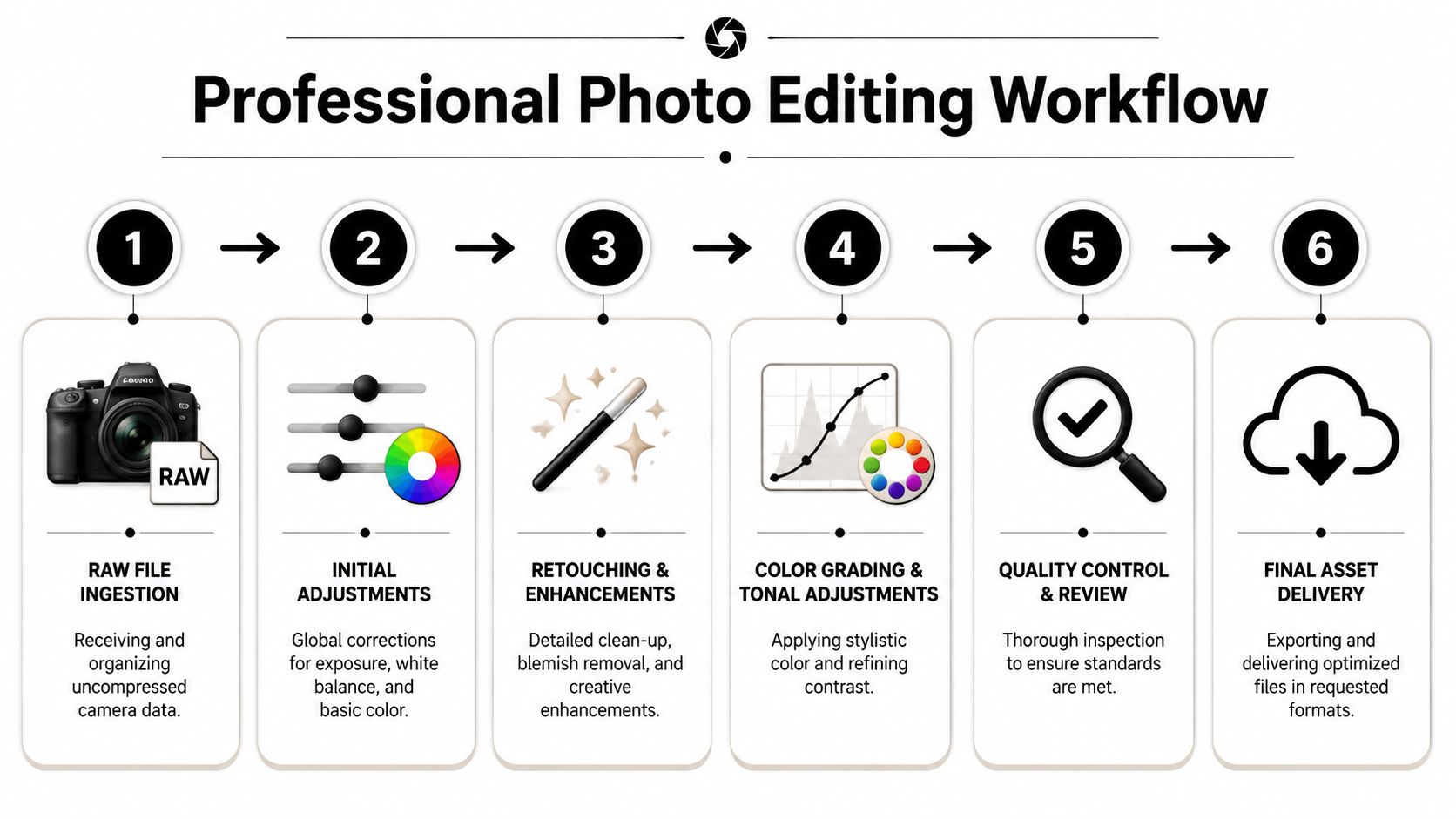
Professionals usually start with RAW captures for a simple reason. According to technical guidance on editing and retouching workflows, RAW files preserve the sensor's unprocessed tonal and color data, which gives editors more latitude to correct exposure, white balance, and highlight recovery without visible artifacts.
Why RAW matters in real projects
Think of RAW as the full working file and JPEG as a compressed interpretation. If a window is slightly hot, a tungsten fixture is warming one side of the room, or a portrait has mixed ambient and flash color, the RAW file gives the editor room to solve those issues cleanly.
That's why most serious workflows use Adobe Lightroom or Adobe Photoshop in sequence. Global corrections happen first. Then local retouching, cleanup, masking, and final finishing happen after the foundation is stable.
For examples of how this approach supports property and location-based image sets, review a specialized look at real estate photography editing workflows.
What a managed editing engagement looks like
A professional service usually follows a pattern that's easy to evaluate:
File intake
The client sends selects or a full set through a secure transfer method such as Dropbox, WeTransfer, or an FTP-based system, along with naming conventions and delivery notes.Creative brief
The creative brief determines whether the project stays efficient or goes sideways. It should include sample references, brand tone, output use, crop needs, and specific “do not do this” notes.Global corrections
Exposure, white balance, lens correction, tonal shaping, and color normalization happen at the set level.
Before moving deeper into retouching, it helps to see a straightforward demonstration of how editors think through tonal and file-level decisions.
Localized retouching
Dust spots, distractions, reflections, skin cleanup, compositing, perspective refinement, and edge cleanup happen image by image.Proofing and revision
A first pass should reveal whether the editor understood the brief. If revisions are needed, they should refine direction, not redefine the whole project.Export and delivery
Final files are prepared for their intended use, whether that's print, web, MLS, press, internal presentation, or a digital asset management system.
A clean workflow doesn't just improve image quality. It reduces miscommunication.
When buyers complain about outsourced editing, the problem usually isn't the software. It's the lack of a clear brief, inconsistent standards, or an approval loop that started too late.
Understanding Pricing Models and Turnaround Times
Pricing only feels confusing when the scope is vague. Once you know whether you're buying batch corrections, detailed retouching, or complex composites, the cost structure becomes much easier to read.
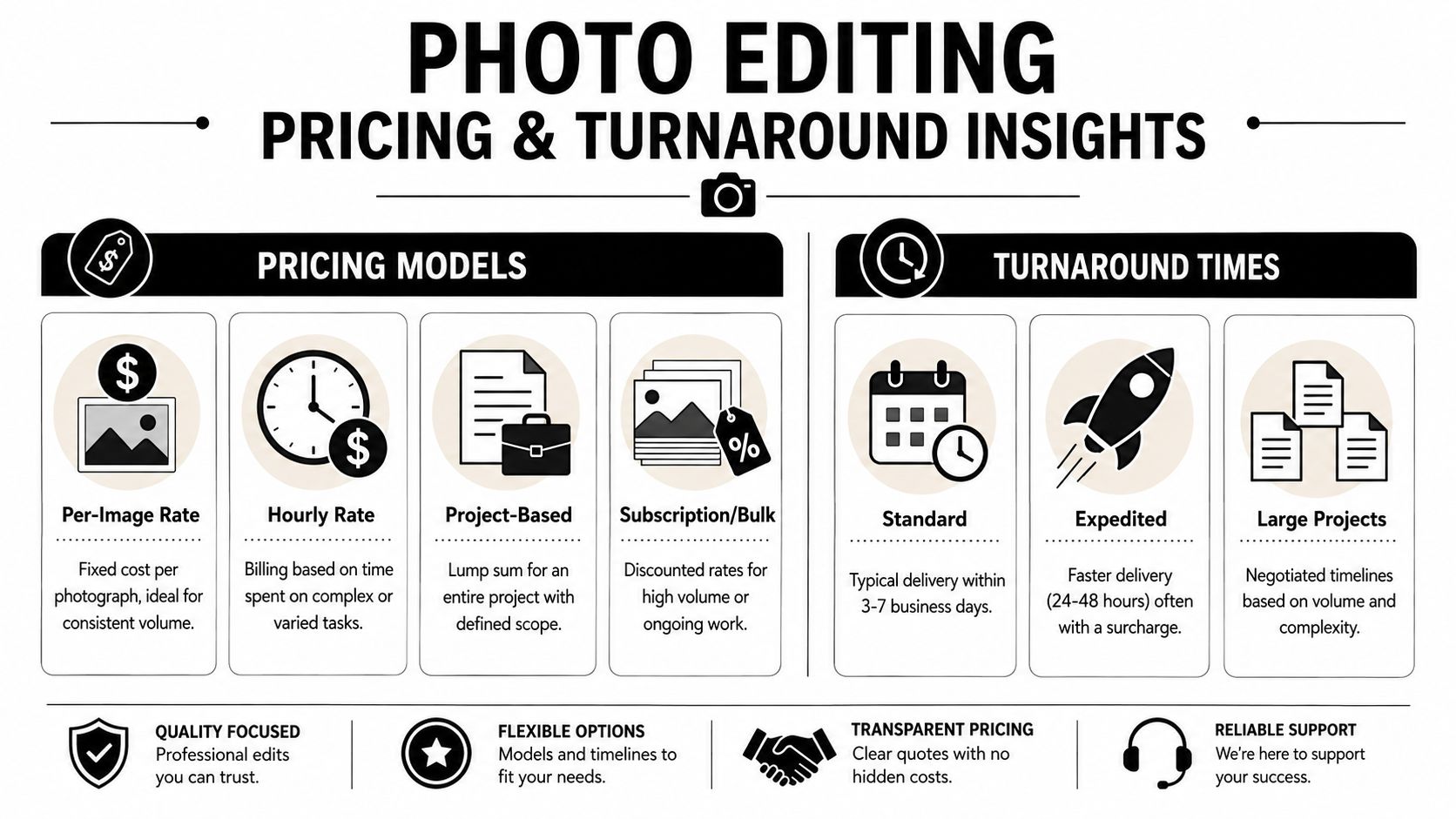
Industry pricing snapshots show the basic range. According to pricing guidance for photo editing services, basic retouching commonly runs from $0.20 to $5.00 per image, background removal from $0.50 to $2.00 per image, and real estate editing at roughly $1.00 to $2.00 per image, or about $20 to $40 per listing. The same source notes hourly professional Photoshop editing rates of $50 to $150, and says outsourcing can reduce overall expenses by 30% to 40% compared with maintaining in-house staff.
How pricing models usually work
Not every project should be quoted the same way.
- Per-image pricing: Best for repeatable work with a clear edit recipe, such as background cleanup, basic retouching, or real estate batches.
- Hourly pricing: Better for layered retouching, composites, ad work, and files that need judgment rather than a template.
- Project-based pricing: Useful when the deliverables are fixed but the mix of work varies.
- Bulk or retainer structures: Common when a company needs recurring output and wants predictable production planning.
The mistake buyers make is comparing a low per-image quote against a high-touch retouching quote as if they're the same service. They're not. One may cover exposure balancing and dust cleanup. The other may include perspective refinement, compositing, color harmonization across a campaign, and multiple rounds of revisions.
Turnaround depends on volume and complexity
Editing speed is often framed as a simple deadline question, but three factors usually drive it:
| Factor | What it affects |
|---|---|
| Image complexity | How much manual retouching each file requires |
| Batch size | Whether consistency across a set becomes the main labor |
| Approval structure | How many review rounds slow final delivery |
The same pricing source notes that service teams may process 2,000 to 4,000 images per day and operate with near 24/7 availability across time zones, which explains why high-volume outsourcing can be attractive for recurring production work.
If a quote promises fast delivery, ask what level of quality control is still included.
For business buyers, the right question isn't “What's the cheapest edit?” It's “What quality standard am I buying, and is the delivery model stable enough for recurring work?” Cheap edits become expensive when your team has to re-brief, recheck color, or fix mismatched files internally.
How to Vet a Provider A Buyer's Checklist
Most editing disappointments are operational, not artistic. The images come back close, but not consistent. Skin looks different from one frame to the next. Interior whites shift warm and cool across the same project. A deadline slips, file naming is messy, or no one can explain how assets are being handled.
That lines up with industry guidance on evaluating editing vendors, which recommends checking sample work, turnaround commitments, software or tool stack, and data-security measures. It also highlights common failure points such as inconsistent rendering, mismatched color between image sets, and missed deadlines.

Start with proof of relevant experience
A polished portfolio can still be the wrong portfolio.
If you need architectural post-production, ask to see architectural sets. If you manage hospitality or interiors, look for controlled window pulls, believable lighting balance, and material accuracy. If your need is executive portraiture, study whether the retouching preserves skin texture and expression.
For interiors-focused criteria, a useful reference point is how specialists approach an interior design photo editor's workflow.
Here's a practical checklist to use with any provider:
- Relevant portfolio fit: Ask for examples in your category, not just general before-and-afters.
- Sample edit from your own files: One test image reveals more than a polished gallery.
- Style matching: Confirm they can follow a brand reference instead of imposing their own look.
- Set consistency: Request examples of a full gallery, not only hero shots.
Ask operational questions early
Good providers welcome operational scrutiny. Weak ones hide behind aesthetics.
Use questions like these:
- How do you handle intake, file naming, and version control?
- What's your standard turnaround for this type of work?
- What changes count as revisions versus new work?
- Who checks the work before delivery?
- How are files stored, transferred, and protected?
- What happens if a batch comes back inconsistent?
A strong answer is specific. It explains process. A weak answer stays vague and talks mostly about talent.
Buyers should evaluate professional photo editing services the same way they evaluate any production partner. On reliability, repeatability, and risk control.
Review the edits for what not to do
Most clients know when they like an image. Fewer know how to diagnose bad retouching. Look for these warning signs in sample work:
- Architecture that bends reality: Overstretched rooms, glowing windows, fake skies, or edges that halo around structural lines.
- Commercial work with clipped products: Uneven shadows, poor masking, and colors that don't match from image to image.
- Portraits with plastic skin: Smudged texture, brightened eyes that look synthetic, or facial shaping that changes likeness.
An editor who can make a single image look dramatic may still fail on a 50-image deliverable. That's why batch review matters. Ask for a representative set.
Treat the first project as a systems test
The first assignment should be scoped to evaluate fit, not just to get files out the door. Even if the provider is promising, start with a project large enough to test communication and consistency but contained enough to manage risk.
Watch for four things during that initial engagement:
| What to observe | Why it matters |
|---|---|
| Brief adherence | Shows whether the vendor listens well |
| Consistency across files | Reveals process maturity |
| Revision handling | Tells you how collaborative they are |
| Delivery discipline | Shows whether they can support real business use |
This is the lens buyers should use with any provider, including a studio photographer who also handles post-production. The question isn't only whether the pictures look good. It's whether the entire editing relationship is dependable enough to support your brand.
Editing as an Investment in Your Brand's Visual Identity
The business case for editing isn't vanity. It's clarity.
When a company presents architecture, products, spaces, or people to the market, every image makes a promise about quality. Crooked lines, uneven color, rushed retouching, and inconsistent output dilute that promise. Careful post-production strengthens it. It gives the work a point of view without compromising trust.
What strong editing really buys you
Professional photo editing services create value in ways that are easy to underestimate during planning and impossible to ignore after launch.
- They unify mixed assets so a campaign looks intentional.
- They protect realism in sectors where accuracy matters.
- They reduce internal cleanup for marketing and design teams.
- They raise the perceived level of the brand before a single word is read.
This is especially true in architecture and corporate branding, where the viewer is often scanning for signals of competence. If the visuals feel exact, calm, and controlled, the brand earns confidence faster.
The long view matters
A one-off project can benefit from editing. A brand system depends on it.
That's because visual identity isn't built through isolated hero images. It's built through repetition. The same tonal discipline. The same restraint. The same standard for skin, surfaces, windows, fabrics, signage, and atmosphere. Over time, those decisions become part of how clients recognize professionalism.
Strong post-production doesn't change what you photographed. It helps the audience see it at its best.
The smartest buyers don't separate the shoot from the finish. They treat photography as one continuous production process, from planning and capture through retouching and final delivery. That's the mindset that turns photos from project leftovers into durable brand assets.
If you need imagery that holds up in architecture, interiors, commercial branding, or professional portraits, Jimmy Clemmons Photographer brings that full-process discipline to the work. The studio combines editorial shooting experience with carefully managed post-production so your final images feel precise, credible, and ready for client-facing use.