
A doorway, a chandelier, a corridor with just enough wear in the brass to prove people mattered here. At the Mayflower, the building gives away its history before any plaque does.
The Hotel Where History Checks In
Start with a specific room. At the Mayflower, Room 776 gives the hotel's history a fixed point in space. Franklin D. Roosevelt worked on his inaugural address there in 1933, and that fact matters less as trivia than as evidence that national history unfolded inside real walls, under real ceiling heights, with a particular window line and a particular sense of enclosure.
That is how this building should be read. The Mayflower holds attention because its interiors still register use, hierarchy, and ceremony in physical terms. Truman's line about it being Washington's “second-best address” endured because the hotel was designed to project rank. You can see that intention in the scale of its public rooms, the disciplined procession through corridors and thresholds, and the way private spaces were buffered from spectacle.
For photographers, that distinction matters. A historic hotel is rarely most interesting at its most polished. It becomes more legible where preservation and revision meet, where an original proportion survives but the finishes show another decade's priorities. I use the same approach in other heritage properties, including this Auberge du Soleil Napa Valley hotel study, where the strongest images come from reading what the building kept and what it had to change.
The Mayflower has survived because it kept functioning. Its rooms, ballrooms, service paths, and renovated surfaces show pressure from politics, hospitality, and changing standards of luxury. The building did not remain frozen, and that is exactly why it still carries authority on camera.
Historic hotels photograph best when you treat them as edited buildings, not frozen ones. The useful question isn't “What was original?” It's “What changed, what remained, and why?”
The visual narrative emerges from the evidence of adaptation, not from celebrity alone.
A Grand Vision For a New Era
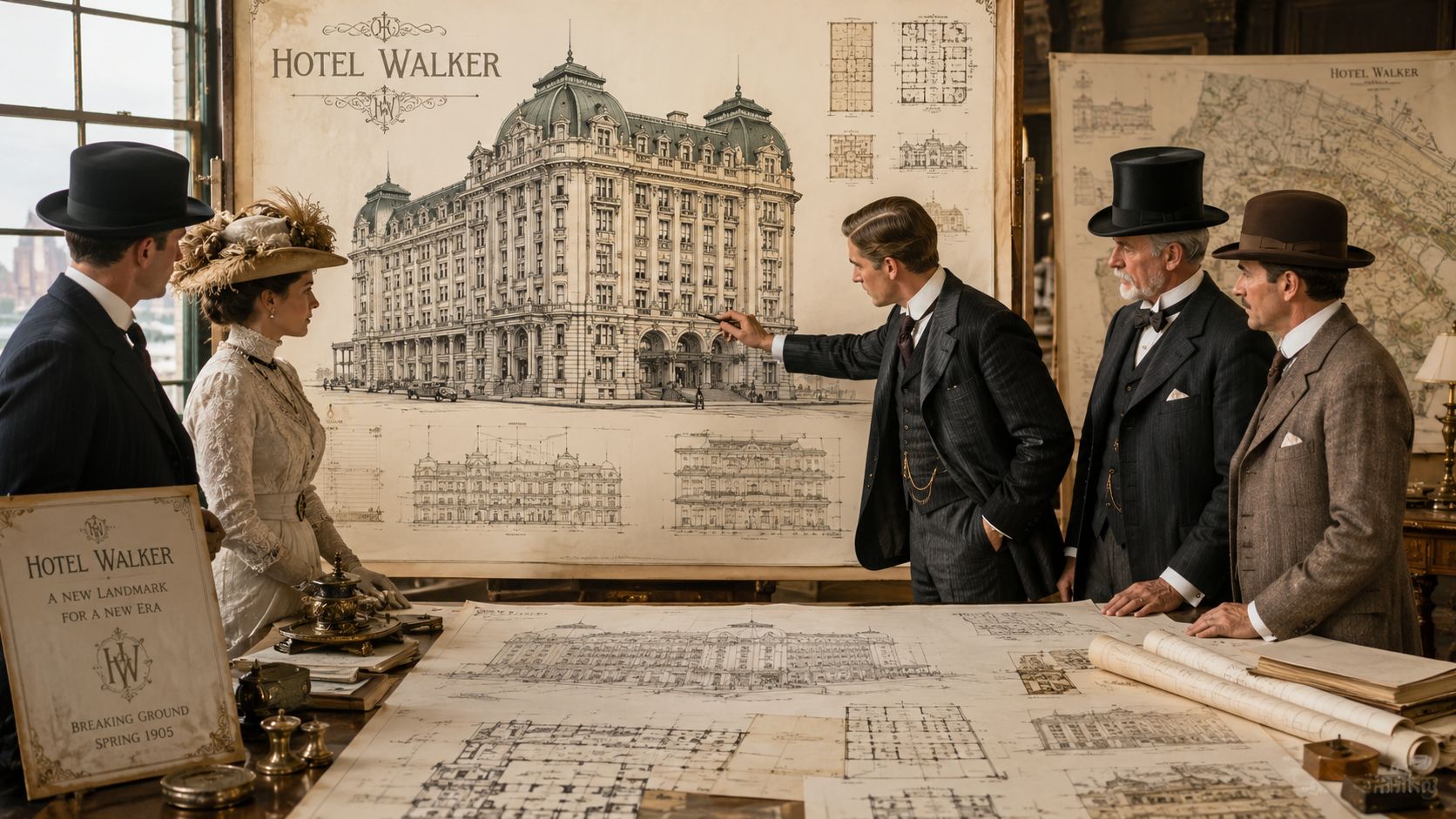
The Mayflower began with an enormous ambition. Built by Allen E. Walker, it was originally conceived as an 11-story hotel with approximately 1,100 guestrooms, a project so large that its 1922 to 1925 construction required over 2,500 laborers, and its budget nearly doubled from $6 million to $12 million, according to Historic Hotels of America's history of the property.
Engineering made the luxury believable
The most important design fact isn't ornamental. It's mechanical. The Mayflower was one of the world's first buildings to feature integrated air conditioning, a decision that changed what guests expected from high-end urban hospitality. That single system tells you the hotel was never meant to be merely handsome. It was meant to outperform its peers.
Private baths and indoor plumbing reinforced that same point. In the context of the 1920s, those weren't just amenities. They were part of a larger promise that the hotel could deliver elite comfort at scale.
From a design reading, that matters for two reasons:
- Infrastructure shaped prestige: Guests might remember a ballroom, but the mechanical systems determined whether the experience felt modern or exhausting.
- Ambition was embedded in the plan: A hotel of this size had to solve circulation, service, and comfort long before it could trade on glamour.
- Luxury wasn't surface-only: The visible finishes worked because the invisible systems supported them.
What to notice in the original concept
When I look at old grand hotels, I try to separate decorative flourish from structural intent. The Mayflower rewards that approach. It was conceived with apartment-style logic in parts of the building, which explains why some early suites had a scale and rhythm that feel more residential than transient. That hybrid planning gave the hotel a layered identity that still affects how rooms and corridors photograph today.
A useful comparison point for clients is how other legacy hospitality properties balance their setting, approach, and interior reveal. A project like Auberge du Soleil in Napa Valley shows a very different visual language, but the same principle applies. The strongest hotel architecture controls anticipation before the guest ever reaches the room.
Practical rule: When you photograph a historic hotel's origins, don't start with décor. Start with the decisions that were expensive, difficult, and risky when the building was new. Those choices usually explain why the property still matters.
The Mayflower's first story is one of confidence expressed through engineering, labor, and scale.
An Architectural Tour of the Grande Dame
The Mayflower reveals itself in layers. From the entrance, the sequence is deliberate. Compression at the threshold gives way to lift in the lobby, and the room starts doing what the best historic hotels do. It tells you where to look before you notice a single decorative motif.
The lobby teaches you how to look
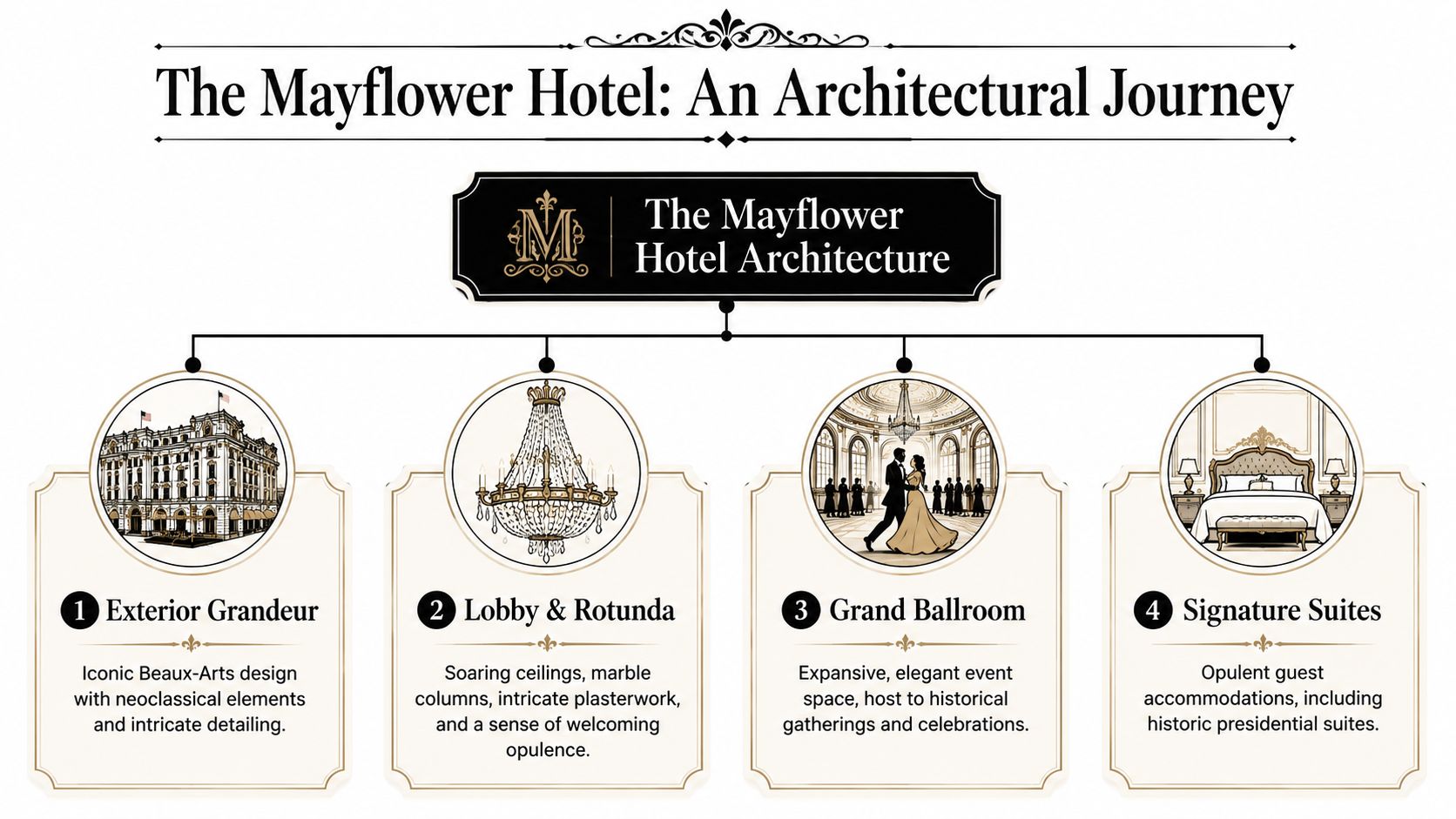
I usually tell clients that a grand hotel lobby is a circulation machine disguised as ceremony. The Mayflower is a strong example. The volume feels formal, but the planning keeps people moving, which is one reason the space still photographs with clarity instead of chaos.
Its materials do much of the storytelling. Polished stone catches broad light. Brass trims pick up smaller highlights. Plaster softens transitions overhead, while glass and reflective flooring add a second layer of geometry. A camera sees those differences quickly, especially in a building that was designed to project order as much as luxury.
The common mistake is easy to spot. Photographers go too wide, flatten the room, and treat every surface as equal. A better set starts with hierarchy. Let the chandeliers establish scale. Let columns and ceiling ornament pull the eye upward. Then use the floor reflections to hold the frame together.
Three compositions usually earn their place here:
- A centered axial shot that respects the room's symmetry and ceremonial balance.
- A slightly offset view that shows how guests pass through the space.
- A close material study where stone, metal, and plaster meet, because age never registers evenly across those surfaces.
The Chinese Room and what proportion does to sound
The Chinese Room is useful because it reads as more than decoration. It shows how a formal dining or reception room can be elegant, slightly hard, and acoustically revealing at the same time. Historic anecdotes tied to the room often focus on who spoke there. I find the more interesting question is why the room would carry speech so clearly in the first place.
The answer is visible. Hard finishes, controlled geometry, and limited absorption tend to sharpen sound. In rooms like this, proportion is not abstract. You can see it in the wall treatment, ceiling height, and the way surfaces return light instead of swallowing it.
That matters for photography.
A room that carries sound sharply often carries visual detail the same way. Decorative programs read cleanly. Edges stay legible. Reflections become part of the composition, not background noise. Good hospitality photography shows that behavior, not just the furniture and finish palette.
Strong architectural images suggest how a room performs, how it directs movement, and how it holds attention.
Ballrooms, promenades, and visual pacing
The larger public rooms show another side of the hotel's evolution. These spaces were built for assembly, spectacle, and controlled procession, which means they live or die by pacing. A ballroom needs a foreground anchor before the eye moves to the chandelier and ceiling. A promenade needs repetition and falloff. If you record only the width, you lose the room's intent.
That is one of the enduring lessons in the evolution of architectural photography. Historic interiors ask for interpretation, not just coverage.
A practical shooting brief looks like this:
| Space | What to emphasize | What usually fails |
|---|---|---|
| Lobby and rotunda | Height, symmetry, material contrast | Overcorrecting perspective until the room looks stiff |
| Ballroom | Chandelier scale, ceiling ornament, floor pattern | Empty width with no visual anchor |
| Corridor or promenade | Repetition, vanishing lines, light falloff | Shooting so wide that the sequence loses intimacy |
What makes the Mayflower interesting is not a single room. It is the way the building stages experience through one room after another. That sequence is the architecture's real narrative, and it is why the hotel still reads like a participant in its own history rather than a backdrop.
The Stage For a Century of American History
Walk into a hotel long enough after midnight and you can usually tell what kind of history it was built to hold. Some properties are all public face. They photograph well from the front, then flatten out once you move past the lobby. The Mayflower never worked that way. Its plan gave Washington something harder to find: ceremonial rooms with enough scale for public ritual, plus quieter pockets where political work could happen without visual noise.
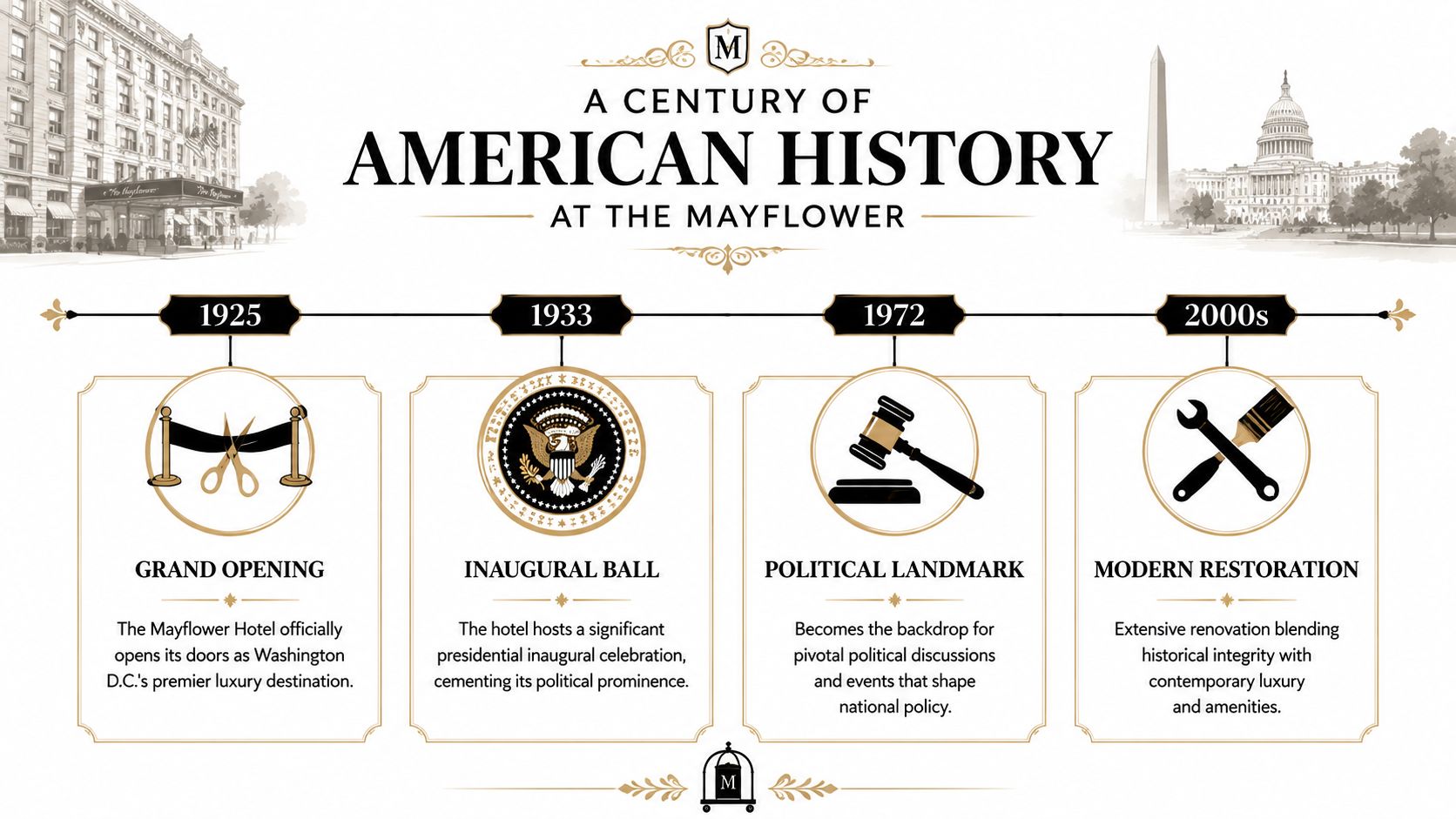
That physical mix explains why the building kept attracting national events soon after opening. In 1925, it entered Washington's civic life with unusual speed by serving as the setting for that year's inaugural celebrations. Over the following decades, the hotel remained tied to inaugural tradition through repeated use for presidential balls, a pattern noted earlier in the article.
Why this building kept getting chosen
Buildings earn political trust through logistics as much as style. At the Mayflower, the architecture offered a formal arrival sequence, large entertaining rooms, and controlled separation between public display and private discussion. That combination matters. A state dinner needs visual authority. A closed-door meeting needs discretion, manageable circulation, and staff routes that do not interrupt the room.
The hotel's history includes both kinds of use. Room 776 is associated with consequential political writing. Room 570 is widely cited as the place where work tied to the GI Bill took shape during World War II. The building also served diplomatic functions, including a period in the 1970s when it housed Chinese representatives in Washington. Those facts are interesting on their own, but the stronger point is architectural. The Mayflower kept being selected because its spaces could separate visibility from access.
From a photographer's standpoint, that tension is the story. Public rooms carry the symbolism. Secondary rooms carry the evidence of power being exercised out of sight.
The hotel also proved it could absorb events with very different visual demands. Large breakfasts, medal presentations, diplomatic dinners, and political gatherings all fit within the same envelope because the building was planned for both spectacle and control. That is a difficult balance to preserve over time. Push too far toward openness and the hotel loses privacy. Subdivide too aggressively for efficiency and the original grandeur stops reading in the frame.
The Mayflower avoided that collapse for decades. Its importance came partly from who entered the doors, but just as much from what the building allowed them to do once inside. The facade announced status. The interiors organized movement, distance, and access. In that sense, the hotel was never a passive backdrop to American history. It acted more like stagecraft in stone, plaster, metal, and carpet, shaping what could be seen and what could remain private.
By its centennial, the building's continuing operation gave that history added weight. Hotels survive by changing. Historic hotels survive by changing without erasing the spatial logic that made them matter in the first place. The Mayflower's long public life is visible in exactly that trade-off.
Decline Revival and a Legacy Preserved
A historic hotel usually gives away its hard years in small, physical ways. A patched run of molding. A lobby proportion that feels slightly re-edited. Stone or plaster that changes character at a doorway. The Mayflower carries that kind of evidence. Its later history matters because the building did not survive on prestige alone. It survived because owners kept deciding how much of the old fabric to protect, and how much had to change to keep the place usable.
By the mid-century years, the hotel's standing had weakened along with the area around it. That decline was not just a matter of image. Once a grand hotel loses public confidence, every design decision becomes more difficult. Deferred maintenance shows first in finishes, then in systems, then in how people move through the building and judge it on arrival.
Decline changed the reading of the building
The important point is practical. A revival at a hotel like this cannot stop at decoration. New management in the 1960s approached the property as an operating problem as much as a styling problem, as described in the National Park Service overview of the Mayflower Hotel. That distinction matters to anyone who photographs or restores historic interiors. Paint and furniture can freshen a room. They cannot repair circulation, security, service flow, or the public's sense that a place still has authority.
For architecture and hospitality clients, the trade-offs are usually clear:
| Goal | What it requires | What it risks |
|---|---|---|
| Preserve atmosphere | Retain finishes, spatial drama, historic detailing | Functional problems if too much remains untouched |
| Modernize operations | Upgrade systems, accessibility, and guest expectations | Losing original character if interventions become too aggressive |
| Rebuild reputation | Improve security, circulation, and arrival experience | Flattening the hotel into something generic |
The Mayflower also went through a prolonged closure later in its life, a fact noted in earlier sources discussed in this article. For a photographer, those interruptions matter because closure and reopening rarely leave the building untouched. They usually produce visible joints between eras: replaced trim beside older profiles, updated lighting within historic ceilings, room proportions adjusted to meet new expectations, and surfaces that show where preservation stopped and replacement began.
Preservation is visible in the seams
That is where the hotel becomes interesting again.
I tell clients to photograph the joins, not just the chandeliers. A restored grand hotel earns belief when the original intent still reads clearly, even after decades of repair, code work, and repositioning. If you want a useful framework for that kind of visual reading, this guide to photographing architecture and interiors is a good companion.
Preservation works best when it keeps the building legible. The Mayflower's design always argued for grandeur in active use, not grandeur frozen behind velvet ropes. Its revival succeeded because later interventions, however imperfect, kept the hotel functioning as a real place rather than a period set.
A preservation success is not a building that hides every change. It is a building where the changes still respect the original logic. At the Mayflower, that logic remains visible in the walls, the public rooms, and the repaired edges where one generation handed the building to the next.
Photographing a Historic Icon A Guide
The Mayflower punishes lazy coverage. If you show up with one wide lens, shoot everything at standing height, and chase empty symmetry, you'll come back with competent files and no story. This building needs a sequence of images that moves from scale to detail to evidence of age.
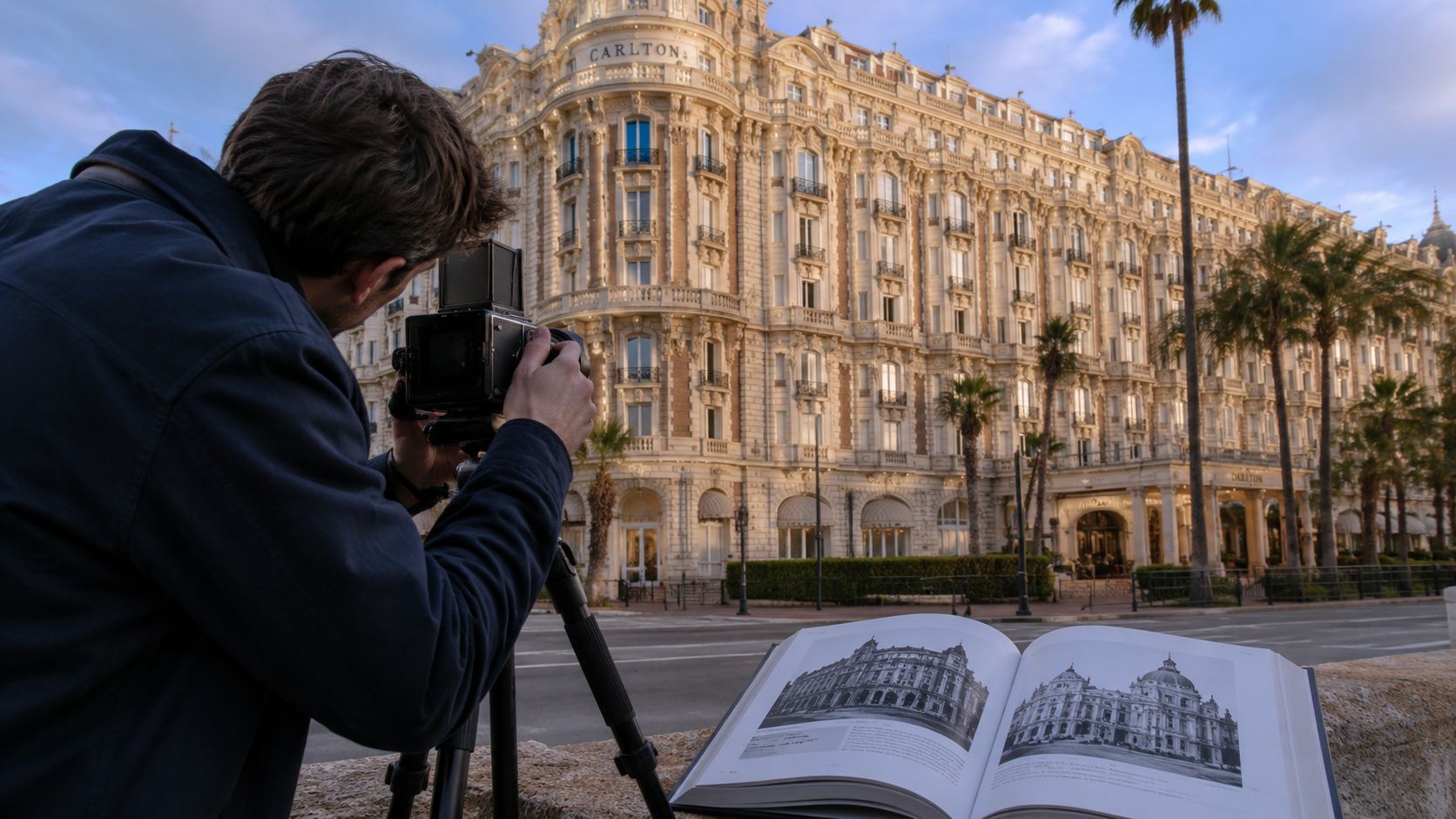
Start with the structure of the room
Before shooting details, establish what the room is trying to do. Is it ceremonial, transitional, intimate, or diplomatic? Once you answer that, lens choice and camera height become easier.
A practical shooting order helps:
- Begin wide, but not ultra-wide. Keep proportions believable. The goal is to describe the room, not stretch it.
- Add a medium framing pass. Doorways, chandeliers, columns, and furniture groupings often tell the truth better than a maximal overview.
- Finish with details that show time. Brass wear, stone variation, plaster edges, hinge hardware, and flooring transitions give the history texture.
What to look for at the Mayflower
This hotel rewards photographers who pay attention to materials and transitions. The story often sits where one renovation period meets another.
Focus on these kinds of subjects:
- Surface patina: Brass that has softened with use photographs differently from polished replacements.
- Floor geometry: Marble and patterned flooring can anchor a frame and guide the eye toward the room's hierarchy.
- Ceiling relief: Historic plasterwork often needs side light or a slightly oblique angle to read properly.
- Thresholds: Doors, trim, and corridor turns reveal whether a guest experience was meant to feel formal or private.
If you want a strong technical baseline for interiors and building coverage, this guide to photographing architecture and interiors is a useful reference point.
Don't miss the non-obvious frames
A lot of photographers stop at the obvious hero shot. The Mayflower asks for more than that. Photograph the long axis of a corridor, but also turn around and record the service logic of a smaller transition space. Shoot the ballroom, then photograph the edge where the grandeur starts to taper into function.
A few final judgment calls matter:
- Wait for useful light. Historic interiors often need gentle directional light, not flat ambient fill.
- Let dark tones stay dark. Over-lifting shadows can erase mood and age.
- Include human scale selectively. A single figure can clarify size, but too many people can turn a study of architecture into an event recap.
The best frame in a historic hotel is often the one that proves the building has been used, altered, and kept alive.
That's the difference between documentation and narrative.
Frequently Asked Questions About The Mayflower
How much of the original room planning still survives
A major architectural change involved the reduction or repurposing of the hotel's original apartment-style suites, some of which had 7 bedrooms. A 2025 centennial report noted that only 30% of the original suite configurations remain, and a 2024 DC Historic Preservation Office audit indicated that 42% of original materials were replaced during the 2015 to 2025 renovation under Marriott, according to the compiled discussion referenced in this Marriott-focused preservation thread.
For anyone studying the Mayflower Hotel history through design, that's one of the most useful data points available. It confirms that the building's current interiors can't be read as a simple untouched survival. They're the result of adaptation.
Did modernization damage the hotel's authenticity
It depends on what you mean by authenticity. If you mean untouched 1925 fabric, then no major urban hotel of this age can fully present that condition. If you mean whether the building still communicates its original ambition, status, and spatial character, the answer is more favorable.
The practical standard isn't purity. It's legibility. Can a visitor still read the design intent? At the Mayflower, enough of the public character remains for that reading to hold, even where materials and room layouts have changed.
How did the hotel function as a diplomatic or intelligence setting
The verified record is stronger on role than on operational detail. The hotel served as a temporary embassy for the Chinese government in 1973, and its history includes use for high-level confidential meetings, which is why people often describe it as a de facto diplomatic hub. Publicly available summaries don't provide verified counts of covert meetings or specifics about intelligence exchanged, so any more detailed claim would go beyond the record.
That limitation is worth respecting. Buildings like this often accumulate myth faster than documentation.
What should architects, designers, and photographers study first on site
Start with evidence of change, not the most polished room. Look for altered suite plans, replaced materials, circulation edits, and places where historic form still governs current use. Those are the points where the building is most intellectually interesting.
A quick site checklist helps:
- Public rooms first: They preserve the hotel's intended social identity.
- Transitional spaces next: Corridors and thresholds show how privacy and procession were managed.
- Material junctions last: Old and new fabric often meet in trim, flooring, and hardware details.
Why does the Mayflower still matter as an architectural subject
Because it shows that preservation is never passive. The hotel survived by changing, but not changing indiscriminately. Its history lives in planning decisions, mechanical ambition, social choreography, and renovation scars.
That makes it more than a famous address. It makes it a building worth reading carefully.
If you need images that treat architecture as narrative instead of background, Jimmy Clemmons Photographer brings an editorial eye to hotels, interiors, and built environments. The studio works with architects, designers, developers, and hospitality teams to create photographs that show not just what a space looks like, but how it holds history, material, and use.