
It’s hard to imagine now, but there was a time when the only way to truly experience a building was to stand right in front of it. Our collective understanding of architecture was pieced together from drawings, paintings, and the stories of travelers. Then, photography arrived and changed everything.
Architectural photography didn’t just create a new way to see buildings; it transformed local landmarks into global icons. This journey isn't just about evolving cameras and film; it’s about the ever-deepening relationship between technology, art, and the spaces we build.
Framing History: The Journey of Architectural Photography
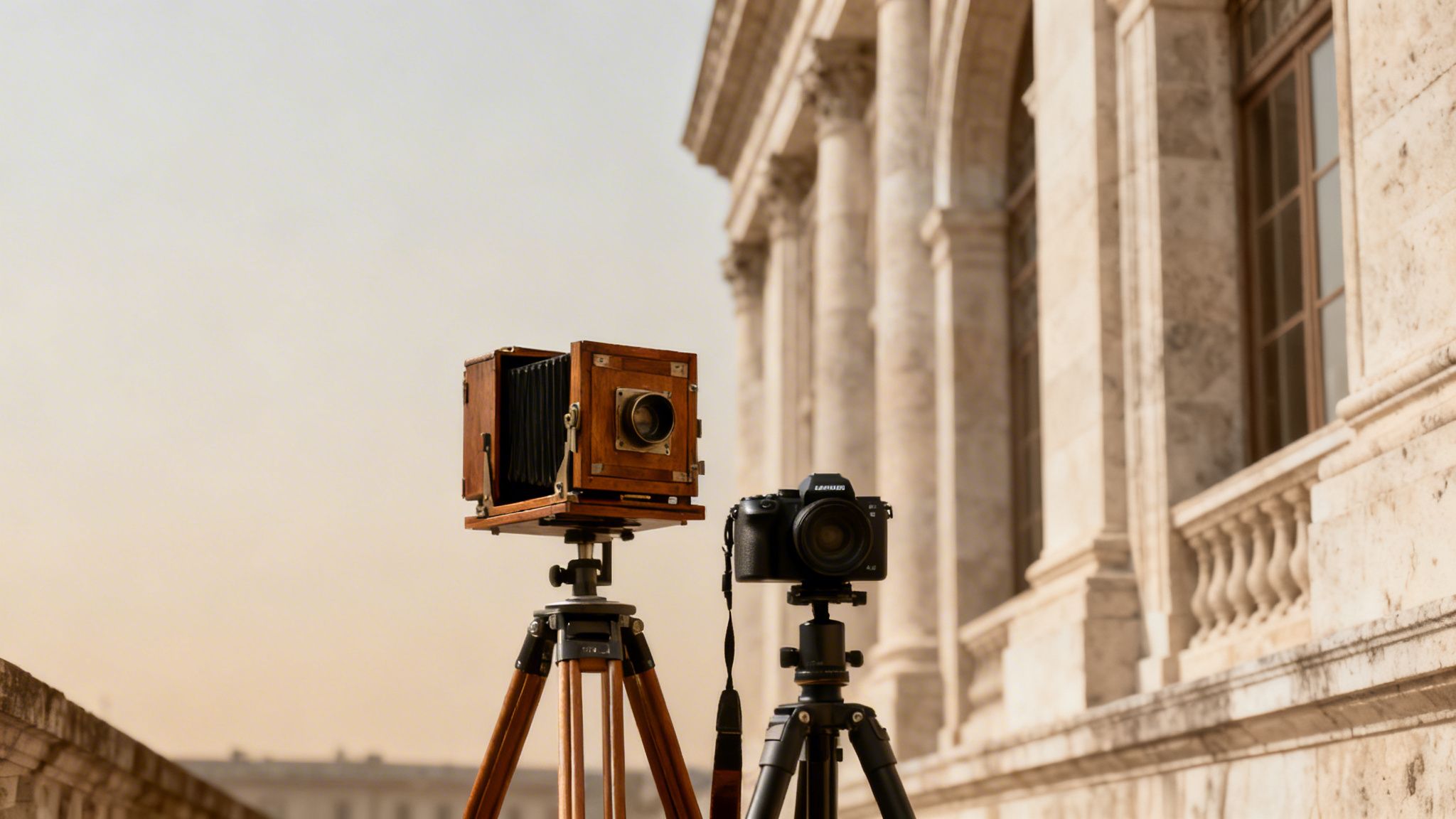
This craft was born from a practical problem. The very first photographic processes, like the daguerreotype, demanded subjects that could stay perfectly still for what felt like an eternity. Buildings, with their unwavering stillness, became the perfect models.
That early technical limitation forged a bond between architecture and photography that has defined the practice ever since. It began as pure record-keeping and evolved into a powerful art form.
From Documentation to Storytelling
In the beginning, the goal was simple documentation. Architects and historians used photographs to create faithful, accurate records of structures. But as the technology got better and faster, so did the artistic ambition behind the lens.
The history of architectural photography is really a story about this shift—from producing static, objective views to creating dynamic, interpretive narratives. Photographers learned to wield light, shadow, and perspective to do more than just show a building. They learned to make you feel it.
This shift unlocked entirely new ways for architects and designers to communicate. A photograph could now convey the soul of a building, its atmosphere, and how it connected with its surroundings. Several key moments pushed the craft forward:
- The Reproducible Image: Moving from one-of-a-kind daguerreotypes to paper negatives meant images could be shared far and wide, sparking a massive public fascination with architecture.
- Artistic Composition: Modernist photographers stopped seeing buildings as mere subjects and began treating them as opportunities for artistic expression, focusing on form, texture, and abstract beauty.
- Human-Centric Views: Adding people to the frame was a game-changer. It breathed life into the images and showed how a building truly functions as a living space.
- Digital Mastery: Today's incredible tools, from drones to sophisticated editing software, give photographers the control to create stunningly perfect and persuasive visual narratives.
Architectural photography is ultimately a meticulous, intentional process that prioritizes getting things right. It’s a craft where professionals deliberate over inches in a composition and chase the sun to be at the right place at the right time.
This rich history directly informs what we do today. Modern firms depend on this same blend of technical precision and artistic vision to communicate their work and secure their next great project.
The Dawn of a New Vision: Capturing the First Structures
Imagine trying to take a portrait, but your subject had to sit perfectly still for hours. That was the reality for the first photographers in the 19th century. Their new technology was miraculous, but painfully slow, making it nearly impossible to capture fidgety people or the ever-shifting natural world.
So, they turned to architecture. Buildings, with their immovable foundations and stoic patience, became the perfect models for these early pioneers. It was a choice born of necessity, but it forged an unbreakable link between photography and architecture, establishing the principles of precision and composition that still define the evolution of architectural photography.
The Problem of Patience
Early processes like the daguerreotype demanded incredibly long exposure times—we're talking minutes, sometimes even hours. The camera's shutter had to stay open, staring at a scene for an eternity just to burn an image onto a light-sensitive plate.
Any movement meant a blurry, useless mess. But buildings, monuments, and cityscapes didn't budge. This made them ideal subjects, turning the first architectural photographs into exercises in deliberate, calculated documentation.
Daguerreotypes vs. Calotypes: A Critical Shift
The mid-19th century saw a battle between two primary photographic methods, and the winner would change how we saw buildings forever.
- The Daguerreotype: This French process created a single, breathtakingly detailed image on a polished silver plate. Each one was a unique object, like a tiny painting made of light. Beautiful, but its inability to be copied severely limited its reach.
- The Calotype: Invented in England, the calotype used a paper negative. This was the breakthrough. From one negative, a photographer could create countless positive prints, making images reproducible for the first time.
The calotype's reproducibility was the key that unlocked architectural photography for a wider audience. It transformed a building from a local landmark into an image that could be studied, admired, and desired by people hundreds or thousands of miles away.
This ability to mass-produce images had an immediate, powerful effect. When both processes were announced in 1839, photographers quickly aimed their lenses at static structures that could endure grueling exposure times, some lasting up to eight hours. The calotype’s negative-positive process was a game-changer, fueling a tourism boom as images of Greece and the Middle East became coveted souvenirs for wealthy Grand Tour travelers. You can explore the detailed history of this period and how it laid the groundwork for modern practice by reading more about early photographic methods and their impact.
From Souvenir to Sales Tool
The reproducible photograph did more than just satisfy a traveler's curiosity; it handed architects a powerful new marketing tool. Suddenly, an architect's portfolio wasn't limited to sketches and models anymore.
By the 1870s, prominent architects like Henry Hobson Richardson began commissioning photographic portfolios of their finished work. When the American Architect journal started featuring photographs in 1876, it cemented the medium's role in professional practice. These images weren't just records; they were advertisements, designed to win new clients and build a firm’s reputation.
This early era established the dual purpose that architectural photography still serves. It's both a form of documentation, preserving a building for history, and a form of narrative, telling a story to a specific audience. The technical hurdles forced a focus on precision, while the commercial opportunities demanded a clear, persuasive vision—qualities that remain at the heart of the craft today.
Modernism And The Artistic Eye: A 20th-Century Shift
As the 20th century rolled in, the world of architecture was changing fast—and so was the way we photographed it. The rigid, almost scientific documentary style of the 19th century just wasn't cutting it anymore. Something more expressive was needed, and this shift wasn't happening in a vacuum. It was a direct response to Modernism.
Modernist architects were all about clean lines, bold geometric forms, and new materials like steel and glass. The old way of taking a straight-on, flat picture of a building’s facade felt completely out of step with structures that were more like functional sculptures. This paved the way for a powerful new partnership between architects and a new breed of photographer.
The camera was no longer just a passive recording device. It became an active participant, an interpreter. Photographers weren't just documenting a building; they were celebrating its core principles of form, light, and function. This was the moment architectural photography went from a technical craft to a true art form.
The Photographer As Interpreter
Pioneering photographers like Margaret Bourke-White started landing major commissions not just to record buildings, but to create powerful, artistic statements. They ditched the flat "elevation" shots and began hunting for dramatic angles, exploring the dance between light and shadow, and finding abstract beauty in a building's structural details.
Their work wasn't just about showing what a building looked like. It was about conveying what it felt like. They aimed to capture the soul of modern design—its energy, its clean simplicity, and its focus on people. Of course, this brought new challenges, like figuring out how to balance the harsh sun on a glass curtain wall while properly lighting the vast new interior spaces.
The groundwork for these artistic leaps was laid decades earlier. The timeline below shows how early photographic innovations set the stage for the 20th century's creative explosion.
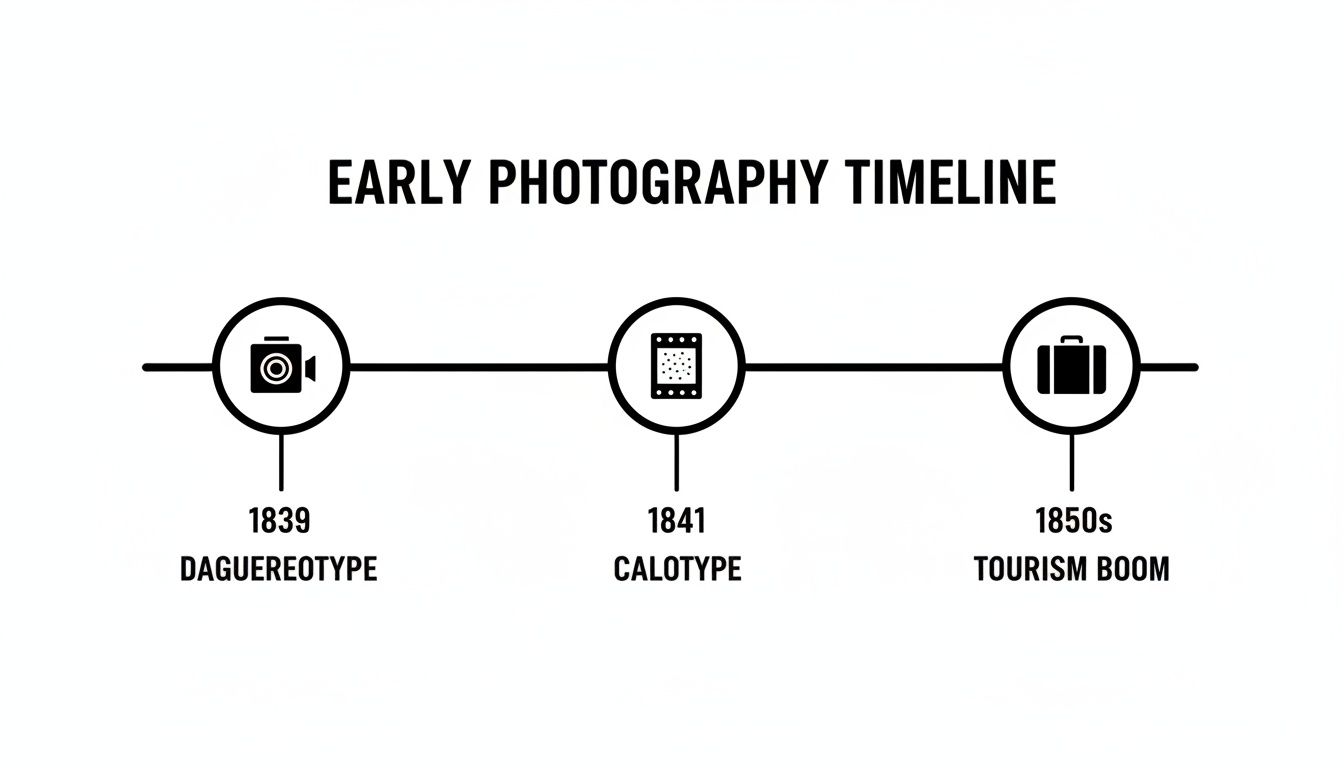
Moving from one-of-a-kind plates to reproducible prints was a huge deal. It opened the door for photographers to build careers and share their vision widely, paving the way for the Modernist masters.
Adding The Human Element
One of the most important changes during this period was putting people back in the picture. For the first time, photographs started showing how spaces were actually used. This breathed life and scale into otherwise static structures and was a game-changer for understanding a building’s real-world purpose.
By the 1920s and 30s, this narrative approach was in full swing. Architects weren't just hiring photographers; they were collaborating with them. Artists like Bourke-White, alongside names like Henry Russell Hitchcock and August Sander, were tasked with crafting images that told a story. They showed people interacting with the architecture, a practice that directly informs how we approach commercial and residential photography today.
Capturing Dynamism In A Static Form
If one project captures this artistic evolution, it’s David Moore’s iconic work documenting the construction of the Sydney Opera House. Instead of presenting the building as a finished, static monument, Moore used creative techniques to fill his images with life and motion.
He played with light, shadow, and even slow shutter speeds—a trick he famously used for a 1/8-second shot at the Epsom Derby—to capture the raw energy of the construction site. His images tell a story of human ambition and architectural genius. It’s a quality that modern clients now expect, and it requires a deep understanding of how to work with the environment. Getting this right involves mastering the craft of choosing the best light for a site shoot.
This era cemented the photographer’s role as a storyteller. It proved that a well-composed image could do more than just document—it could persuade, inspire, and forever shape how we see the world around us.
The Digital Revolution: From Film to Pixels
Anyone who shot on film remembers the ritual. The careful loading of a roll, the finite number of exposures, and the long wait for the darkroom to reveal what you captured. The shift to digital wasn't just an equipment upgrade; it was a fundamental change in how we work, think, and see. It tore down the old world of chemicals and patience and rebuilt it with pixels and instant feedback.
This didn't happen in a flash. It was a slow burn at first, with one innovation sparking the next, each one picking up the pace. Looking back, you can see how the entire craft of architectural photography evolved as we journeyed from film to the digital sensor.
From Chemical Reactions to Digital Sensors
For over a century, photography was chemistry. We were capturing light on a physical medium, and every click of the shutter was a commitment. You had to get it right in-camera because there was no "undo" button in the developing tray.
The invention that changed everything was the charge-coupled device (CCD) in 1969. This small sensor was the beginning of the end for film. Instead of a chemical reaction, the CCD translated light into a grid of electronic data—what we now know as pixels. That single device laid the groundwork for the first digital camera in 1975 and every sophisticated machine we use today.
The change from film to a CCD sensor felt like switching from a typewriter to a modern computer. Both get the words down, but one gives you the power to edit, refine, and perfect your work instantly.
This new technology brought an incredible new efficiency to our work. The 20th century was already moving at a breakneck speed—think of the Empire State Building rising at 4.5 floors per week back in 1931. Photography was trying to keep up. From the first Kodak camera in 1888 to the CCD, the goal was always faster, cleaner images. Today, that progress allows for 1.8 billion photos to be uploaded every single day. You can trace these technological milestones and their impact on photography on ArchDaily.
The Power of the Digital Darkroom
The real game-changer wasn't just what happened in the camera, but what we could do after the photo was taken. Digital files opened up a world of control that was simply impossible with film. Software like Adobe Photoshop became our new darkroom, giving us an almost unbelievable level of precision.
Suddenly, the classic challenges of architectural photography had new solutions. This new digital toolkit meant we could:
- Blend Exposures: We could finally capture the full dynamic range of a space. By taking multiple shots and blending them, we could show the bright view through a window and the subtle details in the room's darkest corners—all in one perfectly balanced image.
- Retouch with Precision: Distracting elements that pull focus—an exit sign, a stray wire, or a scuff on the floor—could be seamlessly removed. Creating this perfected version of a space became the new standard for commercial and portfolio work.
- Control Color Perfectly: Matching the exact shade of a corporate brand color or capturing the true warmth of a wood finish became a matter of simple adjustments. We could now guarantee that the final image was a perfect reflection of the architect's or designer's intent.
This level of polish quickly became an expectation. Architects, builders, and designers needed these flawless images to showcase their work. Presenting a project in its most ideal form was no longer a nice-to-have; it was a necessity.
For me, this digital transition was never about replacing the core disciplines I learned on film. It was about enhancing them. The same principles of composition and lighting still apply, but now they’re combined with powerful tools that let us deliver images that meet the high standards of today’s market.
The Modern Photographer's Toolkit
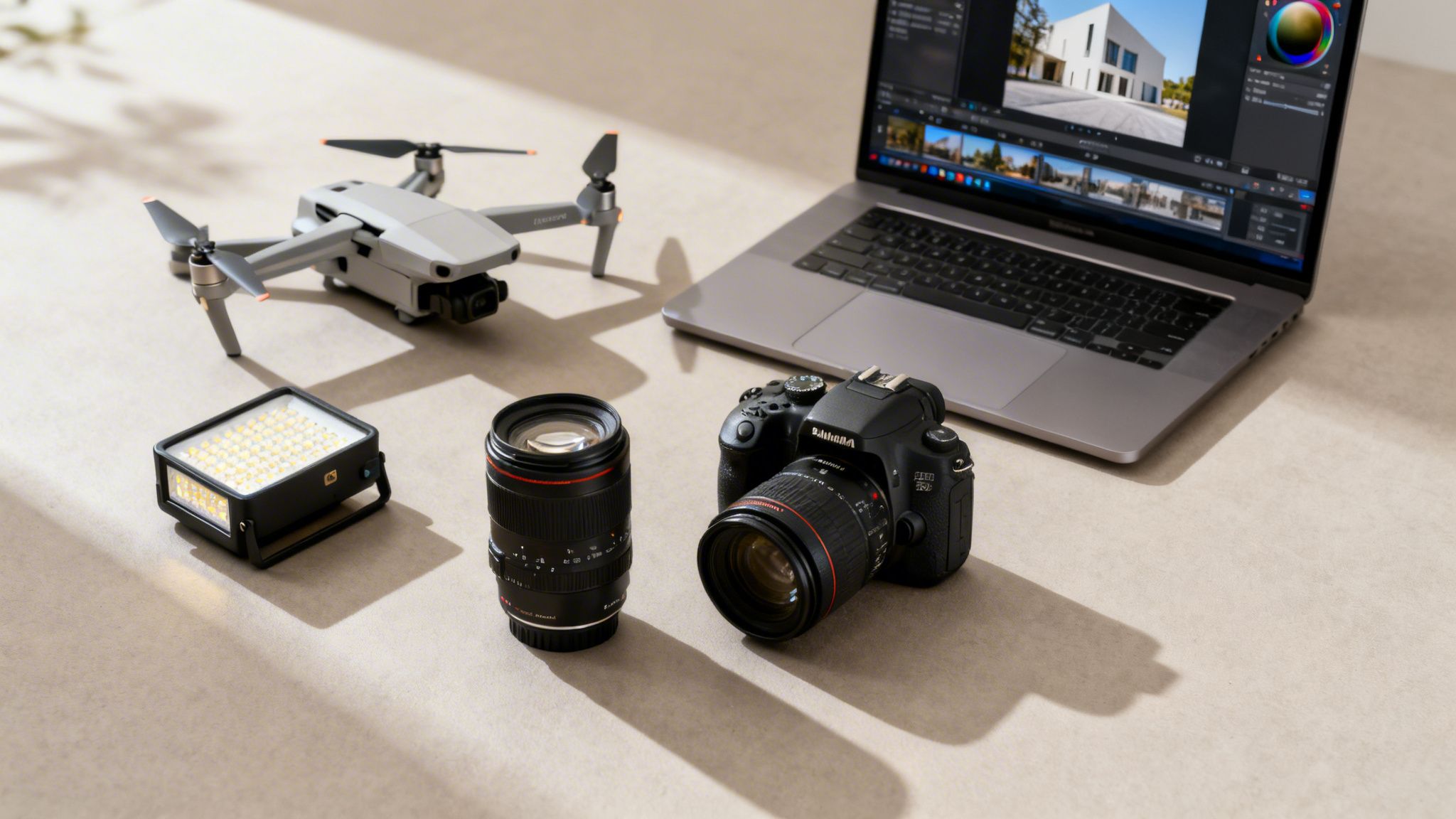
The switch to digital completely redefined what's possible in architectural photography. The modern toolkit is far more than just a camera; it’s an entire ecosystem of specialized hardware and powerful software. Each piece is there to solve a specific problem, giving me absolute control over the final image.
It’s this combination of gear and technique that turns a simple photograph into a piece of art that truly represents the architect’s vision. Let's pull back the curtain on the tools I use every day to understand the skill that goes into creating the flawless images you see in magazines and portfolios.
Correcting Reality with Specialized Lenses
One of the oldest puzzles in our field is dealing with perspective distortion. When you aim a regular camera up at a tall building, the vertical lines appear to converge and lean inwards, making it look like the structure is falling backward. For years, we solved this with bulky view cameras and their adjustable bellows.
Today, we use tilt-shift lenses. They're essentially a modern, miniaturized version of that classic technology. These lenses let me shift the optics up or down while keeping the camera's sensor perfectly parallel to the building. The result? Every vertical line is perfectly straight and true, presenting the architecture exactly as it was designed to be seen.
Painting with Light
My job isn't just to find the light; it's to shape it. While beautiful, natural light is almost never perfect on its own. It's up to me to supplement, sculpt, and sometimes even create light from scratch to highlight a building’s best features. One of my go-to techniques for this is "light painting."
Instead of blasting a scene with one big flash, I take multiple long exposures of the exact same composition. During each shot, I use a portable light to “paint” light onto specific surfaces—a textured wall, a piece of custom furniture, or a key architectural detail. Later, in post-production, I meticulously blend these individual light "layers" together. This process creates a final image with a depth, richness, and clarity you could never get in a single frame.
A professional photoshoot is an intentional, meticulous process. Delivering just 12-15 exceptional images in a full day is standard, as we focus on quality over quantity, deliberating over every compositional detail and chasing the perfect light.
This methodical approach is absolutely essential. Knowing just how much planning goes into the lighting and composition can make all the difference, which is why our guide on how to prepare your project site for a professional photoshoot is so helpful for clients.
Analog vs Digital Architectural Photography
The move from film to digital wasn't just an upgrade; it was a fundamental shift in how we approach our work. The table below breaks down the key differences between the classic analog process and the modern digital workflow.
| Aspect | Analog (Film) Photography | Digital Photography |
|---|---|---|
| Immediate Feedback | None. Results are only visible after developing the film, often days later. | Instant. Live view and image review allow for real-time adjustments on site. |
| Cost Per Shot | High. Each frame costs money for film and processing. | Virtually zero. You can shoot thousands of images on a single memory card. |
| Workflow | Linear and deliberate. The shot must be near-perfect in-camera. | Iterative and flexible. Bracketing and compositing are standard practices. |
| Post-Production | Done in a physical darkroom with chemicals and enlargers. Limited scope for correction. | Done in a "digital darkroom" with software like Photoshop and Lightroom. Nearly limitless control. |
| Specialty Tools | Large format cameras with bellows for perspective control. | Tilt-shift lenses, drones, and advanced lighting systems. |
| Artistic Feel | Characterized by film grain, unique color renditions, and a sense of permanence. | Known for its sharpness, clarity, and the ability to create hyper-realistic images. |
While both mediums can produce stunning architectural photographs, the digital workflow provides a level of precision, flexibility, and creative control that has become the industry standard.
Mastering the Digital Darkroom
My work is far from finished when I pack up my gear. Post-production is where the raw files from the camera are carefully developed into a polished final image. This is much more than just applying a filter; it's an art form in itself that relies on highly advanced techniques.
Here are a few of the methods I use to bring an image to life:
- High Dynamic Range (HDR) Blending: Our eyes can see details in bright skies and dark shadows at the same time, but cameras struggle with this. HDR involves shooting multiple frames at different exposures and blending them to create one perfectly balanced image that mirrors how we naturally see the world.
- Luminosity Masking: This is a powerful technique for making extremely precise adjustments. Instead of changing the color of an entire wall, for example, I can create a "mask" that targets only the brightest highlights or deepest shadows on that wall, giving me surgical control over the final look.
- Drone and Aerial Perspectives: Not long ago, getting a high-angle shot required an expensive helicopter and pilot. Drones have put those dramatic, context-rich perspectives right at my fingertips, allowing me to showcase a property’s scale and its relationship to the surrounding landscape.
These tools, from specialized lenses to sophisticated software, are the instruments I use to tell a visual story. They help me overcome technical challenges and deliver images that aren't just accurate, but are compelling narratives that capture the true soul of a space.
The Future of Seeing: AI, Drones, and Virtual Spaces
If the digital revolution felt like a massive shift, what’s coming next is a whole new dimension. The future of architectural photography isn't just about better cameras; it's unfolding where intelligent automation, aerial robotics, and immersive digital worlds collide. These tools aren't just improving what we do—they're changing how we capture, experience, and even define a "space."
We're moving past the static image and toward dynamic, intelligent visual assets. The photographer's role is evolving right along with it, expanding from image-maker to a kind of strategic visual technologist.
AI in the Digital Darkroom
Artificial Intelligence is already making its way into the post-production workflow, but not in the way you might think. It’s less about replacing artistic vision and more about becoming an incredibly smart assistant that handles the tedious, time-consuming tasks. This frees me up to focus purely on creative decisions.
AI-powered software can now do things that once took hours of painstaking manual work. Imagine intelligently removing distracting power lines or construction debris with a single click. It can even analyze a photographer’s unique editing style and apply it consistently across a hundred images, ensuring a cohesive look for the entire project.
The Drone's Evolving Perspective
Drones have given us incredible aerial views for years, but their real potential is just now being unlocked. The latest models are a far cry from manually operated flying cameras. They are becoming autonomous cinematographers and powerful data collectors.
We can now program sophisticated drones with automated flight paths to capture perfectly smooth, cinematic video sequences that reveal the full scope of a property. But what's truly game-changing is their role in photogrammetry—a process where a drone captures hundreds of overlapping photos of a building from every conceivable angle. This data is then stitched together to create a stunningly detailed and dimensionally accurate 3D model.
This technology is what turns an architectural photograph into a digital twin. A developer can use this model for a virtual sales tour, while a construction firm can use it to track progress against blueprints. Suddenly, the image has value far beyond simple marketing.
This evolution is vital for firms wanting to showcase massive projects, from sprawling corporate campuses to complex urban developments. Capturing those views is a specialized skill, and you can see more of our approach in our guide to photographing office building exteriors.
Entering the Virtual Space
The final frontier is creating fully immersive digital environments where the line between photography and virtual reality completely dissolves. We're now creating assets designed from the ground up for digital exploration.
This includes:
- 360-Degree Virtual Tours: These allow a potential client to "walk" through a finished space from anywhere in the world, giving them a real feel for the flow and scale.
- Augmented Reality (AR) Applications: Picture pointing your phone at an empty lot and seeing a fully rendered 3D model of the proposed building rise up, perfectly integrated with the real-world view.
- Digital Twins for Facilities Management: A detailed virtual model can be linked to a building's live operational data, helping property managers monitor systems, schedule maintenance, and run the facility more efficiently.
These technologies are transforming the architectural photograph from a flat, two-dimensional picture into a gateway to a multi-layered digital experience.
Frequently Asked Questions
After walking through the history of this craft, a few key questions always come up from architects, designers, and marketers I work with. Here are my thoughts on some of the most common ones.
How Is Architectural Photography Different from Real Estate Photography?
I get this one a lot. The simplest way I can put it is that the two have entirely different goals. Real estate photography is a sales tool, plain and simple. It’s about speed and volume—capturing a property’s layout and features quickly to get it on the market.
Architectural photography, on the other hand, is about translating design intent. My job isn't just to show a space, but to interpret it. I’m looking for the story the architect or designer wanted to tell, focusing on light, form, and composition to create a curated set of images that truly celebrate the design. It's a much more deliberate and artistic process.
Why Do Professional Architectural Photos Take So Long to Create?
It’s a meticulous craft. A full day on-site might only yield 12-15 final images, which can surprise some clients. That time is essential for getting the shot just right.
The process for a single hero shot involves a lot more than just clicking the shutter:
- Scouting: I walk the space, often for hours, finding the perfect compositions that speak to the design.
- Staging: This is where we perfect the scene, moving furniture an inch at a time or clearing away anything that distracts from the architecture itself.
- Lighting: We might wait for hours for the natural light to hit a certain way, or I'll spend just as long setting up my own lights to sculpt a room and draw attention to specific textures and forms.
- Capture: I'm not just taking one picture. I'm shooting multiple exposures and layers that I'll blend together later.
Each final image you see is almost always a composite. It’s built from several different frames, pieced together in post-production to achieve a level of clarity, balance, and perfection that a single snapshot simply can't match. It’s what separates a quick picture from a piece of commercial art.
Can't I Just Use My Smartphone for Architectural Shots?
Modern smartphones are incredible, but for a professional portfolio or publication, they just don't have the right tools for the job. The difference is immediately obvious to a discerning eye.
For starters, phone cameras create lens distortion that makes vertical lines appear to converge or lean backward. They also have a limited dynamic range, which means you lose all the detail in the bright light of a window or the dark shadows of a corner. Most importantly, I lose the precise manual control needed for advanced techniques like light painting or creating the composites I mentioned earlier.
Hiring a professional is an investment in presenting your work with the same level of precision and quality that you put into designing it in the first place.
At Jimmy Clemmons Photographer, I blend a deep respect for the history of this craft with the most advanced modern techniques to create images that tell your story with clarity and intent. Learn more about my approach and see how I can showcase your next project.