
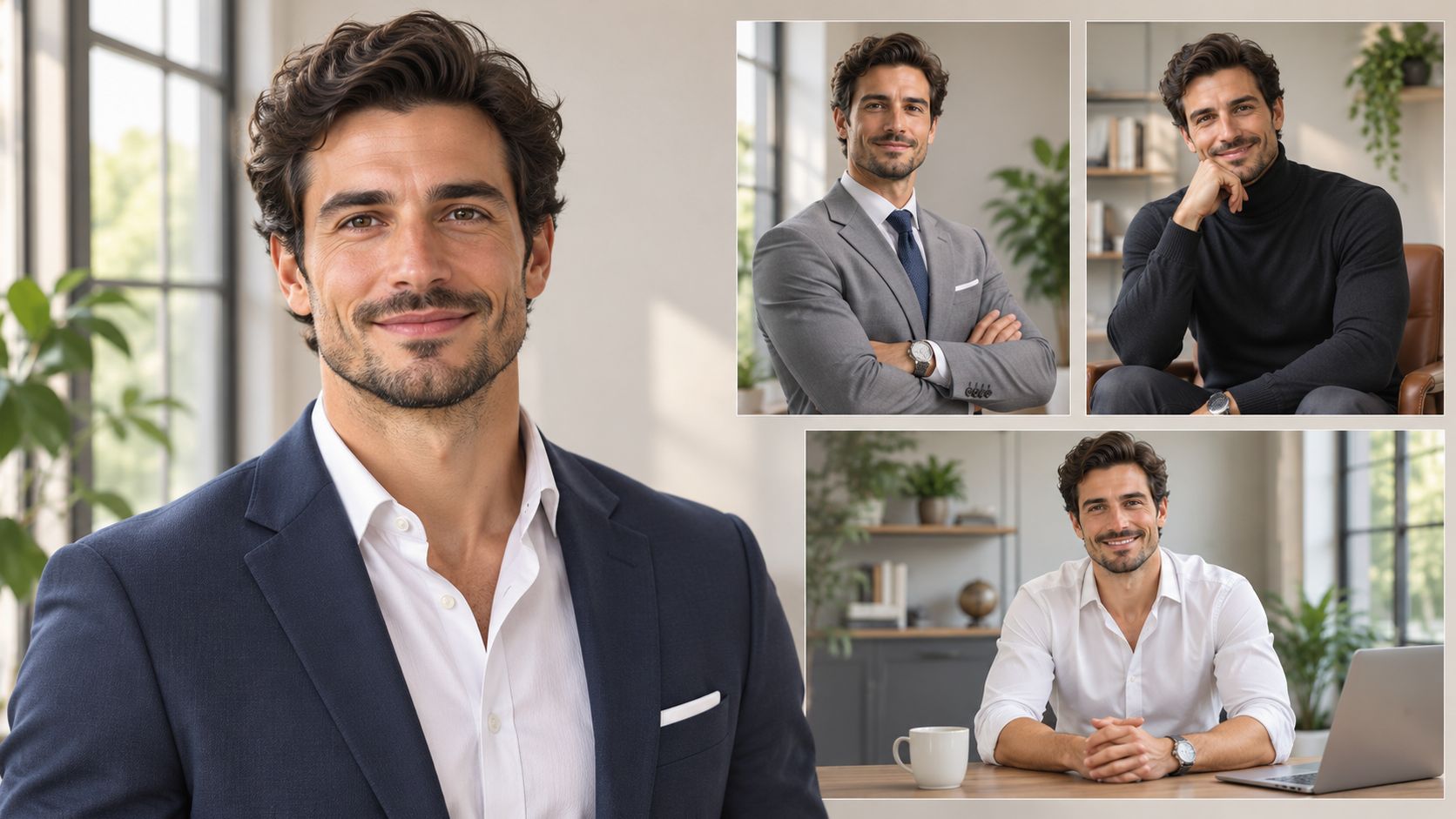
A man in a decent suit sits on the stool, squares his shoulders to the lens, lifts his chin, and holds it. The frame that comes back looks like a passport photo with better lighting.
Give him five minutes of direction and the same man looks like the person his title claims he is. Turn the body 40 degrees, drop the near shoulder, push the chin forward and tip it down slightly, then ask him to look into the lens as though a colleague just called his name across the lobby. Nothing about his face changed. The photograph did.
A corporate headshot is crafted, not caught, and the stakes are commercial. Profiles with a photo can receive as many as 36 times more messages and 9 times more connection requests than profiles without one, according to LinkedIn photo statistics compiled by Picsuit. That is a lot of business resting on a square the size of a postage stamp.
The eight looks below cover pose, wardrobe, environment, and lighting. Each one is written as a directing decision: what to tell the subject, what to correct on set, and where the finished frame earns its keep. Hand these notes to a photographer, or run the session yourself. For the written half of the same profile, this LinkedIn summary checklist that works covers the copy that sits under the picture.
1. Three-Quarter Turn with Shoulders Angled
This is the workhorse, and it earns the spot. The body turns 30 to 45 degrees away from the camera while the head comes back toward the lens. Fully sideways, a man looks like he's leaving the room. Square to the lens, he looks like he's being booked. The three-quarter turn splits the difference and gives the face dimension that a flat-on portrait flattens out.

Directing the turn on set
Reset the feet first, then the ribs, then the head. If the feet stay planted square while the shoulders rotate, the torso twists and the jacket pulls across the chest in a way no retoucher can fully rescue. Bring the head back toward the lens by 10 to 15 degrees, no further, or the neck starts to look strained and the strain reads as tension rather than interest.
Lean in slightly: A small forward lean from the waist engages the expression and stops the shoulders from sitting back on the spine.
Watch the shoulder line: The near shoulder shouldn't sit higher than the far one unless you want dominance built into the frame deliberately.
Shoot two eye heights: One run at lens level, one with the eyes just below the lens, gives the client print and web options from a single session.
Leadership pages, proposal title pages, conference programs, and recruitment decks all live in this pose. A regional construction executive against a neutral gray backdrop belongs here, and so does a civil engineering partner whose portrait sits on proposal covers and speaker bios for the next five years.
The pose survives because it stays legible at thumbnail size. Capturely's guide to LinkedIn photo tips notes that profiles with a photo see approximately 14 times more profile views, which is the argument for a crop that still reads at 40 pixels wide and for consistent treatment across every placement. Research cited by Snappr's analysis of LinkedIn profile photos puts the first trust and competence judgment at 100 milliseconds, so the silhouette has to work before anyone reads a name. For the full range of body positions, see this collection of corporate headshot poses.
2. Seated Pose with Forearms Resting on Knees or a Desk
A standing man presents. A seated man confers, and that distinction is worth a second setup in any session. Sit him toward the front edge of the chair, forearms on the thighs or the desk, hands loosely clasped, torso angled slightly toward the lens.

The chair decides half the frame
Skip the arms: A chair with arms crowds the silhouette and pushes elbows out of the crop. A backless stool or a low-arm chair keeps the line clean.
Front edge of the seat: Sitting deep into the chair rounds the spine. Perching on the front third stacks the torso over the hips and fixes posture without a word of instruction.
Props only when they carry meaning: A rolled set of plans or a tablet reads as work. A coffee cup reads as stock photography.
Jacket open when seated: Buttoned jackets bunch at the waist and pull at the lapel. Unbutton, then dress the jacket back behind the shoulder so it hangs clean.
Seated portraits suit leadership team pages and long-form features, where the image sits beside text instead of in a grid of faces. Picture a managing director at a plain conference table, notebook and pen in frame, shot for a trade magazine profile. Or a property development principal leaning over a drafting table, hands flat on the surface, the drawing board just out of focus behind him.
The format has commercial pull. In a 2024 survey of 1,087 U.S. recruiters, 74.4% said they were more inclined to interview a candidate whose profile included a headshot, per Capturely's report on the Ringover survey. A recruiter scanning a small circle on a screen reads an open, seated frame as a person who answers questions rather than dodges them.
3. Arms-Crossed Confident Stance
Folded arms are the most misused pose in the corporate repertoire. Directed well, they signal conviction and experience. Left alone, they read as a locked door. The difference lives in the hands and the jaw.
Two fixes that save the pose
Hands on the upper arms, not gripping the elbows: A grip turns knuckles white and pulls the fabric into a knot. Rest the hands lightly and let the fingers relax.
Drop the shoulders, then set the jaw: Roll the shoulders back and down before the arms cross. A light set of the back teeth gives definition without a scowl.
Unbunch the sleeves: Pull the jacket cuff down over the shirt cuff at the elbow so the arm doesn't look inflated.
Warm the expression: A slight smile or a soft, steady gaze keeps the frame open. Crossed arms plus a hard stare is a bouncer, not a partner.
Practical rule: If the arms look defensive in the back of the camera, have the subject drop them and reset the shoulders. The pose is only doing its job when the face is doing the opposite.
The stakes are documented. In a survey of more than 200 human-resources professionals, managers, and business owners, 71% said they had rejected a candidate because of a poor LinkedIn profile picture despite the candidate being otherwise qualified, while 80% called the image an important ranking factor, as reported by the Professional Convention Management Association. Those are self-reported answers, not a controlled hiring study, but they describe exactly the perception risk a closed, tense frame creates before anyone reads a résumé.
This look belongs to founders of design-build firms shot against a large window for a conference speaker profile, and to senior partners of regional engineering consultancies photographed in studio for an annual report.
4. Environmental Headshot with Architectural Context
Lobby, staircase, studio floor, site. When the work is the selling point, the background earns its place in the frame instead of sitting behind it as wallpaper. The subject stays the anchor; the space supplies the proof.
Scouting the location before the subject arrives
Hunt one dominant line: A stair rail, a column edge, a window mullion. One strong line behind a face organizes the frame. Four competing lines turn it into clutter.
Use a longer lens: An 85mm to 135mm focal length compresses the background and separates the subject from the space without the distortion a wide lens brings to a face.
Check the verticals: Architects and interior designers read crooked lines instantly. Level the camera and correct converging verticals in post, or shoot them deliberately and obviously.
Balance ambient with fill: A window behind a subject will underexpose the face. Bring a fill source in, or turn the subject so the daylight crosses the face rather than backlighting it.
Safety gear worn correctly: If the site requires a hard hat, the chin strap is fastened and the hat sits level. A hard hat worn wrong is a credibility problem, not a detail.
Site and studio portraits fit construction, architecture, real estate, and development firms, where individual experts act as visible evidence of project quality. A project architect photographed at a staircase detail in a completed office interior says more about the practice than any backdrop. A general contractor on site with a partially framed structure behind him carries the same weight into a company profile or a recruiting page.
5. Tailored Suit and Tie with Strategic Color Palette
Navy or charcoal, a crisp shirt, a restrained tie. This remains the default for finance, law, and the executive suite, and it works when the fit is right at the shoulder and the color is chosen for contrast rather than personal taste.
Why dark beats light on camera
A 2023 study that tested 32 subjects across 30 color variations found blue-purple tones drew the highest trust ratings, and darker clothing scored significantly higher on perceived trust than lighter garments, as reported in Capturely's guide to what to wear for professional headshots. Practically, that points to navy, charcoal, and deep gray, with a shirt light enough to separate the face from the jacket.
Fit at the shoulder: The jacket shoulder is the most visible area in a headshot. If it droops past the natural shoulder line, nothing else in the frame recovers.
Button for standing, unbutton for seated: Follow the tailoring rule and let the jacket drape open when the subject sits.
Avoid high-contrast stripes and fine checks: Tight patterns shimmer and moiré on camera at small crop sizes.
Bring options: Two or three shirt and tie combinations let the subject choose under studio light, where the surprise choices often win.
This is the standard look for legal, banking, and corporate leadership placements, and it travels well from a mid-gray studio backdrop into a leadership directory or a practice-area page. More on how these frames get deployed across a business is covered in this guide to professional headshots for work.
6. Open-Collar Smart Casual Look
A blazer over an open-collar shirt, or a fine-knit sweater under a sport coat, no tie. This reads as modern and collaborative, and it's the right register for design studios, creative practices, and firms that want to look like the people clients meet.
Matching the signal to the role
Attractiveness doesn't stay outside this decision. A 2025 study of professional photos treated attractiveness and age as visible characteristics that can affect competence judgments, and evaluator and candidate gender changed how those judgments landed, as reported in Phys.org's coverage of the customer-evaluation research. The takeaway isn't to chase polish or avoid it. It's to decide which signals belong to the role and then shoot for those.
Collar flat and pressed: An open collar only looks relaxed when it's crisp. A curled collar looks careless at thumbnail size.
Texture over pattern: Oxford cloth, fine merino, a subtle weave. Texture gives the frame interest without competing with the face.
Minimal accessories: A watch or a simple pen. Nothing else needs to be in a head-and-shoulders crop.
Agree the look before the shoot: Confirm with the person handling brand tone so the frame doesn't fight the rest of the company's imagery.
The blazer version and the suit version are not rivals. Shoot both in one session and you stop needing a new portrait every time the company tone shifts.
An interior design principal in an unstructured navy blazer and open-collar shirt works for a studio site. A college facilities director in a fine-knit sweater under a sport coat works for campus communications. Same pose, different register.
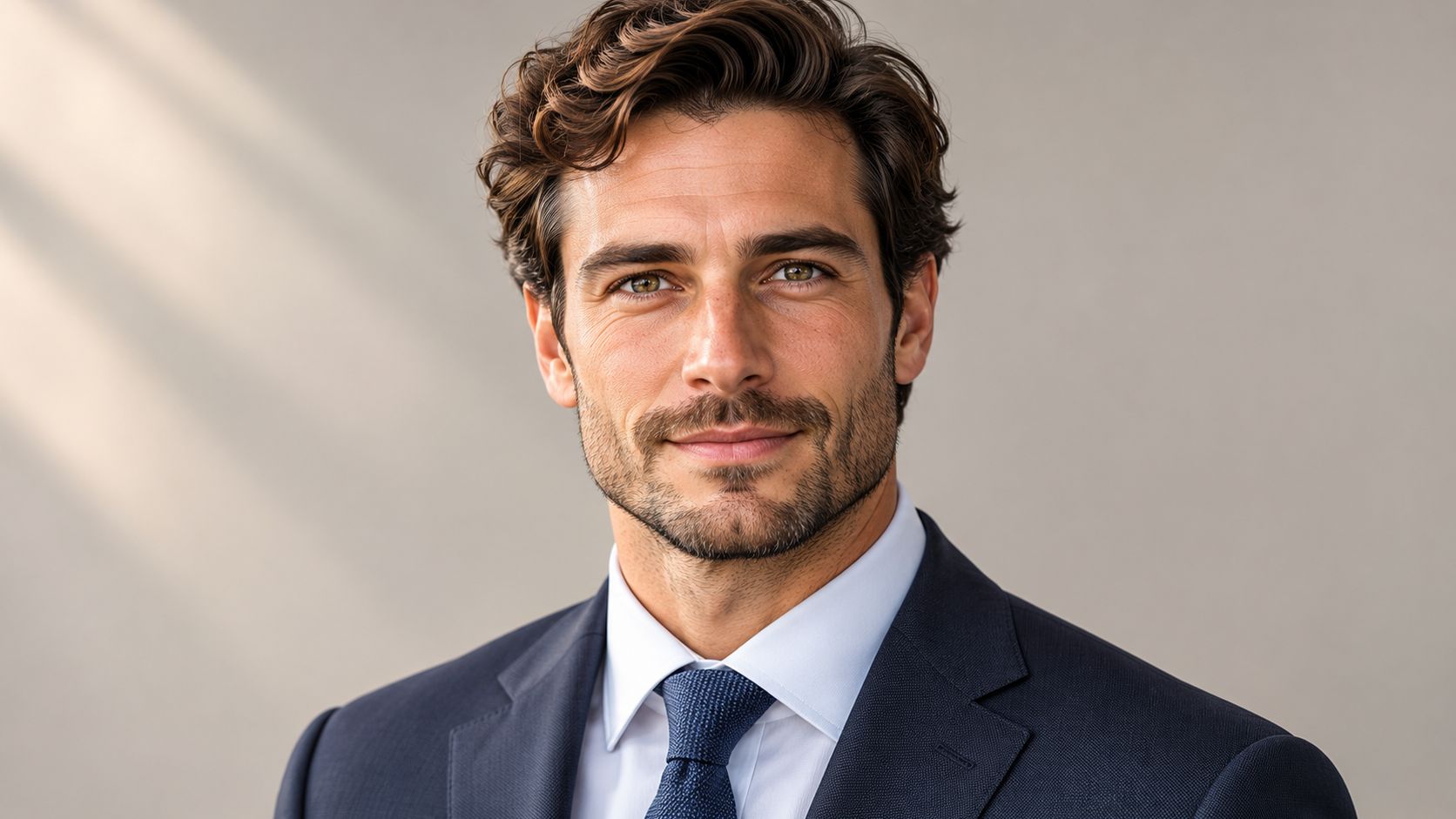
7. Tight Head-and-Shoulders Crop with Split or Rembrandt Lighting
Tight crop, directional light. Split lighting lights one side of the face and leaves the other in shadow. Rembrandt lighting puts a small triangle of light on the shadow cheek. Both add depth that flat, even light removes, and both belong to editorial use rather than a directory grid.
A repeatable lighting baseline
One cited industry guide recommends approximately 5600 K illumination with a color-rendering index of at least CRI 95 for neutral corporate portraits, which preserves natural skin tones across executives photographed on different days, per this corporate portrait lighting guide. That's a production-control target, not proof of business impact, and it's the right way to read it.
Key light high and toward the far side: Position it slightly above eye level and angle it across the face. The nose shadow falls away from the camera.
Control the shadow side: A reflector or fill card sets how much detail survives in the dark half of the face. Black flag for drama, white bounce for editorial warmth.
Keep the chin level: A lifted chin throws a hard shadow under the nose and hollows the eye sockets.
Deliver a soft version: Make a lower-contrast frame for digital use alongside the dramatic one. The same face, two jobs.
A keynote speaker portrait with split lighting suits a conference brochure. A design firm principal in Rembrandt suits a founding-story feature. For the underlying setups, see this guide to business portrait lighting.
8. Relaxed Lean with Hands in Pockets
Lean against a wall, a column, or a railing, one or both hands in the trouser pockets. The pose says ease without saying casual, which is why it fits mid-level managers, project leads, and specialists who work shoulder to shoulder with clients.
Directing the lean
Back straight, weight on the leaning shoulder: Weight dumped into a hip turns the posture slack. Keep the spine long and let the structure carry the lean.
Pull the jacket back first: Hands in pockets pull fabric tight across the front. Draw the jacket back and let the pockets do their work without stretching the button stance.
Choose a clean surface: A plain wall, a steel column, a smooth railing. A surface with signage or clutter behind it undermines the ease the pose is buying.
Shoot hands-out frames too: Four frames with pockets, four without. Recruiting pages and press use often want different energy from the same session.
This is also where the authenticity question lands. Most of the loudest adoption claims for synthetic portraits come from companies selling synthetic portraits, and Banana Thumbnail's comparison of AI LinkedIn pictures puts the question where it belongs: how much alteration still matches the subject's actual appearance. A relaxed, verifiable likeness photographed on a real site is a hard asset to fake, and it's the version that survives a reference check, a conference introduction, or a client walking into the room.
A project manager leaning against a steel column on a job site suits a recruiting campaign. A regional sales director against a plain showroom wall suits a company newsletter.
8 Corporate Headshot Ideas for Men at a Glance
| Item | Best For | Formality Level | Typical Use |
|---|---|---|---|
| Three-Quarter Turn with Shoulders Angled | Most professionals and body types | Professional | Corporate websites, print materials, and social profiles |
| Seated Pose with Forearms Resting on Knees or a Desk | Leaders seeking a thoughtful, approachable look | Professional | Leadership pages, team portraits, and feature articles |
| Arms-Crossed Confident Stance | Senior leaders, founders, and experts | Formal | Executive portraits and speaker profiles |
| Environmental Headshot with Architectural Context | Architecture, construction, and real estate professionals | Professional | Company profiles and industry-focused portraits |
| Tailored Suit and Tie with Strategic Color Palette | Executives, legal professionals, and finance leaders | Formal | Leadership directories and professional practice pages |
| Open-Collar Smart Casual Look | Creative, collaborative, and tech-focused teams | Smart casual | Team pages, studio websites, and culture-focused imagery |
| Tight Head-and-Shoulders Crop with Split or Rembrandt Lighting | Speakers and professionals seeking a dramatic editorial portrait | Formal | Print features, speaker profiles, and conference materials |
| Relaxed Lean with Hands in Pockets | Client-facing managers, project leads, and experts | Business casual | Recruiting campaigns, brand imagery, and company newsletters |
Choosing the Right Look and Getting It Shot Right
Four decisions drive every men's corporate headshot, and they run in a fixed order. Role sets the wardrobe register. End use sets the crop and the pose. Environment sets the background. Lighting sets how much the face reads as character rather than record.
An executive on a leadership directory needs the three-quarter turn, a dark suit, and clean, even light. A construction principal in a recruiting piece needs the environmental frame with a hard hat that's properly fastened. A keynote speaker needs the Rembrandt crop for the brochure and a softer version for the conference app. Shoot one look only and the client returns in eighteen months for the rest. For context on scale, the global professional headshot photography services market was estimated at $2.8 billion in 2025, with corporate headshots accounting for 38.4% of it, per Dataintelo's market report. Most of that demand is exactly this problem of matching one face to several placements.
Before the session, work through a short list with the subject.
- Confirm the end uses: Ask where the image will appear in the next two years. Directory, proposal, press, conference, recruiting. Each one has a crop requirement.
- Pack more than you need: Two jackets, three shirts, two tie options, one open-collar combination. Options cost nothing on the day and everything later.
- Groom a few days ahead: A haircut in the same week photographs harsher than the everyday look, and a morning-of shave often shows irritation under bright light.
- Bring every pair of glasses: Anti-reflective coatings behave differently under studio light, and the pair that works is decided on set, not at home.
- Brief the expression, not just the outfit: A warm half-smile for client-facing work, a calmer closed-mouth look for legal and finance. Shoot both when time allows.
In Atlanta, executives and teams can work with Jimmy Clemmons Photographer, whose editorial background at publications including Condé Nast and Atlanta magazine shapes a portrait practice built on crafted lighting, precise on-set direction, and professional editing. The studio's approach treats a headshot as a directed frame rather than a captured moment, which is the whole argument of this list.
A leadership team photographed under one lighting standard produces a usable image library for directories, proposals, press, and recruiting, and a single executive session produces the crops that keep a profile current for years. Jimmy Clemmons Photographer brings editorial discipline to that work, with controlled lighting, direct guidance on set, and editing that keeps a face recognizable. Visit Jimmy Clemmons Photographer to plan a corporate headshot session for yourself or your team.