
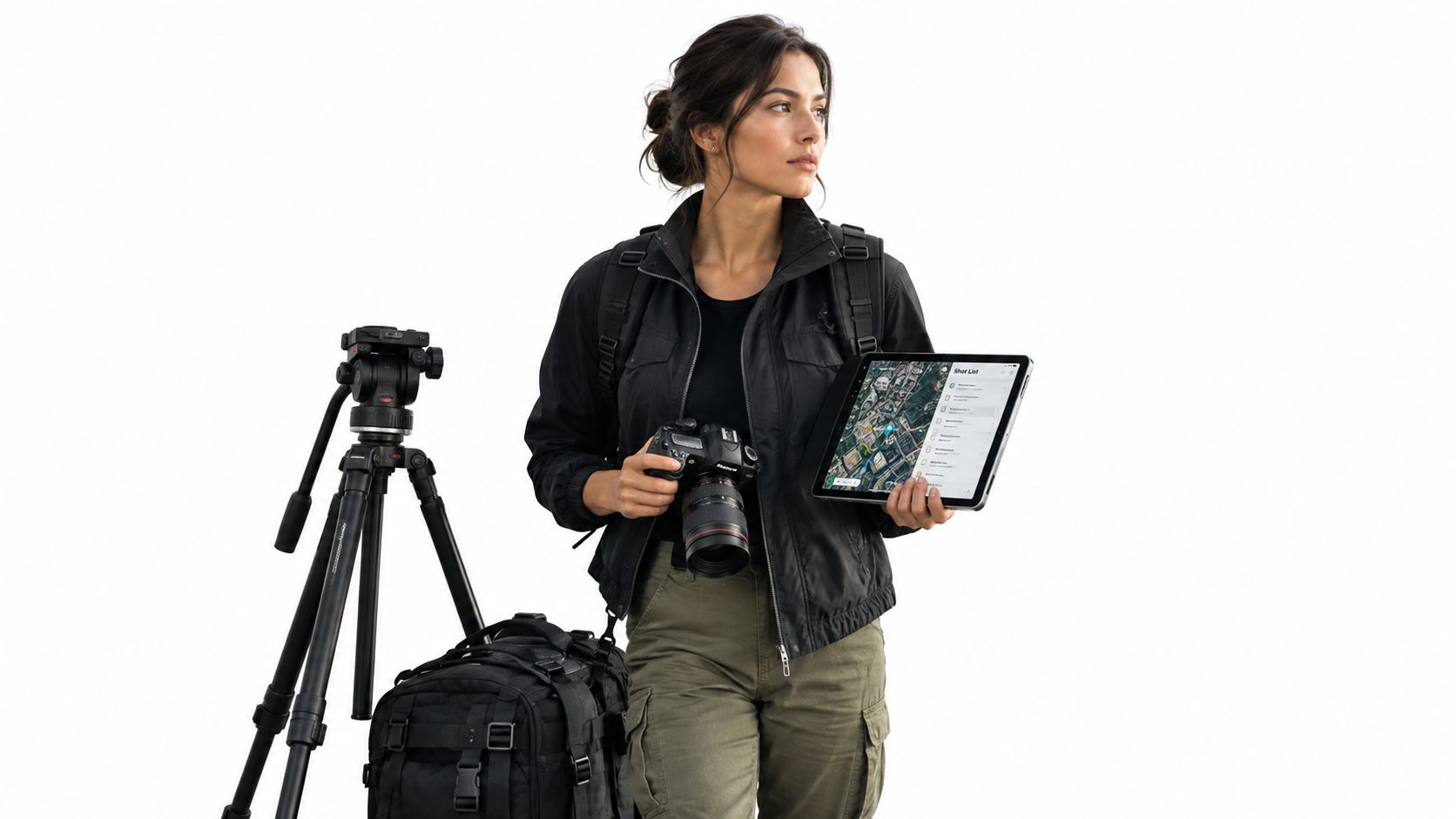
You arrive at a beautiful building with a clean façade, controlled light, and exactly the architectural rhythm the brief requires. Then the practical questions start. Where does the equipment vehicle stop? Can cases pass through the entrance? Is there enough power, who controls the property, and will construction noise ruin the scheduled frame?
That tension defines professional location scouting. A strong site must satisfy the eye, but it also has to support people, equipment, permissions, timing, safety, and the final image. The most useful scout does more than find a photogenic backdrop. They identify friction early, document it clearly, and give the production a realistic path from pre-visualization to approved shoot.
The Modern Reality of Location Scouting
A location can fail long before the camera is unpacked. A narrow doorway can block a lighting case. A promising courtyard can become unusable when a delivery truck occupies the only loading point. A glass interior may look perfect in a still image, yet offer no practical way to control reflections or route power without crossing the frame.
That's why modern location scouting has become a data-heavy planning function rather than a purely visual search. A location database can record shootability ratings, permit requirements, parking and bathroom access, road accessibility, average cost per day, and availability calendars. The industry patent describing searchable location information systems illustrates how teams can compare candidate sites across visual, legal, and operational variables instead of relying only on photographs or local recommendations.
The scout now manages uncertainty
The romantic version of scouting involves wandering until a compelling view appears. That approach can still produce a useful discovery, but it doesn't answer the questions that determine whether a production can proceed. Modern teams need to know whether a site is available, legally usable, physically accessible, and workable for the intended crew.
Digital databases also centralize aerial imagery, permit status, and climate information. The market report cited in the patent reference estimates that digital databases can reduce location-selection timelines from weeks to days by bringing those materials into one planning environment. The gain isn't just speed. A centralized record gives the photographer, producer, client, and location manager a shared basis for deciding.
Practical rule: Treat every candidate location as a bundle of visual, legal, and operational data.
This changes how you judge a site. A dramatic staircase might be less valuable than a quieter, easier-to-access interior with reliable power and a clear approval path. A less spectacular exterior may produce stronger commercial work if it lets the crew move efficiently and repeat the shot under controlled conditions.
Pre-visualization must meet the permit office
The best early question isn't “Can I make a beautiful picture here?” It's “Can I make the required picture here under the actual production conditions?” That means recording sun direction, access routes, parking, neighboring activity, ownership, restrictions, and likely equipment needs before presenting the location as a solution.
For distributed teams, a virtual location scouting workflow can help organize remote review before an in-person visit. Remote material won't replace physical verification in every assignment, but it can remove weak candidates before anyone spends time traveling to them.
A useful scouting record should make risk visible. Include annotated views, approximate camera positions, access notes, light observations, and unresolved questions. If the location still depends on a guess about power, permission, or noise, it isn't ready for a confident recommendation.
Executing the Three-Phase Scouting Workflow
Professional scouting works best as a sequence, not a single walk-through. The three phases are desk scouting, on-site scouting, and contingency planning. Each phase answers a different question, and skipping one usually pushes avoidable uncertainty onto shoot day.
Begin with desk scouting
Start with satellite imagery and street-level views. Examine the approach roads, neighboring buildings, parking opportunities, entrances, service access, and the relationship between the proposed camera position and the sun. Street-level imagery can reveal sightlines and obstructions, while satellite views help you understand the larger movement of vehicles, people, and equipment.
Create a short candidate record for each site. Note the likely hero view, the strongest time-of-day opportunity, the access concern, and the question that still needs an answer. Use a location scouting template to keep research consistent across several properties.
Desk work isn't about approving a location from a screen. It's about removing obvious mismatches before the physical visit. If a building has no credible load-in route or the desired façade faces an unsuitable direction for the brief, you can redirect your effort early.
Validate the picture on site
The physical scout should test the assumptions made at the desk. Walk the route from vehicle to set. Open doors, measure constraints where necessary, listen for noise, inspect backgrounds, and stand at the intended camera positions. Look through the space at the height and orientation you expect to use, rather than judging it only as a visitor.
Check how the location behaves during the planned shooting period. Light changes, traffic rises and falls, and neighboring activity can become the dominant feature of an otherwise quiet site. Document the location with stills and video so remote decision-makers can understand scale, texture, sightlines, and practical limitations.
Identify three to five hero compositions during the walk-through. The recommendation is supported by this professional scouting checklist, which explains that defining those compositions reduces decision churn on shoot day and helps produce a clean set of editorially strong frames.
Build the fallback before you need it
Contingency planning records alternatives for weather, crowding, access failure, or a change in site availability. A backup doesn't need to match the first location perfectly. It needs to preserve the essential visual and operational requirements of the assignment.
For each fallback, record what it protects and what it sacrifices. One site may offer stronger architecture but weaker parking. Another may have less dramatic light but a simpler permit path. That comparison gives the producer a decision framework instead of forcing the team to improvise when the preferred option fails.
The Essential Scouting Location Checklist
A useful checklist starts with the problems that are easiest to overlook while admiring a space. Access, power, sound, permissions, light, and surrounding activity deserve the same attention as composition. If one of those systems fails, the image may not be possible no matter how strong the architecture looks.
Start with the route equipment must take
Follow the complete load-in path, from vehicle to working position. Check entrances, doorway widths, elevators, stairs, floor transitions, and the distance cases must travel. A route that works for a person may not work for stands, modifiers, carts, or large camera systems.
Confirm where vehicles can stop and whether the crew can unload without blocking residents, visitors, or emergency access. Review parking capacity and identify a safe staging area. Accessibility and emergency exit routes matter for both efficiency and safety, particularly in unfamiliar or partially occupied buildings.
Test power rather than assuming it
Find working outlets and determine whether the available electrical supply supports the intended equipment. Check breaker capacity, cable-run distance, and the position of outlets relative to the frame. If a generator is necessary, establish where it can operate safely and how ventilation, noise, and cable routing will affect the production.
The professional location-scouting checklist emphasizes that blocked loading access, inadequate power, noise, permit gaps, construction, festivals, and traffic are common operational failures. It also recommends verifying entrances, doorway widths, elevator and stair constraints, breaker capacity, and generator requirements.
Listen at the actual hour
Visit at the same time of day as the planned shoot whenever possible. Record traffic, mechanical systems, deliveries, nearby work, public activity, and any repeating sound that could interfere with direction or recording. A quiet site at midday may behave very differently during a commute, school release, or building turnover.
Capture photos and video from useful camera positions, not just attractive corners. Include ceiling height, wall outlets, access doors, adjacent streets, and anything likely to affect crew movement. The documentation should let someone who wasn't present identify both the opportunity and the constraint.
Use the embedded reference below as a reminder that the scout's job includes observing the whole production environment, not just framing the subject.
Verify the conditions around the property
Look beyond the property line. Construction, festivals, traffic, neighboring events, and changing public access can create delays even when the property itself is fully prepared. Ask who can confirm surrounding activity and whether restrictions change during the planned production period.
Finally, record the unresolved items in writing. A site should not be labeled “approved” while power, access, sound, or permission remains an assumption.
Navigating Permits, Risks, and Market Variables
A beautiful location without lawful access is not a production location. It's only a visual possibility. Before a client approves a site, establish who controls the property, what permission is required, which authority issues permits, and what insurance documentation the owner or jurisdiction expects.
Clearing a location may involve confirming availability, paying owner or agent fees, providing a certificate of insurance, and securing film permits. This overview of location scouting and clearance also notes that public-location permits may range from a few hundred dollars to several thousand, depending on the jurisdiction and type of site. Those costs are only one part of the decision. Lead time, restrictions, neighborhood coordination, restoration, and vehicle access can matter more than the fee itself.
Compare the assignment before choosing the site
Commercial work usually gives logistical reliability a high priority. The client may need repeatable views, controlled branding, product integration, staff movement, and a predictable schedule. A location with a clear approval path and dependable access can outperform a more dramatic site that creates uncertainty around signage, privacy, parking, or restoration.
Editorial work may tolerate more friction when the location carries strong narrative value. That doesn't remove the need for permission or safety planning. It changes the trade-off. A photographer may accept a less controlled environment for authentic context, but still needs to understand what can be photographed, when access is allowed, and how external activity may alter the story.
| Decision factor | Commercial assignment | Editorial assignment |
|---|---|---|
| Visual control | Prioritize repeatable compositions and clean brand presentation | Accept more environmental variation when it supports the narrative |
| Access | Favor predictable load-in, crew movement, and schedule control | Balance access against the location's documentary value |
| Permissions | Clarify usage, property approval, insurance, and production restrictions early | Confirm editorial access and any restrictions on subjects or areas |
| Risk tolerance | Avoid friction that could disrupt a planned deliverable | Manage friction without losing the location's authentic character |
Score friction before beauty
Ask practical questions before you become attached to the image. Can the owner approve the intended activity? Will trucks, crew size, prep days, or restoration obligations affect neighboring properties? Does the site require coordination with a public agency or nearby community?
Public-agency guidance emphasizes early permitting, property-owner contact, community coordination, and production details such as trucks, crew size, prep days, and restoration. The production permitting FAQ is a useful example of how those operational details can shape approval.
A location with low visual appeal but low friction may be the responsible recommendation. A site that avoids complaints, hidden costs, and delay often protects the final image better than a spectacular place that consumes the schedule.
For property paperwork, keep the release process aligned with the scout record. A location release form resource can help organize the information needed before the crew commits to the site.
Adapting Scouting for Commercial and Editorial Needs
The same building can serve two very different assignments. For a commercial shoot, the space may need to communicate a specific identity, support a product, or present a workplace with controlled visual order. For editorial photography, the same space may be valuable because it reveals use, age, atmosphere, or the relationship between people and architecture.
The scout should therefore arrive with the intended use in mind. Don't document a site as a collection of attractive views. Document how it can deliver the assignment.
Build the record around the final deliverables
For commercial work, test whether the location supports the required brand decisions. Look for distracting signage, inconsistent finishes, uncontrolled reflections, and backgrounds that compete with the subject. Note where people, equipment, and products can sit without interrupting circulation or creating an untidy frame.
For editorial work, record transitions and relationships. Photograph how a hallway opens into a larger room, how daylight moves across a façade, or how an occupant changes the scale of a space. These observations help the final story feel connected rather than assembled from unrelated views.
Use test frames to expose compromises
Make quick test images from proposed camera positions. They don't need to be polished. Their purpose is to show the height of the viewpoint, the amount of surrounding context, the shape of the light, and the objects that will need to move before production.
Annotate each frame with practical notes:
- Composition: State what the frame communicates and what must remain clear.
- Light: Record the direction, quality, and likely change during the shooting period.
- Crew position: Mark where the photographer, subject, assistants, and equipment can stand.
- Restrictions: Identify areas that require permission, protection, supervision, or removal.
- Client decision: Flag whether the frame is approved, provisional, or dependent on a site change.
Historically, the profession developed as filmmaking moved away from improvised access and toward regulated production. Early filmmakers often depended on instinct, local fixers, and even trespassing, but rising production costs and insurance requirements helped create the professional location-manager role responsible for legal access and logistics, as described in this historical account of movie location scouting.
That history still matters. A scout doesn't separate creative judgment from compliance. The photograph depends on both.
Adjust the questions to the audience
An architect or design client may care about geometry, material transitions, and the relationship between interior and exterior. A property manager may prioritize operational continuity and minimal disruption. A marketing team may need clean brand context, usable orientations, and enough variation for a campaign. An editor may respond more strongly to atmosphere, sequence, and narrative tension.
Ask what the images need to do after delivery. Then scout for that purpose, not for a generic idea of beauty.
Finalizing the Shot List and Client Coordination
A shot list should preserve the decisions made during the scout. For each frame, record the camera position, orientation, subject, intended light, required access, equipment implications, and any dependency that could change the plan. If the light is only workable during a specific period, write that beside the frame rather than leaving it as a verbal memory.
Arrange the list by location flow, not only by creative priority. Group frames that share a setup, then account for the movement of people and equipment between them. This reduces unnecessary resets and makes the schedule easier to explain to the client and crew.
Present trade-offs plainly
A client doesn't need a folder of unfiltered scouting images. They need a decision-ready presentation. Show the proposed hero frames, the practical notes that support them, and the compromises attached to each option.
A useful summary distinguishes between:
- Approved conditions: What the site can support now.
- Open approvals: Which owner, agency, or manager still needs to confirm access.
- Production risks: What could affect timing, sound, power, safety, or composition.
- Fallback choices: Which alternative protects the most important deliverable.
- Client decisions: What must be selected before the crew arrives.
The strongest recommendation isn't always the most photogenic frame. It's the option that gives the team a controlled path to a purposeful image while respecting the property, the schedule, and the people involved.
A precise scout turns visual ambition into executable work. It lets the photographer protect composition without ignoring power, access, permits, light, safety, or the surrounding environment. That preparation doesn't reduce creativity. It gives creativity a stable set on which to operate.
Jimmy Clemmons Photographer provides location scouting, lighting design, on-set direction, and professional editing for architectural and commercial assignments. To plan a shoot around composition, access, power, permits, and client goals, visit Jimmy Clemmons Photographer and discuss the location before production begins.