
You already know the feeling. The calendar is tight, the creative brief is solid, and the site photos looked promising. Then the first scout turns into a long drive, a parking problem, a loading dock negotiation, and a discovery that the best elevation is blocked by temporary fencing, bad angles, or light that dies two hours earlier than expected.
For architectural, commercial, and branded photography, that kind of miss isn't a minor inconvenience. It affects scheduling, crew decisions, permit timing, styling, and the confidence everyone brings to shoot day. The larger the project, the more expensive uncertainty becomes.
That's why virtual location scouting matters now. Not because it replaces judgment, taste, or the trained eye. It doesn't. What it does is sharpen them. It gives the photographer, the architect, the marketing team, and the client a more precise way to test assumptions before committing time, budget, and creative energy to a location.
The End of Wasted Site Visits
A traditional scout often fails in predictable ways. The listing photos are old. The floor plan is incomplete. The ceiling height works on paper but not once stands, modifiers, and a crew are in the room. Exterior access looks simple until someone learns the property line, traffic flow, or neighboring structures change the shot completely.
Architectural and commercial clients usually don't need more “coverage.” They need better decisions earlier.
That's where virtual location scouting changes the process. Instead of sending decision-makers into the field just to eliminate obvious problems, teams can review a space digitally, narrow choices, and arrive on site with intent. The physical visit becomes a confirmation pass, not a fishing expedition.
Practical rule: If a first scout exists mainly to answer measurement, access, or angle questions, those questions should often be resolved before anyone gets in the car.
This matters most on projects with multiple stakeholders. A design principal may care about how an atrium reads in elevation. A brand director may care about where people can be staged without cluttering the architecture. A producer may only want to know whether gear can move efficiently through the site. Virtual scouting gives each of those people a common working model.
What wasted visits usually look like
- The access problem: The room is visually strong, but hallways, elevators, or service entries won't support equipment movement.
- The angle problem: The hero view exists, but only from a position that won't accommodate the lens choice or camera height the project needs.
- The timing problem: Natural light hits beautifully, just not during the approved shoot window.
- The coordination problem: Everyone approved the location from stills, but each person imagined a different use of the space.
A bad scout doesn't just waste a day. It dilutes confidence. Virtual location scouting restores control by turning early-stage guesswork into a more disciplined review process.
What Is Virtual Location Scouting
A client approves a space from a polished photo set. Then the working team opens the scan and sees the constraint that the stills hid. The ceiling drops where the boom needs clearance, the corridor pinches before the gear cart can turn, and the camera position that gives the architecture proper balance sits hard against a wall. That is the core job of virtual location scouting. It shows the location as it behaves, not just as it photographs.
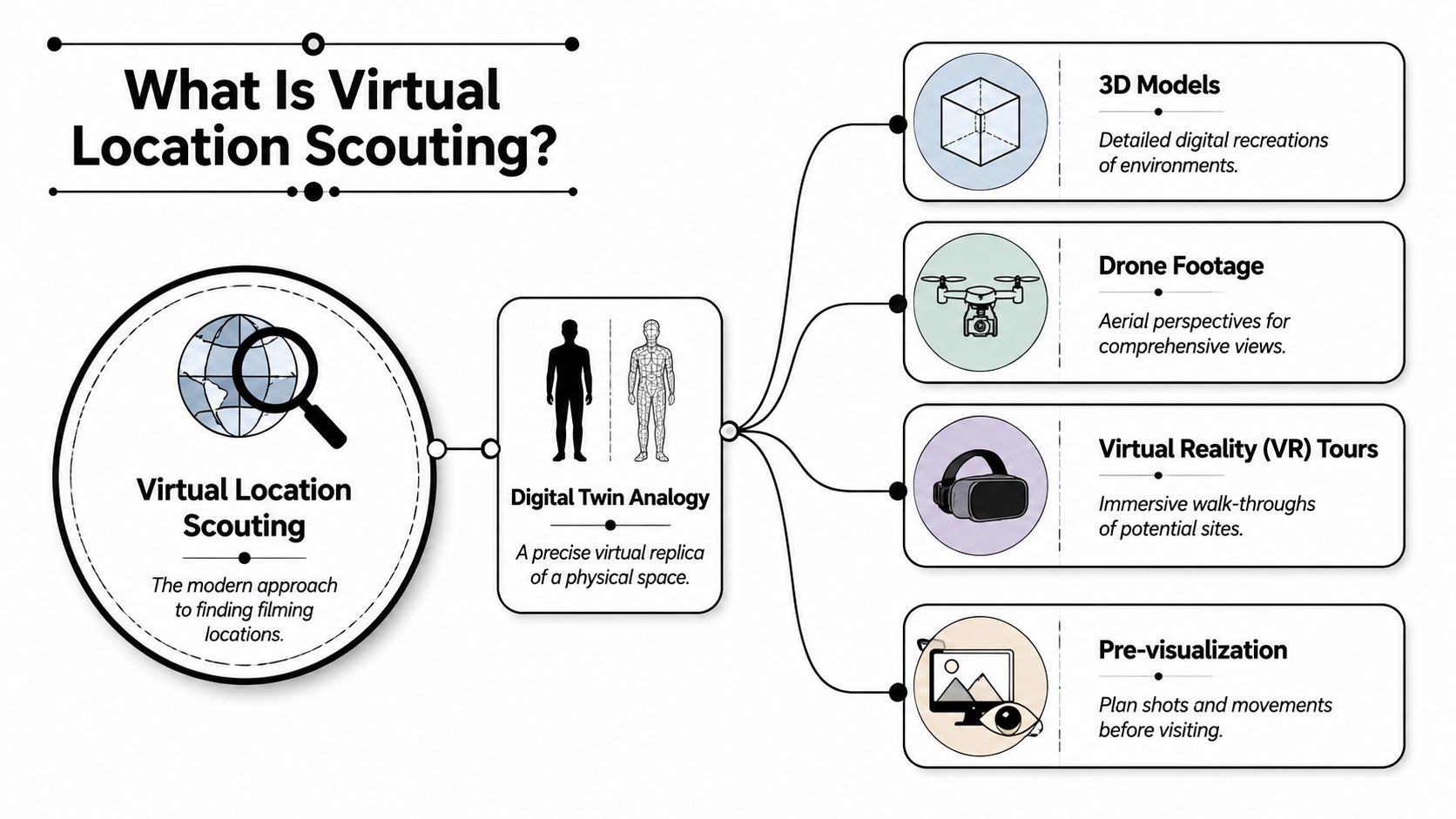
Virtual location scouting is the digital review of a real site through a measurable 3D model, panoramic capture, or mapped spatial dataset. Disguise describes virtual location scouting as the exploration of filming sites inside a 3D environment, and that definition holds up well for architecture and interiors too. The value is not novelty. The value is that creative and production decisions happen against the actual geometry of the place.
The digital twin idea
In practice, the model works as a shared spatial reference. It is built from real-world capture, then reviewed on screen by the photographer, client, producer, and any other decision-makers who need to judge how the space will perform.
That distinction matters.
A rendering shows what a project is meant to become. A virtual scout shows what exists right now, with its limits, opportunities, and quirks intact. For an architectural shoot, that changes the quality of the conversation. Instead of debating impressions from a handful of corrected stills, teams can examine sightlines, scale, adjacencies, and access with much more discipline.
Typical questions become easier to answer:
- Whether the camera can sit where the composition needs it
- Whether ceiling height and structure allow the required support
- Whether window placement supports the intended light quality
- Whether crew movement will interfere with operations or occupants
On larger properties, aerial capture can strengthen that review. A mapped overhead pass is often the fastest way to understand building orientation, approach routes, and exterior relationships. For projects that need that layer of planning, drone photography for site surveying adds context that ground-level scans alone will miss.
How the model gets built
The best virtual scouts are assembled from several capture methods, each chosen for a reason. 360-degree imaging gives fast visual coverage. Photogrammetry reconstructs form from overlapping photographs. LiDAR adds dependable depth data and improves confidence in proportions and measurements.
The point is not to chase a perfect simulation of reality. The point is to build a model accurate enough to answer creative and logistical questions before the crew arrives.
For architectural work, that threshold matters. A photographer does not need every surface modeled at forensic detail to know whether a long lens can isolate the stair, whether the lobby axis will hold a symmetrical frame, or whether a conference room will collapse visually once furniture, talent, and lighting are added. The model only needs to be honest about space.
What you can actually do inside it
A usable virtual scout gives a team more than a rotating panorama. It allows people to move through the site, compare positions, judge depth relationships, and discuss framing with a shared point of reference. That is where the tool starts serving the image rather than just documenting the property.
Some workflows also support lighting previews, camera path planning, and layered notes tied to specific viewpoints. Destination Film Guide's overview of high-tech scouting tools points to features such as GPS tagging, cloud syncing, AR previews, drone integration, and AI-assisted search. In practical terms, that means fewer disconnected files and fewer rounds of people talking past one another.
Why this matters creatively
Virtual scouting does not replace the photographer's eye. It sharpens it.
The eye still decides what matters, what to exclude, where the frame begins, and how the architecture should read. Virtual scouting gives that judgment better raw material. It lets the team test assumptions earlier, protect key compositions, and arrive on site with a plan that is already visually coherent.
That is the key advantage. More precision before the shoot usually leads to more freedom during it.
Virtual Scouting Versus On-Site Scouting
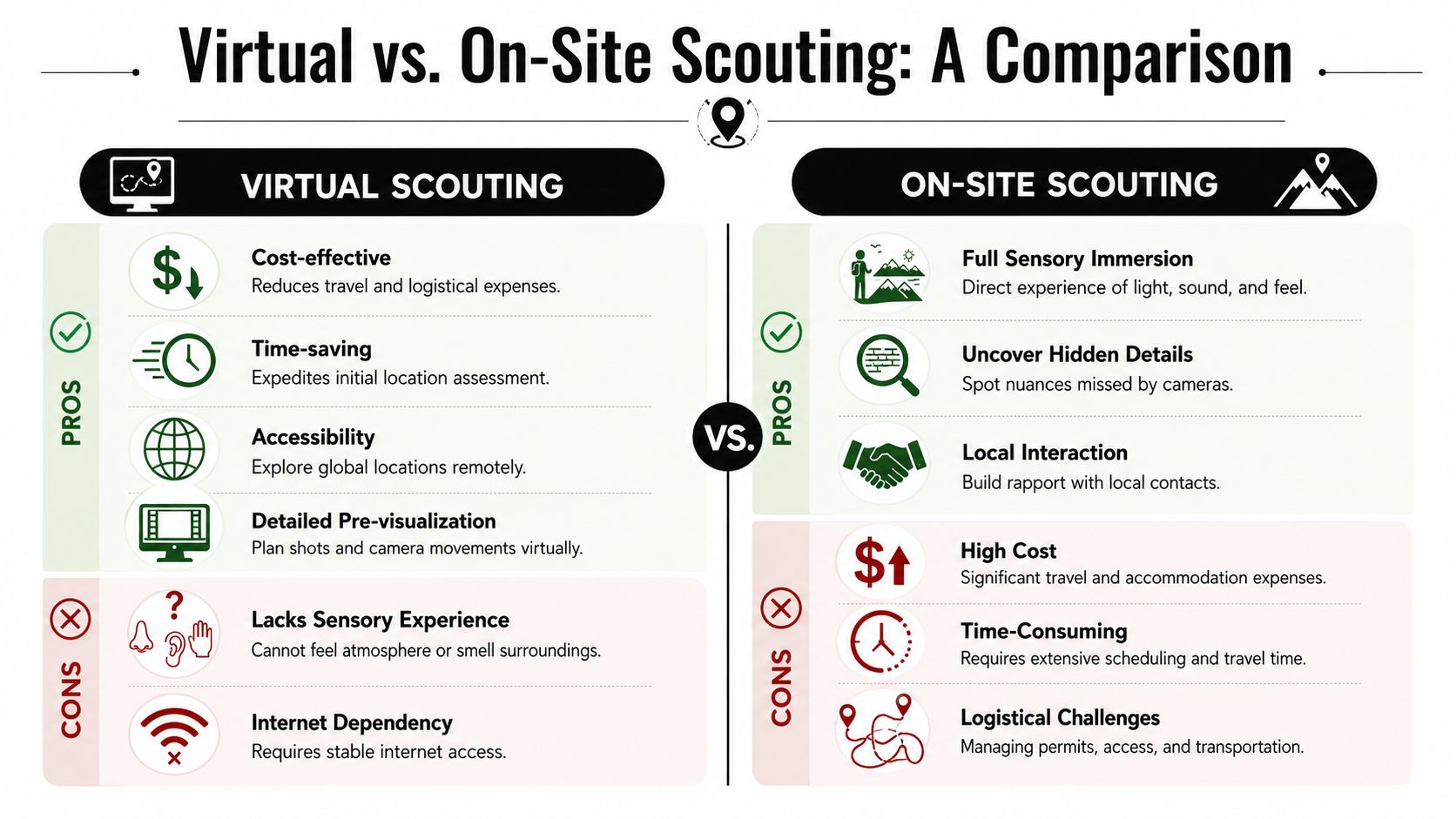
The useful comparison isn't old versus new. It's when each method does its best work. Virtual location scouting is strongest in the filtering and planning phase. On-site scouting is strongest in the sensory and final-confirmation phase.
Where virtual scouting wins
Virtual scouting is excellent when the first decision is binary. Does the location fit the brief, or doesn't it. Can it support camera movement, crew access, and a clean composition, or should it be eliminated before anyone commits a day to it.
That advantage gets stronger when multiple departments need a shared reference. The photographer sees perspective and light. The client sees brand fit. Operations sees access. A virtual environment gives them one object to discuss, not five different interpretations of a photo set.
There's also a precision advantage. Evercast's write-up on remote scouting notes that integrating LiDAR and 360-degree cameras into game engines can produce real-time 3D environments with ±2mm accuracy, while also reducing production travel costs by 40% and pre-production time by 70%.
For exterior and campus-scale properties, aerial data often closes the gap between a nice-looking site and a workable one. A strong drone photography approach for site surveying can reveal circulation patterns, rooflines, setbacks, approach roads, and neighboring visual interference long before the crew arrives.
Where on-site scouting still matters
A physical visit still does things no virtual system can fully replicate.
You notice temperature shifts. You hear road noise, mechanical noise, and human activity patterns. You see how reflective finishes behave outside the polished logic of a model. You learn whether a lobby feels generous or photographs wide. These are not small details in high-end architectural or brand work.
A location can be technically correct and still feel wrong. That judgment still belongs to experienced eyes on site.
The atmosphere of a place also matters when people will occupy the frame. Executive portraits, hospitality scenes, and branded lifestyle work all depend on more than geometry. The emotional character of a space often reveals itself in person.
A practical head-to-head view
| Criteria | Virtual scouting | On-site scouting |
|---|---|---|
| Early elimination | Excellent for removing weak options quickly | Slower and more expensive for first-pass filtering |
| Measurements and access review | Strong when the model is captured well | Strong, but requires travel and coordination |
| Mood and atmosphere | Helpful, but incomplete | Best method |
| Stakeholder review | Easy to share and revisit remotely | Harder to coordinate with larger teams |
| Final confidence before shoot | Good for planning | Best for confirmation |
What doesn't work
Virtual scouting fails when teams expect it to answer every question. It also fails when capture quality is rushed, incomplete, or poorly organized. Missing corners, weak scan overlap, bad naming conventions, and unclear priorities can make an advanced workflow feel clumsy fast.
On-site scouting fails for the opposite reason. Teams use expensive field time to discover information they could have resolved earlier.
The strongest practice is hybrid. Use virtual scouting to narrow, measure, and pre-visualize. Use the physical visit to validate feel, refine timing, and make the final compositional decisions.
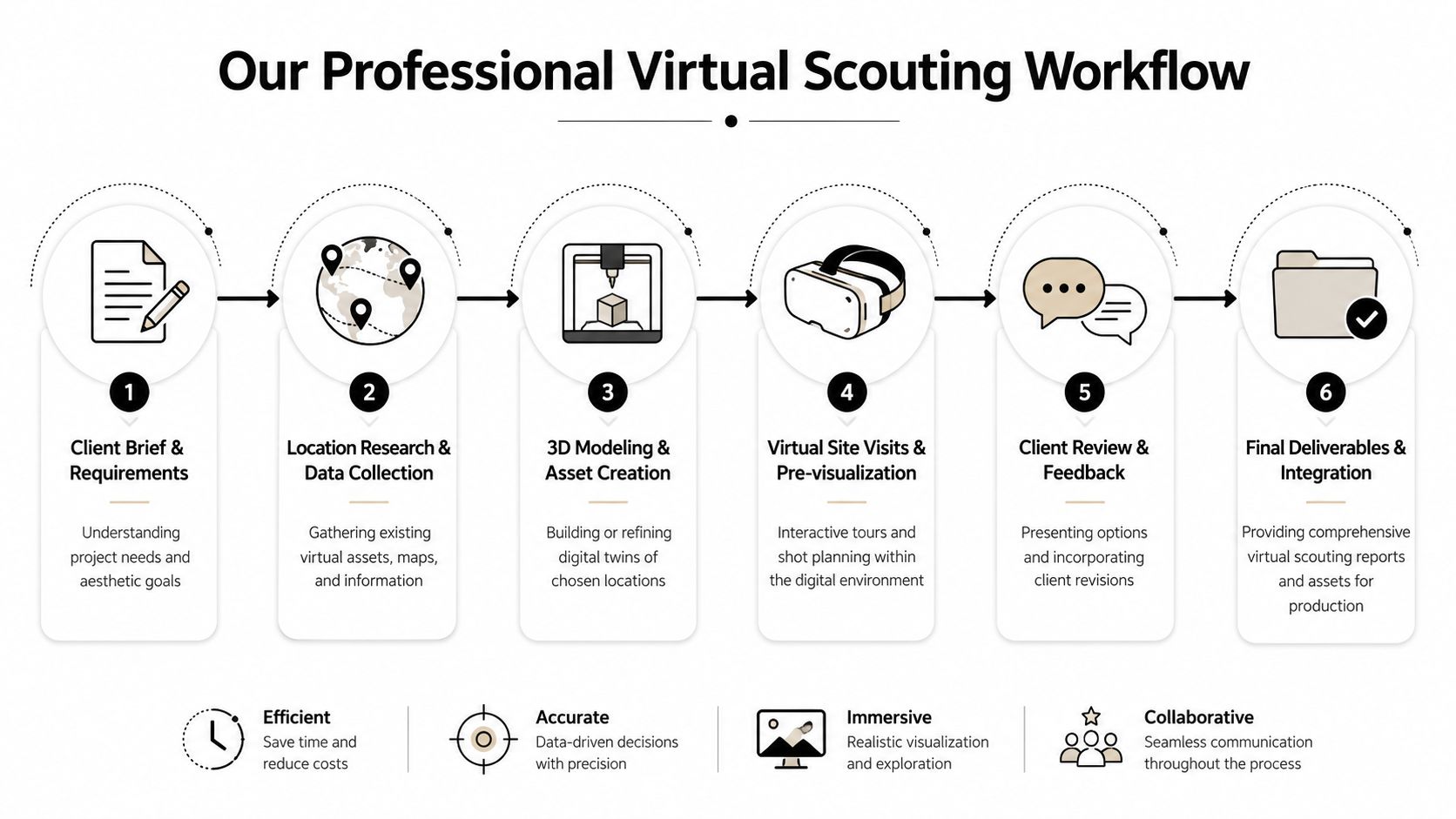
Our Professional Virtual Scouting Workflow
A good virtual scout starts before anyone opens a camera app or books a scan. The useful part is not the model itself. It is the decision-making discipline that shapes what gets captured, how it gets organized, and how it will be used to protect the shoot.
Phase one and two
Phase one is the digital brief. During this phase, the photographer's eye still leads. The team defines what the project needs to say visually, which architectural moments carry the story, where people may appear in frame, what light matters, and which views need to feel editorial rather than purely descriptive. Without that clarity, a scan becomes a generic record of a building instead of a planning tool for images.
Phase two is capture planning and field collection. Precision starts here. If the brief identifies hero angles, problem areas, and access constraints, the capture plan can focus on the spaces that affect composition, staging, and timing. If the brief is broad, the model may still look impressive, but it will answer fewer of the questions that matter on shoot day.
A disciplined capture plan usually covers:
- Priority zones: Arrival sequence, signature interiors, façades, amenity spaces, and transitions that affect visual continuity across the final set.
- Measurement-sensitive features: Window walls, corridor widths, ceiling shifts, stair landings, loading routes, and any clearance point that could limit cameras, grip, or lighting.
- Context views: Street approach, neighboring buildings, exterior obstructions, and sightlines that will shape framing choices.
The goal is simple. Capture what improves decisions. Ignore what adds file weight without helping the creative plan.
Phase three and four
After capture, the files move into model creation. This stage turns raw material into a working reference. Cleanup, alignment, labels, saved viewpoints, and logical navigation all matter. If the model is hard to read, clients spend their time learning the interface instead of reviewing the space.
Then comes the virtual walkthrough, which is where the process earns its keep.
This is the point where aesthetic judgment and production logic meet. The team studies candidate camera positions, tests focal length assumptions, checks what sits behind the subject, and identifies where the architecture holds form or collapses into visual clutter. A room can be beautiful in person and still fail photographically from the only legal or practical shooting position. It is better to learn that during review than with a crew waiting on site.
To support those conversations, it helps to watch a concise demonstration of how virtual scouting tools function in practice:
Working principle: If a stakeholder cannot understand the model within a few minutes, the workflow needs to be simpler. Clear organization matters as much as capture quality.
What the client should prepare
Clients get stronger results when they arrive with priorities already sorted. Virtual scouting gives the team precision, but precision only helps when the brief distinguishes hero frames from secondary coverage.
A useful prep package includes:
A shot list with hierarchy
Separate must-have images from optional variations. Different spaces deserve different levels of scouting attention.Existing plans and reference imagery
Drawings, finish schedules, previous photography, renderings, and brand references help the review stay tied to the actual brief.Operational constraints
Include access windows, occupied hours, restricted areas, security rules, and whether furniture, styling, or staging can change.Decision-makers
Name the people approving visuals, the people protecting operations, and the people who need logistics answered before shoot day.Usage goals
A website hero image, an editorial feature, a leasing campaign, and an executive portrait ask different things of the same room.
For teams that want the prep work organized before the scout begins, this photo shoot checklist for commercial projects is a practical starting point.
What works and what doesn't
Specificity works. Vague ambition does not. The strongest virtual scouts are built around known questions: which view carries the story, where equipment can move, when daylight reaches the right plane, which background relationships support the brand, and which areas should be ruled out before anyone travels.
Timing matters too. The scout needs to happen early enough to influence planning, but late enough that the site resembles the conditions that will be photographed. On active projects, that often means an initial scan for direction and a tighter confirmation pass closer to the shoot.
Used this way, virtual scouting sharpens the photographer's judgment instead of replacing it. The model does not choose the frame. It gives the team a cleaner way to test options, protect time on site, and arrive ready to make deliberate photographic decisions.
Virtual Scouting in Action Case Studies
The best proof of value isn't the software. It's what happens when a team arrives on site already knowing what matters.
Corporate headquarters planning
A corporate marketing team needed a multi-day image set for a new headquarters. The brief included architecture, culture imagery, executive portraits, and branded environmental scenes. The risk was obvious. Too many stakeholders. Too many spaces. Too many ways to lose half a day deciding where anything should happen.
A virtual scout solved the first problem by turning the building into a shared reference. The architect could point to design moments worth preserving. Marketing could identify spaces that matched the brand story. Production could assess movement paths and staging zones. By the time the final schedule was built, discussions were about sequencing, not guesswork.
The result was better alignment and faster approvals. That's consistent with SCENA's notes on immersive 3D virtual tours, which describe remote scouting with 98% accuracy in spatial planning and a 50% faster approval cycle for location selections in major markets.
Residential architecture with difficult natural light
A high-end residence presented a different challenge. The architecture depended on natural light transitions, layered materials, and framed views that only worked during narrow windows of the day. A conventional scout would have revealed the rooms. It would not have given the same confidence about timing, sequence, and where each shot should sit within the day.
The virtual review helped the team decide which rooms belonged to morning, which needed late-afternoon shape, and which should be reserved for controlled supplemental lighting. It also exposed a few compositions that looked promising in snapshots but fell apart once the full room geometry was considered.
The quiet benefit of virtual scouting is that it removes false favorites early. A room may be beautiful and still not produce the image the project needs.
In both examples, the technology did not make the pictures. It protected the conditions that allowed good pictures to happen. That's the right standard for evaluating virtual location scouting.
Integrating Virtual Scouting Into Your Project
For serious architectural and commercial photography, virtual location scouting isn't a novelty add-on. It's part of a more disciplined way to prepare. When a project has design intent, stakeholder complexity, and a finite schedule, guessing less is not a luxury. It's the work.
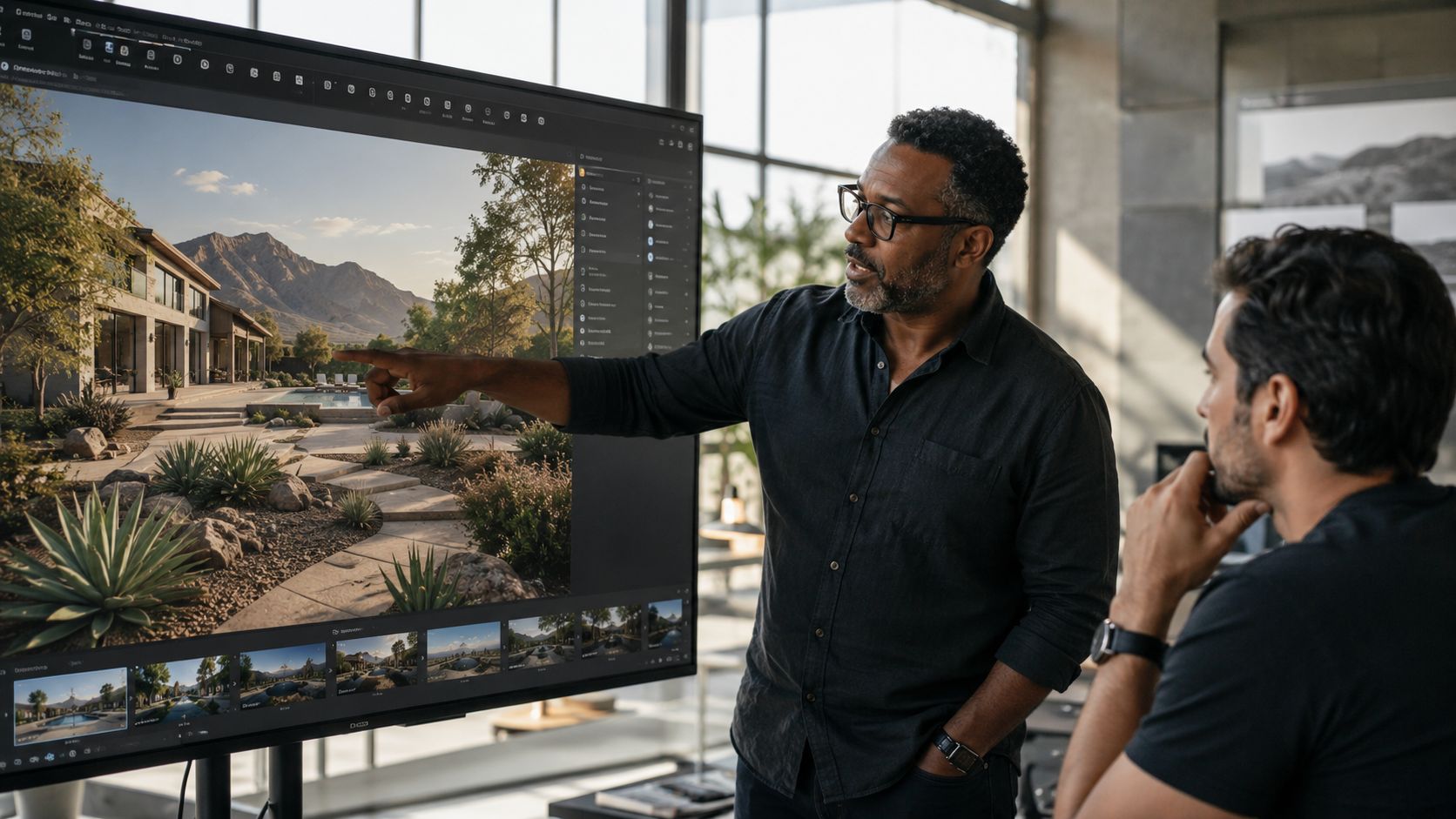
I see significant value in how this process supports judgment. It lets me walk into a site with stronger assumptions, cleaner priorities, and a better sense of what the architecture is willing to give back. That changes everything from lens choice to pacing to how a client experiences the day.
Where it fits best
Virtual scouting is especially effective when:
- The property is large or operationally complex: Campuses, headquarters, hospitality projects, and active commercial sites benefit from earlier coordination.
- The image set has multiple audiences: Editorial, leasing, investor, recruiting, and brand uses often pull in different directions unless the team aligns early.
- Timing matters: Natural light, occupancy windows, and permit limitations make pre-visualization more valuable.
- The budget needs predictability: Cleaner planning reduces improvisation that doesn't improve the final image.
A better standard for prep
Years in editorial and production work teach a simple lesson. The strongest images rarely come from chaos. They come from controlled flexibility. You prepare rigorously so you can respond intelligently when the unexpected happens.
That same thinking applies to site readiness. A practical guide to preparing your project site for a professional photoshoot pairs well with virtual scouting because both processes serve the same goal: fewer preventable problems on the day the camera arrives.
Virtual location scouting doesn't replace the final walk-through or the intuitive read of a space. It makes those moments sharper. It helps the team spend energy on nuance instead of avoidable surprises. For clients who care about precision, schedule control, and imagery with real intention, that's a meaningful advantage.
If you're planning an architectural, corporate, or commercial shoot and want a more exact way to prepare, Jimmy Clemmons Photographer can help you build a virtual scouting process that protects creative intent, streamlines logistics, and leads to stronger final images.