
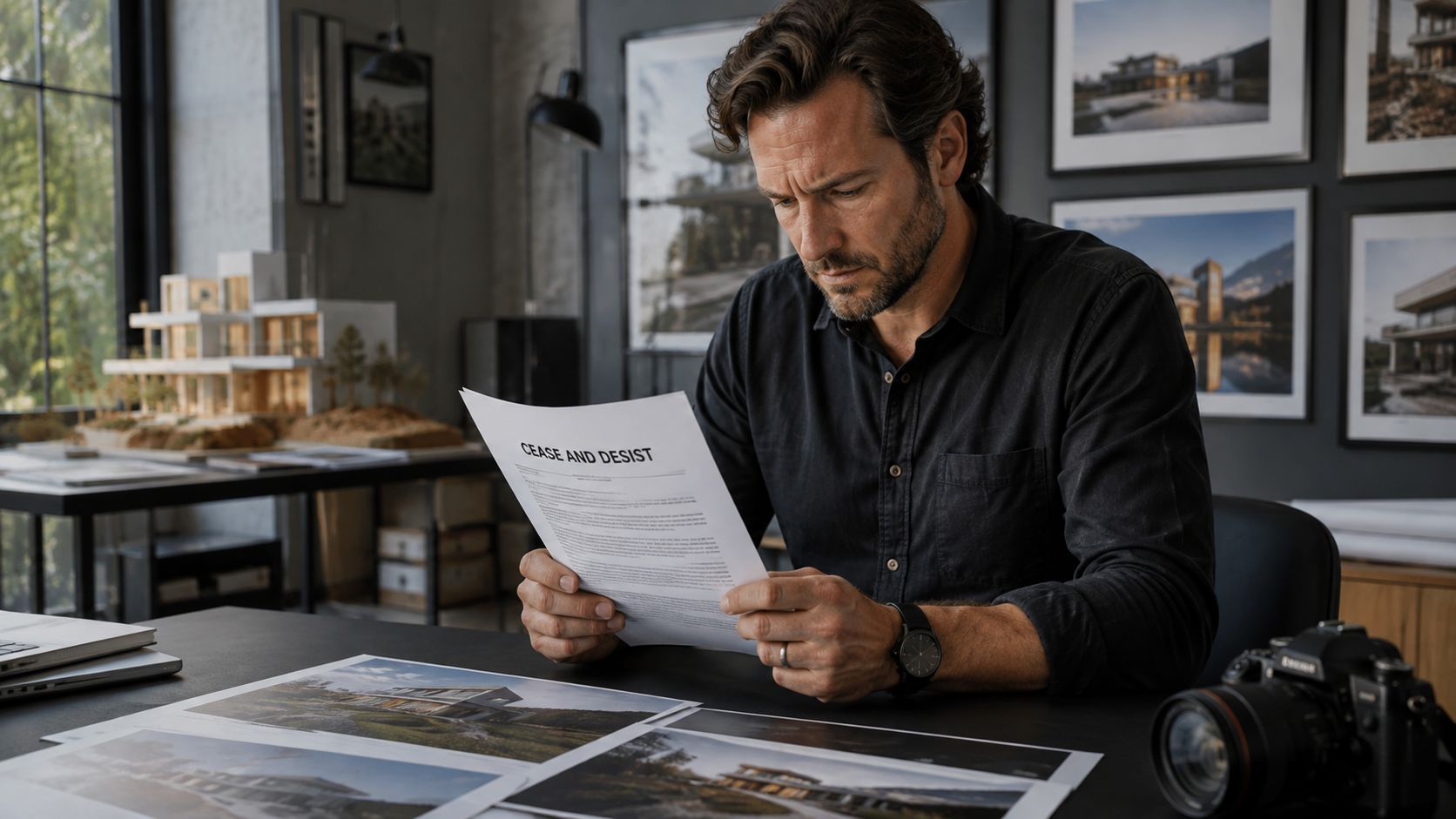
You've finished a polished architectural shoot. The client has approved the images, the campaign is moving toward publication, and everyone assumes the property owner's informal permission covered the work. Months later, a cease-and-desist letter arrives, challenging the commercial use of the photographs. The client pauses distribution, the owner demands removal, and you're left proving what was agreed after the fact.
That situation is avoidable. Location release forms document both access to private property and the rights connected to the resulting photographs or footage. For architectural, interior, hospitality, and brand photography, that distinction matters long after the camera is packed away. A release can support licensing, insurance claims, client approvals, and future distribution, while a vague conversation can leave each party remembering a different agreement.
The Hidden Risks of Shooting Without a Release
A photographer arrives at a newly renovated private residence for a high-end interiors assignment. The owner welcomes the crew, walks everyone through the rooms, and approves a few styling adjustments. Nobody signs anything because the property manager says, “The client already cleared it.”
The shoot goes well. The client uses the images in a campaign, a portfolio, and promotional materials. Later, the owner objects to the commercial use and says permission was limited to documenting the renovation. The photographer may have delivered excellent work, but the paperwork doesn't establish what the owner authorized, who could use the images, or how broadly the images could be distributed.
Verbal permission leaves too much open
Industry and legal guidance consistently treats verbal consent as inadequate for commercial production on private property. A written release records the owner's permission to enter and helps reduce later disputes involving trespass, licensing, ownership, or use of the resulting work, as explained in guidance on location release forms.
The danger isn't limited to an aggressive property owner. A well-intentioned owner may believe they approved a private documentation shoot, while the client believes the images can support advertising across websites, brochures, social channels, and paid campaigns. The photographer then becomes responsible for reconciling two incompatible assumptions.
Practical rule: If the property is private and identifiable, get written permission before the first shutter click.
The downstream cost appears after delivery
A missing release can affect more than the photographer's relationship with the owner. A client may delay publication, remove images from a campaign, question the photographer's production process, or ask for replacement work. If a marketplace or brand requires documentation, the absence of a release can also block submission or licensing.
A release won't solve every rights issue. It won't automatically clear recognizable people, artwork, logos, signage, or other protected material. It does establish the property owner's agreement, which is the foundation for handling those additional permissions responsibly.
What Location Release Forms Actually Do
A location release is a written contract in which a property owner or authorized representative permits a production to enter, photograph, film, and distribute images of a specific location. It normally identifies the property, the parties, the shoot terms, compensation where applicable, and the permitted uses.
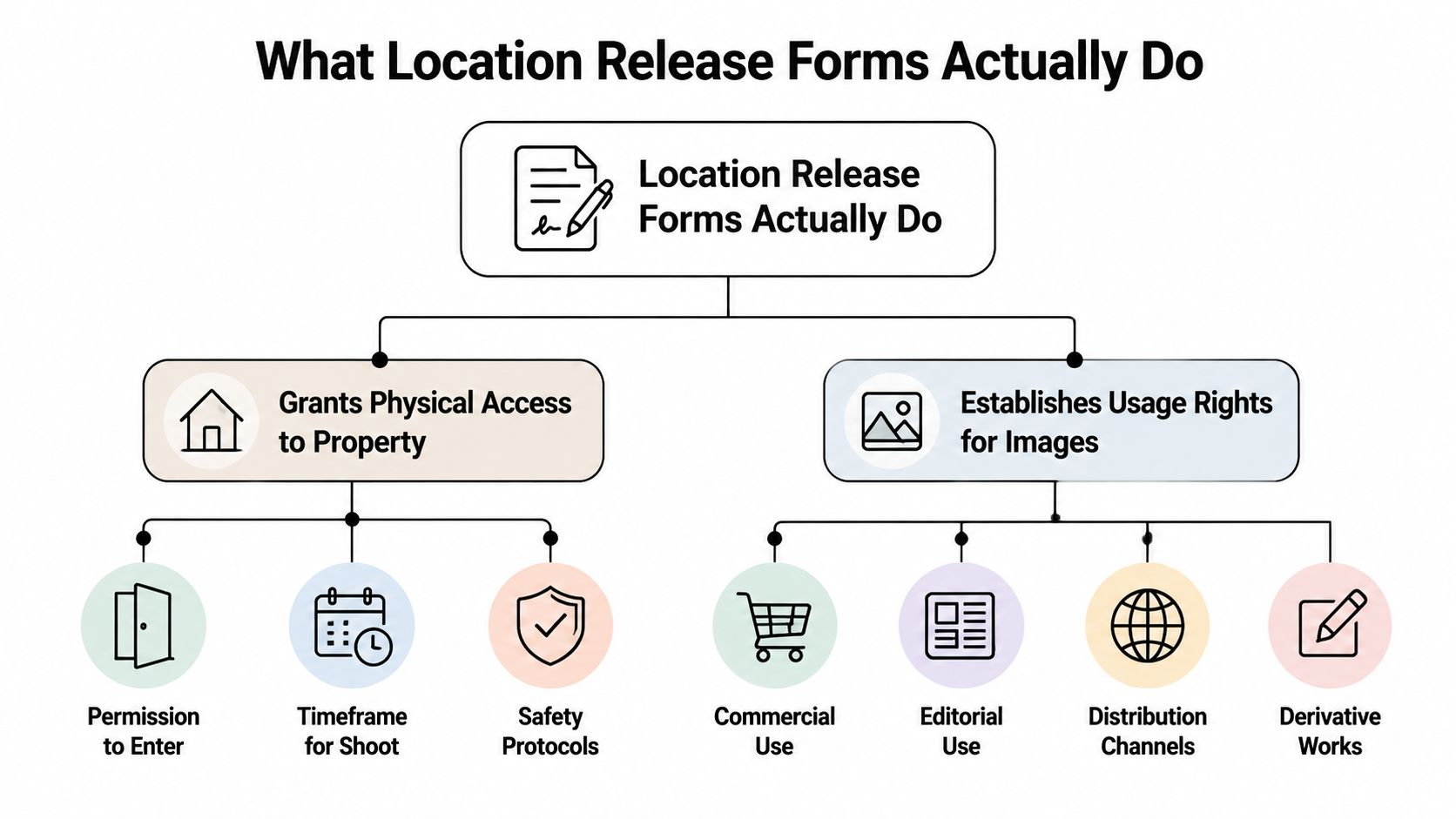
The document performs two connected but separate jobs. First, it authorizes physical access. Second, it defines what the photographer, producer, client, or distributor may do with the resulting images. Industry location-release guidance describes this broader function, including dates, fees, usage scope, media rights, and the relationship between the location owner's consent and ownership of the resulting footage.
Access is not the same as image permission
A property owner might allow a photographer onto the premises but object to an image appearing in an advertisement. Another owner might approve broad commercial use but restrict identifiable security features, private rooms, or sensitive business information. The form should make those distinctions visible.
A location release is different from other production documents:
- Location release: Covers permission connected to the property and the use of images depicting it.
- Model release: Addresses an identifiable person's consent and related publicity or image-use concerns.
- Filming permit: Usually concerns authorization from a public authority or site administrator to conduct production activity in a particular place. It doesn't automatically replace a private owner's release.
The form can also separate the photographer's ownership of the photographs from the owner's consent to the property's depiction. That separation helps prevent a client from receiving on-site approval while later facing an objection to publication or marketing use.
A location release also doesn't replace clearance for artwork, trademarks, people, or privacy-sensitive material. Property-release guidance from Unsplash identifies recognizable private locations as requiring a property release for commercial use, while other visible elements may require separate attention.
The following video provides a useful visual overview of how release documentation fits into production planning.
Types of Location Releases and When You Need Them
The right signer depends on the property and the person controlling access. A photographer shouldn't assume that the person who opens the door has authority to grant every right required for commercial distribution.
| Property Type | Release Required | Who Can Sign | Special Considerations |
|---|---|---|---|
| Privately owned residence or commercial building | Usually, when the location is identifiable and used commercially | The owner or an authorized representative | Confirm the signer's authority and identify the exact premises |
| Tenant-occupied property | Often, with limits based on the tenancy agreement | Tenant for the rights they control, or owner for broader property rights | A tenant may control access but not structural, exterior, or ownership-related permissions |
| Public space | Depends on the location, activity, and intended use | Relevant public authority, venue operator, or site administrator where required | Public access doesn't automatically create unrestricted commercial-use rights |
| Managed venue, hotel, campus, or facility | Usually, for organized commercial production | Authorized facilities, property, or communications representative | Ask about house rules, security, branding, and scheduling restrictions |
| Aerial or drone project over private property | May require property permission and separate operational approvals | Property owner for property-related rights, plus applicable authorities or operators | Airspace, privacy, safety, and neighboring properties create additional clearance questions |
Owner releases and tenant permissions
A tenant's signature may be appropriate when the tenant controls the interior and has authority under the lease to permit photography. It may not cover the owner's rights in the building, exterior façade, landscaping, or future commercial uses. For a branded office, retail site, or hospitality property, the tenant may also lack authority to approve visible trademarks or corporate identity elements.
Ask a direct question before scheduling: “What rights are you authorized to grant, and does anyone else need to approve this use?” Record the answer and obtain additional signatures when the property, tenancy, or client's intended use makes authority uncertain.
Public property is not automatically unrestricted
A photographer may be able to make images from a public place, but commercial use can raise different questions from personal or editorial photography. Arts Law's discussion of location releases explains that photographing a building may be permitted under copyright law in Australia while still recommending a release for private property as evidence of consent.
Public sites may also impose rules through permits, venue policies, event restrictions, or security requirements. Treat public access and production authorization as separate checks.
Essential Clauses Every Location Release Must Include
A useful release should answer a simple operational question: who permitted what, at which property, for which uses, under which conditions? If a clause leaves a material issue open, the photographer may have a document that looks official without providing dependable protection.
Start with identification and authority
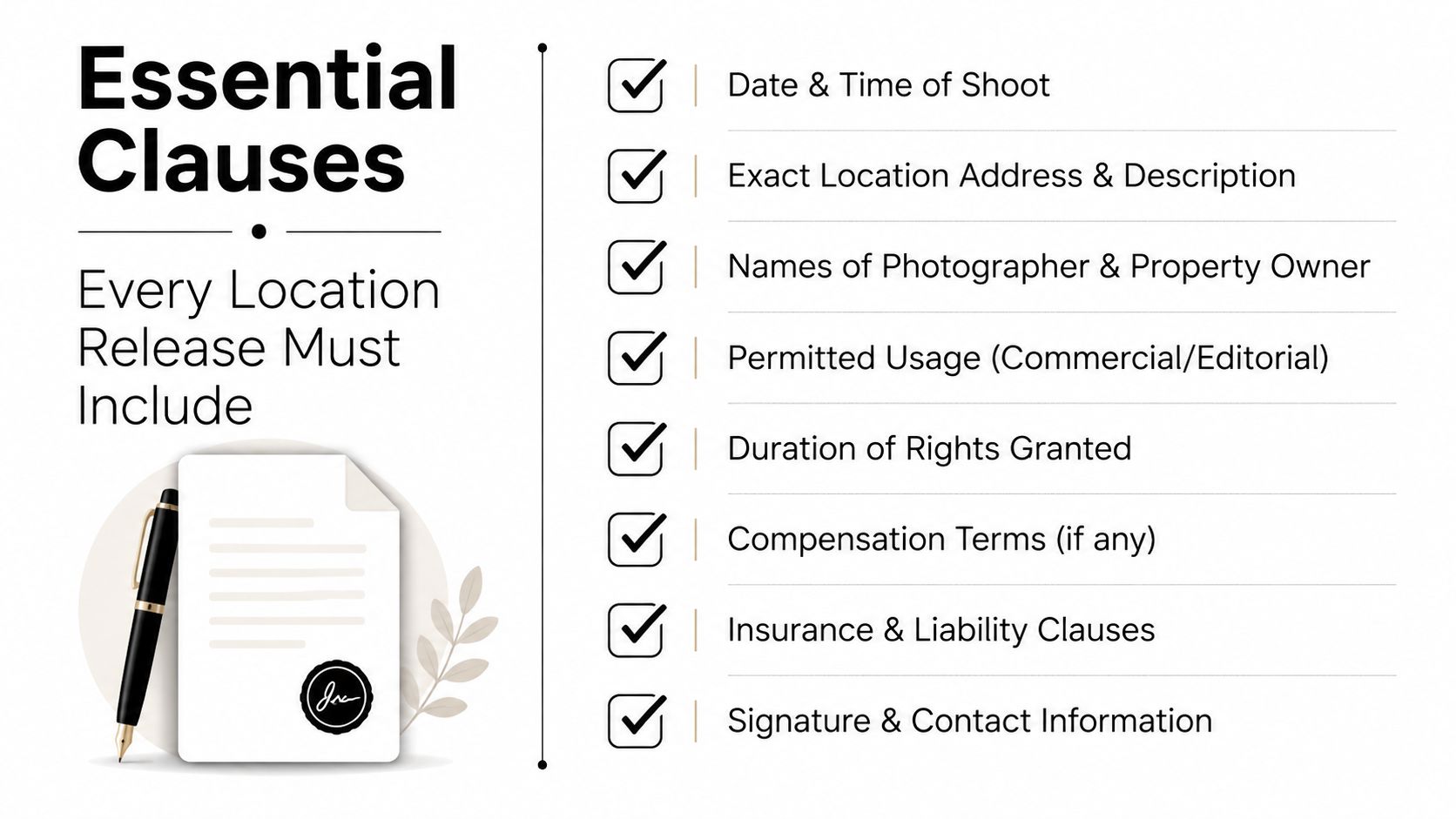
Write the exact property address and describe the relevant areas. Include the legal names and contact details of the property owner, photographer, production company, and client where appropriate. If a representative signs, identify their role and confirm that they can grant the permissions stated in the agreement.
The release should also state the shoot date, access window, setup requirements, crew activities, and any restrictions on rooms, equipment, lighting, sound, or movement. “Photography at the property” is weaker than a clear description of the premises and permitted activity.
Define the usage scope
The usage clause deserves more attention than the access clause. Specify whether the images may be used for:
- Commercial advertising and marketing
- Editorial publication
- Portfolio and self-promotional work
- Websites, social media, brochures, and presentations
- Licensing to third parties
- Trailers, campaigns, or other derivative promotional materials
Clarify duration, territory if relevant, media, exclusivity, and whether the owner waives claims connected to the agreed depiction of the property. A release that grants access but says nothing about distribution may not match the client's actual campaign.
For photographers managing client rights, the distinction between property permission and downstream image licensing is also central to licensing a photo for commercial use.
Allocate money, damage, and risk
State the compensation, payment timing, cancellation terms, and whether the owner receives anything beyond the agreed fee. Add the production's duty to restore the property, address damage caused during the shoot, follow site rules, and remove equipment and materials.
A strong form also includes insurance and indemnification language suited to the production. Avoid copying a template without checking whether its liability provisions conflict with your policy or client agreement.
Review before signing: Check the parties, property description, usage rights, restrictions, compensation, condition obligations, insurance language, and signature authority as separate items.
Negotiating Release Terms for Commercial and Architectural Shoots
A standard release may secure access but still fail the assignment. Architectural photographs often move through several channels after delivery, including a designer's portfolio, a developer's marketing campaign, editorial coverage, awards submissions, social media, and future licensing. If the release only permits “photographs for the client website,” the photographer may have created valuable work with unusable rights.
Ask for the rights the assignment actually needs
Start negotiations with the client's distribution plan, not with a generic demand for unlimited language. Explain that the property owner isn't transferring ownership of the building. They're consenting to the agreed depiction of the location.
A practical commercial release should address:
- Portfolio use: Permission for the photographer to display the work in print, online, and promotional presentations.
- Campaign use: Permission for the commissioning client to use the images in identified marketing channels.
- Future licensing: Clear treatment of sublicensing, publication, or third-party distribution.
- Duration: A defined period or continuing permission that matches the intended campaign.
- Alterations: Rules for cropping, retouching, compositing, color treatment, or other edits.
- Exclusivity: Any restriction should identify who receives exclusivity, for what images, and for how long.
Perpetual rights can be valuable, but they can also create resistance when an owner worries about losing control. A narrower, clearly described license may secure cooperation more effectively than an expansive clause the owner refuses to sign.
Handle restrictions without surrendering usefulness
Owners commonly ask to approve every final image, prohibit exterior views, restrict publication before a launch, or prevent visible personal details. Some restrictions are reasonable. Others can make the assignment commercially impractical.
Tie approval rights to objective concerns, such as confidential information, occupants, security systems, or unreleased branding. Avoid language that gives the owner unlimited editorial control over the photographer's work after delivery unless the client has accepted that constraint.
The same discipline applies to the client relationship. Clear expectations about image selection, retouching, and permitted use reduce conflict, which is why managing client visual expectations belongs alongside release planning rather than after the shoot.
Keep the conversation professional
Send the release before arrival, explain the purpose in plain language, and invite questions. Owners are more likely to sign when they understand the document records access and agreed use rather than granting unrelated control over their property.
Location Releases and Insurance Requirements
A signed release is part of the production risk file. It shows who authorized the shoot, what property was involved, what conditions applied, and which responsibilities the parties accepted. That record can become important when equipment damages a surface, a crew member disputes access, or a client asks for proof that the images were cleared.
Industry guidance warns that insurance carriers may refuse claims connected to filming on private property without a signed release. A location-release template discussing production responsibilities highlights obligations such as restoring the premises, covering production-caused damage, and confirming the owner's authority to grant permission.
Match the document to the policy
Before accepting a demanding location, review your policy requirements and ask your broker what documentation the carrier expects. Confirm whether the release needs insurance wording, additional insured language, certificates, indemnification provisions, or separate approval for unusual activities.
The release should also align with the production's actual setup. A quiet interior still-life session has different exposure from a lighting-heavy campaign with assistants, stands, vehicles, generators, or drones. Describe the activity accurately instead of relying on a generic form that understates the risk.
Preserve evidence for a claim
Store the signed release with the estimate, invoice, certificate of insurance, site photographs, condition notes, permits, and relevant correspondence. Photograph pre-existing damage when the property owner's concerns make that prudent. These records give the insurer and the client a coherent account of what happened before, during, and after production.
Insurance doesn't cure weak rights language. A carrier may address covered damage while the photographer still lacks permission to distribute the images. Treat coverage, access, and licensing clearance as connected but separate controls.
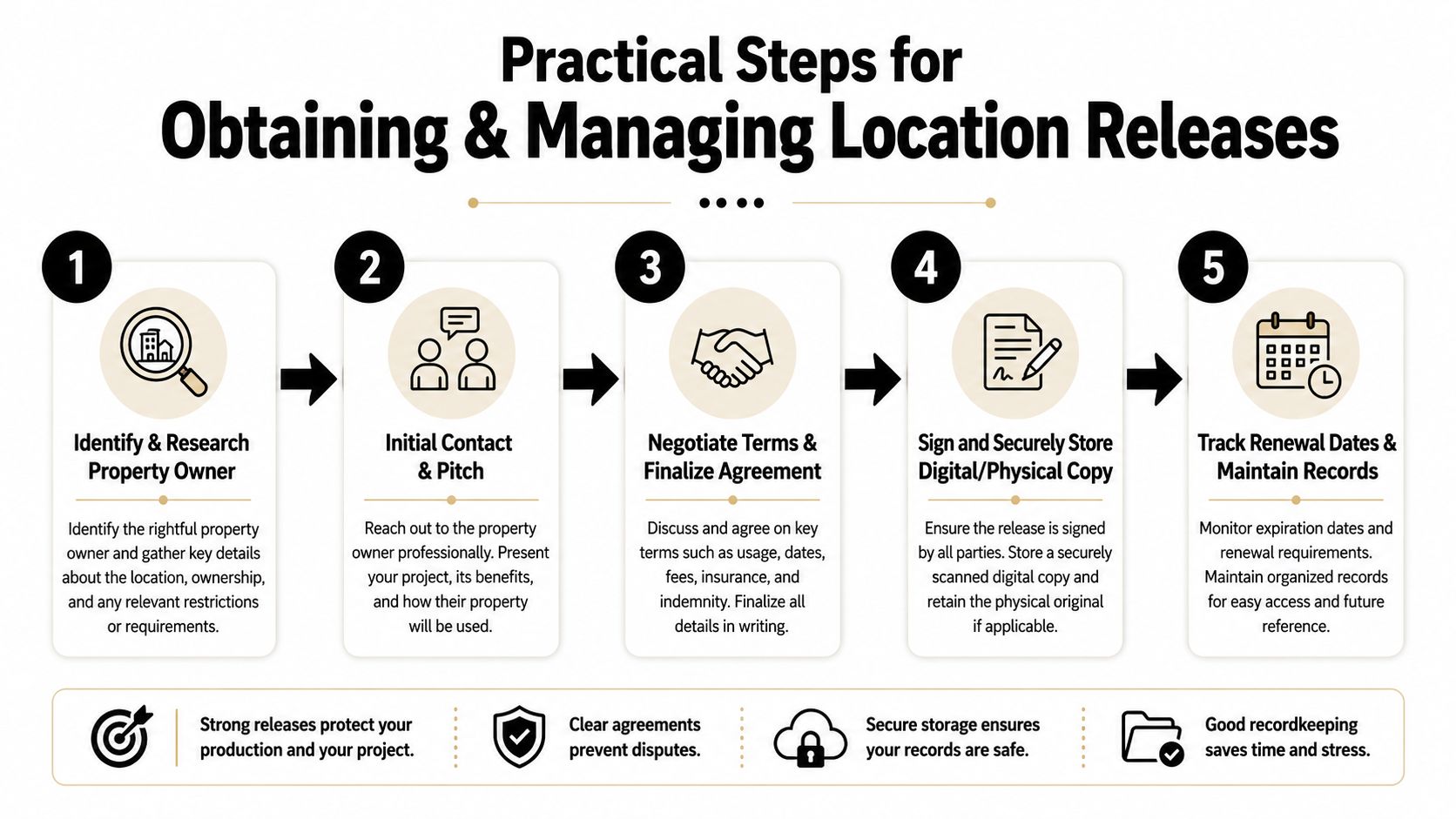
Practical Steps for Obtaining and Managing Location Releases
Release management works best as a repeatable production habit, not an emergency task after delivery. Add the document to the same planning stage as the estimate, shot list, access schedule, and insurance review.
Identify the decision-maker early
Ask the client who owns or controls the property. For a development, that may be an owner, property manager, architect, tenant, marketing director, or facilities team. Don't assume the person arranging access can approve commercial distribution.
Search the client's records, request the correct contact, and send a short explanation of the shoot, crew, equipment, areas, dates, and intended image use. If the location has multiple stakeholders, identify them before the schedule becomes fixed.
Make signing easy
Use a clear template, customize the property and usage terms, and provide a digital signing option when appropriate. Explain what the owner is permitting and what they aren't giving away. A concise email can prevent confusion:
“The release confirms our access to the property and the agreed use of photographs showing the location. It doesn't transfer ownership of the building or authorize unrelated activities.”
Allow time for questions. If the owner objects to a clause, document the proposed revision rather than accepting a verbal side agreement. Send the final version to every relevant party and confirm that all required signatures are present.
Build a retrieval system
Use a consistent file name that includes the property, client, project, and date. Keep the signed original in secure storage, maintain a backup, and connect the file to the project record in your business system. Preserve email approvals and revisions with the final release so you can understand the negotiation history later.
Track restrictions in the project notes. A release may permit portfolio use but prohibit publication before a launch, restrict specific rooms, or require removal of private details. Those limits should be visible when an editor, client, or licensing partner requests the images.
Recheck before licensing
Before submitting or licensing an image, compare the proposed use with the release. Confirm the image doesn't include an un cleared person, artwork, logo, private document, or neighboring property that creates a separate issue. Adobe Stock's property-release guidance notes that recognizable places, buildings, artwork, cars, pets, and other owned property may require a property release for submission.
For location preparation, use a practical site checklist such as how to prepare your project site for a professional photoshoot. The best release workflow is simple: identify the authority, define the use, sign before production, store the record, and verify clearance before distribution.
Jimmy Clemmons Photographer brings production discipline to architectural imagery, commercial brand content, and location-based assignments, with support for scouting, lighting, on-set direction, and polished editing. If you want a photographer who treats access, visual quality, and downstream image use as one coordinated process, visit Jimmy Clemmons Photographer to discuss your project.