
You arrive on Collins Avenue expecting a luxury hotel, then realize the property asks you to read it like a layered architectural document. The driveway, the sweeping curves, the ocean-facing massing, and the newer Nobu identity don't resolve into one clean visual language. They overlap, sometimes elegantly and sometimes awkwardly.
That tension is the core story of Nobu Hotel at Eden Roc Miami Beach. It isn't just a Nobu-branded tower beside an older resort. It's a hotel-within-a-hotel operating inside a much larger oceanfront asset, and that distinction affects what guests buy, what marketers promise, and what photographers need to show.
A First Look at Nobu Hotel at Eden Roc Miami Beach
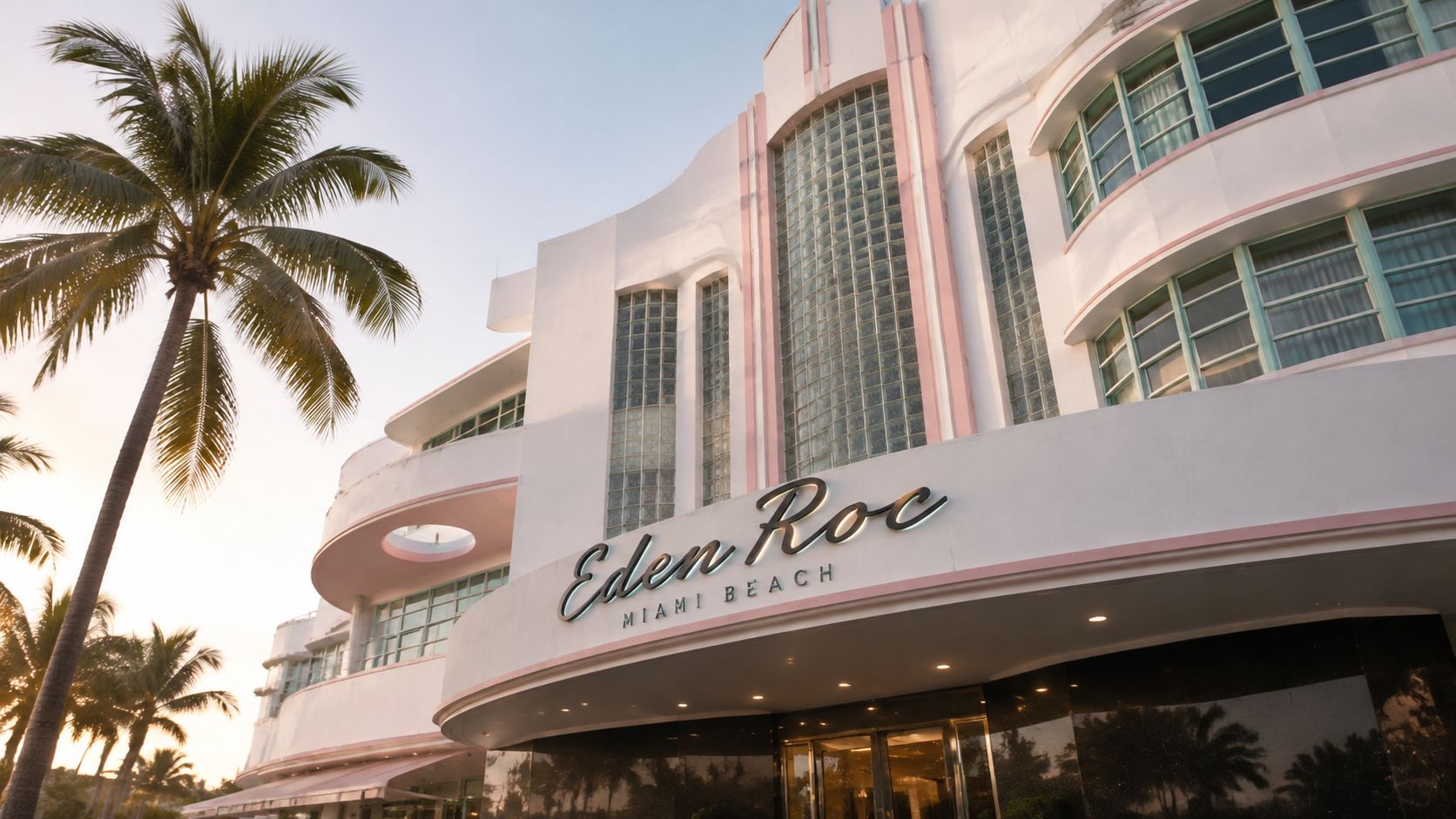
At the Collins Avenue arrival, the property reads in layers. Rounded forms, projecting balconies, and the broad scale of postwar Miami resort architecture establish Eden Roc before the Nobu identity comes into view. Architect Morris Lapidus designed Eden Roc in 1955, placing the resort among the defining Miami Modern, or MiMo, landmarks on Collins Avenue, as documented in the Eden Roc Miami Beach history and property overview.
The first visual challenge is orientation. Guests encounter the established resort identity, then locate the contemporary Nobu presence within the larger complex. The experience resembles a branded district with shared routes, overlapping expectations, and distinct areas of emphasis. That arrangement is the subject worth documenting, because the hotel-within-a-hotel model shapes both the stay and the images used to sell it.
A room frame can show material quality, comfort, and finish. It cannot, by itself, explain how Nobu relates to Eden Roc's older structure or its wider public life. A stronger set begins before the room, establishing the property's scale and showing how guests move from shared resort territory toward the Nobu experience.
Read the property as a sequence
Treat the visual geography as a connected route:
- Arrival: Collins Avenue frontage establishes the MiMo silhouette and the resort's civic scale.
- Threshold: Entrances, corridors, elevators, and lobby transitions mark the shift from shared spaces into Nobu-branded territory.
- Interior identity: Materials, lighting, furniture, and controlled detailing introduce a contemporary Japanese-inflected mood.
- Oceanfront context: Beach, pools, and public amenities place the Nobu stay within Eden Roc's broader resort operation.
The property's scale affects both guest perception and production planning. It is documented as having 621 guest rooms, including 96 suites, so the setting operates as a substantial oceanfront resort rather than a compact boutique hotel. That scale can produce richer context, but it also introduces longer walks, competing visual signals, and more care in sequencing a shoot.
Practical rule: Photograph Nobu with Eden Roc in the frame of the story. The shared setting is part of the product, even when the brand presentation gives Nobu the lead.
For architects and hospitality marketers, the dual identity creates productive tension. Eden Roc contributes recognizable curves, history, and place. Nobu adds a newer layer of privacy, dining, and lifestyle positioning. The most credible image set holds those identities together instead of presenting either one as the whole property.
The MiMo Origins and Modern Reinvention
Eden Roc makes more sense on a shoot when its layers are read in order. The property began with a strong architectural proposition, then absorbed renovations and a second hotel brand that altered how guests move through, and see, the original resort.
Start with the Lapidus foundation
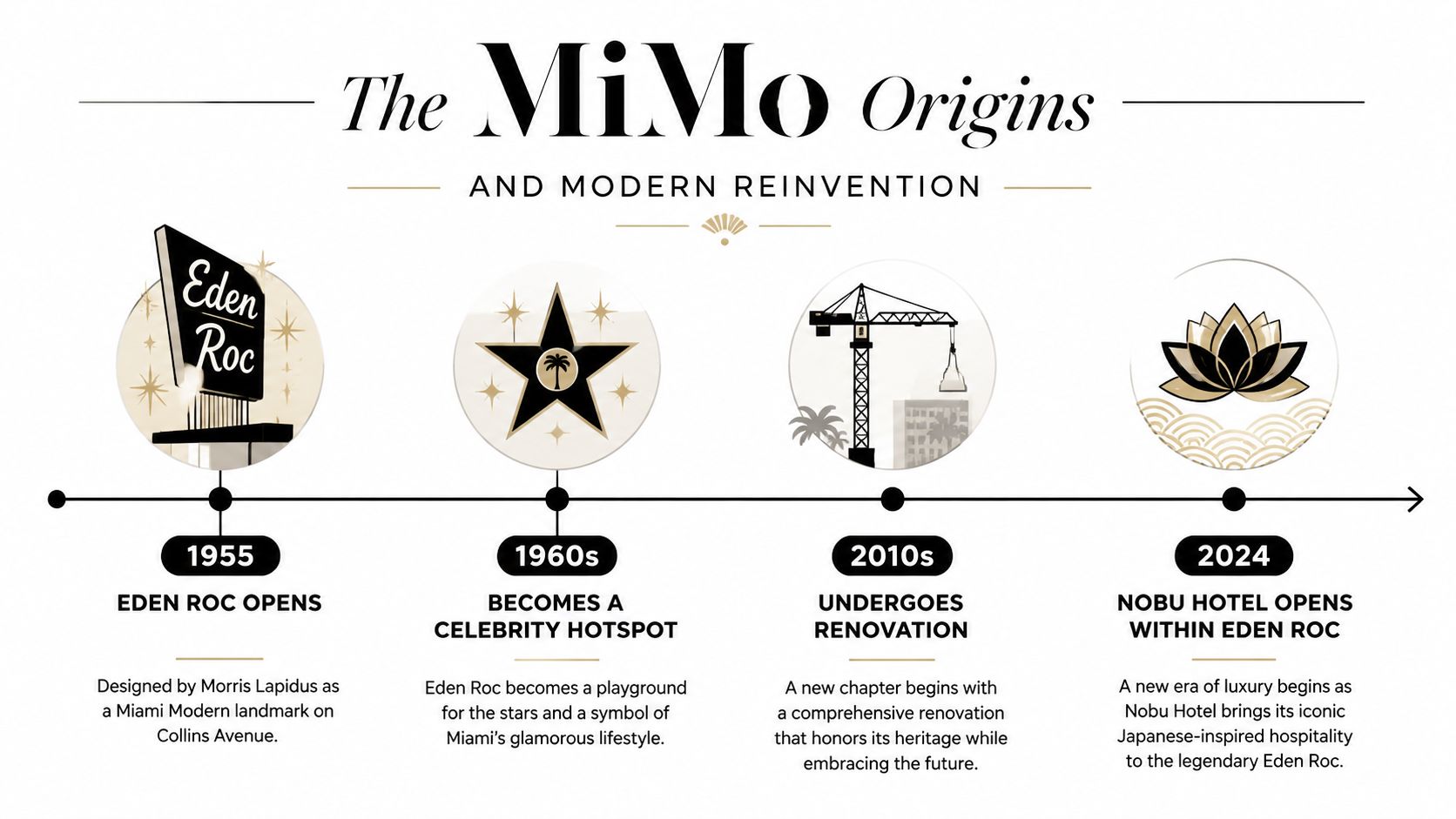
Morris Lapidus designed Eden Roc in 1955, and construction was completed across 1955 and 1956, according to its documented history. That timing places the resort within Miami Modern architecture's formative period, when Collins Avenue hotels used expressive curves, dramatic arrivals, and generous public spaces to make hospitality feel theatrical.
The original design still controls the proportions and visual vocabulary that later work had to negotiate. New finishes and amenities can change the experience, but they do not remove the underlying massing. On a property walk, the most useful evidence appears where contemporary materials meet older geometry, particularly at corners, thresholds, and framed views.
The Mayflower Hotel history offers a relevant comparison: a historic hospitality property can retain architectural meaning beyond its current operating model. Continuity has commercial value only when the present experience keeps the inherited structure legible.
Follow the renovation logic
Eden Roc underwent a major renovation in 2008. The later repositioning had greater impact on how the property operates and how a visual story needs to be constructed.
Nobu Hotel Miami Beach opened inside Eden Roc in 2016, with reservations reported for stays beginning September 16, 2016. The Nobu component launched with 206 rooms and three 2,400-square-foot penthouse suites, showing that the brand entered an existing resort through a defined inventory rather than a separate ground-up building (Nobu Hotel Miami Beach opening coverage).
The 2018 transformation was tied to a reported $250 million renovation, Rockwell-designed public areas, and the introduction of Nobu's signature restaurant and hotel tower concept (Eden Roc's reported transformation). A reported public-space footprint of roughly 70,000 square feet, together with a private pool, shows that the work addressed circulation, dining, events, and lifestyle positioning as much as bedrooms.
That sequence creates the property's visual tension. Lapidus supplied the expressive resort bones. Later interventions introduced a more controlled luxury language, while Nobu added a food-and-beverage anchor capable of drawing attention beyond the room inventory. For photographers, the value lies in documenting the joins, not flattening the hotel into either a preserved MiMo landmark or a new Nobu product.
Understanding the Dual-Brand Structure
Walk from a Nobu-branded arrival into the wider Eden Roc operation, and the ownership of the experience becomes the central question. Marketing imagery can make the property look more divided than it feels on site.
The property's own FAQ confirms the shared-resort arrangement, including common access to major amenities and Nobu-branded dining within the Eden Roc complex (Eden Roc official FAQ). Pools, beach access, and selected public areas remain shared. A Nobu reservation therefore does not create a fully separate resort environment.
As noted in the MiMo Origins section, the transformation connected existing resort infrastructure with a more controlled Nobu identity. That arrangement gives guests a defined room inventory, branded arrival and circulation cues, and access to Nobu's design and dining language. The value sits in that concentration of identity, not in exclusive control of every amenity.
What is shared, and what is differentiated?
The property works through three connected layers:
- Shared resort layer: Pools, beach access, and selected public amenities serve both brands within the same oceanfront operation.
- Nobu layer: Nobu rooms, suites, dining, and arrival cues create a more focused product identity.
- Commercial layer: Eden Roc provides scale and resort infrastructure, while Nobu provides recognition and a premium lifestyle signal.
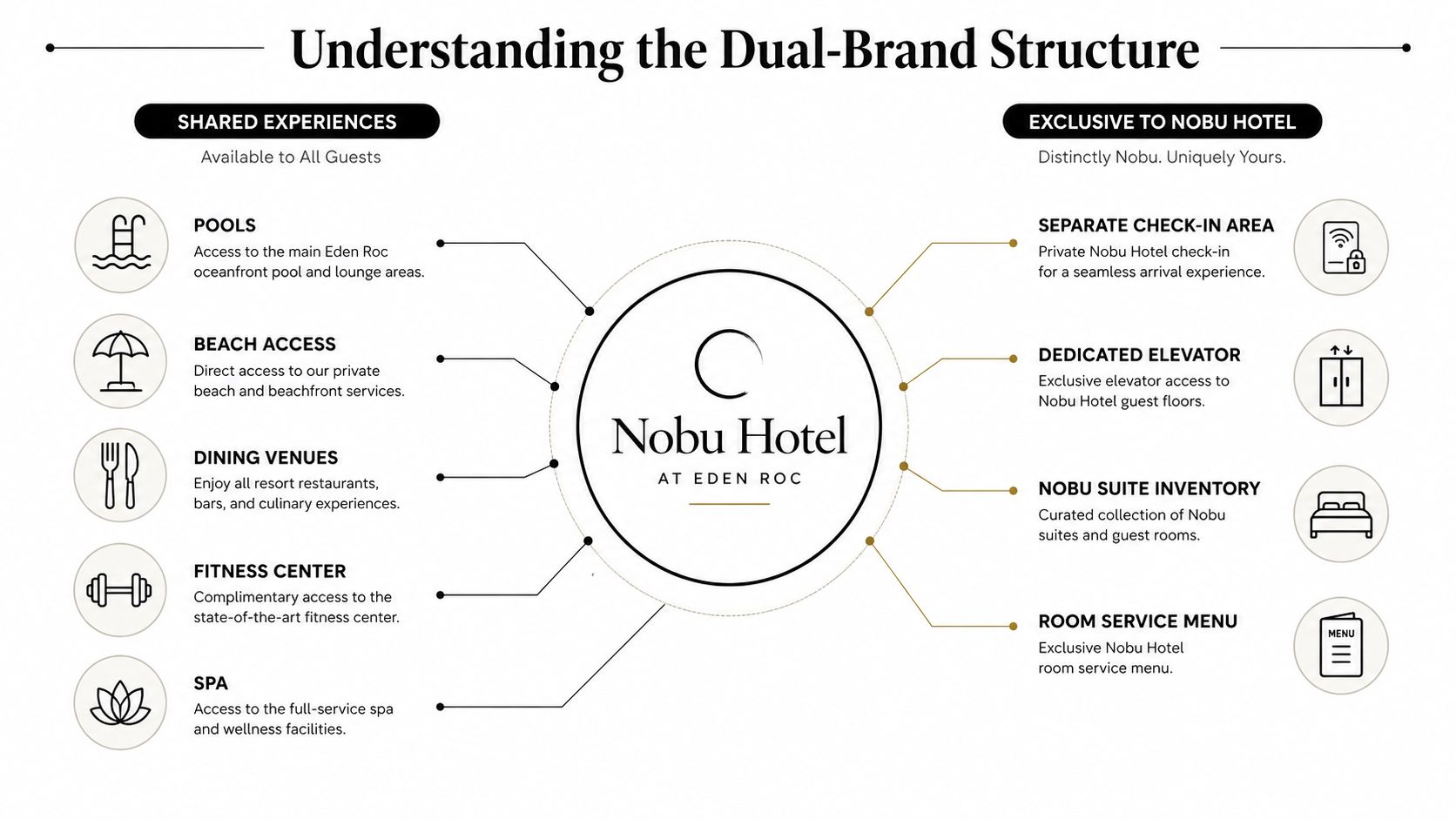
That distinction matters at booking. Guests prioritizing Nobu design, restaurant access, and a distinct room identity may find the arrangement compelling. Guests expecting private control across the pool, beach, and public realm may read the shared amenities as a limitation on the premium they imagined.
It also changes the photography brief. A Nobu-only library can misrepresent the stay if every Eden Roc reference is cropped away. Show the separation where it exists, then include the shared context: circulation, amenity connections, and the resort scale surrounding the Nobu component. That approach gives prospective guests a clearer mental model and gives the brand a more defensible visual story.
Room Types, Suites, and the Nobu Tower Experience
A room assignment here sets the visual and operational brief before the first frame. Nobu and Eden Roc aren't interchangeable inventories, although both sit within the same resort. Nobu offers a concentrated branded experience, while Eden Roc places guests within the broader historic property and its larger range of accommodations.
The Nobu launch inventory consisted of 206 rooms, including three 2,400-square-foot penthouse suites (Nobu Hotel Miami Beach opening details). As documented in the earlier A First Look section, Eden Roc has 621 rooms and 96 suites across the property (Eden Roc room inventory documentation). These figures clarify the dual-brand structure: Nobu is a defined branded component, while Eden Roc supplies the larger resort framework around it.
Compare the experience before comparing the finish
| Feature | Nobu Tower | Eden Roc Tower |
|---|---|---|
| Brand identity | Contemporary Nobu positioning within the Eden Roc complex | Original Eden Roc resort identity |
| Room inventory | 206 rooms at the 2016 launch, including three penthouse suites | Part of the property's larger documented inventory |
| Design reading | More restrained, Japanese-influenced luxury layered into the resort | MiMo heritage, oceanfront resort scale, and established Eden Roc character |
| Public amenities | Connected to shared resort facilities | Operates within the same shared resort environment |
| Best fit | Guests prioritizing Nobu branding, dining, and a defined tower experience | Guests prioritizing the wider Eden Roc resort context and room choice |
| Photography cues | Material restraint, controlled lines, detail, and branded transitions | Curves, scale, balconies, views, and historic resort presence |
The Nobu Tower can feel more specific through its finishes and arrival sequence, yet the surrounding resort remains active. A separate brand identity therefore does not promise a separate atmosphere. Booking language should distinguish design character from privacy, especially when the visual promise depends on shared public areas.
For an architectural photographer, the tower changes the shot list. Nobu rooms reward close studies of joinery, texture, tonal restraint, and the relationship between furniture and view. Eden Roc rooms and shared spaces call for wider compositions that establish scale, horizon lines, balconies, and the older architecture framing the oceanfront setting. The strongest library includes both levels of information, the branded room experience and the property context that makes the hotel-within-a-hotel model legible.
Dining at Nobu and the Food-and-Beverage Anchor
The restaurant gives the property a reason to visit beyond the room, while also revealing how the dual-brand model operates in practice. Nobu's signature dining identity sits inside Eden Roc's larger resort system, connecting lodging, public circulation, and food-and-beverage activity rather than creating a fully separate destination.
For a photographer, the restaurant works as part of a sequence. Arrival establishes the Nobu experience within the broader Eden Roc envelope. The lobby sets the material language, the lounge slows movement, and the restaurant provides a destination point. Photographing that progression produces a more useful story than collecting isolated interior details.
Photograph movement, not just objects
Build the brief around transitions and use:
- Arrival views: Show how guests enter Nobu through the larger Eden Roc setting.
- Lobby transitions: Record shifts in flooring, ceiling height, lighting temperature, and texture.
- Lounge atmosphere: Include seating, circulation, and the boundary between public and semi-private areas.
- Restaurant sight lines: Choose positions that explain depth, table spacing, service routes, and architectural rhythm.
- Material details: Isolate the restrained Nobu palette against the more expressive MiMo character around it.
The transformation previously documented added roughly 70,000 square feet of public space, which makes circulation a meaningful part of the visual brief. A series of disconnected room views would miss the property's scale and commercial intent.
Food-and-beverage imagery benefits from restraint. A server crossing a threshold, a table edge catching controlled light, or a lounge view into the restaurant can communicate use without heavy styling. These frames also show the operational relationship between the two brands, where guests move through shared territory while responding to distinct design cues.
The same approach applies to other destination properties, including the visual strategy described for the Auberge du Soleil Napa Valley hotel. Hospitality photography becomes more persuasive when it records how people move through a property, how spaces connect, and where the branded experience meets the resort's established identity.
The Honest Trade-Offs of a Shared-Resort Stay
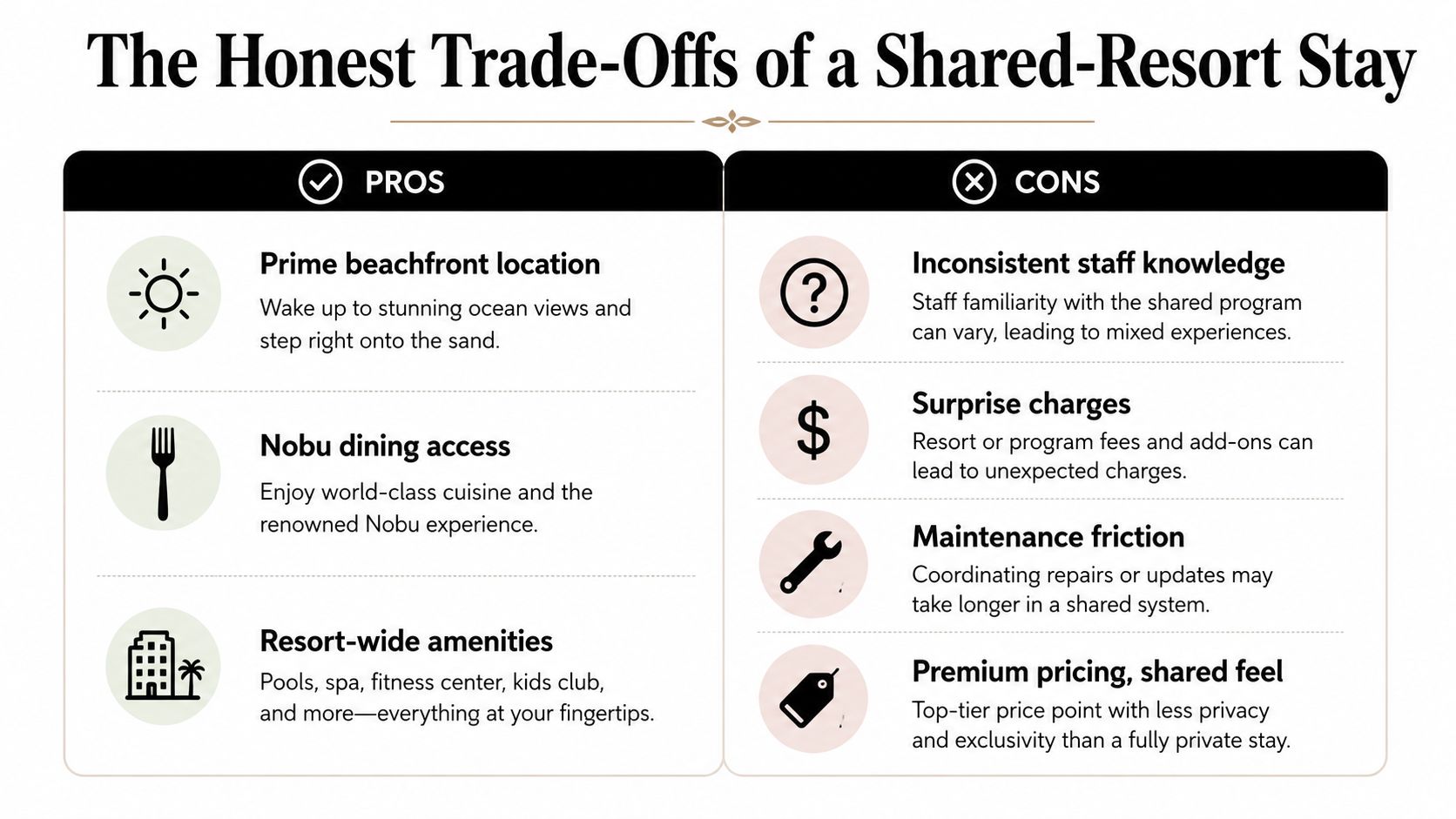
Luxury branding often creates an assumption that every part of the stay will feel exclusive and carefully controlled. The public feedback around Nobu Hotel Miami Beach complicates that assumption. Reviews praise the location, cleanliness, and views, but they also surface complaints involving inconsistent staff knowledge, surprise checkout charges, room comfort, maintenance, parking, and service friction (Nobu Hotel Miami Beach guest review).
That mixed pattern doesn't prove that every stay will include a problem. It does show why buyers should evaluate operations alongside architecture. A polished lobby and recognizable restaurant can establish a premium expectation that inconsistent answers or unexpected charges then weaken.
What works for the buyer
- Beachfront positioning: The oceanfront setting gives both brands a strong location story.
- Nobu dining: The restaurant provides a recognizable reason to visit beyond accommodation.
- Resort scale: Shared amenities and public spaces create more options than a small standalone hotel.
- Architectural character: Eden Roc's MiMo identity gives the property visual distinction that newer luxury hotels may lack.
Where expectations can break
- Shared amenities: Pools and beach access don't necessarily deliver the exclusivity some Nobu guests expect.
- Service consistency: Reviews describe staff knowledge and communication as uneven.
- Additional charges: Guests report surprise charges, so the final folio deserves careful review.
- Maintenance and comfort: Feedback includes room temperature concerns and occasional facility issues.
Before booking: Ask which amenities are shared, request a complete explanation of added charges, and confirm the room's location within the Nobu inventory.
For hospitality marketers, this is a reputation issue rather than a reason to hide the shared model. Clear positioning can prevent the wrong expectation from forming. If the product is presented as a distinct Nobu experience inside a full-service Eden Roc resort, the guest can judge the trade-off fairly.
Photography Suggestions for Architects, Designers, and Hospitality Marketers
A bedroom-only shoot would make Nobu Hotel at Eden Roc look polished but incomplete. The stronger brief treats the property as dual-brand hospitality architecture, showing how Lapidus's expressive resort language meets Nobu's controlled contemporary identity.
Start outside before the light turns harsh. Establish the Collins Avenue frontage with a wide frame, then work closer to the curved forms, balcony rhythm, entry canopy, and arrival signage. Avoid a generic Miami postcard. The images should explain why Eden Roc remains visually legible as a MiMo landmark while accommodating a newer hotel brand.
Photograph the handoffs
Build the story around points where the property changes character:
- Exterior context: Capture the full massing, then isolate the curves and details that carry the MiMo identity.
- Arrival and circulation: Follow the route from the broader Eden Roc environment into Nobu-branded spaces, including thresholds and directional cues.
- Public interiors: Balance bright exterior views with interior material detail, especially where older architectural gestures meet newer finishes.
- Restaurant flow: Photograph from the lobby, lounge, and dining room so the relationship between arrival, hospitality, and food-and-beverage spaces remains clear.
- Rooms and suites: Pair a composed wide frame with close studies of joinery, textiles, lighting, and views.
- Shared resort amenities: Include enough surrounding context to show how Nobu operates within the larger Eden Roc property.
The sequence matters more than isolated hero shots. A transition from exterior curves to contemporary interior thresholds can communicate the dual-brand structure faster than a set of disconnected room images.
Schedule each location according to the story it needs to tell. Early or late light gives the exterior curves more dimension. Controlled interior exposures preserve the restraint of Nobu spaces. Mixed daylight may call for bracketed exposures or carefully balanced supplemental lighting, while the final image should still resemble the room's actual atmosphere.
Keep camera height, lens choices, and color treatment consistent across the assignment. The guide to photographing architecture and interiors provides a broader working reference. At this property, the additional discipline is to preserve the relationship between the two brands rather than edit the friction out of the frame.
For commissioned work, Jimmy Clemmons Photographer provides architectural imagery, commercial brand content, location scouting, lighting design, on-set direction, and professional editing through its Atlanta-based studio. That scope fits a brief covering architecture, interiors, dining spaces, and brand context within one visual system.
Key Takeaways for Booking, Branding, and Visual Storytelling
For travelers, Nobu makes the most sense when the branded room experience, restaurant identity, and contemporary design justify the premium in your own priorities. It makes less sense if you expect every pool, beach, and public area to feel separately controlled. Eden Roc may offer the better fit for guests who want the broader resort environment without placing as much weight on the Nobu label.
For hospitality marketers, the shared-property structure is an asset when described clearly. Eden Roc supplies scale, history, and oceanfront recognition. Nobu supplies a sharper luxury-food-and-beverage identity. The strongest messaging shows how those layers work together instead of pretending they operate as entirely separate hotels.
For photographers and designers, the essential subject is the transition. Photograph the MiMo curves, then the contemporary thresholds. Show the restaurant as a destination and the public realm as a connected system. Let the images acknowledge shared amenities and operational complexity, because credibility is part of luxury communication.
The property works best as a case study in layered hospitality architecture. Its appeal doesn't come from a single tower or room category. It comes from the way history, resort infrastructure, branded dining, and contemporary design occupy the same oceanfront address.
Jimmy Clemmons Photographer creates architectural and hospitality imagery that documents both the designed details and the guest journey, from MiMo exteriors and Nobu interiors to restaurant circulation and branded transitions. Visit Jimmy Clemmons Photographer to discuss a cohesive visual brief for your hotel, architecture, or hospitality marketing assignment.