
You're booked to photograph cecil b day chapel, the client sends a calendar invite, and the first real problem isn't exposure or composition. It's identity. In Georgia, that name points to multiple venues with different architecture, different access rules, and different photographic demands.
That confusion costs time fast. Show up expecting a forest-filtered modern chapel and find yourself in a Gothic interior with stained glass and stone. Build a lighting plan for an intimate sanctuary and discover the assignment is tied to a large event campus. The cleanest shoots start by confirming the exact chapel, then building a process around what that specific building needs.
Planning Your Cecil B. Day Chapel Shoot
The first question is simple. Which Cecil B. Day Chapel are you photographing? The two locations that most often matter to architectural photographers are the chapel at Perimeter Church in Johns Creek and the chapel at the State Botanical Garden of Georgia. There's also the Cecil B. Day Chapel at The Carter Center in Atlanta, which adds another layer of naming overlap.
Perimeter Church and the Botanical Garden aren't interchangeable assignments. Perimeter Church includes a 462-seat worship center, a narthex, and a fellowship hall for 250 as part of a campus expansion by NELSON Worldwide, while the chapel at the State Botanical Garden of Georgia dates to 1994 and presents a distinct modern design. The same philanthropic legacy sits behind both through the Day Foundation, which issued 64 grants in 2023 according to the Cecil B. Day Foundation profile.
Cecil B. Day Chapel locations at a glance
| Venue | Location | Architectural Style | Key Photographic Features |
|---|---|---|---|
| Cecil B. Day Chapel at Perimeter Church | Johns Creek / Atlanta area | Gothic-inspired ecclesiastical interior within a modern campus expansion | Long axial views, stained glass, wood paneling, stone surfaces, event-support spaces |
| Cecil B. Day Chapel at State Botanical Garden of Georgia | Athens | Modern design integrated with natural surroundings | Forest-influenced light, warm wood tones, sanctuary and reception-oriented details |
| Cecil B. Day Chapel at The Carter Center | Atlanta | Modern mission-driven campus architecture | Event-oriented imagery, clean lines, campus context, foyer and gathering spaces |
What to confirm before you pack
Start with the venue coordinator, not the client's shorthand. Ask for the exact address, the space name as listed by the venue, current access windows, and whether the booking includes support areas such as dressing rooms, fellowship spaces, lobby access, or only the main sanctuary.
Then ask for three visual references:
- A current phone walkthrough from the on-site contact.
- Any floor plan or event layout the venue can share.
- A list of restrictions covering tripods, lighting, ceremony blackout times, and load-in paths.
Those details shape everything from lens choice to crew size.
Practical rule: If the venue name is ambiguous, don't rely on the calendar title. Confirm the address and the room name in writing.
Build the scout around the job, not around curiosity
Virtual scouting is useful, but it shouldn't become guesswork. I use it to identify likely hero angles, likely problem windows, and whether the space rewards symmetry or asymmetry. Then I walk the site with a tighter checklist: approach shot, exterior establishing frame, entry sequence, nave or sanctuary axis, side aisles, altar or platform detail, material vignettes, and any support spaces the architect or venue operator cares about.
A pre-shoot checklist for the client also helps. If you need one, this guide on how to prepare a site for a photoshoot is the kind of prep document that prevents small on-site problems from becoming lost shooting time.
Access matters more than most photographers admit
At the Botanical Garden chapel, access should run through the rentals department listed on the venue page. At a church campus, access often depends on staff schedules, worship programming, rehearsals, and custodial windows. A gorgeous room you can only enter for a narrow slice of the day is a different assignment than a room you can control for several hours.
That's why I treat scheduling as part of the creative plan. If I can't control the room, I simplify the shot list and prioritize the images that can't be faked later.
Recommended Gear for Flawless Chapel Photos
The gear list for cecil b day chapel work isn't about owning the most equipment. It's about bringing the few tools that solve architectural problems cleanly. Chapel interiors punish weak support gear, sloppy wide-angle choices, and any setup that forces rushed decisions.
The core kit
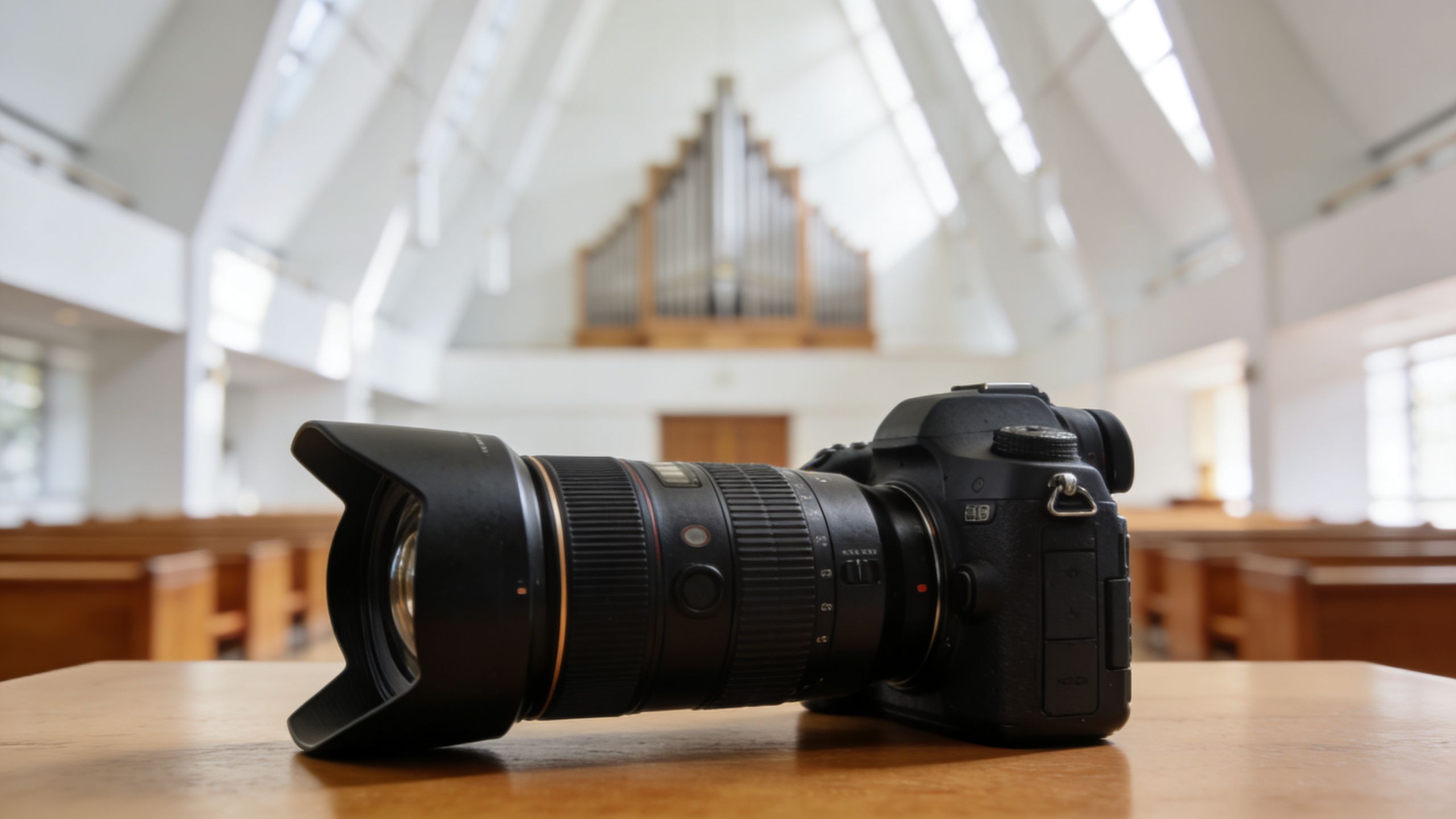
A full-frame mirrorless body is the baseline. Not because smaller formats can't make good images, but because chapel work often means bright windows, dark wood, stone, and reflective finishes in the same frame. You need room in the file for careful blending and color correction later.
The most important lens in the bag is still the tilt-shift. Straight verticals matter in sacred architecture. They matter even more when you're photographing spaces that architects, contractors, and developers will inspect closely. A corrected frame feels intentional. A distorted frame feels hurried.
My normal carry for this type of assignment looks like this:
- Tilt-shift wide lens for hero interiors and any elevation where vertical control matters most.
- Rectilinear wide-angle zoom for speed when access is limited and I need coverage from several positions.
- Normal or short telephoto prime for details, joinery, fixtures, and compressed views that isolate design decisions.
- Heavy tripod with a geared head for repeatable composition and bracket consistency.
- Remote release or app trigger to keep the camera stable during multi-frame sequences.
What earns its place
The tripod isn't optional. In a chapel, the difference between a frame that feels calm and one that feels unsettled is often a minor correction in height, pitch, or lateral shift. A geared head lets you make those adjustments without fighting the camera.
I also bring color control tools every time. Mixed light in religious interiors can drift fast, especially when daylight, chandeliers, stained glass, and bounced fill all interact. If wood turns orange or stone picks up a strange cast, the image stops feeling trustworthy.
For photographers refining their architectural kit, this overview on photographing architecture and interiors aligns with the same principle. Bring gear that protects line integrity, tonal control, and repeatability.
What I leave behind
I avoid novelty lenses, ultra-fast primes I won't use at working apertures, and lightweight travel tripods that flex under pressure. Chapel assignments reward precision more than improvisation. If a tool doesn't help hold perspective, stabilize the frame, or solve a lighting problem, it stays in the case.
The best architectural kit is boring in the right ways. It lets the building do the talking.
Mastering Natural Light and Ideal Timing
Light tells the story before composition finishes it. At cecil b day chapel, that story changes completely depending on which location you're in and what time you arrive. The same pews, stone, or wood can read contemplative in the morning, flat at midday, and dramatic again at dusk.
Morning makes different promises than afternoon
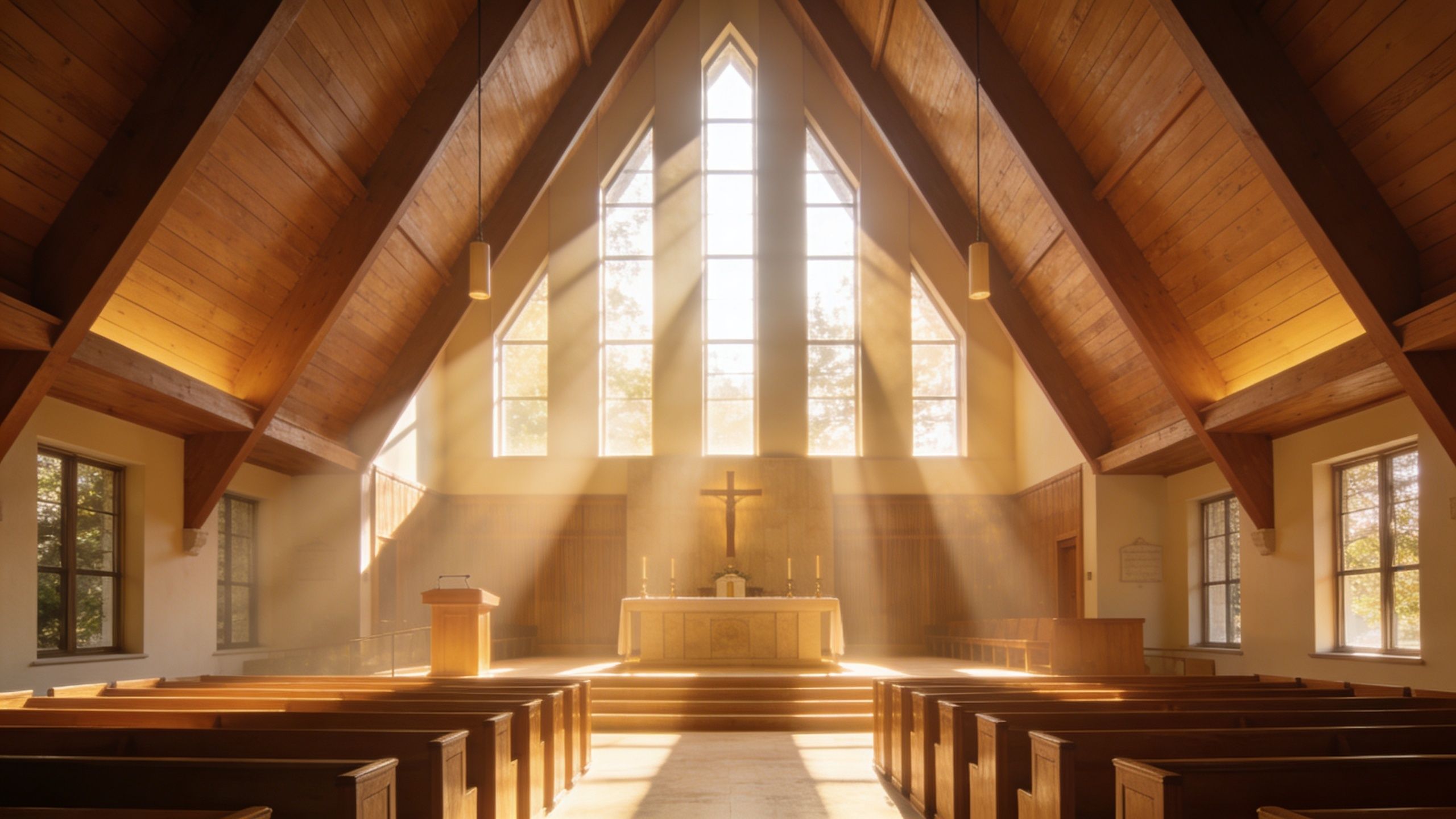
When I scout a chapel, I usually think in three windows. Early light is useful for texture and directional shape. Midday gives a more literal record of the room, though it can flatten forms and intensify hot spots near glazing. Late-day light often brings the most emotional frame, especially when the interior materials pick up warmth without losing detail.
At the State Botanical Garden chapel, natural light has to be read through the site itself. The surrounding natural environment changes the color and softness of what enters the building. That's great for mood and difficult for consistency. In a Gothic-inspired room like Perimeter Church, the stained glass and high interior finishes can make timing more theatrical. You don't just get illumination. You get hierarchy.
Read the building before you read the meter
I like to walk the room without the camera first. Watch where the brightest patch lands. Watch which wall goes muddy. Look for where the platform, altar, pews, or side aisles gain separation. The right shooting time is the one that clarifies the architecture you were hired to show.
A few practical timing calls tend to hold up:
- Exterior establishing images often work best near blue hour, when interior glow and exterior form can coexist.
- Symmetrical sanctuary views usually benefit from softer daylight, especially when windows sit inside the frame.
- Material and detail studies often improve when direct sun is off the surface and texture isn't fighting specular highlights.
This is why blue-hour scheduling still matters for high-end architectural work. The discipline behind it is well explained in this blue hour guide for luxury projects.
A full-day light read
Overcast days are underrated for chapel interiors. They remove some drama, but they also give you a calmer tonal base for wide compositions. That can be exactly what the architect wants if the assignment is about form, finish, and spatial flow rather than spectacle.
Later in the day, I'll often return for the emotional frames. Those aren't always the broadest views. Sometimes they're the side angle where the pew rhythm catches light, or the back-of-room composition where the volume of the space finally reads.
A short visual reference helps when planning these windows:
Don't chase “good light” in the abstract. Chase the light that explains the room.
Composing and Framing the Architecture
You arrive with a clean light window, set the tripod on center, and get the expected wide shot. Then the essential work starts. A strong set for cecil b day chapel has to explain how the building is read, not just prove you were in the room.
That matters even more here because "Cecil B. Day Chapel" usually refers to two very different Georgia locations. The Perimeter Church chapel asks for formal, processional compositions with strong axial control. The Day Chapel at the State Botanical Garden rewards frames that account for a smaller footprint, heavier wood presence, and surrounding greenery that can shift both color and contrast. If you treat them as the same building, the gallery looks generic fast.
The foundational shot list
I build coverage around a few required views, then adjust the camera height, focal length, and spacing to suit the architecture.
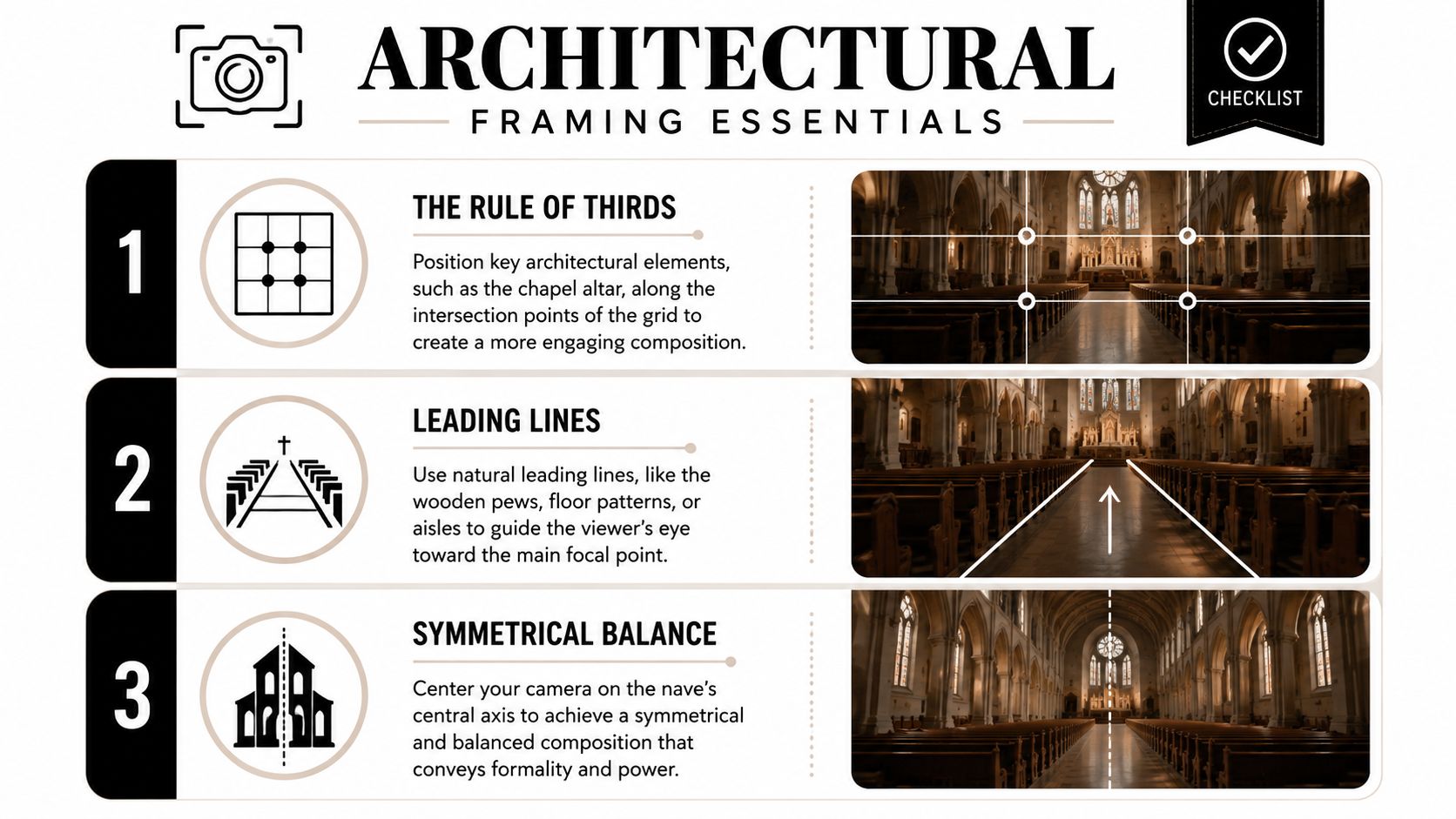
- The axial view: Use the main centerline for a clear one-point perspective through the sanctuary.
- The offset wide: Step off axis enough to show depth, sidewall rhythm, and how circulation reaches the focal point.
- The threshold frame: Show the transition into the worship space from the exterior, foyer, or vestibule.
- The material vignette: Isolate joinery, stone, wood, hardware, or liturgical elements with architectural intent.
- The support-space image: If the commission includes lobby, bridal suite, reception use, or gathering space, photograph those rooms with the same discipline as the sanctuary.
Symmetry earns its place
Chapels usually want one centered hero frame. Clients expect it, and for good reason. It describes hierarchy, procession, and proportion in one image.
It should not carry the whole gallery.
After I have the centered nave view locked, I start looking for frames that explain authorship. An aisle that reveals pew spacing. A side angle that shows how the platform sits in the volume. A corner where daylight separates timber from stone. Those photographs tend to be more useful to architects because they show decisions, not just scale.
A complete chapel gallery shows order, use, and material intent.
Different buildings, different framing priorities
At Perimeter Church, the room can handle stricter symmetry and longer visual runs. I usually keep the camera lower than many photographers expect, around seated eye level or slightly above, so the pews lead into the chancel instead of flattening out. Longer focal lengths from the rear third of the room often describe the space better than going ultra-wide from the back wall.
At the State Botanical Garden Day Chapel, I work more carefully around edge distortion and color contamination from the site. My own preference there is a tilt-shift wide lens or a corrected moderate wide, usually stopped down enough to keep the envelope crisp without pushing diffraction too far. I also set a custom white balance or make a gray-card reference frame because the surrounding canopy can push the wood cooler or greener than it reads in person. Those are workflow choices from field experience, not venue rules.
Bracketing can help in the Botanical Garden chapel when stained glass, bright openings, and dark timber all sit in the same composition. I use it selectively, especially for locked-off interior views where I know the client will care about window detail and believable wood tone.
Framing choices that weaken the set
The easiest way to lose discipline is to chase drama with focal length. Go too wide and the pews start bowing, the platform feels farther away than it is, and verticals need more correction than the file wants to tolerate. Stand too high and the room stops feeling welcoming. Stand too low without purpose and foreground furniture takes over.
I would rather deliver a tighter frame with clean geometry than a louder frame that advertises the lens.
Sacred spaces show every shortcut.
Advanced Lighting for Interiors and Exteriors
You arrive before sunrise, the scouting notes say "Cecil B. Day Chapel," and the lighting plan you built for one building does not fit the other. That happens more often than it should in Georgia because two very different venues share that name. The Perimeter Church chapel asks for controlled interior shaping across a larger worship space. The State Botanical Garden chapel rewards a lighter touch because glass, timber, and surrounding greenery can turn artificial light into a color and reflection problem fast.
Build the light around the architecture
At Perimeter Church, I usually treat the room in zones instead of trying to blast the whole sanctuary into balance with one idea. A three-light approach is often enough. One controlled key light to reinforce the direction the room already suggests, one bounced fill source to open the shadow side of pews and paneling, and one accent light only where trim or architectural separation disappears on camera.
Placement matters more than quantity. I set the key off-axis so columns, millwork, and seating keep shape. Fill gets bounced, flagged, and kept modest because the goal is readable wood tone with depth still intact. The accent light is selective. If every edge glows, the room starts to look staged rather than designed.
At the State Botanical Garden Day Chapel, I cut that plan back. The materials and setting are less forgiving. Glass picks up stray sources quickly, and the surrounding environment can push green spill into both shadows and highlights. In that space, one bounced interior source and careful exposure control often outperform a bigger setup.
Control spill before adding power
Stone, polished floors, varnished wood, and glazed openings punish sloppy light. The first fix is not more watt-seconds. The first fix is tighter control.
Grids, flags, black side panels, and disciplined feathering keep the beam off surfaces that should stay quiet. If a floor catches a hard hotspot or a window frame flashes brighter than the wall around it, the image stops feeling architectural and starts feeling lit. Clients may not describe the problem technically, but they see it immediately.
A few trade-offs are consistent across both chapels:
- Bare flash into open space covers ground quickly, but it flattens form and creates reflections you will spend too long correcting.
- Bounced fill takes longer to position, but it preserves the room's natural hierarchy.
- Large soft sources help with wood and painted plaster, but they need flags or they will wash into glass and stone.
- Small controlled accents are useful on trim, organ details, or entry doors, but only when those elements are getting lost.
I would rather make three careful frames with adjusted light positions than force one compromised setup across the whole assignment.
Interior and exterior lighting need different priorities
Interior work is about separation, material accuracy, and keeping practical fixtures believable. Exterior work is about balance. For Perimeter Church, that often means letting the building carry most of the frame and using a small amount of supplemental light at the entry or under covered areas where the façade falls dead. For the Botanical Garden chapel, I am even more restrained because the exterior already has a softer visual rhythm. Too much added light fights the site.
Twilight can help, but only if the interior exposure and the sky exposure feel related. If the windows glow several stops hotter than the façade, or the sky goes electric while the building stays flat, the file looks assembled instead of observed.
Light should clarify the building's intent. If the lighting becomes the subject, the photograph has drifted off brief.
Post-Processing and Image Blending Workflow
Post is where chapel files either stay architectural or drift into effect-driven rendering. I don't want a glossy HDR look. I want a finished image that feels calm, accurate, and intentional.
Start with selection, not software tricks
Import everything, then cull by composition first. Don't get distracted by a bright stained-glass detail if the frame itself is weak. I rate the locked-off hero shots, then the support images, then the detail set. That order keeps the edit centered on the story of the building rather than isolated visual bait.
Once the selects are set, I sync baseline adjustments only where they genuinely match. Chapel interiors often vary enough from angle to angle that blanket settings create more cleanup later.
Blend for natural range
For bracketed interiors, I prefer a restrained blend. Merge enough exposure information to hold window detail and interior texture, then refine manually so the image still looks like a real space. If the pews glow unnaturally or the shadow side of the room becomes as bright as the sunlit side, the file stops feeling trustworthy.
A clean workflow usually looks like this:
- Correct lens profile and perspective before serious tonal work.
- Balance white point and wood color so warm materials stay rich without turning orange.
- Blend exposures selectively with attention to windows, floors, and dark trim.
- Tame local distractions such as bright exit signs, uneven practicals, or color contamination from mixed sources.
- Sharpen late and only to the level needed for the delivery use.
Keep materials honest
Wood should read like wood. Stone should stay neutral unless the actual light says otherwise. Painted walls and trim need consistency from image to image, especially if the client is using the set in a proposal, portfolio, or editorial spread.
I'm careful with clarity and local contrast in sacred spaces. Too much and the room starts looking brittle. The better result is usually a softer hand with contrast and a firmer hand with color accuracy and line correction.
Delivering Images for Your Architectural Client
The finished gallery isn't a dump of your best frames. It's a business tool. For an architect, developer, contractor, or venue operator, the value of a cecil b day chapel shoot comes from how clearly the images communicate design intent and practical use.
Sequence the gallery like a walkthrough
Lead with the image that establishes identity. Then move into arrival, entry, primary volume, secondary views, and tactile details. That sequence mirrors how people understand buildings. It also helps non-photographers read the set without effort.
A smart delivery usually includes a mix of uses:
- Portfolio hero images for architects and designers
- Context frames for real estate and development teams
- Detail and finish images for contractors and millwork-focused stakeholders
- Event-capable views for venue and hospitality marketing teams
Why adaptive reuse matters in the edit
This matters more now than many photographers realize. The repurposing of U.S. church properties has risen 25% since 2020, and for a venue like the Perimeter Church chapel, imagery that highlights capacity and AV integration for corporate or hybrid events can answer a real market need for architects and developers, according to NELSON Worldwide's project page discussion of adaptive reuse demand.
That changes what “complete coverage” means. A sanctuary image alone may not be enough. The client may also need views that show circulation, ancillary gathering areas, staging logic, or how the room can host more than one kind of use.
Strategic photography beats simple documentation
If you deliver only beautiful symmetry, you've documented the room. If you deliver a narrative that shows atmosphere, material quality, and flexibility, you've helped the client sell the building's value.
That's the difference between being treated as a shooter and being treated as a partner. The gallery should help a client win approvals, market the venue, support a feature, or demonstrate that a sacred space can serve broader civic and commercial functions without losing its identity.
The strongest architectural set doesn't just show what a building looks like. It shows what the building can do.
If you need architectural photography that treats a chapel, campus, or commercial interior with that level of care, Jimmy Clemmons Photographer brings an editorial eye, precise lighting control, and a design-focused workflow to projects across Atlanta and the region.