
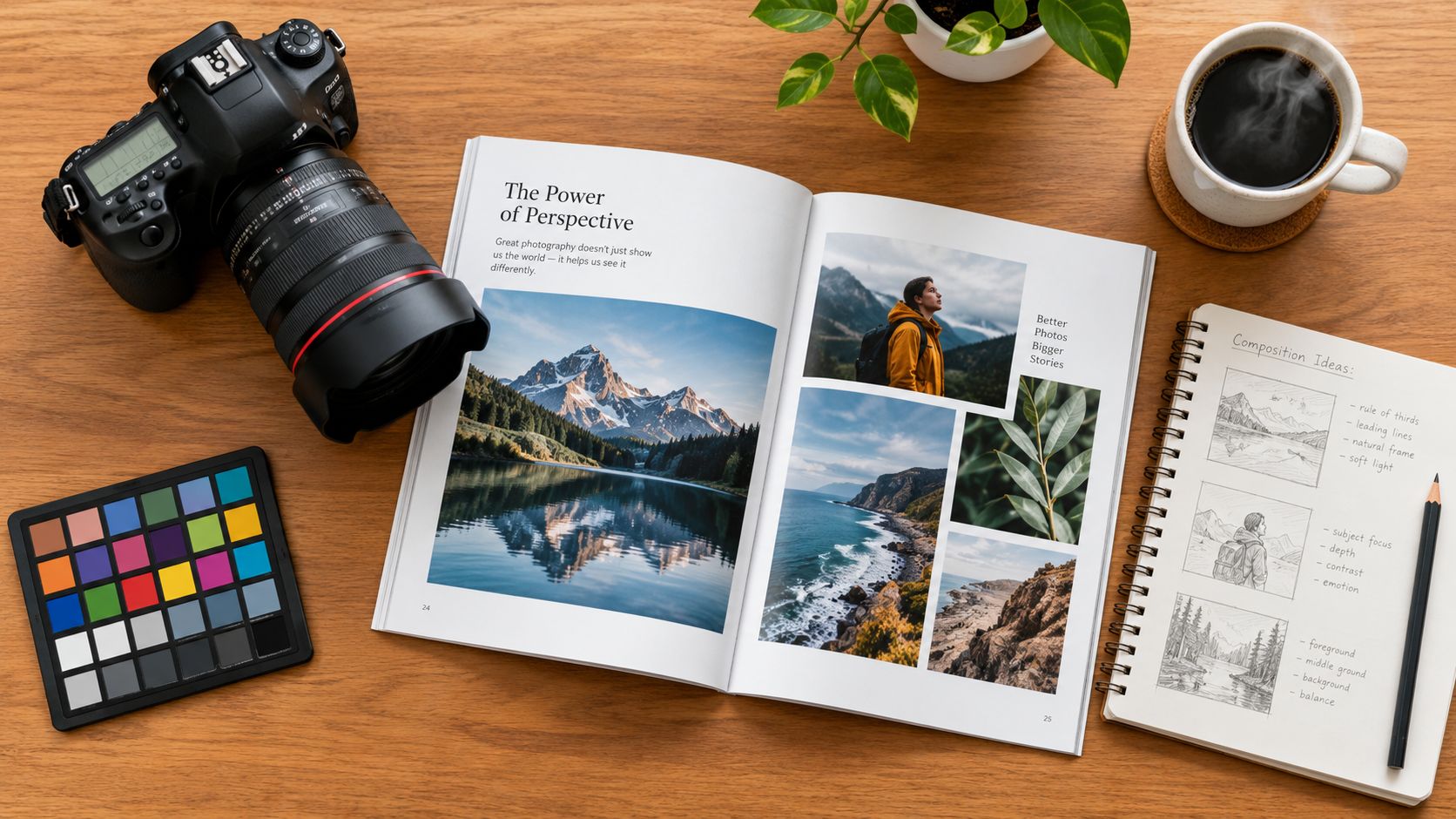
Editorial photography is visual reporting created to support a published story, prioritizing context and credibility over direct product promotion. It can be candid or carefully directed, but its purpose is to inform, explain, document, or establish atmosphere rather than sell.
You may be standing in a finished interior with a camera, surrounded by polished surfaces, controlled light, and a client asking for “editorial-looking” images. That phrase sounds clear until the same photograph is proposed for a magazine feature, a property website, a paid social campaign, and a sales brochure. The visual treatment might remain similar, yet the assignment can move from editorial to commercial as soon as its intended use changes.
That distinction matters more than whether an image feels candid, cinematic, minimal, or magazine-like. Editorial photography is defined by purpose, context, placement, and rights.
Understanding Editorial Photography in Context
A beautifully lit photograph of a dining room can serve two entirely different functions. In a design feature, it might show how daylight moves across stone, timber, and upholstery, helping readers understand the architect's decisions. In a property campaign, the same frame might persuade prospective buyers to schedule a viewing. The composition may be identical. The assignment is not.
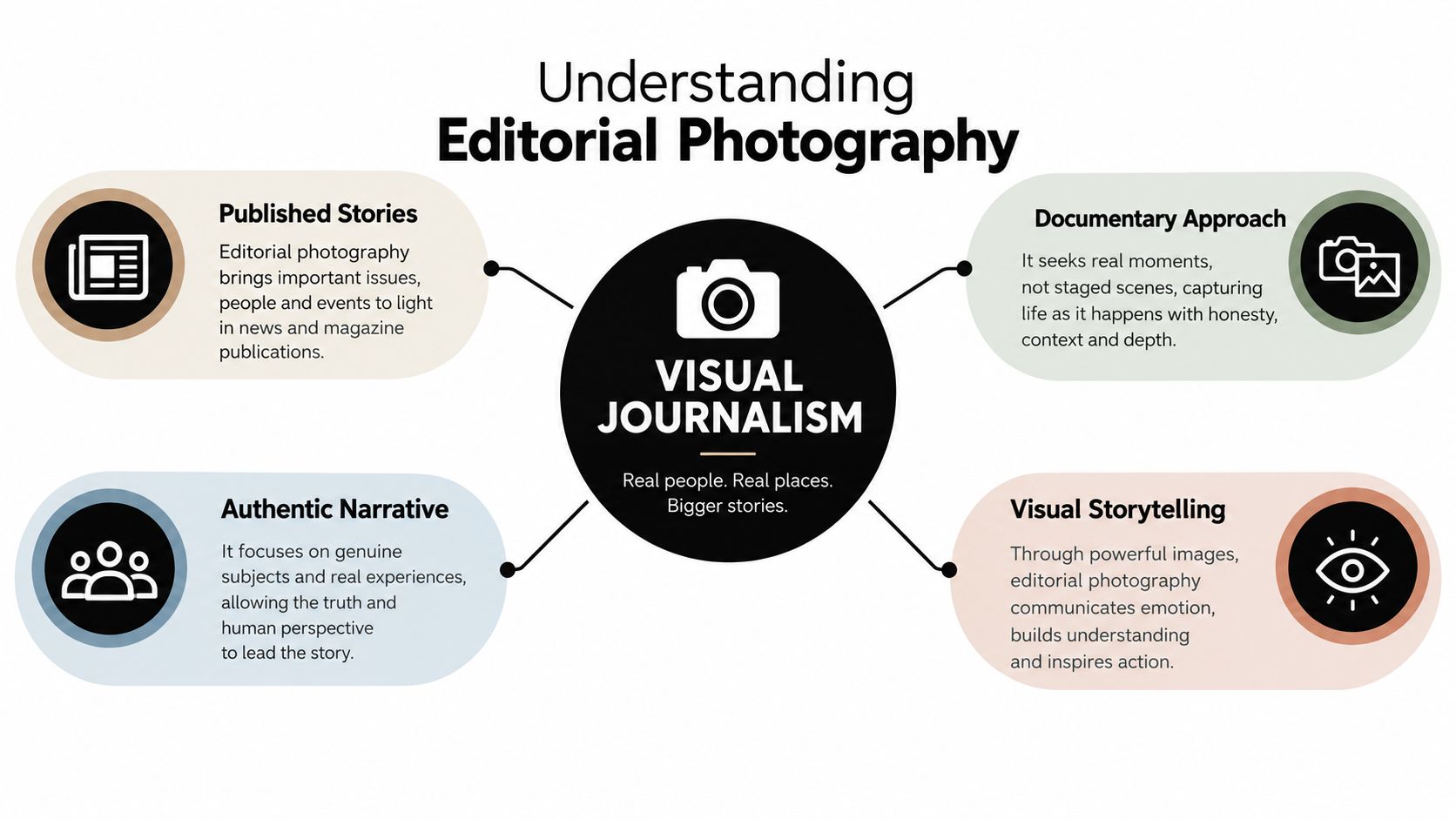
Editorial photography is photography created to support a published story, argument, or subject rather than to advertise a product directly. Its defining function is contextual. The image works alongside written reporting or a feature to inform, explain, document, or establish atmosphere. Editorial photographs commonly appear in newspapers, magazines, journals, online publications, and educational media, and may depict real people, places, events, or environments. The genre developed from photojournalism during the mid-19th century, when advances in printing made it increasingly possible to reproduce photographs for mass audiences. This history of editorial photography places the medium within the development of reproducible visual reporting.
More than illustration
An editorial photograph doesn't decorate a page. It gives readers evidence of a place, a person, a process, or a social condition. A portrait can establish character, an exterior can locate a story, and a detail can reveal the material or human reality that written description alone might miss.
That evidence doesn't require a photographer to work invisibly. Editorial assignments may be candid and documentary, or they may involve deliberate composition, lighting, location selection, and portrait direction. The test is whether the decisions help communicate the story's meaning without turning the image into an unacknowledged sales device.
The genre's roots sit in photojournalism. Early documentary photographers showed that pictures could influence public opinion and encourage social reform, while later illustrated magazines established the photo essay as a major editorial form. Contemporary publications continue that tradition across print and digital platforms, where a considered sequence can make a reported subject easier to understand and more emotionally immediate.
A working definition for teams
For an architect, editor, or marketing manager, the useful question isn't “Does this look editorial?” Ask instead:
- What story does the image support? Identify the article, interview, visual essay, or reported subject.
- Who controls the surrounding context? A publication may frame the image through captions and reporting, while a brand controls its own promotional placement.
- What will the audience be asked to do? Understanding a place differs from buying, booking, applying, or endorsing.
- What rights were agreed? Editorial publication and later promotional reuse aren't automatically interchangeable.
Editorial planning also benefits from a clear assignment calendar. Teams coordinating interviews, photography, captions, and publication dates may find editorial template picks for marketers useful for organizing dependencies without confusing content planning with image licensing.
For photographers working across architectural, portrait, and brand assignments, it also helps to distinguish this genre from broader commercial categories. A practical comparison of commercial photography types can clarify where an image package serves a publication and where it serves a business objective.
Technical Workflow and Publication Standards
Editorial credibility depends on more than a strong frame. A publication needs files that survive design, cropping, color conversion, archiving, and multiple rounds of review. Technical decisions made on location affect what an editor can use later.
Start with the publication specification
The Professional Publishers Association identifies 300 pixels per inch as a typical magazine-print resolution, while noting that individual publications may specify different requirements. It recommends supplying files in RGB with an embedded, accurate ICC profile unless the publication defines a destination CMYK space. Its picture delivery guidance also advises minimal or no sharpening on supplied files, maximum tonal range for archival images, and lossless formats such as TIFF when appropriate.
That guidance should shape the shoot, not just the export. Capture at the camera's maximum native resolution, protect highlight detail in windows and bright façades, and preserve a broad tonal range through raw processing. A file that looks dramatic on a laptop but clips the sky, erases shadow detail, or shifts neutral walls during conversion gives the publication less to work with.
Build the file around the crop
Ask for the intended placement before you photograph. A double-page spread, vertical cover, web header, and mobile crop all demand different compositional allowances.
For a large interior spread, the page gutter can remove important central content. Keep critical architectural features away from frame edges, and include deliberate negative space where type may sit. Make publication-specific proofs before final delivery, especially when the image includes skin, wood, daylight, painted walls, or mixed artificial lighting.
Color management deserves the same attention as composition. An embedded profile helps editors and designers interpret color consistently. Premature conversion to an unspecified CMYK profile can create avoidable shifts in neutral walls, wood tones, skin, and daylight balance.
A dependable delivery sequence
A practical workflow looks like this:
- Confirm the brief. Record publication, story angle, required image count, orientations, crop expectations, captions, credits, and delivery deadline.
- Capture generously but purposefully. Make establishing frames, medium views, details, portraits, and alternate orientations rather than repeating near-identical compositions.
- Preserve originals. Keep raw files and an organized archive separate from edited exports.
- Edit for truth and range. Correct exposure, color, dust, and minor distractions without changing the factual meaning of the scene.
- Export to specification. Use the requested dimensions, color space, profile, file format, naming convention, and sharpening settings.
- Review in context. Check a proof against the proposed page or screen placement, not only as a full-frame image.
Teams managing interviews, selects, approvals, captions, and delivery can also streamline your content pipeline by keeping those stages visible to everyone involved. The software won't replace editorial judgment, but it can reduce avoidable confusion about which file is approved and which caption belongs with it.
Rights belong in the same pre-production conversation as file specifications. Before a building is photographed, clarify permissions, permitted uses, duration, territory, exclusivity, and whether the client expects later marketing reuse. An overview of architectural image rights and licensing is a useful reference when the same location may appear in editorial and commercial contexts.
Narrative Alignment in Architecture and Design
An architectural assignment fails when every frame is attractive but none explains the building. A polished elevation can establish location and proportion, yet it rarely tells a reader how occupants move through the space, how materials meet, or how light changes the atmosphere.

For architecture and design assignments, the photographer should document more than a polished elevation. Images should explain how a space is experienced, identify the relationship between materials and light, and provide a mixture of establishing views, detail frames, and human-scale moments. Unlike advertising imagery, editorial photographs generally prioritize credibility and contextual meaning over idealized brand control. The image earns its place when it helps the reader understand the story. Adobe's editorial photography guide makes that narrative alignment central to the genre.
Design the sequence before chasing the hero frame
A useful architectural sequence often moves from orientation to experience:
- Establishing view: Show the building in its neighborhood, terrain, or surrounding infrastructure.
- Threshold image: Explain how a visitor enters, approaches, or transitions between public and private areas.
- Spatial relationship: Connect rooms, levels, sightlines, or circulation routes.
- Material detail: Isolate a joint, texture, reflection, fixture, or construction decision that supports the written story.
- Human-scale moment: Show how a person occupies the space without making the photograph feel like an advertisement.
- Atmospheric frame: Use light, weather, shadow, or stillness to communicate the building's character.
This sequence gives editors options while preserving a visual argument. It also stops the shoot from becoming a checklist of isolated rooms.
Practical rule: If a reader can admire the photograph but can't infer how the place works, the package needs more context.
Lighting should serve that understanding. Balance daylight and practical fixtures rather than flattening every room into a uniform brightness. A carefully placed person can reveal scale, but a staged gesture that implies an activity never performed in the space can weaken credibility. The photographer's job is to direct what helps the audience read the environment, not to manufacture a lifestyle claim.
Work with the story's point of view
Before arriving, ask what the assignment is actually about. Is the feature concerned with adaptive reuse, material conservation, workplace behavior, hospitality, sustainability, construction craft, or the relationship between an interior and its setting? Each answer changes where you stand and what you prioritize.
A feature about material decisions needs close frames and controlled reflections. A story about community use needs people and interactions. An interview with a designer may require portraits that connect the subject to the work rather than placing them against an anonymous backdrop.
The same discipline applies to corporate spaces. A headquarters photographed for a reported feature should reveal how people use it, while a campaign image may prioritize a controlled, aspirational environment. Editorial photography doesn't prohibit polish. It requires polish to remain subordinate to meaning. For a deeper look at turning places and people into coherent visual narratives, photography storytelling techniques provide a useful conceptual foundation.
A short visual walkthrough can help teams assess sequence and spatial logic before final selection:
The strongest package feels intentional without feeling over-controlled. It gives the publication enough variety to build a page, enough accuracy to support the reporting, and enough visual character to hold attention.
Distinguishing Editorial Purpose from Commercial Style
The common mistake is to define editorial photography by appearance. People associate the genre with available light, unposed subjects, muted color, imperfect details, or a magazine aesthetic. Those choices can support editorial work, but none of them determines the category.
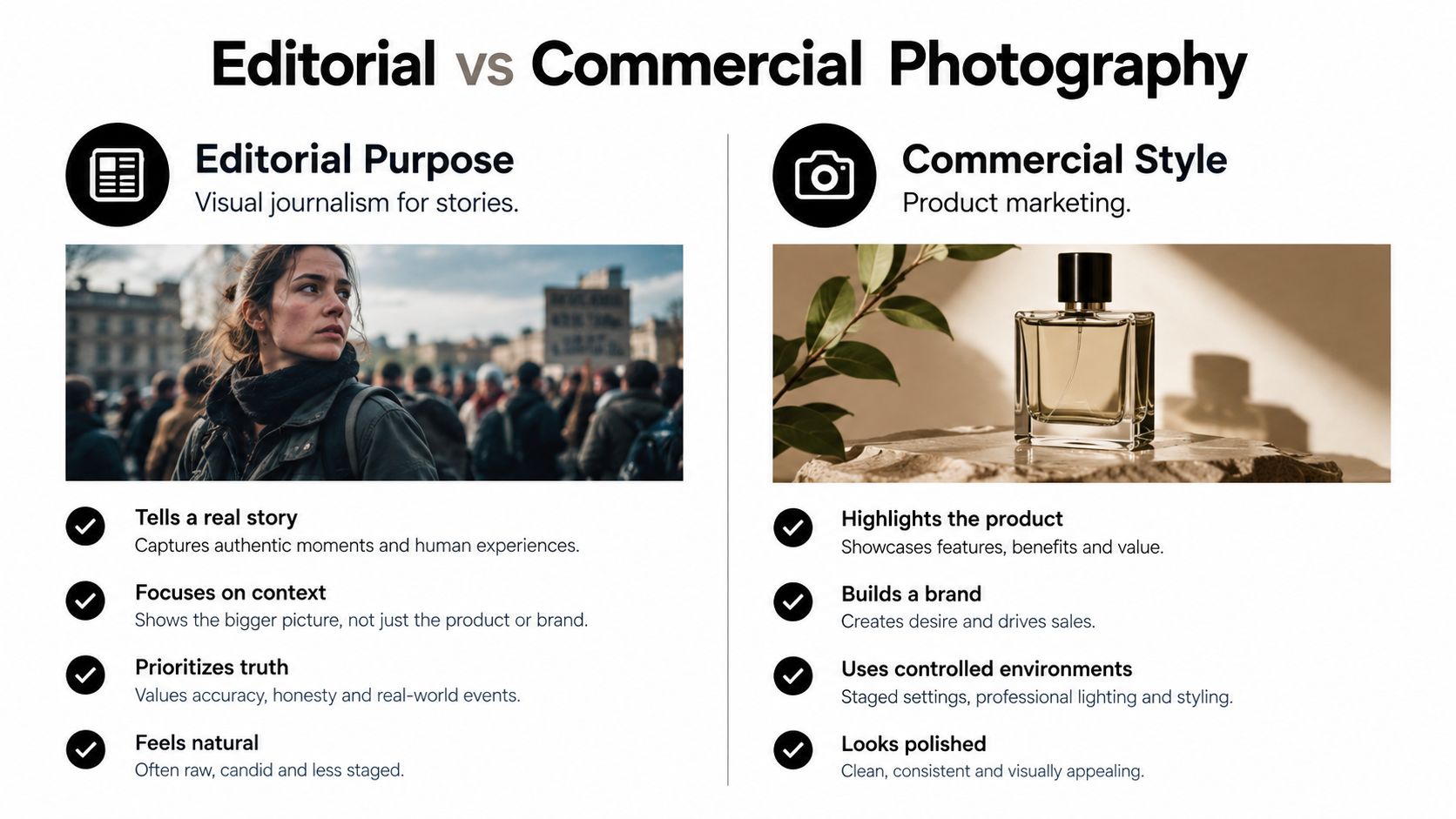
A photograph of an office can be editorial when a publication commissions it to accompany a reported workplace feature. The same photograph can become commercial when the building owner places it on a leasing page, in a brochure, or in a paid campaign designed to attract tenants. The camera doesn't make that decision. Intended use and placement do.
Use this decision test
Ask four questions before the shoot:
| Question | Editorial direction | Commercial direction |
|---|---|---|
| What surrounds the image? | Reporting, criticism, interview, or feature | Promotion, sales material, campaign, or endorsement |
| What is the image meant to do? | Inform, document, explain, or establish context | Persuade an audience to choose or support an offering |
| Who controls the message? | Publication and editorial process | Brand, owner, agency, or marketing team |
| What rights are needed? | Agreed publication use and editorial placement | Promotional licensing, reuse, duration, territory, and campaign terms |
Hybrid assignments need especially careful wording. A magazine may commission a photograph, then the subject may request permission to reuse it in marketing. A brand-funded story may appear in an editorial-looking environment while still serving a commercial objective. Neither situation should be left to assumption.
Settle usage rights, subject releases, property permissions, exclusivity, territory, duration, and retouching limits before production. If the client wants one shoot to serve publicity and brand marketing, price and license those uses separately where appropriate. The photograph may be reusable, but the original editorial purpose doesn't automatically grant commercial permission.
Protect the evidentiary role
Truthful representation is the principal ethical boundary. Editorial captions should reflect reality, avoid unsupported assumptions, and stay within what the photographer knows or what can be sourced. Government guidance describes news or editorial use as reporting on people, places, matters, events, or exhibitions that are newsworthy or of general public interest, rather than advertising or other promotional use. This licensing guidance reinforces why placement matters.
Images shouldn't be presented as spontaneous evidence if they were materially staged or altered in ways that change their meaning. The National Press Photographers Association's ethics guidance is described as prohibiting staging and adding or removing elements, while journalism guidance requires substantial digital manipulation to be labeled a photo illustration. This discussion of editorial ethics explains the boundary in practical terms.
Captions are part of the reporting, not an administrative afterthought. Identify people and place, state when the image was made, describe what is happening, and add relevant context. Use complete sentences, correct names, formal place names, and factual language rather than guesses. Caption-writing guidance from a journalism school offers a useful model for building that information into the opening sentence or sentences.
Navigating AI, Authenticity, and Audience Trust
Synthetic image tools have made the old distinction between correction and alteration harder to maintain. Tonal adjustment, dust removal, and cropping generally support presentation. Generating a person, removing a structural element, or changing an event can alter what the image claims to show.
Recent U.S. research found that about half of respondents considered AI labels essential even when journalists remained involved in verification. 58% wanted news organizations to establish ethical guidelines before using AI, and nearly six in ten expressed little or no confidence in news organizations using AI to create images or articles. The research summary from the University of Minnesota reports these findings.
A University of Warwick study adds a useful complication. When audiences believed an image was AI-generated, demand and perceived outlet quality fell by roughly 10 percentage points, while believing an image was authentic produced the opposite effect, as reported in the same source. Disclosure therefore isn't just a compliance task. It can affect whether audiences trust the publication and the visual evidence.
Make the production trail visible
A transparent editorial workflow should distinguish ordinary photographic processing from generative intervention:
- Preserve originals: Keep raw files and maintain a clear record of edits.
- Document substantive AI use: Record whether a tool generated, extended, replaced, or removed content.
- Label meaning-changing edits: Use a photo illustration label when manipulation changes the image's factual claim.
- Write contextual captions: Explain who, what, where, and when without implying knowledge the photographer doesn't have.
- Supply purposeful alt text: Describe the image's intended message, not just a list of visible objects.
Accessibility belongs inside editorial planning. Alt text should help a reader understand why the image matters to the story, while complex graphics may need a longer textual description. A photograph of a civic interior, for example, may need more than “large room with chairs.” Its alternative text might communicate that the image shows how a public space is arranged for community use, provided that interpretation is supported by the story.
The question isn't only whether an image is “real.” Readers need to understand how it was made, what it represents, and where photographic evidence ends and synthetic construction begins.
Building Trust Through Intentional Visual Storytelling
Editorial photography creates value by connecting visual craft to a clear responsibility. The photographer chooses a useful viewpoint, the editor supplies context, the caption identifies reality, and the client licenses the image for an understood purpose. Each decision strengthens the others.
That discipline also benefits brands. A truthful interior, thoughtful portrait, or carefully observed construction detail can communicate quality without making an exaggerated claim. For teams adapting approved photography across digital channels, guidance on how to master visuals for social media can help preserve the original story while changing format and placement.
The practical standard is simple: make images that tell the truth about the subject and give the audience a reason to understand it. That approach produces work with editorial credibility and enough visual control to serve professional communication.
For architectural, corporate, and publication assignments, Jimmy Clemmons Photographer offers location scouting, lighting design, on-set direction, architectural imagery, professional portraits, and editing shaped around the intended story and use. Visit Jimmy Clemmons Photographer to discuss a visual package that documents your space or team with clear narrative purpose.