

The leasing brochure is due Friday, and the same exterior shot is already on three other desks. The developer paid for the building photography. The architect wants it in an awards packet. A tenant's marketing lead wants it on social. A magazine editor asked whether the lobby view can run as a feature. Each person assumes the invoice covered their plan.
That assumption is where usage rights photography usually breaks. Paying for the shoot buys time on site and a defined permission, not a free pass for every later use. A line that says "commercial use" can still leave a contractor's portfolio, an award entry, a tenant campaign, and a publisher's cover without a clear yes.
The file is a set of keys. Each key opens one door. If the door isn't named, it stays shut.
Who Owns the Picture and What a Client Really Gets
A developer commissions a building shoot, pays the creative fee, and receives the selected files. Months later, the same facade appears in a competitor's advertisement. Payment alone does not settle whether that use was allowed. The photographer is generally the copyright owner from the moment the image is created; the client receives the permissions set out in a written agreement.

A photo license works like a lease. The licensor, usually the photographer, retains ownership, while the licensee, usually the client, receives a grant to use the image. That grant has a defined scope. It can specify permitted media, territory, duration, exclusivity, audience, and purpose.
Three points often cause confusion after a shoot:
- The creative fee does not transfer copyright. Payment covers the permissions agreed in writing, not ownership of the underlying image.
- Delivered files do not authorize every future use. Receiving a download does not, on its own, permit a new campaign or transfer ownership.
- Copyright protection is generally automatic. Under the Berne Convention framework, copyright arises in most member countries without registration. The WIPO guide to copyright explains that owners can authorize use through paid or unpaid licenses, and that member countries must protect works for at least 50 years after the creator's death. Some countries provide a longer term.
Permission can also involve people beyond the photographer and the commissioning client. A developer, architect, contractor, tenant, or publisher may each have a different intended use, and one party's license does not automatically grant permission to everyone else. A broad “commercial use” clause may leave those uses unclear. For example, a contractor's portfolio or a tenant's promotion may fall outside the client's stated permission, even when both feature the same building.
A logo within the frame raises a separate question. The photo license does not itself resolve rights in the brand shown in the image. This overview of trademark protection for business brands explains why that distinction matters before a sign is used in advertising.
A license is a bundle of permissions. Any use outside that bundle remains with the owner.
License Types Compared at a Glance
| License Type | Who Holds Copyright | What It Typically Allows | Main Limit | Best Fit |
|---|---|---|---|---|
| Rights-managed | Photographer | One defined use: channel, territory, term, and audience | Price rises with reach; no reuse outside the grant | National ad campaign or magazine cover |
| Royalty-free | Photographer | Broad reuse across many projects for one fee | Limits on sensitive uses, logos, merchandise, and resale of files | Website sections, internal decks, social posts |
| Non-exclusive commissioned | Photographer | Defined uses agreed for the shoot | Competitors can license similar images | Standard architectural or corporate coverage |
| Exclusive | Photographer, locked out of covered rights | Named rights only, such as one market for a set term | Highest fee; scope must be written precisely | Flagship campaign in one region |
| Full assignment (buyout) | Client, once transferred in writing | Broad rights set by the contract | Highest transfer price; photographer may keep portfolio rights | Rare; used when the client needs total control |
| Editorial | Photographer | Factual news, feature, or documentary coverage | No advertising, endorsement, or promotion | Magazine feature about a completed building |
| Work made for hire | Commissioning party, if statutory conditions are met | Employer or client owns the work from creation | Narrow categories for independent contractors in the US | Staff photography for an in-house team |
Read the table by two questions, not by the label on the invoice.
Does the license name a single use, or a broad permission? Rights-managed names one use. Royalty-free is broad, and it is not free of rules. Sensitive uses, logos, merchandise, and resale of the files stay off limits unless the grant says otherwise. Editorial is factual coverage only.
Does the licensor keep the power to grant the same rights to others? A non-exclusive license leaves that power in place. An exclusive license does the opposite for the rights it covers. WIPO's licensing text is clear that the licensor then loses the ability to grant similar licenses to others and may also lose the ability to exploit those rights personally. Exclusivity can still be limited by territory, medium, duration, image set, or industry category. "Exclusive" with no boundary is not a clause. It is a blank check.
A hotel group and two honest answers
A hotel group commissions interior images for its website and a printed brochure. A non-exclusive commissioned license covers both if the grant names those two uses. An exclusive license is needed only if the group wants no other hotel in its region using the same images. Full assignment is a different deal. Copyright moves to the client only after a written transfer. Work made for hire is narrower still. For an independent contractor in the United States, the job must fit specific statutory categories and sit under an express written agreement. Staff work for an in-house team is the usual fit.
Labels are shared vocabulary. The signed sentences override them. If a later project trains a model on the files, that is a new use, and training data licensing at truelabel shows how dataset permissions get written when images leave a normal campaign.
The Scope Levers That Define a Usage Right
In the United States, the copyright owner controls separate rights, not one blob called "use." The U.S. Copyright Office lists the ones that matter for a photograph: reproduction, public display, distribution, and the power to authorize others to exercise those rights. Permission to display an image on a website does not automatically allow printed advertising, handoff to a third party, or another organization's reuse. Those rights can be licensed one by one or together.
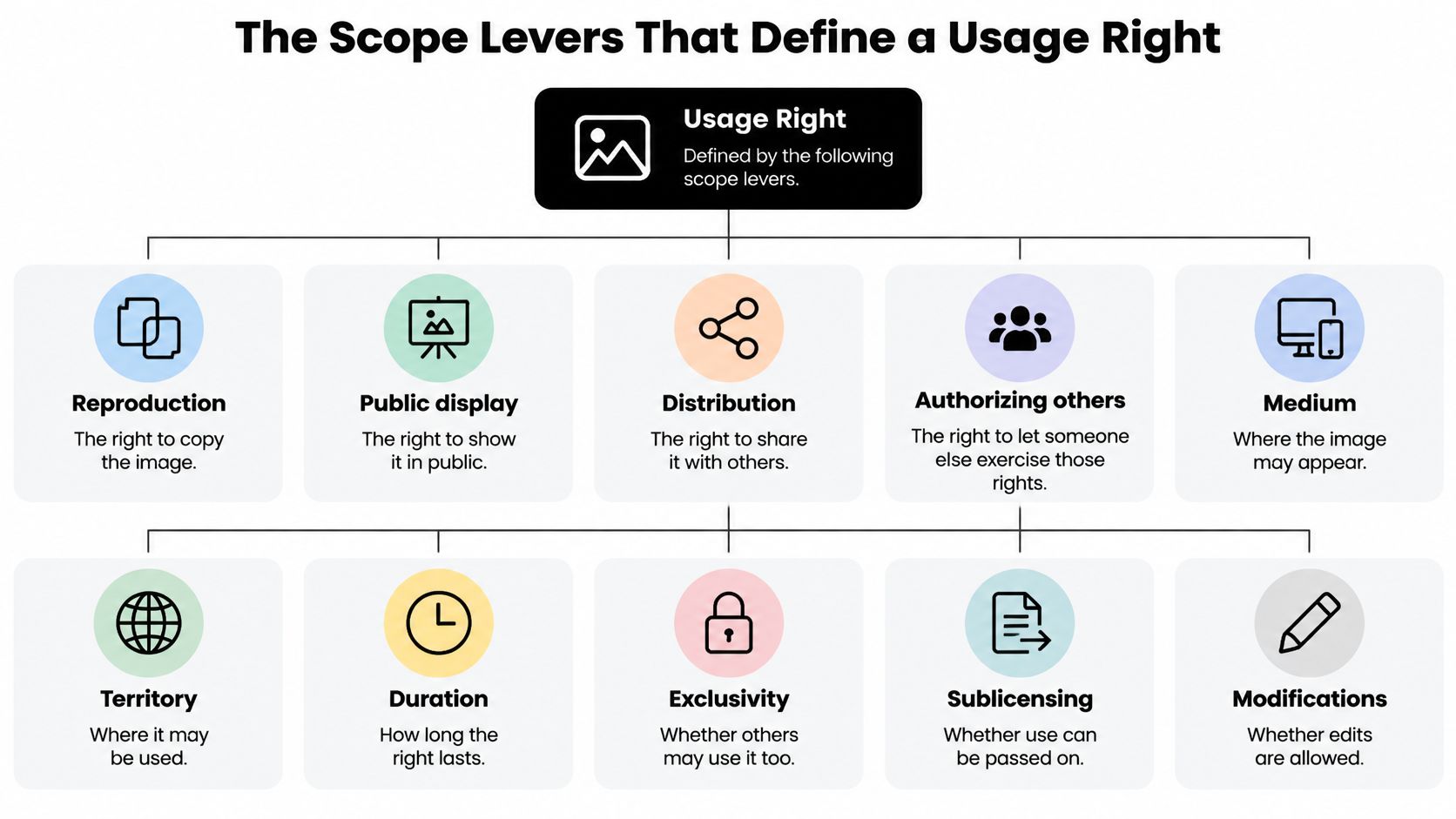
The levers a usable grant actually sets
- Media and channels. A website grant does not cover a printed billboard. Name formats too: homepage hero, PDF brochure, paid social, lobby signage.
- Territory. "North America" and "this metropolitan area" are different deals. Write the map.
- Term. A one-year term on a building image can expire before the tenant's next leasing push. Put a start date and an end date on the page.
- Exclusivity. An exclusive grant limited to one metropolitan market leaves the photographer free to license the same image nationally.
- Audience or campaign size. A single property microsite is not a national brand campaign. Cap the market or the placement if that is the bargain.
- Sublicensing. Say which partners may act for the client. Silence means they may not.
- Editing. Routine color and crop are not the same as removing a column or swapping the sky.
Levers stack. One license can combine a three-year term, digital and print channels, and a single region. Each added lever widens or narrows the bundle. Adding print widens it. Cutting the map to one city narrows it. Price follows that shape, which is why a vague verb is expensive to argue about later.
If the only verb in the grant is "use," you don't have a right you can point to. You have a disagreement waiting for a campaign.
Write a named channel list with formats, a region, a start and end date, and a sentence naming which partners may act. Then test any planned use with one question. Can you point to the clause that authorizes it? If you can't, it isn't licensed yet.
How Usage Rights Shape the Price
The fee tracks the scope of the license, not the hours on set. A half-day shoot with broad rights can cost more than a full-day shoot with a tight grant. You are paying for doors the file may open, and for doors the photographer agrees to keep shut.
| Price Driver | Effect on the Fee | Negotiation Lever |
|---|---|---|
| Term length | Longer term raises the fee | Shorter term with a renewal option |
| Territory | Worldwide costs more than one country | Limit to named countries or regions |
| Media and channels | Paid, print, and outdoor add cost beyond web use | Price each channel as a separate line |
| Exclusivity | Largest multiplier, because the photographer gives up sales | Exclude one category or one time window |
| Audience or campaign size | Wider reach raises the fee | Cap the market or impression volume |
| Editing rights | Routine retouching is usually included; scene changes add cost | Define allowed edits in writing |
| Raw files and archive | Often excluded or priced separately | Request as a separate line item |
| Partner and sublicensing use | Each partner may need its own grant | Name partners in the license |
Why exclusivity moves the number most
Exclusivity is the largest multiplier because the photographer gives up the chance to sell that same right to someone else. The buyer is paying for lost income, not for extra hours. Narrow it. Hold exclusivity to one property category, or to a six-month window around a launch, and the rest of the photographer's market stays open. Shorten the term and add a renewal option instead of buying a decade up front. Price paid media as its own line, separate from website use, so a later ad buy doesn't reopen the whole contract.
Exact rates change with market, experience, and project size. The table shows direction, not a rate card. Ask for a written quote that itemizes each license element, so a scope change gets a new price instead of an argument. A copyable shape looks like this.
- One-year term, US website and social media, with its own quoted fee.
- Paid social add-on for that same year, quoted separately.
- Exclusivity limited to one metropolitan market for six months, quoted separately.
- Raw files and archive access, quoted separately.
If any line changes, ask the photographer to re-price that line only. Teams comparing how a studio packages this kind of work can review corporate photography packages and then match each package to the channels they plan to run.
Contract Clauses to Negotiate Before Signing
Read the draft in the order the clauses appear, and ask for language before anyone signs. A red flag is any sentence you can't apply to next year's brochure.
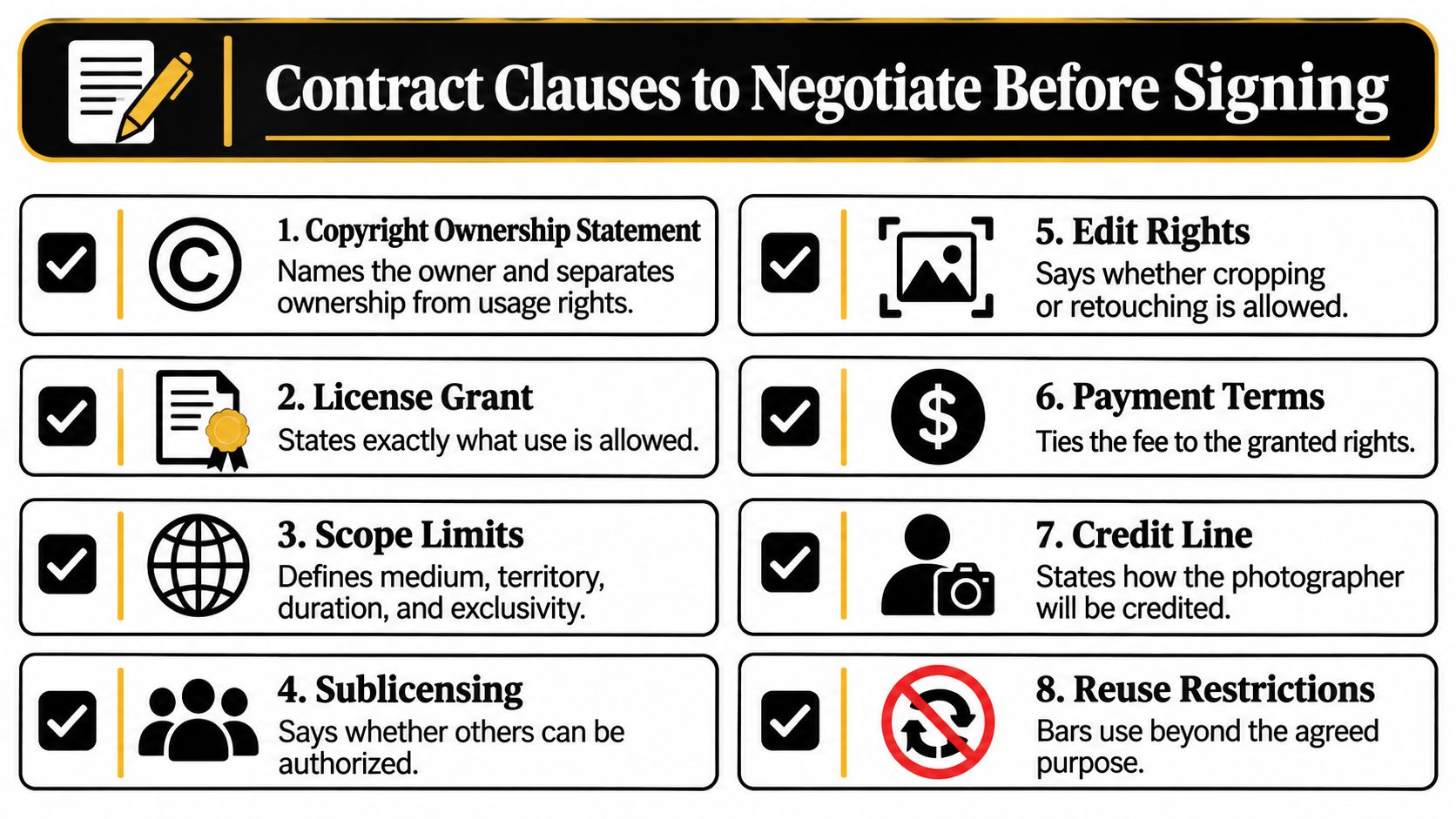
The checklist, in contract order
1. Copyright ownership. Ask for a sentence that names the owner and says ownership is separate from the usage grant. Red flag: "client owns all work product" with no written assignment and no work-made-for-hire basis.
2. Grant type. Ask whether it is exclusive or non-exclusive, and list the named rights. Red flag: the word "exclusive" with no campaign, region, or window attached.
3. Channels, formats, territory, term, and renewal. Ask for a channel list, a region, start and end dates, and how renewal is priced. Red flag: "in perpetuity, all media" when the budget was for a website.
4. Exclusivity definition. Ask for the exact slice, such as one campaign, one region, or one time window. Red flag: a lockout that also blocks the photographer's portfolio with no discussion.
5. Sublicensing and partners. Name general contractors, architects, property managers, agencies, publishers, and award entries if they will receive files. Red flag: "affiliates and partners" with no list and no limit.
6. Attribution, approvals, and transfer. Ask for credit language, approval deadlines measured in business days, and what happens if the property or the company is sold. Red flag: approval with no deadline, which can freeze a launch.
7. Releases and warranty. Ask who warrants model and property releases for every identifiable person and place. Red flag: a warranty the photographer can't give because a tenant never signed.
When the term ends, the grant ends. Put a takedown date on web and social uses, and put renewal pricing in the same clause so nobody invents it during a lease-up.
Editing and provenance
This clause needs the most ink, because a finished file is no longer the only file. The U.S. Copyright Office reported in January 2025 that purely AI-generated outputs are not copyrightable, while human-authored elements, creative arrangements, or substantial modifications may qualify. A client can hold permission in the original photograph and still lack a clean exclusive claim over an AI-altered derivative.
Ask the clause to separate permitted retouching from prohibited scene changes. Require disclosure of synthetic additions, retention of original files and edit history, and a named party responsible for third-party AI tool terms. Say whether rights extend to the altered derivative or only to the source photograph. A sky replacement may be acceptable on a documentary view and misleading on a property listing, so the clause should say which category the image is. Red flag: "client may edit by any means" with no disclosure and no original kept. For the surrounding paperwork, keep commercial photography contracts beside the usage grant so payment, credit, and delivery don't contradict the license.
Clearance Workflow That Prevents Costly Reuse Disputes
Usage rights on a building are a chain, not a two-person deal. A developer, an architect, a general contractor, an interior designer, a property manager, a publication, and a brand agency can each have a legitimate reason to show the same frame. The U.S. Copyright Office fair use FAQ states that the photographer generally owns the copyright, although an employer may own it in some circumstances, and that fair use is decided case by case rather than by a fixed percentage or a set number of copies. That is not a planning tool. A rights matrix is.
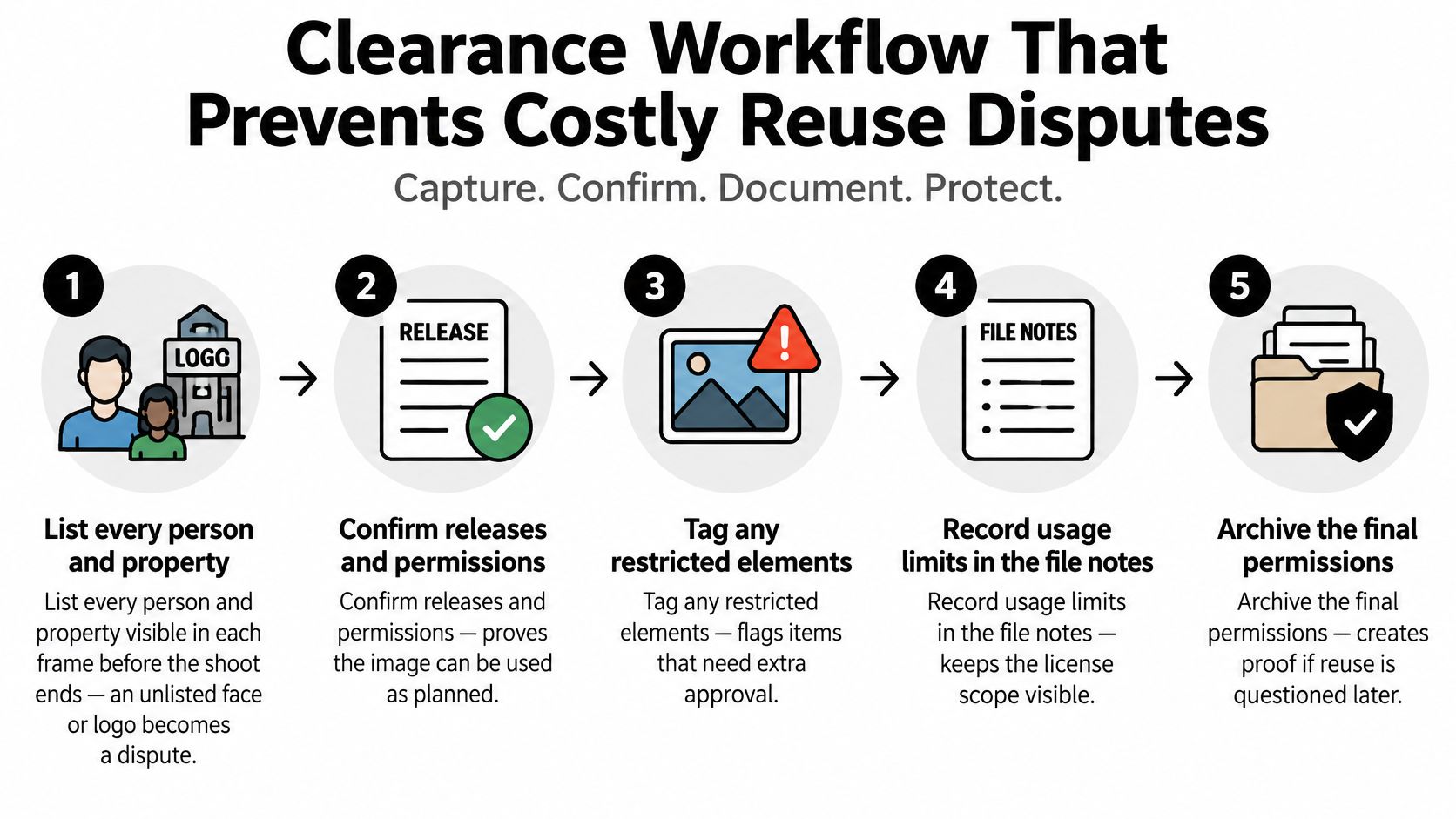
Eight steps, and why each one exists
- List every person and property in each frame before the shoot ends. An unlisted face, artwork, or logo becomes a clearance gap the week someone wants a billboard. Walk the set with the shot list and write what the camera will see.
- Collect signed model and property releases and file them against image numbers. A release in a general folder doesn't help if nobody can match it to frame 184. Tie the paper to the file name the day it is signed. Practical location release forms belong in that same folder.
- Classify each image as documentary editorial or promotional. Editorial images generally can't support advertising, endorsement, or promotion, even when the picture is accurate. Mark the class on the select, not in someone's memory.
- Record the channel list. Include website, social media, print, paid media, signage, presentations, and third-party sites. If a channel isn't on the list, it isn't cleared.
- Build a rights matrix for every stakeholder. Rows for developer, architect, general contractor, interior designer, property manager, and publisher. Columns for property or campaign, channels, term, and whether that party may repost, crop, alter, sublicense, or submit to awards and editorial outlets.
- Set term, territory, and expiry, then add a renewal reminder. A long-lived property outlasts the department that commissioned the shoot. Calendar the end date where the marketing lead will see it.
- Log every retouch and AI-assisted edit with approver and date. Sky swaps, furniture inserts, and removed scaffolding change what the picture claims. The log is what you show if a listing is challenged.
- Review the matrix before each campaign, sale, leasing push, award, or editorial submission. New use, new check. Don't rely on last year's approval.
Two mistakes that get expensive
A website grant does not cover paid media. Reproduction and public display are separate acts, and each channel needs its own grant. The team that "just boosts" an organic post has started a different use.
A stakeholder may not drop the images into a portfolio because they worked on the building. A contractor's portfolio, an architect's award submission, a tenant's social campaign, and a publisher's cover each need permission. A broad "commercial use" clause often fails all four. An editorial image later dropped into marketing breaks the license even when the photo is accurate. A replaced sky or a removed structure can create advertising risk on a listing that buyers treat as fact.
If a demand letter arrives anyway, a defense-oriented explainer such as RNC Group על הגנות בשימוש בתמונות is a useful companion to the matrix, not a substitute for having one.
| Misconception | What Is Actually True | What to Do |
|---|---|---|
| Paying the photographer buys the copyright | The fee buys a license; copyright stays with the creator unless assigned in writing | Read the grant clause before paying |
| A website license covers print ads | Each channel needs its own grant | List every channel in the contract |
| A licensed image can run forever | Licenses carry term and territory limits | Set an end date and a renewal check |
| Any stakeholder can reuse the photos | Each party's use needs its own permission | Map every stakeholder in a rights matrix |
| Editorial images can appear in ads | Editorial licenses exclude promotion | Buy a commercial license for marketing |
| A small AI edit does not matter | Altered scenes can misrepresent a property | Disclose edits and set limits in writing |
Split the work so it doesn't live in one inbox. The photographer owns capture notes, file names, and the edit log. The project manager owns the matrix and the renewal reminder. The legal reviewer owns grant language, releases, and sale or transfer terms. In-house teams keep the matrix in a shared file. Agencies attach a copy to each project so the next producer isn't starting from a download link.
Confirm the Rights Before You Publish
Confirm the rights in writing before the first frame is shot, and again before any new use. On architectural and corporate work, the same image moves from a website to a leasing brochure, a press kit, and a stakeholder's portfolio. Each move needs its own clause. A use with no clause behind it is not licensed, whatever the project team believes.
Before you publish, check four lines:
- Owner and grant type are named, and ownership is not confused with permission.
- Channel, region, and end date match this specific use, not last year's.
- Every partner who will receive the file is on the matrix.
- Edits are disclosed, and originals plus the edit log are still on file.
Jimmy Clemmons Photographer, an Atlanta-based studio focused on architectural imagery and corporate brand content, offers professional editing and can help define license scope during location scouting and planning, before the first frame is shot. Architectural work here is built around sweeping exteriors and refined interiors that show form, light, and detail, and the license should be just as specific as the frame. Keep the rights matrix current as the property changes hands, leases space, or launches a new campaign.
Jimmy Clemmons Photographer builds architectural and corporate images with license scope set before the shoot, so developers, architects, and brand teams know which channels, terms, and partners are cleared. Professional editing stays tied to that grant, including what may be retouched and what must stay documentary. Visit Jimmy Clemmons Photographer to plan the next property or brand assignment with the usage rights written into the job from the start.