
You're probably here because a shoot is getting close, the estimate is approved in principle, and then someone says, “Send over the contract.” That's usually the moment clients realize they've been thinking about pictures, not rights, timing, revisions, insurance, file delivery, or what happens six months later when marketing wants to reuse the images in a completely different campaign.
That's exactly why commercial photography contracts matter.
A good contract isn't legal theater. It's a working roadmap. It tells both sides what's being photographed, when it's being photographed, what gets delivered, how it can be used, what it costs, and what happens if the plan changes. If you're commissioning architecture, interiors, hospitality, corporate, or brand imagery, that document protects your budget and your brand just as much as it protects the photographer.
Why Commercial Photography Contracts Matter Before the Shoot
Your team books a shoot for a new development. The estimate looks fine, the date is held, and everyone is focused on shot lists, access, and launch timing. Months later, the same images get pulled into a broader ad campaign, dropped into broker materials, printed for signage, or reused after the property changes hands. That is where an easy project turns into an avoidable argument.
The fight usually starts with one basic question. What did your company buy?
In commercial photography, paying for the shoot and receiving the files are not the same as receiving unlimited rights. Copyright usually stays with the photographer unless the contract says otherwise in writing, and the client receives a license that defines how the images may be used, as explained in this usage-rights overview. From the client side, that matters because unclear rights create budget risk. Your marketing team may assume broad reuse is covered while your legal or procurement team later learns it was never spelled out.
A contract fixes that before money is spent and calendars fill up. It gives both sides a shared operating document for the job: what is being photographed, who is approving what, what happens if access falls apart, whether outtakes stay with the photographer, how long usage lasts, what renewals cost, and whether metadata and credit lines must stay attached to the files. Those last points get skipped all the time. They should not.
Three problems a contract prevents
The first is rights drift. A file delivered today often gets reused by a different department next year. Sales wants it for a deck. Leasing wants it for paid ads. A parent company wants it on a national site. Without written license terms, your team is left guessing, and guessing is expensive. This commercial photography contracts guide explains why file delivery and usage rights need to be stated separately.
The second is scope creep with no clean way to price it. Commercial shoots change fast. Weather shifts. A decision-maker adds twilight coverage. A location contact shortens access and forces a return visit. If the contract does not say what is included, your team cannot tell the difference between the original job and an added cost.
The third is surprises after delivery. Clients often discover too late that editing rounds, rush turnaround, additional licensing, alternate crops, or archive pulls were never included in the original number. A good contract separates creation fees from usage fees and states what happens if you want to renew rights, expand media, or license unused selects later.
Read the agreement with one blunt question in mind: can a new person on your team pick this up six months from now and know exactly what your company is allowed to do?
If the answer is no, do not treat the contract as paperwork. Treat it as production planning. Get it signed before scouting, before crew bookings, and before anyone starts acting like assumptions are terms.
The Building Blocks of Every Commercial Photography Contract
Commercial photography contracts are just a stack of decisions written clearly enough that nobody has to reconstruct them later from email.
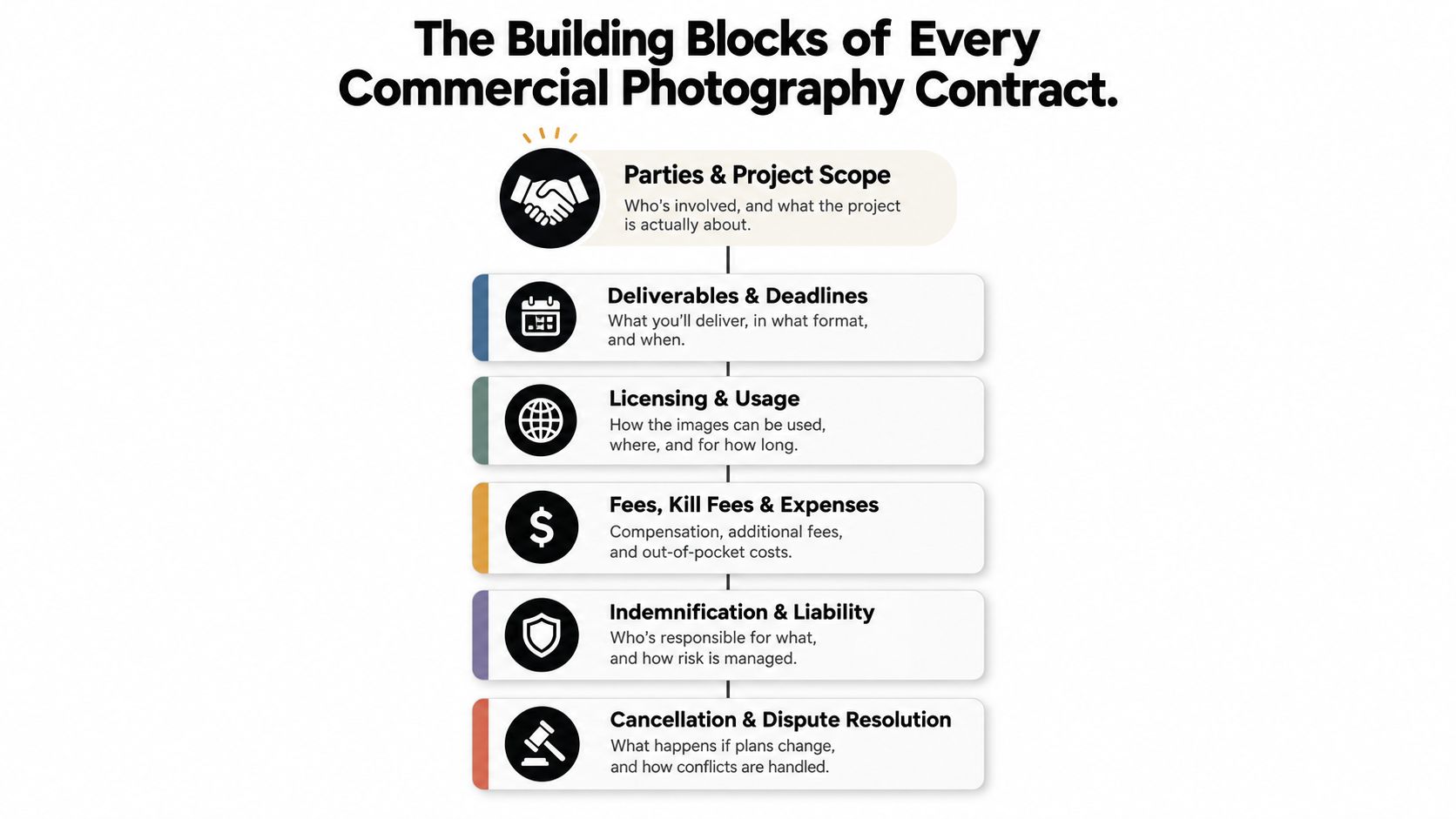
The clauses that belong in every serious agreement
Start with parties and project description. Name the legal entities correctly. Not the marketing department nickname. Not the building name everyone uses casually. The actual contracting party matters if there's a payment issue or a rights dispute.
Then define the scope of work. That includes shoot dates, number of shoot days, locations, access windows, whether talent or stylists are involved, and whether props, scouting, permits, assistants, retouching, or travel are included.
The next block is deliverables. Spell out what the client will receive, in what format, by what deadline. This replaces the vague “we'll send the selects after the shoot” language that causes most delivery arguments.
Then comes the section clients should read twice: licensing and permitted usage. Commercial contracts should separate rights from file delivery. They should say where the images may appear, for how long, in which territory, and whether the client can share them with affiliates, agencies, media buyers, franchisees, or downstream partners.
The money and risk clauses clients underweight
The compensation and expenses section should separate creative fees, licensing fees, and reimbursable costs. That split is standard practice because rights have independent value from the act of photographing. Procurement data has even tracked commercial photography as its own purchasing category, listing a U.S. commercial photography day rate benchmark of $372 in 2026, with prices rising at a 3.14% compound annual growth rate from 2023 to 2026, according to IBISWorld procurement data. Whether your photographer charges more or less than that benchmark, the structure matters.
You also want kill and cancellation fees, insurance and indemnification, termination, and dispute resolution. These aren't filler. They decide who eats costs when access falls through, weather shifts, a location damages equipment, or a client pauses the project after pre-production has already happened.
For architecture and commercial assignments, releases and permissions often differ from portrait work. You may need location access language, landlord approval, building rules, loading dock windows, and restrictions on photographing branded interiors. Portrait jobs usually stress model consent more heavily. Property-based work often lives or dies on access and approval language.
A solid contract usually includes these building blocks:
- Parties and authority: Who is hiring, who is shooting, and who has authority to approve changes.
- Scope and schedule: What will be photographed, when, where, and under what access conditions.
- Deliverables and license: What gets delivered versus what rights are granted.
- Money and remedies: Fees, expenses, cancellation terms, and what happens if either side defaults.
Most contract fights aren't about photography. They're about assumptions nobody wrote down.
Reading the Licensing Clause Without a Lawyer
This is the section clients misread most often. They see “licensed for marketing use” and assume that means anything the company wants, anywhere, forever. It doesn't.
A licensing clause should answer four separate questions: where, how, for how long, and whether anyone else can use it.
Read the clause in plain English
A simple commercial license might say:
Client receives a non-exclusive license to use the final delivered images for its company website, organic social media, and printed collateral within the United States for one year. No sublicensing, assignment, resale, or third-party transfer is permitted without written approval.
That's plain enough to decode:
- Media: Website, organic social, printed collateral
- Territory: United States
- Duration: One year
- Exclusivity: Non-exclusive
- Transfer rights: Not allowed
That's the job of commercial photography contracts. Not sounding impressive. Defining use.
How the fee moves when the usage expands
Recent guidance shows small-business marketing use such as web plus organic social for one year often prices at about 1.25x to 1.5x the creative fee, while national advertising can rise to 3.0x to 4.0x, and perpetual buyouts can reach 5.0x to 8.0x+ of the base fee, based on this commercial pricing guide. That's why broad rights cost more. You're not just paying for labor. You're paying for commercial reach.
| Usage Variable | Lower-Scope Option | Higher-Scope Option | Approximate Fee Multiplier |
|---|---|---|---|
| Media | Website + organic social | National advertising campaign | Higher-scope use can move from 1.25x to 1.5x toward 3.0x to 4.0x |
| Territory | Local or limited market | National or broader market reach | Fee typically increases as audience reach expands |
| Duration | One-year term | Perpetual use | Perpetual buyouts can reach 5.0x to 8.0x+ |
| Exclusivity | Non-exclusive | Sole or restricted competitive use | Exclusive rights usually increase pricing materially |
If you're comparing contract drafts from multiple vendors, a side-by-side redline saves time. A simple tool like the PDFKing PDF comparison guide helps clients catch changes in license language that often get buried in updated PDFs.
For a useful companion read on rights from the buyer's side, see this explanation of licensing a photo for commercial use.
Rights-managed versus buyout
A rights-managed license gives you defined use for a defined term. A buyout pushes much further, often toward perpetual, broad, multi-channel use. Most commercial photographers resist campaign buyouts for a simple reason: they erase future licensing value.
That resistance isn't stubbornness. It's pricing logic.
If your campaign might expand later, negotiate that possibility now. Don't ask for a cheap narrow license and then expect silent expansion into packaging, paid ads, investor decks, trade show walls, and partner channels.
Watch sublicensing and assignment language
If your company hires an outside agency, regional distributor, property operator, or affiliated entity, smart clients still get caught. Can they use the images too? Not automatically.
If the contract bars sublicensing or assignment, your internal handoff may be fine, but third-party reuse may not be. Get that language straight before launch.
Deliverables, File Formats, and What the Client Actually Receives
Clients often focus on the image count and miss the harder question: what exactly are we receiving?
That answer belongs in the deliverables clause, and it should separate final assets from everything the photographer used to make them.
Three buckets to define clearly
First, specify file format and color profile. Commercial photographers usually deliver edited JPEGs or TIFFs, often in sRGB or ProPhoto RGB depending on the intended use. That's normal. Camera RAW files are not the same thing as finished deliverables. RAW files are source material, not client-ready assets.
Second, define resolution tiers. Your website team, print vendor, and archive manager may each need different versions. Name the intended output clearly: web-ready files, print-ready files, and archival masters if included.
Third, state what is excluded. Most misunderstandings live.
A technically strong contract should separate deliverables from rights and should specify which final files are included, whether RAW or outtake files are excluded, what resolution or format is delivered, and whether the client may modify or sublicense the images, as explained in this contract and licensing overview.
| Deliverable Category | Usually Included | Usually Excluded |
|---|---|---|
| Final edited images | Selected, retouched JPEGs or TIFFs | Unedited captures |
| Web and print exports | Files prepared for agreed uses | Open-ended unlimited file prep for every future use |
| Archival masters | Sometimes included if stated | Automatic delivery if not listed |
| Source material | Rarely included by default | RAW files, layered PSDs, rejected frames, test shots |
| Transfer rights | Limited to the licensed client use | Sublicensing to agencies, franchisees, affiliates, or contractors unless stated |
Sample clause you can paste into a brief
Photographer will deliver final edited images as high-resolution JPEG or TIFF files in the agreed color profile. RAW captures, outtakes, layered working files, and unselected images are excluded unless listed as a separate deliverable. Delivery of files does not grant sublicensing, assignment, or transfer rights beyond the stated license.
That last sentence matters. A shared drive is not a license expansion.
If you need your agency, property manager, international affiliate, or print vendor to use the files directly, say so in the contract. Don't leave it to assumption.
Model and Property Releases for Architectural and Commercial Work
Releases are separate from copyright. That distinction matters because clients often think “we paid for the shoot” solves everything. It doesn't.
A model release covers a recognizable person's likeness. A property release covers use of private property or an object in a commercial context, as outlined in this release guide.
When a property release is usually needed
If the shoot happens inside a private office, lobby, hotel, retail space, or controlled residential property, the owner or authorized representative may need to sign off on commercial use. The issue isn't just ownership. It's control of access and commercial exploitation of the space.
Public streets and parks are different. Several release guides note that public property generally doesn't require a property release. That doesn't mean every public shoot is frictionless. It means the release question is different from the permit or access question.
Sample property clause:
Property owner grants permission to photograph the premises for the agreed commercial project and to use the resulting images within the scope of the client's licensed usage. This permission does not extend beyond the described project and approved use.
When a model release is usually needed
If recognizable staff, guests, diners, tenants, or bystanders appear in branded imagery, get a release. In the United States, model and release language should identify the person granting permission, the receiving photographer or company, the image description, the shoot date, scope of use, consideration, and signatures, including a parent or guardian for minors, as noted in this release checklist.
For location-specific projects, this practical reference on location release forms helps clients distinguish access permission from image-use permission.
Sample model clause:
Individual grants permission for their likeness to appear in the described photographs and for those photographs to be used within the commercial license granted for the project. Any use outside that scope requires additional written permission.
The part clients skip
Talent agreements can carry their own restrictions. Minors need guardian signatures. Some performers or creators may require separate terms about duration, media, or approvals. Some venues also impose their own conditions, including credit requirements or limitations on commercial reuse.
Don't bury those terms in email. Attach them or incorporate them into the contract set.
Payment Terms, Kill Fees, and Dispute Resolution
This is the financial spine of the job. If the payment section is fuzzy, everything gets harder when the schedule slips or the scope changes.
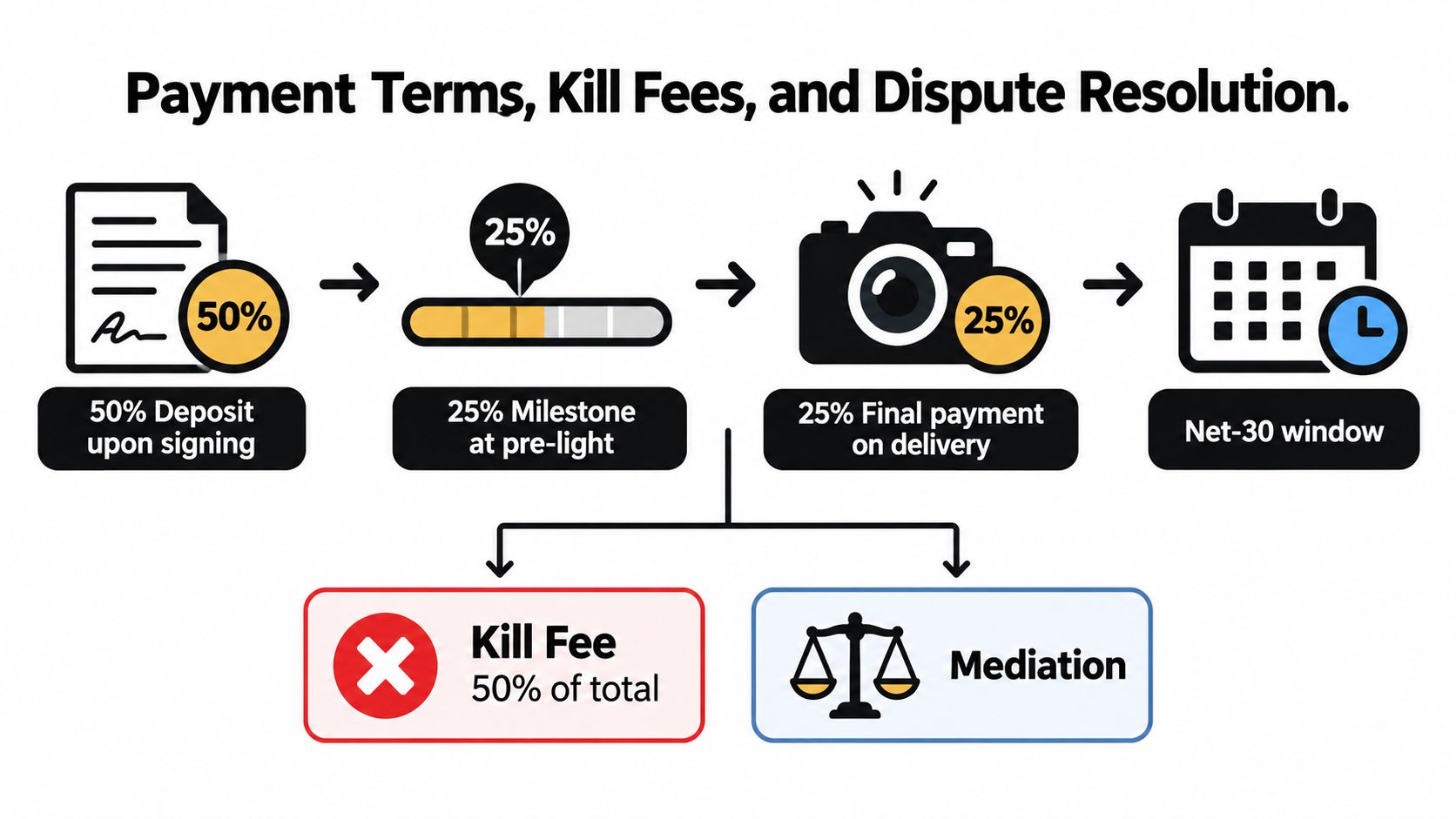
Commercial shoots commonly require 50 percent up front. That isn't arbitrary. Pre-production starts before the shutter does. Scouting, crew holds, scheduling, lighting plans, travel bookings, permits, and coordination all create real cost and real commitment. The infographic above uses a common structure: deposit on signing, milestone payment, then final payment on delivery.
If you want a broader look at how clear invoicing terms can improve cash flow via terms, that framework applies cleanly to photography commissions too.
What a payment clause should include
At minimum, define:
- Deposit and timing: What is due on signing and whether the date is held only after payment clears.
- Milestones: If the shoot spans planning, production, and post, tie payments to those phases.
- Final payment window: State whether payment is due on delivery, on invoice, or under a net term.
- Expenses: Travel, assistants, rentals, permits, parking, shipping, stylists, and rush retouching should be addressed explicitly.
Here's the hard part clients often resist but later appreciate: the kill fee.
A kill fee compensates the photographer if the client cancels after substantial pre-production has already happened. If crew was booked, scouting was done, equipment was reserved, or travel became non-recoverable, someone has to absorb that cost. It shouldn't automatically be the photographer.
Insurance, indemnification, and dispute mechanics
Commercial photography contracts should also cover insurance and indemnification. If a stand scratches a floor, a person trips over a cable, or a location imposes certificate requirements, you want those responsibilities clearly assigned.
For a practical overview of how payment timing intersects with the rest of the project, this short explainer is worth watching:
Then decide how disputes get handled. My recommendation is simple:
- Negotiation first
- Mediation second
- Arbitration or court only if needed
For lower-value disputes, small claims court can be practical. For larger commercial jobs, jurisdiction and venue should be written clearly so nobody fights over where the fight happens.
A contract that defines payment but ignores cancellation, damage, and nonpayment is only half a contract.
AI, Metadata, and Renewing Usage Rights After Delivery
A client gets final files, sends them to the design team, and six months later those same images show up in a new market, a new ad set, and an AI editing workflow nobody mentioned during the shoot. That is exactly when a weak contract starts costing both sides time and money.
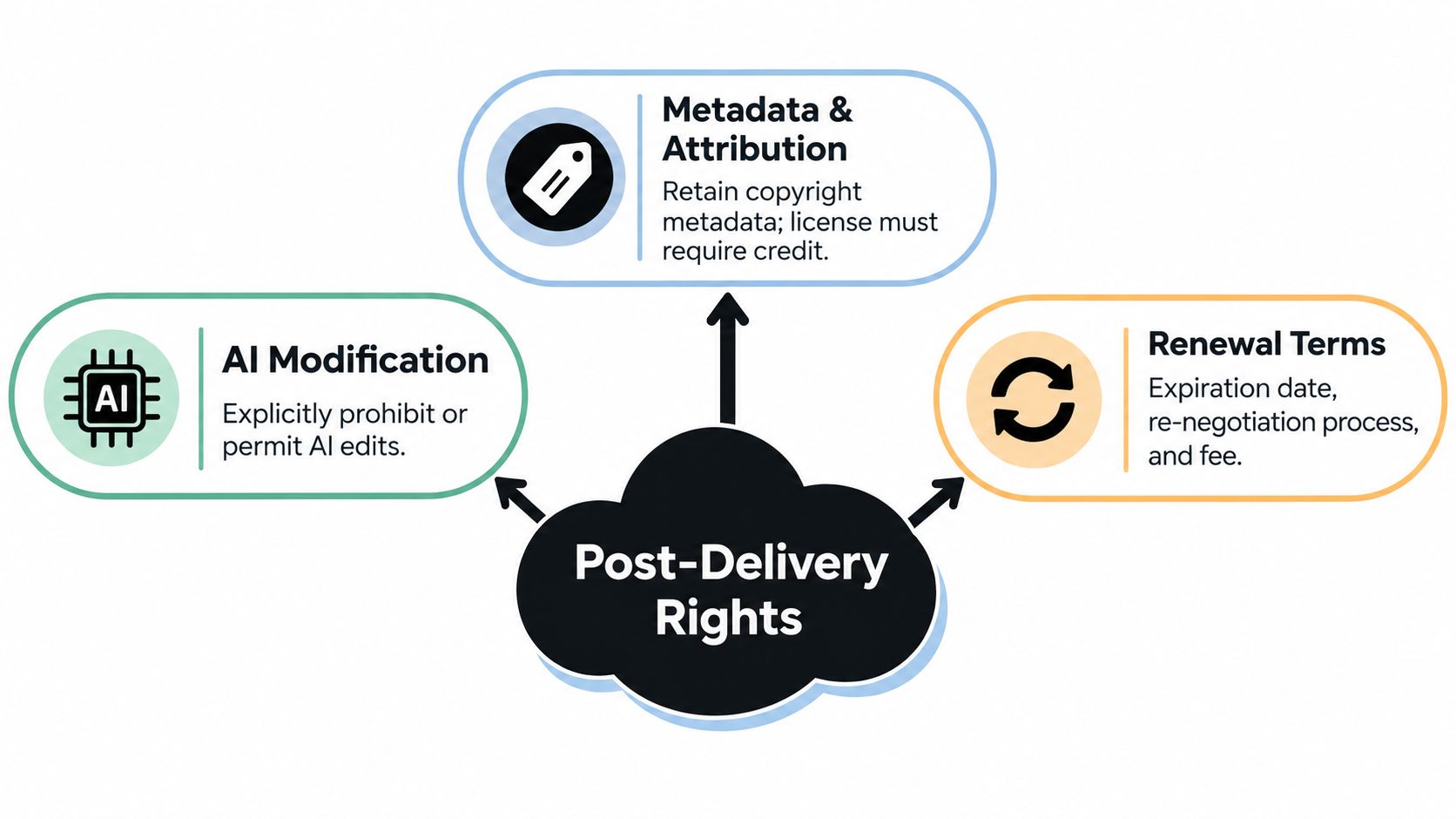
AI modification needs its own rule
If your team plans to do more than normal retouching, write that into the contract. Do not leave it implied.
The document should say whether you may run licensed images through generative tools, create synthetic variations, remove or replace objects, extend backgrounds, or train any internal or third-party model on the files. Those uses affect brand accuracy, legal exposure, and the photographer's authorship in ways standard editing never did.
Recent industry coverage says C2PA Content Credentials signing is spreading beyond flagship cameras in 2026, which makes contract language around provenance, metadata preservation, and unauthorized edits newly relevant, according to this industry prediction piece. That matters if the photos document a real space, real product condition, or real people doing real work.
Here is the clean rule I recommend. Basic color correction, cropping, resizing, and agreed retouching are permitted. Changing factual content, generating new scene elements, or using the images to train AI requires specific written permission.
Metadata and provenance are now contractual issues
Metadata is part of the job record. Treat it that way.
EXIF and IPTC fields can carry authorship, copyright notice, capture details, usage notes, and caption context. Once a file gets exported by a social team, compressed by an ad platform, or handed to an outside editor, that information often disappears. Your contract should say whether metadata must remain intact, who may remove it, and whether altered files need a new naming or versioning standard so nobody confuses an edited derivative with the delivered original.
Under U.S. copyright rules, copyright initially belongs to the photographer once the work is fixed unless the image is work made for hire or transferred in a signed writing, as summarized in this copyright and contracts overview. Metadata does not replace the contract, but it does help preserve a clear chain of authorship and usage history when files start moving between teams.
One more point clients should ask about: outtakes. The contract should state who owns unused captures, contact sheets, rejected frames, and alternate edits, and whether any of them are included in the license. If that line is missing, people make bad assumptions fast.
Renewal terms should never be an afterthought
Renewal pricing belongs in the original deal, even if the exact extension fee is not fixed yet. If you wait until the campaign is successful, everyone negotiates from a worse position.
The contract should answer four questions before delivery: how long the initial license lasts, what happens if use continues past that date, whether renewal pricing is pre-set or quoted later, and whether expanded media, territory, or audience changes the fee. The American Society of Media Photographers' licensing guidance makes the same underlying point. Expanded use carries added value and should be priced separately, not treated as a free continuation of the first term.
Use plain language such as:
License expires at the end of the stated term. Continued use requires written renewal before expiration. Renewal pricing will be quoted based on current media, territory, duration, and any expanded use. If no renewal is agreed, usage ends automatically.
That clause protects the client too. It gives your team a clean process for budgeting future use, avoids accidental infringement by an agency or distributor, and keeps a good project from turning into a rights dispute a year later.
Negotiation Tips and a Pre-Shoot Checklist to Carry Into the Project
Most clients don't need a longer contract. They need a cleaner one and a better negotiation strategy.
Three moves that actually change the deal
First, trade a higher upfront fee for broader planned use. If you already know the images will be needed across multiple campaign phases, it's usually cleaner to negotiate that early than to pretend the use is narrow and reopen it later.
Second, trade a shorter usage term for faster delivery or tighter budget control. If the campaign window is limited, don't pay for perpetual rights you don't need.
Third, trade visibility or portfolio permission for narrower scope, but be precise. If the photographer can show the work in a portfolio or case-study setting, that may affect the final structure. Keep it written. Don't leave it verbal.
If you want a broader business-side framework, this guide to contract negotiation for professionals is useful for thinking through concessions, fallback positions, and approval authority.
A checklist worth copying into your own template
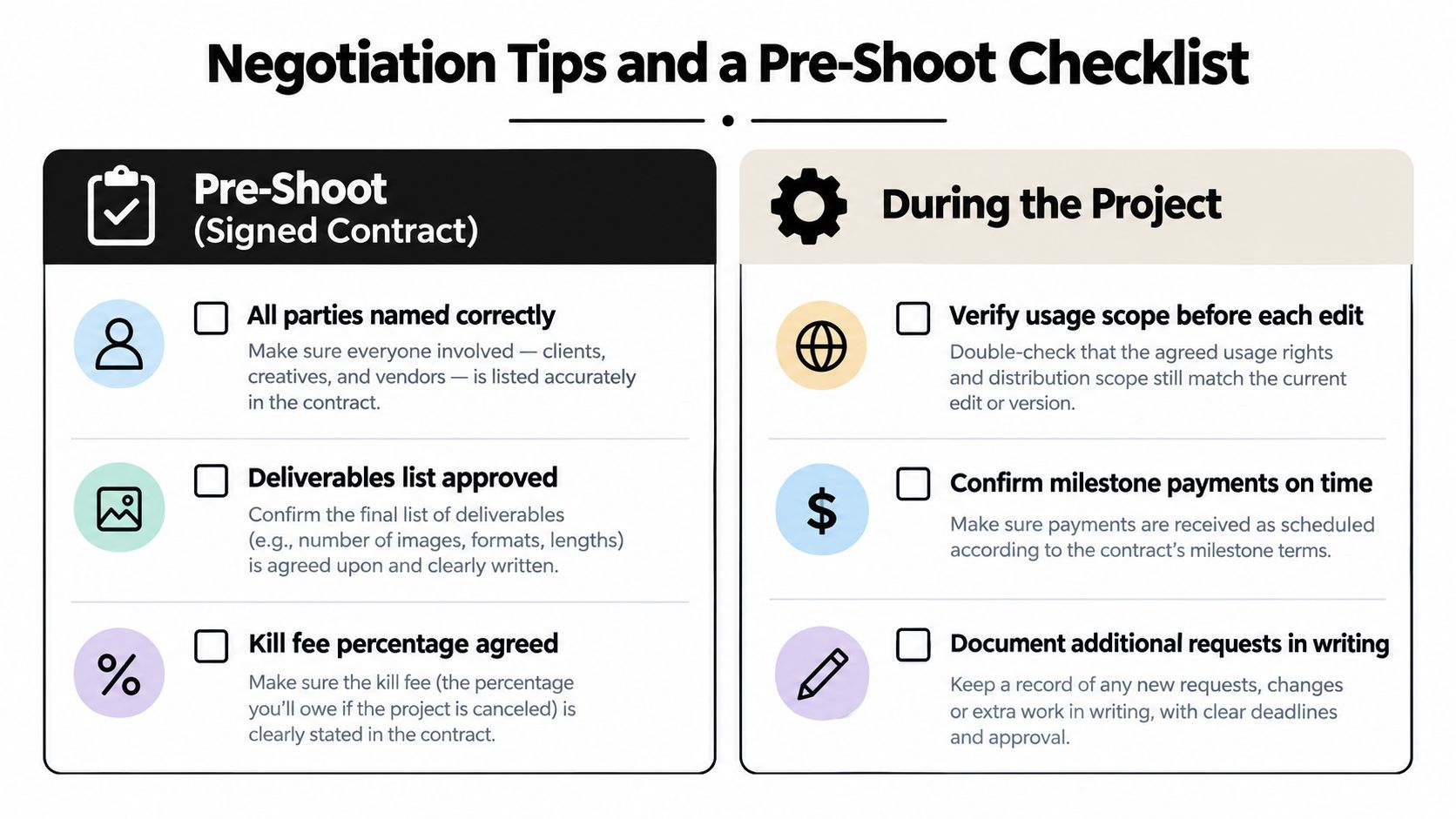
Pre-shoot
- Name every party correctly: Contracting entity, photographer, and any parent company or property owner that needs to be referenced.
- Approve the deliverables list: Final image count, formats, delivery timing, and exclusions.
- Lock the usage scope: Media, territory, duration, exclusivity, and third-party sharing.
- Confirm the kill fee and cancellation rule: Especially if scouting, crew holds, or travel are involved.
- Set logistics in writing: Access windows, on-site contact, staging limits, weather backup, and approval chain.
A practical project prep resource like this photo shoot checklist helps teams catch operational gaps before they become contract problems.
During the project
- Document additions fast: New angles, extra locations, twilight coverage, or rush edits should be approved in writing.
- Track payment milestones: Don't let accounting drift behind production.
- Clarify who can approve on set: Too many voices create extra work and muddy authorship.
Post-shoot
- Verify delivery against the contract: Not against memory.
- Track the usage window: Put the expiration date on the calendar.
- Review renewals before reuse: Especially if the campaign expands or another business unit wants the files.
One practical option when you're evaluating photographers is to ask for estimates that separate creative fee, expenses, deliverables, revision terms, and license. Jimmy Clemmons Photographer uses that structure for architectural and commercial assignments, which makes buyer-side review easier because you can see what is being purchased in each bucket.
Commercial photography contracts work best when you treat them as operating documents, not signature rituals. If a clause affects budget, timeline, brand control, approvals, or reuse, it belongs on the page.
If you need commercial, architectural, or brand photography with a contract that's clear about licensing, deliverables, and usage from the start, Jimmy Clemmons Photographer handles that work with a structured estimate and a plain-English agreement. Visit Jimmy Clemmons Photographer to review services, see the type of projects the studio handles, and start a conversation before the paperwork gets messy.