
Listings with video receive 403% more inquiries and sell 32% faster, according to Amplifiles' roundup of real estate video statistics. That number changes the conversation. Real estate photography video isn't a decorative upgrade anymore. It's a sales and brand tool that changes how a property is understood before anyone books a showing.
For high-end properties, the gap between “there's a video” and “the video was produced with intent” is enormous. A quick phone walkthrough can record a room. It usually can't communicate why the room feels calm at dusk, how the stair sequence opens into the living volume, or why a facade reads differently as the camera approaches from the drive. The better the architecture, the more that difference matters.
A strong video does more than document square footage. It controls pace, reveals sequence, and frames attention. It shows how light moves across limestone, how a lobby transitions from public to private, and how a residence or commercial property sits within its surroundings. That's why discerning developers, architects, and luxury agents increasingly treat video as part of the core visual package rather than an optional add-on.
Beyond a Listing A New Standard in Property Storytelling
The most useful way to think about real estate photography video is this. Still photography captures moments. Video captures intent.
Architecture is experienced in sequence. You approach, enter, turn, pause, and discover. A still frame can isolate material, proportion, and detail with precision. Video can reveal circulation, rhythm, and atmosphere in a way photography alone can't. For properties where design is part of the value proposition, that distinction isn't academic. It affects how buyers, investors, tenants, and stakeholders judge quality.
Why high-end properties need more than a basic walkthrough
A basic walkthrough often answers only one question: what's in the house? That's useful, but it's incomplete.
A professionally directed video answers more important questions:
- How does the property feel to move through
- What is the hierarchy of spaces
- Where does natural light shape the experience
- Which details deserve emphasis because they support value
- What kind of buyer or tenant is this property speaking to
That last point is easy to overlook. A design-forward residence, boutique hospitality project, or commercial development needs a visual language that matches the audience. The framing, lens choice, camera movement, color treatment, and edit rhythm all influence perception.
A polished video doesn't just show that a property is expensive. It shows that it was considered.
Narrative control matters
Without narrative control, viewers form their own hierarchy. They may focus on the wrong room, misunderstand scale, or miss the relationship between spaces. Strategic video solves that by guiding attention. It can start with site context, move into arrival, build toward signature interior moments, and close on the emotional image that stays with the viewer.
That's especially valuable for architects and developers. The video becomes more than listing media. It becomes a portfolio asset, a presentation tool, and proof that the project deserves serious attention.
The Unmistakable Business Value of Real Estate Video
Properties marketed with stronger visual assets move faster through the decision process. Video plays a specific role in that result. It helps a buyer, tenant, investor, or client understand the asset before anyone gets on a call.
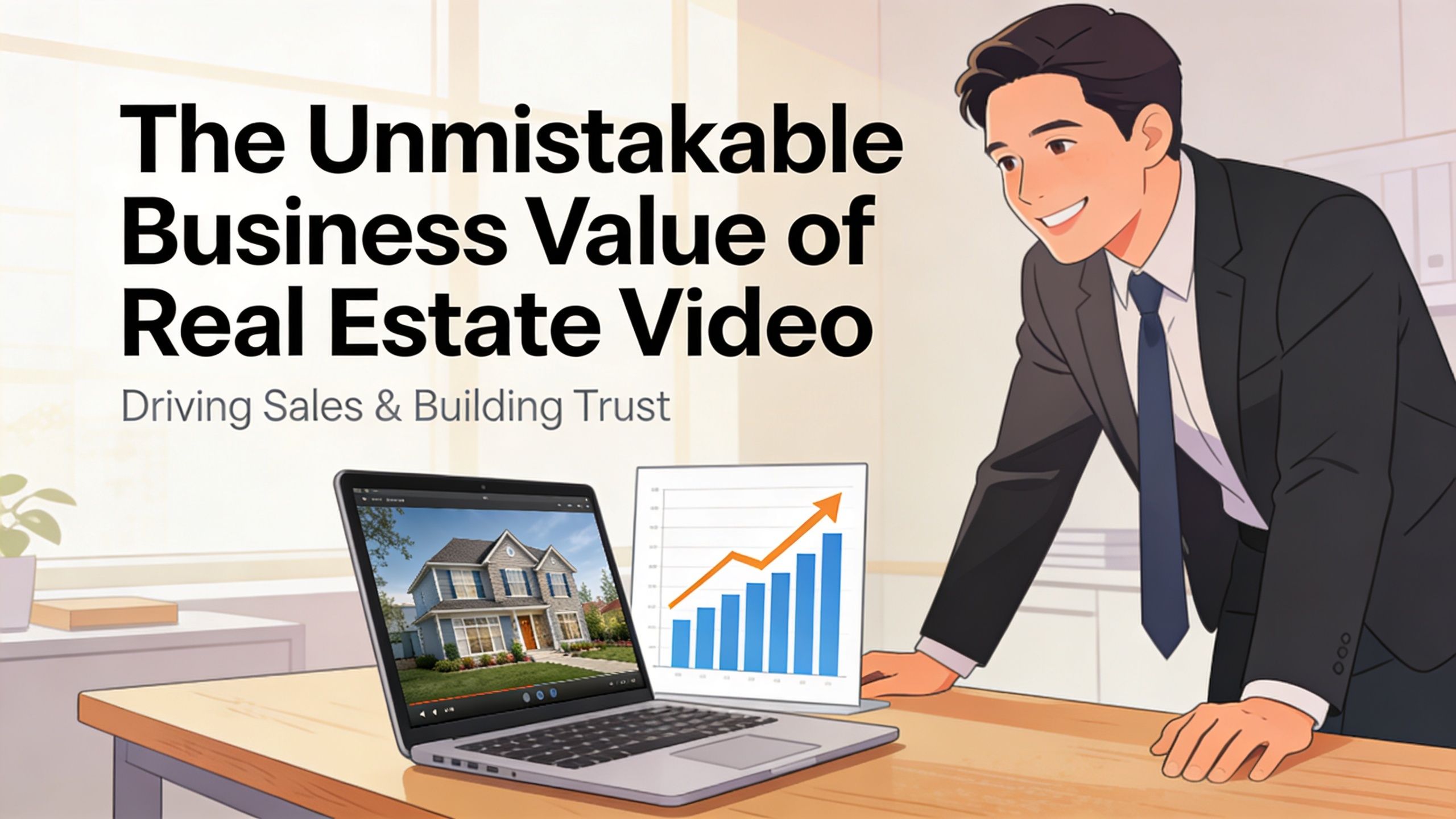
That matters because speed is not the only metric. Quality of attention matters just as much. A well-made property film reduces wasted inquiries, shortens explanation cycles, and gives the audience enough context to respond with intent instead of casual curiosity. For luxury agents, that can mean fewer low-fit showings. For developers, it can mean cleaner conversations with buyers, brokers, or capital partners who already grasp the project's value proposition.
In high-end real estate, video is less about volume than precision.
A polished film pre-qualifies the viewer in ways still photography cannot always handle on its own. It shows how arrival unfolds, how public and private zones relate, how light moves across materials, and whether the property reads as understated, architectural, resort-driven, or purely investment-focused. Those cues shape expectations before the first meeting, which saves time on both sides.
Used well, video supports three business goals at once:
- It sharpens market positioning by presenting the property with a visual language that matches the target buyer or tenant.
- It improves lead quality by helping viewers judge fit before they request a tour.
- It extends the life of the asset because the footage can be reused across listing campaigns, websites, presentations, and brand marketing.
That last point is where discerning clients see the difference. A residential listing video may have a short campaign window, but a design-driven film for an architect, developer, hospitality group, or luxury brokerage can keep working long after a single sale or lease. The same piece can support award submissions, investor materials, recruiting, social campaigns, and future business development.
This is why I advise clients to judge video by utility, not by production cost alone. A film that helps sell one property is useful. A film that also strengthens your brand, supports your next pitch, and reinforces the quality of your portfolio has a much broader return. The same logic applies to stills, as outlined in this analysis of the ROI of professional photography.
Business reality: Premium properties rarely compete on square footage alone. They compete on perception, confidence, and the clarity of the story wrapped around the asset.
For luxury agents, that credibility helps win stronger listings. For architects and developers, it helps turn completed work into the next commission.
Exploring the Types of Real Estate Video Services
Real estate photography video isn't one format. Different assignments call for different kinds of films, and the right choice depends on the business goal. Some videos prioritize clarity. Others build emotion. The mistake is ordering a style because it sounds impressive instead of because it solves the right problem.
Professional visual packages already have measurable value. High-quality photography, including drone shots and virtual tours, helps homes sell 32% faster and for 5-10% more, and 82% of agencies use drone footage, according to Gitnux's real estate photography statistics. Video works best when it complements that foundation instead of competing with it.
Walkthrough videos for spatial clarity
A walkthrough is the closest thing to a guided visit. Its purpose is simple. Help viewers understand the property's layout, flow, and room-to-room relationship.
This format works well when the audience needs orientation first. Think residential listings, multifamily leasing, office suites, educational spaces, or hospitality interiors where circulation is part of the pitch. Camera movement is usually restrained and readable. The edit should feel clean, not flashy.
Use a walkthrough when the question is, “How does this place function?”
Cinematic property films for desire and positioning
A cinematic film is less like a guided tour and more like a trailer. It's built around mood, light, pacing, and selective emphasis. You don't show everything equally. You choose what defines the property and build around it.
This is often the best fit for:
- Luxury residences where atmosphere helps justify premium positioning
- Architect-designed homes where intent and materiality deserve a more editorial treatment
- Hospitality and branded environments where emotional response is part of the sale
- Developer marketing campaigns that need a signature asset for launch materials
A cinematic edit can be memorable, but only if it remains legible. If style obscures layout, the film starts serving the production instead of the property.
The best cinematic videos still respect geography. Viewers should feel seduced, not confused.
Aerial and drone footage for context and scale
Drone footage earns its place when site context matters. It shows setbacks, approach, adjacency, outdoor design, surrounding amenities, and the relationship between a building and its environment. On larger estates, campuses, developments, and commercial properties, that context can be as persuasive as the interior.
Drone footage is especially useful for properties where location, access, or site planning carries significant value. Used well, it establishes orientation fast. Used poorly, it becomes a generic orbit reel.
Brand and profile videos for trust
Not every real estate video is about a single property. Agents, architecture firms, developers, and commercial teams often need profile videos that explain who they are and how they work. These pieces build trust before a proposal, listing appointment, or stakeholder meeting.
They usually combine on-camera presence, project footage, and selective detail shots. The goal isn't to list every service. It's to make competence visible.
A simple way to choose the right format
| Goal | Best-fit video type | What it should emphasize |
|---|---|---|
| Help prospects understand layout | Walkthrough | Flow, sequence, usability |
| Build premium desire | Cinematic film | Mood, materials, signature moments |
| Show land, context, and approach | Drone-led video | Scale, setting, surroundings |
| Win future business | Profile or portfolio film | Process, credibility, body of work |
If you're choosing between formats, start with the audience decision you need to influence. The answer usually becomes obvious from there.
The Professional Video Production Process Demystified
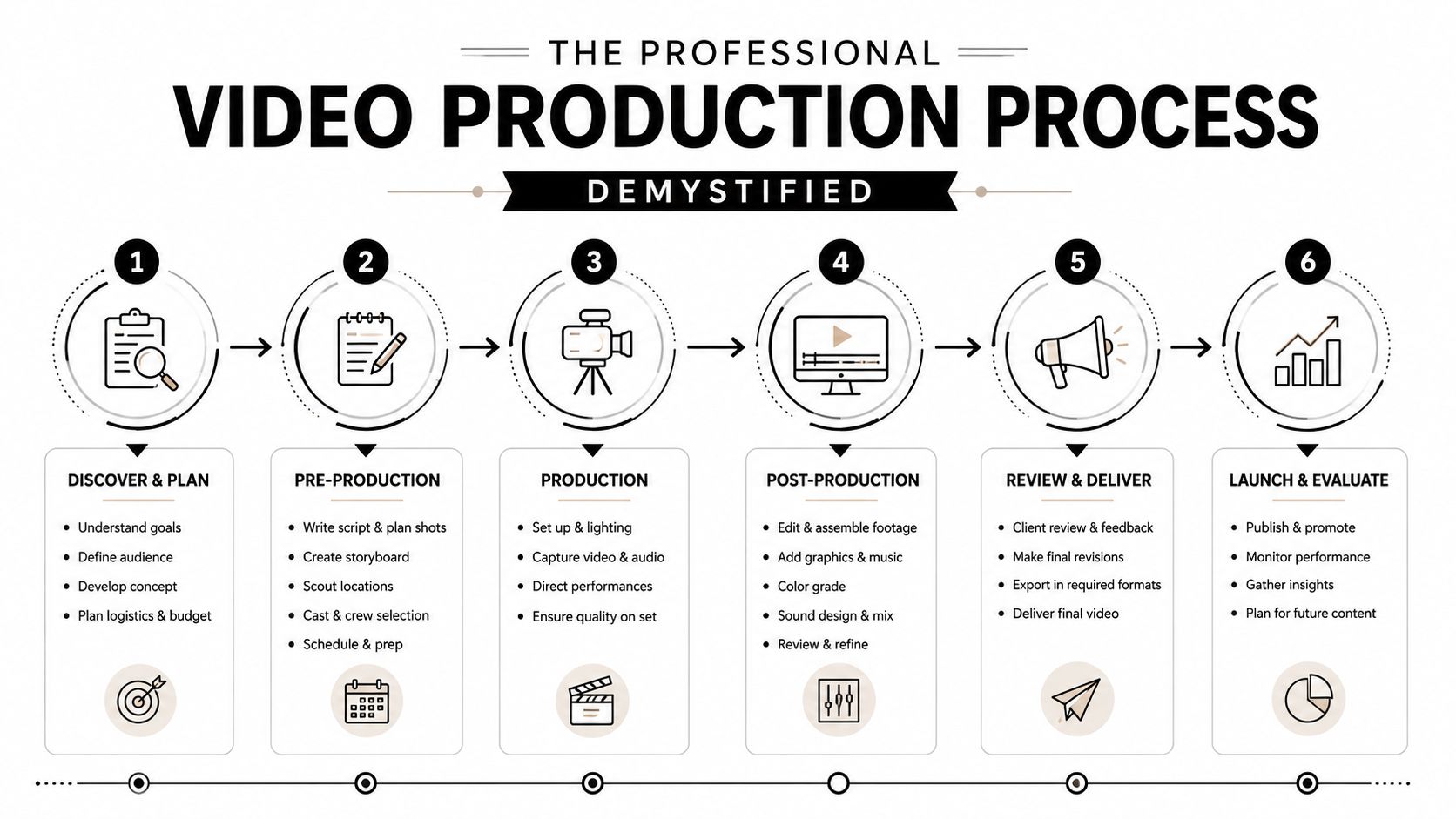
Clients often assume the value of a video production is concentrated on shoot day. In reality, the quality of the final film is usually decided earlier. The disciplined part of real estate photography video isn't only camera operation. It's planning, coordination, and making good choices before expensive mistakes happen.
Pre-production is where the video gets its backbone
Pre-production starts with questions, not gear. What is this video supposed to do? Who needs to be persuaded? Which spaces matter most? What time of day shows the project at its best? Are there occupancy, access, weather, or scheduling constraints?
For architects, developers, and commercial clients, this stage often includes a shot list aligned to business priorities. A leasing team may need amenity coverage. An architect may care more about sequence, form, and detail. A hospitality client may need service moments and atmosphere.
Strong pre-production usually includes:
- Creative direction with a clear purpose for the film
- Location review to identify hero angles, lighting challenges, and access issues
- Scheduling around sunlight, building use, and on-site activity
- Styling decisions about what stays, what moves, and what should be minimized
- Delivery planning so the shoot matches the intended platforms and edit versions
On more technical assignments, this planning can overlap with proposal and presentation needs. A focused example appears in this look at video walkthroughs for engineering proposals, where clarity and stakeholder communication drive shot decisions from the start.
The shoot is controlled problem-solving
Production day is where craft becomes visible. Camera movement, composition, exposure, lens choice, and lighting all have to work together. Good crews move efficiently, but not hurriedly. Rushing almost always shows up on screen.
Some spaces are straightforward. Others fight back. Glass reflections, changing daylight, active occupants, mixed fixtures, deep shadows, bright windows, and narrow circulation paths all force trade-offs. A professional crew manages those variables instead of pretending they don't exist.
On-site rule: If a move looks elegant but confuses the room, it's the wrong move.
This is also where direction matters. Chairs get squared. Shades get adjusted. Lamps get tested. People clear frame. Exterior timing is refined. The difference between average and polished work often comes from dozens of small corrections that a client doesn't need to notice, but absolutely benefits from.
Post-production shapes clarity and tone
Editing is not a cleanup stage. It's where the film becomes coherent. The editor decides pace, shot order, duration, transitions, music fit, and whether the story reads cleanly from beginning to end.
A strong post process usually includes three layers:
- Structural edit that establishes sequence and trims anything repetitive.
- Color and finishing that unify rooms, preserve realism, and protect the intended mood.
- Export and delivery in versions suited to listing platforms, websites, presentations, and social placements.
The goal isn't to make the property look different. It's to make the presentation feel intentional. Clients notice that immediately, even if they don't use the same vocabulary.
Understanding Key Technical Specs and Deliverables
Technical specs matter because they change how a property feels on screen. Clients don't need to become camera operators, but they should know which choices signal quality and which ones are mostly marketing noise.
A good example is motion. Shooting at 60fps with a shutter speed double the frame rate, such as 1/120s, is a benchmark for natural motion blur and smooth walkthrough footage under the 180-degree shutter rule, as explained in this real estate videography technical overview on YouTube. That's not trivia. It's one of the reasons professional property tours feel fluid instead of twitchy.
The specs clients should actually ask about
Some deliverables affect quality more than others. These are worth discussing before production:
Resolution
Ask whether the master delivery is in 4K or 1080p. Higher resolution gives more flexibility for cropping, reframing, and long-term reuse. Even when final platform playback is compressed, a stronger master usually holds detail better.Frame rate and motion approach
Ask how the producer plans to shoot movement. Smooth pans, gimbal passes, and slider moves need a deliberate frame-rate strategy. If the answer is vague, the result often looks generic.Color flexibility
Ask whether the footage will be captured and graded in a way that preserves a natural look across bright windows, dark interiors, and mixed finishes. This matters in design-centric spaces where white walls, wood tones, stone, and metal all need to read correctly.Audio and music licensing
Even if the final video relies mostly on music, sound still matters. Ambient details, voiceover, and clean mastering all affect polish. Clients should also confirm that music use is properly licensed for the intended platforms.
A practical deliverables checklist
| Deliverable | Why it matters |
|---|---|
| Main branded film | Best for website, presentations, and direct sharing |
| Listing cut | Tighter version for MLS-style use and quick viewing |
| Social edits | Cropped or shortened versions for platform-specific promotion |
| Thumbnail frame | Helps control first impression before playback |
| Usage summary | Clarifies where and how the video can be published |
Ask for deliverables based on use, not just duration. A single great master file is helpful. A well-planned package is more useful.
The best technical choices are the ones a viewer never notices directly. They make the property feel composed, credible, and easy to trust.
A Client Checklist for a Flawless Video Shoot
Most video problems start before the cameras roll. The good news is that many of them are preventable with a short, disciplined prep process. That prep doesn't need to feel theatrical. It just needs to remove distractions and make the property readable.
One issue deserves special attention. Mixed lighting is a common problem in interiors, and relying on post alone to fix tungsten and LED mismatches can make footage look unnatural. Pre-shoot lighting discussions and tests lead to 30% higher client satisfaction, according to this industry-focused lighting discussion.
Exterior prep that saves time on set
First impressions begin before the front door opens. Exterior footage records everything, including the things people stop noticing in daily use.
Use this exterior checklist:
- Clean approach paths so driveways, walkways, and entry sequences read clearly.
- Trim and tidy landscaping because overgrowth can block architecture and flatten lines.
- Move vehicles and bins out of frame unless they're essential to the story of the property.
- Check exterior lighting if dusk coverage is planned. Burned-out fixtures stand out immediately on video.
- Coordinate access for gates, garages, rooftop areas, and shared amenities before crew arrival.
Interior prep that protects the final edit
Inside, the priority is visual consistency. Video is less forgiving than people expect because the camera moves. Anything that feels slightly off in person can become obvious once a room is scanned from one side to the other.
A useful interior standard is simple:
If an object pulls attention away from space, materials, or function, remove it.
Focus on these areas:
- Declutter surfaces such as kitchen counters, desks, bath vanities, and nightstands.
- Straighten furniture and decor so lines feel intentional when the camera glides through.
- Hide cords, remotes, tissue boxes, and personal items unless the property is being styled for lived-in warmth.
- Replace inconsistent lightbulbs so color temperature doesn't shift wildly from fixture to fixture.
- Plan occupant movement so staff, pets, residents, and vendors aren't drifting in and out of shot.
For teams managing larger sites, this kind of preparation is easier when everyone works from a shared reference. A practical starting point is this guide on how to prepare a site for a photoshoot, which aligns well with video production needs too.
Detail decisions that improve polish
The last layer is small but important. Open or close blinds consistently. Decide which lamps should be on. Steam or smooth textiles if they'll appear in close-up. Test feature elements such as fireplaces, water features, elevators, media walls, or motorized shades before the crew arrives.
Those details don't make a production feel fussy. They make it feel finished.
Answers to Common Questions About Real Estate Video
Clients usually ask the same practical questions, and they're the right ones.
How is video priced
Most productions are priced around scope, not just time on site. The variables usually include property size, number of deliverables, drone coverage, complexity of lighting, travel, talent or on-camera needs, and the amount of editing required. A compact walkthrough and a design-led film may be filmed in the same building, but they aren't the same assignment.
How long does turnaround take
Turnaround depends on complexity and revision needs. A straightforward edit can move quickly. A multi-version package with color work, sound polish, drone footage, and stakeholder review will take longer. The important question isn't only speed. It's whether the timeline supports quality and approvals.
How does video work with professional photography
They do different jobs. Photography gives you the controlled hero frames that anchor listings, editorial features, pitch decks, and print use. Video adds sequence, movement, and emotional continuity. The strongest marketing packages use both.
What should I ask about quality
Ask how the producer handles focus, motion, and room-wide sharpness. For real estate work, deeper apertures in the f/7 to f/11 range are often preferred because wider settings like f/2.8 can blur important architectural detail. That deeper focus is associated with 25% higher viewer engagement in property tours, according to this real estate videography settings guide.
What about usage rights
Always clarify usage before production begins. You'll want to know where the final video can be used, whether edits can be repurposed later, and whether music or talent agreements affect distribution. Clear terms prevent headaches after delivery.
If you need design-forward real estate photography video that respects architecture, clarifies value, and presents property with editorial precision, Jimmy Clemmons Photographer offers Atlanta-based visual production for architects, developers, commercial teams, and hospitality brands.