

Your team just wrapped a project worth talking about. The building is refined, the interiors are thoughtful, the client experience was strong, and everyone agrees it should help win the next commission. Then the photos arrive, and they feel like proof of completion instead of proof of value.
That gap is where marketing asset creation either succeeds or fails.
For architecture firms, developers, property groups, and corporate brands, the problem usually isn't access to a camera. It's that the visuals were never built to carry a narrative, support multiple channels, or help the marketing team put the work into motion after the shoot. A polished image can still be strategically weak if it doesn't answer a business need.
From a photographer's side, that changes everything. The assignment isn't just to make a room look clean or a team look confident. It's to create visual assets that can sell a point of view, support proposals, strengthen a website, feed editorial outreach, and hold up inside a long-term asset library.
Beyond Pictures A New Mindset for Marketing Assets
A lot of firms still treat photography as the last task on the checklist. The project is done, the ribbon is cut, someone schedules a shoot, and the expectation is that “good photos” will somehow cover every future need.
They won't.
Marketing asset creation starts earlier and asks better questions. What story does this project tell about your firm? Who needs to believe that story? Where will the images live first, and where else should they work later? If those answers aren't clear, even expensive photography can end up generic.
The broader market has already moved in this direction. The content marketing market is projected to grow from about $72 billion in 2023 to over $107 billion by 2026 according to Salesgenie's content marketing statistics roundup. That projection matters because it reflects how companies now treat asset creation. Not as a side task, but as a growth function tied to search, social, websites, and ongoing brand communication.
What changes when you think strategically
When a client brings me in early, the conversation is different. We aren't talking only about elevations, lobby shots, or headshots. We're deciding which visuals need to persuade a developer, which ones need to support recruiting, which ones belong in a press kit, and which ones should anchor the homepage for the next year.
That shift usually leads to better decisions in three areas:
- Coverage becomes intentional: You stop collecting random pretty frames and start building a useful set of assets.
- The shoot supports business goals: Images are planned for proposals, case studies, web pages, email campaigns, and social crops.
- The investment lasts longer: The same assignment can serve marketing, business development, editorial outreach, and internal communications.
Practical rule: If an image can't be tied to a business use, it probably shouldn't be the center of the shoot.
Professional photography becomes much easier to justify when leadership sees it as a business tool rather than a finishing expense. That's the core point behind understanding the ROI of professional photography. The value isn't only in how the work looks. It's in how many jobs the imagery can do once it's delivered.
The Foundation Your Creative Brief and Strategy
The strongest shoot I've ever walked onto was already half-built before the first light stand came out. Not because the crew was larger or the budget was higher, but because the client knew what the images had to accomplish.
A creative brief does that work. It gives the production a spine.

Start with the story, not the shot list
Clients often begin with requests like “we need exteriors, interiors, details, and a few people shots.” That's understandable, but it isn't strategy. It's inventory.
A better brief starts with the narrative. Is this project meant to position your firm as a design leader? Prove operational sophistication to a corporate tenant? Show warmth and hospitality for an education or residential environment? Those are different stories, and they change how I frame, light, cast, and edit the work.
Original imagery matters here. Guidance increasingly shows that original photography outperforms generic stock imagery, as noted in Canto's discussion of digital marketing assets. The practical challenge isn't just knowing that. It's building a repeatable process for creating authentic visuals at scale without losing consistency or speed.
Questions that belong in every brief
I like briefs that answer a few plain questions clearly. Not in marketing jargon. In usable language.
- Who needs to respond to these images: A design-savvy architect, a procurement team, a tenant prospect, a college admissions audience, or prospective hires all read visuals differently.
- What should they feel: Confidence, calm, trust, innovation, precision, welcome.
- What should they do next: Request a proposal, schedule a tour, contact leasing, submit a feature, or stay on the page.
- What must be visible: Materials, circulation, daylight, craftsmanship, branding, collaboration, scale, occupancy.
- What must be avoided: Empty spaces that feel lifeless, overly staged scenes, dated styling, inconsistent wardrobe, visual clutter.
Good briefs create better trade-offs
Not every shoot can capture everything in one day. That isn't a failure. That's normal production reality. The brief helps decide what gets priority when light changes, access narrows, or the executive portrait session runs long.
Here's a simple comparison I often use with clients:
| Brief quality | What the shoot becomes |
|---|---|
| Vague goals | A record of the space |
| Audience-defined goals | A targeted marketing package |
| Narrative + channel plan | A reusable asset library |
The right brief doesn't make the process rigid. It gives the creative team permission to solve the right problem.
A useful brief also saves clients from one of the most common mistakes in marketing asset creation. Asking for imagery that looks “premium” without defining what premium is supposed to communicate. In B2B work, polish alone doesn't persuade. Relevance does.
Planning for a Flawless Production
Pre-production is where expensive mistakes are averted. If you want calm on shoot day, the work happens before anyone unloads a case from the van.
For architecture and corporate assignments, planning isn't bureaucracy. It's how you protect time, light, access, and people.
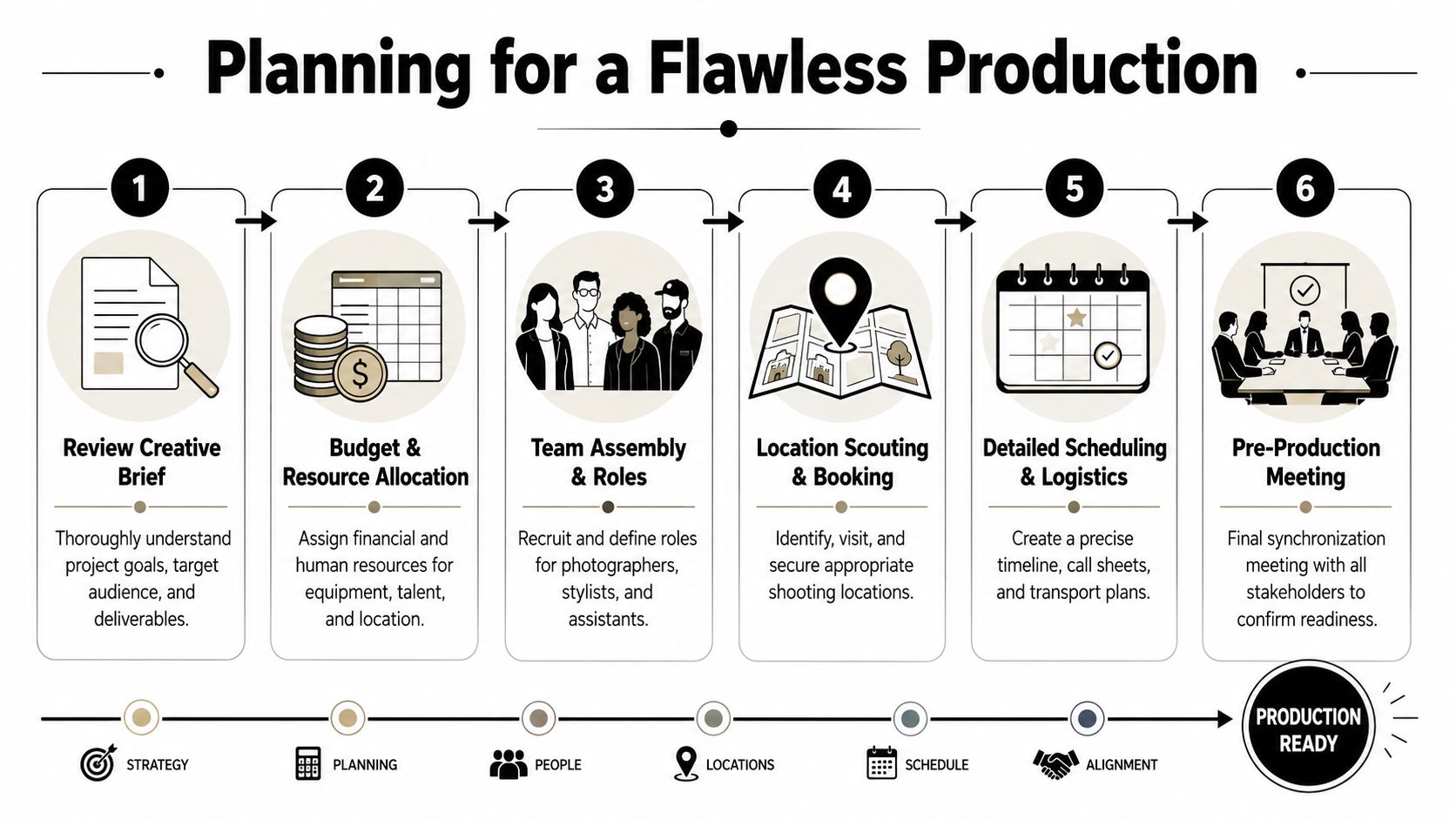
Scouting changes everything
A scout answers practical questions that no mood board can solve. Where does the sun land at the facade in late afternoon? Which conference room has mixed lighting that will fight the camera? Which sightlines reveal mechanical clutter, exit signage, or neighboring construction? Where can the crew stage gear without disrupting occupants?
On architecture shoots, I also look for rhythm. The obvious wide shot matters, but so does the sequence around it. A revealing detail, a compressed hallway view, a transition from public to private space. Those frames often give the final gallery its narrative flow.
Site readiness matters just as much as visual opportunity. If the property team hasn't coordinated cleaning, furniture alignment, screen content, landscaping touch-ups, or access permissions, the camera ends up documenting avoidable problems. That's why clients benefit from a practical prep process like this site preparation guide for a photoshoot.
Build a schedule around reality
Clients sometimes think the schedule is just administrative. It isn't. It's a creative document.
A realistic production schedule accounts for the best exterior light, when occupants are available, elevator access, traffic through shared areas, loading restrictions, and how long it takes to reset a room. If executives are being photographed, their availability has to work with the lighting plan, not against it. If an active office is involved, employee scenes need timing that feels natural instead of disruptive.
Here are the pre-production decisions that usually matter most:
- Lock the priority frames first. Hero exteriors, signature interiors, and any must-have brand moments should be protected early.
- Coordinate human subjects carefully. Employees, talent, or leadership should know wardrobe, timing, and intended tone before arrival.
- Plan for room turns. A lobby, boardroom, or break area may need several versions. Empty, lightly occupied, and fully active.
- Confirm permissions. Security desks, property management, tenants, and site supervisors all need the same schedule.
- Leave margin. Strong shoots need room for weather shifts, styling tweaks, and the unexpected frame that becomes the favorite.
A rushed shoot doesn't just produce fewer images. It usually produces safer images.
Shot lists should guide, not trap
A detailed shot list is useful, but only when it's built with hierarchy. If every frame is labeled equally important, the list becomes noise.
I prefer a shot list with tiers. Hero images at the top. Supporting views beneath them. Detail and texture frames after that. For corporate work, I separate environmental portraits, interaction scenes, workspace vignettes, and branded moments. That lets the whole team make faster decisions if timing changes.
Planning won't remove every surprise. It will make the surprises manageable.
Executing the Vision On Set
Once the shoot starts, the job becomes part choreography and part judgment. Good planning gives you a map. It doesn't give you the image. That still has to be found.
On a typical architecture assignment, I arrive knowing the required views. What I'm looking for on set is the frame that says something more specific than “this room exists.”

Light tells the truth or hides it
I start by watching what the light is doing to the surfaces. On a glass-heavy facade, I may wait for reflection balance instead of forcing the shot too early. In a corporate interior, I might build the exposure so the room feels dimensional rather than flat and overlit. Good architectural photography isn't about making every surface bright. It's about making the space believable and intentional.
When people are part of the frame, the scene has to feel lived-in without becoming messy. A gesture that's too posed kills credibility. A gesture that's too loose can make the image directionless. On corporate sets, I spend a lot of time making tiny adjustments. Turn the chair slightly. Relax the shoulders. Shift the laptop. Let the conversation continue. Those small refinements are where the image starts feeling real.
Composition has a job
A strong composition doesn't just look balanced. It directs attention.
If the client wants to emphasize openness, I'll use leading lines and negative space differently than I would for a detail-driven hospitality project. If the message is precision, the framing needs discipline. If the message is collaboration, I want the eye to move through the room and land on interaction naturally.
On set, I'm usually balancing three layers at once:
- Architecture: Lines, proportion, material relationships, and clean geometry.
- Human presence: Scale, energy, realism, and emotional temperature.
- Brand use: Space for copy, alternate crops, homepage ratios, and editorial flexibility.
Sometimes the most useful image for marketing isn't the widest or most dramatic one. It's the frame with enough clarity and negative space to work everywhere.
A lot of clients like seeing the rhythm of a commercial production in motion, especially if they haven't commissioned this kind of work before. This behind-the-scenes look gives a good sense of how quickly direction, lighting, and timing all interact on set.
Problem-solving is part of the craft
Some of the best frames come after something goes wrong. Weather shifts. A conference room books over your time slot. The west-facing elevation gets blocked by delivery trucks. You adapt.
That adaptability comes from experience, but it also comes from staying loyal to the brief. If I know the story is about precision, warmth, innovation, or trust, I can make faster decisions under pressure. The image may change. The purpose doesn't.
This is also where a photographer with editorial discipline can help. You're not just recording surfaces. You're shaping a sequence of images that can carry a client presentation, a feature story, a project page, or a recruiting campaign without feeling disconnected.
From Capture to Client Post-Production and Delivery
Once the gear is packed, the second half of the assignment starts. The raw capture then turns into a usable visual system.
Post-production isn't cosmetic cleanup. It's where consistency, restraint, and brand alignment either hold together or fall apart.
Culling decides the story
A shoot can produce a large volume of frames, but clients don't need all of them. They need the right ones. Culling is the process of narrowing the take to the images that carry the narrative cleanly.
That means removing near-duplicates, cutting frames that are technically fine but strategically weak, and building a set that feels coherent. I don't want a client scrolling through twenty versions of the same lobby angle with tiny differences. I want them to receive a tightly edited package where every image earns its place.
The strongest final selects usually include a mix:
- Hero images for websites, proposals, and press outreach
- Supporting views that show adjacency, circulation, and context
- Detail frames that reveal craftsmanship, finishes, and design intent
- People-driven images when the brand needs culture, occupancy, or scale
Editing should feel invisible
Professional editing works best when it doesn't call attention to itself. Color needs to be accurate. Vertical lines need to feel disciplined. Window views should support the room instead of distracting from it. Skin tones should look natural. Retouching should remove distractions, not erase reality.
This is especially important for architecture and B2B brand work because consistency carries trust. If one project gallery is moody and contrast-heavy while another is cold and clinical, the brand starts to feel unstable. A disciplined editing process keeps the visual language unified across projects and campaigns.
For teams comparing vendors or deciding how much finishing support they need, professional photo editing services can include color correction, perspective control, retouching, and channel-ready output. The important question isn't whether editing happens. It's whether the final files arrive ready for actual use.
Editing should refine what was true on set. It shouldn't invent a different project.
Delivery should reduce friction
A polished gallery isn't enough if the files are hard to use. Delivery needs structure.
I recommend organizing final assets in a way that matches how marketing teams work. By project. By campaign need. By orientation. By intended use. A design director and a social media manager often need the same source image in different formats, so the file package should respect both.
A clean delivery often includes:
| Asset type | Typical use |
|---|---|
| High-resolution files | Print, editorial, large-format materials |
| Web-optimized files | Website pages, blogs, online features |
| Cropped variations | Social, banners, thumbnails, profile headers |
| Contact sheet or gallery | Internal review and quick selection |
| Naming convention | Easier search, sorting, and archive use |
One provider that fits this workflow-based approach is Jimmy Clemmons Photographer, an Atlanta studio that handles architectural imagery, commercial brand content, location scouting, lighting design, on-set direction, and editing for client delivery. That combination matters when the same assignment needs to serve both design storytelling and practical marketing use.
Maximizing Your Investment Asset Management and Repurposing
Most firms think the project ends when the final gallery lands in the inbox. In practice, that's when the assets start working.
If the files live on one person's desktop, get renamed inconsistently, or disappear into old email threads, the value drops fast. Good marketing asset creation doesn't stop at production. It depends on how the work is stored, tagged, reused, and measured over time.
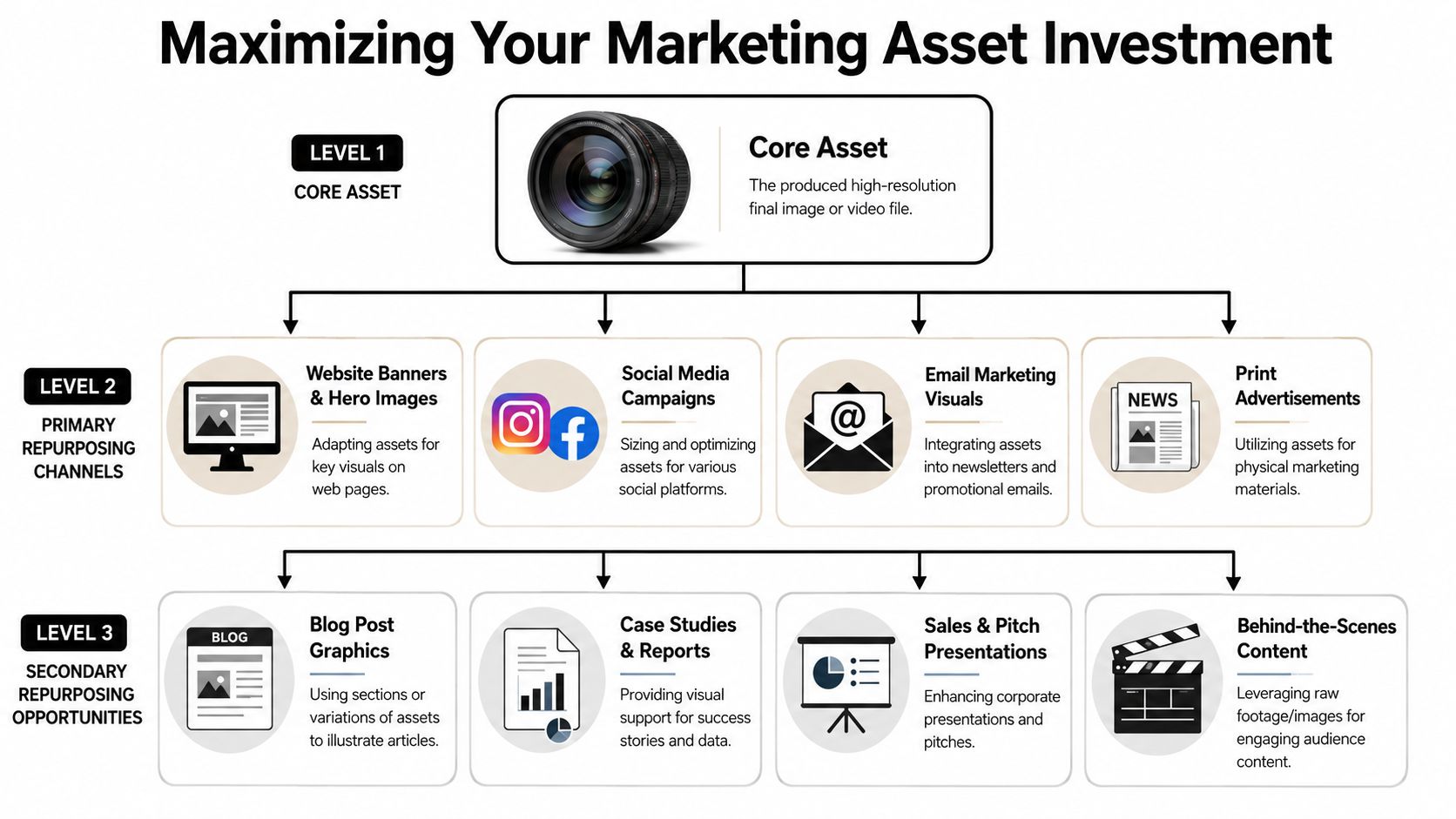
Treat every asset like a business object
In a mature workflow, each asset gets a unique ID and is connected to campaign metadata so teams can track impressions, clicks, form submissions, purchases, approval-cycle duration, cost per use, and return on asset. An example framework described by Activo's guidance on tracking asset usage across campaigns recommends improving asset reuse ratio from 20% to 40% within 12 months.
That idea matters because it changes the status of a photograph. It isn't just a finished creative file. It's a tracked asset with measurable utility across channels.
Build the library for search, not for memory
A good digital asset management habit starts with simple discipline. Folder structures should make sense across teams. File names should be consistent. Metadata should match how people search.
Best-practice DAM methodology also emphasizes standardized naming, metadata tagging, and automated approval workflows with role-based permissions and expiration dates, as outlined in Aprimo's marketing asset management best practices. In practical terms, that means your marketing coordinator shouldn't have to remember who shot a project two years ago to find the correct lobby image for a proposal due tomorrow.
Here's the basic operating model I recommend:
- Centralize the archive: Keep approved assets in one shared location, not scattered across personal drives.
- Tag by real use cases: Include project name, client, location, industry, subject matter, orientation, and campaign relevance.
- Separate approved from in-process: Marketing teams move faster when they know which files are final.
- Review the library periodically: Retire outdated visuals, update metadata, and note which assets are still being used.
Repurpose with intention
A single architecture shoot can support a homepage hero, project gallery, proposal cover, LinkedIn post, recruiting page, press submission, presentation deck, and email header. The mistake is assuming repurposing means random resizing.
It doesn't. Each channel asks the image to do a different job. A website hero needs clarity and room for text. A proposal cover can be more atmospheric. Social crops need immediate readability. A case study may need details and process images, not only polished wides.
The most valuable asset package is the one your team keeps finding new uses for six months later.
The firms that handle this well tend to start with an inventory, normalize IDs, remove duplicates, clean metadata, and align assets to buyer stage or persona before analyzing usage. Then they look at adoption signals such as views, shares, meeting usage, and unique users, and segment performance by region, channel, format, and launch versus evergreen use, following the workflow described in Umbrex's guide to marketing asset utilization rate.
One final caution. Measurement often stalls at vanity metrics. Engagement and click-through rates are useful, but they don't fully answer which asset influenced revenue when the same visual appears across web, email, social, and sales materials. Brandlife's perspective on marketing assets points to that gap clearly. Teams still need better ways to connect asset-level creative decisions to business outcomes across channels.
The practical answer is to build cleaner asset systems now. Better naming. Better metadata. Better reuse discipline. Better tracking. That foundation won't solve every attribution problem, but it gives your team a much stronger way to learn what deserves to be shot again, expanded, or retired.
If you're building a visual library for architecture, commercial property, or corporate marketing, Jimmy Clemmons Photographer creates narrative-driven imagery designed for real business use, from pre-production planning through final delivery and long-term asset value.