
You're standing outside a locker room in Tuscaloosa with a camera case in one hand and a text thread blowing up in the other. Marketing wants energy. Athletics wants speed. Facilities wants nothing touched. Compliance wants names, times, approvals, and a clear understanding of who will be in the room. That's a normal start.
A Locker Room Tuscaloosa shoot isn't just another interiors assignment. Campus spaces carry ritual, hierarchy, school identity, and access rules that can change by the hour. The room may look calm in a scouting photo, then turn into a moving corridor of equipment staff, players, coaches, and custodial teams once you arrive.
What works is a decision-first approach. Know what the images need to do before you decide how they should look. A recruiting piece needs a different visual rhythm than an architect's portfolio. A donor deck needs polished spatial coverage. A social campaign can tolerate more atmosphere, tighter crops, and selective motion.
Introduction to Locker Room Photography
When a college marketing team calls about locker room photography, they're usually asking for more than room coverage. They need images that communicate pride, order, performance, and identity. In Tuscaloosa, that often means balancing architecture with team culture so the space doesn't feel like a catalog set or a sterile facilities survey.
Locker rooms are tricky because they're built from reflective finishes, deep cubbies, overhead fixtures, and strong branding. Every one of those elements can help the frame or ruin it. Glossy floors throw glare. Metal hardware catches stray highlights. Team colors can shift if the white balance drifts. A room that feels impressive in person can look flat if you shoot it like a generic office interior.
The other challenge is emotional tone. A locker room should feel used, respected, and ready. It shouldn't look sloppy, but it also shouldn't feel over-sanitized unless the client specifically wants a pure architectural read. That's where experience with architectural and interior photography matters. You're not just recording surfaces. You're shaping how the viewer reads the room.
What makes Tuscaloosa shoots different
Tuscaloosa campus work tends to involve tighter coordination than a stand-alone commercial property. Security, practice schedules, and internal approvals all affect your window. Even if the room itself is available, nearby corridors, equipment areas, and player access routes may not be.
That changes how you scout. Don't just ask, “Can I photograph the locker room?” Ask which doors you can use, whether adjacent spaces will be open, whether branded materials can be staged, and who has final authority if a coach or operations lead changes the plan.
Practical rule: If the room matters to recruiting, donors, or team identity, assume multiple stakeholders will care about how it's shown.
What strong locker room photography delivers
A useful locker room set usually needs to satisfy several audiences at once:
- Athletics staff: Clean, energetic images that feel current and credible.
- Architects and designers: Spatial logic, finishes, millwork, lighting, circulation.
- Facilities teams: Accurate documentation of layout and condition.
- Marketing departments: Brand consistency across web, print, social, and presentations.
That overlap is what makes this subject worth doing well.
Pre Shoot Planning and Permissions
If access isn't locked down, the rest doesn't matter. The most common failure on a locker room Tuscaloosa assignment isn't bad lighting. It's arriving with partial approval and learning that the person who said yes can't authorize entry, staging, or athlete presence.
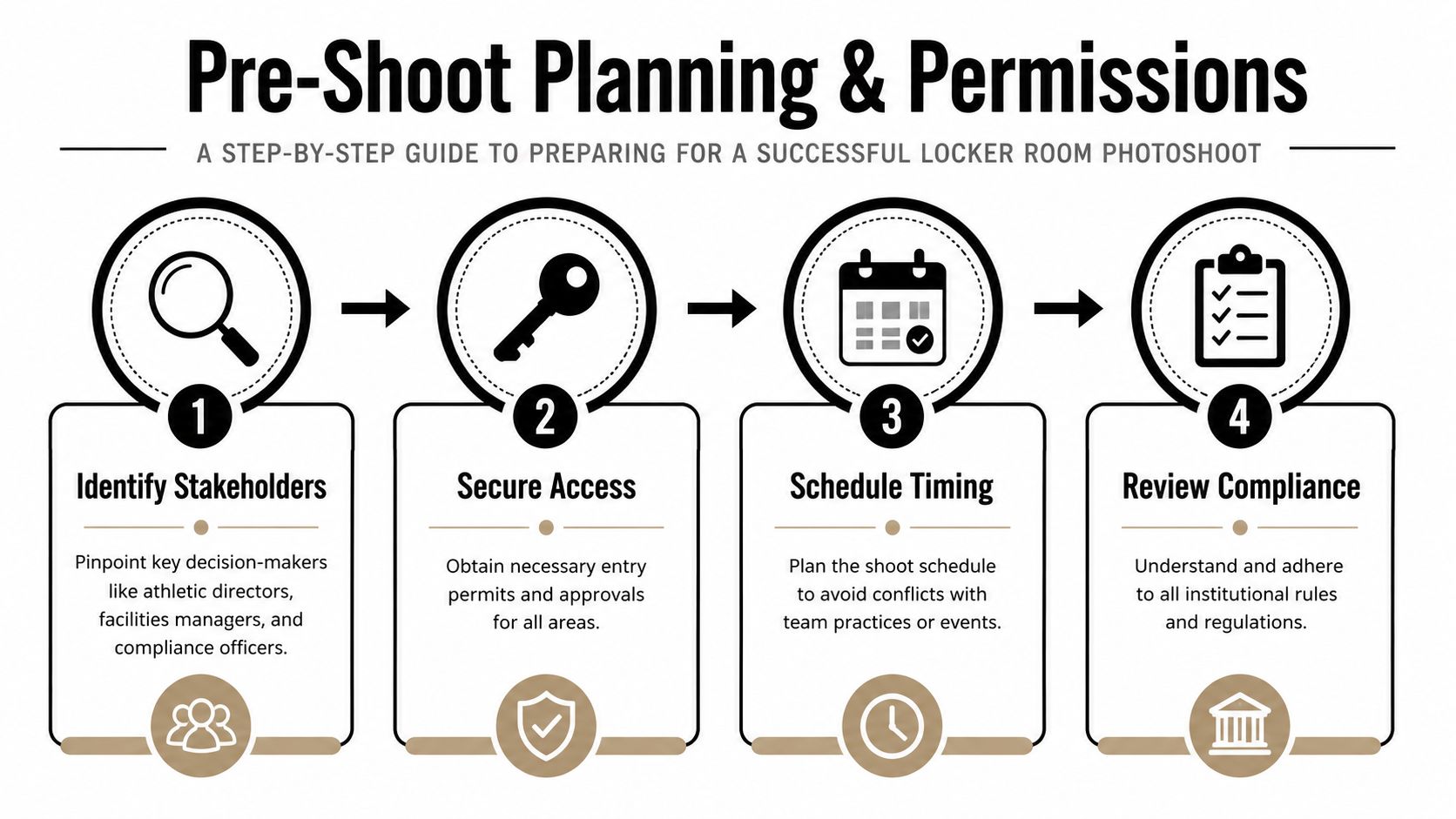
Who needs to approve the shoot
Start with the established chain of control, not the first person who replies. On a campus locker room shoot, that often means several layers of approval.
- Athletics or marketing lead handles the image purpose. They define whether the shoot is for recruiting, facilities promotion, donor materials, editorial use, or a design archive.
- Facilities or operations manager controls room readiness, access timing, and what can be moved.
- Compliance, communications, or campus administration may set rules for athlete visibility, logos, posted materials, and timing.
If the room is inside a broader athletic complex, ask whether loading access, parking, and gear carts require separate authorization. It's easier to solve that a week early than with cases piled on a sidewalk.
A useful prep reference is this guide on preparing your project site for a professional photoshoot. The same principle applies here. The room has to be operationally ready, not just visually ready.
Build the schedule backward
The best planning starts with the final use of the images. If marketing needs broad, empty-room hero shots, schedule around practice and cleaning. If they need atmosphere, coordinate a controlled window with staff and selected players or equipment personnel.
Use a short approval checklist before the date is confirmed:
- Access confirmation: Which doors open, who meets the crew, and who holds keys or credentials.
- Room condition: Confirm whether lockers will be dressed, stripped, or partially staged.
- Usage rights: Clarify where the images will appear and whether rostered athletes may be visible.
- Crew limits: Ask how many people can be in the room without disrupting operations.
A locker room can be available on paper and unusable in practice if the benches are stacked with maintenance gear or the branding isn't in place.
What works on campus
Short emails work better than vague creative pitches. State the purpose, desired date range, estimated crew size, gear footprint, and whether you need the room empty or active. Decision-makers respond faster when they can see the operational impact.
Mastering Interior Lighting and Gear
Locker rooms punish lazy lighting. Overhead fluorescent fixtures, dark cubbies, wood or laminate finishes, polished hardware, and mirrors all pull the frame in different directions. If you don't control color and spill, the room starts looking uneven fast.
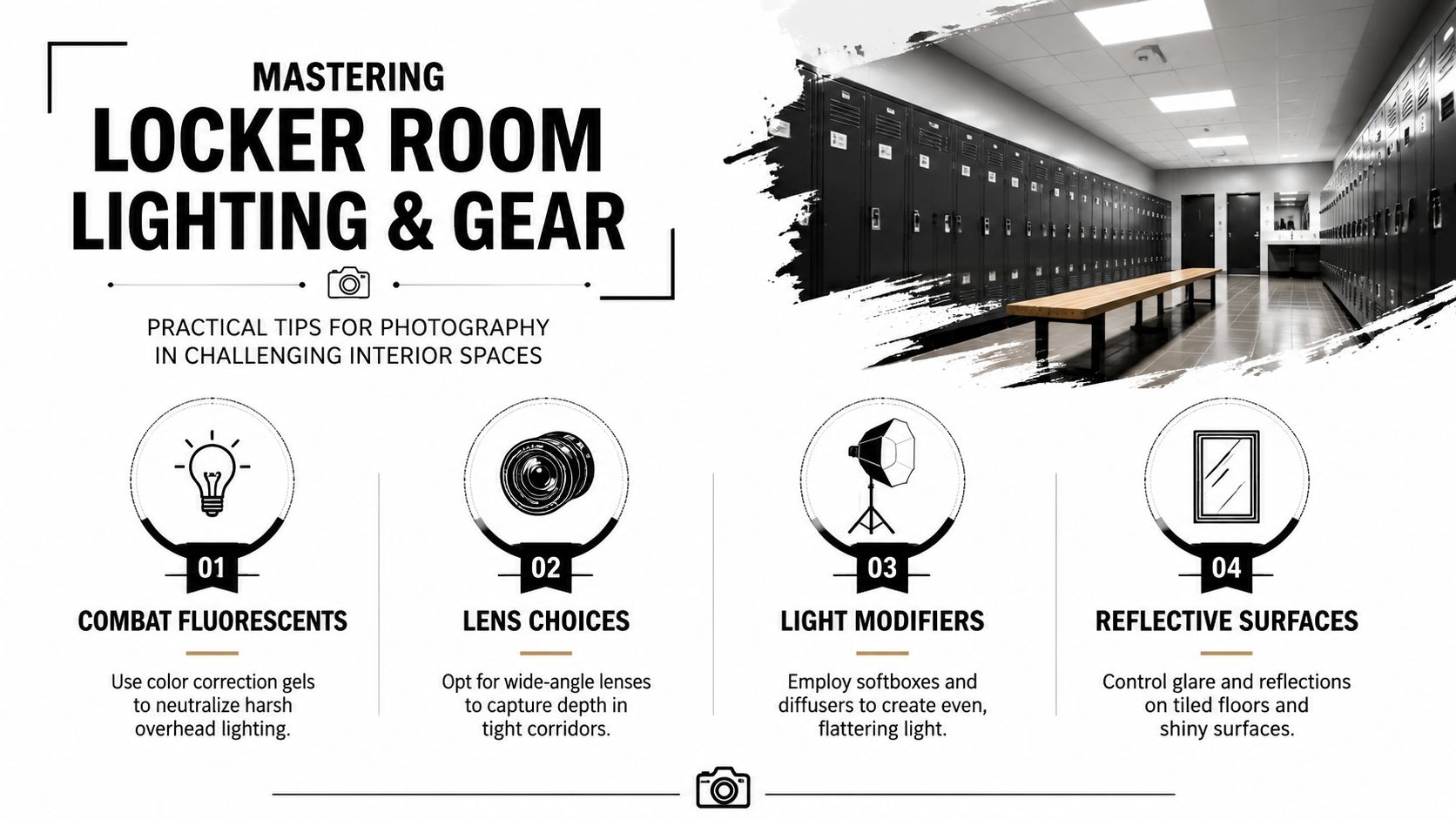
A good baseline approach is to treat the room as an architectural interior first, then add selective drama. That means stable camera support, disciplined verticals, controlled highlights, and light placement that respects the geometry of benches and locker runs. If you need a stronger technical foundation, this overview of lighting for interior photography is a solid companion.
Gear that earns its place
For most locker room work, a compact but capable kit beats a giant production footprint.
- Wide-angle zoom or controlled wide prime: Useful for room overviews without forcing exaggerated perspective.
- Standard focal length lens: Better for details, signage, hardware, and tighter brand compositions.
- Tripod: Keeps framing exact when blending ambient and supplemental light.
- Portable strobes or LEDs: Helpful for lifting dark millwork and evening out bench areas.
- Flags, diffusers, and clamps: Small grip tools solve more problems than another light head.
What doesn't work is blasting the entire room with flat frontal light. That kills depth and makes every surface look equally important.
Mixed light needs a decision
Most locker rooms combine overhead fixtures with some daylight from adjacent corridors, sidelights, or entry doors. You have two choices. Balance everything toward a neutral look, or preserve a little warmth and atmosphere while keeping team colors believable.
This video shows the kind of practical thinking that helps in difficult interiors:
In Tuscaloosa, humidity and temperature shifts can also affect gear when you move from an air-conditioned interior to warm outdoor loading areas and back again. Give lenses and bodies a little time to stabilize before critical frames. Rushing straight from the lot into the room can leave you fighting haze or condensation instead of composing.
Keep your lighting consistent from frame to frame. The marketing team can work with moody or clean. They can't use a gallery where every corner of the same room feels like a different building.
Composing Shots and Crafting a Locker Room Shot List
Composition in a locker room is about control. Benches create strong lines. Locker bays repeat. Ceiling fixtures establish rhythm. If you don't direct that structure, the room will direct you, and not in a good way.
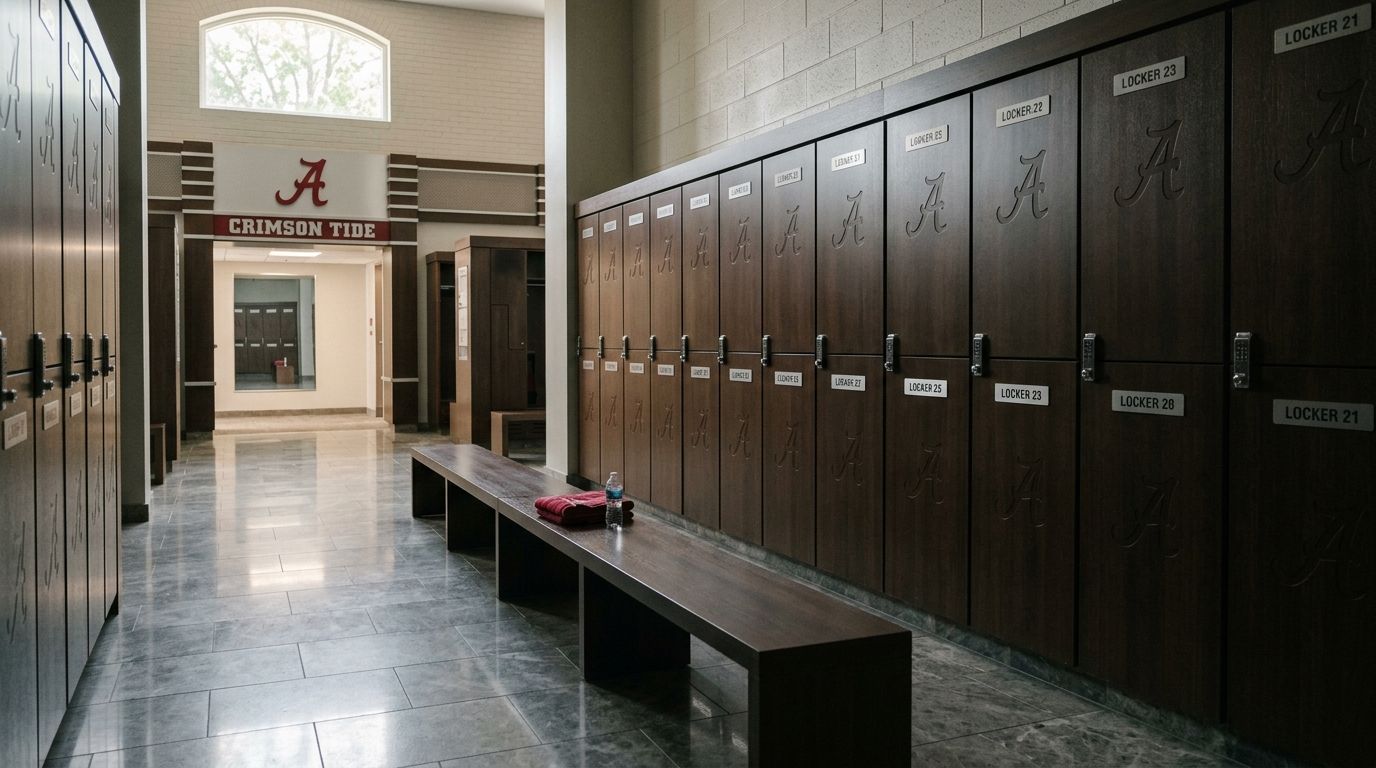
Start with the hero angle. Usually that's the cleanest view that shows the room's organizing logic: entry axis, central bench, locker symmetry, branded focal wall, or ceiling feature. From there, move into supporting frames that isolate details without losing the sense of place.
Read the room before you shoot it
Some locker rooms want a centered, formal composition. Others look better from a slight offset that reveals depth and keeps the room from feeling static. The mistake is assuming every athletic interior should be shot dead center. Symmetry is powerful when the design earns it. Otherwise, use diagonal bench lines, open lockers, or foreground gear to pull the eye through the frame.
A practical shot list keeps everyone aligned.
| Essential Locker Room Shot List | |||
|---|---|---|---|
| Shot Type | Focal Length | Orientation | Quantity |
| Wide entry hero | Wide | Horizontal | 2 |
| Center aisle symmetry | Wide | Horizontal | 2 |
| Angled room overview | Wide | Horizontal | 2 |
| Locker bank detail | Standard | Horizontal | 3 |
| Nameplate close-up | Standard | Vertical | 3 |
| Bench and floor texture | Standard | Horizontal | 2 |
| Logo wall or emblem | Standard | Vertical | 2 |
| Gear vignette | Standard | Horizontal | 3 |
| Architectural material detail | Standard | Vertical | 3 |
| Environmental portrait position | Standard | Vertical and horizontal | 4 |
What to adjust on the fly
A rigid list helps, but the room will always give you something unplanned. A shaft of light across helmets, a reflection that suddenly works, or a doorway alignment that creates depth may become one of the strongest frames of the day.
When that happens, pause and take it. Just don't let improvisation replace coverage.
- Cover the room first: Secure the must-have views before chasing details.
- Watch the edges: Locker rooms clutter at the frame boundaries long before they clutter in the center.
- Leave copy space: Marketing teams often need negative space for type, banners, or crops.
Staging Brand Elements and Team Gear
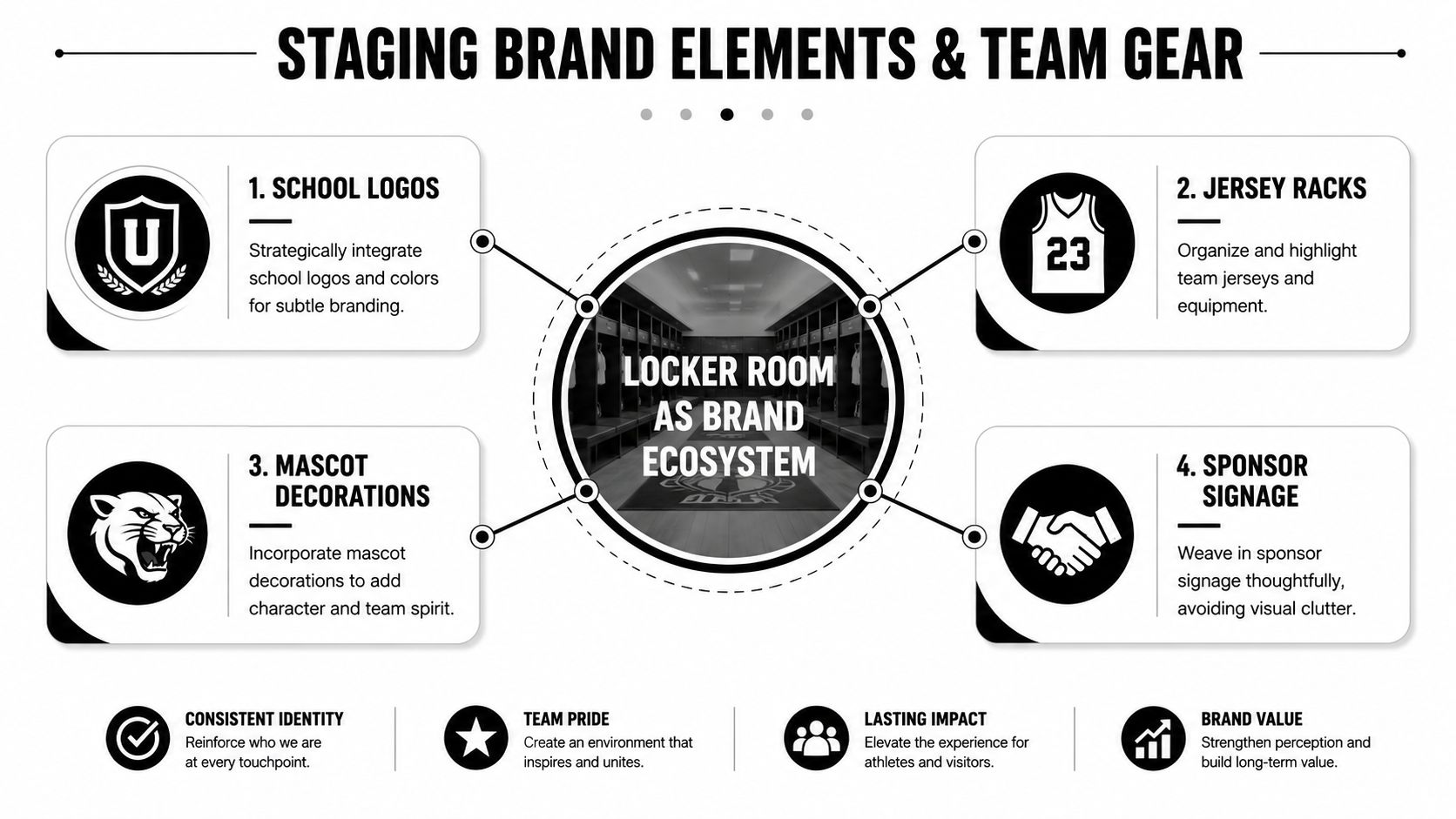
A locker room without brand cues can feel anonymous. A locker room with too many cues feels like a sporting goods display. The job is to stage identity without turning the room into a prop closet.
Use fewer items, placed better
The strongest brand staging usually relies on selective repetition. A few well-positioned helmets, folded apparel, towels, or water bottles do more than a room packed with every available item. Give each visual element a job. One item can establish school color. Another can anchor the foreground. A third can point back toward the architecture.
If the room has a strong identity wall, logo panel, or custom millwork feature, don't compete with it. Stage support around it.
Respect team hierarchy
Some lockers carry more meaning than others. Don't assume every locker can be opened, adjusted, or dressed the same way. Ask an equipment manager or athletics contact which zones are flexible and which should remain untouched.
That one question prevents the most avoidable friction on set.
On-set reminder: If a space has rituals attached to it, treat staging like set dressing in a museum. Adjust what's allowed, then stop.
Brand decisions that usually work
Try these simple staging moves when the room needs life but not chaos:
- Cluster by purpose: Keep apparel together, hydration together, protective gear together. Mixed piles read as mess.
- Echo the architecture: If the bench line is strong, place gear to reinforce that line instead of interrupting it.
- Use school colors sparingly: One concentrated patch of color often reads stronger than color spread everywhere.
- Keep sponsor presence secondary: If sponsor signage must appear, frame it intentionally so it supports the story instead of hijacking it.
Good locker room tuscaloosa images feel like the brand belongs to the space. They don't feel pasted onto it.
Ensuring Safety Privacy and Compliance
Locker rooms are private spaces first and photo locations second. That order matters. The fastest way to lose trust with athletes, staff, or facilities teams is to treat the room like an unrestricted set.
Privacy has to be visible
Before the first frame, establish camera zones and who can enter them. If athletes or staff will appear in environmental portraits, make those moments controlled and obvious. Don't rely on informal assumptions. People move in and out of locker room areas quickly, and a frame that feels harmless in the moment can create problems later if someone appears unexpectedly in the background.
Post simple notices at entrances if the institution allows it. Have a staff contact help clear the room before wide shots. If the room can't be cleared, tighten the composition and avoid photographing unattended personal items.
ADA details affect both framing and credibility
Accessibility isn't just a design compliance issue. It affects how you represent the space. The ADA mandates a clear floor space of 30×48 inches at lockers and benches, with forward reach limits of 48 inches high and 15 inches low, to ensure wheelchair accessibility, as outlined in this ADA locker room design reference.
If you're photographing for architects, contractors, facilities leaders, or institutional marketing, don't casually stage gear bags, benches, or rolling carts in a way that blocks those clear areas in the final image. That creates a false read of the room and can undermine the usefulness of the photos.
Crew behavior matters as much as camera skill
A clean set protocol keeps the day moving:
- Limit loose gear: Keep stands, bags, and cases consolidated outside traffic paths.
- Use one voice for approvals: One client contact should answer staging and access questions.
- Check reflections: Mirrors, glossy locker fronts, and metal hardware can expose people who think they're off camera.
- Clear the frame of identifiers: Remove or avoid any private information that shouldn't be published.
Safety, privacy, and compliance rarely show up in a highlight reel. They do show up when a client decides whether they trust you with another assignment.
Post Production Delivery and Wrap Up
Editing is where the shoot either tightens into a useful set or falls apart into a pile of disconnected images. The goal isn't just beauty. It's consistency, usability, and clean handoff.
Build a delivery set with purpose
Cull in groups, not as isolated frames. Compare hero shots against one another. Compare detail shots against one another. The client doesn't need five near-identical angles of the same bench line if only one carries the story cleanly.
During color work, keep team colors believable and wood tones stable. Locker rooms often drift toward green or magenta if you push mixed light corrections too hard. Straighten verticals carefully, but don't overcorrect until the room feels distorted.
Deliver for real-world use
A dependable handoff usually includes:
- Clear filenames: Name files by space and view, not by camera sequence.
- Web and print versions: Give marketing and design teams options without forcing them to reprocess.
- Simple review gallery: Make selection and comments easy for non-photographers.
- Usage notes: Clarify which frames include recognizable people, private materials, or restricted branding.
The best locker room tuscaloosa galleries feel intentional from first scout to final export. Strong planning prevents access problems. Controlled lighting preserves the space. Disciplined composition makes the room readable. Careful staging strengthens identity. Respect for privacy and accessibility keeps the work trustworthy.
If your team needs polished architectural and brand photography for athletic facilities, interiors, or campus environments, Jimmy Clemmons Photographer brings a design-focused approach shaped by editorial experience, precise lighting, and efficient on-site direction.