
A practical U.S. location scout day rate is roughly $400 to $1,200 per day, depending on the market, production budget, and scope. That headline number usually excludes separate costs for permits, mileage, and image usage.
The number matters when you're defending a production budget, but it rarely tells the whole story. A client may want a property that looks right in photographs, works at the requested time of day, accommodates equipment, allows smooth crew movement, and can be secured. A producer may have a narrow shoot window and a client expecting certainty before anyone loads a camera case.
That's why architectural, interior, hospitality, and corporate brand shoots need a more useful way to think about the location scout day rate. The scout isn't just driving around looking at attractive buildings. The scout is reducing production risk before the shoot begins.
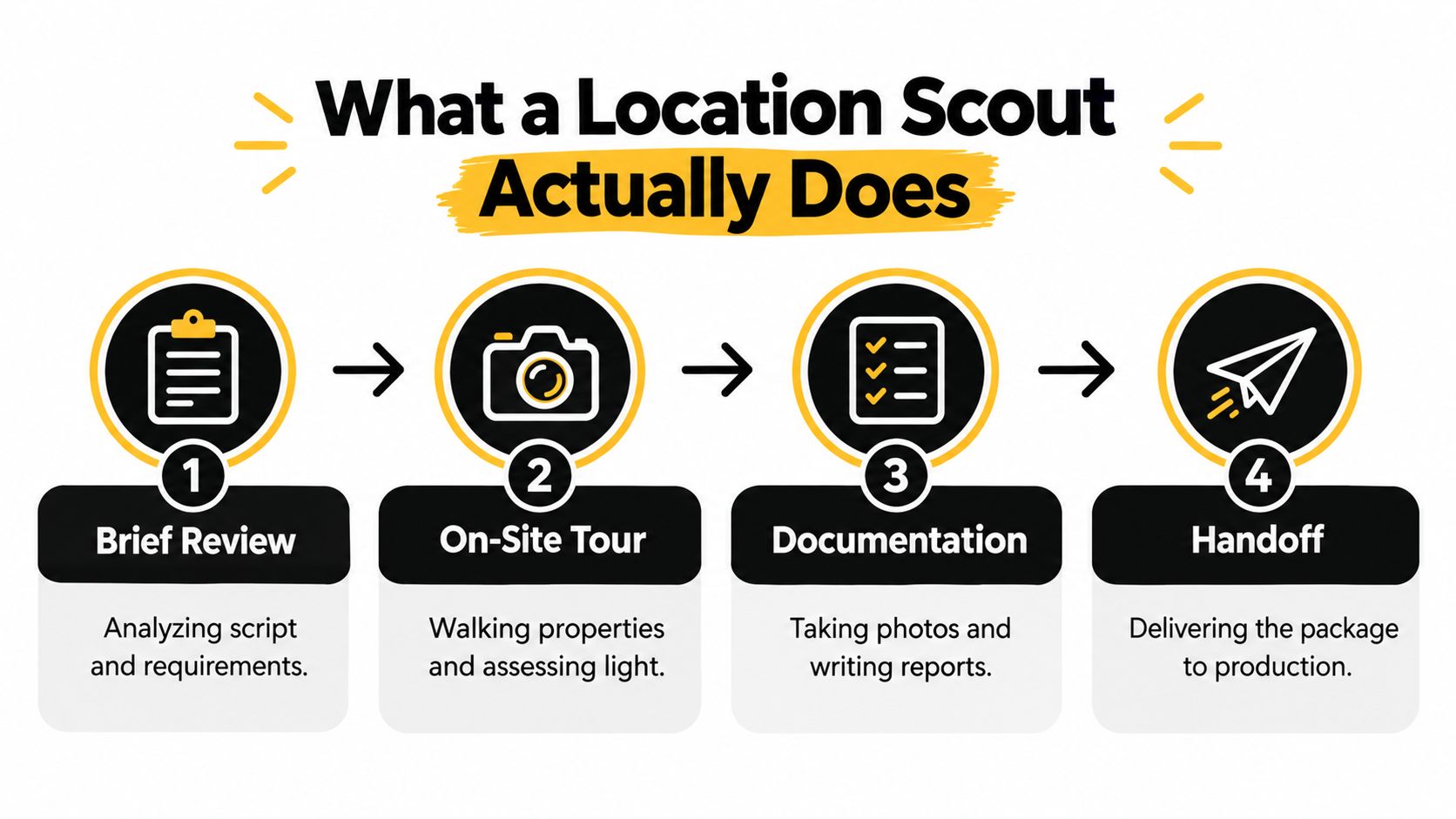
What a Location Scout Actually Does
A typical day starts before the first property visit. The scout reviews the creative brief, floor plans, reference images, access requirements, preferred neighborhoods, parking needs, and the intended use of the final photographs. For an architectural shoot, that may mean identifying clean sightlines and studying how daylight enters a room. For a corporate assignment, it may mean finding a space where staff can work normally while the crew moves through it.
The work then becomes a sequence of research, travel, site inspection, photography, and reporting. At each property, the scout checks more than appearance. Loading access, elevator dimensions, parking, power, noise, occupancy rules, weather exposure, and permission requirements can determine whether a visually strong site is practical.
The deliverable is a decision package
A useful scouting package gives the creative and production teams enough information to make a decision without guessing. It commonly includes:
- Location photographs: Exterior approaches, primary rooms, secondary spaces, service areas, access points, and problem areas.
- Light observations: Direction of daylight, likely changes through the day, glare, deep shadow, and blackout possibilities.
- Access notes: Parking, loading routes, stairs, elevators, doors, restrictions, and contact procedures.
- Production notes: Power availability, crew circulation, equipment staging, noise, weather contingencies, and occupancy limitations.
- Written comparison: A concise report that explains which property fits the brief and what compromises each option carries.
Research and conversations with owners are also part of the day. The scout may need to confirm whether furniture can move, whether a brand can photograph signage, whether a building manager requires insurance documentation, or whether a hospitality space can remain open during production.
For a commercial photographer, the distinction between a pretty property and a workable property is the entire point. Architectural location scouting services can be scoped around that assessment rather than around a vague promise to “find a place.”
Practical rule: If the client can't identify the photographs, access notes, daylight observations, and follow-up included in the quote, the day rate isn't defined well enough.
Typical Pricing Bands and Where They Fall
A scout quoting for an architectural or hospitality shoot is pricing a working day, not an annual salary. The assignment may involve only a few pre-production days, yet those days can determine whether a property works for daylight, access, brand requirements, and production logistics. The rate should match that responsibility and the local market.
Industry guidance places U.S. location-scout rates at approximately $400 to $1,200 or more per day. Industry location-scout rate guidance places independent and low-budget work commonly near $400 to $600 per day. Mid-budget television, streaming, and feature assignments in markets such as Los Angeles, New York, and Atlanta commonly fall near $600 to $850 per day. High-budget studio and premium productions can reach approximately $850 to $1,200 or more per day.
| Production context | Common working range | What usually changes the quote |
|---|---|---|
| Independent or low-budget production | $400 to $600 per day | Limited properties, lean reporting, local travel |
| Mid-budget television, streaming, or feature work | $600 to $850 per day | Multiple stakeholders, detailed logistics, major-market demand |
| High-budget studio or premium production | $850 to $1,200 or more per day | Higher risk, complex access, negotiations, production scale |
| Short film or micro-budget project | $200 to $350 per day or a negotiated flat fee | Reduced scope, local sites, simplified deliverables |
Short films and micro-budget projects may fall around $200 to $350 per day or under a negotiated flat fee, according to the same industry reference. That range can suit a nearby search with a short visual shortlist. It is harder to justify when the client also expects technical analysis, owner negotiations, permit support, or several rounds of revisions.
Why union references don't produce one universal answer
Union and commercial agreements provide useful benchmarks, but they do not set one freelance rate for every shoot. Teamsters Local 399 rate information distinguishes location managers from location scouts and publishes rate sheets for covered feature, episodic, and made-for-television productions. Its current location-department agreement has a 2024 to 2027 term, illustrating how covered rates can come from negotiated labor contracts rather than a national tariff.
A published 2026 commercial-agreement lookup lists a minimum location-scout-manager rate of $957.58 per day. That number applies within its agreement and classification. Jurisdiction, coverage, production budget, overtime, and the difference between a scout and a department head still affect the comparison.
For context, the U.S. Bureau of Labor Statistics reported a 2023 median annual wage of $61,800 for television, video, and film camera operators, while workers in motion-picture and video industries averaged $84,070, according to BLS wage data for camera operators. Those figures concern an adjacent occupation and do not convert directly into a freelance scouting day rate. The FAQ compares that employment data with project-based pricing in more detail.
Factors That Move a Day Rate Up or Down
Two quotes can carry different prices because the assignments differ. A half-day visit to one nearby property has little in common with a full-day search across a metro area involving owners, building managers, detailed light studies, and a formal report.
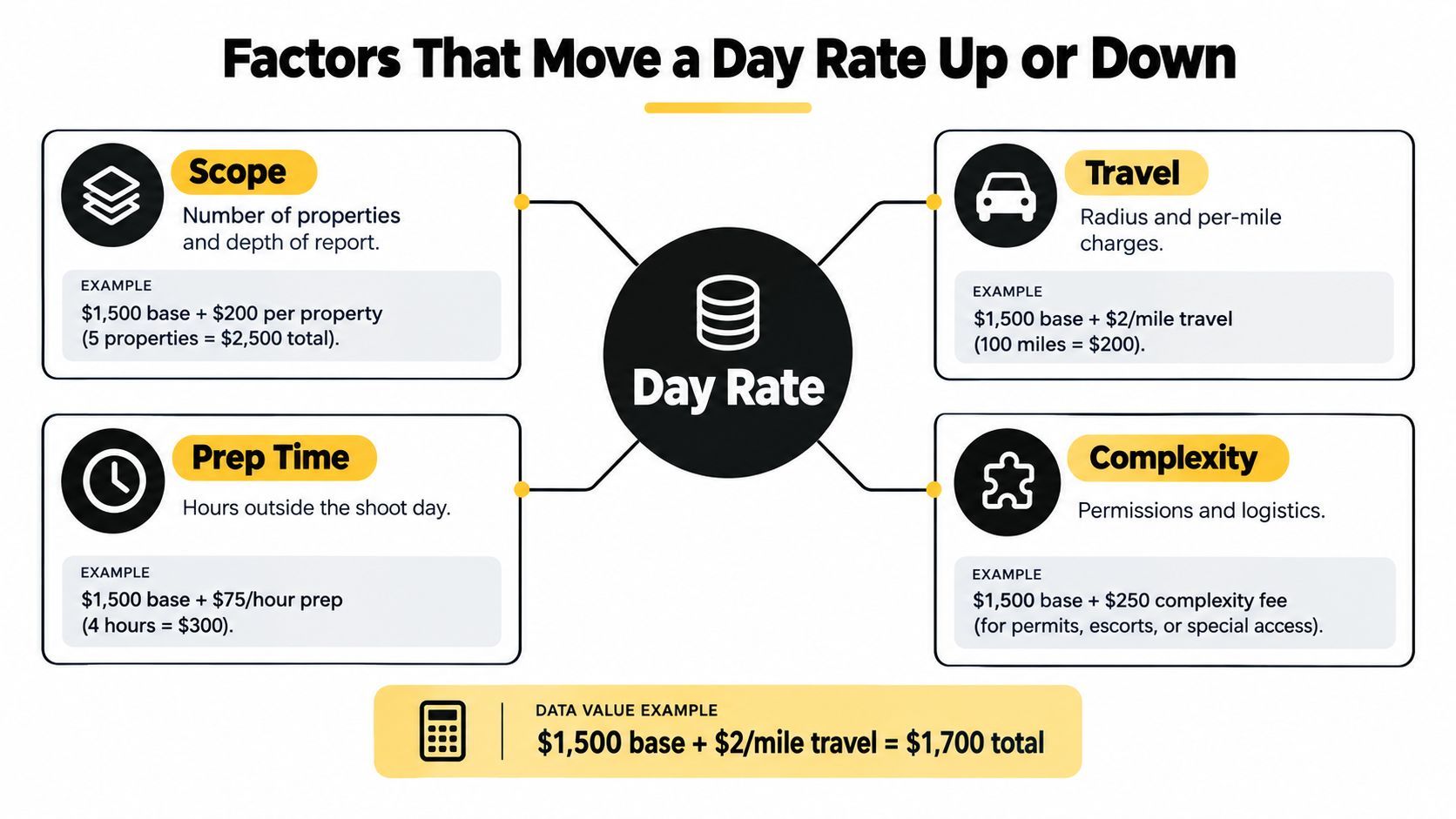
Scope comes first
The number of properties matters, but the depth of assessment matters just as much. One interior may need a quick feasibility check. Three properties may require travel planning, separate access arrangements, room-by-room photographs, daylight observations, and a comparison report.
A quote should state whether it covers one property, a defined number of properties, or a block of scouting time. “Location scouting” by itself leaves too much room for disagreement.
Travel creates a second adjustment. A scout may use a personal vehicle, a rental vehicle, parking, toll routes, or specialized equipment. Industry rate guidance distinguishes labor from expenses and treats mileage, lighting kits, camera packages, and other costs as separate line items. Location-manager rate guidance also treats prep, scouting, and travel as working days that should be billed at the full rate or at an explicitly agreed fraction.
Complexity changes the economics
The difficult part may happen before or after the site visit. Researching properties, contacting owners, collecting documents, arranging access, reviewing restrictions, and preparing a report can add substantial work outside the visible driving time.
Image usage also needs a separate conversation. Scouting photographs may be internal decision tools, or they may later appear in a campaign, presentation, editorial feature, property listing, or public-facing marketing system. Those are different uses, and the quote should identify whether the images are for planning only or whether the client receives defined usage rights.
A practical Atlanta proposal might offer a half-day reconnaissance option for nearby sites and a full-day technical scout when several properties, permissions, or architectural-lighting questions are involved. It should also identify whether follow-up revisions are included.
The phrase “labor only” sounds simple, but it usually hides the work that causes the most friction.
Sample Pricing Scenarios for Commercial and Architectural Shoots
A day rate becomes easier to evaluate when the assignment has a shape. The following examples are hypothetical, but they reflect the way commercial and architectural scopes commonly diverge.

Single-property interior assignment
A design team needs to photograph one finished interior in the same metro area. The scout reviews the brief, visits the property, checks the best camera positions, studies daylight, confirms parking and equipment access, and supplies a short report with photographs.
A sensible proposal might separate:
- Scouting labor for the agreed visit.
- Local mileage or parking, if applicable.
- Photography and report delivery.
- Any owner or building-management coordination.
- Usage rights if scouting photographs will be published.
This is the kind of assignment that may support a half-day reconnaissance option, provided the property is nearby and the client doesn't expect extensive negotiation or multiple rounds of site comparisons. The low price only works when the scope stays narrow.
The scout should still check the less glamorous details. A polished living room may have reflective glass that creates lighting problems, a narrow stair that blocks equipment movement, or a loading route that forces the crew through a public entrance. A real estate image enhancement resource can help present reference images clearly, but it can't solve an access or daylight problem discovered too late.
Multi-property hospitality campaign
A hospitality client wants several spaces assessed for a campaign. The brief includes exterior arrival images, interior rooms, public areas, service access, daylight behavior, guest privacy, and a preferred schedule.
This scope is materially different from one property. The scout is coordinating appointments, comparing sites, recording operational restrictions, and considering how a crew will move without disrupting guests. The proposal should identify the number of properties, the expected report format, local travel, access coordination, and any post-scout calls or revisions.
A lower day rate with undefined follow-up can cost more than a higher rate with a clean handoff. If the client asks for a second shortlist after rejecting the first set, that is a new scope unless the original quote includes a stated revision allowance.
A visual reference can clarify what the final scouting package should contain:
Corporate campus with a restricted window
A corporate marketing team has one narrow window to inspect a campus before a planned brand shoot. The scout must confirm exterior approaches, interior routes, employee circulation, parking, security procedures, power, weather alternatives, and permission requirements.
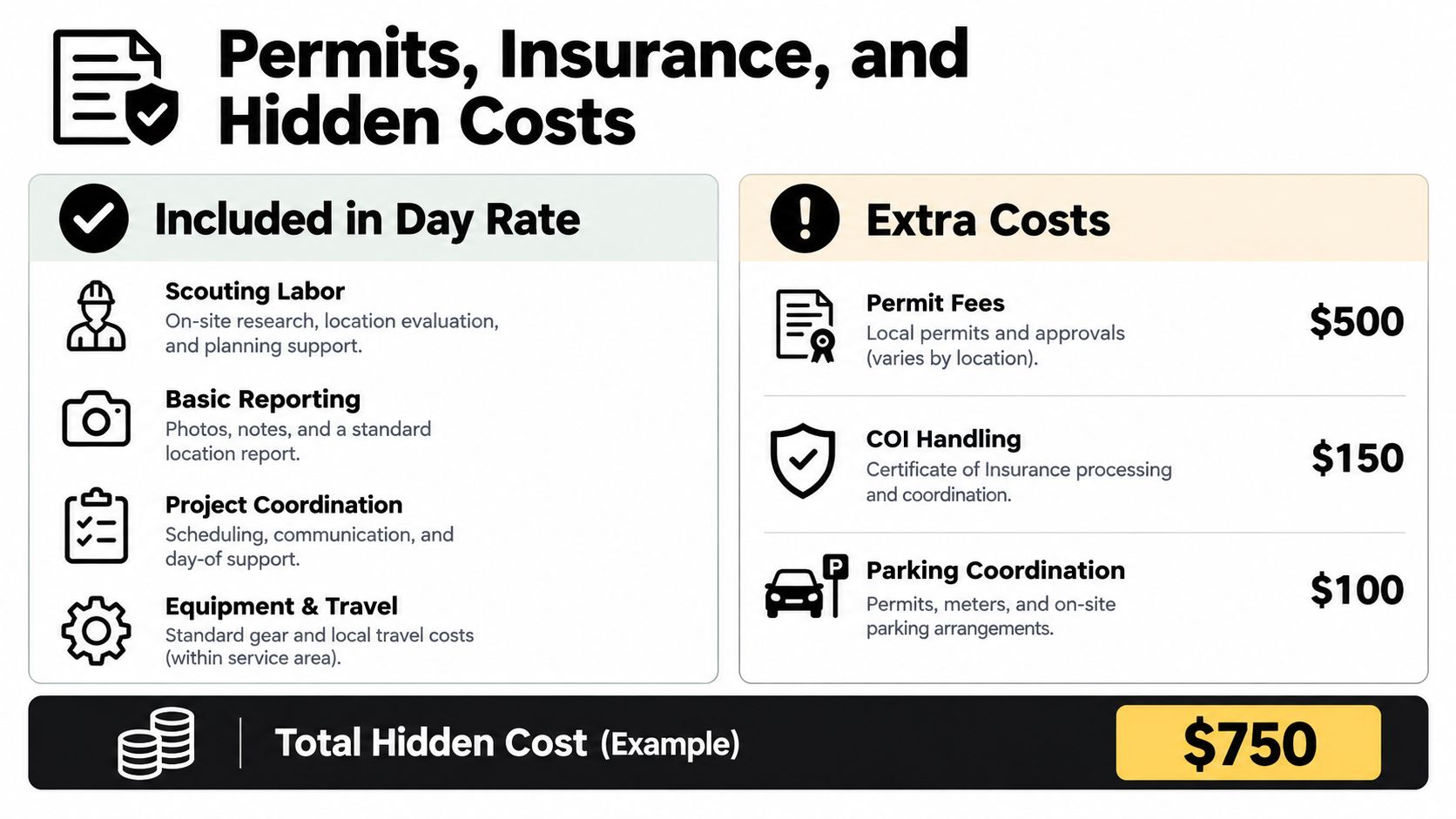
The quote should distinguish the scout's fee from municipal charges, insurance processing, parking, travel, and any additional administrative work. A site that looks perfect but can't accommodate the proposed equipment or schedule isn't a successful find.
The strongest proposals state assumptions in plain language. They say how many locations are included, when the report arrives, who supplies approvals, what happens if access is denied, and what a later revision costs. That clarity protects the client from surprise invoices and the scout from unpaid expansion of the assignment.
Permits, Insurance, and the Costs That Hide Inside the Quote
A scout's professional fee covers work. It doesn't automatically cover municipal charges, insurance requirements, parking, permits, or third-party services. Keeping those categories separate makes the quote easier to defend and prevents the day rate from becoming a catch-all.
Permit rules can be triggered by production activity rather than crew size or camera count. A Georgia municipal filming policy requires a permit for commercial filming using public or private property or a public right-of-way in one location for more than five consecutive minutes, or when normal traffic is affected. On-street parking, interrupted pedestrian or vehicle movement, and equipment placed on public property can all matter. The policy lists a $25 base processing fee, with additional fire, state, or federal approvals possible for specialized activity. The Georgia municipal filming policy explains the local trigger in detail.
Municipal charges vary by location
| Location | Published permit example | Operational implication |
|---|---|---|
| New York City | $500 for each consecutive 14-day period, or portion of that period | Duration and exterior activity affect the permit budget |
| Chicago | $250 per day per location | Applications generally need four full business days, or five when traffic control or drone use is involved |
| Chicago student film | $25 per day per location for verified student films | Project classification can change the charge |
These examples come from New York City permit guidance and the municipal rules described in the verified rate information. They aren't a universal price list. The scout should identify the jurisdiction, number of locations, permit duration, project classification, and lead time before promising a total.
Insurance and agreements create another administrative layer. A Nashville permit form requires a completed application, signed location agreement, certificate of liability insurance, and full payment before issuance. It calls for submission at least three business days before the first shoot date and lists a $130 application fee plus $21 per parking space per day. A later Nashville form lists a $230 application fee, showing that published municipal charges can change or vary by filing context. This contractor insurance guide offers useful background for teams trying to understand why insurance documentation deserves its own review.
The proposal should state whether the scout drafts or collects agreements, verifies insurance, arranges parking, submits permits, and handles revisions. Location releases belong in the same administrative conversation, so a location release form resource can help teams prepare the paperwork before access becomes urgent.
Negotiation and Contract Considerations for Both Sides
A day rate becomes reliable only when the scope is written down. The quote should attach a deliverables list, assumptions, expense policy, usage terms, cancellation language, and revision allowance. Without those terms, both sides may remember the conversation differently once a property becomes difficult or the schedule shifts.
Start with the labor and expense split. The scout's fee might cover research, visits, photographs, and reporting, while mileage, parking, tolls, permits, insurance certificates, equipment, and third-party charges sit outside it. If travel is included, define the boundary. If it isn't, say how it will be calculated.
Clauses worth settling before approval
Cancellation and postponement deserve plain language. A scout blocks time, schedules owners, and may turn away other work. The client needs to know what happens if the shoot is postponed, access is canceled, or the creative brief changes after research begins. A kill fee or cancellation policy can protect both sides, but it must be agreed before the date is held.
Usage rights should identify what the scouting photographs are for. Internal planning, client approval, editorial publication, property marketing, and advertising are not interchangeable. The quote should say whether the client receives a limited planning license or broader rights, and whether later uses require a separate fee.
Revisions need a boundary. One reasonable follow-up clarification is different from a new property search, a second round of owner outreach, or a changed creative direction. Define the included allowance and the rate for additional work.
Ask before signing: What exactly will be delivered, which expenses are separate, and what happens if the brief or schedule changes?
The scout benefits from precision because it prevents unpaid scope expansion. The client benefits because a precise quote makes competing proposals comparable. A lower headline rate may stop looking inexpensive once it excludes travel, paperwork, reporting, and follow-up.
Two clauses are often overlooked. The first is responsibility for obtaining permissions and insurance documents. The second is responsibility for conditions discovered after the scout's visit, such as changed access, construction, weather, or owner restrictions. Assigning those responsibilities doesn't eliminate risk, but it tells everyone who must act when conditions change.
Practical Checklist and Common Questions
Before approving a location scout day rate, a producer, studio lead, or marketing manager should confirm what the day actually covers. A useful checklist includes:
- Scope: How many properties are included, and what rate applies if the shortlist grows?
- Deliverables: Will the client receive photographs, daylight observations, access details, and a written comparison?
- Travel: Are mileage, parking, tolls, rental vehicles, and out-of-area travel included?
- Preparation: Does the fee cover research and owner outreach before the scouting day?
- Technical review: Will the scout assess power, loading, elevator dimensions, crew circulation, noise, available light, and weather alternatives?
- Permissions: Who handles location agreements, insurance certificates, permits, and parking arrangements?
- Usage: Are scouting photographs for internal planning only, or may the client publish them in marketing or editorial materials?
- Revisions: How many follow-up calls, new properties, or report changes are included?
- Cancellation: What happens if access is canceled or the production date moves?
- Payment: Are municipal and third-party charges paid directly by production or advanced by the scout?
A reusable location scouting template can turn these points into a consistent request, quote, and approval process. For architectural, interior, hospitality, and corporate work, the checklist should also identify daylight studies, access coordination, and intended usage of the scouting images. Those items often matter more than the film-style job title attached to the work.
Common questions
How does scout pay compare with annual camera-operator wages?
The comparison is limited. Annual wage data describes employed camera operators over a year, while a location scout usually handles a short pre-production engagement and bills by the day or project. The BLS camera-operator wage data provides employment context, but it does not establish a location scout's freelance day rate. A scout's quote must account for research, travel, site assessment, reporting, access coordination, and periods between assignments.
Why might a location manager quote more than a scout?
A location manager may handle negotiations, permits, parking, vendor coordination, neighbor relations, restoration paperwork, and shoot-day supervision. A scout focused on research, site assessment, photographs, daylight conditions, and reporting may have a narrower scope. Titles overlap, so compare the deliverables and responsibilities rather than the label.
What happens when the project needs multiple revision rounds?
Treat additional rounds as a scope change unless the original quote includes them. A new creative direction, wider search area, expanded property list, or repeated owner outreach consumes working time. State the included revision allowance and additional rate before the first shortlist is delivered.
How do short films and micro-budget projects manage the same work?
They may reduce the search area, choose nearby properties, accept a simpler report, negotiate a flat fee, or limit technical review. A flat fee is defensible when the shortlist is local and the report is a straightforward visual comparison. Complex access coordination, permitting, daylight analysis, or repeated outreach should remain separate unless the quote expressly includes them.
The strongest quote makes the work visible, separates labor from expenses, and gives the client enough information to choose a location confidently.
For architectural, interior, hospitality, and corporate shoots, Jimmy Clemmons Photographer provides location scouting focused on access, available light, production requirements, and the visual demands of the assignment. Review the scouting and photography services at Jimmy Clemmons Photographer and request a scope separating the day rate, travel, production costs, post-production, and usage rights.