

You're probably sitting on a finished project that looks excellent in person and oddly ordinary in the first round of photos. The materials are right. The lines are clean. The furniture styling works. But the images don't hold the depth, calm, or drama that the space has when you stand in it.
That usually isn't a photography problem alone. It's a lighting problem.
As an architectural photographer, I can tell within a few frames whether a space was lit as part of the design or lit as an afterthought. The difference shows up fast. Good lighting gives surfaces separation, reveals texture, controls glare, and lets the eye move through a room with intention. Weak lighting flattens stone, muddies wood tones, blows out windows, and turns a carefully designed interior into a record shot. If the goal is magazine-quality imagery that helps sell the project, lighting design services are part of the visual outcome long before the camera arrives.
More Than Just Lightbulbs Why Great Design Needs Great Lighting
A common scenario goes like this. The architect has finished a beautiful residence or hospitality space. The contractor executed the details well. The client walks through at dusk and loves it. Then the marketing team gets the final photography, and the room that felt layered and luxurious now looks uneven, dull, or strangely harsh.
That disconnect happens because people don't experience a space the way a camera does. Our eyes forgive contrast, adapt to color shifts, and mentally organize visual hierarchy. A camera is less generous. It records every bright hotspot, every dead corner, every reflection in glass, and every fixture that fights the architecture instead of supporting it.
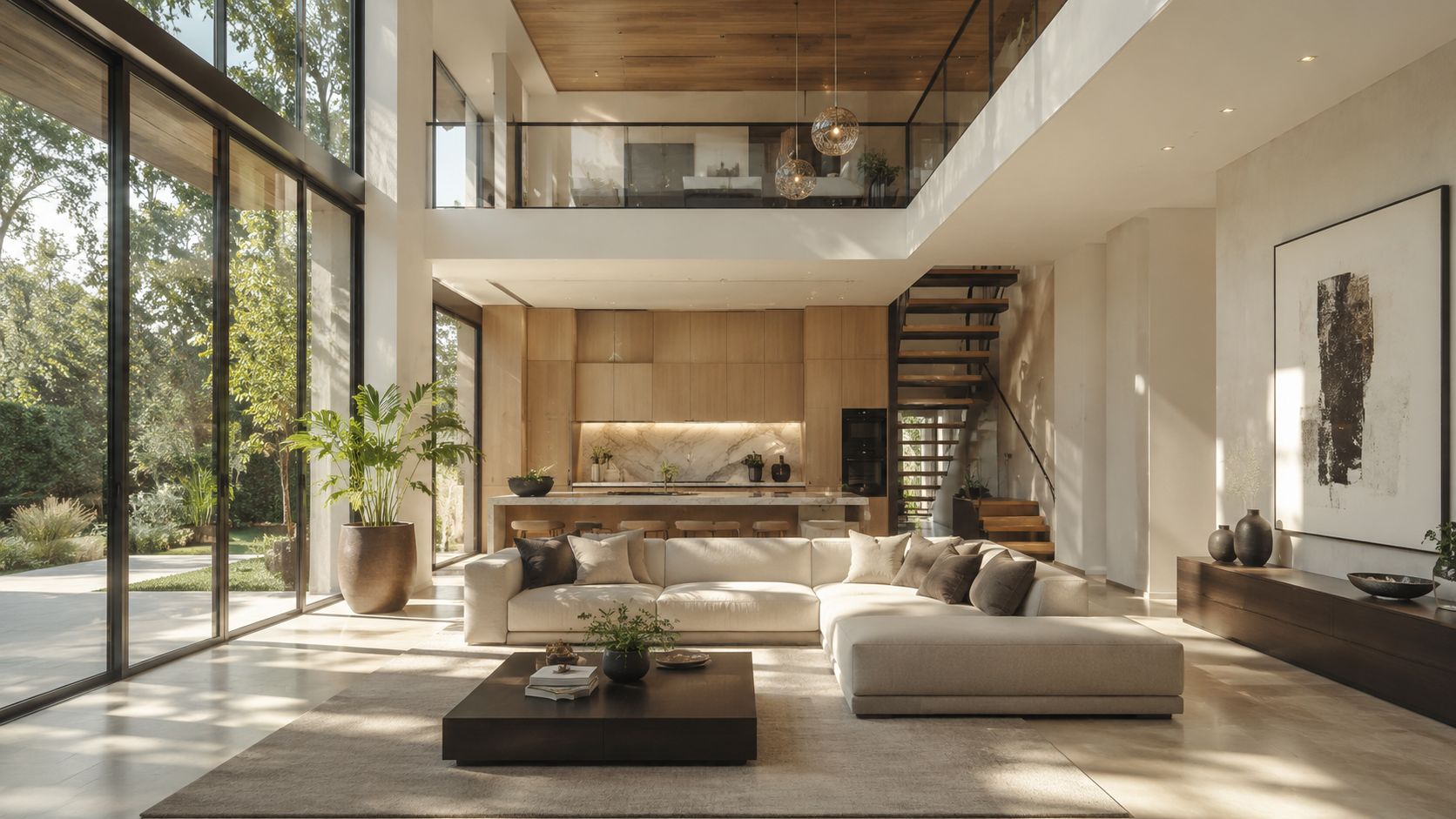
Lighting sets the emotional read
A room can be technically bright and still photograph poorly. That's the part many clients don't expect. More output doesn't create better images. Better control does.
A lighting designer shapes the emotional read of a space. They decide whether the room feels intimate or open, whether a corridor invites movement or feels sterile, whether a retail display catches the eye naturally or screams for attention. From the camera's perspective, those decisions determine whether the photograph has rhythm.
Practical rule: If every plane in a room is lit the same way, the photograph loses hierarchy.
In strong architectural imagery, you want gradation. You want one surface to lead and another to recede. You want a textured wall to hold detail instead of turning into a flat patch. You want a ceiling to support the composition without becoming the brightest object in the frame.
The market is treating lighting as a real discipline
That shift isn't just aesthetic. It's structural. The global lighting design services market was valued at USD 18.8 billion in 2023 and is projected to grow to USD 28.2 billion by 2032, a trajectory that reflects rising demand for specialized lighting in architectural projects, according to Wise Guy Reports on the lighting design services market.
That growth makes sense from where I stand behind the camera. Teams are asking more from buildings now. They want efficiency, comfort, identity, and visual distinction. Lighting carries all of that at once. It affects how a guest reads a hotel lobby, how a buyer responds to a model unit, and how an editor chooses one project image over another.
The projects that photograph best don't treat lighting as decoration. They use it as part of the architecture itself.
The Language of Light How Designers Shape a Space
Think of a lighting designer as a composer. Fixtures are only the instruments. The work lies in arrangement. A well-lit space doesn't happen because someone chose expensive pendants. It happens because different kinds of light are layered, timed, aimed, and balanced so the room reads clearly.
From a photographer's side of the process, three layers matter most.
Ambient task and accent
Ambient light gives the room its base tone. It's the broad wash that tells the camera whether the space feels soft, crisp, moody, or clinical. If ambient light is too flat, the image has no depth. If it's too aggressive, every surface competes at once.
Task light handles function. It belongs where work happens. Counters, vanities, desks, reading chairs, reception areas. Good task lighting doesn't just make a space usable. It also makes the photograph believable. Viewers can tell when a room would work for the life it promises.
Accent light creates attention and narrative. It picks up art, reveals millwork, shapes columns, or gives shelving presence. This is often the layer that makes an image memorable because it tells the eye where to go first.
Here's what usually works and what doesn't:
- Layered scenes work: Ambient for structure, task for logic, accent for emphasis.
- Single-source schemes fail: One blanket of downlights often leaves rooms looking generic on camera.
- Selective focus works: Not every feature needs equal attention.
- Over-lighting fails: It erases contrast and makes premium materials look cheaper than they are.
Color quality changes everything on camera
Once the layers are right, color quality decides whether the finishes hold together. It is for this reason that many otherwise polished spaces break apart in photographs.
Color temperature affects mood. Warm light can make walnut, limestone, plaster, and textiles feel rich and calm. Cooler light can sharpen a workspace or contemporary gallery setting. Neither is automatically correct. The issue is consistency and intent. If one area drifts warm and the adjacent zone goes cool without a reason, the camera sees confusion.
Color rendering matters just as much. If the light source can't render material color well, the photo won't either. White oak can go gray. Skin tones in hospitality spaces can feel unhealthy. Artwork can lose subtlety. A beautiful palette only survives into the final image if the light respects it.
For teams thinking about the camera during planning, this guide to lighting for interior photography is useful because it connects fixture decisions to how the room will be recorded.
The best-lit rooms don't announce the lighting first. They let you notice the architecture.
Control is part of design
A final point clients often overlook is controls. Dimming, zoning, aiming, and scene-setting aren't accessories. They're part of the composition of the space. A room with strong fixtures and weak control still photographs poorly because the designer can't tune the scene.
That's why professional lighting design services feel different from fixture selection. One is product choice. The other is authorship.
From Blueprint to Final Shot The Design Process Unpacked
Clients often assume lighting design begins with fixture cut sheets. In practice, the process starts much earlier, while the architecture is still flexible enough to support good decisions. That early timing matters because once ceilings close and millwork is installed, many of the smartest adjustments become expensive or impossible.
The technical side is also more rigorous than many teams realize. Professional lighting design services rely on software-based modeling. The design standard referenced by the New South Wales education technical specification requires light level calculations using industry-standard software such as AGI32, Dialux, or Relux, along with early coordination using dimensioned floor plans that show ceiling heights, beams, columns, and skylights. That modeling helps avoid over-illumination, wasted energy, and fixture conflicts with architectural elements, as outlined in the lighting technical standard for software-based light level calculations.
A clear process usually looks like this.
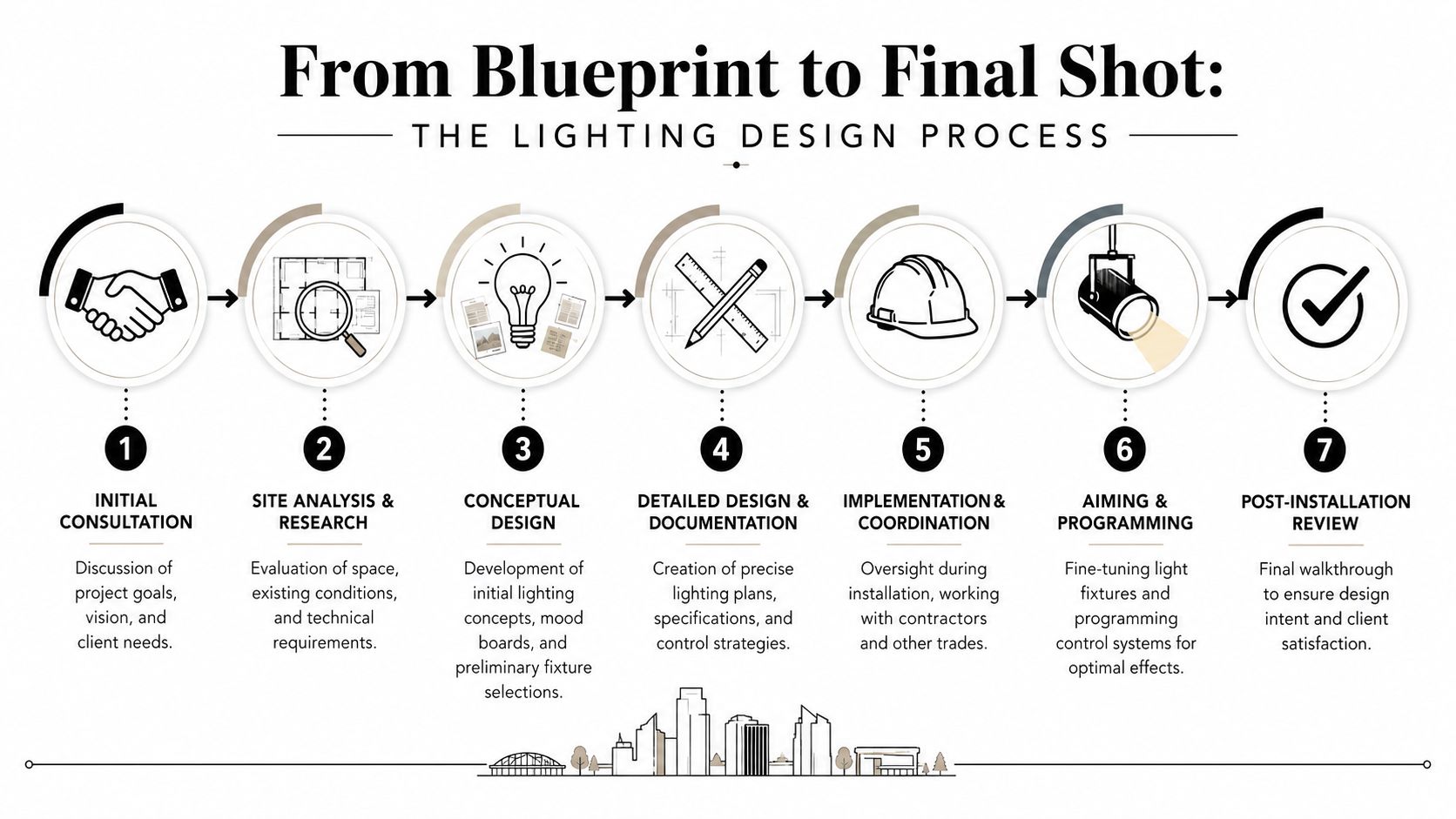
Discovery and concept
First comes discovery. The designer needs to know how the space should feel, how it will be used, and what the visual priorities are. A hospitality lounge isn't lit like a private school commons. A residential project intended for editorial publication isn't approached like a standard leasing unit.
Then concept work begins. Here, the lighting plan starts responding to materials, sightlines, circulation, and mood. Also, smart designers begin considering what the camera will see. Reflective stone, glazing, polished metals, and glossy millwork all require discipline early.
For teams preparing a visual shoot, this piece on choosing the best light for a site shoot helps frame the relationship between natural conditions and the installed design.
Documentation and coordination
After concept comes documentation. During this stage, the project becomes buildable.
- Plans and layouts: Fixture locations, aiming logic, and relationships to ceiling forms.
- Specifications: The exact luminaires, lamping or LED characteristics, and control intent.
- Coordination: Conversations with architects, electricians, millworkers, and sometimes signage teams so one decision doesn't sabotage another.
This stage is where poor projects start showing stress. A downlight lands too close to a beam. A decorative fixture interrupts a clean elevation. A cove detail looks elegant on paper and creates ugly striping on site. None of that is abstract to a photographer. It all shows up in the final frame.
A useful visual reference sits below.
Aiming programming and shoot-day refinement
Installation isn't the finish line. Aiming and programming are where many spaces finally become photogenic. Accent fixtures need to hit the right surface. Scene levels need to make sense together. Brightness must be tuned so a hero feature reads clearly without burning out nearby finishes.
Good lighting plans can still produce weak photos if nobody spends time aiming, dimming, and balancing the scene after installation.
On shoot day, the best results come when the photographer and lighting designer collaborate. Sometimes the room needs a dimming adjustment. Sometimes one fixture should go lower so exterior detail holds through glass. Sometimes a dramatic wall wash needs to be softened because the camera is seeing texture too aggressively. That final layer of judgment is what turns a competent lighting plan into imagery that feels composed.
Understanding the Investment Key Cost Drivers Explained
The price of lighting design services varies because the service itself varies. A short consultation for a compact retail interior is one thing. A full design engagement for a hotel, campus building, or large residence is another. If you're comparing proposals, the useful question isn't “Why is one fee higher?” It's “What level of thinking, coordination, and protection of the final result is included?”
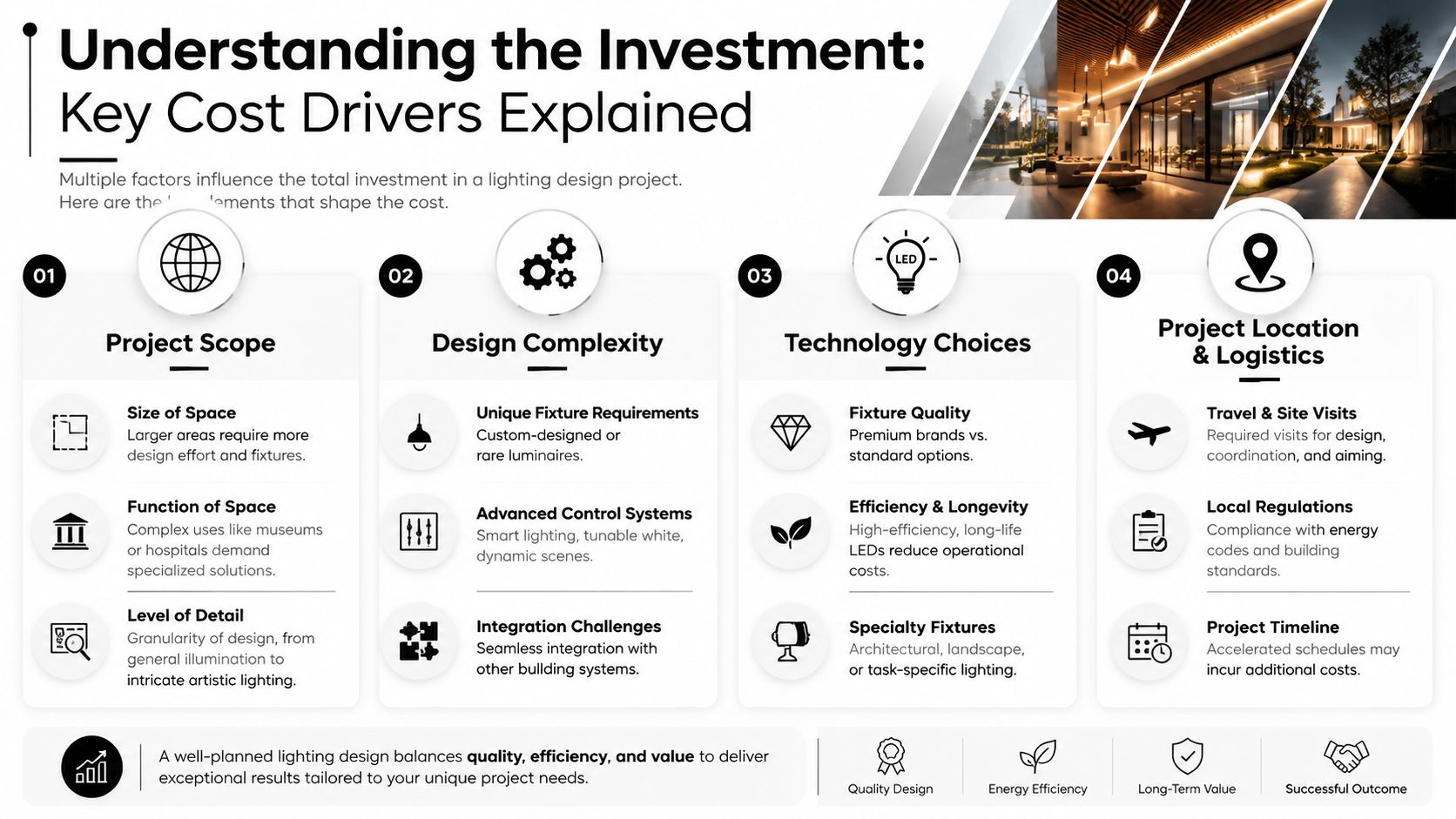
What usually drives cost
Some cost drivers are obvious. Others only become visible after a project goes off course.
| Cost driver | Why it changes the fee | What it changes in the final images |
|---|---|---|
| Project scope | Larger or more varied spaces require more layouts, review, and coordination | More consistent visual language across the property |
| Design complexity | Specialty conditions, custom details, and tricky materials take more problem-solving | Cleaner highlights, fewer distractions, stronger focal points |
| Technology choices | Advanced controls and premium fixtures require deeper specification and programming | Better dimming behavior, steadier color, stronger scene control |
| Logistics | Site visits, installation review, and travel all add effort | Fewer on-site surprises that ruin a shoot |
Cheap lighting often gets paid for twice
The most expensive line item isn't always the design fee. It can be the correction cost. If a project installs the wrong beam spread, poor controls, or inconsistent color quality, someone pays later. That might be through field revisions, replacement product, delayed photography, or marketing assets that don't look premium.
Clients should think like publishers. A project may only get one major photography window before occupancy, launch, or press outreach. If the lighting isn't resolved, the image library suffers. And those images often carry the burden of sales decks, award submissions, leasing campaigns, editorial pitches, and portfolio use long after the project is complete.
Value shows up beyond the fixture schedule
Strong lighting design has practical value in the building itself. It can improve visual comfort, support the intended use of the space, and make architectural decisions legible. But from a photographer's viewpoint, the financial case becomes very concrete. Better lighting preserves material investment. It helps expensive finishes read as expensive finishes.
A well-priced proposal usually reflects design time, coordination depth, and post-installation attention. A bargain proposal may only cover selection, not authorship.
Questions to Ask Your Prospective Lighting Designer
A polished portfolio matters, but it's not enough. Some designers can make a presentation board look elegant and still struggle in the field. Others understand light at a deep technical level and miss the emotional or visual side. The right partner needs both.
When I'm brought in to photograph finished work, the projects that hold up best usually come from teams that asked better questions early.
Ask about collaboration not just taste
Start with how they work with others. Lighting affects architecture, interiors, engineering, construction, and photography. A designer who operates in isolation usually leaves problems behind for everyone else.
Consider asking:
- How do you coordinate with architects and interior designers? Listen for specifics about reflected ceiling plans, material review, mockups, and field adjustments.
- How do you think about photography during the design process? You want someone who understands glare, reflections, contrast management, and what a lens notices that the eye often ignores.
- What happens after fixtures are installed? A serious answer should include aiming, programming, and final tuning.
Ask for one solved problem
A designer's philosophy sounds good in a meeting. Their problem-solving tells the truth.
Ask them to walk you through a difficult condition they've handled. It could be a low ceiling, a highly reflective lobby, a façade with competing light sources, or a mixed-use project where one zone needed calm and another needed punch. You're listening for judgment. Did they add more fixtures, or did they control what was already there better?
A strong designer can explain what they removed, softened, or restrained. Not just what they added.
Ask about spaces nobody photographs first
This question separates thoughtful designers from surface-level ones. Public areas usually get the most attention because they end up on websites, in brochures, and in awards submissions. But the building is also used by staff, maintenance teams, service workers, teachers, healthcare personnel, and support crews.
The Illuminating Engineering Society explicitly calls for designers to prioritize daylight and eliminate glare in back-of-house staff areas, a point raised in its discussion of equitable indoor lighting for staff zones. That matters because these spaces often get shortchanged even though the people using them spend long hours there.
A useful question is simple: What is your philosophy for staff-only and utilitarian areas compared with public-facing spaces?
That answer tells you whether the designer understands lighting as care, not just branding.
For project teams preparing clients for what a completed space can and can't do visually, this article on managing client visual expectations is a strong companion.
The Tangible Results of Expert Lighting Design
The payoff shows up in the photograph. Not as a trick. As clarity.
When lighting is resolved well, the camera stops fighting the room. Stone reveals grain. Wood gets warmth without going orange. Upholstery separates from the wall behind it. Corridors gain rhythm. Glass feels intentional instead of chaotic. The image starts carrying the same confidence the physical space has in person.
What changes in architectural imagery
In one type of project, the biggest improvement is often depth. A flat scheme makes every surface read on a single visual plane. Layered light creates foreground, middle ground, and background. That matters in photography because composition depends on separation.
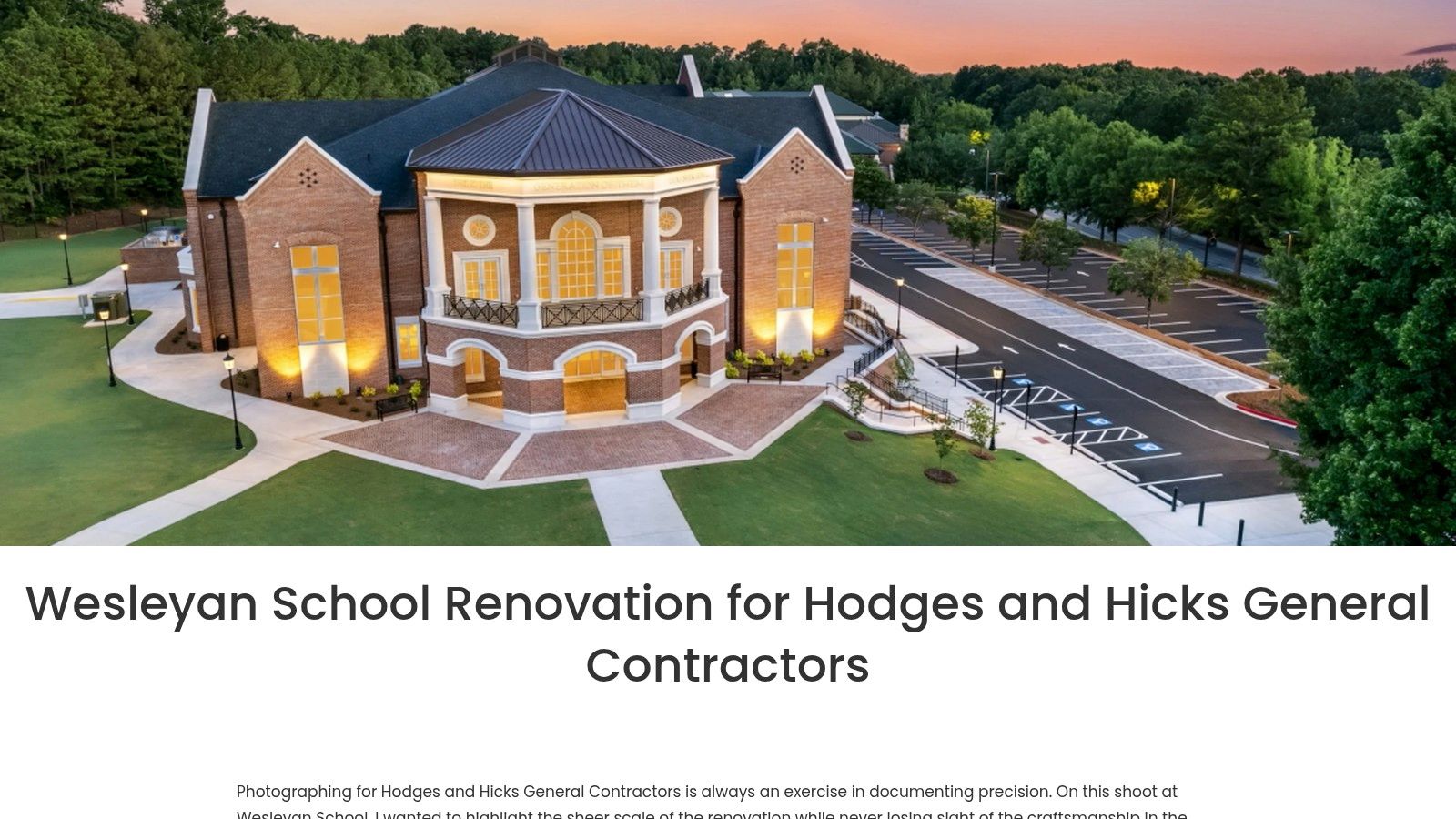
A school, corporate interior, or residential project may all share the same issue. The design team invested heavily in texture and material transitions, but the lighting failed to reveal them. Once the light is layered correctly, the camera can finally describe the architecture instead of merely recording it.
What changes in commercial and brand spaces
Brand environments often need something slightly different. They need direction. The viewer should understand where to look and what matters first.
That's where accent and scene control do the heavy lifting. Product, signage, seating zones, feature walls, or circulation paths can all be clarified with light. In the final images, that creates a sense of intention. The photograph doesn't feel crowded because the eye has guidance.
A well-lit commercial image also sells mood without losing function. That's difficult to fake in post-production. Editing can refine. It can't invent believable hierarchy that wasn't there on site.
The strongest final images usually look effortless because the hard decisions were made before the shutter clicked.
Why it matters after the shoot
Photography is often the longest-lasting record of the project. The flowers get changed. Furniture gets moved. The building ages. But the launch set, the award submission images, the portfolio gallery, and the editorial selects remain. If lighting design supported those images from the start, the work keeps paying off.
That's why expert lighting design isn't separate from the final visual story. It is the condition that lets that story be seen.
If you need architectural photography that respects the design intent of a space and brings out the value of smart lighting decisions, Jimmy Clemmons Photographer creates polished, design-forward imagery for architects, developers, brands, schools, and commercial teams that need images with depth, clarity, and purpose.