
A cobra rises from a wicker basket. A man in bright cloth leans into a pungi, and for a second the street scene looks like a postcard from another century.
Then the questions arrive. What looks timeless is also illegal, physically risky, economically fraught, and far harsher for the snake than the performance suggests.
The Enduring Image of the Indian Snake Charmer
The image has traveled far beyond India. It appears in travel memories, old films, colonial-era fantasies, and tourist expectations: the charmer seated cross-legged, the cobra swaying, the reed instrument sending out a thin, haunting note. For many viewers, that single tableau stands in for India itself.
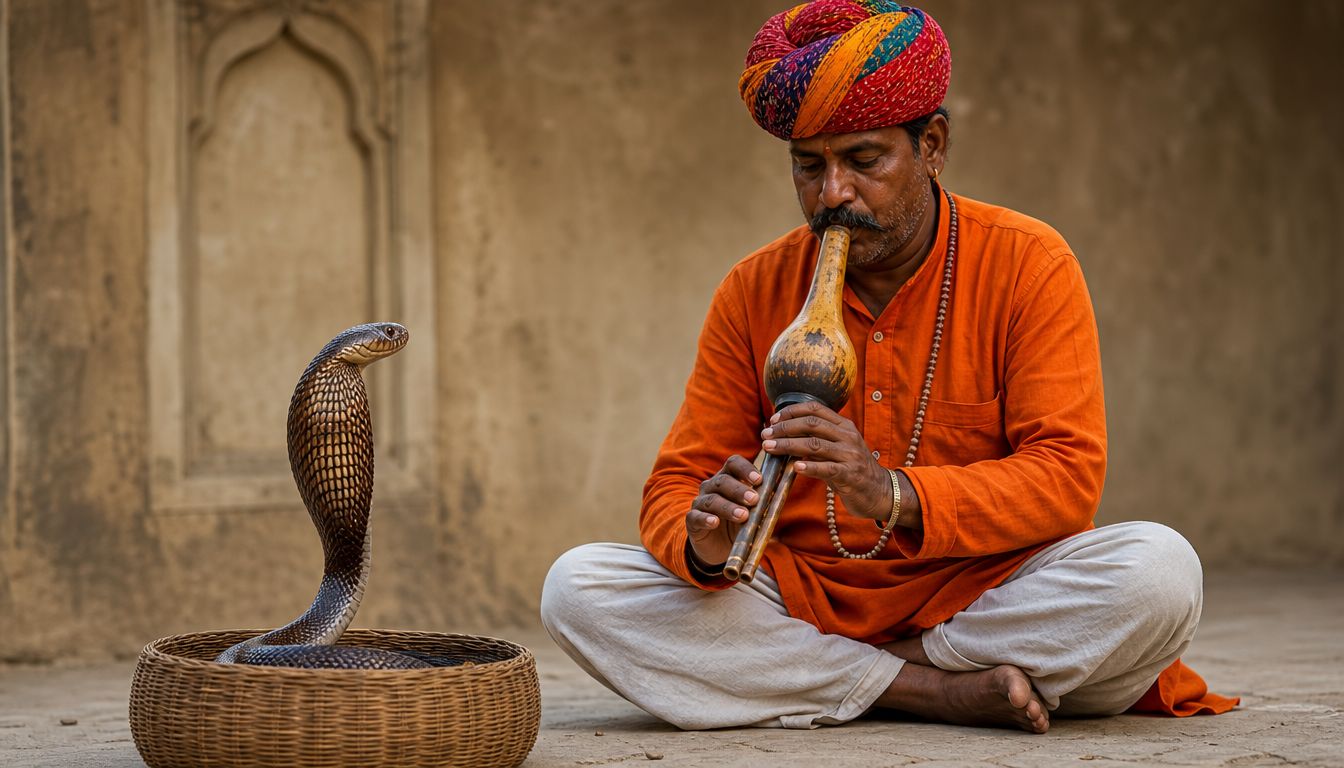
The power of that image is visual. It has rhythm, color, danger, and ritual all at once. It also has the tidy simplicity that strong pictures often carry, which is why it remains so persistent in visual culture and why thoughtful photography storytelling matters here.
The postcard and the street
The old romantic version of India snake charmers casts them as guardians of secret knowledge, half performer and half mystic. In that telling, the cobra is enchanted by music, the crowd is delighted, and the whole exchange feels folkloric rather than commercial.
But the scene on the pavement contains other realities. There is the law. There is the snake's welfare. There is the pressure on families whose work was once inherited and public but is now pushed into legal and moral shadows.
The photograph most people recognize first is often the one that explains the least.
That tension is what makes the subject difficult to dismiss and difficult to celebrate. To look closely is to hold two truths at once. Snake charming has deep cultural roots, and the modern performance can involve coercion, injury, and illegality.
Why the image still matters
India's snake charmer remains one of the most durable icons attached to the country. Yet icons flatten people into symbols. Once that happens, the person with the pungi becomes a type rather than an individual, and the snake becomes a prop rather than a living animal under stress.
A better approach starts with attention. Look at the basket. Look at the crowd. Look at the distance between reverence and survival. That's where the story begins.
A Tradition Rooted in Mythology and Caste
Long before the modern ban, snake charming was a recognized profession tied to hereditary communities. It wasn't just a trick performed for passersby. It was livelihood, social identity, and in many cases a craft learned within families over generations.
Historical accounts connect the community's ancestral roots to Poona, now Pune, near Bombay, now Mumbai, with migrants carrying the trade into places like Singapore, where it remained popular street entertainment until the 1970s, according to the National Library Board of Singapore's account of Indian snake charmers. That same account notes that many charmers traditionally believed serpents were sacred and related to the Nagas.
Sacred snakes and social status
That belief matters. In Hindu tradition, snakes are not only feared animals. They are also charged figures, linked in popular understanding to divinity, protection, fertility, danger, and cosmic power. The charmer stood at the edge of those meanings, someone who could approach what others avoided.
For some communities, that role created a strange blend of respect and marginalization. The charmer could be seen as spiritually potent and socially vulnerable at the same time. He might be welcomed during a festival, then pushed back to the margins once the performance ended.
A street profession can look casual from the outside. In reality, it often rests on strict inheritance. Children watch. Skills pass down. Instruments, handling methods, songs, routes, and reputations become family property.
More than performance
Snake charming also moved across borders with migration. The mention of migrant charmers in Singapore is revealing because it shows the practice as portable labor. Families didn't carry only stories. They carried a trade.
That trade depended on recognizable elements:
- The pungi: A double-reed instrument associated with the performance.
- The basket: Both stage and container, practical and symbolic.
- The cobra: The animal most tied to the public image of the charmer.
- The audience: Essential to the economy. Without onlookers, there is no exchange.
A tradition survives when it answers several needs at once. Snake charming did that. It generated income, affirmed group identity, drew on religious symbolism, and gave performers a public role that was difficult to replace with ordinary wage work.
The burden of inheritance
That history complicates easy judgments. If snake charming were only a tourist gimmick, its disappearance would read one way. If it were only sacred tradition, it would read another. In practice, it has been both cultural inheritance and street economy.
Context matters: When a state bans a hereditary occupation, the loss is never only financial. It also affects status, memory, and the stories a community tells about itself.
That doesn't excuse what happens to the animals. It does explain why some families didn't easily walk away when the law changed. For communities built around the identity of handling snakes, the end of the trade threatened more than a daily income. It threatened belonging.
Deconstructing the Performance The Truth Behind the Magic
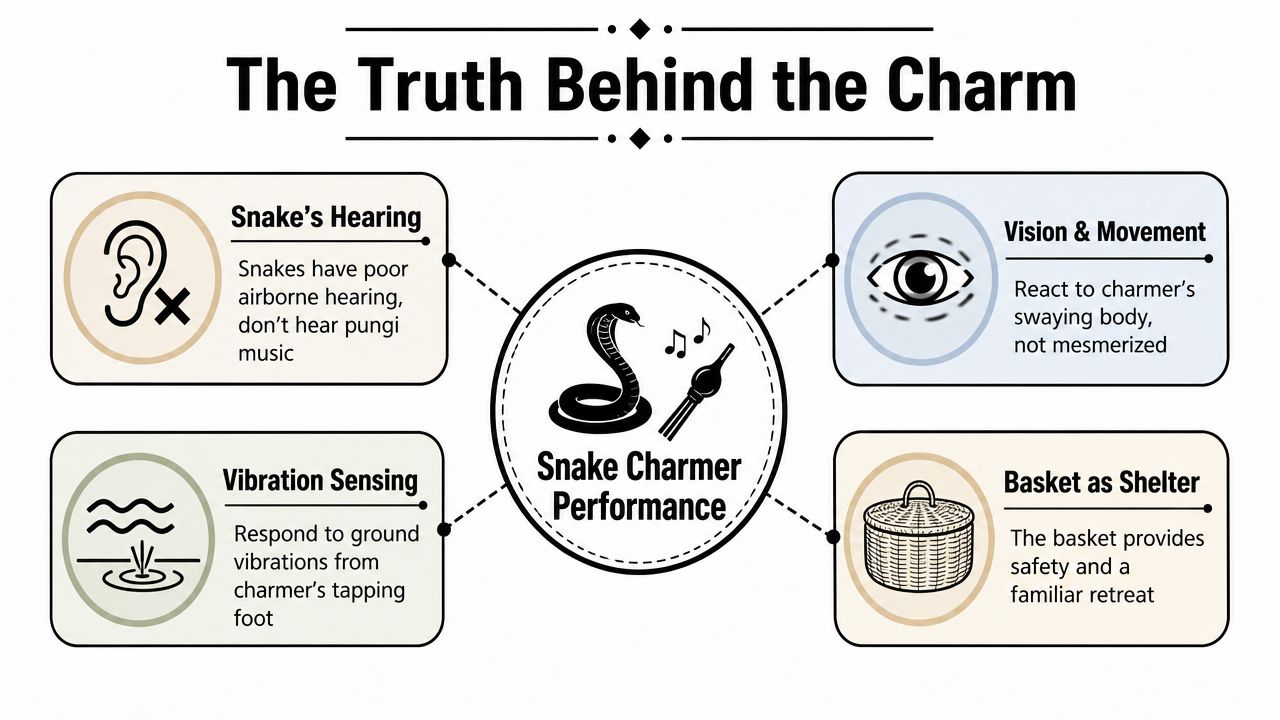
The cobra does not rise because it loves music. The central illusion of snake charming is also the one many still repeat.
According to Business Insider's reported account of modern snake charming practices in India, the “charmed” cobra is not hypnotized. It reacts to the movement of the pungi as a defensive threat. What the audience reads as dance is, from the snake's side, a posture of vigilance.
For visual storytellers, that distinction changes everything. A compelling frame can still be made, but it needs the honesty that comes with environmental portrait photography, where setting, gesture, and context reveal a subject rather than mythologize it.
What the snake is actually doing
The raised hood, fixed gaze, and swaying motion are often interpreted as entrancement. The more grounded explanation is simpler. The snake tracks motion in front of it and responds as if confronting danger.
The charmer exploits that response. The performance depends on controlling distance, tempo, and the snake's field of attention. The pungi functions as a visual focal point as much as an instrument.
A useful way to think about the act is to separate what the audience sees from what the snake experiences.
| Audience impression | Likely reality |
|---|---|
| The cobra is dancing to music | The cobra is following movement defensively |
| The charmer has mystical control | The charmer manages a risky routine through handling methods |
| The snake is calm | The snake may be stressed and hyper-alert |
The hidden violence
The same Business Insider report says practitioners may surgically remove fangs or tie the snake's mouth shut to prevent biting. Those details move the subject out of folklore and into ethics.
A performance that looks elegant can depend on mutilation. It can also depend on a snake weakened by confinement and handling. Once that's understood, the old language of “charm” starts to collapse.
Here are the myths that most need retiring:
- Music controls the snake: The visual motion of the instrument is central to the reaction.
- The snake is a willing participant: The behavior is defensive, not cooperative.
- The danger is pure theater: Handlers reduce risk through physical restraint or alteration of the animal.
- The act is harmless heritage: The animal cost can be severe.
A cobra facing a pungi is not performing for pleasure. It is responding to pressure.
What a camera can miss
Photographs of India snake charmers often isolate the elegant moment. The hood is open. The charmer's eyes are intent. The basket curves neatly in the frame. What remains outside the image may be more important than what's inside it.
The missing details include the altered body of the snake, the conditions of captivity, and the economics of the encounter. Documentary work that ignores those facts risks turning suffering into texture.
That doesn't mean no one should photograph the subject. It means the camera shouldn't repeat the lie that the performance is magical in the innocent sense of the word.
The Wildlife Protection Act and the End of an Era
India's legal break with snake charming came through wildlife law, not through a cultural debate alone. The decisive framework was the Wildlife Protection Act of 1972, which banned the ownership, capture, and exploitation of snakes in India and made the traditional trade illegal, as summarized in the Wikipedia overview of snake charming in India.
A separate account circulated by Sanctuary Asia states that the law imposes a 7-year imprisonment penalty, designates all Indian snakes as protected species, and that enforcement contributed to the number of active charmers falling by over 80% by the 1990s in its discussion of the Wildlife Protection Act's impact on snake charmers.
What the law changed
The law did more than ban a street act. It criminalized the entire chain that made the act possible: capture, possession, transport, exhibition, and commercial use. What had once been public work became evidence.
The original legislative motivation included stopping the export of snake skins. Over time, stricter enforcement in the 1990s and 2000s helped drive the entertainment use of snakes toward near extinction in India, according to the same Wikipedia summary.
That sequence matters because it explains why older images and current reality can feel out of sync. The iconic photograph survives in memory long after the conditions that made it legal have disappeared.
The intent and the consequence
Conservation law often acts broadly. It protects species first and lets cultural fallout unfold afterward. In this case, the state drew a bright line around wildlife protection.
The law's logic was straightforward:
- Snakes are protected wildlife.
- Protected wildlife cannot be privately owned or exhibited as entertainment.
- Traditional snake charming therefore becomes illegal.
The practical consequence was less neat. Families whose identity and labor centered on snakes lost lawful access to both.
Legal reality: In India, snake charming is not a gray-area folk performance. It is legally prohibited under wildlife law.
Why the ban still feels unfinished
Law can end legitimacy faster than it ends practice. That helps explain why the phrase “dying art” lingers. It captures part of the truth, but not all of it.
Snake charming did decline sharply under enforcement. At the same time, disappearance in public view isn't the same thing as total disappearance. Some former performers shifted to other work. Others continued in hidden or selective ways. The legal story is clear. The lived story is not.
The Human Cost Economic Hardship and a Shadow Economy
When a hereditary profession is outlawed, the question isn't only whether the ban is justified. It's also what happens to the people left behind by it.
Public discussions of India snake charmers often split into two moral camps. One side emphasizes animal cruelty and conservation. The other stresses culture and poverty. The harder truth is that both can be real at once.
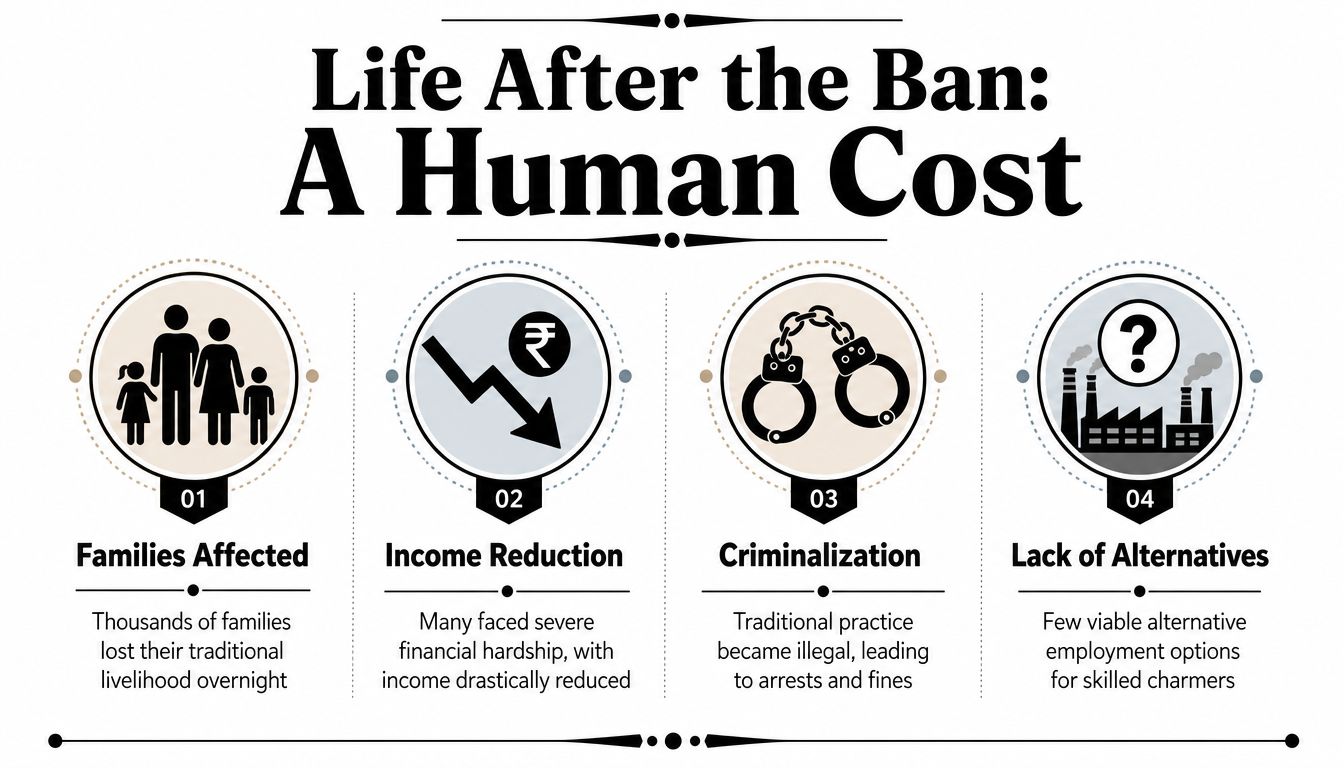
A claim shared in a Reddit discussion about the persistence of snake charming argues that the trade did not fully stop because of an “unpayable bribe” culture and cites 800,000 unlicensed charmers identified in 2007 navigating illegality through informal networks in that discussion of selective enforcement and unlicensed charmers. That source is weaker than formal reporting, but it points to a recurring theme in how people describe the trade's survival: prohibition on paper, uneven enforcement on the ground.
After the ban
For many families, the loss wasn't abstract. A banned trade leaves behind skills that don't easily transfer. Handling snakes, reading crowds, moving through festival circuits, and performing for small cash payments don't convert neatly into salaried work.
Some former charmers reportedly adapted by becoming snake removers in urban areas rather than exhibitors, as described in the Sanctuary Asia-linked account cited earlier. That shift is significant. It preserves expertise with reptiles while moving the work toward public safety rather than spectacle.
Others appear to have remained in the informal economy. Tourist corridors and festival settings can still reward the old image. A law may prohibit a cobra in a basket, but a crowd with cameras can keep the incentive alive.
Why the practice persists
The persistence of illegal performance usually rests on a mix of pressures rather than a single cause.
- Inherited identity: Some performers aren't only protecting income. They're protecting a role passed down through family history.
- Limited alternatives: Skills tied to an outlawed craft rarely attract formal support quickly.
- Tourist demand: Romantic expectations can create a market even when the law condemns the act.
- Selective enforcement: Inconsistent policing creates space for shadow transactions.
This doesn't make the practice legitimate. It makes it understandable.
The man holding the basket may be participating in cruelty. He may also be trying to keep a family fed with the only work he was taught to do.
Sympathy without sentimentality
It's possible to reject the exploitation of snakes and still recognize the precarious lives of people who built their world around this trade. Journalism often fails here by choosing a single emotional register. Nostalgia erases the animal. Condemnation erases the person.
A better reading asks harder questions. Who benefits when the performance continues? Who pays when it ends? Which institutions enforce the ban, and which communities absorb the shock?
The answers don't fit on a souvenir postcard. They live in the gap between law and livelihood.
A Photographer's Guide to Responsible Portrayal
Photographers have unusual power in this story because the public knows snake charming largely through pictures. A single frame can either repeat an old fantasy or puncture it with context.
The first ethical question is simple. Don't pay for a performance involving a live snake. Payment rewards the very conditions that keep illegal exhibition and animal harm economically useful.

A blunt reason for caution comes from photographic evidence discussed in a post about snake handling practices, which says coverage often romanticizes snake charming while omitting fang removal and burning, and notes that many modern charmers tie mouths shut or remove fangs entirely in that discussion of how photography can omit animal trauma. If the image hides the mechanism of harm, the image misleads.
What to photograph instead
The strongest work on India snake charmers may not center the performance at all. It may center the aftermath, the adaptation, or the individual outside the stereotype.
Consider these alternatives:
- Portraits without props: Photograph the person at home, at work, or in ordinary dress rather than staging “tradition” for the frame.
- Transitions in livelihood: If a former charmer now does snake rescue, labor work, vending, or another trade, document that change accurately.
- Material details: Instruments, baskets, family photographs, hands, and domestic spaces can say more than a cobra ever will.
- Community context: Show the neighborhood, not just the performer. Identity is social, not theatrical.
These choices produce more demanding pictures, but also more truthful ones.
Captioning with integrity
An ethical image can still be undermined by a lazy caption. Avoid language that mystifies the act or presents coercion as spiritual spectacle.
A useful captioning checklist looks like this:
| Avoid | Prefer |
|---|---|
| “A holy man mesmerizes a cobra” | “A man from a snake-charmer community poses with a pungi” |
| “Ancient ritual” | “A hereditary practice now banned under wildlife law” |
| “The snake dances” | “The cobra faces the instrument during a staged interaction” |
Practical rule: If your caption makes the act sound magical, ask whether you've removed the animal's suffering and the person's economic reality from the story.
Responsible visual work also includes informed consent, especially if the photograph could expose someone involved in illegal activity or social stigma. You should know why you're making the picture, how you'll use it, and whether the subject understands that use. Those standards matter just as much as the mechanics of licensing a photo for commercial use, because distribution changes the stakes of any documentary image.
The story worth telling
The most ethical frame usually resists the easiest symbolism. It doesn't reduce a person to an exotic type. It doesn't turn a distressed animal into ornament. And it doesn't confuse visual drama with truth.
There is still a powerful story here. It lives in contradiction: sacred associations and illegal trade, inherited skill and public discomfort, conservation law and economic vulnerability. Photographers who stay with those contradictions can make work that respects the subject without excusing the harm.
That's harder than photographing a cobra in a basket. It's also better journalism.
Jimmy Clemmons Photographer creates editorially sharp visual work for brands, publications, and organizations that need images with context, structure, and narrative clarity. If you're planning a feature, portrait series, or documentary-style assignment and want a photographer who approaches complex subjects with precision and restraint, visit Jimmy Clemmons Photographer.