
The architect stood in the lobby of a building he'd spent years drawing, revising, and defending. A tight headshot would've shown confidence. The wider frame, with the stair geometry, unfinished concrete, and morning light cutting across the floor, showed authorship.
Beyond the Headshot An Introduction
A strong environmental portrait does more than identify a person. It explains why that person matters in that place. For editorial clients, that means giving readers immediate context. For corporate teams, it means turning a leadership portrait into a statement about culture, capability, or craft.
That's why environmental portrait photography sits in a different category from the standard headshot. A headshot says, “This is the person.” An environmental portrait says, “This is how they operate, what they shape, what they're surrounded by, and what kind of world they belong to.” The distinction matters when the audience needs more than a face.
I've seen this most clearly with architects, executives, chefs, and makers. Put an architect against a plain backdrop and you get a polished likeness. Put that same architect inside a finished atrium, where the structure, materials, and circulation lines all support the frame, and the image carries authority. It starts to communicate taste, process, and accountability.
Why clients ask for context
Clients usually come to environmental portraiture when they need one image to do several jobs at once. It needs to work on a website, in a magazine layout, in a pitch deck, and often on a press release. That image has to feel personal without becoming casual, and branded without becoming sterile.
A useful environmental portrait can help communicate:
- Expertise: The setting shows the subject in a world they understand.
- Credibility: Tools, materials, workspace, and architecture support the claim.
- Personality: Expression and gesture feel grounded because the subject isn't floating in a blank space.
- Narrative: The viewer can infer what the subject does before reading the caption.
A good environmental portrait answers the question behind the assignment, not just the assignment itself.
What separates the strong frames from the forgettable ones
Most weak environmental portraits fail for one of two reasons. Either the background is decorative and irrelevant, or the environment overwhelms the person. In both cases, the frame looks busy but says very little.
The best frames hold a more difficult balance. The subject remains the anchor. The surroundings contribute information. The composition feels discovered, but it's built with intent. That's the discipline that makes environmental portrait photography so valuable for clients who care about story, place, and perception.
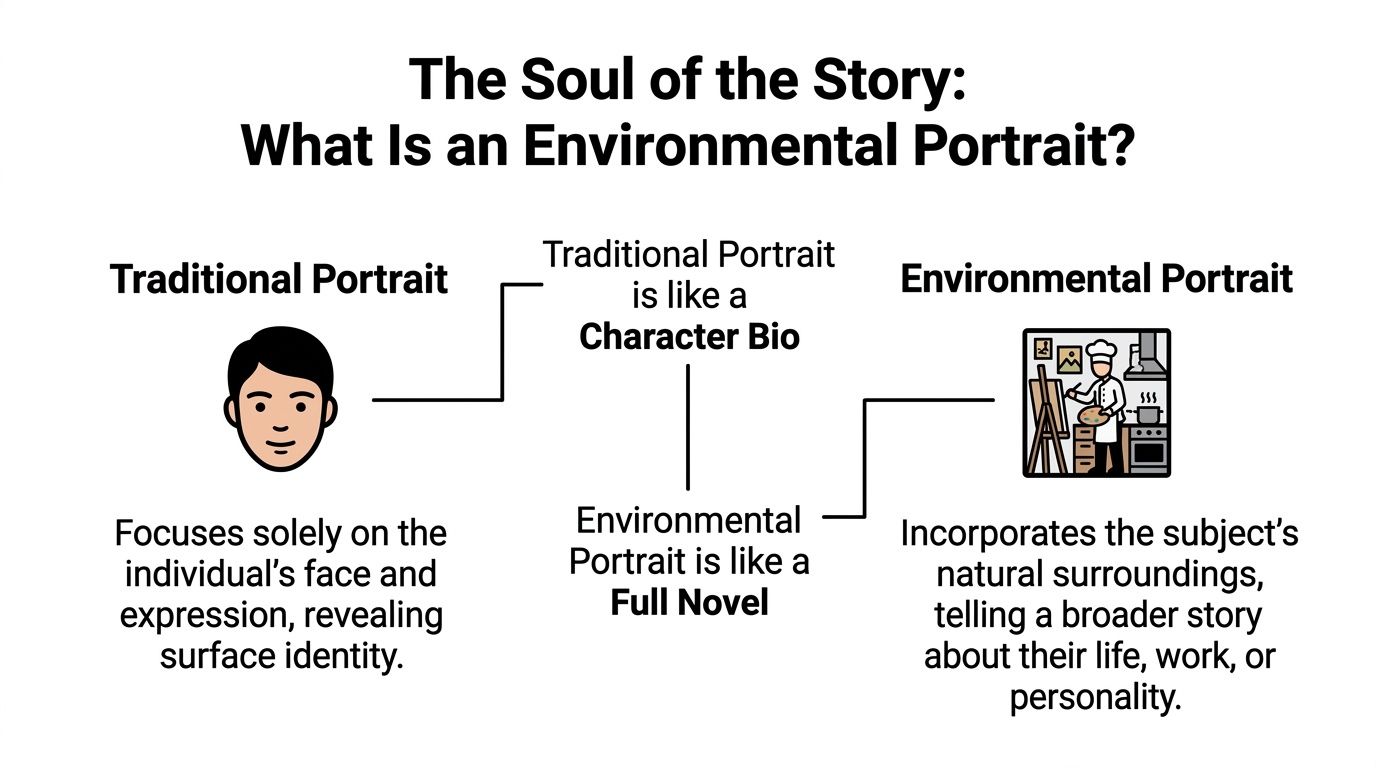
The Soul of the Story What Is an Environmental Portrait
A CEO stands in a spotless lobby and looks accomplished. Put that same CEO on the production floor, with noise, scale, and the specific conditions of the operation visible behind them, and the portrait starts making a more specific claim. That shift is the heart of environmental portraiture. The frame describes a person, but it also tests the story being told about them.
An environmental portrait places the subject inside a meaningful setting and asks the viewer to read both at once. The person is still the anchor. The room, tools, surfaces, sightlines, and working conditions supply evidence. In strong editorial and corporate work, that evidence does more than confirm a job title. It can introduce tension, showing the pressures, contradictions, or constraints that shape the way the subject works.
The setting has a job to do
A blank backdrop isolates identity. An environmental portrait builds a relationship between identity and place. That distinction matters because the location is never neutral. A lab suggests control. A workshop suggests process. A glass boardroom can imply authority, distance, or exposure, depending on how it is framed.
The best locations do more than flatter the subject. They add information that the face alone cannot carry. Sometimes they support the client's message cleanly. Sometimes they complicate it in a useful way. A founder in a half-finished office, an architect in a raw construction site, or a chef in a cramped prep kitchen often feels more convincing than a polished setup because the environment shows what the work costs.
That is where many portraits either gain depth or turn generic.
A working definition that holds up on assignment
For practical purposes, an environmental portrait is a portrait in which the setting remains legible enough to shape meaning. If the room could be swapped for any other attractive space and nothing important would change, the environment is decorative, not narrative.
I judge a location with a simple test. Remove the person mentally and look at what remains. Does the space still tell you something specific about their role, standards, pressures, or point of view? If not, the frame may be tidy but thin.
Use this comparison to evaluate what the image is really doing:
| Approach | What it emphasizes | What it often misses |
|---|---|---|
| Traditional portrait | Face, expression, styling | Place, working context, spatial relationships |
| Environmental portrait | Person in relation to a real setting | Clarity, if the location adds noise instead of meaning |
Practical rule: Every visible element should either support the subject's story or create a useful tension within it.
Context alone is not enough
The common shorthand says environmental portraiture is about showing context. That is true, but incomplete. Context can be obvious and still say very little. A lawyer in an office and a designer at a desk are only descriptive until the frame reveals something more precise about how they operate in that space.
Narrative tension is often the difference between a serviceable portrait and one an editor or client keeps returning to. The environment can challenge the subject's polished image, expose scale, suggest responsibility, or show friction between brand message and daily reality. For corporate clients, that tension has to be handled with care. Too little and the image feels staged. Too much and it starts to undermine trust. The craft is in choosing details that make the portrait more truthful without making it hostile.
Story drives the choice. Aesthetic appeal follows. A beautiful room helps, but truth carries the frame.
The Professional's Toolkit Gear and Settings
A CFO in a glass boardroom and a machinist on a factory floor can both be photographed with the same camera body. They should not be photographed with the same settings. Environmental portraiture asks more of the file. It has to hold a face, a space, and the friction between them when that tension is part of the brief.
That changes the toolkit.
Most assignments work better with a wider field of view than portrait specialists usually reach for, and with more depth of field than a conventional headshot. If the architecture, tools, signage, or production line carry meaning, they need to stay readable. In practice, that often means working somewhere between 24mm and 35mm and stopping down enough to keep the room coherent.
Lens choice changes the reading
Focal length does more than decide how much background fits in the frame. It decides how the subject relates to the environment.
A longer lens can make a cluttered room look cleaner, but it also compresses space and weakens the sense of place. That may help when the client wants polish over specificity. It hurts when the room itself is part of the argument. Wider lenses preserve distance, scale, and adjacency. In editorial work, that can reveal pressure, authority, isolation, or responsibility. In corporate work, it can show whether the subject belongs in the space the brand wants to claim.
My default range depends on what the environment needs to say:
- 24mm to 28mm: Best when the setting carries equal weight with the subject and spatial scale matters.
- 35mm: Usually the safest balance for a single person in a meaningful interior.
- 50mm and longer: Useful when the location is already clear and a simpler frame serves the brief better.
Wide lenses reward precision and punish laziness. Camera position matters more. Vertical lines matter more. Edge control matters more.
Aperture decides what the viewer can verify
Environmental portraits often fall apart because the aperture is chosen for style instead of clarity. A blurred background can look expensive while stripping the image of the very evidence that makes it believable.
For this kind of work, I usually want the subject sharp and the environment legible. That often puts the aperture in the middle range rather than wide open. The exact setting depends on distance, sensor size, and how much of the room needs to read, but the principle stays the same. Use blur selectively. Do not let it erase the story.
Subject separation should come from light, placement, and tonal contrast. Depth of field is part of the solution, not the whole solution.
Light the face first. Keep enough detail in the room that the viewer can understand why this person is here.
Lighting that respects the room
Lighting has to support the location without sterilizing it. A lot of environmental portraits go wrong because the subject is lit beautifully and the room dies around them. The result looks pasted together.
Available light is usually the first thing to assess. Window light can carry an entire frame if the room has direction and the subject can be placed well. Bad overheads are another story. Office fluorescents, green practicals, and mixed LED color temperatures can turn skin and walls muddy fast, so I switch off what I can and rebuild only what the frame needs.
For a closer look at shaping a face while keeping the setting believable, see this guide on lighting for portraits.
A simple setup usually does the job:
- Start with the room: Walk it before opening a case. Check window direction, wall color, and reflective surfaces.
- Remove bad light first: Turning off ugly practicals often improves the frame more than adding another strobe.
- Add one controlled source: A single soft key or bounced fill is often enough to separate the subject without overpowering the space.
- Check reflective materials: Glass, polished tables, monitors, machinery, and framed art reveal sloppy placement immediately.
- Match the intent: Cleaner light suits some corporate commissions. Editorial assignments often benefit from keeping more of the room's natural contrast and imperfection.
The trade-off is simple. More gear gives more control, but it also increases setup time, crew footprint, and the risk of flattening the location. The best toolkit for environmental portraiture is usually the one that leaves the room recognizable and the subject credible.
Composing the Scene with Narrative Intent
Composition is where environmental portrait photography stops being descriptive and starts becoming editorial. A well-lit subject in a real location isn't enough. The frame has to direct the viewer through the image in the right order.
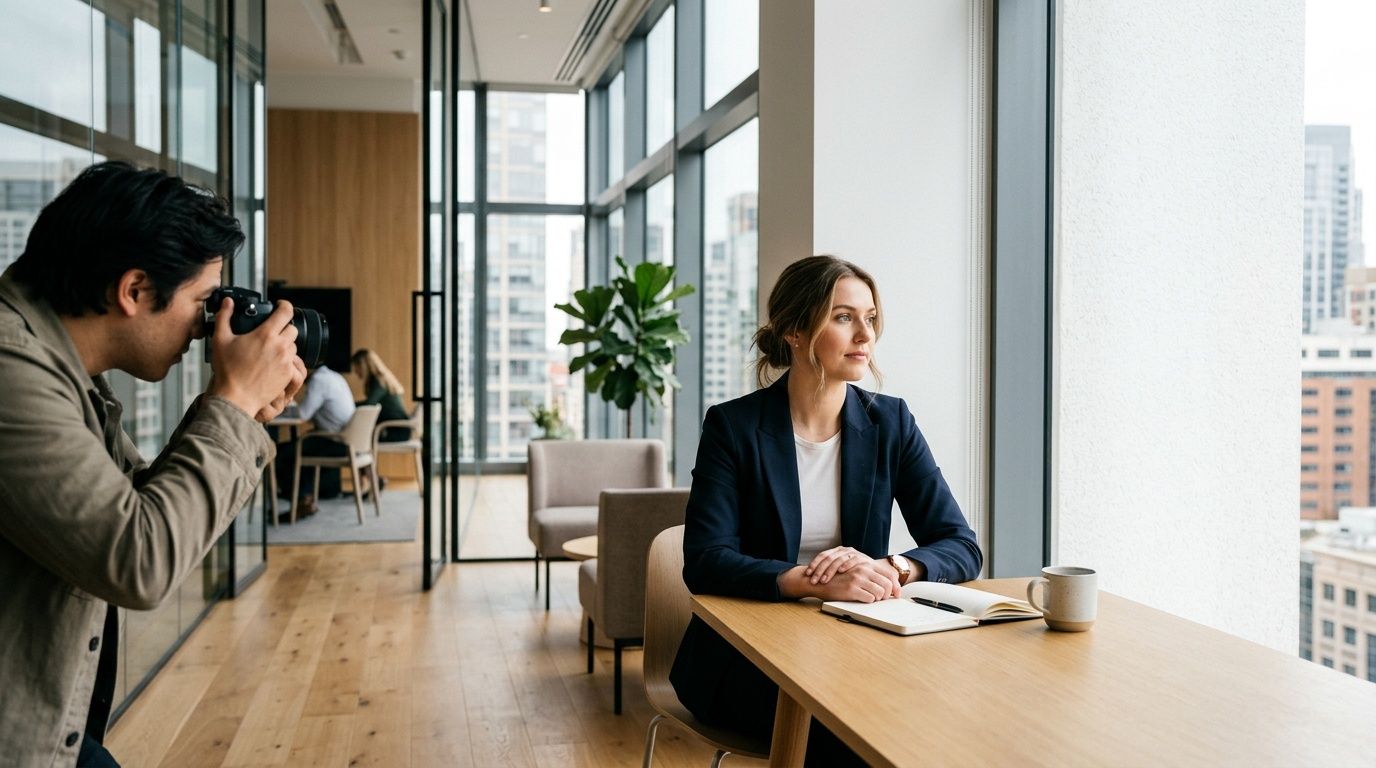
The easiest way to think about it is this: every object either supports the sentence or interrupts it. In a strong frame, architecture, furniture, foreground details, and negative space all pull toward the same reading of the subject.
The core rule is simple. Fill the frame with meaning. Exclude anything that doesn't help tell the story, and use negative space with care so it feels intentional rather than empty, as discussed in Fstoppers' breakdown of environmental portrait composition. That's one reason the 35mm prime lens remains such a reliable choice. It gives enough spatial context to include foreground and background details without making the subject feel distant.
Build a visual path
When I'm composing, I don't start with the person. I start with the route the eye will travel. Floor lines, desks, handrails, shelving, door frames, and windows can all work as directional tools. Then I place the subject where those elements naturally converge.
Three compositional moves work repeatedly in professional settings:
- Leading lines: Corridors, tabletops, beams, and tile seams direct attention.
- Layering: Foreground objects can suggest occupation and depth if they're controlled.
- Framing within the frame: Doorways, arches, and partitions can isolate the subject without losing context.
For a broader creative perspective on building story into commercial images, this piece on photography storytelling is worth reading.
Remove before you add
Most scenes improve when you subtract. Move the rolling chair. Close the half-open cabinet. Rotate the monitor. Shift the plant that's clipping into the shoulder. These aren't cosmetic tweaks. They're editorial decisions.
A fast pre-shot check helps:
| Check | What to look for |
|---|---|
| Edges | Bright distractions, cut-off objects, awkward tangents |
| Background | Items that merge with the head or hands |
| Foreground | Elements that add depth instead of accidental clutter |
| Negative space | Room for layout, copy, or simply visual breathing room |
Later in the process, this short demonstration shows how subtle framing choices affect the final read of a business portrait.
Let the room speak, but not ramble
The room should contribute information quickly. A single drafting table can say more than a dozen decorative details. A well-placed stack of material samples may tell the story better than a wall full of awards.
The strongest composition usually feels inevitable after you've seen it, even though it was built through a series of deliberate removals.
Directing Authenticity The Art of Engagement
A technically perfect environmental portrait still fails if the subject looks guarded. That happens often with executives, architects, physicians, faculty, and craftspeople because they aren't models, and they don't want to perform. They want the process to move efficiently and not make them look foolish.
That's why rapport matters more than gear. The camera records whatever emotional weather you bring into the room. If you arrive rushed, overcomplicated, or uncertain, the subject reflects that back. Don MacGregor's point is blunt and accurate: subjects tend to mirror the photographer's mood, so walking in with positivity leads to more authentic expressions.
Direct the person, not just the pose
Busy professionals usually respond better to tasks than to abstract posing language. “Turn your shoulders a bit” may work. “Look at the plans you marked up and then back to me” works better because it gives them something to do.
What gets natural results on set:
- Ask work-specific questions: What part of this project was hardest? Which machine do you use most? What changed in this redesign?
- Use action prompts: Pick up the sample, review the sketch, check the monitor, step into the light.
- Keep adjustments concrete: Chin slightly down, weight on the back foot, lean into the counter, eyes to camera now.
These prompts create transitional moments. Those moments often look more credible than a frozen pose.
People relax when the frame makes sense
Subjects stiffen when they don't understand why they're standing somewhere. If the location choice is arbitrary, the pose feels arbitrary too. When you explain, “I want the glazing line behind you because it shows the building language,” or “I'm using this workstation because it shows your process,” they become collaborators.
That collaboration improves expression fast. The subject stops wondering how they look and starts understanding what the image is meant to say.
Ask about the work, not about the smile. Expression usually follows attention.
Energy control on set
Photographers often think direction means talking more. It usually means editing your own energy. Give concise instruction, then pause. Let the subject settle into the space. Watch for the small moments between formal poses, especially after they've just answered a question or completed a simple action.
Authenticity in environmental portrait photography rarely appears on command. It appears when the subject trusts the frame, understands the purpose, and has enough room to act like themselves.
Advanced Narrative Creating Tension and Depth
A founder once asked for a portrait that would make him look calm, decisive, and in control. The office said something else. Half-unpacked samples sat on the floor, two team members were troubleshooting a shipment in the background, and the whiteboard behind him was full of crossed-out deadlines. The clean conference room would have produced a safer picture. The work area produced the honest one.
That is the difference between context and narrative tension. Context tells the viewer where the subject works. Tension shows what the work asks of them.

A lot of environmental portrait advice favors visual harmony. Clean backgrounds, balanced compositions, tidy color relationships. Those choices are useful for annual reports, recruiting campaigns, and any brief that needs optimism or polish. They are less useful when the assignment calls for authority under pressure, credibility, or a portrait that feels earned rather than staged.
The stronger frame often includes a controlled amount of resistance. Steam crossing the face of a chef. A site manager dwarfed by unfinished structure. A hospital director placed in a corridor that never really goes quiet. The environment is no longer decoration. It becomes an active force in the picture.
When friction adds meaning
A chef in a spotless kitchen reads as accomplished. A chef surrounded by heat, stainless reflections, and bodies moving through the frame reads as accomplished under demand. That second version carries more story because it contains a problem the subject has to hold.
Editorial and corporate clients both respond to that difference when the tension matches the brief:
- Architecture: Photograph the architect with a project in progress, where dust, scaffolding, and temporary lighting reveal process and scale.
- Corporate leadership: Put the executive near the operation they are responsible for, especially if the setting shows pace, complexity, or constraint.
- Healthcare and education: Use the visual density of the actual workplace when it clarifies care, decision-making, or institutional pressure.
This approach requires judgment. Too much friction and the subject loses authority. Too little and the portrait collapses into brand wallpaper.
How to build tension without losing clarity
The frame still needs hierarchy. The subject has to win the visual argument, even when the room pushes back. In practice, a few techniques work well:
| Technique | Effect |
|---|---|
| Off-center placement | Creates pressure, asymmetry, or a sense that the space matters as much as the person |
| Partial obstruction | Adds point of view and realism if the obstruction belongs to the subject's working world |
| Active background layers | Suggests process, urgency, or social context without turning into random clutter |
| Uneven visual weight | Makes the environment feel heavier, larger, or more demanding than a balanced frame would |
I usually test a clean version first, then introduce one variable at a time. A foreground edge. More negative space on one side. Background activity that stays legible but not dominant. That sequence shows the client how far the image can be pushed before the story starts to break.
Remove every distraction and you often remove the pressure that made the portrait worth taking.
Narrative tension works best when it reveals a true contradiction. Expertise inside chaos. Leadership inside constraint. Precision inside a messy process. That is where environmental portraiture stops describing a workplace and starts saying something harder, and more useful, about the person in it.
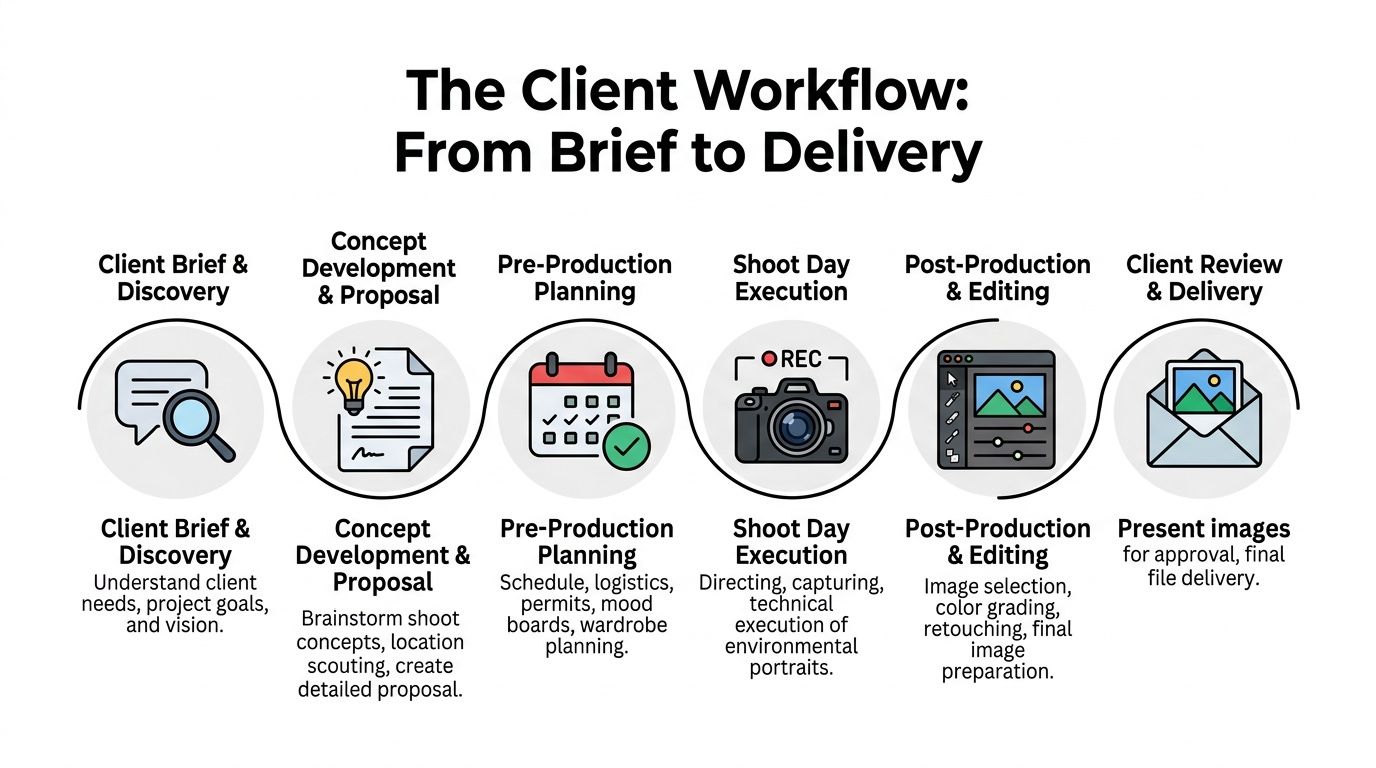
The Client Workflow From Brief to Delivery
Good environmental portraits don't happen because a photographer finds a nice corner and improvises well. They happen because the brief, location, subject, light, and final use all align before the camera comes out.
Start with the real assignment
The first conversation should establish what the image must communicate. Not just where it will appear, but what the audience should infer. Authority? Innovation? Precision? Warmth? Grit? If that isn't clear, the shoot drifts toward generic “nice portraits.”
A practical workflow often looks like this:
Interrogate the brief
Ask what the image needs to say, where it will run, and whether the client wants harmony or tension.Scout for meaning
Look for spaces that reveal process, culture, or authorship. The prettiest room isn't always the right room.Pre-visualize usage
Consider crop ratios, copy space, vertical and horizontal needs, and whether the art director needs clean options as well as layered ones.
Run the set efficiently
On shoot day, the job is part direction, part editing, part logistics. Keep the subject informed. Keep the client aware of what's working. Show enough previews to build confidence, but don't turn the session into a committee exercise.
One of the most useful preparation habits is clarifying taste and approval criteria before the shoot. This guide on managing client visual expectations is a strong reference for avoiding mismatched assumptions.
Edit with restraint
Post-production should refine the frame, not rewrite the location. Clean distractions that undermine the image. Keep the texture, atmosphere, and character that made the frame worth shooting in the first place. If every surface becomes perfect, the portrait often loses its authority.
A reliable delivery set usually includes variation:
- Hero frames: The clearest narrative read
- Safer options: Cleaner, more conventional selections for corporate use
- Tighter crops: Useful for press kits and profile placements
- Wider frames: Better for editorial layouts and website banners
The strongest client workflow treats environmental portrait photography as both image-making and problem-solving. That's what keeps the pictures useful after the shoot, not just impressive on the day.
When your project needs portraits that carry story, design awareness, and editorial discipline, Jimmy Clemmons Photographer creates environmental imagery that connects people to place with clarity and intent. From architects and developers to corporate teams and editorial clients, the studio brings location scouting, lighting control, and narrative direction to every assignment across Atlanta and regional markets.