

Late afternoon is when this place starts to explain itself. The steel reads clean, the seating bowl tightens around the field, and Midtown stops feeling like a backdrop and starts acting like part of the composition.
More Than a Ballpark An Introduction
I usually know within five minutes whether a venue will keep giving me frames after the obvious establishing shot. Russ Chandler does. The first read is straightforward enough. A college baseball park on an active urban campus. Stay with it a little longer, and the site starts showing what matters to a photographer, an architect, or a client trying to tell a story about place.
The Georgia Tech baseball stadium, formally Mac Nease Baseball Park at Russ Chandler Stadium, works because its setting and structure stay in conversation. On game day, the bowl pulls attention toward the field with tight sightlines and compressed energy. Before the gates fill, the building reads differently. It becomes a carefully placed piece of campus construction, one that has to answer to pedestrian flow, nearby streets, and the visual pressure of Midtown.
That is why a serious scout here should start outside the foul lines.
Typical coverage centers on roster history, ticketing, and atmosphere. Useful, but incomplete. The stronger interpretation is visual and architectural. Along Fifth Street NW, the stadium presents itself as both athletic infrastructure and public face. From one angle, it reads as an institutional venue with clear utility. From another, it becomes a city-edge set piece, with steel, concrete, and signage carrying the identity of Georgia Tech into the street.
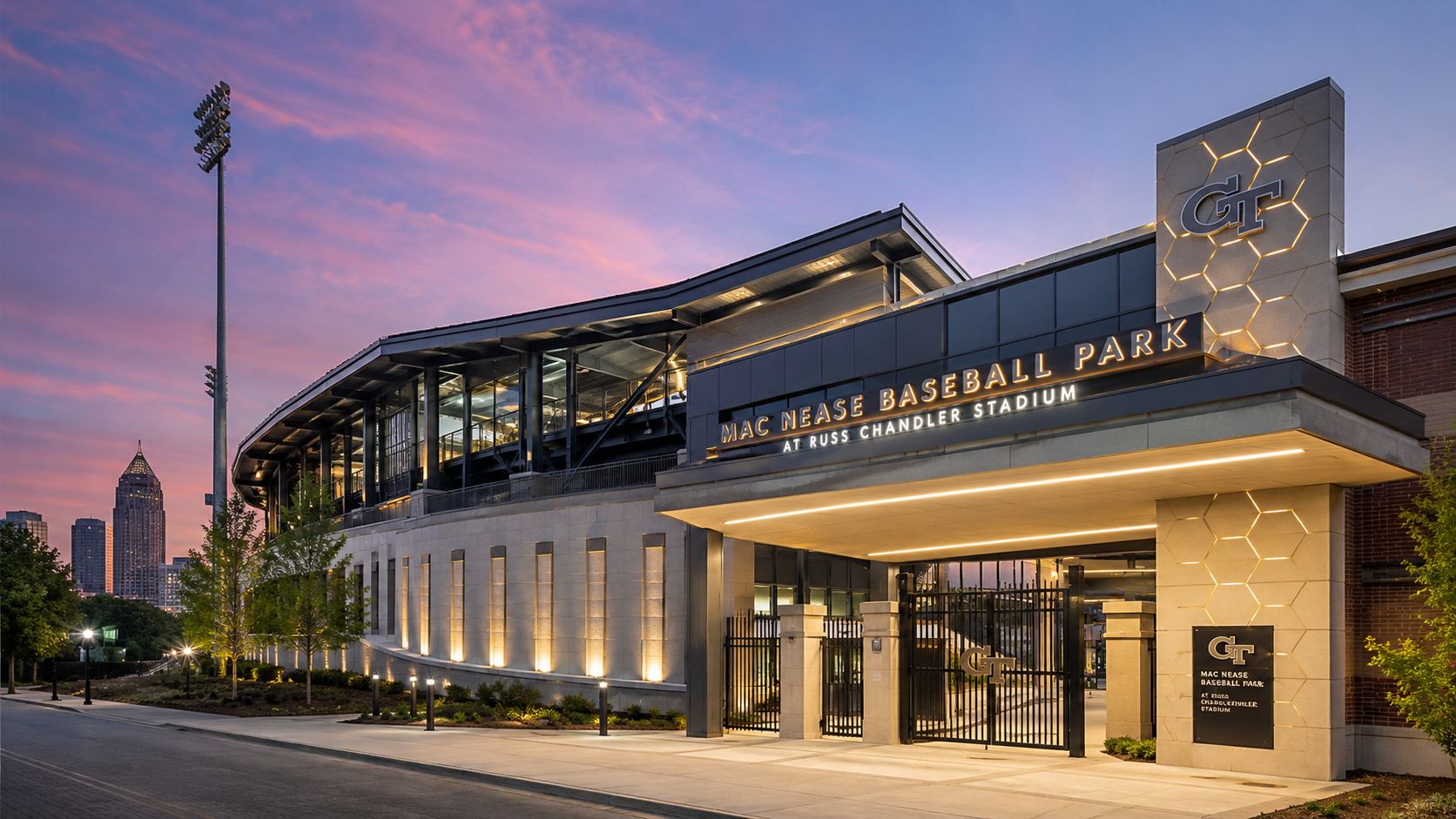
Why the venue rewards a slower look
Good stadium photography depends on relationships, not isolated features. At Russ Chandler, those relationships are unusually clear if you walk the site with intent.
- Street to structure: The exterior has to handle campus movement, city adjacency, and event arrival without losing legibility.
- Older ground to updated form: The site carries institutional memory, while the visible materials speak in a more contemporary vocabulary.
- Field intimacy to urban context: The seating bowl stays close and focused, yet the surrounding city still has a role in the frame.
A simple test helps here. If a stadium only produces one reliable hero shot, its visual range is limited. This one keeps opening up. The entrance sequence, concourse edges, and seating bowl each tell a different part of the same story.
For a design team, that range is useful. For a photographer, it is the difference between coverage and interpretation. You can shoot this venue as a baseball facility, a piece of campus architecture, a civic-facing project, or a place where history and daily use still meet in the same structure.
A Century of Yellow Jacket Baseball The Stadium's History
I like to arrive at old ballparks early, before the gates matter and before the crowd explains the place for you. Russ Chandler reads best in that quiet window. The site does not need nostalgia added to it. Time is already built into the ground, and that changes how the stadium should be seen.
Georgia Tech baseball has played on this site since 1930, and that continuity gives the venue unusual visual authority. A lot of college parks try to manufacture tradition through graphics, memorial walls, or retro detailing. This one starts with a simpler advantage. The address has held baseball for generations.
Built with practical intent, retained through institutional memory
The stadium began as a working athletic facility, funded during an era when program success in one sport could directly shape the physical future of another. That origin still matters because it places the park inside a broader Georgia Tech story of resourcefulness, campus identity, and athletic ambition rather than treating baseball history as a separate thread.
Long use changed the reading of the site. What started as a practical build became a place of accumulated ritual. Players, coaches, alumni, and local fans returned to the same ground often enough that continuity itself became one of the venue's defining design conditions.
That is a harder condition than it sounds.
Historic sports sites usually drift toward one of two weak outcomes. Some stay frozen and become visually sentimental. Others chase upgrades so aggressively that they erase their own memory. Russ Chandler holds more tension than either of those paths, which is why it photographs well. The site kept its baseball identity while accepting change.
For Atlanta readers already attuned to how age and setting shape the experience of a place, the park belongs in the same conversation as other architectural landscapes in Atlanta that reward careful observation.
What continuity gives you on camera
A stadium that remains on the same ground for decades gives a photographer something a replacement facility cannot. It gives inherited perspective. Approaches feel established. Circulation patterns feel learned rather than imposed. Even before you isolate details, the larger composition carries a sense of repetition and return.
That opens up a few strong narrative directions on site:
| Narrative thread | What to look for on site |
|---|---|
| Legacy | Established arrival paths, older campus adjacencies, signs of repeated use |
| Adaptation | Places where newer construction serves older patterns of movement and view |
| Ritual | Batting practice routines, gate activity, pregame circulation, dugout energy |
| Identity | Georgia Tech branding layered onto a venue with much older roots |
The best historic ballparks rarely announce their age with force. They let present-day use reveal it.
The 2002 renovation changed the building, not the story
The major renovation completed in 2002 matters because Georgia Tech chose to modernize the stadium without abandoning the site. That decision preserved the one thing a new facility cannot copy. Geographic memory.
From a visual standpoint, this is the park's central subject. The work is not about preserving a relic under glass. It is about carrying a long baseball history through a later architectural expression. That is a better story, and a more demanding one, because it asks the building to perform in the present while still acknowledging where it started.
For photography, the trade-off is clear. If you chase only heritage, the images can turn sentimental and thin. If you shoot only structure, the venue loses its depth. The stronger frames hold both. Clean contemporary surfaces. Old institutional gravity. A ballpark that still knows exactly where it is.
Design and Technology The Architecture of the Ballpark
You feel this park before you diagram it. Walk the concourse with a camera near first pitch and the building reveals its priorities in sequence. Tight edges. Clear view corridors. Structure that stays quiet so the field, the crowd, and the Midtown setting can carry the story.
The current ballpark succeeds because the renovation was disciplined. Steel, concrete, and direct geometry do the work. The composition relies on proportion, compression, and restraint instead of decorative moves that would date quickly. On a constrained urban site, that choice matters. The venue sits close to active campus routes, with little room for wasted gestures, so every major element has to earn its place in the frame.
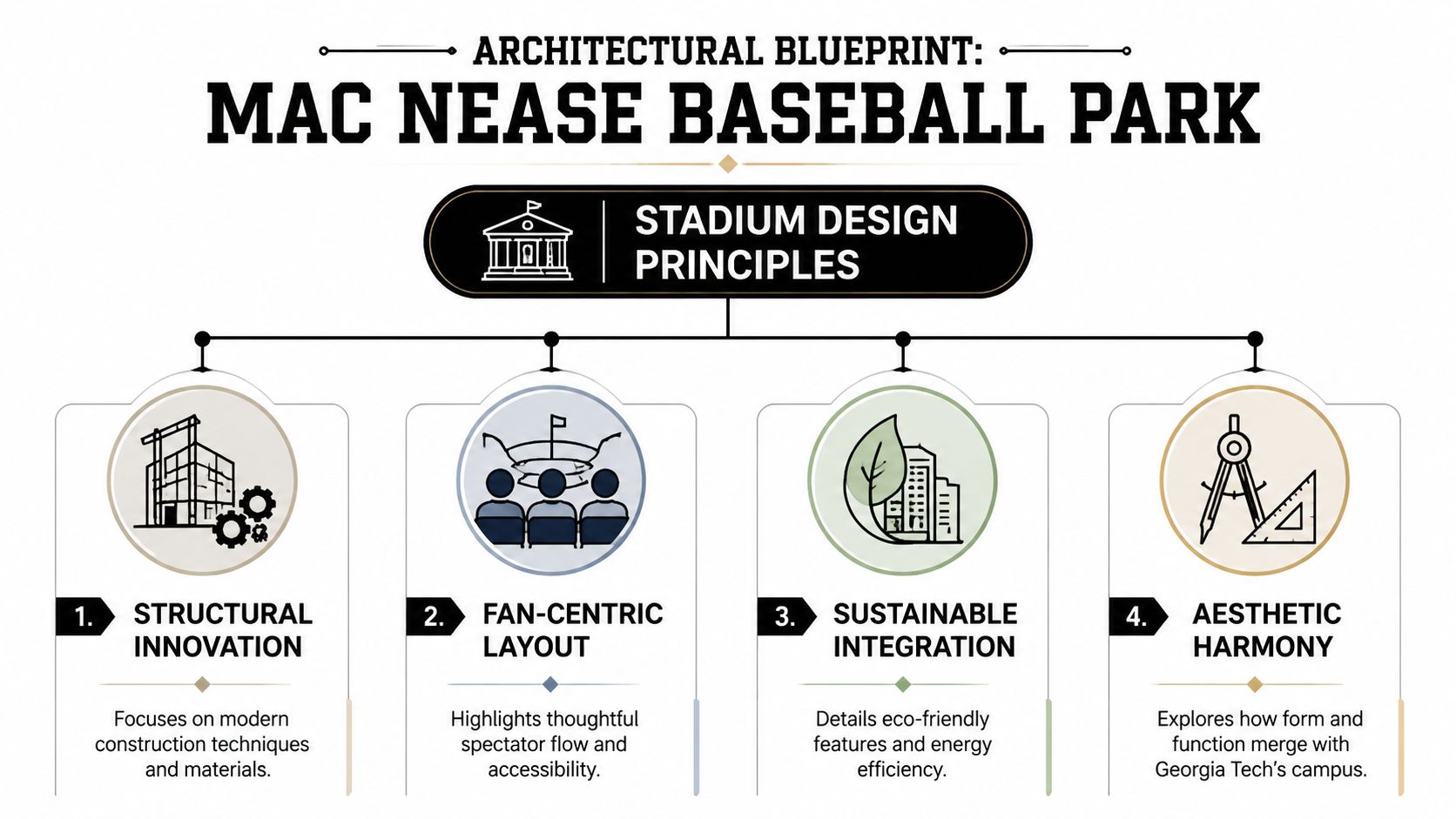
A compact bowl with deliberate sightlines
What reads strongest on site is the bowl's control of distance. Views stay close to the action, but the park does not feel cramped. That balance is difficult. Expand a college stadium too aggressively and the lower bowl loses energy. Tighten it too much and circulation starts to feel pinched, especially once fans stack along the rails and cross aisles.
Russ Chandler handles that trade-off well. The seating geometry keeps attention on the diamond, while the circulation edges still leave room for secondary frames. For a photographer, those edges are useful. They let you build layered images with foreground movement, midground structure, and the field beyond, rather than relying on a single wide overview.
This kind of site-sensitive design shows up elsewhere in the city. Architectural sites around Atlanta that use topography, edges, and circulation well offer a useful comparison, especially if you study how arrival sequence shapes the way a place is understood before its details come into focus.
Technology integrated into the architecture
The smartest technical work here is not theatrical. It is built into the venue's operating logic and kept visually subordinate to the game.
According to Collins Cooper Carusi's project description of the Georgia Tech baseball stadium, the ballpark uses embedded cameras, sensors, and real-time display systems to support player analysis during practice and competition. The same project description explains that the setup captures metrics tied to batting, pitching, and fielding performance.
That shifts the way the building should be read. It functions as a spectator venue, but it also supports measurement, review, and player development at a high level. In design terms, that means coordination matters as much as hardware selection. Camera positions, cable routing, protected mounting points, and control locations have to be resolved early or they start to clutter sightlines and weaken the clarity of the architecture.
I usually judge this kind of integration by absence. If the tech is doing its job and the venue still photographs cleanly, the design team made the right calls.
Field geometry and lighting discipline
The field and its edges leave little room for sloppy decisions. In a compact park, outfield depth, foul territory, wall lines, and support structures all influence how the bowl is shaped and how backgrounds read from seat level. Small dimensional constraints can have a large visual effect.
Lighting has the same character. It has to serve hitters, fielders, coaches, spectators, and broadcast coverage without flattening the place. Good baseball lighting is never only about brightness. It is about control. Glare management near the batter's eye, even infield coverage, and stable color for high-resolution capture all affect whether the park reads as crisp or chaotic after sunset.
For photography, that creates a clear working method. Exposures need to be precise, highlights need watching, and angles toward the field should be chosen with the fixture pattern in mind. This stadium rewards preparation. It gives back strong, disciplined images when you respect how tightly the architecture, technology, and light have been tuned together.
The Gameday Experience Seating and Amenities
I like to enter this park before the crowd settles. The first useful read comes from the pause at the concourse rail, where the field opens up, the seating bowl tightens around it, and the whole place shows its priorities at a glance. Russ Chandler does not try to impress with scale. It works through compression, proximity, and a seating mix that gives different stories to different viewers.
That matters for spectators, but it matters just as much for anyone scouting the venue visually. Seat type changes the narrative. A central chairback position gives order and legibility. A lower premium angle gives contact, pressure, and the social energy around the dugouts. The circulation edges are often the smartest positions for showing how the building connects game action, hospitality, and campus context.
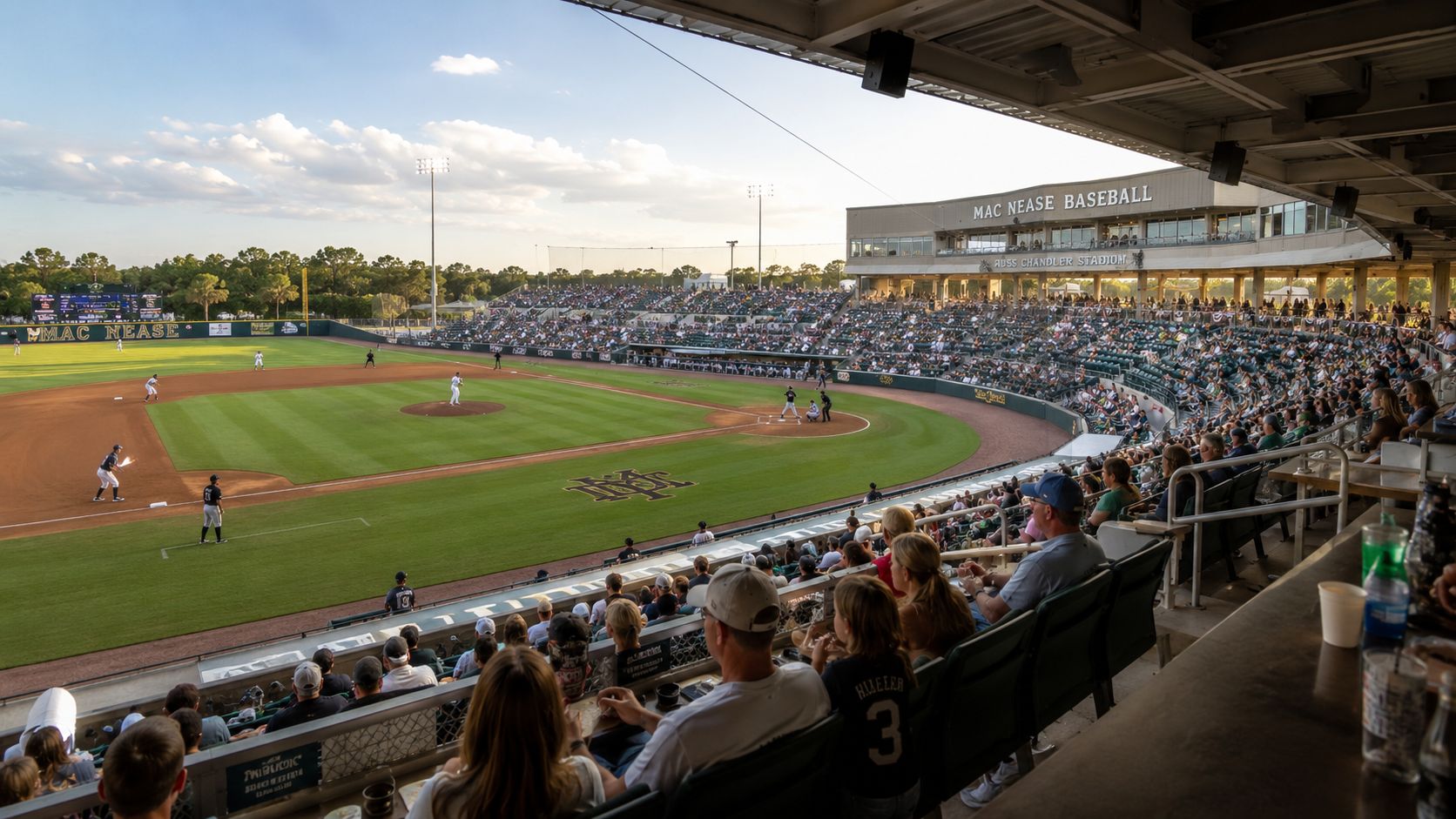
How to read the bowl as a scout
The mistake here is choosing only the cleanest midfield view and calling the job done. That angle explains baseball. It does not fully explain the venue.
For client work, I usually sort the seating into three practical uses:
- Chairback sections: Best for balanced frames, repeat viewing, and a composed perspective that shows the geometry of the bowl without distortion.
- Lower premium seating: Best for proving intimacy. These positions shorten the emotional distance between fan and field, which is often what a client wants to communicate.
- Terraces, rails, and circulation edges: Best for mixed-use frames that include people, structure, signage, and pieces of the larger setting.
Each position carries a trade-off. Lower and closer feels more charged, but backgrounds can become messy fast. Higher and more centered reads clearly, but the atmosphere thins out if the frame gets too clinical. Good scouting means deciding which compromise serves the story.
A strong visual survey of the park usually needs all three.
Operations show up in the fan experience
Compact urban stadiums are judged by how they handle pressure. At Russ Chandler, the true test is not whether every seat has a good field line. It is whether arrival, circulation, concessions, and premium access stay orderly when attendance rises and the building has to work harder.
That operational layer is easy to miss if you only watch the game. It becomes obvious when you study how people stack at railings, where they stop, and which paths stay fluid between innings. The best amenities are not only the premium ones. Clear routes, sensible sightlines, and places to pause without blocking movement do as much for the experience as upgraded seating products.
For a more visual read of those relationships, this Russ Chandler Stadium photo study in Atlanta is useful because it shows how seating, circulation, and field orientation register in finished imagery.
What works for spectators, and what needs care
This park performs well when its compactness is treated as an asset rather than a limitation. The strongest features are the ones that keep fans close to the field while still giving the venue enough variety to support hospitality, student energy, and a polished game presentation.
| Works well | Needs careful handling |
|---|---|
| Close viewing angles that make college baseball feel immediate | Overly centered wide views that flatten the character of the park |
| Layered seating choices that create distinct experiences inside a tight footprint | Premium positions that can feel visually detached if framed without crowd context |
| Circulation edges with useful sightlines for social viewing and photography | Peak-traffic pinch points during busy series or between innings |
| A visible sense of place tied to campus and the city | Generic fan imagery that could have been made at almost any college field |
The larger point is simple. Amenities are only part of the story. The quality of the gameday experience comes from how seating, movement, and sightlines work together inside a relatively compact envelope.
Good stadium photography should prove that relationship. A seat is not interesting because it exists. It becomes interesting when the angle, the light, and the surrounding architecture show why someone would choose it again.
A Photographer's Guide to Russ Chandler Stadium
This stadium rewards prep. If you show up at first pitch with one lens and no route through the building, you'll come away with coverage, not a body of work.
The visual strength of the Georgia Tech baseball stadium comes from contrast. Historic ground, updated structure, compressed bowl, urban backdrop. The assignment is to keep those elements in conversation instead of isolating one and losing the others.
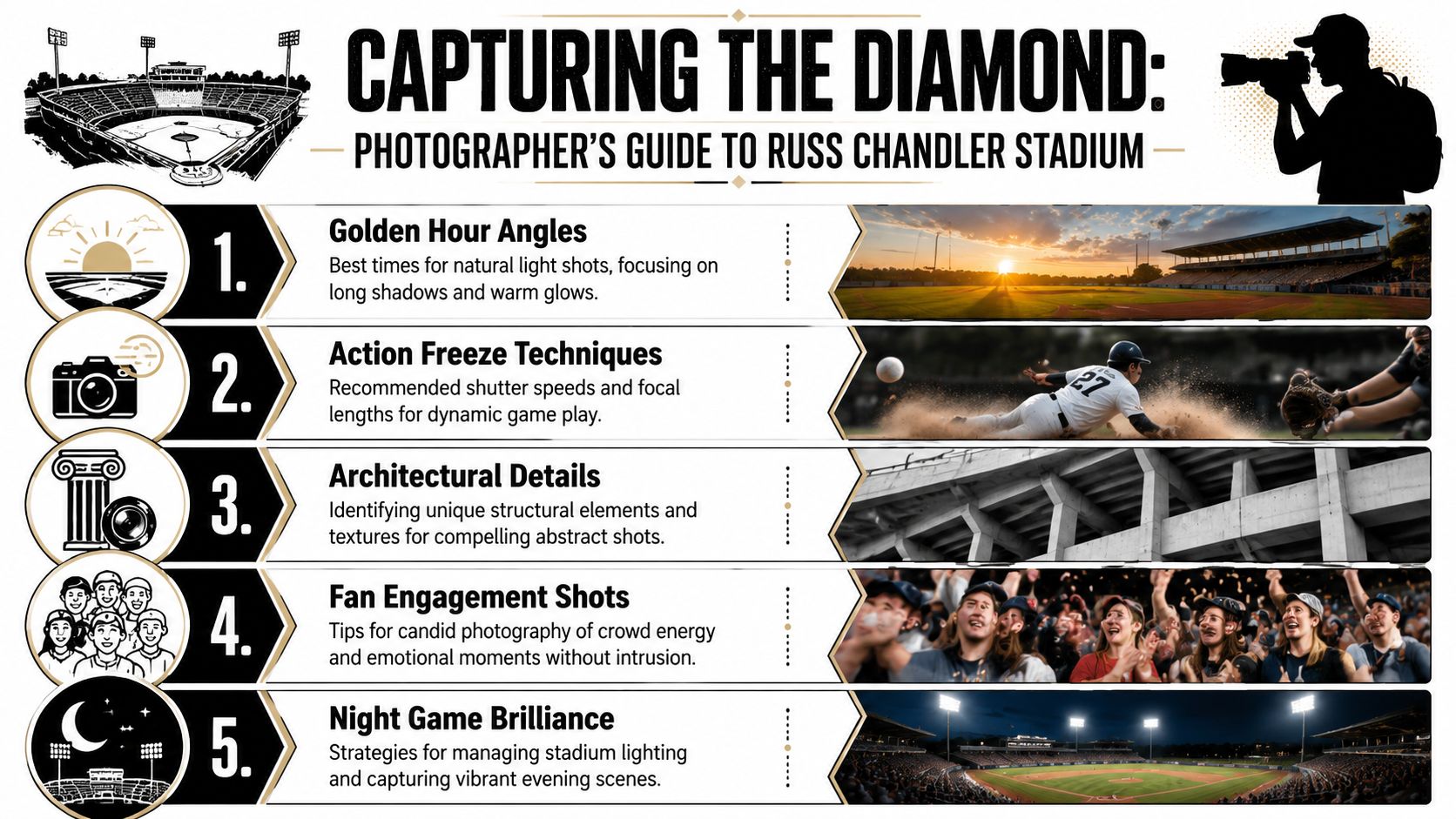
Start with three shot families
Before choosing gear, define what kind of story you need. I usually sort this venue into three shot families.
Context frames
These establish the stadium inside campus and Midtown. Exterior approaches, visible street edges, and upper-bowl views that let the city register are useful here.Architectural frames
Focus on structure, rhythm, materials, circulation, railings, and the way the seating geometry wraps the field.Event frames
Crowd density, dugout energy, field action, and the transition from daylight to stadium lighting belong in this set.
This separation keeps a scout from chasing random moments. You can decide early whether the client needs a design portfolio, an editorial story, or a blended package.
Know where the compact geometry helps you
The Georgia Tech facility page notes that the 2002 renovation more than doubled the original seating footprint, and that the right field line is about 328 feet with power alleys at about 353 feet. For photography, those dimensions suggest a field environment where background management matters. There isn't endless space to let distracting elements disappear.
That can be an advantage.
A tighter park lets you make stronger relationships between subject and setting. Players don't feel lost in the frame. Seating reads as immediate. The architecture stays present even during action.
If you want a visual reference for how the venue reads in finished imagery, this Russ Chandler Stadium gallery and location feature gives a useful sense of its layered exterior-interior character.
Work the light in phases
This is not a one-time-of-day venue.
Before game light
Early arrival gives you the cleanest architecture. Seats are empty or nearly empty, concourses are legible, and branding elements aren't fighting with crowds. This is the time for symmetry, material studies, and wide establishing views.
Late afternoon and sunset
This is when the stadium starts to feel cinematic. Warm side light can shape the grandstand and pull texture out of concrete, railings, and seat rows. Exterior signage and entry conditions usually look best here as well.
Night game coverage
Once the stadium lights take over, you have to respect the building's lighting logic rather than fight it. The same facility source notes that the lighting plan is engineered to avoid hitter glare and reduce infield shadows for television and high-resolution photography. That's helpful, but it doesn't mean every angle is easy. Mixed color temperatures, bright signage, and reflective surfaces can still complicate exposures.
Expose for the field first. Then decide how much atmosphere you want to keep in the stands and skyline. If you reverse that priority, the playing surface usually falls apart.
Scout the details that tell the full story
Architectural storytelling at a ballpark isn't only about the bowl. The secondary details often carry the assignment.
- Grandstand structure: Look for repeating lines, underside geometry, and connection points.
- Seating transitions: Premium areas versus standard seating can reveal how the venue handles hierarchy without breaking cohesion.
- Circulation edges: Railings, stairs, and terrace zones often show the renovation's practical intelligence.
- Technology integration: Where cameras, displays, or support hardware sit cleanly inside the architecture, take the shot. Those are the images design teams often need later.
- Campus adjacency: Frames that show the ballpark as part of Georgia Tech, not detached from it, usually have greater editorial value.
Logistics that affect the shoot
Game-day access changes everything. Crowds improve atmosphere but restrict movement. Empty-venue access gives control but can flatten the emotional register. For commercial work, credentialing, timing, and whether the goal is editorial, architectural, or promotional should be settled before anyone arrives on site.
The other practical issue is patience. This stadium offers more than one hero frame, but not always at the same moment. The exterior might peak before first pitch. The bowl may look best once fans settle in. The field often reaches visual balance during the crossover from ambient daylight to artificial light.
That sequence is why quick in-and-out coverage rarely captures what makes Russ Chandler distinctive.
Commissioning Professional Architectural Photography
I can usually tell within ten minutes whether a stadium has been photographed for memory or for meaning. Russ Chandler rewards the second approach. The venue has enough visual order, campus context, and layered history that a casual gallery will miss the point.
Commissioned architectural photography turns that complexity into a usable set of images. The goal is not just to record the park on a pleasant evening. The goal is to show how the venue works, how it sits within Georgia Tech, and how design decisions shape the experience from gate arrival to first pitch. That requires planning, timing, and a clear brief before the first frame is made.
A scout confirms access, vantage points, and light behavior. A commissioned assignment has to do more. It needs to serve architects, athletics staff, donors, contractors, and editors without feeling generic. One client may need proof of material quality and structural clarity. Another may need images that explain premium hospitality, circulation, and the stadium's relationship to campus identity.
The difference comes down to choices made on site and in edit.
- Shot sequencing: Exterior frames often need to be made before the light drops off the facades. Interior bowl views usually improve once the seating has some life in it. Detail work often belongs in the quieter windows between those moments.
- Coverage strategy: The set should include hero views, medium frames that explain adjacency and movement, and detail images that show craft, signage, junctions, and wear patterns accurately.
- Exposure control: Stadium assignments are difficult because grass, concrete, painted steel, digital displays, and skin tones all respond differently under mixed light. Good coverage holds those elements together without letting one dominate.
- Intended use: Strong edits account for web banners, donor decks, press kits, award entries, sponsorship presentations, and vertical crops for social distribution.
Good architectural photography gives the building a readable argument.
That matters at Russ Chandler because the story is more nuanced than baseball atmosphere alone. The park benefits from images that explain intimacy without making the seating bowl feel small, that show premium areas without isolating them from the larger venue, and that place the stadium inside the visual fabric of Georgia Tech rather than treating it like a detached event box. Those distinctions help clients explain value with more precision.
For organizations that need that caliber of coverage, a commercial architectural photographer for sports and campus venues brings the production discipline to handle access, timing, mixed lighting, and final image use. At a stadium like this, that discipline is what separates attractive pictures from photographs that design teams, athletics departments, and publications can keep using for years.