
You arrive at a commercial site before the crew, expecting a straightforward record of the finished work. Instead, the strongest photographs begin with a half-completed room, a conversation between trades, and a shaft of light revealing how the project is coming together. That tension sits at the heart of documentary style photography. It must feel observed, but it also has to communicate clearly, protect the client's reputation, and work across a complete visual library.
For architecture, interiors, and corporate teams, documentary photography isn't a promise to leave everything uncontrolled. It's a method for balancing real activity, editorial judgment, and brand-safe composition. The photographer prepares carefully, then makes fast decisions about position, timing, inclusion, and sequence while people work naturally.
A Morning on a Live Renovation Site
Plastic sheeting is taped across the doorways of a commercial interiors project. A client representative stands to one side with a clipboard, watching the renovation crew move between rooms. The space is loud, unfinished, and visually cluttered, but the photographic story is already there.
The photographer arrives before the trades and walks the site without lifting the camera. Clerestory windows create a clean strip of illumination across the main room. A north-facing corridor offers a deeper, more even exposure, and the crew is likely to pass through it repeatedly before lunch. Those observations shape the coverage before anyone is asked to do anything.
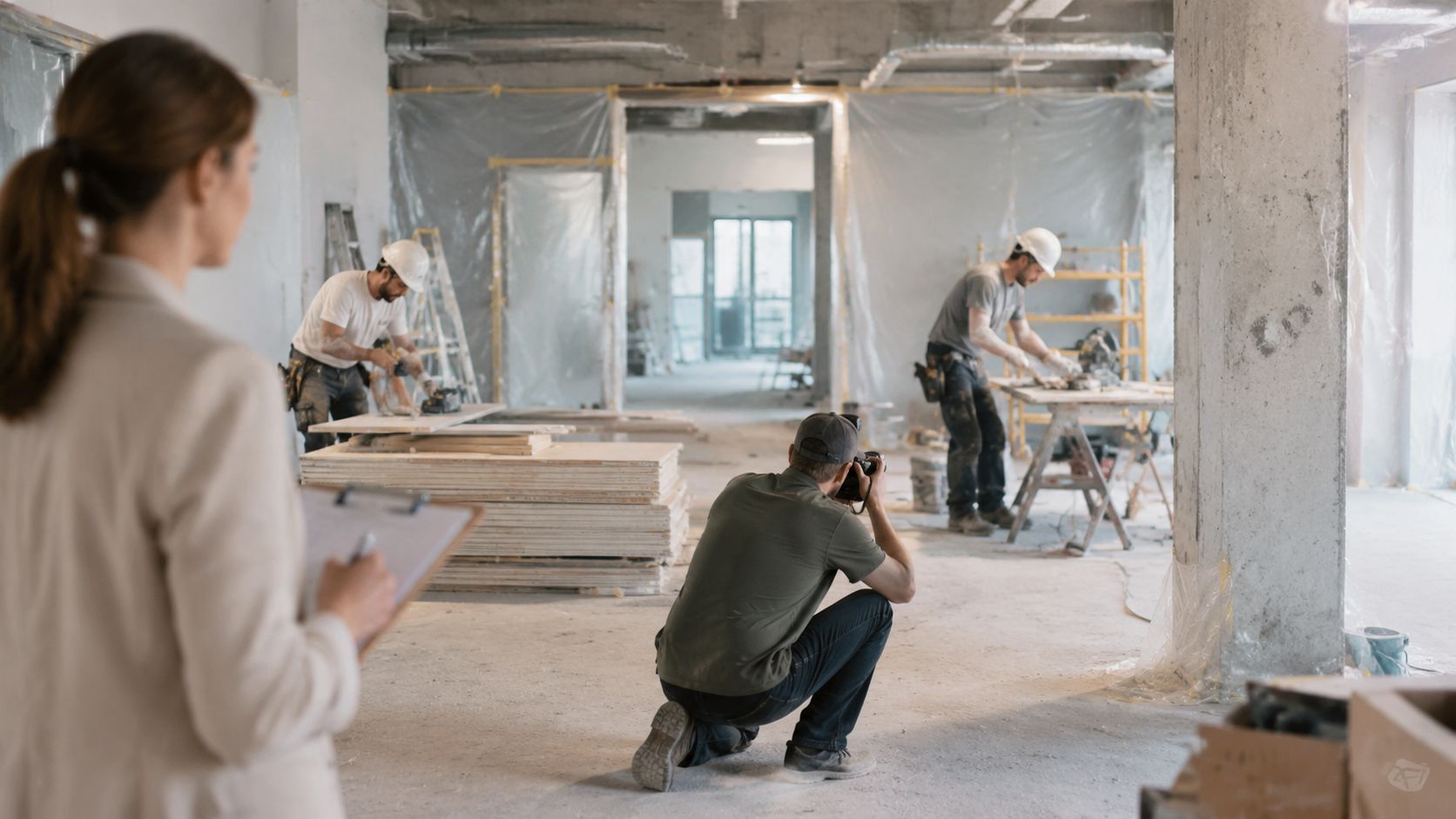
The first useful frames aren't polished portraits. A foreman demonstrates a tile cut while another worker checks the edge. A junior architect measures a sample board against the developing wall. Dust drops through a shaft of sun, turning an otherwise ordinary construction detail into a visual marker of the work underway. The client representative remains in the periphery, providing scale and context without becoming the subject of every frame.
The project is the subject
Finished interiors are important, but they show only the result. Documentary coverage preserves the evidence of process, including decisions, collaboration, material handling, and the physical conditions that shaped the final space. For a contractor, architect, or developer, those photographs can explain capability more convincingly than a series of empty rooms.
That doesn't mean photographing indiscriminately. The photographer still chooses which workers, tools, gestures, and surfaces belong in the story. A frame that includes a distracting safety sign or an exposed cable may be accurate but commercially weak, while a carefully timed image can show the same environment with clarity and respect.
Site readiness affects the outcome as much as camera skill. A client can use this project site preparation guide to coordinate access, clean pathways, identify contacts, and protect the natural movement that makes the assignment worthwhile.
Practical rule: Document the work as it happens, but choose the position that lets the viewer understand what's happening.
What Documentary Style Photography Actually Means
Documentary style photography observes real activity and shapes it into a coherent visual account. The people, materials, spaces, and interactions remain grounded in what occurred. The photographer still decides where to stand, when to press the shutter, what to leave outside the frame, and how the finished images should be arranged.
Four traits define the approach:
- Observational capture: The photographer watches real behavior instead of manufacturing every gesture.
- Editorial sequencing: Individual images work together, moving from setting to action, detail, interaction, and consequence.
- Contextual completeness: The frame gives enough information for the viewer to understand the environment and the relationship between people and place.
- Brand-safe composition: The work remains usable for a client, with attention to visual hierarchy, distractions, privacy, safety, and consistency.
A useful analogy is this: documentary photography is to a snapshot what a well-edited long-form article is to a social post. Both can be fact-based, but only one is shaped with sustained intent. The long-form article selects details, establishes context, controls pacing, and gives the reader a reason to continue. Documentary photography makes similar decisions through framing and sequence.
Observation isn't the same as passivity
The style isn't synonymous with raw candids, hidden cameras, or strict photojournalism. A photographer may ask a team to work in a safer area, move a distracting object, or wait for a person to finish a task before crossing the frame. In an interior, the photographer may also direct light or gently adjust a subject's position when that intervention clarifies the activity rather than replacing it with a performance.
Ethics remain central. The National Press Photographers Association ethics guidance frames documentary practice around avoiding intentional alteration of events and misleading viewers through manipulation. That principle makes capture-time choices about positioning, timing, and selective inclusion more than aesthetic preferences. They determine what the viewer believes happened.
The difference becomes clearer beside related approaches. Documentary borrows from candid photography, journalism, and editorial work, but it doesn't sit entirely inside any one of them.
Where Documentary Sits Among Candid, Journalistic, and Editorial Work
Photography approaches overlap, so a rigid hierarchy isn't useful. A candid image may be completely unposed yet poorly suited to a campaign. An editorial photograph may be carefully directed and still communicate a genuine aspect of a brand. Documentary style occupies the space where observed reality meets deliberate visual construction.
| Approach | Primary Goal | Staging Tolerance | Craft Standard | Best Fit |
|---|---|---|---|---|
| Candid | Preserve an unposed moment | Low, often informal | Variable, depending on context | Informal team activity and personal storytelling |
| Photojournalistic | Communicate news or public events quickly | Limited by events and access | Strong emphasis on accuracy and speed | News coverage, public milestones, urgent records |
| Editorial | Express an idea through visual design | High when concept requires it | Deliberate composition, lighting, and styling | Campaigns, features, portraits, launch imagery |
| Documentary style | Build a truthful, usable account of people and place | Moderate, with boundaries | Editorial consistency grounded in observation | Architecture, interiors, workplace culture, project stories |
Candid begins with the moment
Candid work prioritizes the absence of posing. It may capture a good interaction in whatever light and framing happen to be available. That can produce warmth and surprise, but a client commissioning a complete library may find gaps in orientation, scale, or visual consistency.
Photojournalism adds context and sequence, often under pressure. Its first duty is to record what matters as events unfold. A building case study may use that discipline, but it usually needs more control over color, composition, access, and final usage than a news assignment allows.
Editorial brings control forward
Editorial photography starts with a visual idea. The photographer may design the setting, select wardrobe, arrange objects, and direct the subject toward a specific expression or posture. That approach works well for a hero portrait or a campaign image, but it can make a real workplace feel artificial if every frame is engineered.
Documentary style takes the observational honesty of candid work, the sequential logic of journalism, and the craft discipline of editorial photography. For an interiors launch, it can combine finished hero frames with designers moving through the space. For a corporate culture campaign, it can capture genuine collaboration while maintaining consistent color and framing. For a building case study, it can follow the project from work in progress to completed environment.
The right choice depends on the client's message. If the assignment needs one controlled visual statement, editorial may be the better tool. If it needs a credible account of how a place functions, documentary style usually offers more depth.
The Decisions That Shape the Documentary Frame
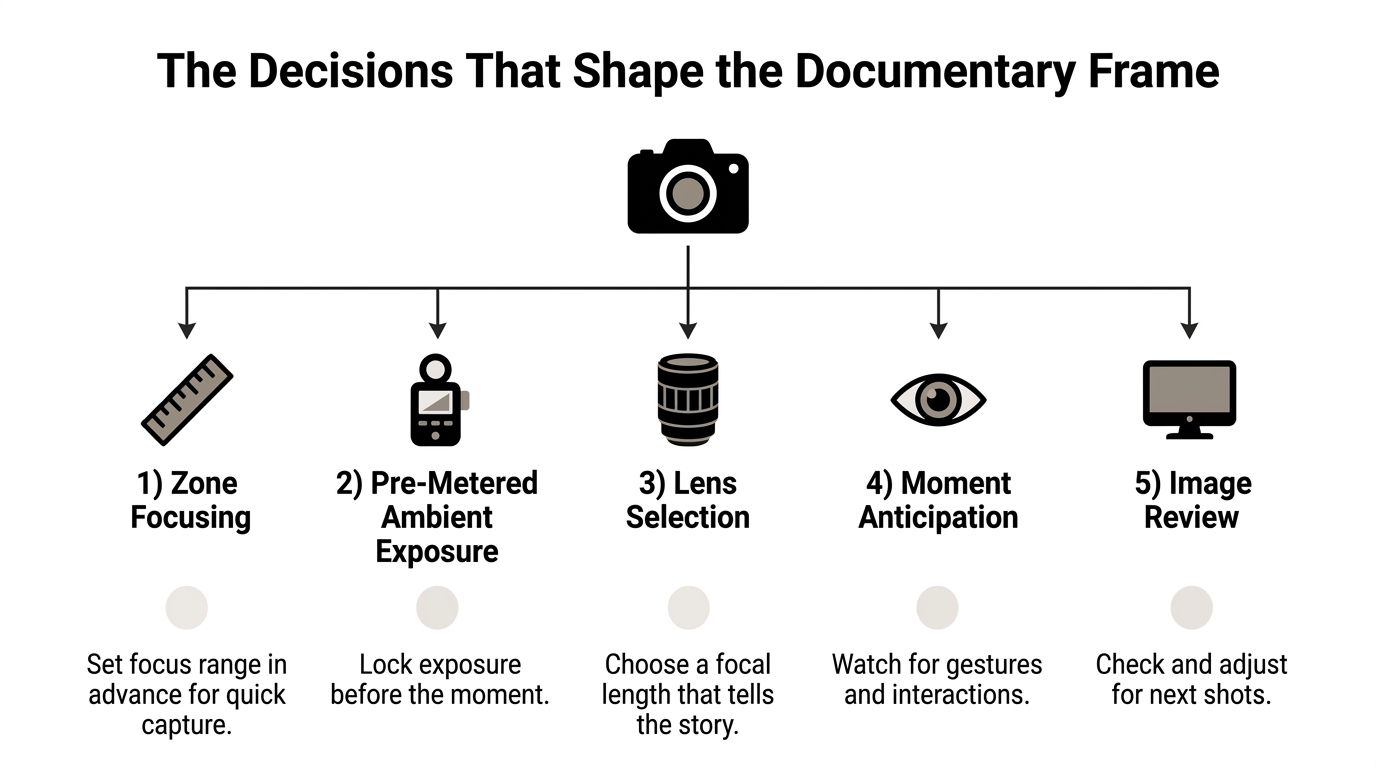
A snapshot assumes one lucky frame will carry the story. Documentary capture works differently. The photographer prepares the camera so attention stays on people and movement, then builds meaning through a series of choices made before, during, and after each exposure.
Prepare the camera for reaction
Zone focusing can keep the photographer from waiting for autofocus confirmation as a subject enters a known area. Pre-metered ambient exposure prevents every dark shirt or bright window from shifting the reading at the decisive moment. A preset white balance can maintain continuity through a sequence, particularly when mixed light would otherwise produce distracting changes.
Lens selection also establishes the relationship between the subject and the environment. A wide lens can connect a worker to a room, while a normal focal length may preserve a more natural sense of distance. A longer lens can isolate a gesture without interrupting the activity. Silent shutter may help in quiet offices or sensitive interactions, though it should be tested for movement artifacts and used only when it serves the setting.
Shutter speed deserves special attention in low light or fast-moving environments. Guidance for documentary practice recommends a minimum of about 1/250 second to freeze moving subjects, while slower speeds deliberately introduce motion blur. The documentary photography shutter guidance also notes that limited light often leads photographers to raise ISO or use stabilization and tripods to reduce shake and preserve a usable exposure.
Anticipate instead of chasing
The reactive layer begins with position. Stay on one side of a room long enough for the activity to develop, rather than crossing constantly and changing the viewer's relationship to the space. Wait for foreground layers, watch hands and shoulders, and notice when a conversation is about to turn into an action.
A corridor sequence might begin with an empty passage, continue with a worker entering, then show the exchange that caused the movement. The edit gains coherence because the photographer has recorded cause, action, and context instead of collecting unrelated candids.
Construction still happens in the camera and in the sequence, not through post-production staging. The photographer can correct exposure, color, and minor distractions, but editing cannot create an interaction that never occurred. The stronger the preparation, the less pressure there is to force one perfect frame.
Applying the Approach to Architecture, Interiors, and Corporate Culture
The same method produces different deliverables because each environment has its own rhythm. Architecture depends on progress and material transformation. Interiors depend on spatial relationships and use. Corporate culture depends on behavior that may be subtle, repeated, and easy to overlook.
Architecture follows change
A project story can begin with groundbreaking, continue through framing and installation, and end with the punch list. The most valuable frames often appear between those milestones. A crane operator, a surveyor checking alignment, or a contractor reviewing a detail can explain the standards behind the finished building.
The photographer scripts the coverage by identifying access windows, safety requirements, major phases, and recurring locations. Once on site, the crew's actual movements determine the images. A sequence might move from a broad exterior to a close material detail, then to the person responsible for installing it. The final library gives the client a record of both scale and care.
Interiors need evidence of use
An interior assignment shouldn't reduce the space to empty rooms. A designer-client walkthrough can provide the structure for an editorial sequence, beginning with the threshold and moving through circulation, material transitions, light, and occupation. Styled hero frames establish design clarity, while lived-in observations show how the space supports people.
That balance is especially useful when the images must serve a project feature, website, awards submission, and sales presentation. The photographer can prepare key viewpoints and still let the walkthrough unfold naturally. Guidance about where to pause or how to avoid blocking a circulation path protects the design without turning the participants into actors.
A practical reference for planning this work is photographing architecture and interiors, particularly when the assignment needs both spatial precision and human context.
Corporate culture lives in small behavior
Corporate teams rarely reveal their identity through a single formal portrait. It appears in an engineer pairing with a colleague, a leader listening during an off-site, or a group preparing a room before a meeting. These actions may seem ordinary, but they establish how the organization works.
The photographer can define coverage zones, identify people whose roles need representation, and protect time for unscripted observation. The resulting library might include leadership, collaboration, environment, tools, and quiet transitions. Because the images come from one considered capture, they can feel consistent across recruiting pages, annual reports, press materials, and web placements without making every subject perform the same scene.
How Much Direction Is Too Much Before It Stops Feeling Documentary
Clients often worry that documentary photography means surrendering control. They imagine a photographer standing in the corner, waiting for luck, while a carefully planned project produces an inconsistent set of images. That isn't a professional documentary workflow.
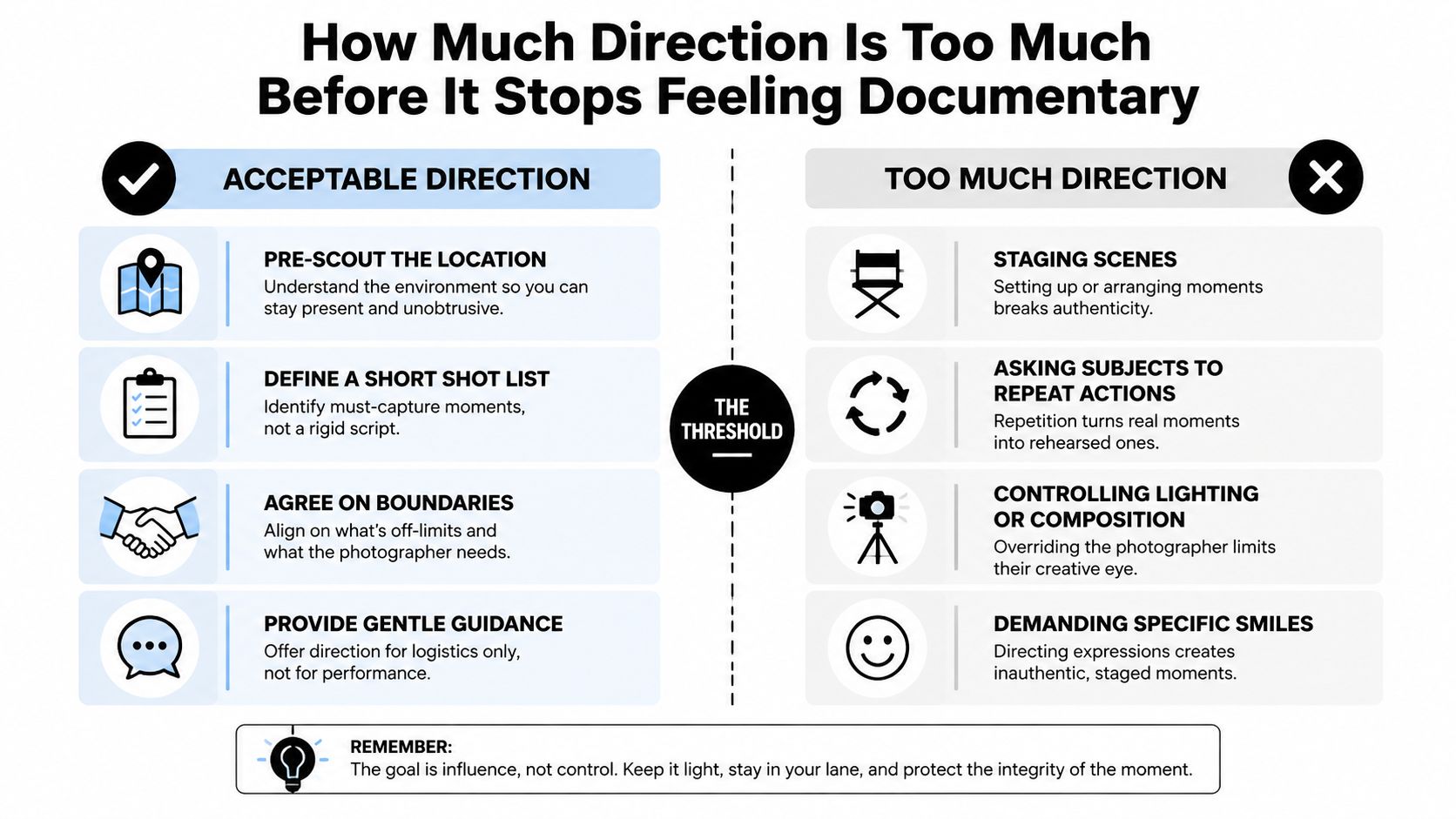
Control belongs before the action, not inside every interaction. A location scout identifies useful light, safe positions, visual distractions, and likely movement. A short shot list distinguishes essential moments from optional discoveries. Coverage zones keep the photographer present without making subjects feel watched from every direction.
Direction should solve a real problem
Intervention is appropriate when it addresses safety, logistics, privacy, or brand risk. A photographer may ask a worker to pause near an active machine, move a bag out of a key view, or wait until a private conversation ends. A team may be asked to use a particular entrance because it provides safe access and a stronger sense of place.
The line is crossed when direction manufactures the evidence. Repeatedly asking people to perform the same action, controlling every expression, or scripting dialogue produces images that may look polished but no longer describe the working environment.
Watch for signs of performance
Direction has probably gone too far when:
- Actions repeat mechanically: Subjects perform the same task for the camera rather than continuing their work.
- Dialogue sounds rehearsed: People deliver lines or gestures that don't belong to the setting.
- Expressions become uniform: Every frame contains the same smile, posture, or eye line.
- The environment loses its function: Objects and people are arranged for appearance, even though the arrangement makes no practical sense.
Current photography trend discussion describes a movement away from polished perfection toward human presence, while wedding and editorial coverage increasingly describes a hybrid model that combines candid observation with intentional framing. The photography trends discussion also points toward AI-assisted workflows and vertical-first framing, but those developments don't remove the need for location awareness, sequencing, and editorial judgment.
Authenticity comes from preparation, not from the photographer disappearing.
The most convincing documentary work often looks composed because the photographer solved the difficult problems before pressing the shutter. The subjects remained engaged in their own activity, while the visual system around them was carefully considered.
A Practical Brief for Commissioning Documentary Style Work
A documentary assignment becomes much easier when the client defines the operating conditions without trying to choreograph every frame. Procurement teams, marketing departments, and project leads should treat the brief as a shared production document rather than a list of poses.
Start with alignment
A pre-shoot meeting should confirm the people involved, locations, access limitations, working hours, and the moments the client considers essential. The photographer needs enough information to anticipate movement and enough flexibility to respond when the schedule changes.
Put the priorities in writing. Separate must-capture moments, such as a material installation or leadership discussion, from desired moments, such as informal interactions that may or may not occur. This distinction prevents the team from treating every image request as a production command.
Build access around reality
An access plan should include site contacts, safety notes, restricted areas, equipment rules, and the timing of useful natural light. Documentary work can't be compressed into a tightly scripted list because the strongest moments depend on actual activity. Allowing room for observation is a production requirement, not wasted time.
For a multi-day assignment, establish a review cadence. The client can receive rough selects during the project, helping identify missing roles, spaces, or story beats before the photographer leaves the site. Review should guide coverage, not turn the assignment into a demand for repeated scenes.
Define the finish before the shoot
Post-production terms should cover retouching limits, color treatment, captioning, file naming, archive delivery, and usage rights. Ethical documentary practice depends on preserving the truth of the event, so the contract should distinguish routine cleanup from changes that alter meaning.
Use guidance on managing client visual expectations to keep the commissioning conversation practical. The client and photographer should agree on what “finished” means before the first image is made.
When comparing photographers, look for an editorial-grade portfolio made in environments similar to yours, references from commissioning teams, and a contract that clearly states deliverables, usage rights, review stages, and turnaround. A photographer who can explain both the creative method and the production limits is better positioned to deliver a coherent library than one who promises unlimited spontaneity.
Jimmy Clemmons Photographer brings editorial discipline to architectural imagery, commercial brand content, and authentic corporate portraits, with location scouting, on-set direction, and professional editing shaped around the realities of each assignment. If your project needs documentary style photography that preserves real activity while maintaining design clarity and brand consistency, visit Jimmy Clemmons Photographer to discuss the brief.