
You have a completed building you're proud of, a folder of strong photographs, and a deadline for a proposal, an award submission, or a website refresh. Then you open the draft portfolio and the work goes flat. The hero image looks fine, but nothing explains what the project solved, what your firm did, or what changed after people moved in. That gap, not image quality alone, is where most portfolios lose the reader.
What a Portfolio Has to Do Now
I've stood in a finished lobby at dawn, watching light do exactly what the architect said it would do, then later seen that same project reduced to three exterior shots and a paragraph about materials. The building had solved a difficult site, a tight program, and a phased occupation. None of that survived the edit. A prospective client couldn't tell whether the firm had led the work or just contributed a piece of it.
That is the common failure. An architecture firm portfolio gets treated as a gallery when readers are using it as evidence. A developer scans for delivery credibility and comparable scale. An institutional client looks for sector relevance and technical range. A jury reads for design intent. A future hire reads for the kind of work they'd get to do. Same images, four different tests.
The question behind every page turn
Every one of those readers is asking a version of the same thing. What did the design accomplish after completion? Polished photography answers how a place looks. It doesn't answer whether circulation works, whether daylight reached the rooms that needed it, whether an existing structure was kept in use, or whether the team handled a constraint that resembles the reader's own. Portfolios that stop at appearance force the reader to guess, and guessing rarely favors you.
A portfolio doesn't have to prove everything. It has to prove the specific things your next client is worried about.
Scale matters here, because you're not competing in a small, informal market. The American Institute of Architects' 2024 Firm Survey analyzed data from more than 1,200 architecture firms, more than twice its 2022 survey, representing approximately $104.1 billion in gross U.S. architecture billings during 2023. In a field that large and diversified, showing only new construction, or only one building type, undersells range. Renovation, rehabilitation, additions, and preservation all generate real work, and a portfolio that includes them signals capacity across a building's life.
What good looks like in practice
You don't need more pages. You need a tighter argument, project by project. Studying interior website design inspiration is useful at this stage not for decoration, but for seeing how other design led sites sequence images, pace text, and give a visitor a clear next step. Borrow the discipline, not the styling.
The sections that follow give you a working method. You'll select fewer projects and defend them better, plan photography as a narrative sequence instead of a shot list, write case studies in a repeatable structure, and choose formats based on how each reader uses them. The standard throughout is simple. If a reader can't tell what problem you solved and what your role was, the page isn't finished, however beautiful it looks.
Choosing the Projects That Earn the Space
Most firms select projects by memory and affection. Someone loved working on it, someone else has good photos, and the list grows until it mirrors your website menu. Start instead with an audit you can do on one spreadsheet. List every completed and credible unbuilt project, then mark sector, location, project type, your scope, delivery status, and what evidence you have for the outcome. Gaps become obvious fast.
Run every candidate through one filter
Score based on merit. A project that photographs beautifully but duplicates two others and proves nothing new is a weak inclusion. A modest renovation that proves you can work in an occupied building may be worth more.
| Criterion | Question to Ask | Weight |
|---|---|---|
| Relevance | Does it match a sector or client type you're actively pursuing? | High |
| Differentiation | Does it show a capability competitors can't easily claim? | High |
| Completion | Is it built, occupied, and photographable as finished work? | High |
| Evidence | Can you state a result beyond square footage and materials? | Medium |
| Authorship | Can you describe your role without ambiguity? | Medium |
| Visual strength | Will the images hold a page and reward a closer look? | Medium |
Aim for a small, deliberate set you can defend in a pitch meeting. Separate flagship projects, which carry reputation and design ambition, from strategic projects, which exist to prove a sector, a delivery method, or a geography. Both earn space, but for different reasons, and your captions should say so. When you're planning the photography for that short list, this breakdown of the essential portfolio shots every project needs helps you judge whether an existing image set is complete or just attractive.
Signals worth including, without padding
International work is one signal readers notice, even at small scale. International projects accounted for an average of 5.0% of architecture firm billings in 2023, with 9% of firms billing for international work, up from 7% in February 2023, and frequent destinations including Canada at 35%, Western Europe excluding the United Kingdom at 26%, and Central America and the Caribbean at 24%. If you have one project abroad, don't inflate it. State the location, the regulatory or climate conditions you worked within, and your exact scope. That specificity is the differentiator.
The same restraint applies to detail driven work. A single well photographed stair, guardrail, or junction can prove craft more convincingly than another wide interior, especially when you show finish and material decisions up close. Browsing a railing finish options gallery is a good reminder of how much information a tight detail image carries about specification and fabrication quality. Include unbuilt or competition work only when it proves thinking you can't show in built work, label it clearly as unbuilt, and never let it outnumber completed projects. Retire work that points at clients you no longer want. Keeping it because it once won attention is how portfolios drift away from the practice you run now.
Planning the Shoot Day So the Images Carry the Story
A shoot fails before anyone picks up a camera when the brief is a shot count. Ten images, mixed orientation, delivered Friday. That tells a photographer nothing about what the case study needs to prove. Write the brief as a sequence instead, tied to the claims each project page will make.
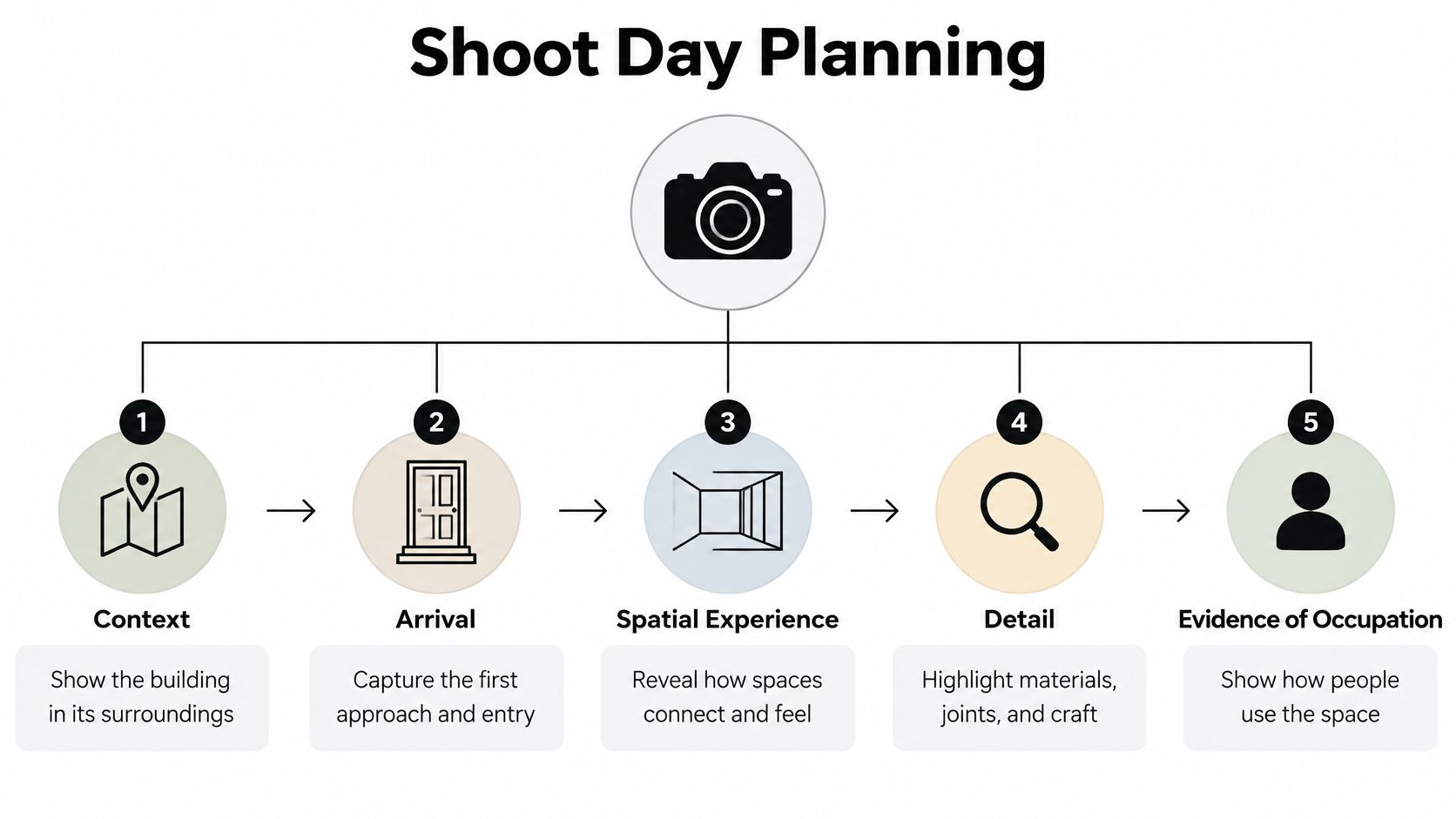
The visual plan below shows the five part sequence worth briefing on every commission.
Brief the sequence, not the shot list
- Context first: Show the building in its street, site, or campus so scale and adjacency read immediately.
- Arrival next: Photograph the approach a visitor takes, including thresholds and the first interior view.
- Spatial experience: Capture how rooms connect, where light falls, and how ceiling height and structure shape movement.
- Detail: Isolate joints, materials, and custom elements that prove technical resolution.
- Occupation last: Show people using the space as intended, which turns a finished object into functioning place.
This order isn't aesthetic preference. A 2025 academic study developed and validated the Architectural Portfolio Evaluation Rubric (APER) through subject matter experts and a modified Delphi process, scoring projects on design quality, technical competence, communication clarity, project relevance, team contribution, and outcome evidence. A hero exterior can support design quality. It can't, on its own, support technical competence or outcome evidence. The sequence can.
Decisions that shape the asset set
Walk the site with the photographer before the shoot day, ideally at the hour you plan to photograph key elevations. Note where sun hits the primary facade, which interiors go flat at midday, and what needs to be moved, cleaned, or switched on. That pre light walk is where you discover the parked contractor truck, the locked roof terrace, and the one room that only works at dusk.
Time of day is a design argument. Early light raking across a textured wall explains a material choice. Dusk shots with interiors lit explain transparency and evening use. Weather works the same way. Overcast conditions flatter interiors and even out exteriors, while hard sun proves shading devices shade. Don't automatically reschedule for blue sky.
Staging should clarify, not decorate. Remove visual noise, align furniture to the plan's logic, and keep a few signs of real use. An empty workplace reads as a rendering. A workplace with bags under every desk reads as a snapshot. Aim between those extremes, and decide in advance whether people will appear, who they are, and what permissions you need.
Plan interiors and exteriors as one day with a running order, not two competing lists. Exteriors anchor to sun position, interiors fill the in between hours, and detail shots happen whenever a space is quiet. Build slack into the schedule. The best frame of the day often appears when a planned shot fails and you have time to find the better angle.
Building a Case Study That Reads From Both Sides
A case study has to work for two readers at once. One reads images first and text only if the pictures earn it. The other reads text first, hunting for scope, sector, and status before looking closely at anything. A repeatable structure serves both, because each block sits where a scanning reader expects to find it.
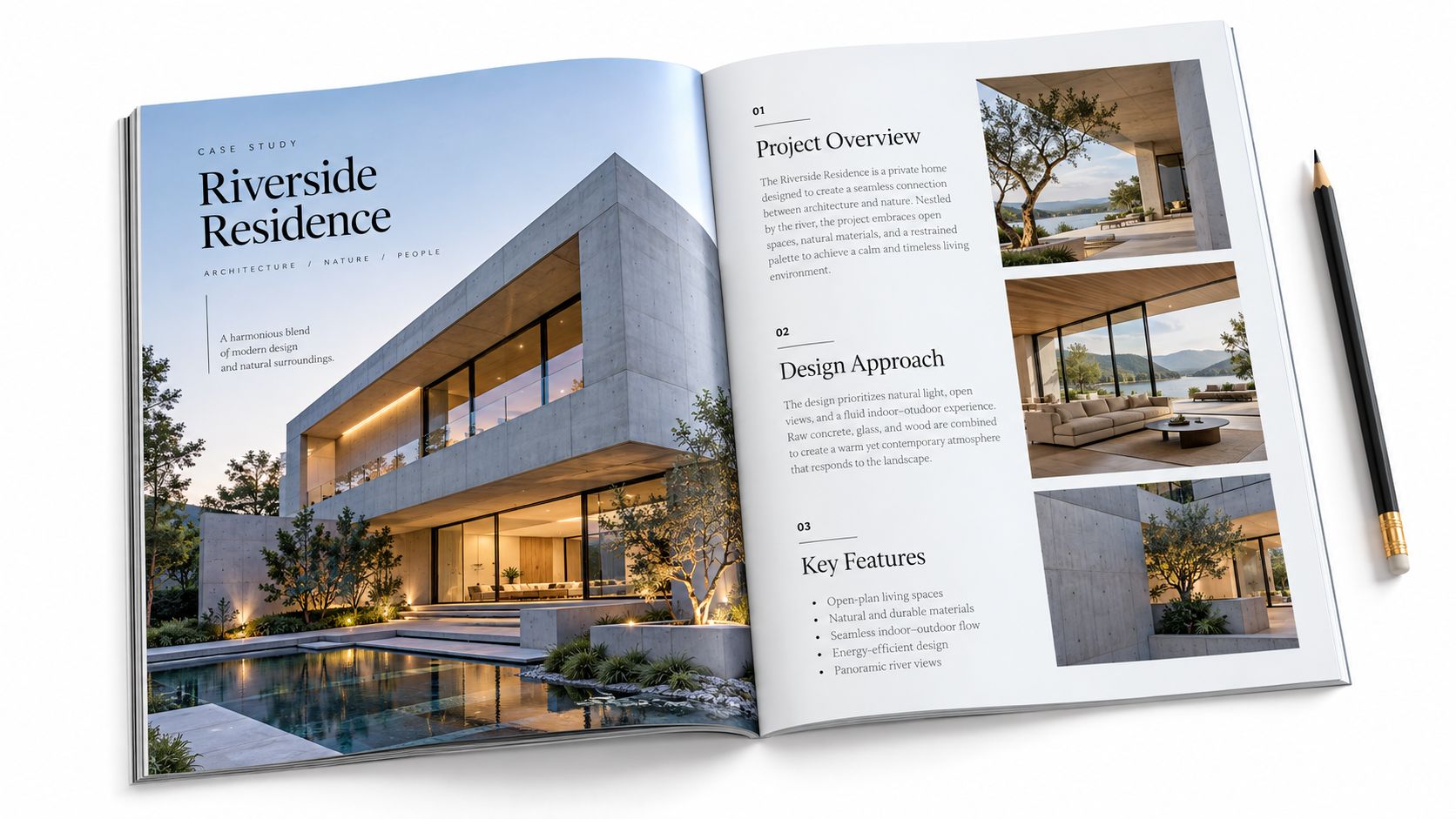
The spread below shows how a structured case study pairs photography with project facts in a format a reader can absorb quickly.
Six blocks, each doing one job
Challenge comes first, in two or three sentences. Name the client's actual problem, whether that's consolidating teams, adapting a structure that couldn't be demolished, or fitting a program onto a constrained site. Skip the history of the neighborhood unless it shaped a decision.
Role follows immediately, and it's the block firms most often fudge. State whether you were design architect, architect of record, interior designer, or part of a joint team, and which phases you carried. Readers don't punish a partial scope. They punish discovering it late.
Design response explains the organizing move in plain language. One short paragraph, supported by a plan or diagram, beats three paragraphs of adjectives. Technical resolution is where process evidence belongs, including sections, material details, or a construction photograph that proves the idea was buildable. This is also where photography used as deliberate storytelling rather than decoration earns its place, because an image sequence can show resolution that text would take a page to describe.
Delivery status should be unambiguous. Completed, under construction, or unbuilt, with the stage reached. Mixing renderings into a built project without labels destroys trust in everything around them.
Measurable outcome closes the page, and it's the block most portfolios skip. Where you have verified performance information, such as energy, daylight, material reuse, or post occupancy feedback, publish it plainly. Where you don't, say what the client gained in operational terms, such as consolidated departments or extended building life, and be honest about trade offs. A transparent account of a constraint and how you handled it persuades experienced clients more than a flawless narrative.
On crediting: Name collaborators, consultants, and the photographer on every project. Clear credit strengthens your authorship claim instead of diluting it, because it shows you know exactly which part was yours.
Keep the whole case study tight enough that a junior designer given the template produces something that reads like your best page. Consistency is the point. When every project follows the same anatomy, readers stop decoding your format and start comparing your work, which is the comparison you want.
Choosing Between Website, PDF, and Print Formats
Firms often build three portfolios that slowly contradict each other. The website says one thing, the PDF another, and the printed book is two years behind both. Pick one master set of case studies, then let each format draw from it. The formats differ in how readers use them, not in what they claim.
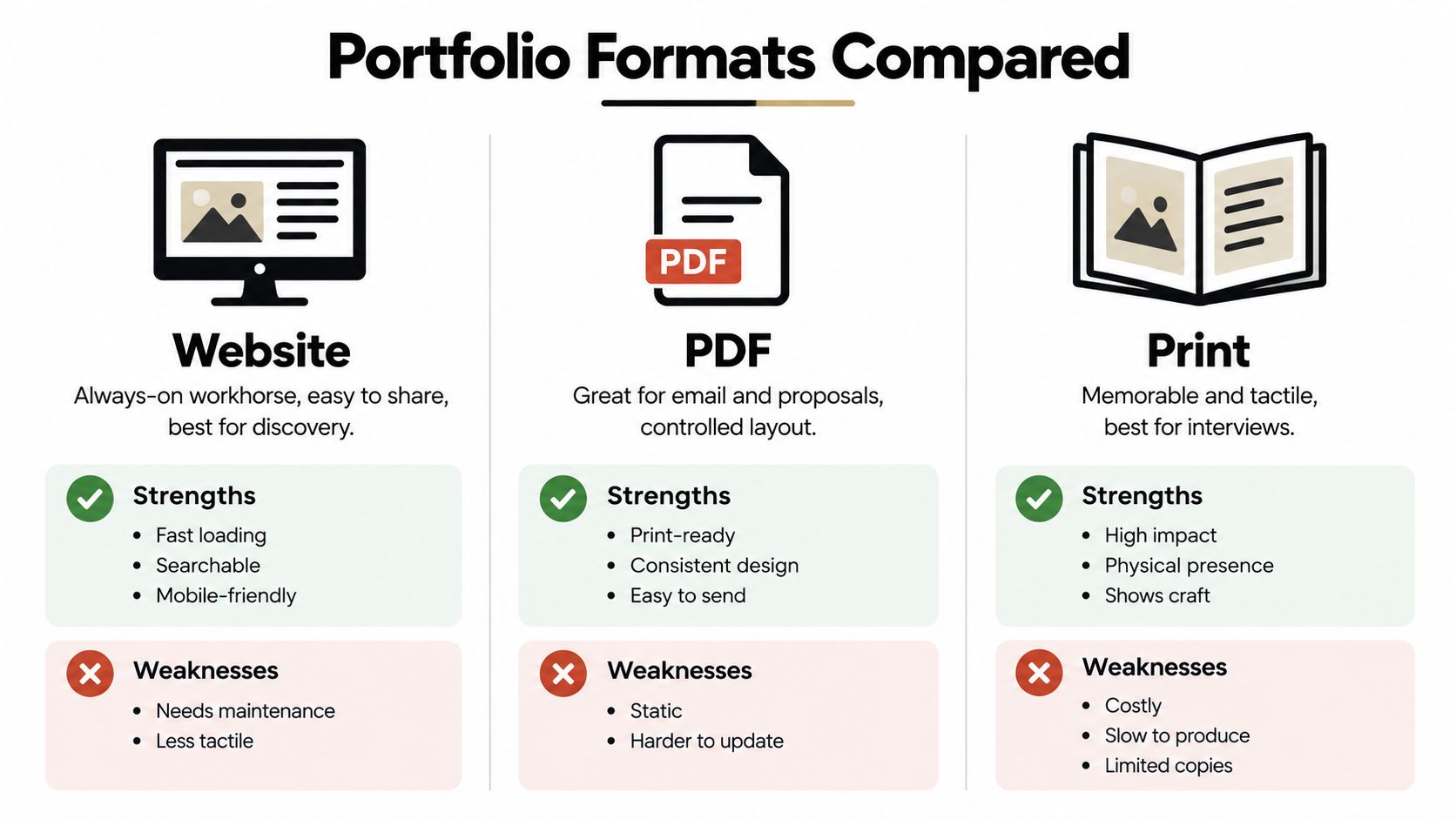
The comparison below lays out where each format earns its cost.
Website as the always on workhorse
Your site is where discovery happens, and it's also where most firms underperform. A 2025 analysis of 2,305 architecture firm websites found an average overall score of 49/100, with more than 85% scoring below 60 and median organic search traffic of approximately 160 visits per month, while one quarter received fewer than 50 monthly visits. Treat that as a warning about passive galleries. Each project page needs indexable text with location and sector terms, properly sized images, descriptive titles and alt text, and a visible inquiry path. Practical guidance on optimizing a firm website for image speed covers the technical side of keeping image heavy pages fast.
PDF as the deliberate pitch document
A PDF wins when you control the sequence and the reader is comparing you against a shortlist. It's portable, prints predictably, and lets you set project order to suit one opportunity. Its weakness is maintenance, since every correction means a new export. Keeping source files organized and using dependable PDF editing solutions for creatives reduces the friction of swapping a project, updating a credit, or compressing a file before it goes to a client with a strict attachment limit. Send a focused PDF, not your entire archive.
Print as the high touch closer
Print earns its cost in interviews and leave behind situations where tactility signals care. Paper, binding, and image reproduction become part of the argument about craft. Its limits are obvious. It's slow to update, expensive to reprint, and useless for discovery. Reserve it for flagship work that won't change soon.
Choose by decision, not habit. Discovery and first contact belong to the website. A specific pursuit belongs to a PDF made for the purpose. A final interview where you're one of two firms belongs to print. One source of truth, three expressions, and no version should ever contradict another on scope, status, or credits.
Layout, Copy, and the Edit That Pulls It Together
Good layout isn't a style. It's the reader never having to work out where to look next. Start with a strict grid, one type pairing, and a consistent placement for project facts so every page or screen orients a reviewer in seconds. Then spend your energy on sequence, because order is where portfolios are won and lost.
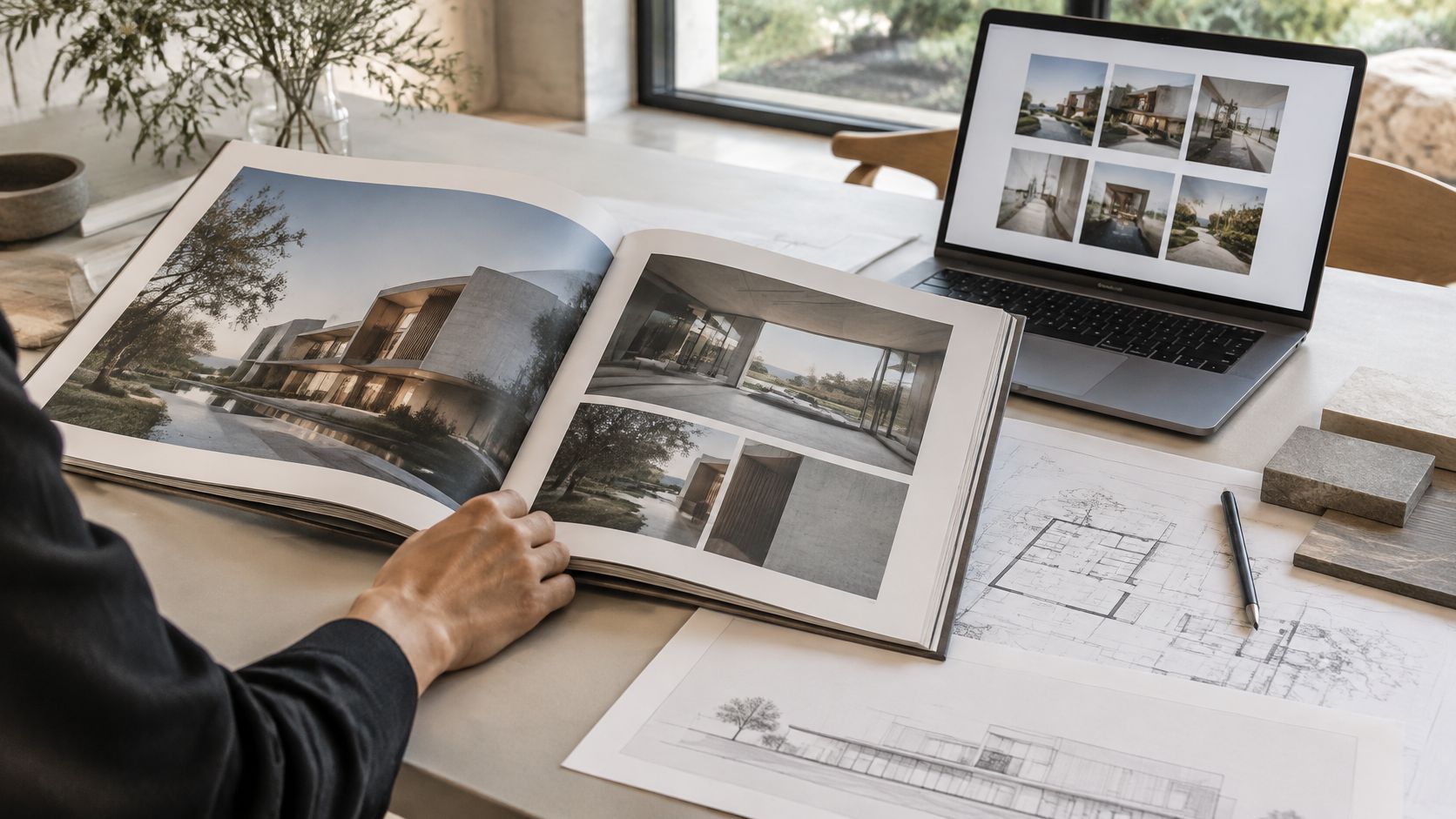
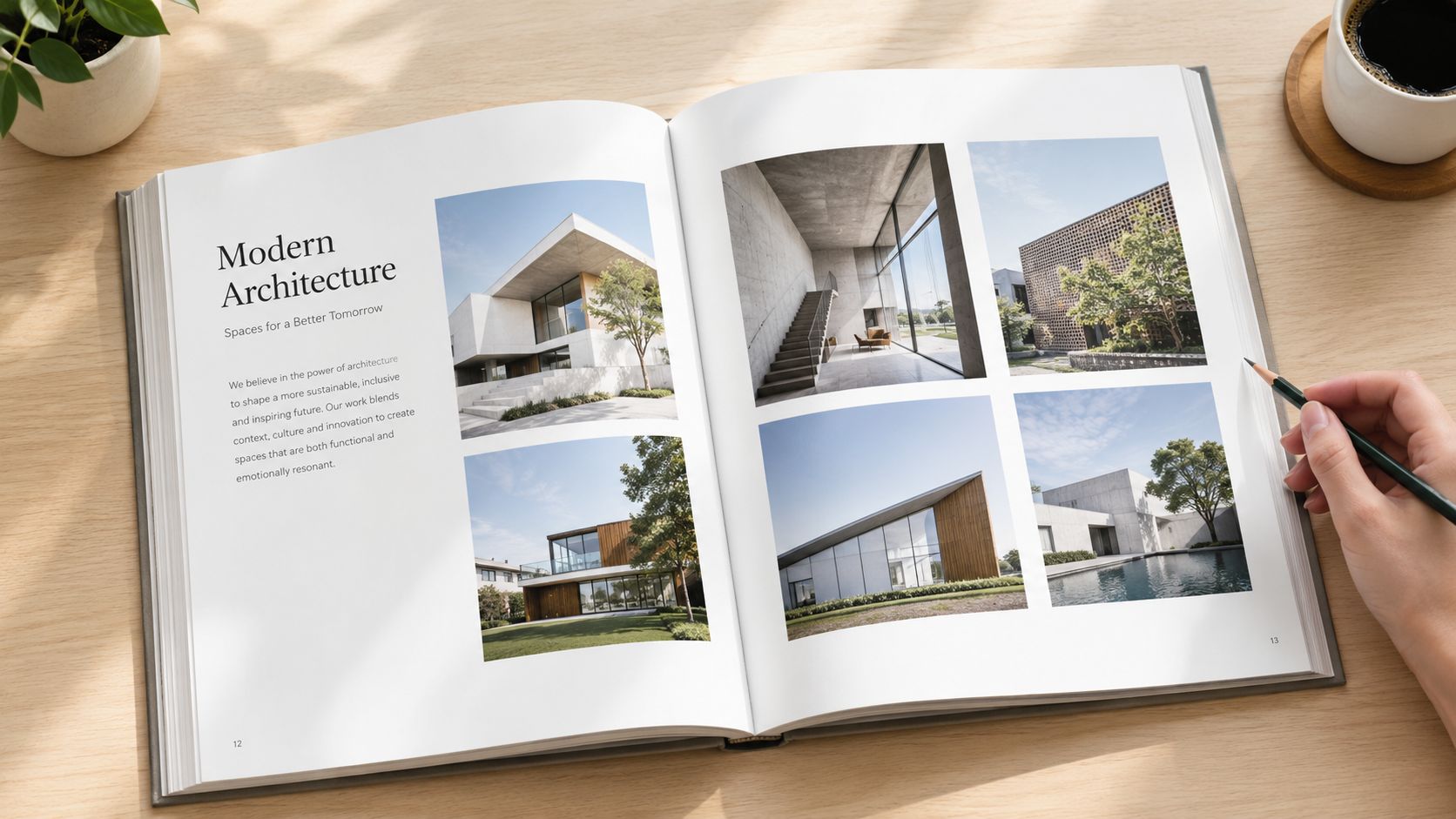
The image below shows the kind of working edit where prints, sketches, and layouts sit together before anything is finalized.
Sequencing and the thirty second test
Open each project with the image that explains the building fastest, which isn't always the prettiest exterior. Follow with the plan or diagram that makes the idea legible, then move through arrival, main spaces, and details, and close on occupation or dusk. Vary image scale deliberately. A run of same sized frames flattens everything, while one full bleed image followed by smaller, quieter frames creates pace.
Put a new reader in front of any project page and time them. Within thirty seconds they should be able to tell you the building type, location, your role, and whether it's built. If they can't, the problem is hierarchy, not content. Enlarge the project title and fact block, cut competing elements, and add white space around what matters.
Captions, metadata, and performance
Captions do real work when they contain information the image can't show. Name the space, the material or system in view, and the decision it represents. Avoid repeating the headline or writing mood copy. Keep a consistent metadata block for every project covering location, sector, status, scope, and completion, and write it in plain text rather than graphics so it stays searchable and accessible.
Performance is part of design, not an afterthought. Google's Core Web Vitals guidance sets a good Largest Contentful Paint threshold of 2.5 seconds or less at the 75th percentile of visits, and classifies anything above 4 seconds as poor. On image heavy pages the hero photograph is usually that largest element, so compress exports, size images to their display dimensions, and test on a phone over a real connection. Accessibility belongs in the same pass. Meaningful images need informative alt text, and captions and navigation need enough contrast to stay legible against photography.
The short film below walks through editing and sequencing decisions in practice, which is worth watching with your own draft open beside it.
Finish every deliverable with the same edit pass. Check image order, credits, fact consistency, file size, and whether each project ends with a clear next action. Your homepage deserves the same discipline. Treat it as a curated selection of your strongest current arguments, not a feed of whatever finished most recently.
Frequently Asked Questions
How many projects does an architecture firm portfolio need
Fewer than you think. A tight set that maps cleanly to the work you're pursuing will outperform a vast archive, because reviewers decide quickly and relevance beats volume. Keep a longer version ready for interviews where you can talk through depth, and lead every version with your strongest, most relevant built work rather than chronological order.
How often should we refresh it
Refresh when your positioning changes, when a significant project completes, or when photography no longer matches the quality of recent work. Small, frequent updates to the master case studies beat a rebuild every few years. If a project no longer points at clients you want, retire it at the next update instead of carrying it forward out of habit.
How do rights and credits work with photography
Don't assume that paying for a shoot means owning the images outright. Under U.S. copyright rules, an original architectural photograph receives protection when it's fixed in a tangible medium such as a digital file, and registration, though not required for protection to begin, creates a public record of ownership and can provide additional legal benefits including eligibility to bring an infringement claim. Agree in writing, before the shoot, who owns copyright, what uses your license covers, whether collaborators and consultants may use the images, and how credit will appear. Distinguish permission to display an image from ownership of the underlying copyright, and keep those agreements with the project files.
How do we know whether it's performing
Measure qualified inquiries, not gallery views. Set up analytics with conversion goals, inventory every project page, and review which project types and traffic sources produce real conversations. Check page speed, mobile layout, and crawlability in the same review, since a slow or unfindable page can't convert anyone.
Final checklist before anything goes out
- Selection: Every project maps to a target sector, geography, or capability.
- Structure: Challenge, role, response, resolution, status, and outcome appear in that order.
- Photography: Context, arrival, spatial experience, detail, and occupation are all covered.
- Accuracy: Scope, credits, and built versus unbuilt status are labeled.
- Technical pass: Images are compressed, alt text is written, and the inquiry path works on mobile.
Run that list on your next project page before you publish it. The portfolio that wins work in 2026 won't be the one with the most images. It'll be the one that answers, clearly and with evidence, what your design accomplished once the building opened.
If your next project deserves photography planned as a case study sequence rather than a set of isolated hero shots, Jimmy Clemmons Photographer offers architectural photography with location scouting, lighting design, on set direction, and professional editing built around how firms present work. Visit the studio site to discuss an upcoming completion, review relevant project imagery, and plan a shoot that gives your portfolio the context, detail, and evidence of occupation it needs.