
A property website goes live in six weeks, the leasing deck ships to brokers next month, and the investor update was due last Friday. Someone asks the obvious question: will the photos on the shared drive cover all three?
That question is where commercial photography budgets break. The problem is rarely the shoot. It's the assumption that one set of images, bought for one purpose, can stretch across every channel for the next five years without anyone reading the paperwork.
Atlanta is generating a lot of this work. In 2025, the city's office market had 667,254 square feet undergoing conversion or partial conversion while only 250,000 square feet of new office space was scheduled for delivery, according to CBRE's Atlanta office conversion analysis. Metro Atlanta also recorded nearly $1.2 billion in office sales volume during 2025, a 12.3% increase from 2024, per Partners Real Estate's Q4 2025 office market report. Every conversion and every trade needs images for a new owner, a new lender, or a new leasing campaign.
So here's the position I'll defend. The day rate isn't the price. The price is the day rate plus the cost of the reshoot you'll book when the license turns out to cover the website but not the brochures, or when the lobby frames arrive with a color cast that fights the new brand palette. Copyright and usage rights are separate things, and paying an invoice has never granted every use a marketing team assumes it has.
Match the Shoot Type to the Right Photographer
A developer is repositioning an eighties tower: new lobby, spec suites, a rooftop amenity floor. Marketing wants leasing images, HR wants leadership portraits for the hiring page, the contractor wants progress frames for the investor deck, and a design magazine has asked for a feature. One building, four jobs.
No single photographer is the best answer to all four, and a brief that treats them as one job is where the trouble starts. Sort the work by what the images have to do first.
| Shoot type | What it covers | Typical deliverables | Where it is used |
|---|---|---|---|
| Architectural exteriors and interiors | Facades, lobbies, suites, hospitality rooms | HDR-merged interiors, twilight exteriors, detail crops | Leasing decks, property websites, architect portfolios |
| Corporate people and culture | Leadership portraits, team environments, workplace candids | Environmental portraits, headshot sets, candid sequences | Recruiting pages, annual reports, LinkedIn |
| Products and brand spaces | Product close-ups, showrooms, brand campaign scenes | Studio product set, lifestyle set, cropped variants | Paid ads, e-commerce, signage |
| Construction progress | Site milestones and finished phases | Dated sets from the same angle, before-and-after pairs | Investor updates, contractor portfolios |
| Editorial features | Story-driven series on a project, company or space | Narrative sequence with captions | Magazines, case studies, feature pitches |
Most projects need two or three rows, not one. The leasing team wants twilight exteriors and clean suite interiors. HR wants portraits that look like people work there. The contractor wants dated frames from a fixed position, shot again next quarter.
Commercial property marketing has also gone multimodal: recent guidance on commercial real estate marketing treats high-resolution photography, virtual tours, and AI-generated video walkthroughs as complementary tools rather than substitutes. Complementary is the operative word. Stills have to intercut with a 3D tour and survive a crop into a vertical story ad. A photographer who hands you a gallery with no thought to that system has delivered a folder, not an asset library.
If you're still fuzzy on categories, this breakdown of types of commercial photography maps them clearly enough to argue about in a planning meeting.
Write down every channel the images will appear on before you call anyone: leasing deck, property site, LinkedIn, signage, recruiting page, award submission, magazine pitch. The row that matches your main use is the one you carry into every conversation that follows.
How to Hire an Atlanta Commercial Photographer Step by Step
A clean hire starts before the first estimate. Decide what the images must do, what they must cover, and what happens if weather, access, or art direction forces a reshoot.
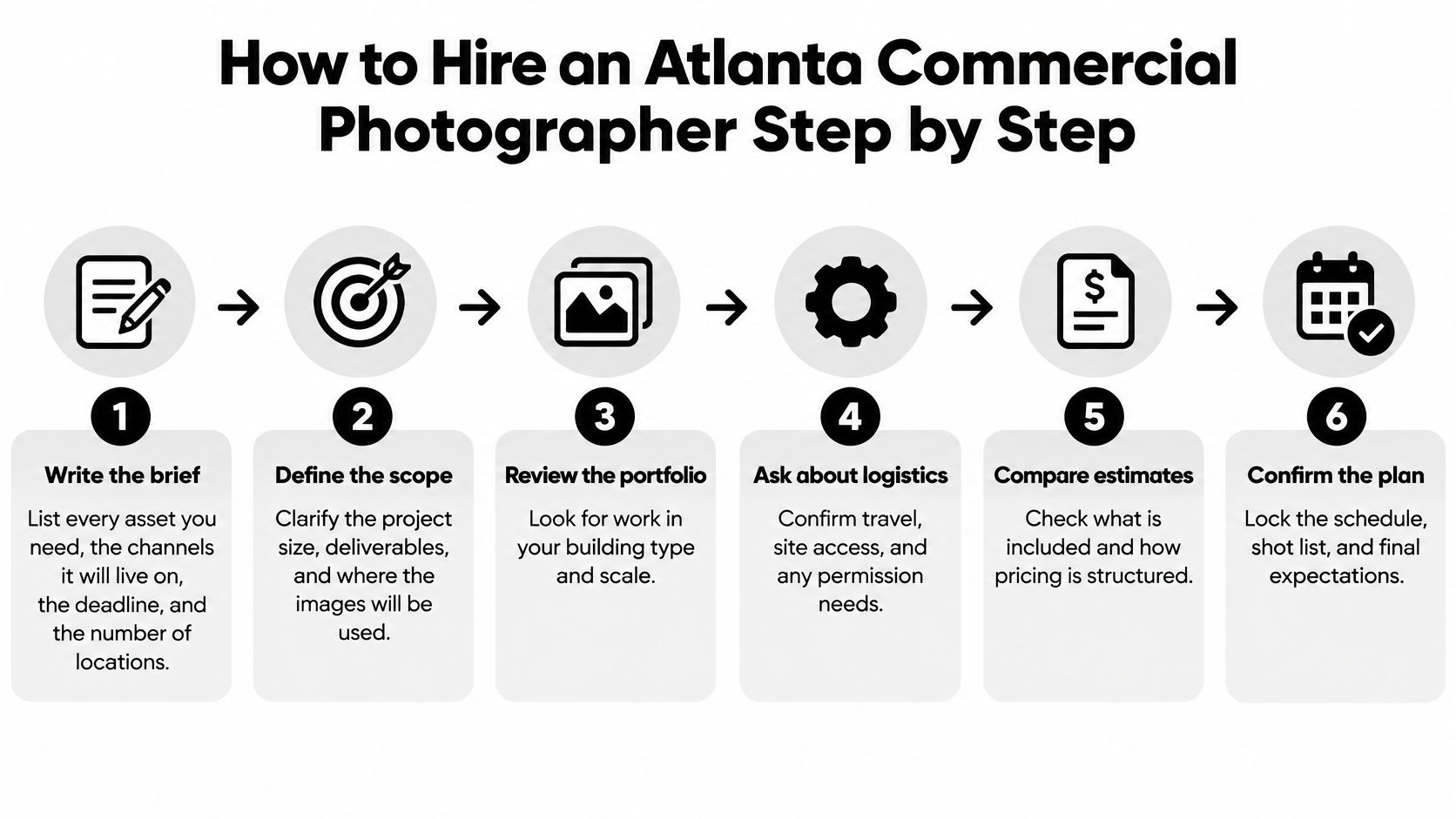
1. Write the brief. List every asset, the channel it will live on, the deadline, the locations, and who must approve each set. “Building photos” earns a gallery. “Twelve vertical crops for paid social, six horizontals for the deck, two dusk exteriors” earns a production plan.
2. Define the output before quotes arrive. Web, print, editorial, and construction documentation need different file sizes, color spaces, crops, and retouching depth. Put the delivery spec in the request. If you settle it after the shoot, you are paying to solve the same problem twice.
3. Record the light in each space. Curtain-wall daylight, mixed LED, tungsten accents, shaded loading docks, and west glass all change color, contrast, and material finish. Note when sun hits each facade and where artificial light cannot be switched off. That record decides whether you buy a golden-hour slot, a mid-morning interior block, or extra lighting.
4. Shortlist three to five photographers. Match recent work to building type and scale. Someone strong in a glass tower can still miss the brief in a low brick warehouse with small windows and dark ceilings.
5. Request a written proposal. Require a shot list, schedule, crew, delivery format, retouching scope, usage terms, permit responsibility, travel costs, and reshoot terms. Usage belongs in writing: media, geography, duration, exclusivity, paid versus organic, and whether third parties may reuse the files. Most delays start when proposals arrive as a day rate attached to undefined work.
6. Compare total cost before day rate. Price the identical shot list across every bid so the numbers mean something. A lower fee can hide weaker coverage, fewer processed selects, narrow usage, no assistant, or a reshoot billed at full rate. Ask each bidder to state what one weather miss costs and who pays if access fails.
7. Hold a scouting call, then sign. Build the schedule around the light and the usage deadline. Put approval windows, cancellation terms, and file delivery dates in the agreement before the calendar invite goes out.
Required: no shot list, no comparison. An estimate without one is a guess with a letterhead.
Color is part of the contract, not taste. For architecture, specify the pipeline: required output first, highlight bracketing, protected windows, a neutral reference, recorded lens and lighting conditions, exposure merges before heavy tonal edits, lens geometry correction, and export from a profiled working space into the client's specified color space. Technical research on calibrated architectural imaging catalogs saturation-point errors, shutter-speed inaccuracies, sensor blooming, photon noise, demosaicing order, lens flare, and uncalibrated color transforms as major HDR error sources; a calibrated workflow substantially reduces illuminance and chromaticity error. That discipline is what keeps the twentieth room faithful to the first.
Portfolio Signs That Predict a Strong Shoot
One weak portfolio review can cost you an entire second shoot. A single hero frame proves someone found good light once. It says nothing about the twentieth room, the deliverable due in March, or whether color holds across a set. Miss those weaknesses in review and the invoice arrives later: a reshoot, where you pay for crew, location access, and post-production all over again.

Judge the portfolio on evidence that the photographer has solved your problem before. Start with building type and scale, because a hospitality lobby and a converted warehouse office demand different lighting decisions. Then read the whole set, not the frame.
Three checks that separate a technician from an image-maker
- Color consistency across rooms: open four interiors from one project. If white balance drifts between the lobby and the conference room, the photographer is fixing mixed light in editing instead of controlling it on site.
- Corners and window edges: zoom to 100% and look there first. Soft corners, haloed frames, and blown highlights show up in those zones before anywhere else.
- Series integrity: a portfolio of one-off hero shots rarely predicts how a full set will look. Look for consistent framing and one edit across different spaces.
Ask for two or three uncropped projects so you can see what sits outside the frame, and check whether people look natural in environmental portraits rather than posed against a backdrop.
The local bench is deep enough to be picky. In fiscal year 2022, 412 projects including 42 commercials spent approximately $4.4 billion in Georgia, according to the New Georgia Encyclopedia's film industry overview, which is why crews, studios, lighting resources, and post-production talent are hired here instead of imported.
Then ask how interiors get captured. According to technical guidance on high dynamic range capture, a controlled setup means a tripod, white balance locked to daylight, ISO 100, roughly f/11, and a bracket spanning 6 to 8 shutter speeds merged from RAW before tone mapping; the same work reports average HDR error below 10% overall and below 5% for grayscale targets when capture and post-processing stay controlled. A photographer who can walk you through that pipeline in plain terms has thought about repeatability, and repeatability is what keeps a reshoot off your budget.
Run this review before you compare a single day rate. A photographer who passes these checks rarely sends you back for a second production day, and avoiding one is where the genuine savings lie.
Questions and Usage Terms to Settle in Writing
Ask these five in writing before you sign. The answers separate photographers who can deliver from photographers who only shoot well.
- What are the final deliverables? Get a named file count, formats, and written confirmation that retouching and color correction are included.
- How do you handle mixed lighting? Listen for the kit they bring, color checks, and test frames, not a plan to fix color in editing.
- How do you access occupied or construction sites? Expect a permit plan, a safety orientation, and timing windows.
- Who owns the files, and what license comes with the fee? Media, territory, and term in writing.
- Can we reuse the images after a rebrand or a sale? The answer should explain license extensions and renewal cost.
Buyers rarely get clear answers on who owns the files, whether the fee covers advertising, editorial, recruitment, signage, paid social and third-party tenant use, or whether an architect, contractor, or new owner can reuse the images after a property changes hands. Published guidance on Atlanta commercial photography notes how rarely those risk questions get addressed, even though one shoot often serves several stakeholders for years.
| Usage term | What to confirm | Why it matters |
|---|---|---|
| Media | Web, print, paid social, signage, recruiting | A web-only license may not cover brochures or ads |
| Territory | Local, national or worldwide use | Regional rights can block a national campaign |
| Duration | Start and end dates, renewal cost | Expired images can stay live without a license |
| Exclusivity | Whether the photographer can resell the same images | Shared images can appear in a competitor's materials |
| Alterations | Crops, retouching and composites allowed | Heavy edits may breach the license terms |
| Third-party use | Tenants, contractors, architects, buyers | New owners often need a separate grant |
Our founder's editorial work for Condé Nast and Atlanta Magazine is a reminder that publication rights are the narrowest grant in the room, and they're negotiated separately from every commercial use. Put the plain-English version of these terms in your contract rather than an email thread, and use this guide to commercial photography contracts to find the clauses worth arguing over.
Ask this one first: "What exactly does this fee license, for how long, and to whom?"
A vague shot list and a verbal promise of unlimited use are the two warning signs that matter. The lowest day rate stops being the lowest cost the moment usage is narrow.
What Drives the Total Cost of an Atlanta Shoot
Compare proposals on what drives the total, not the headline number. Five line items move an Atlanta bid further than anything else.
- Shoot length and travel: a half day or a full day, and whether time between sites is billed by the hour or by mileage.
- Post-production: retouching, color correction, lens correction, and HDR merging per image, plus whether the proposal caps the number of edited files.
- Permits and access: property approvals, safety orientation, and permit fees for drone or exterior work.
- Usage tiers: the license level for each channel on your list, with a stated price to renew each term.
- Reshoot policy: who pays if the first set misses a crop, a color target, or a usage need, and whether travel is billed again on a return visit.
The upside of doing this properly is measurable, at least in the residential market where the data exists. A 2013 comparison of professional DSLR listing photographs against amateur point-and-shoot images across 22 major markets reported a price premium of $3,400 to $11,200 relative to list price depending on the property segment, with homes around $400,000 selling 21 days faster when photographed professionally, per Redfin's study announcement. Listings in the sharpest 10% of photographs sold at or above asking price 44% of the time, against 13% for average sharpness. Sharpness is a technical variable, not a taste one, and it's why lens and focus discipline belong in a budget conversation.
An analysis of more than 4,000 residential listings published the same year found interior photography associated with a 3.9% increase in final sale price against 1.9% for exteriors, as summarized by Houston Agent Magazine's analysis of listing photography. Budget your interiors accordingly and skip the empty corridor shots nobody uses.
A cheap shoot with narrow usage isn't cheap. It's a deposit on the second one.
Treat any unclear fee as a question to resolve before signing, not a surprise to discover on site.
Atlanta Locations, Permits and Travel Considerations
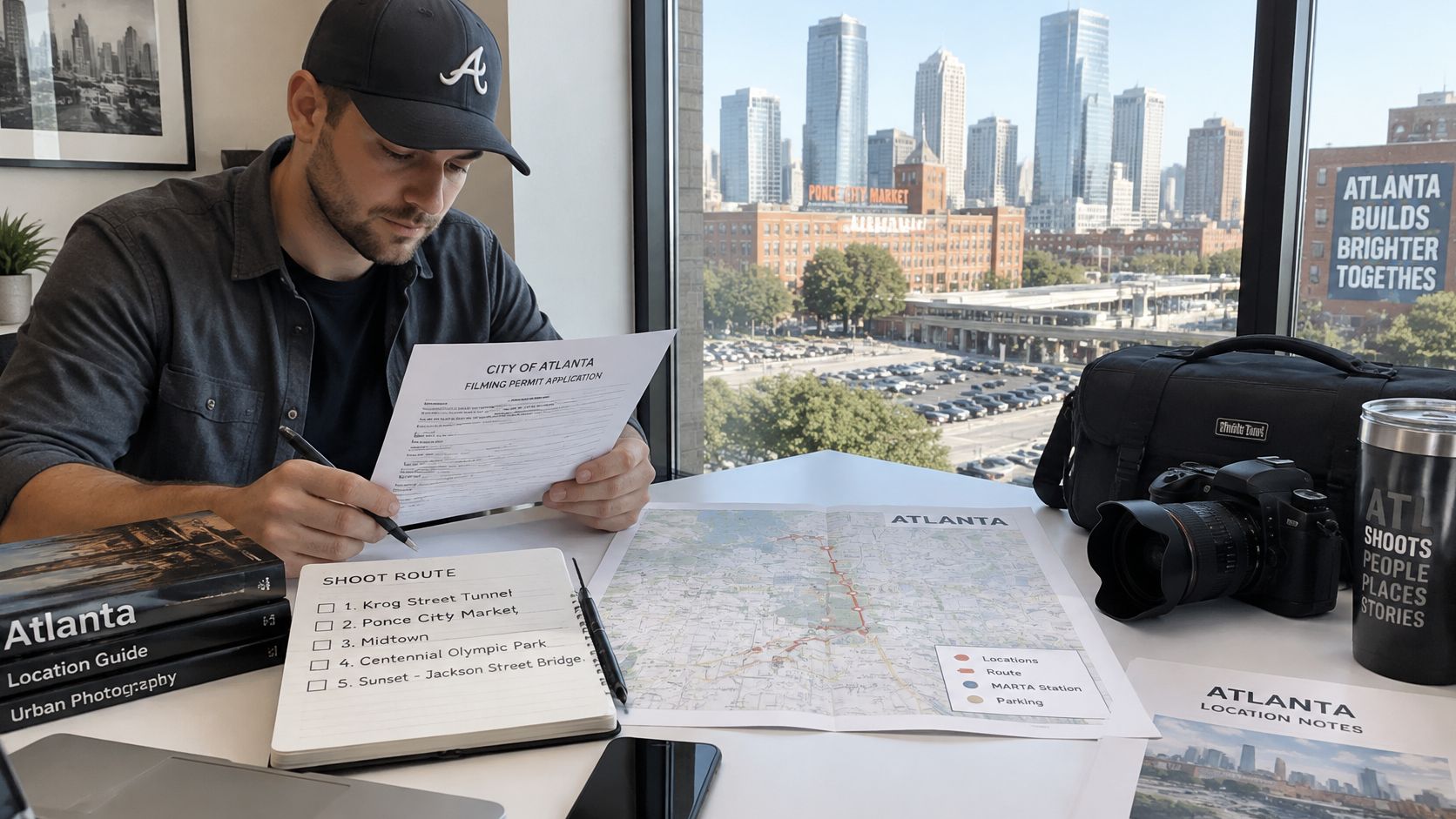
More Atlanta shoots slip on logistics than on talent. Three things decide whether the day runs on schedule: what the buildings demand of the lighting plan, who has to say yes before cameras come out, and how long it takes to drive between addresses.
The building stock sets the lighting plan
Atlanta's visual identity isn't one period or building type. The eight-story Equitable Building, completed in 1892 and demolished in 1971, is widely identified as the city's first skyscraper, and the New Georgia Encyclopedia's Atlanta entry counts seventeen buildings taller than fifteen floors added in the 1960s alone. Over the same decades, an interconnected complex of towers, hotels and retail pulled the commercial core north along Peachtree Street, and the tower completed in 1992 has held the city's height record ever since. A single shoot day can move from a masonry warehouse to a glass lobby to a hospitality suite, and the lighting decisions change at every address.
Permissions, in order of who says no
Start with whoever controls the door. Property owners and managers approve access. Tenants and employees sign releases before they appear in frame, and that paperwork is easier three weeks out than on the morning of the shoot. Security-sensitive areas and active construction sites add a harder gate: a safety orientation plus approval from the general contractor, who can restrict which phases you photograph and when.
Drone work stacks federal airspace rules on top of whatever the building owner and nearby venues require. Confirm both before the drone goes in the car, because an aircraft that cannot fly that morning is a second shoot day you still have to pay for.
Sequencing rule: property approval first, tenant releases second, safety orientation third. Each one can veto the other two.
Travel and light windows
Budget real drive time between Buckhead, Midtown, Downtown and the industrial corridors; metro traffic eats schedules that look clean on a map. Schedule exteriors around the light you want rather than the light your calendar allows. Get the travel policy in writing as well: whether drive time and mileage bill separately, and whether the day rate changes outside the city. A regional job priced like an in-town one usually means corners get cut on site.
Scouting settles most of this before it becomes a problem, and this walkthrough of location scouting for commercial shoots shows what a proper recce covers. It is the cheapest insurance on the job.
Send One Written Brief and Book on the Proposal
Write one brief before you contact a single studio. It should carry the shoot types, output specifications, sites and permissions, usage channels, and deadline in one place. A proposal can only be compared against the document that produced it, so vague input creates expensive-looking bids that are impossible to score.
Put accessibility in the same spec: meaningful images need a text alternative, decorative ones should carry an empty alt value, and a review of WebAIM accessibility data found that 53.1% of the top one million home pages had at least one image missing alternative text. For architectural imagery, name the subject and its function, such as a lobby, facade, or accessible entrance.
Send the brief to three to five photographers and require a written proposal that answers the five questions and prices each cost driver line by line. Score portfolios against your building type and scale using sharpness and consistency checks, and keep the review on a calibrated monitor rather than a phone screen. If your team needs a shared tracker for the bid matrix, compare client management tools before the first proposal lands so the scoring sheet is ready when pricing starts.
Then apply the rule that protects the budget: book the photographer whose proposal states the shot list, the license, and the reshoot policy in writing. The day rate is the entry fee. Usage, revisions, and the cost of returning to a finished space are the actual price, because a lobby reshoot can mean new access windows, fresh releases, and another crew day. If two bids are close, choose the one whose paperwork makes a bad week cheaper and a good shoot easier to reuse.
Jimmy Clemmons Photographer is based in Atlanta, Georgia, with a current focus on architectural photography and corporate brand content across products, people, and spaces. The studio lists location scouting, lighting design, on-set direction, and professional editing for Atlanta architectural and corporate brand projects. Call 770.365.6864 or visit Jimmy Clemmons Photographer to start the conversation.