

A corporate headshot is not decoration. It's the first contract a company signs with its audience, promising something about the people behind its work. Yet a more attractive photograph doesn't necessarily produce a better professional outcome for women: a field study of employment applications found that women submitting no photograph received a 16.6% callback rate, compared with 12.8% for women judged attractive.
Hiring applications aren't company biographies, and those results don't mean women should avoid portraits. They do challenge the assumption that looking prettier is the same as looking professionally credible. A useful headshot should communicate role, confidence, and brand values at a glance, without making youthfulness or constant agreeableness the assignment.
For corporate headshots women can use confidently, brand fit comes before generic flattery. A technical director, school principal, and hospitality executive don't need identical expressions, backgrounds, or lighting. Someone working with an executive coach for professional women can bring that same clarity about leadership presence into the photography brief.
The eight styles below connect posing, lighting, lens choice, wardrobe, and retouching to a specific professional purpose. Choose the setting your audience needs, then build the photograph deliberately.
1. Classic Three-Quarter Studio Headshot
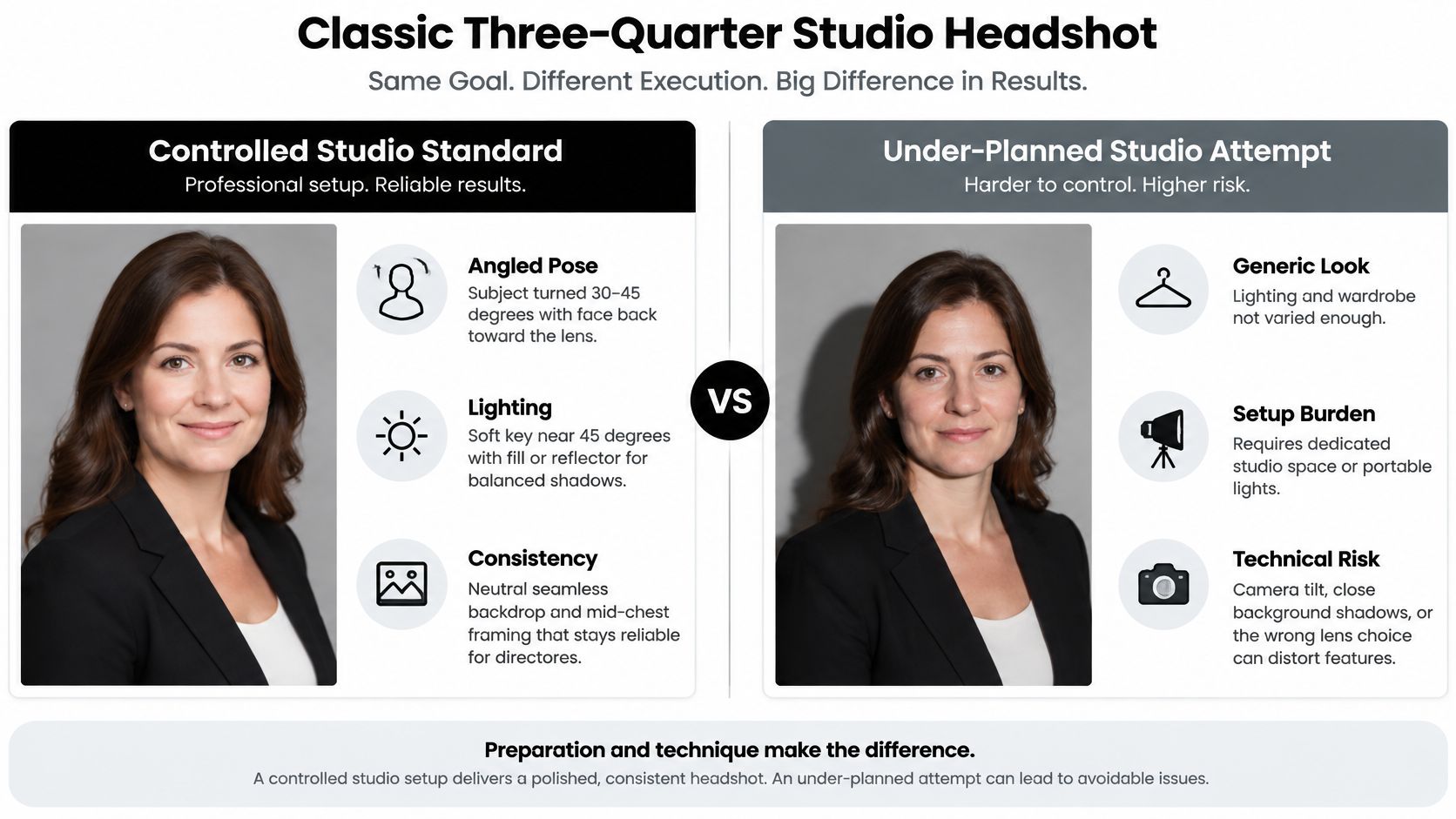
A controlled studio portrait is the dependable choice when a company needs clean, repeatable images for leadership biographies, proposals, and employee directories. Turn the shoulders gently away from the camera, then bring the face back toward the lens. The angle gives the portrait dimension without making the pose feel theatrical.
Use a short telephoto lens and enough camera distance to preserve natural facial proportions. The working distance matters more than the lens label alone. Keep the camera near eye level, ask for a slight forward inclination from the torso, and avoid pushing the chin downward.
Build a Repeatable Baseline
Place a large softbox beside the camera and slightly above the subject's eyes. Add a white reflector opposite it if the shadows feel too strong, and leave space between subject and backdrop so the background doesn't collect a distracting shadow.
- Wardrobe logic: Choose a jacket, blouse, or knit with a neckline that stays tidy when the shoulders turn. Texture can add interest without competing with the face.
- Expression: Photograph a relaxed smile and a composed, closed-mouth alternative. Select for the intended use rather than treating smiling as compulsory.
- Retouching: Remove temporary distractions, lint, and isolated flyaways. Preserve skin texture, facial structure, and recognizable age.
For a hypothetical engineering director appearing beside colleagues in a proposal, this style keeps attention on identity rather than scenery. Its limitation is context: the viewer won't learn much about the person's working environment.
Replicable takeaway: Establish the background tone, camera height, and light direction before refining expression. That order produces a portrait the company can reproduce later.
2. Environmental Office Headshot
An office portrait should tell the viewer something useful about the subject's work. A meeting room might support a leadership biography; a materials library might suit a design principal. A generic lobby adds little unless its architecture clearly belongs to the brand story.
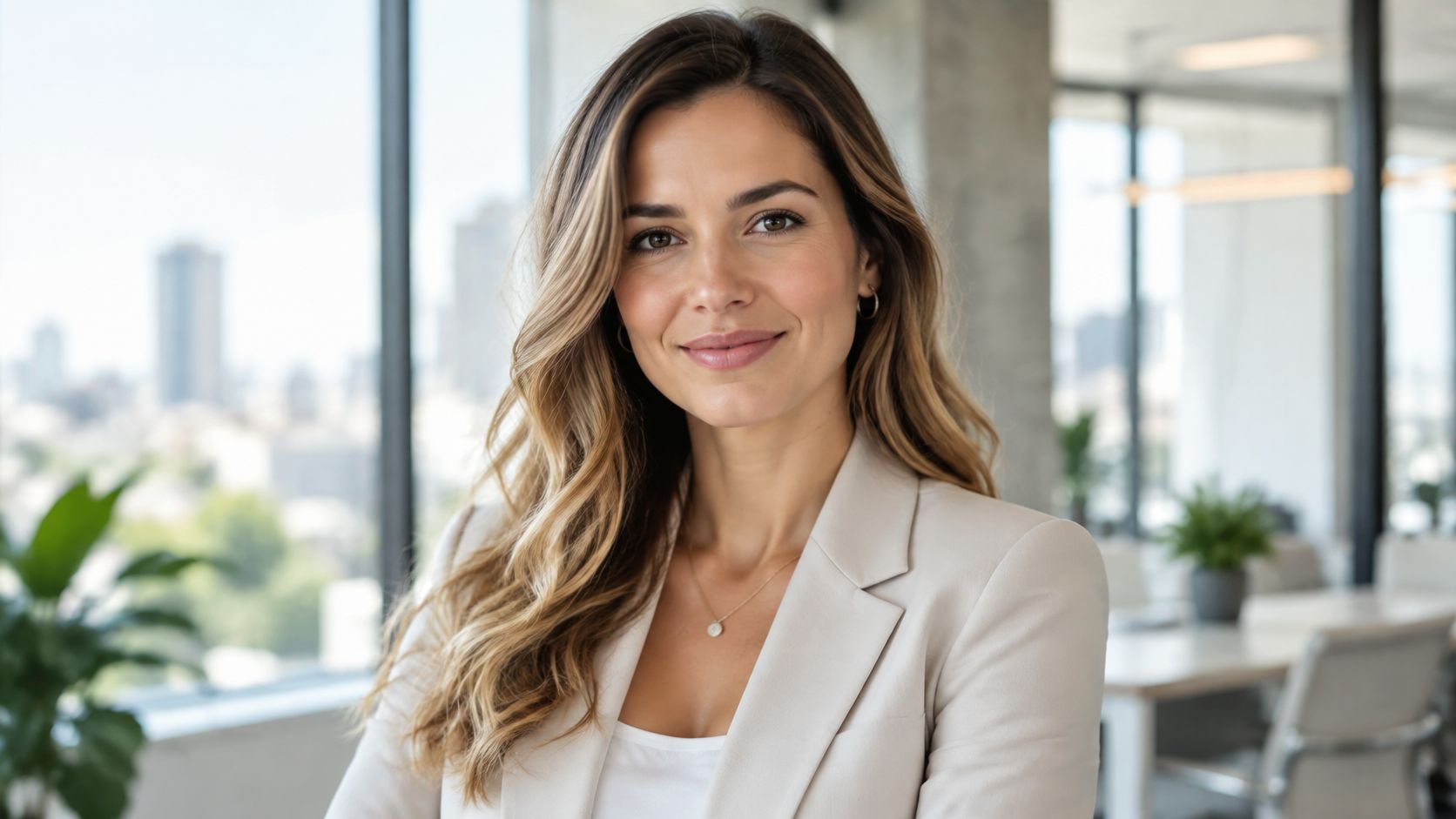
Start by removing cables, abandoned cups, confidential documents, and bright objects behind the head. Use a normal-to-short-telephoto lens, then move the subject away from the background so the surroundings remain legible without competing with her expression.
Let the Office Support the Role
Place the subject beside a broad window rather than directly against it. If flash is needed, soften it and match its color to the dominant ambient light, or switch off fixtures that introduce an unwanted color cast. Correcting incompatible light sources afterward is less convincing than controlling them on set.
Wardrobe should separate from the room. A pale jacket can disappear against pale stone; a saturated blouse can dominate an otherwise restrained interior. Test the actual outfit against the actual background.
For a construction leader's project biography, include a relevant drawing wall or meeting space without turning the portrait into a staged activity scene. The principles of environmental portrait photography are especially useful when the workplace needs to carry part of the narrative.
Keep enough context to explain the role, but not so much that viewers have to search for the person.
Retouch temporary distractions and distracting reflections, not the defining character of the workspace. The practical takeaway is to choose the background for meaning first, then simplify it for composition.
3. Soft Window-Light Natural Headshot
For an educator, healthcare administrator, or hospitality leader, soft daylight can support a welcoming, conversational portrait. It doesn't require an elaborate lighting package, but it does require control. A bright window isn't automatically a flattering light source.
Position the subject at an angle to a large window, with the face turned toward the light. Use a normal or short telephoto lens from a comfortable working distance. A sheer curtain can diffuse direct sun; a white reflector on the shadow side can open the face without flattening it.
Control the Daylight Before the Expression
- Watch the background: Expose for the face. If the window appears in the frame, decide whether to retain its detail or intentionally let it become bright.
- Choose the reflector carefully: White gives a gentle lift. Silver adds stronger fill but can feel harsh when placed too close.
- Keep clothing believable: A soft blouse, structured knit, or familiar jacket usually fits this treatment better than an outfit that feels borrowed.
Say a school leader needs a portrait for a welcome letter. Seat her near the window, keep the shoulders relaxed, and photograph while she speaks between still expressions. Don't substitute a permanently tilted head or oversized smile for warmth.
The trade-off is repeatability. Changes in cloud cover and sun direction can alter the look during a team session, so window-light photography needs exposure checks and a plan for controlling changing daylight.
Keep retouching restrained, especially around the eyes and smile lines. Replicable takeaway: Make a test frame with the subject in place before settling on the room. Beautiful daylight elsewhere in the office may not work where the portrait needs to happen.
4. Executive Low-Key Editorial Portrait
Dark backgrounds and directional light can give a leadership portrait concentration and visual weight. This style suits press features, speaking materials, and executive profiles where the image needs presence beyond a small directory tile. It becomes less useful when dramatic lighting overwhelms the person.
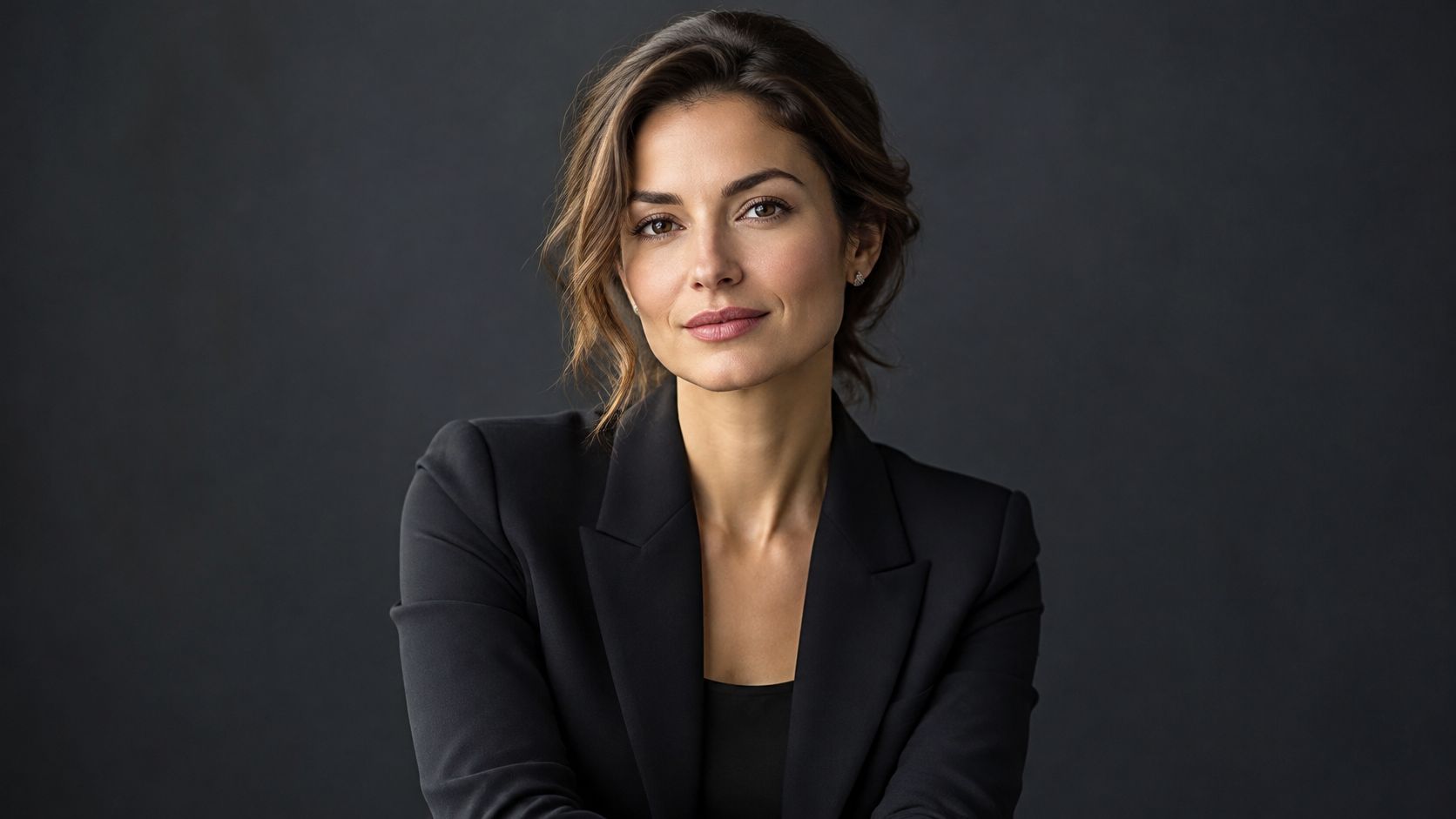
Place a gridded softbox above eye level and off to the side. Use flags to keep light off the background, and check that the eyes remain readable. A short telephoto lens keeps the frame concentrated without requiring the camera to crowd the subject.
Authority Without an Artificial Persona
Ask the subject to settle her weight forward slightly and release her shoulders. A composed expression can work beautifully here, but don't direct a scowl or assume that leadership requires severity.
The graduate business school analysis of professional imagery describes how women are systematically portrayed as younger than men, particularly in higher-status occupations. That makes preserving visible seniority an important editorial choice, not a retouching problem to solve.
Dark tailoring needs separation. If a black jacket disappears into the background, adjust the key light, add restrained edge light, or choose a slightly lighter backdrop. Don't rely on aggressive shadow recovery afterward.
For a hypothetical finance executive discussing a difficult strategic decision, this treatment can support a thoughtful, direct presence. It would be a less natural match for a cheerful customer-service welcome page.
Practical rule: Use contrast to organize attention, not to manufacture toughness.
Remove temporary blemishes and distracting shine, but retain texture and age. The takeaway is straightforward: build authority through posture, controlled light, and clear eye contact rather than cosmetic transformation.
5. Consistent Team Headshot Set
The challenge in a team session isn't making everyone identical. It's giving everyone an equally considered portrait within a recognizable visual system. Standardize background tone, apparent head size, crop, and light direction while adapting the setup to the individual.
A study of generated workplace imagery found that women represented 42% of all generated images but only 16% of managerial and senior roles. Those findings concern generated imagery, not photographed teams, but they offer a useful prompt: check whether the organization's real image library shows women as decision-makers and technical experts.
Standardize the Result, Adapt the Setup
Use a short telephoto lens and mark the starting positions for camera, subject, and lights. Treat those marks as references, not restrictions. Adjust for height, mobility, glasses, head coverings, and seated positioning while preserving the finished composition.
- Before the session: Send wardrobe guidance that explains the background and crop. Recommend solid colors and restrained patterns without imposing identical clothing.
- During the session: Review a test frame for each person. Check glasses reflections, collar placement, exposure, and background separation.
- At delivery: Use a shot list and consistent filenames so marketing staff can match approved portraits to the correct people.
A hypothetical architecture practice refreshing its proposal library needs enough consistency for portraits to sit together, plus a repeatable approach for future hires. Planning corporate headshot scope and pricing should begin with those deliverables rather than appearance-based upgrades.
Apply the same retouching standard across the team. Don't smooth women's faces more heavily or give senior men more assertive crops.
The replicable takeaway is a written visual specification, supported by reference frames, that allows accommodations without lowering anyone's production standard.
6. Seated Boardroom Lifestyle Portrait
Hands, posture, and furniture change what a portrait communicates. A seated boardroom image can suggest active participation in the company's work rather than a formal introduction detached from it. It suits leadership interviews, annual reports, and profiles about decision-making.
Say a development director needs an image beside an interview about a complex project. Seat her near the end of a meeting table, position the camera slightly off-center, and use the room's lines to lead toward her face. A normal lens includes context without the exaggerated hands and foreground objects a close wide-angle position can create.
Give the Hands Something Credible to Do
Rest a hand beside a closed notebook, lightly touch a drawing, or let the forearms settle comfortably on the table. Avoid staged pointing, forced steepled fingers, and a laptop placed solely to signal busyness. If the action doesn't belong to the conversation, remove it.
Light from a large window or broad softbox placed beside the table. Watch for reflections on polished surfaces and glasses, and keep overhead fixtures from creating dark eye sockets.
Choose wardrobe while seated. Jackets bunch, necklaces shift, and blouse closures can pull differently once the subject leans forward. Check the full visible outfit before photographing expressions.
A review of workplace evaluation identifies how attractiveness, sociability, and morality can carry different weight in evaluations of women. Don't answer that bias with compulsory friendliness; photograph an expression appropriate to the actual role.
Retouch distracting table marks and temporary clothing creases without reconstructing posture. Replicable takeaway: Begin with comfortable seating and believable hand placement, then refine the frame. A convincing gesture matters more than an impressive boardroom.
7. Tight Crop Digital Profile Headshot
Shrink the photograph before approving it. A portrait that looks compelling on a large monitor may become unreadable inside a small circular avatar. For digital directories, conference profiles, and professional networking pages, the face needs clear separation and uncomplicated edges.
Use a short telephoto lens, a plain background, and broad light close to the camera axis with enough direction to retain shape. Photograph slightly wider than the intended final crop. That gives the designer room to accommodate square, vertical, horizontal, and circular placements without cutting into the face.
Design for Recognition, Not Just Resolution
A survey of professional profile photograph use found that slightly more than 56% of respondents had met someone whose real-world appearance differed substantially from their professional networking image. The practical priority is recognizable identity, not an idealized version of the subject.
- Crop clearance: Leave space above the head and beside the hair so interface masks don't create awkward cuts.
- Wardrobe contrast: Separate the shoulders from the background without letting a bright neckline dominate.
- Expression testing: Compare options at thumbnail size. A subtle expression may work better than an exaggerated smile.
- Export discipline: Retain a generously framed master and make destination-specific crops from it.
For a hypothetical university department directory, test the portrait in the actual page layout rather than approving it in isolation. Check it against neighboring portraits and the background color used by the site.
Retouch with particular restraint around defining features. Removing every line won't make a tiny image more useful, but preserving glasses, hairstyle, and facial character can help people recognize the subject.
The best small-format portrait is the one someone can connect to the person walking into the room.
8. Design-Forward Interior Context Leadership Portrait
An interior can do more than establish location. Its geometry, materials, and light can connect a leader to the organization's design judgment. This style is especially useful for architecture, construction, property, and hospitality profiles where the built environment is part of the professional story.
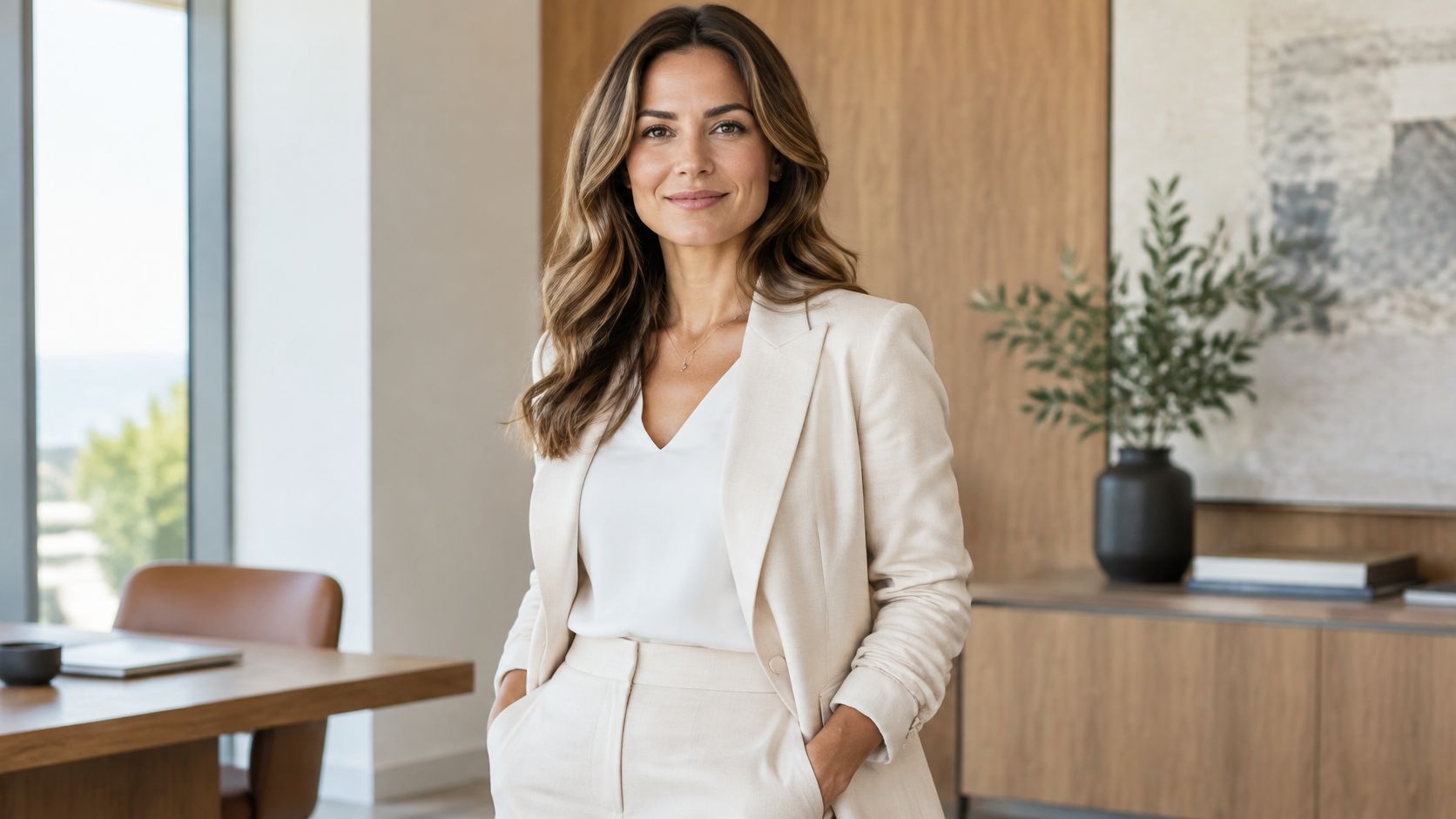
Scout for clean lines, useful daylight, and a background that relates to the subject's responsibilities. Use a wide-to-normal lens with enough camera distance to keep the face natural. Keep the camera level, and position the subject away from frame edges where perspective can stretch her appearance.
Compose the Room Around the Person
A hypothetical interior design principal might stand beside a material transition or within a carefully framed doorway. Keep vertical lines from intersecting her head, and place her face in a well-lit area rather than accepting whichever spot produces the strongest architectural symmetry.
The face still needs priority. If the room is beautifully exposed but the eyes are dark, add soft fill or change the position. Architecture should support the portrait, not reduce the subject to a scale reference.
Choose wardrobe that relates to the interior without disappearing into it. A textured dark jacket may work against pale plaster; a restrained color can distinguish the subject from timber and stone. Avoid choosing clothes solely to match upholstery.
In editing, correct perspective carefully and inspect the person after architectural adjustments. Heavy stretching can alter body proportions even when the walls look straighter.
The trade-off is portability: a contextual image can be excellent in a feature spread but weak as a tiny avatar. Replicable takeaway: Capture the environmental composition and a closer portrait while the lighting and wardrobe remain coherent.
8 Corporate Headshot Styles at a Glance
Scan the trade-offs first: light control, context, crop, and the message each treatment sends.
| Style | Best For | Lighting Setup | Framing | Brand Impression |
|---|---|---|---|---|
| Classic Three-Quarter Studio Headshot | Corporate directories, executive profiles, and professional identity | Soft side key with fill or reflector; neutral backdrop | Mid-chest or shoulders up, angled pose | Confident, approachable, polished |
| Environmental Office Headshot | Leaders and professionals whose work benefits from workplace context | Ambient daylight with subtle flash | Wider frame showing softly focused workspace | Authentic, contextual, connected to place |
| Soft Window-Light Natural Headshot | Education, healthcare, hospitality, and budget-conscious teams | Large diffused window light, optionally lifted with a reflector | Relaxed headshot with soft facial shadows | Warm, natural, approachable |
| Executive Low-Key Editorial Portrait | Senior leaders, founders, spokespeople, and media materials | Single directional key light against a dark background | Tight to medium framing focused on expression | Dramatic, authoritative, memorable |
| Consistent Team Headshot Set | Company websites, proposals, annual reports, and directories | Consistent light direction and quality, adjusted per subject | Standardized framing with consistent eye height | Cohesive, organized, professional |
| Seated Boardroom Lifestyle Portrait | Leadership profiles, annual reports, and company storytelling | Natural light with soft frontal fill | Medium-wide frame including the subject and meeting space | Collaborative, engaged, day-to-day leadership |
| Tight Crop Digital Profile Headshot | Social avatars, conference badges, and digital directories | Simple, even lighting with minimal shadows | Tight head-and-shoulders crop | Clear, recognizable, trustworthy |
| Design-Forward Interior Context Leadership Portrait | Design, construction, real estate, and hospitality leaders | Controlled light that complements the interior | Subject composed within architectural lines and materials | Distinctive, design-conscious, aligned with expertise |
When a row fits, build the session around that lighting logic first, then refine pose, lens distance, and wardrobe to serve the same brand signal.
Choose the Style, Then Craft the Image
Start with the viewer's context, not the photographer's favorite treatment. Someone scanning a directory needs recognition. An editor preparing a leadership feature needs expression, narrative space, and a composition that can survive a page layout. A proposal reader may need both an identifiable face and a credible connection to the work.
Match the style to the brand's behavior. A precise, technically focused organization might choose controlled studio portraits or restrained interior context. A people-centered institution might prefer soft window light. A leadership campaign can use low-key editorial images without imposing that dramatic treatment on every employee directory portrait.
Set Standards That Protect Identity
Approve a common approach to background, crop, color, and retouching before production begins. Define what should be removed, such as temporary blemishes, lint, and distracting reflections, and what should remain, including skin texture, recognizable age, disability, and cultural identity. Consistency should mean equal care, not identical faces.
Wardrobe belongs in that discussion, but it shouldn't become a restrictive costume brief. Bring options that reflect the role and fit comfortably in the intended pose. If preparation feels difficult, find effortless work outfit combinations, then test the strongest options against the actual background and lighting.
- For directories and avatars: Prioritize readable eyes, a clean silhouette, and adaptable crops.
- For press and speaking materials: Allow expression, negative space, and a stronger editorial point of view.
- For proposals and leadership stories: Include relevant context when it helps explain expertise.
- For team libraries: Preserve consistent production quality while accommodating individual needs.
Great portraits are crafted rather than caught. That philosophy guides our Atlanta-based practice, with an editorial background that informs composition, light placement, and attention to narrative detail. Authentic expression and flattering lighting work together; neither requires erasing the person's character.
Choose the intended use before choosing the final frame. Review portraits in their destination layouts, involve the subject in selecting an expression that feels credible, and retain enough framing flexibility for future applications. The strongest result is not just a pretty portrait. It is an accurate, purposeful image that belongs to the person and the organization she represents.
Jimmy Clemmons Photographer offers professional portraits built around authentic expression, flattering lighting, and professional editing, alongside architectural and corporate brand imagery. Bring your intended placements, brand references, and team requirements to Jimmy Clemmons Photographer to discuss a portrait approach that connects your people to your organization's identity.