
You've got a listing ready to go live, or a building ready to lease, and two photography quotes land in your inbox. One looks reasonable. The other is three times higher, and neither explains its math in a way you can compare. One counts images, one counts square feet, and one leaves out aerial work, retouching, or the right to reuse the photos next year.
That's the usual problem with real estate photography pricing. The headline number tells you almost nothing until you split it into the shoot itself, add-ons, usage rights, and compliance. Once you price by scope instead of square footage alone, the gap between quotes usually makes sense, and the missing line items become obvious before you sign.
Typical Real Estate Photography Rates at a Glance
A standard listing quote may cover only edited stills, while another includes extra services. Published guidance puts typical residential photography at $150–$300 for an average home and 20–30 images in the United States (2025 pricing guidance). A separate residential pricing overview gives a typical range of $150–$500 per shoot, with larger or luxury properties costing $800 or more per project.
The range reflects scope as well as property type. A basic package typically covers interior and exterior stills with editing. A longer shot list or more involved property can raise the fee. Video and virtual tours can push premium packages into a higher range.
Residential Photography Rates by Service Type
| Service | Typical Range | What It Usually Includes |
|---|---|---|
| Standard residential listing, single home | $150–$300 | 20–30 edited still images |
| Typical residential shoot per project | $150–$500 | Interior and exterior stills, basic editing |
| Larger or luxury property | $800 or more | Expanded shot list and longer shoot time |
| Premium package with video or virtual tour | $500–$2,000 | Stills plus video or virtual tour |
| Aerial drone add-on | Separate add-on fee | Exterior and neighborhood context |
Video and virtual-tour packages often fall in the $500–$2,000 range. Those deliverables require additional production and editing, so compare them separately from the still-photo fee. Aerial work should also appear as its own line item.
Four Ways Providers Quote the Same Job
- Flat per-shoot fee: Suits a standard listing with a predictable room count and one visit.
- Size-based rate: Uses a published band or per-square-foot formula to tie the fee to a measurable input.
- Per-image charge: Can suit a small listing with a defined image count. Confirm the cap before booking.
- Hourly or day rate: Fits a large estate or multi-building project when shoot length is difficult to predict.
Compare the image count, editing, turnaround time, and number of included visits. A quote that leaves these terms unstated is incomplete, even if its headline price looks clear.
How Property Size Shapes the Price
Size-based pricing is popular because it's auditable. You can measure a home, find its band, and check the quote in seconds. But size is a proxy for time and image count, not a perfect measure of difficulty, which is why published schedules combine bands with a minimum charge.
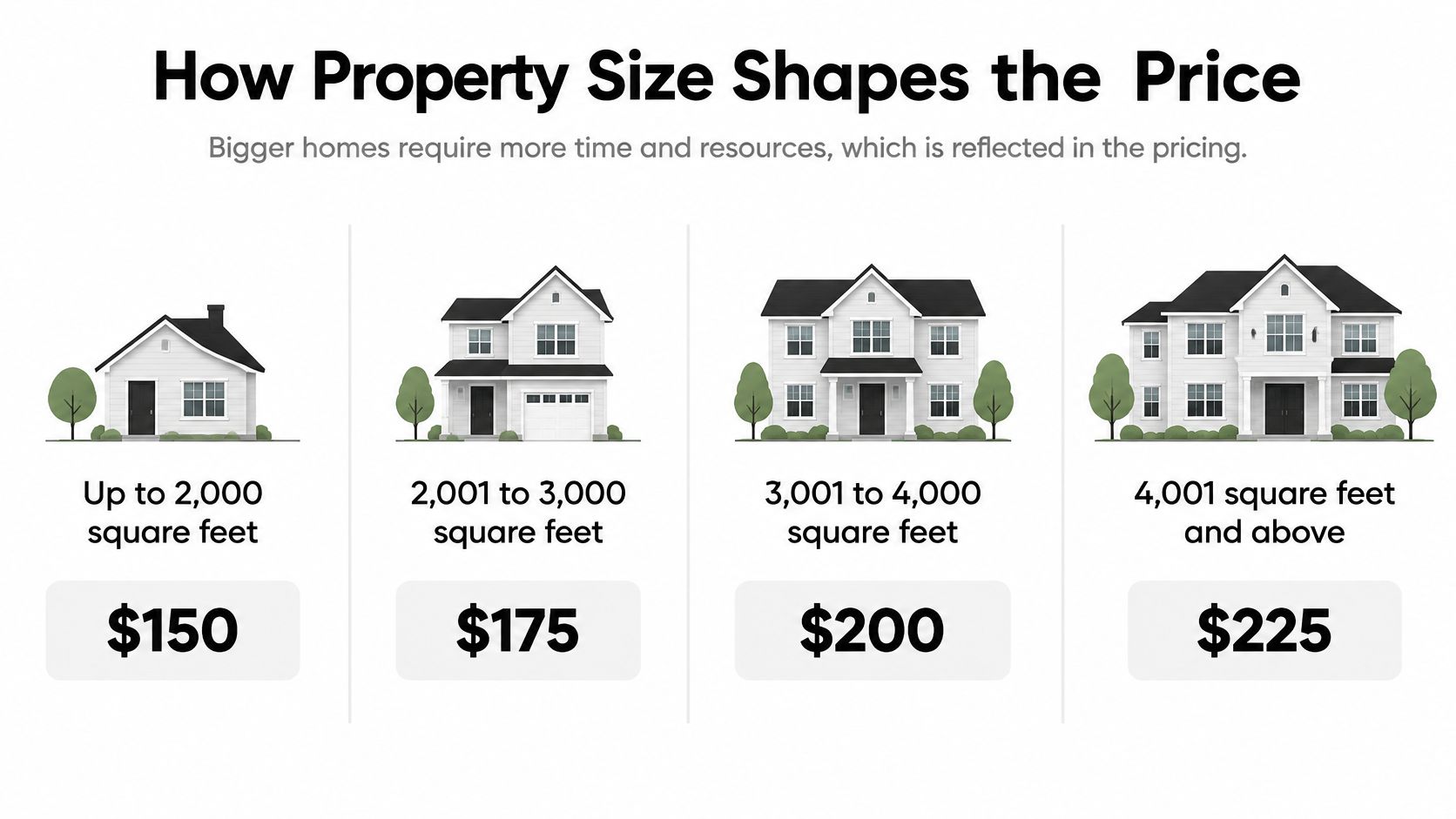
A published rate schedule sets photography prices at $150 for homes up to 2,000 square feet, $175 for 2,001–3,000 square feet, $200 for 3,001–4,000 square feet, and $225 for 4,001–5,000 square feet. The same schedule gives a square-foot formula of $0.11 per square foot up to 3,000 square feet, with a $150 minimum, and $0.10 per square foot above 3,000 square feet.
Photography Prices by Property Size Band
| Size Band | Price | Notes |
|---|---|---|
| Up to 2,000 sq ft | $150 | Entry band and minimum booking charge |
| 2,001–3,000 sq ft | $175 | Flat rate for mid-size homes |
| 3,001–4,000 sq ft | $200 | Flat rate for larger homes |
| 4,001–5,000 sq ft | $225 | Flat rate for large homes |
| Per-square-foot basis, up to 3,000 sq ft | $0.11 per sq ft | $150 minimum applies |
| Per-square-foot basis, above 3,000 sq ft | $0.10 per sq ft | Used for very large properties |
Choosing Between a Band and a Formula
A flat band suits a typical home because the price doesn't move if your measurement is slightly off, and both sides know the total before anyone travels. A per-square-foot quote fits better when the footprint is unusual, the property runs well past the top band, or you're comparing several properties of different sizes under one agreement.
The minimum booking charge deserves attention if you're photographing a small condo or a single exterior. Travel, setup, and editing don't shrink with the floor plan, so a provider sets a floor that keeps the visit viable. A low per-square-foot figure that ignores the minimum will always look better than it bills.
Practical rule: If the size band on the quote doesn't match the home, every add-on built on top of it is suspect too.
To get quotes you can compare, supply three inputs every time: exact square footage, number of rooms and levels, and the property address so travel can be estimated. Then run a simple test on each quote. Does its size band match the home, and does it state the minimum charge clearly? Two quotes built on different bands aren't competing quotes, they're quotes for different jobs.
Add-Ons and Hidden Costs That Change the Quote
Aerial imagery is the clearest example of a cost that looks optional on a rate card but carries real overhead behind it. Ground-level stills need a photographer and an editor. Aerial work needs a credentialed pilot, a registered aircraft, and flight planning, so it's priced as its own line.
In aerial listing guidance, listing promotion using a drone is treated as a commercial operation under FAA Part 107, the person piloting the drone must hold an FAA Remote Pilot Certificate, and the aircraft must be registered for commercial operation. The same guidance lists the knowledge test at approximately $175, a basic drone at $300–$1,000, and aircraft registration at $5 for three years.
Add-On and Compliance Costs for Listing Photography
| Cost Item | Typical Cost | Why It Applies |
|---|---|---|
| FAA Remote Pilot knowledge test | about $175 | Required to fly a drone for commercial listing work |
| Basic drone | $300–$1,000 | Equipment for aerial capture, usually priced as an add-on |
| Aircraft registration | $5 for three years | Required for commercial operation under FAA Part 107 |
| Twilight shoot, floor plan, virtual tour, retouching | Quoted per item as its own line | Each adds capture or post-production time outside the base shoot |
That compliance overhead, on top of capture and editing, is exactly why aerial imagery is usually priced as an add-on or separate service rather than folded into a basic still-photography fee. When a quote bundles drone work into a suspiciously low base price, ask who holds the certificate and whose name is on the registration. If nobody can answer, the cheap line may not be a legal one.
The Rest of the Usual List
- Twilight shoots: Evening exteriors need a second lighting window and often extra setup time, so they rarely fit inside a daytime visit.
- Floor plans: Measuring and drafting are a separate deliverable with their own production step, not a byproduct of stills.
- Virtual tours: Capture is only half the work, since stitching, hosting, and navigation add time after the visit.
- Virtual staging: Furniture and styling are built per room in post-production, priced by the space rather than the shoot.
- Retouching: Sky replacement, clutter removal, and similar fixes are per-image labor that grows with every frame you request.
Travel and parking belong on the quote as a per-visit line too. Distance raises it, and a multi-property route raises it again because each stop adds drive time, setup, and teardown. Occupied or access-controlled properties can add scheduling friction that shows up as a return visit if it isn't planned for.
If a provider quotes a low base price and leaves out drone, travel, or retouching, don't negotiate the total yet. Ask for each item as a separate line first, so you're comparing complete quotes instead of rewarding the one with the most omissions.
Commercial and Architectural Projects Cost More
A residential rate card can break down on a commercial lobby shoot: access windows, lighting needs and stakeholder approvals all affect the production plan.
Commercial and architectural assignments are priced by scope, not square footage alone. Planning, specialized lighting, post-production, access coordination and image usage can all change the quote. A leasing team, design team and property manager may each need to approve access or final selections, adding coordination time. The commercial real estate photography pricing guide outlines the factors that shape these projects.
Commercial and Architectural Project Price Ranges
| Project Type | Typical Range | Main Cost Driver |
|---|---|---|
| Small exterior-only commercial shoot | $1,000–$2,500 | Travel and access coordination |
| Mid-rise office project | $2,000–$5,000 | Specialized lighting and planning |
| Large or complex mixed-use development | $3,500–$15,000 or more | Extensive post-production and usage rights |
These are production estimates: an exterior-only assignment sits at the lower end, while a complex development can require more planning, editing and image licensing. Compare quotes by separating the shoot, add-ons, usage rights and compliance requirements. A single hourly rate can hide differences in deliverables and permitted use, such as brochures, paid advertising or investor materials.
Location also affects rates. One real estate photography pricing analysis reports that major metropolitan areas may cost 40–60% more than smaller markets, comparing a $200 standard package in a smaller market with a $350–$450 equivalent in a large metro. That comparison concerns standard packages, not commercial project pricing.
The video below shows the coverage and pacing involved in photographing a commercial space for screen.
Jimmy Clemmons Photographer focuses on Architectural Photography and Corporate Brand Content. Architectural photography offers sweeping exteriors and refined interiors that highlight form, light and detail; commercial photography covers products, people and spaces for brands. People photography centers on authentic expression and flattering lighting, and professional editing is a listed specialty.
Before signing, check whether the quote states the number of final images and the usage period. Without both, an hourly rate alone does not show the project's full cost or the rights included.
How to Build a Photography Budget Step by Step
A quote can look affordable until a twilight visit, retouching, or broader image use appears as an extra. Build the budget from the shot list, then price each part of the scope so competing quotes cover the same work.
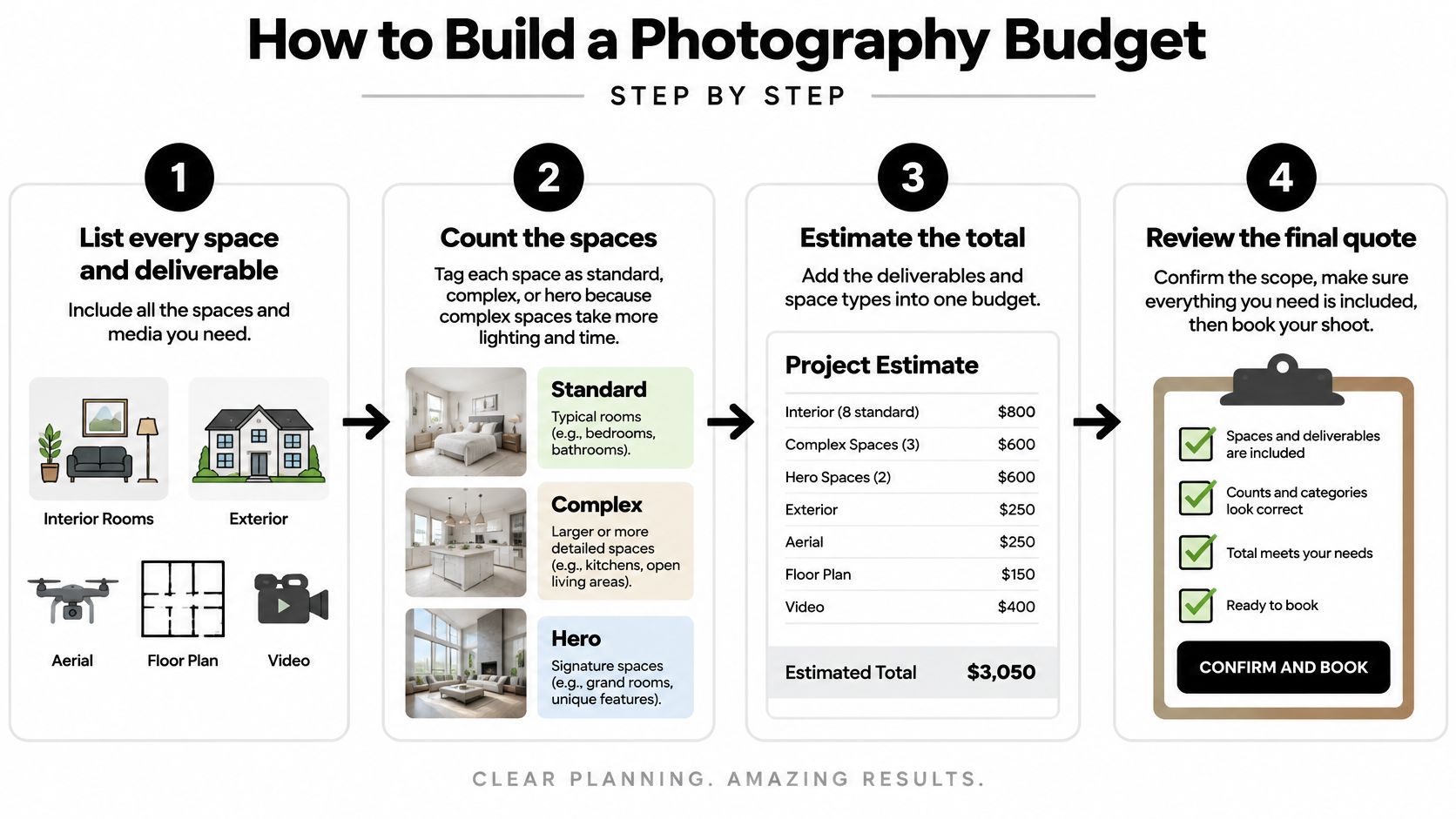
- List every space and deliverable: Give interiors, exteriors, aerials, floor plans, and video separate lines. Include the condition of key surfaces: worn flooring will show in the images, and a guide to hardwood versus LVP and tile can help sellers decide what to refinish, cover, or leave as is.
- Tag each space by difficulty: Mark rooms as standard, complex, or hero. A glass-walled lobby may need more lighting time and takes than a small bedroom, so pricing both alike can understate the work.
- Estimate shooting time: Allow for the property visit, then account for lighting setups, twilight coverage, or staged rooms. A twilight exterior may require a separate visit, so confirm whether that time is included.
- Add travel and access: List travel between properties, paid parking, and scheduling constraints. If access depends on a tenant, manager, or security desk, include the extra coordination in the scope.
- Price editing and retouching per image: Basic correction covers exposure, color, and straightening; major alterations change image content and may have disclosure implications. Professional editing is a listed specialty of Jimmy Clemmons Photographer, so specify the editing level rather than assuming it is included.
- Set usage rights and the period: Price image use according to where and how long the photos will appear. Listing-only use differs from use in brochures, ads, or future leasing campaigns.
- Add a contingency of about 10 to 15 percent: Reserve this amount for possible revisions, weather delays, or a reshoot. Keep it as a separate budget line so the planned shoot cost remains clear.
- Compare against the tiers: Check the total against typical rate tables, then compare a second quote built on the same shot list, editing level, usage, and access requirements. A lower total on a narrower scope is not a like-for-like price.
A useful budget separates the shoot, add-ons, usage rights, and compliance requirements. That makes it easier to see whether a quote covers the complete job or leaves important costs open.
A budget that omits retouching or usage rights can look inexpensive until the invoice arrives.
The finished budget should show one total, named line items, and clear exclusions. With those details visible, you can address scope changes before they affect the shoot.
Contract Terms and Negotiation Moves That Protect Both Sides
The lowest rate isn't the best deal if it buys you images you can't legally reuse, a gallery with no revision path, or a delivery date nobody committed to. Price matters, but the clauses around the price decide whether a cheap shoot stays cheap. I'd rather see a client pay a fair rate with tight terms than a bargain rate with none.
Four Clauses to Insist On
- Written scope: Image count, shot list, and editing level spelled out, so both sides can point to the same definition of done.
- Revision policy: A fixed number of rounds included, with the cost of extra rounds stated before anyone needs one.
- Turnaround date: A real date plus what happens if it slips, because a listing launch can't absorb a vague promise.
- Usage clause: The media, the territory, and the term named explicitly, which is covered in our guide to commercial photography contract terms.
The provider side of the agreement protects you too. Original files should be retained and available, and heavily altered images should be labeled as altered. That way you have no compliance surprises when a listing is reviewed or a brochure is reprinted months later with the same imagery.
Moves That Actually Lower the Total
Trade a lower per-image price for a longer usage term only if you will use that term, since unused rights are wasted money in the other direction. Bundle aerial and still work into one visit to avoid paying travel and setup twice. On a multi-property booking, ask for a day-rate discount, because routing several nearby properties into one day lowers the provider's cost per stop.
Don't cut editing to lower the price. It's the most common trap in real estate photography pricing, and it shows immediately in crooked verticals, mixed color, and windows that blow out to white. If the budget is tight, cut the shot list instead and keep the finishing standard on fewer images.
Before signing, ask any provider four questions: what's included, who owns the files, how many revisions are allowed, and what does a reshoot cost? A provider who answers all four in writing is pricing the same job you're buying. A provider who won't is asking you to fund the difference later.
Confirm the Scope Before You Sign
A quote can look cheaper because it leaves out a required image, service, or usage right. Compare every estimate against the same shot list and property details before weighing the totals.
- Match the size band: Confirm the quote uses the same property-size band as the rate table and names any minimum charge.
- List applicable add-ons: Specify whether aerials, travel, twilight photography, a floor plan, and retouching are included or priced separately.
- Check the full budget: Compare the estimate with your budget, including the contingency and usage rights you have allowed for.
- Read the relevant clauses: Check the usage terms for media, territory, and duration, plus the revision clause for the number of included rounds.
- Compare matching scopes: If one quote is much lower, ask which service, deliverable, or right is excluded before comparing totals.
Keep the signed estimate with the shot list so the agreed scope is clear when the property is photographed and the images are delivered. Jimmy Clemmons has shot editorial content for publications including Condé Nast and Atlanta Magazine. For real estate photography in Atlanta, share your shot list and property details with Jimmy Clemmons Photographer to talk through the scope.