
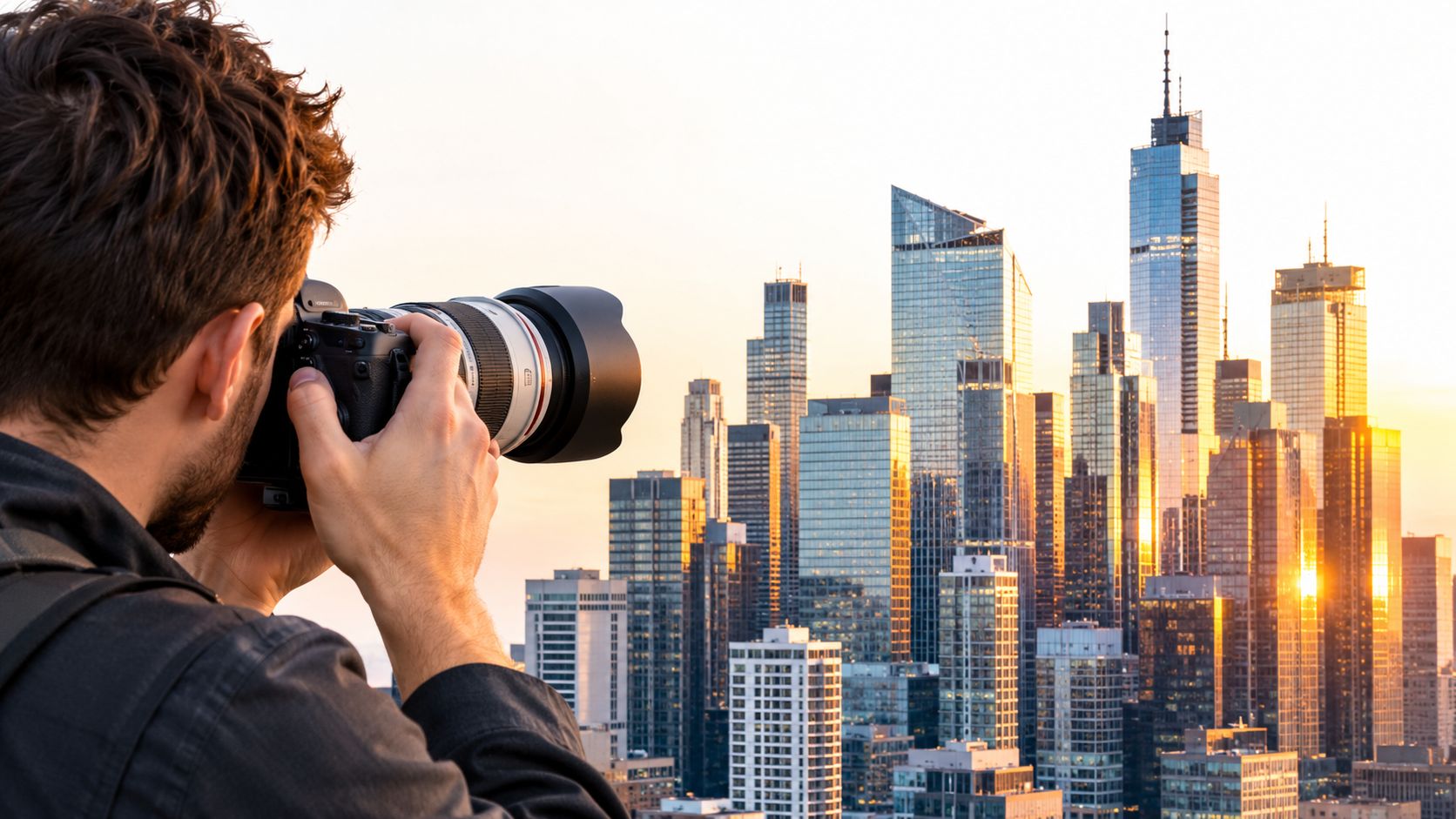
You're standing across a busy Atlanta street from a finished building, waiting for a clean frame. The wide lens shows everything: traffic signs, parked cars, neighboring facades, overhead wires, and a generous slice of pavement. Moving closer only makes the building's edges feel more exaggerated. Then you step back, mount a telephoto lens, and isolate the entrance canopy against a layered city background. The image stops documenting the whole block and starts making a precise editorial point.
That's where telephoto lens uses become valuable in architecture. A long lens isn't merely a way to reach a distant subject. It's a tool for removing clutter, controlling the edges of the frame, organizing layers, and deciding how much of a building's context the viewer needs. The same approach helps with real estate details, corporate portraits, hospitality interiors, construction documentation, and brand campaigns.
The choice requires judgment. A compressed facade can feel monumental and refined, but it can also hide scale and connection to the surrounding site. A tight interior detail may communicate material quality, while a wider view may be more honest about circulation and spatial relationships.
The practical question isn't just, “How far can this lens reach?” It's, “What part of the design should the viewer notice, and what should stay out of the story?”
Introduction Why Telephoto Lenses Change How You See Buildings
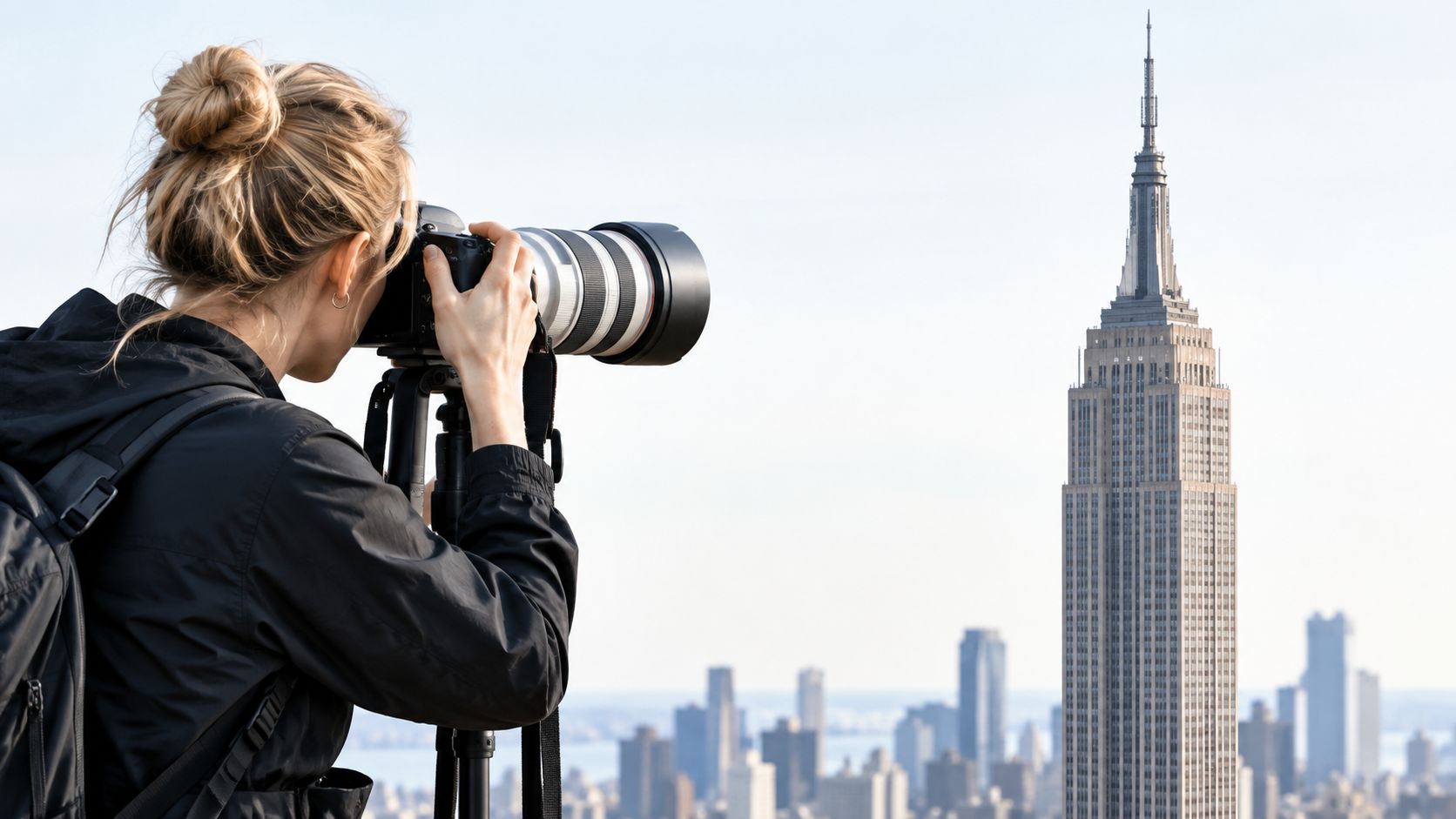
On a commercial architecture shoot, the first frame often reveals the problem before it reveals the building. A wide lens can include the full facade, but it may also pull unwanted street furniture into the composition and make nearby lines feel aggressive. The photographer then has two choices: accept a noisy image or change position and perspective.
A telephoto lens offers a different solution. Instead of trying to fit more into the frame, you can include less with greater intention. A row of windows becomes a rhythm. A material transition becomes the subject. A canopy, stair, balcony, or sign can stand apart from the surrounding visual noise.
The category has a long technical history. The reflecting telephoto concept was first described by Johannes Kepler in 1611, later reinvented by Peter Barlow in 1834, and the photographic telephoto lens is commonly credited to Thomas Rudolphus Dallmeyer in 1891. In 1905, the Busch Bis-Telar became the first optically corrected telephoto system fixed as a complete lens design, marking the movement from optical theory toward a practical photographic tool. These milestones are documented in the history of the telephoto lens.
Practical rule: Use a telephoto when the image needs selective emphasis, not simply more magnification.
Architecture rewards that discipline because buildings contain competing visual messages. A wide exterior can establish site, scale, and context. A telephoto frame can explain the detail that gives the project its identity. Neither view is automatically more truthful. Each answers a different communication need.
The most effective photographers move between those viewpoints deliberately. They scout the scene, identify the design feature that carries the story, and then choose the lens that gives that feature enough visual authority without misrepresenting the property. That process starts with understanding how focal length, distance, and framing work together.
How Telephoto Lenses Work and Why Distance Matters
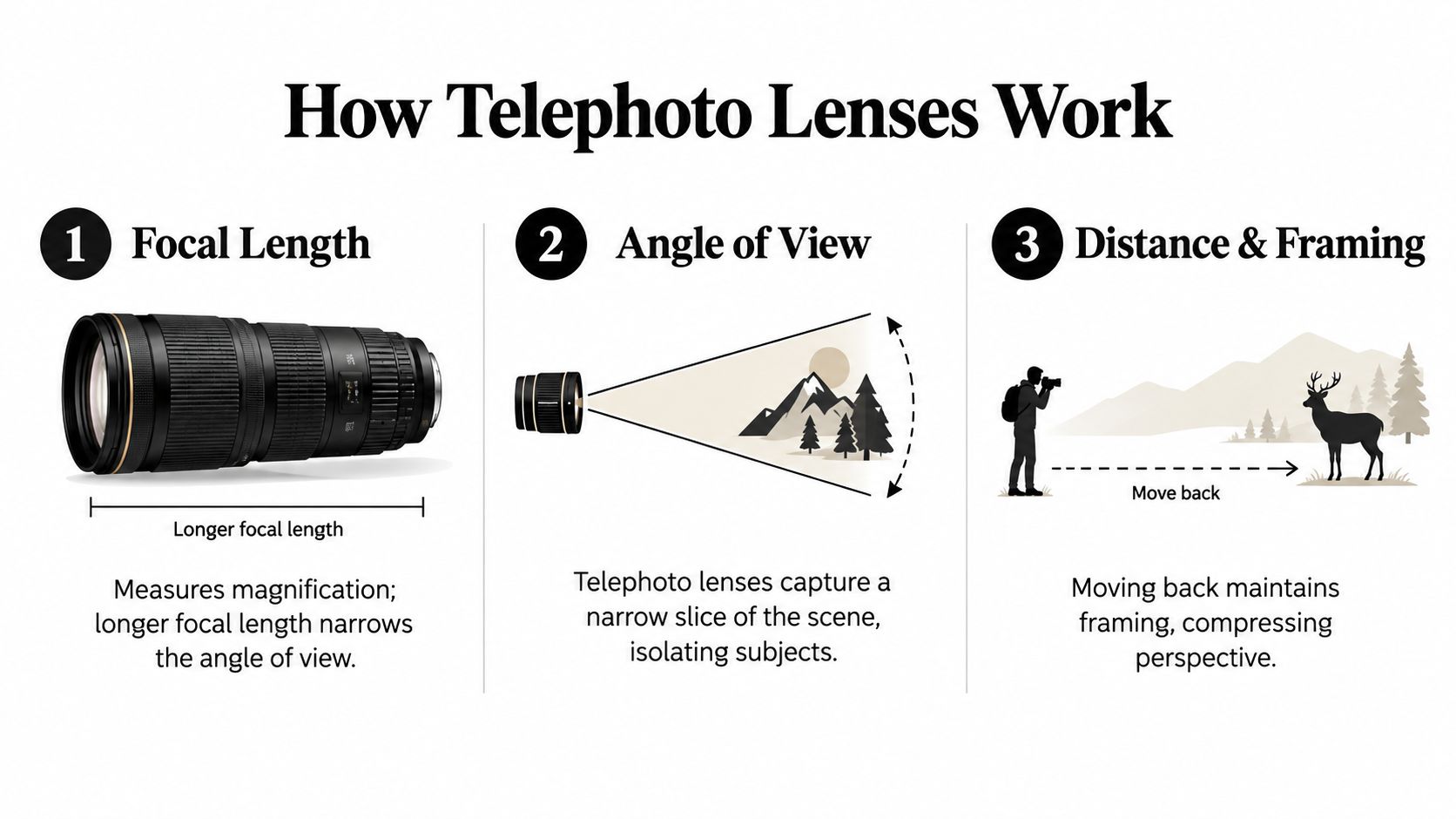
A telephoto lens narrows the slice of the scene captured by the camera. Industry guidance commonly places the beginning of telephoto territory around 60mm or 70mm on a full-frame camera, while many photographers regard lenses above roughly 135mm as full telephoto, as explained in this telephoto lens overview. Other technical references commonly describe telephotos as starting around 80mm or longer, so think of the term as a useful range rather than a single hard boundary.
The simplest analogy is a paper tube. Looking through the open window, you see a broad portion of the street. Looking through the tube, you see a smaller portion, but that portion appears larger and easier to isolate. A longer focal length behaves in a similar way. It magnifies distant subjects while reducing the amount of surrounding scene that reaches the frame.
Focal length controls the slice
Focal length is measured in millimeters. As the focal length increases, the angle of view becomes narrower. A wider lens can show a building and its site, while a telephoto may show only a bay of windows or a distant rooftop against another structure.
That narrowing is useful on location because the frame becomes easier to police. You can position the edges around a facade detail instead of allowing unrelated objects to enter from every side. The technical explanation of telephoto lenses also connects longer focal lengths with changes in scene geometry and with the photographer's need to stand farther away for comparable framing.
The distance matters because framing depends on both focal length and camera position. If you switch from a shorter lens to a longer one and want the subject to occupy the same part of the frame, you'll usually move backward. That change in position alters the relationship between the subject, foreground, and background.
Compression comes from viewpoint
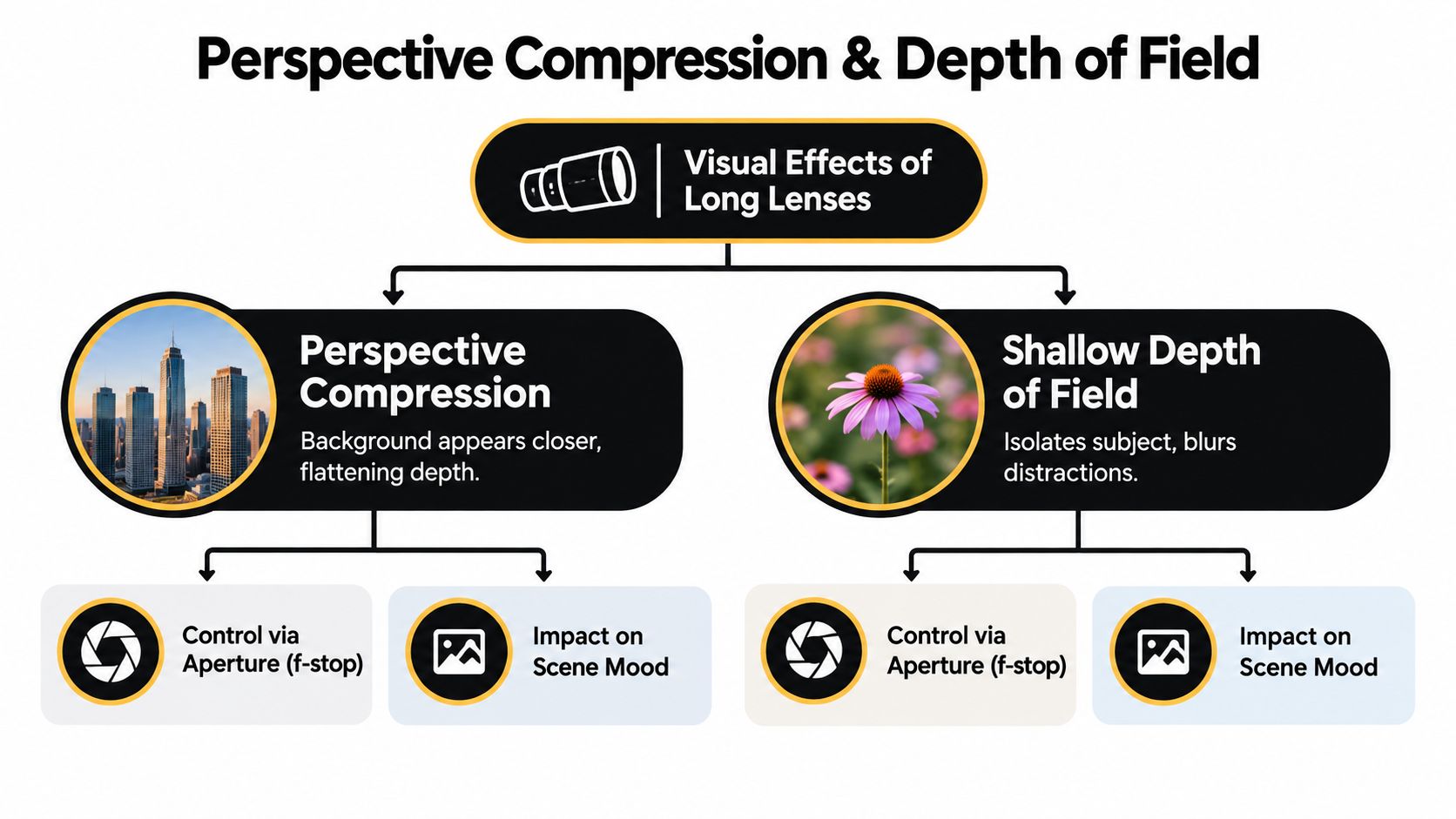
Perspective compression is often described as a telephoto effect, but the lens itself doesn't independently squeeze the scene. The critical cause is the increased camera-to-subject distance. As explained in this telephoto compression guide, a 200mm lens can make the background appear larger and closer than a 50mm lens when both produce the same subject size, because the photographer has changed position.
For a facade, that can stack several building layers into a dense graphic arrangement. It can also reduce foreground clutter because the narrow angle of view excludes much of the street. But if the composition needs to show a plaza, entry sequence, or relationship to neighboring structures, that same selectivity can remove essential information.
Telephoto Versus Wide and Standard Lenses for Architecture
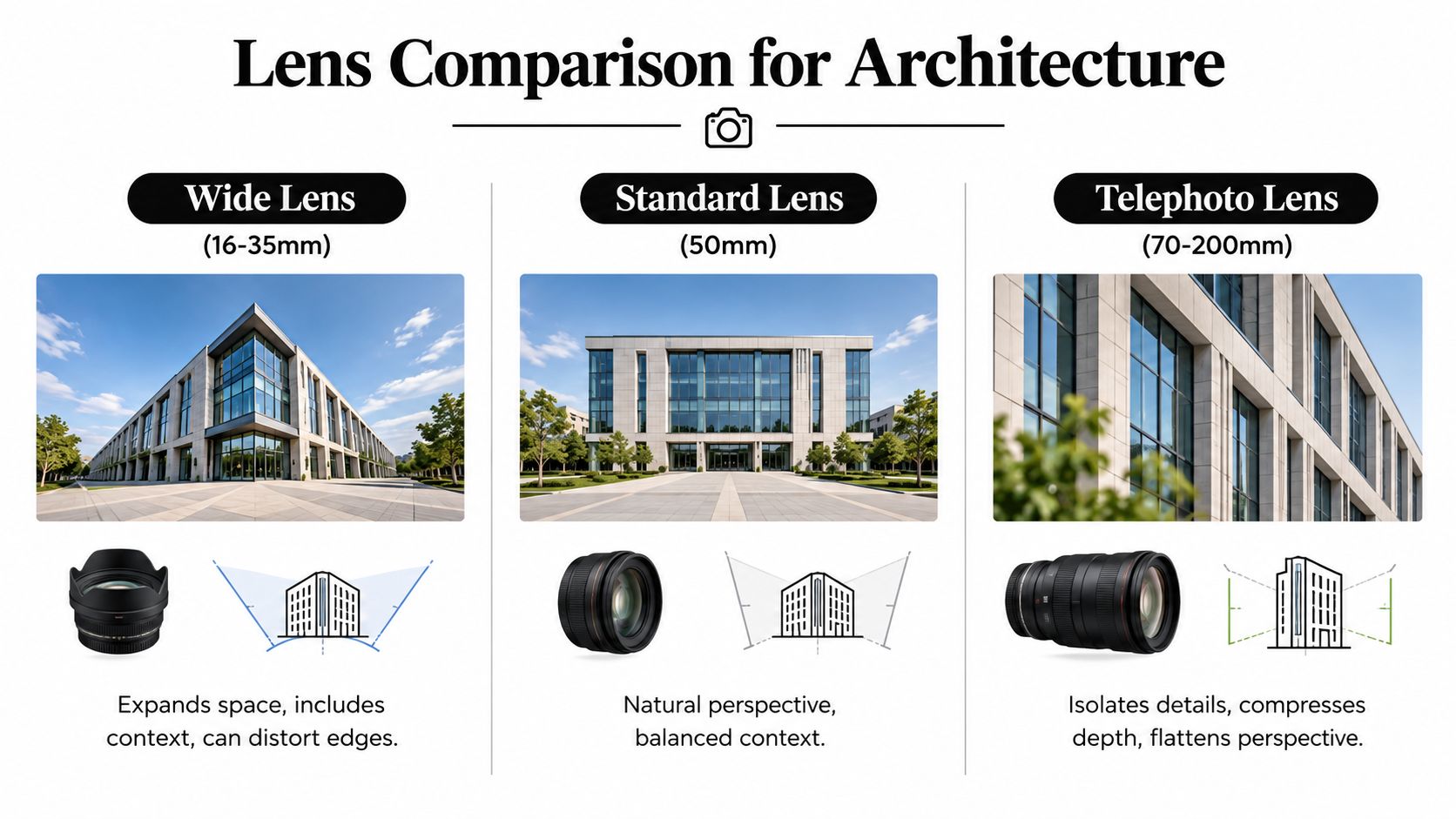
Lens choice should follow the message of the photograph. A wide lens answers, “How does this building occupy its place?” A standard lens asks, “How does this scene appear from a familiar viewpoint?” A telephoto asks, “Which detail or relationship deserves the viewer's attention?”
| Lens approach | Primary strength | Architectural risk |
|---|---|---|
| Wide lens | Shows space, site, and surrounding context | Can exaggerate edges and include distractions |
| Standard lens | Offers a balanced, familiar view | May lack the reach needed for distant details |
| Telephoto lens | Isolates details and layers distant forms | Can flatten context and hide scale cues |
A wide lens is usually the strongest choice for a constrained interior, a complete exterior elevation, or a site photograph where access and context matter. It can make a room feel more expansive, but careless camera height and tilt can make walls and furniture feel unstable. For a deeper discussion of how wide lenses affect buildings, see this guide to wide-angle lenses and building proportions.
A standard lens often provides a calm middle ground. It can show enough environment to establish a subject without the pronounced expansion associated with very wide perspectives. For a lobby detail, workplace portrait, or carefully framed courtyard, that moderate view may preserve context without letting the background dominate.
Telephoto lenses excel when the building is across a street, beyond a courtyard, or surrounded by visual interference. They can isolate a facade module, tighten a composition around a material junction, or align multiple structures into a deliberate pattern. The tradeoff is narrative. A developer may need a hero detail for a campaign, but a design audience may also need to understand how the entrance connects to the public realm.
Architectural correction is a separate concern from focal length. A telephoto can reduce the need to point the camera sharply upward from a close position, but it doesn't replace careful camera placement or a lens designed for perspective control. For a useful comparison of architectural lens decisions, consult Pinnacle Property Media's lens advice.
A short visual demonstration can help make these differences intuitive:
Perspective Compression and Depth of Field in Practice
On a Midtown Atlanta tower, a telephoto lens can turn a repeating balcony grid into the main subject. From across the street, the balconies stack into a clean graphic pattern, and distant buildings appear to sit closer behind the tower. The same framing may leave out the street-level entrance, sidewalk, and connection to the public realm. The result is a strong detail study, not a complete account of how visitors reach the building.
A long lens changes the visual relationship between layers because the photographer moves farther away to maintain a similar framing. Foreground obstructions occupy less of the frame, while a background facade can appear aligned directly behind the feature being photographed. Use that arrangement deliberately. Compression is most useful when those layers tell a related story. It becomes less useful when the missing context carries the meaning.
Compression is a compositional decision
Look for background forms that support the subject. A historic structure behind a new facade can create a clear urban conversation when the buildings are brought together in the frame. If the background produces clutter, a lateral move or a different shooting distance may separate the forms more effectively.
Compression can also change the apparent spacing between buildings. A tight stack may suggest a denser site than pedestrians experience at ground level, hiding setbacks, open space, and scale. For a property presentation, that framing can make the building feel polished and imposing. For a project story, include enough surrounding information to show how the entrance and public realm work.
The strongest compressed frame includes the background for a reason.
Long focal lengths can also make the depth of field appear shallower, particularly with a wide aperture and careful control of subject-camera distance. A discussion of telephoto depth of field explains why longer focal lengths can strengthen background blur while making accurate focus more demanding.
Blur isolates, but focus becomes less forgiving
For a corporate portrait outside a building, a telephoto lens can keep the person prominent while softening windows, furniture, or street activity. For an architectural detail, it can separate a handrail, light fixture, or textured panel from an indistinct background.
The focus zone may be narrow. A small error can leave the intended feature soft while an adjacent edge appears sharp. Set a precise focus point, review the critical plane, and check whether the blur supports the assignment or merely conceals useful information.
A wider aperture increases separation. Stopping down provides more tolerance when the subject has depth, such as a projecting facade, layered railing, or group portrait. Focal length is only one part of the result. Distance, aperture, sensor format, and subject arrangement also shape the visible focus range.
For converging lines and edge behavior, this guide to lens distortion correction offers useful post-production context. Correction can refine the image, but it cannot restore context excluded by the original framing.
Architecture and Commercial Photography Examples That Benefit Most
Telephoto lens uses become clearer when the assignment has a specific communication problem. The lens is rarely chosen because a subject belongs to a category. It's chosen because the image needs a particular relationship between subject, background, and viewer.
Consider a facade detail across a busy street. A wide lens may force the photographer to include traffic signs and neighboring storefronts. A telephoto can isolate the stone joint, shading device, or entry hardware that communicates the project's material character. The building becomes a set of designed decisions rather than a single undifferentiated object.
Four useful assignment scenarios
Material storytelling: Photograph a metal screen, masonry transition, or carefully detailed threshold while suppressing unrelated street activity. The narrow field of view lets texture and craftsmanship carry the frame.
Urban layering: Align a primary facade with distant towers, balconies, or rooflines. Compression can create a dense editorial composition, but check whether the stacked forms still communicate their real relationship.
Corporate portraiture: Place a leadership team or individual against a softened workplace background. The setting remains recognizable without competing with expression, posture, or wardrobe.
Abstract structure: Extract repeating windows, shadows, columns, or balconies from a larger building. The result can support a campaign, magazine feature, or visual identity system that needs pattern rather than a literal property overview.
The decision changes when the client needs proof of spatial conditions. Construction documentation may require the relationship between new work and existing context. A hospitality brand may need to show how a terrace connects to a view. An interior designer may want both a detail of a custom fixture and a wider image that explains how the fixture shapes the room.
This is why a professional shot list often includes selective and contextual frames. The telephoto supplies emphasis. The wider view supplies orientation. The two images can work together without pretending to answer the same question.
Long lenses also have uses beyond conventional still photography. The optical telephoto market includes smartphone periscope cameras, surveillance, traffic monitoring, defense imaging, and professional photography. A 2026 market report identifies mobile devices as the largest application category at 38.0% share, with professional photography at roughly 32% of revenue and surveillance and security at about 18%, as reported in this optical telephoto lens market analysis. Those figures point to a broader shift toward selective visual capture, not a reason to abandon context on an architectural assignment.
For campaigns that combine still images with motion, cinematic commercial production offers helpful perspective on how visual decisions can support a consistent brand story across formats.
Practical Techniques for Sharp Stable Telephoto Images
Long-lens composition only works if the file is sharp where it matters. The narrow field of view magnifies camera movement, and the shallow focus zone leaves less room for imprecision. A repeatable setup prevents technical problems from overwhelming the visual idea.
Build the position before the exposure
Start by identifying the subject plane and the background relationship. Walk laterally before changing focal length. A small shift can separate a window edge from a neighboring tower or move a bright sign out of the frame without sacrificing the desired compression.
Then check minimum focusing distance. A long lens doesn't automatically function as a macro lens. Neutral guidance emphasizes that telephotos are primarily intended to enlarge distant subjects, while specialized examples may focus as close as around 3.0 feet or 0.9 meters, as described in this telephoto photography guide. Confirm the lens specification before approaching a detail, especially inside a compact lobby.
Stabilize the camera deliberately
A tripod remains valuable for architecture because it supports careful alignment, consistent framing, and precise review. Use it when the subject is static, the composition requires fine adjustment, or the shutter speed would otherwise make camera movement visible. A tripod guide for architectural photography can help you evaluate support choices in relation to the camera and lens.
Image stabilization can make handheld work practical when the system is well designed. One manufacturer example describes lens-only stabilization with an effect equivalent to a 5.0-stop increase in shutter speed, while the same lens focuses as close as 0.9m at the wide end and 0.88m at 200mm, according to its telephoto lens specifications. Treat that as a capability, not a guarantee. Subject movement, stance, shutter timing, and focal length still matter.
Focus and aperture with intent
Use single-point or similarly precise autofocus when a facade detail has a clear critical edge. For portraits, place focus on the person's eye and verify that the background softness supports the composition. If the subject extends toward or away from the camera, stop down enough to protect important depth.
For practical planning around visual consistency, architectural visualization tips can complement the photographic workflow. The central habit is simple: stabilize first, focus on the meaningful plane, and review at the detail level before leaving the position.
Choosing the Right Focal Length and Next Steps for Your Kit
Choose focal length by communication goal. If the assignment needs site context, circulation, and a clear relationship between building and surroundings, begin with a wider or standard lens. If it needs a facade detail, layered urban composition, or a portrait separated from a distracting workplace, test a telephoto.
Before the shoot, ask:
- What must the viewer understand? The whole property, a material decision, a brand detail, or a human experience?
- What can leave the frame? Traffic, signage, neighboring buildings, and visual clutter may weaken a selective story.
- What context must remain? Preserve scale cues, entry relationships, and site connections when the audience needs them.
- How will the lens change position? Scout from the actual camera location, not only from the subject. A tighter view can clean the frame, while a wider view may explain how the building belongs to its site.
- Can you test both versions? Make a contextual frame and a compressed frame when the brief allows it.
Use a telephoto when distance helps you edit. It can isolate a structural rhythm, remove competing signs, or place separated planes into a deliberate visual relationship. Compression supports the story when pattern and detail matter. It hides needed context when viewers must understand access, scale, or the building's connection to its surroundings. The telephoto focal lengths and depth of field reference can help clarify how focal length affects framing and background separation.
A telephoto lens becomes most useful when you stop treating it as a reach tool. Use it to organize depth and give a building's meaningful gesture room to speak.
For Atlanta architectural photography, Jimmy Clemmons Photographer brings precise lens selection, location scouting, lighting design, and editorial composition to built-environment and commercial brand assignments. Visit Jimmy Clemmons Photographer to discuss an image set that shows both detail and context.