

Sea spray hit the front element before the sun cleared the horizon, and the house almost disappeared behind the atmosphere that made the location worth photographing in the first place. That's the coastal assignment in one frame. The setting gives you mood, but it can also bury the architecture if you let it.
Beyond the Postcard Framing Architecture on the Coast
A lot of coastal photography stops at the obvious image. Big sky. Soft light. Water glowing in the distance. That works for wall art, but it often fails commercial architecture because the building becomes a prop inside a natural setting instead of the subject with a purpose.
That difference matters. Coastal counties hold 129 million people, almost 40% of the U.S. population, while covering less than 10% of the nation's land mass excluding Alaska. They also generate $10 trillion annually in goods and services, employ 54.6 million people, and pay $4 trillion in wages, which makes coastal development and the imagery around it economically significant for architects, developers, hospitality groups, and marketers, according to NOAA's coastal economics and demographics facts.
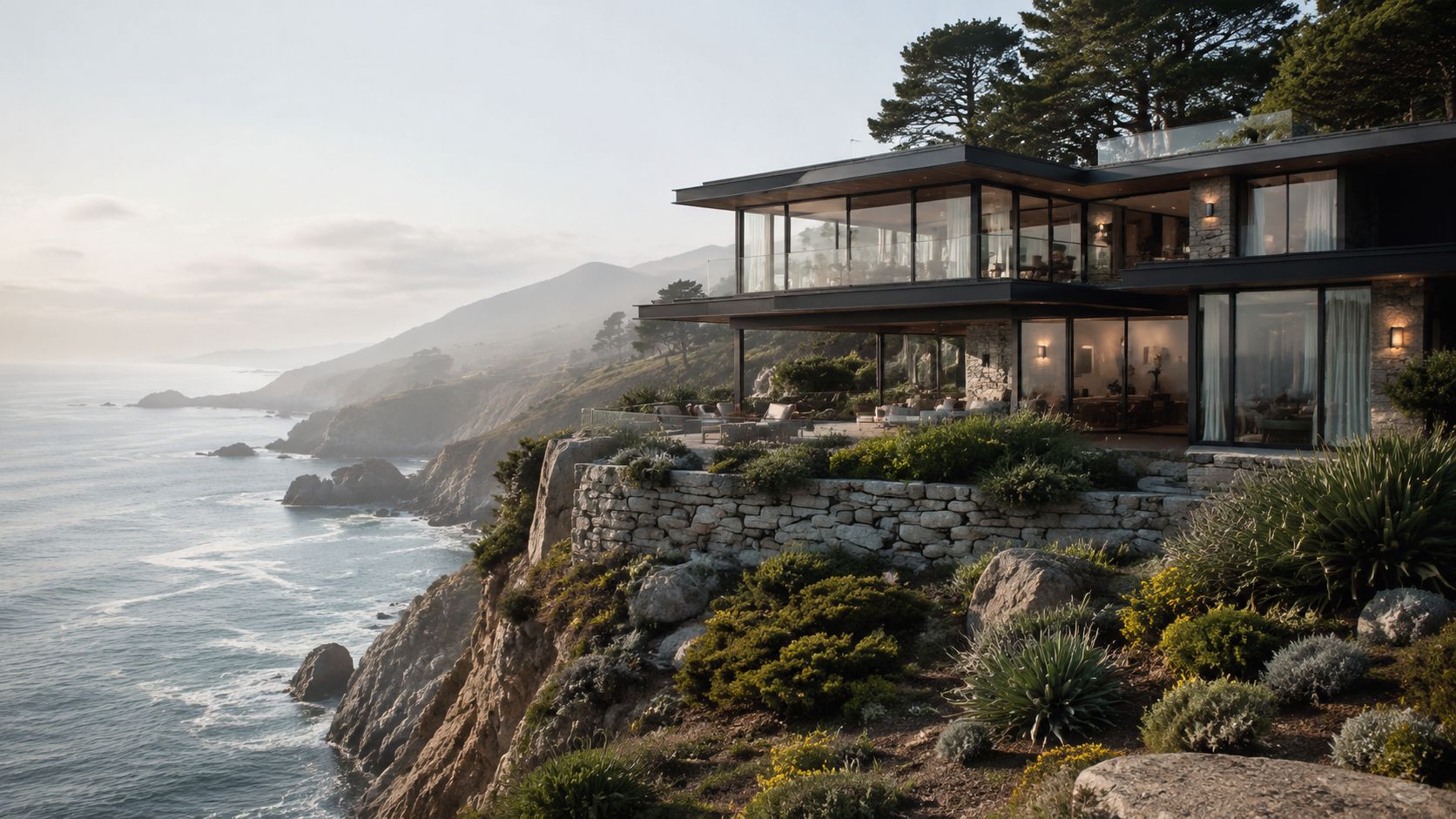
What the postcard approach gets wrong
On the coast of somewhere beautiful, the temptation is always the same. Let the scenery do the work. In practice, that usually produces pretty but disposable frames.
A hospitality client doesn't just need a dramatic ocean view. They need to show arrival, privacy, materials, circulation, outdoor program, and the way the structure belongs to the site. A residential developer needs more than a sunset silhouette. They need images that communicate value, restraint, and livability.
Analysis of coastal beauty photography points to the same gap many architectural photographers run into in the field: existing coastal imagery overwhelmingly leans on fine art clichés, while firms struggle to find work that balances natural beauty with precise compositional control and the narrative detail needed for client storytelling.
Practical rule: If the building could be replaced by any other building and the image still works, you probably made a landscape photograph, not an architectural one.
The real assignment
The job is to photograph a relationship. Wind against stone. Reflections in glass. A board-formed concrete wall holding its line against a shifting horizon. The strongest frames don't ask the coast to compete with the architecture. They make each one explain the other.
That's why coastal architectural work feels different from inland work. The environment is always active. Tide lines move. Clouds rebuild the contrast every few minutes. Salt haze lowers clarity. The horizon can either stabilize the composition or make every mistake more obvious.
For commercial clients, repeatability matters as much as beauty. They need a set, not a lucky frame. They need hero exteriors, contextual wides, detail images, amenities, twilight options, and often a sequence that can live across a website, brochure, pitch deck, editorial placement, and signage. Good coastal work isn't about chasing a single perfect moment. It's about building a visual narrative that still holds together when conditions shift.
The Pre-Shoot Blueprint for Coastal Success
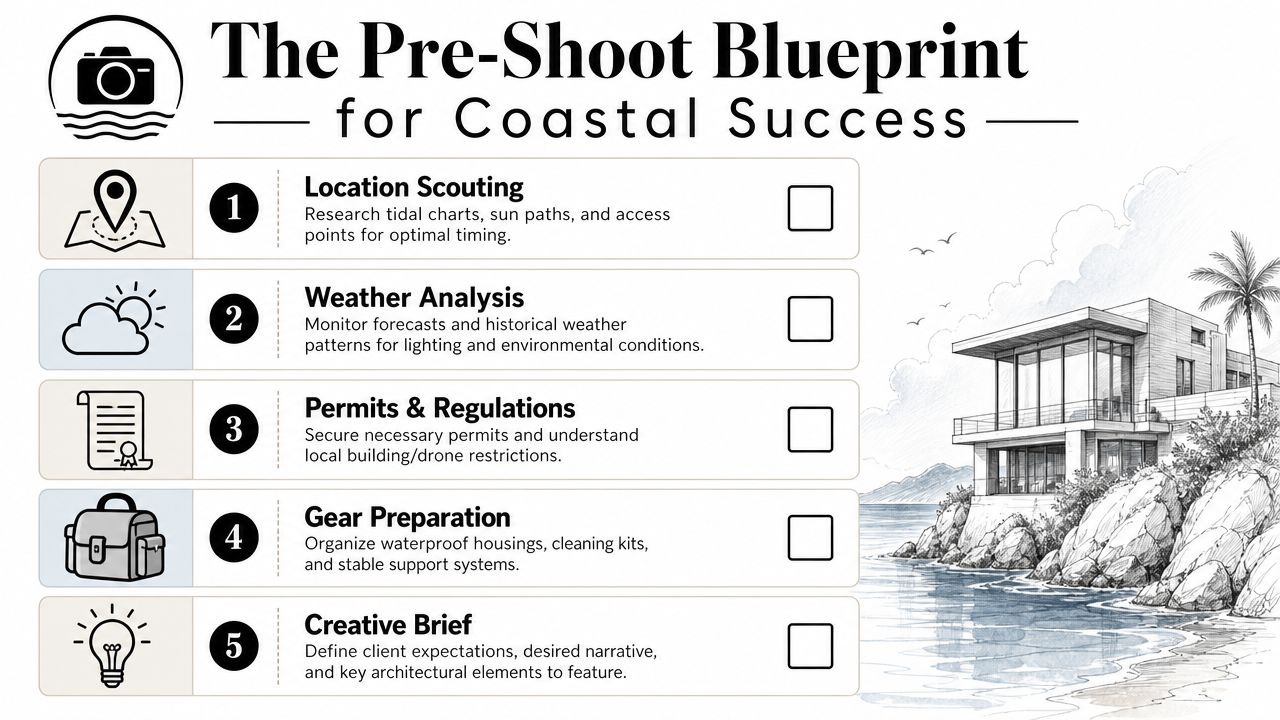
The best coastal shoot usually feels calm because the hard decisions were made before anyone unpacked a tripod. Without that groundwork, the day gets eaten by small failures. Locked gates, tide-cut access, windows facing the wrong light, or a client who says they wanted the property to feel more secluded after you've spent hours emphasizing openness.
Start with the narrative, not the gear
Before thinking about lenses or weather windows, define what the project needs to say.
For a resort, the story may be escape, service, and controlled luxury. For a multifamily development, it may be access to the waterfront and daily lifestyle. For a private residence, it may be shelter, texture, and the way the architect handled exposure to wind and light.
I like to reduce that brief into a short list:
- Primary message: What should a viewer understand in the first few seconds?
- Non-negotiable spaces: Which exterior elevations, amenities, and view relationships must be photographed?
- Usage context: Website banners need different framing than editorial verticals or sales-deck detail images.
- Occupancy strategy: Empty architecture reads differently from lightly styled, human-scaled scenes.
A project site also needs to be camera-ready. Exterior furniture placement, glass cleaning, grounds tidying, and temporary clutter removal can save a day from unnecessary retouching. A solid project site preparation checklist for a professional photoshoot helps align the owner, designer, and photographer before the first setup.
Build the coastal logistics plan
The coast punishes assumptions. Access that looks simple on a map can disappear at high tide. A terrace can become unusable if wind direction changes. A view corridor can haze over even when the forecast says clear.
The planning workflow I trust looks like this:
- Scout in daylight first. Day scouting helps identify angles before low-light work, which matters because trying to solve alignment and composition in darkness creates preventable errors.
- Walk all approach paths. Don't just inspect the hero elevation. Check secondary exterior spaces, neighboring structures, public sightlines, and where service elements intrude.
- Track sun path against façade orientation. Coastal reflections change quickly across glazing, metal, and water-facing surfaces.
- Review tide and surf conditions. Even when the architecture is above the waterline, shoreline access and foreground options often depend on tide timing.
- Plan weather alternatives. The most resilient shoots have a clear order for bright conditions, overcast conditions, and wet conditions.
Guidance on photographing the coast notes that developers increasingly want adaptive coastal photography workflows using extreme ND filters and pre-visualized post-production so deliverables don't collapse when the weather refuses to cooperate. That tracks with what commercial clients expect now. They don't want a hopeful plan. They want a dependable one.
A coastal schedule should never hinge on one magic sunset. It should survive an average day.
Lock the shot list to the site
Once the location has been walked, turn the concept into a sequence, not a wish list.
A useful working structure is:
| Shot type | Purpose |
|---|---|
| Contextual wide | Shows how the structure sits within coastline, bluff, dune, or harbor setting |
| Hero exterior | Carries the strongest branding message |
| Transitional view | Connects approach, entry, and ocean relationship |
| Detail frame | Material, joinery, weathering, or view-specific design decision |
| Twilight or interior-exterior balance | Adds mood and premium positioning |
That's the difference between showing up on the coast of somewhere beautiful and hoping for inspiration, versus arriving with a plan that can absorb changing light, shifting access, and client expectations without losing the story.
Composing the Scene Where Nature Meets Structure
Composition on the coast is less about collecting attractive elements and more about deciding which force leads the image. Sometimes the building should dominate and the water should support. Sometimes the coastline should establish scale and the architecture should answer it. Trouble starts when both compete for attention.
Camera height changes the entire story
One of the fastest ways to improve a coastal architectural frame is to change height before changing focal length.
A low camera position can make a house feel anchored and monumental against open sky. That often works when the architect used strong horizontal slabs, retaining walls, or deep roof overhangs. Raise the camera too much and those same lines flatten into a brochure-safe but forgettable elevation.
A higher vantage can do the opposite. It can reveal how a property terraces into a slope, opens toward a bay, or uses courtyards to mediate wind and exposure. This is especially useful when the site plan matters as much as the façade.
I've seen photographers stand in one spot and keep swapping lenses, trying to solve a relationship problem with optics. Usually the fix is simpler. Move three feet lower. Step farther laterally. Let the foreground breathe. Stop cutting the building off from the land it was designed for.
Use the coast as structure, not decoration
The shoreline gives you ready-made compositional tools, but only if you use them deliberately.
Consider these common pairings:
- Receding surf line with entry axis: Useful when you want to direct the eye from open water back toward the built form.
- Dune contour with roofline: Strong when the architecture echoes the site rather than opposing it.
- Retaining wall with horizon: Effective for emphasizing order against a volatile setting.
- Tidal pool reflections with glazing: Good for symmetry, but only when the reflection strengthens geometry instead of creating visual noise.
The coast already has movement. The photograph needs control.
Keep the horizon honest
The horizon can make an image feel calm, formal, and expensive. It can also expose every compositional mistake in seconds. If it slices through the middle of the frame with no reason, the image stalls. If it tilts, the architecture starts looking careless even when the building is beautifully resolved.
This matters more in coastal work because viewers instinctively understand water level. They may not notice subtle perspective issues in a city image, but they'll catch a crooked horizon immediately.
A few framing decisions consistently help:
- Place the horizon to support the architecture. Don't let it cut through important rooflines or glazing transitions.
- Use negative space with intent. Open sea can create luxury, isolation, or calm, but only when it leaves the building room to breathe.
- Watch edge tension. Palm fronds, railings, neighboring roofs, and parked service vehicles love to sneak into the corners.
Make room for narrative detail
The best commercial set includes more than hero images. It needs intermediate frames that connect the location to the experience of being there.
That might mean a sheltered outdoor dining terrace with the sea beyond, a stair landing where the view opens gradually, or a close shot of weathered timber against a clean ocean line. Those frames often carry the emotional logic of the project. They explain why the building is there, how it handles climate, and what a guest, buyer, or editor should notice.
When a set works, it doesn't feel like architecture dropped onto scenery. It feels inevitable. That's the standard.
Mastering Light and Gear in Harsh Coastal Environments
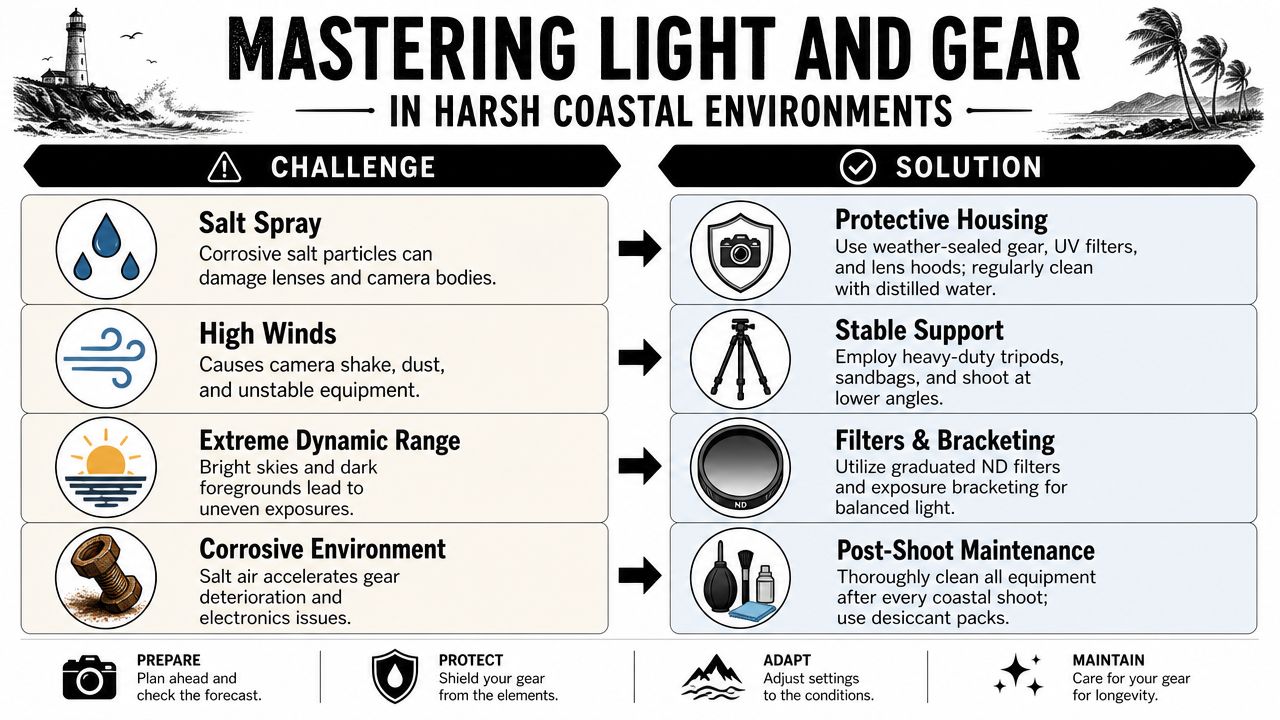
Coastal assignments are hard on cameras and harder on sloppy technique. Wind shakes a lightweight support system. Salt lands where you don't see it until contrast drops. Bright sky and darker structure force exposure decisions fast. You don't need exotic gear, but you do need gear that's chosen for this environment.
A clean starting point for architectural work near the water is below.
Core settings that hold up on site
In coastal architectural photography, the benchmark aperture range is f/8 to f/22, and a low ISO of 100 to 400 helps minimize noise while preserving detail in materials and surfaces, according to Digital Photography School's architectural photography guidance. That range makes sense in practice because edge-to-edge clarity matters more than shallow depth drama for most exterior commercial work.
Longer shutter speeds are often part of the solution, not a problem. Once the light drops or you need to balance an illuminated interior against cooler exterior tones, tripod-based exposures become the stable path to a cleaner file.
The support setup matters as much as the settings:
- Sturdy tripod: Essential whenever shutter speed drops past handhold-safe territory.
- Remote shutter or cable release: Cuts vibration during long exposures.
- Lens hood and cleaning kit: Salt spray reduces clarity fast, especially in side light.
- Weather-aware bag routine: Keep dry cloths, sealed storage, and a place to separate damp gear.
For readers looking at region-specific examples, this Oregon Coast photography page shows the kind of rugged shoreline conditions that reward stable support and disciplined composition.
What works with mixed lighting
One of the most common failures on coastal projects happens at blue hour or dusk. Interior practicals are warm. Exterior ambient goes cool. Reflections intensify. If you rush, you get muddy windows, clipped highlights, or rooms that feel disconnected from the view.
A better approach is to simplify.
Use a wide-angle or standard zoom that lets the room and coastline speak together without over-exaggerating space. Put the camera on a tripod. Let the shutter stay open long enough to gather ambient light cleanly. Then adjust composition and timing rather than forcing the scene with aggressive shortcuts.
This video gives a useful visual reference for thinking through coastal light and field conditions.
Field note: If the wind is strong enough to move your jacket, it's strong enough to soften a long exposure on a weak tripod.
Gear decisions that save the shoot
On the coast of somewhere beautiful, small equipment choices have outsized consequences.
A polarizer can help with certain reflections, but it can also create uneven skies depending on angle and lens width. ND filters are useful when you want to control shutter speed in bright conditions, especially if water movement is part of the concept. Wide-angle lenses are practical for many exteriors and interiors, but they need disciplined camera position or you'll exaggerate perspective in ways that cheapen the architecture.
A simple comparison helps:
| Problem | What usually fails | What tends to work |
|---|---|---|
| Salt haze on glass and lens | Wiping with any available fabric | Clean microfiber routine and frequent checks |
| Wind-induced blur | Lightweight tripod, center column extended | Heavier tripod, lower stance, remote trigger |
| Harsh bright sky | Single exposure compromise | Controlled tripod workflow with multiple exposures |
| Mixed interior and exterior tones | Fast handheld shooting | Locked camera and patient timing |
Coastal work rewards restraint. Better support, cleaner files, and steadier timing beat complicated setups almost every time.
The Digital Darkroom for Polished Coastal Imagery
Most coastal architectural images are won twice. First in the field, then in post. The camera gets you a disciplined RAW capture. The digital darkroom turns that capture into something a designer, developer, or editor can effectively use.
Start with file discipline
Before touching tone or color, sort the set by purpose. Hero frames, support frames, details, and alternates should live in a clear structure from the beginning. That sounds administrative, but it affects editing quality. When files are disorganized, photographers make grading decisions one image at a time instead of building a consistent visual language across the whole assignment.
RAW capture matters here because it gives you room to correct perspective, refine contrast, and handle subtle tonal transitions without the image falling apart. Coastal files often need careful work in highlights, especially around sky, water shimmer, and reflective glazing.
Blend exposure with a light hand
High-contrast dynamic range is a routine coastal problem. A single frame often forces a bad choice between sky detail and architectural detail. A more reliable method is to bracket exposures, capture one frame for the building and another for the sky, then blend them in post, as described in Julia Anna Gospodarou's architectural photography workflow.
That process works best when the blend is invisible. The goal isn't to make the scene look “processed.” The goal is to make it look as if the conditions cooperated perfectly.
A practical sequence looks like this:
- Choose the base frame for geometry and main tonal balance.
- Pull in the sky frame only where highlight retention is needed.
- Protect window edges and rooflines so the blend doesn't halo.
- Recheck shadow density so the structure still feels grounded.
For a deeper look at architectural retouching decisions, this guide on using post-production to fix structural photos is a helpful reference.
If a viewer notices the blend, the edit is doing too much.
Correct color before adding mood
Coastal scenes tempt photographers into overcommitting to blue. Water gets louder, sky gets denser, and suddenly the architecture feels secondary. High-end commercial editing usually goes the other direction. It disciplines color so the building remains the anchor.
That means watching a few problem areas closely:
- Ocean saturation: Rich enough to feel alive, restrained enough to stay believable.
- Sunset warmth on façades: Warm materials should glow, not turn orange.
- Mixed artificial light: Interior warmth should feel intentional, not nicotine-stained.
- Vegetation near the shore: Greens often need taming so they don't overpower neutral materials.
Perspective is not optional
Architectural clients forgive a lot less than audiences of natural scenes do. They expect verticals to hold, edges to read cleanly, and proportions to feel credible. The coast makes this harder because sloping terrain, cliffs, dune lines, and visible water level can trick your eye into accepting distortions that still look wrong on screen.
A careful perspective pass should address:
| Correction area | Why it matters |
|---|---|
| Vertical alignment | Keeps walls, glazing, and columns credible |
| Horizon leveling | Prevents the whole image from feeling careless |
| Lens distortion cleanup | Protects geometry at frame edges |
| Local contrast control | Restores material separation without crunch |
Sharpening comes last. So does output-specific cropping. A web hero image, a magazine spread, and a sales brochure cover may all come from the same base file, but they rarely want the exact same crop or tonal emphasis. Post-production is where the image stops being a record and becomes a deliverable.
Delivering a Visual Narrative That Elevates Brands
The strongest coastal architectural photography does two jobs at once. It satisfies the design audience that cares about line, material, and site response. It also serves the commercial audience that needs the images to attract guests, buyers, tenants, or press attention.
That's why a narrative approach matters more than a collection of attractive frames. A property built on the coast already has atmosphere. Photography adds value when it organizes that atmosphere into a story a client can use. The arrival image creates anticipation. The hero exterior establishes identity. Detail frames validate quality. Twilight views add aspiration. Together, they do more than show a place. They position it.
What clients should ask for
If you're commissioning this kind of work, ask about process before you ask about style.
A good photographer should be able to discuss site readiness, timing strategy, weather contingencies, composition logic, and post-production standards without hiding behind vague creative language. Coastal assignments are too variable for improvisation alone. You want someone who can adapt without losing consistency.
Useful questions include:
- How do you plan for changing coastal conditions?
- How will the image set support web, editorial, and marketing use?
- What's your approach to perspective correction and exposure blending?
- How do you translate the project's brand position into a shot list?
Why the investment pays off
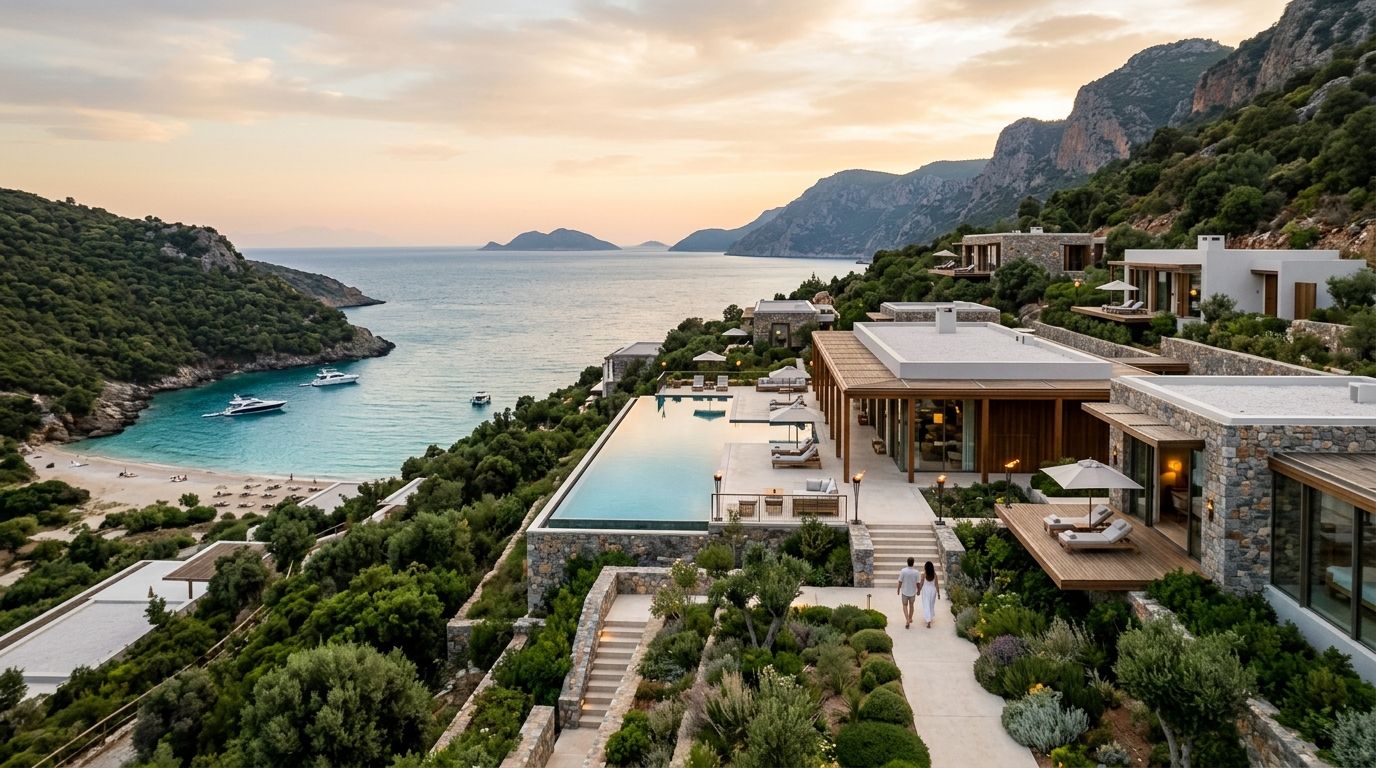
Cheap coastal imagery often looks good for a moment and weakens on repeat viewing. Horizons drift. windows clip. The building gets swallowed by scenery. Strong imagery does the opposite. It becomes more persuasive the longer someone studies it because the composition, light, and sequencing keep revealing intent.
Great coastal photography sells more than location. It sells judgment.
On the coast of somewhere beautiful, that judgment is the whole point. The architecture had to answer weather, light, topography, and exposure. The photography should show that same level of intelligence. When it does, the final set doesn't feel ornamental. It feels like part of the project's value.
If you need architectural photography that treats design, brand goals, and visual narrative with equal care, Jimmy Clemmons Photographer delivers polished imagery for architects, developers, hospitality groups, and commercial teams who need more than a pretty view.