
The first time I stepped onto a tannery balcony in Fez, I didn't raise the camera right away. I stood still, mint under my nose, and watched the vats resolve from chaos into structure.
An Assault on the Senses A Visual Introduction
From above, the Fez leather tanneries don't read like a single scene. They read like a contact sheet of competing subjects. Circular stone pits, wet hides draped over rims, workers bent into repetitive motion, walls stained by years of runoff, and hard sunlight flattening one corner while another falls into dense shade.
That's why most first photos fail.
A visitor sees color and reacts. A photographer sees relationships. The ochre walls against the chalky whites of the treatment pits. The sudden interruption of a cobalt or saffron-toned vat. A figure crossing the frame with a hide over his shoulder, briefly giving scale to an environment that otherwise turns abstract.
The smell hits before the composition does. The sounds arrive next. Voices from the terrace, the slap of wet leather, the scrape of tools, footsteps on stairs behind you as another group enters the shop. It's crowded sensory territory, and that matters because visual discipline gets harder when your body is busy processing everything else.
The tanneries reward patience more than reflex. If you shoot the first spectacle you see, you usually get noise, not narrative.
I treat the first few minutes the same way I would when entering a strong interior with complicated surfaces. I look for texture before I look for action. The weathered plaster, the rough stone rims, the matte surface of dye, the drag marks on the ground where hides have been moved. If you want a stronger frame later, train your eye first on material detail. That habit is the same one behind capturing texture in interior design photos, where surface quality often carries more emotion than the widest view.
What the eye misses at first
The postcard version is obvious. The better story sits one layer deeper.
- The geometry matters: The pits create rhythm, but irregular rhythm. Don't force symmetry where the place offers pattern instead.
- Labor is the scale reference: Without a worker in frame, the scene can become decorative and distant.
- Color isn't the whole story: Some of the strongest images here are nearly monochrome, built on hide, stone, shadow, and skin.
Fez gives you a spectacular surface. The work is learning how to see past the spectacle.
A Craft Unchanged for a Millennium
The reason these views carry so much visual weight isn't just their color. It's continuity. The Chouara Tannery in Fez, Morocco, has operated continuously for over 1,000 years since approximately the 11th century, and Fez became a major leather hub in the 12th and 13th centuries, with leather exported as far as Baghdad, as noted by this historical overview of Moroccan leather craft.
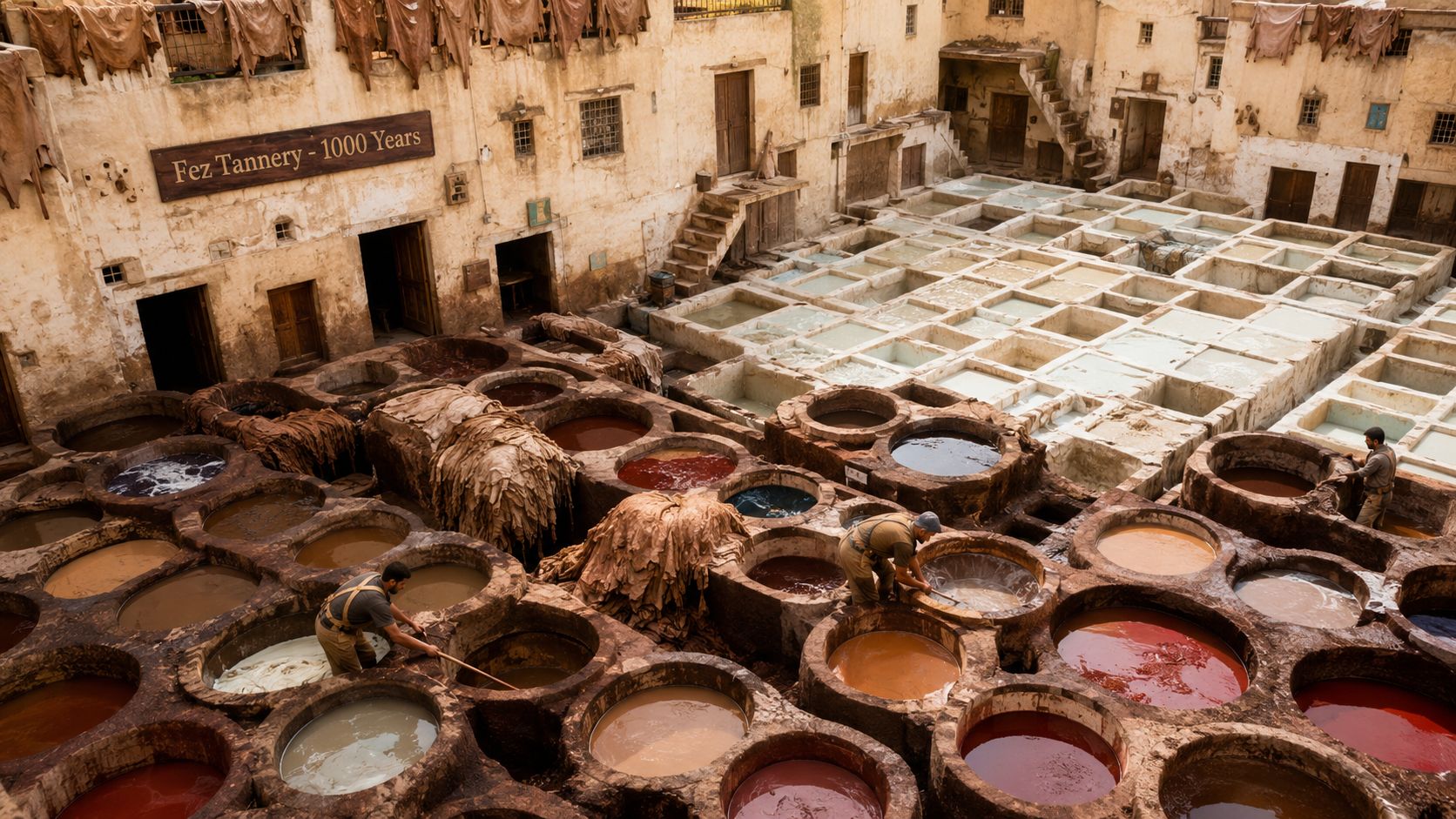
That history changes how you photograph the place. If you treat it as a colorful overlook, you'll make competent travel pictures. If you treat it as an active workshop carrying medieval methods into the present, your decisions get sharper. You stop asking, “How do I fit all the vats into one frame?” and start asking, “What in this frame shows continuity?”
What history looks like in a photograph
In practice, history isn't photographed through labels or plaques. It appears through physical evidence.
Look for these cues:
- Worn stone edges: Repetition leaves marks. The rims of pits tell you this isn't a staged heritage display.
- Layered surfaces: Walls, stairs, and terraces carry use. Freshly renovated spaces don't have this visual density.
- Manual choreography: Workers moving through the vats give the scene its living connection to the past.
A lot of historic sites feel embalmed. Chouara doesn't. It still functions as a production space while also drawing visitors into the medina to observe from surrounding terraces. That dual role creates a productive tension for photographers. You're not documenting ruins. You're documenting survival.
Why the setting matters
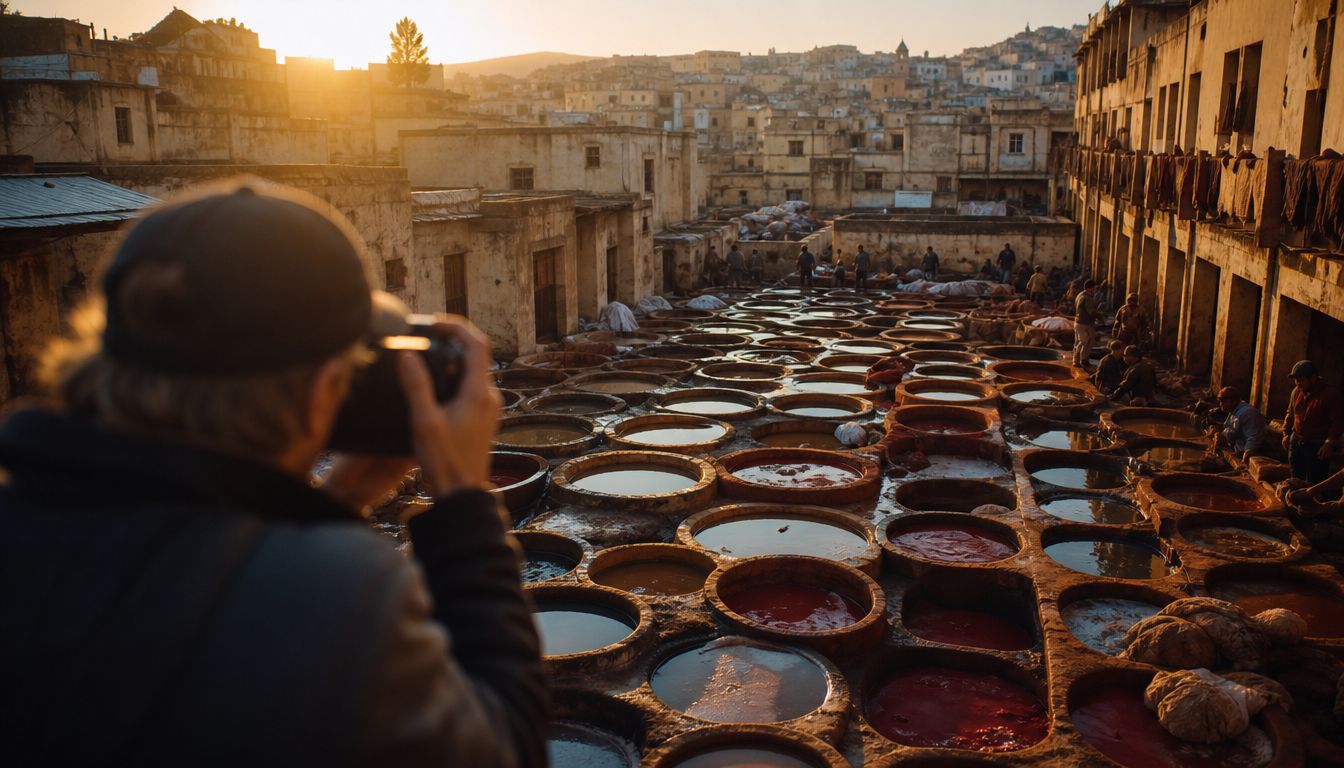
The tannery sits in Fes el Bali, the old medina quarter. That matters compositionally because the surrounding architecture compresses your point of view. You rarely get a clean, detached survey shot. Instead, you work through windows, balconies, doorways, rails, and partial obstructions.
That's not a drawback. It's part of the visual truth.
Practical rule: Don't crop out every sign of the terrace. A sliver of doorway, railing, or wall can place the viewer where the photograph was actually made.
Fez at its best isn't pristine. It's accumulated. The old tanneries make sense when you photograph that accumulation, not when you try to tidy it into a generic aerial pattern.
The Alchemy of Traditional Tanning
Once you understand the process, the visual disorder starts to organize itself. The Fez leather tanneries use a traditional pretreatment called iferd, a fermented mixture of pigeon droppings, animal urine, quicklime, salt, and water. That creates an ammonia-rich environment at about pH 10 to 11 for hair removal, and the full process unfolds over 4 to 6 weeks without modern machinery, according to this detailed description of the Fez tannery process.
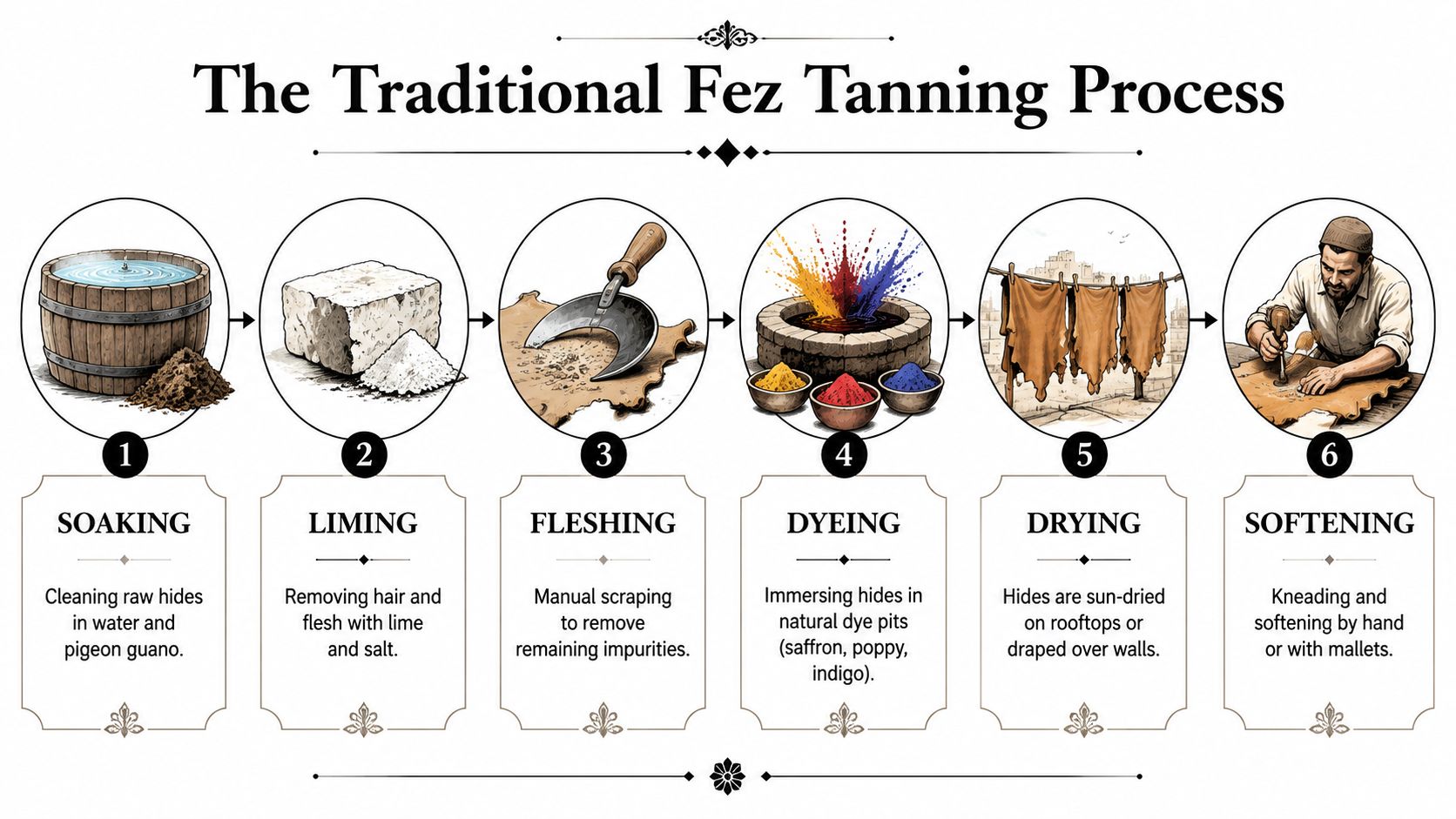
For a photographer, that technical knowledge changes what deserves attention. The pale pits aren't just visually lighter shapes in the composition. They represent a specific working stage. The workers standing knee-deep in solution aren't random figures animating the scene. They're part of a manual system that still depends on chemistry, fermentation, sun, and physical labor.
Read the vats by function
If you approach the scene with no process in mind, every pit can look interchangeable. They aren't.
A useful way to read the tannery is to separate what you're seeing into visual families:
| Visual element | What it often suggests photographically |
|---|---|
| White or pale pits | A quieter, more austere frame focused on preparation and labor |
| Saturated dye vats | Stronger color contrast and more graphic abstraction |
| Drying hides | Shape, repetition, and surface detail rather than liquid texture |
| Workers kneading or stretching leather | Motion, strain, and handcraft |
The process is machine-free, which means the body remains visible at every stage. That's rare in industrial subjects now. In many production environments, the machinery dominates the image. Here, the human figure still explains the workflow.
Shoot the purpose, not just the spectacle
When artisans physically stretch and knead dried leather by foot-treading or rope-pulling, the image gets stronger if the viewer can infer effort. Don't settle for a distant figure in a colorful pit if you can frame bent posture, tension in the arms, or the weight of the hide.
Three approaches work well:
- Compress the action with a longer focal length from the terrace, isolating one worker against a field of repeated forms.
- Go wider when a worker's movement needs the surrounding pits to explain context.
- Wait for the transition moment when a hide is lifted, folded, or carried. Static labor often reads weaker than labor in transfer.
The best tannery photographs usually answer a silent question. What is happening here, and why does it look this way?
Where many frames fall short
What doesn't work is photographing only color without process. A patchwork of bright vats can be attractive, but it often says very little. The stronger frame usually includes evidence of transformation: wet to dry, raw to dyed, slack to stretched.
That's the true alchemy in Fez. The place turns chemistry into texture, and labor into image.
Finding Your Vantage Point Accessing the Tanneries
Photographing the Fez leather tanneries starts with accepting one logistical fact. You usually won't walk up to a formal public overlook with signage and a ticket counter. Access typically comes through the leather shops surrounding the tannery, and each shop offers a slightly different height, angle, and framing.
Treat that like location scouting, not a nuisance.
How to approach the search
The medina can feel disorienting, especially when several people insist they know the best route. Sometimes they do. Sometimes they know the nearest commission opportunity. Either way, your job is to remain calm and evaluate the terrace, not the sales pitch.
I use a simple filter:
- Height first: A higher balcony usually gives cleaner separation between pits.
- Angle second: Slightly oblique views often show depth better than a straight-on overlook.
- Foreground control: Door frames, railings, and hanging goods can either help the frame or clutter it.
The same discipline applies to how to prepare a site for a photoshoot. You're judging access, line of sight, background interference, and how much control you'll have once you start working.
What to expect inside the shops
Most visitors enter through a retail space, climb stairs, pause at a balcony, and then encounter at least some degree of purchase pressure on the way out. That's the normal ecosystem around the tanneries. It doesn't mean you need to be hostile. It does mean you should be direct.
A useful script is simple: you'd like to see the terrace, take a few photographs, and then look around afterward if time allows. Keep it courteous, keep it short, and don't negotiate your own uncertainty out loud.
A weak entrance creates a weak visit. If you seem undecided, everyone around you will decide for you.
Choosing one balcony over another
Not every terrace produces the same kind of image. Before you start shooting, ask yourself what kind of story you want.
- For graphic overheads: Pick the highest angle available.
- For labor and gesture: Choose a balcony close enough to read body language.
- For architecture plus process: Favor a view that includes walls, stairs, and surrounding structure, not just the vats.
The mistake is rushing to the first opening and assuming the location has now been “done.” In Fez, a shift of one balcony can change the entire visual language of the scene.
A Photographers Guide to Capturing Fez
The strongest images of the Fez leather tanneries rarely come from trying to photograph everything at once. They come from deciding what the frame is about. Geometry. Labor. Texture. Color. If you don't make that choice, the scene makes it for you, and usually badly.
Work with the light you have
Many photographers arrive hoping for soft, diffuse light and instead get fierce sun, glare on wet surfaces, and crushed shadows under awnings. Complaining about that won't improve the frame. The answer is to choose a subject that suits the light.
Hard light can work beautifully here when you use it for separation. It defines pit edges, emphasizes wall texture, and gives wet hides a density that softer light sometimes reduces. For a broader approach to this decision-making, the same principles show up in choosing the best light for a site shoot.
If the light is harsh, lean into these subjects:
- Circular forms with defined rims
- Workers casting readable shadows
- Drying hides with sculptural folds
- Plaster walls where wear becomes visible
If the light softens, shift your attention to tonal relationships and layered depth. Softer light is better for subtle color transitions and skin tones, but it can flatten the pit structure if you aren't careful with angle.
Compose for narrative, not coverage
A common mistake is shooting a wide frame that documents the entire overlook but says almost nothing. Coverage has its place, especially editorially, but one good narrative frame usually outperforms five generic overviews.
Try building your sequence like this:
- Establishing frame: Show the field of vats and surrounding architecture.
- Mid-range frame: Isolate a cluster with one or two workers for context.
- Detail frame: Focus on hands, hides, surfaces, dye, or worn masonry.
That structure gives the viewer a way into the place. It's the same logic photographers use in architecture, where a hero exterior alone can't tell the full story of a building.
If every frame is wide, none of them feel intimate. If every frame is tight, the viewer loses the setting. Fez needs both.
Use architecture as a frame, not an obstacle
Because you're often shooting from inside or just outside a shop, you'll deal with partial obstructions. Don't automatically remove them from the composition. A dark doorway edge can create visual containment. A balcony rail can anchor the lower frame. A wall opening can turn the tannery into a revealed scene rather than a flattened map.
That said, be selective. If the edge element doesn't contribute scale, depth, or perspective, it's probably clutter.
A useful field check:
| If the architectural edge does this | Keep it or lose it |
|---|---|
| Frames the vats and gives depth | Keep it |
| Blocks key worker action | Lose it |
| Adds a sense of your position as observer | Keep it |
| Looks accidental and unbalanced | Lose it |
Photograph motion with intention
Workers move in patterns, but not on command. You can't direct the scene, so timing matters more than volume. Don't machine-gun frames every time someone crosses a vat. Watch for repeated routes. A worker carrying a hide often follows a usable path more than once, and that lets you pre-compose.
Motion works best here when paired with a stable structure. The vats are your grid. Let them hold the frame while the figure creates disruption.
I'd rather have one frame where a worker's stride breaks the circular pattern cleanly than dozens where movement is present but meaningless. The same goes for a lifted hide. Wait until the shape opens.
Texture is often the real subject
The photographs people remember from Fez aren't always the brightest. They're often the ones where you can almost feel the place. Cracked plaster, matte dye, slick stone, fibrous leather, dust on a sunlit ledge, stains built over time.
That's where the tanneries become more than a travel subject. They become a study in material memory.
Your Practical Visiting and Cultural Guide
You don't need much gear discipline to visit Fez. You do need body discipline. The medina is busy, the stairs are narrow, the terraces can be cramped, and the tannery environment asks more of your senses than a typical viewpoint.
What to carry and what to skip
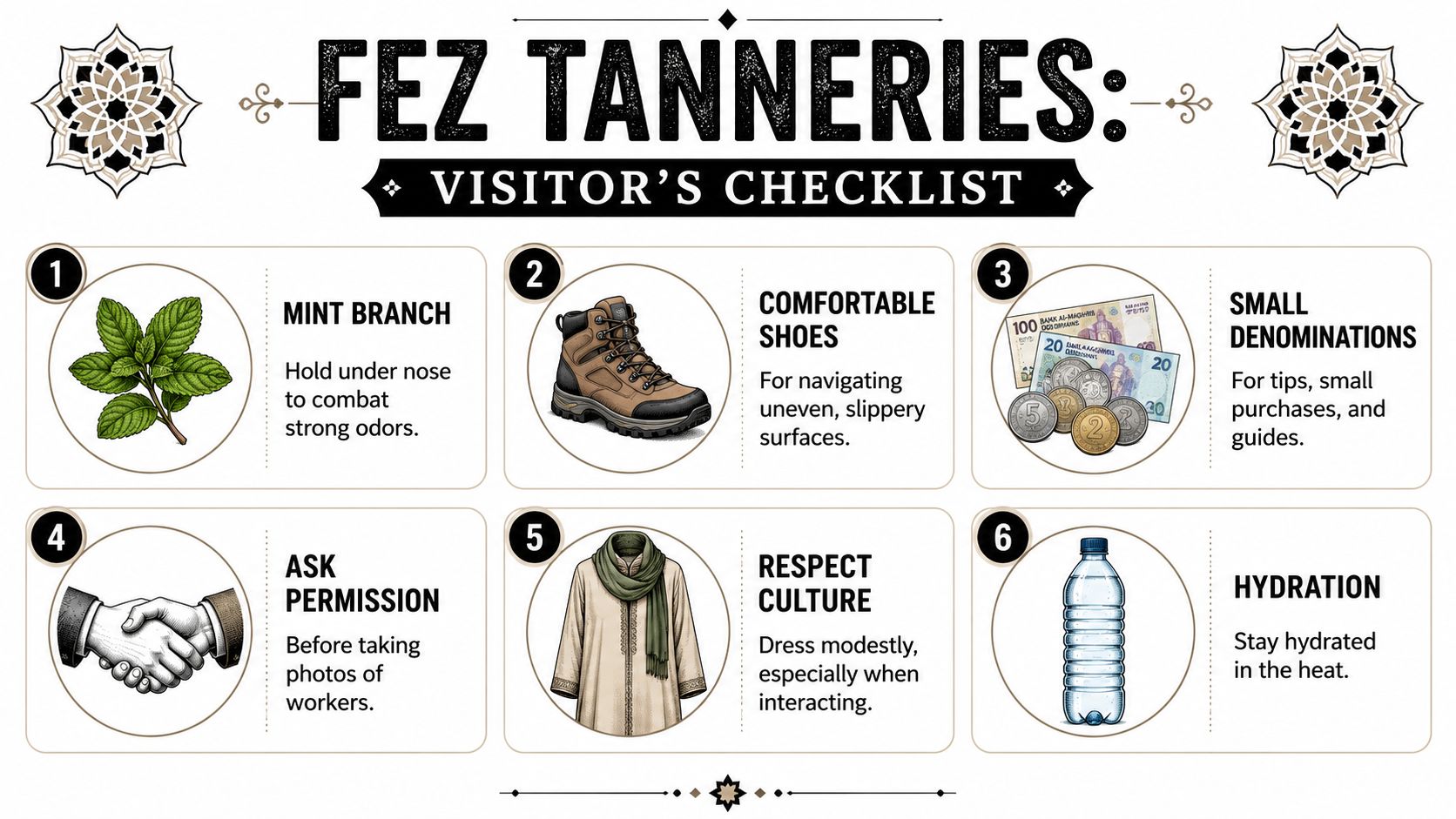
Fresh mint is commonly offered for a reason. Hold it near your nose if you need it, but don't assume it solves everything. The smell is part organic, part chemical, part heat. Adaptation often occurs after a short time, though some won't.
A practical setup is better than an ambitious one:
- Comfortable shoes: Surfaces can be uneven, dusty, or slick.
- A small camera kit: One body and one or two lenses are easier than a full loadout in tight stairs and crowded balconies.
- Water: Heat and sensory fatigue creep up faster than many visitors expect.
- Cash in small denominations: Useful for minor purchases, small tips, or quick transactions.
How to behave with a camera
The tanneries are visually dramatic, but they're still a workplace. That matters most when you move from wide views into close human images. A distant terrace shot of the overall scene is one thing. A close photograph of a worker's face or labor is another.
Ask when you can. Gesture respectfully when language is limited. If someone declines, move on.
Respect usually improves the photograph anyway. People look different when they don't feel cornered.
Don't confuse access with entitlement. Being allowed onto a balcony doesn't mean every person below has agreed to become your subject at close range.
Dress and movement
Modest, practical clothing helps. Fez is a city where standing out less often makes movement easier, especially in crowded lanes and inside shops. Loose, breathable clothing works better than anything precious or restrictive.
A few practical habits matter more than style:
- Keep straps secure: You'll brush walls, doorways, and people.
- Watch your footing on stairs: Looking through a viewfinder while moving is a bad idea here.
- Step aside after shooting bursts: Balconies are shared spaces, not personal platforms.
Buying, declining, and exiting well
You may be offered tea, conversation, and then a stack of jackets, bags, or slippers. None of that is surprising. If you want to browse, do it with genuine interest. If you don't, decline clearly and politely.
What works is straightforward language. What doesn't work is hesitant bargaining over items you never intended to buy. If the atmosphere turns pushy, thank the shopkeeper and leave. A calm exit usually works better than an argumentative one.
Buying Authentic Leather Separating Craft from Commodity
One of the biggest myths around the Fez leather tanneries is that proximity guarantees authenticity. It doesn't. Visitors are often told a given tannery or shop is the best, but there's no credible, widely available framework for confirming whether a product is hand-tanned Fez leather or a mass-produced imitation, as discussed in this analysis of authenticity gaps in Fez leather buying. That same analysis notes a 35% increase in exported “handmade” leather from non-Medina workshops.
That doesn't mean everything is suspect. It means certainty is harder than the sales language suggests.
What you can verify, and what you can't
A lot of the most meaningful production details are invisible by the time a bag or jacket reaches a shelf. Traditional tanning may use natural tannins and other preparation steps, but the finished item doesn't come with a transparent chain of custody. There's also no third-party authentication standard that a tourist can rely on at the point of sale.
So don't pretend you can solve authenticity with one clever trick. You can't.
What you can do is ask better questions and inspect more carefully:
- Ask where the piece was made: Listen for specific answers, not broad heritage language.
- Look at edges and interiors: Mass-produced goods often reveal themselves in lining, backing, edge finishing, and hardware quality.
- Check consistency: Handcrafted work may show variation, but poor construction is not proof of authenticity.
- Smell and feel cautiously: These are useful impressions, not definitive tests.
What doesn't work
The worst buying strategy is romantic certainty. If you want a perfect story more than a truthful object, someone will sell you one.
Be especially cautious with claims like “100% natural” when the seller can't explain process in concrete terms. Also avoid assuming that a rougher finish automatically means traditional craft. Sometimes rough is just rough.
Buy the object in front of you. Don't buy the speech around it.
A good purchase combines workmanship, honesty, and your own tolerance for uncertainty. In Fez, discernment is part of respecting the craft.
If you need imagery that treats craft, architecture, and lived environments with that level of care, Jimmy Clemmons Photographer brings an editorial eye to spaces, materials, and the people who give them meaning.