

You're probably in one of two places right now.
You've got the camera skills, you can produce strong interiors and clean exterior work, but client flow is uneven. Or you've already done some listing shoots and realized the volume game with agents can keep you busy without making your business better.
That's the fork in the road. If you want to learn how to get real estate photography clients, you can chase whoever will book next, or you can build a system that attracts better-fit clients, qualifies them before the first call, and turns each assignment into more work. In a crowded field, that second path matters. IBISWorld estimates the U.S. real estate photography industry had 6,591 businesses in 2024 and $268.3 million in revenue, with business count growing at a 12.6% CAGR from 2019 to 2024 while revenue grew at a 0.6% CAGR over the same period, which points to a fragmented, competitive market where positioning matters a lot according to IBISWorld's industry profile.
The mistake most photographers make is treating client acquisition like a hustle problem. It's usually a positioning problem. Premium buyers such as architects, developers, hospitality groups, and design firms don't hire the cheapest person with a wide lens. They hire the photographer whose work already looks like it belongs in their portfolio, investor deck, leasing package, or editorial feature.
Laying the Foundation for High-Value Clients
Getting any client and getting the right client are different jobs.
A broad portfolio can help you book small listing work. A narrow, deliberate portfolio helps you book the clients who care about design, brand image, and long-term use. That distinction matters because high-value buyers rarely respond to generic “real estate photography” messaging. They're looking for evidence that you understand buildings, space, materials, and visual hierarchy.

Specialize before you promote
In a crowded market, specialization makes outreach easier because the buyer can identify you quickly. “Photographer” is vague. “Architectural photographer for multifamily developments” is specific. “Interior photographer for hospitality and design firms” is specific. Those labels help a prospect decide whether you fit their world.
Use your market to choose a lane. If your city is heavy on mixed-use development, lean into exteriors, amenities, leasing imagery, and twilight work. If you're surrounded by design firms, emphasize interiors, materials, fixtures, and editorial composition. If commercial property managers dominate locally, build examples around office, retail, and public-facing spaces.
A practical niche filter looks like this:
- Client type first: architects, developers, interior designers, brokers, hotels, contractors
- Property type second: hospitality, multifamily, office, retail, luxury residential
- Usage third: listings, portfolio, awards submissions, investor presentations, editorial, website content
That combination is what separates a general shooter from a business with a point of view.
Curate proof, don't dump work
Most portfolios are overbuilt and underedited. Buyers don't need to see everything you've shot. They need to see that you can solve their kind of assignment.
Expert guidance recommends selective proof points instead of a large inconsistent gallery, and it stresses a portfolio-first sequencing strategy, where a credible website is established before outreach so agents and developers can quickly assess fit and quality as outlined by Ricoh360's guidance on starting a real estate photography business.
Practical rule: Your portfolio should answer one question fast. “Can this photographer make my project look valuable, intentional, and publishable?”
That means fewer images, not more. Show establishing frames, hero shots, detail vignettes, and a sense of sequence. Include work that demonstrates you can hold verticals, manage mixed lighting, reveal depth, and photograph reflective or difficult surfaces without losing control of the frame.
A stronger gallery often includes:
- A clear opener that signals your niche immediately.
- A mix of scale with wide compositions, medium frames, and detail images.
- Consistency in color, contrast, and perspective.
- Relevant projects only, even if that means a smaller portfolio.
Turn the website into a sales tool
A premium client doesn't want a mystery. They want clarity.
Your site should make it obvious who you work with, what you shoot, what deliverables you provide, and how to start a project. A gallery alone doesn't do that. A functioning sales site includes service pages, contact paths, licensing language or usage guidance, and enough process detail to reassure a busy marketing team or design principal.
Use the homepage to position the business. Use portfolio pages to prove taste and technical consistency. Use service pages to qualify inquiries. If someone lands on your site and can't tell whether you handle architects, developers, or commercial interiors, they won't spend time decoding it.
A simple website structure works well:
| Page | Job |
|---|---|
| Home | State niche, geography, and visual style |
| Portfolio | Show curated, relevant work |
| Services | Explain assignments and deliverables |
| About | Build trust with experience and process |
| Contact | Remove friction and invite serious inquiries |
That foundation does more than make you look professional. It filters out poor-fit leads before they ever contact you.
Optimizing Your Digital Footprint for Local Discovery
Outreach matters, but it works better when a prospect can search your name and find a business that looks established.
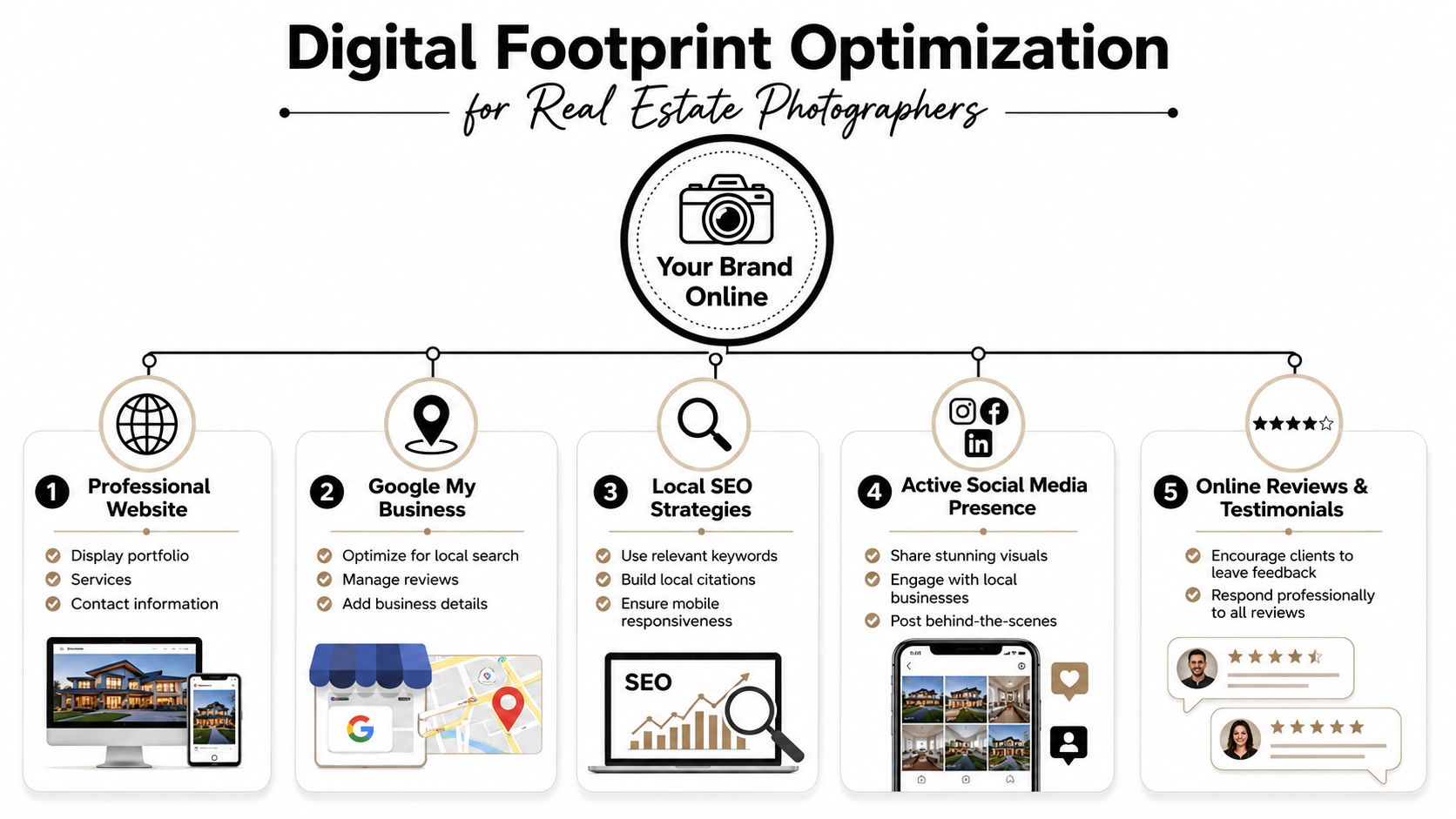
Local discovery has become more important because buyers often vet photographers online before replying. Recent guidance increasingly emphasizes Google Business Profile optimization and city-specific landing pages, noting that Google Business Profile remains a major local discovery surface in Zenfolio's discussion of getting real estate photography clients.
Clean up the search path
A good digital footprint does two things. It helps strangers discover you, and it gives referred prospects enough confidence to respond.
Start with your Google Business Profile. Fill out the core business information completely. Keep service descriptions aligned with the work you want. Upload images that reflect your target niche, not random leftovers from unrelated shoots. If you want architects and developers, your profile imagery should look architectural, not like a mixed bag of portraits and event photos.
Then make the website support local intent. Create pages for the cities or submarkets you serve. Don't spin up thin pages stuffed with place names. Write pages that show relevant property types, practical deliverables, and local understanding.
Build pages that qualify serious searches
The most useful local pages target real buying language. A developer won't always search the same way an agent does. A design firm may search for architectural photography, interiors, hospitality imagery, or commercial brand content. Your site should reflect that range without becoming scattered.
Useful page themes include:
- Service plus location: architectural photographer in Atlanta
- Client type plus location: interior photography for design firms in Atlanta
- Property type plus location: hospitality photographer in Atlanta
- Commercial intent pages: office, retail, multifamily, or campus photography
Site performance affects whether people stay long enough to inquire. Fast image handling matters, especially on portfolio-heavy sites. If you need a reference point for that side of the workflow, image speed on firm websites is worth reviewing before you add more galleries and location pages.
If your site looks slow, cluttered, or vague, local search visibility won't help much. Discovery only matters if the click converts.
Give prospects reasons to trust the profile
Reviews, project descriptions, and current imagery help. So does consistency between your website, business profile, and contact information. A polished digital footprint doesn't replace direct outreach. It makes every outreach attempt stronger because the prospect finds a business that feels active and focused.
Social platforms can support this, especially if you post finished work, on-site details, and project context. But social shouldn't carry the whole load. Your website and Google Business Profile should do the heavy lifting because those are the assets you control.
Developing Your Proactive Outreach System
The fastest way to stall your business is to “network” without a system.
Good outreach is not mass emailing a city and hoping someone bites. It's a repeatable process built around a defined prospect list, relevant work samples, short messaging, and disciplined follow-up. For agents, one proven method is to build a list from active listings, capture fields like address, agent, agency, and contact details, then sort by listing frequency so you target the highest-volume producers first. One guide also recommends contacting at least 200 realtors or motels, starting with 50 phone calls, and keeping outreach brief and specific to a listing address in Jonathan Corbett's client acquisition workflow.
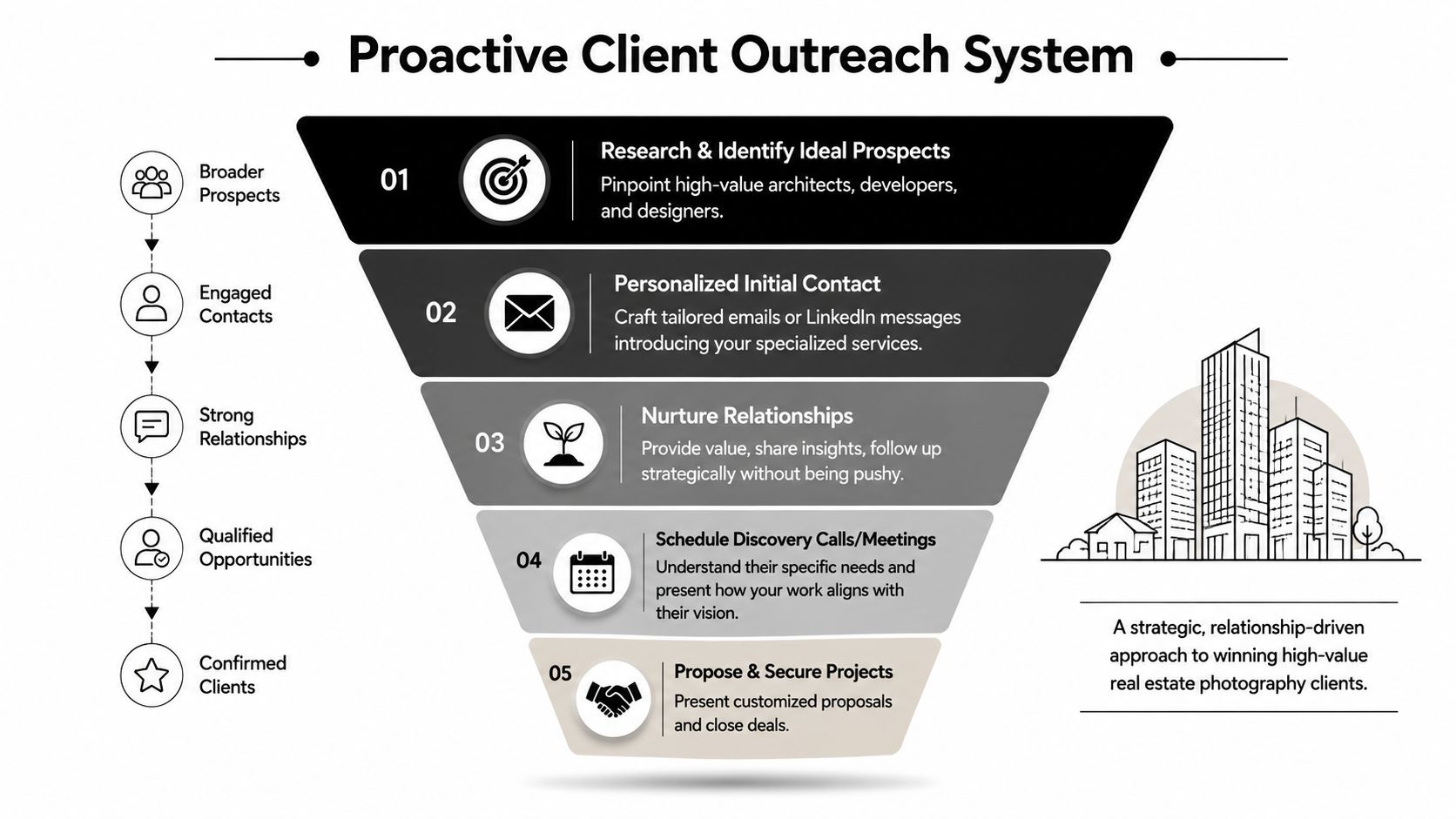
That same logic applies beyond residential agents. For architects, developers, and design firms, you still need active-market signals. You're just pulling them from different places: project announcements, development websites, design directories, firm portfolios, signage at active sites, leasing pages, hotel openings, and local business journals.
Build a prospect list with context
Don't start with a giant spreadsheet of names. Start with categories.
A useful outreach list separates prospects by buying behavior:
| Prospect type | What they usually care about |
|---|---|
| Architects | Portfolio quality, awards, publications, design fidelity |
| Developers | Leasing, investor relations, branding, launch assets |
| Interior designers | Texture, finish detail, editorial feel |
| Commercial brokers | Speed, consistency, listing utility |
| Property managers | Ongoing updates, occupancy marketing, professionalism |
That context changes your message. The mistake is sending the same email to everyone.
Make first contact short and specific
The first message should show that you looked at their work. It should not explain your life story, equipment list, or passion for photography. It should connect your visual specialty to something visible in their portfolio, current project, or active marketing.
Use email, LinkedIn, and direct website forms if needed. The channel matters less than the specificity.
I came across your recent project portfolio and noticed how much emphasis your team places on material contrast and natural light. I photograph architecture and interiors with that same design-first approach. If it's useful, I'm happy to send a short set of relevant project samples for multifamily and hospitality work in Atlanta.
That works because it doesn't ask for a big commitment. It opens a conversation.
Here's a basic framework you can adapt:
Subject: imagery for [project type] work in [city]
Hi [Name],
I was reviewing [project name or firm portfolio] and noticed the emphasis on [specific design element, property type, or visual need].I photograph [relevant niche], with a focus on clean composition, accurate color, and images built for [website, leasing, editorial, awards, investor materials].
If you're updating your portfolio or documenting recent work, I can send a short, relevant sample set.
Best,
[Name]
Treat follow-up like part of the system
Most photographers either stop after one email or follow up in a way that sounds needy. Better follow-up is simple. Add one useful reason to reply. Mention a relevant recent project. Offer a narrow next step, such as a portfolio review, a brief call, or a sample estimate for a specific property type.
This video gives a useful companion perspective on outreach and positioning:
Use a basic cadence. First message. Follow-up a few days later. One more follow-up with a different angle. Then move on. The discipline matters more than the script.
Track every contact in one place. A spreadsheet is enough at first. Record firm, contact, niche, date, channel, status, and next step. Outreach becomes manageable when it stops living in your inbox.
Building Strategic Partnerships That Generate Referrals
One-off shoots keep the calendar moving. Partnerships build a business.
That's the shift many photographers miss. Existing advice often centers on entry-level listing agents, but a major opportunity sits with architects, developers, commercial property managers, and design firms, where buying decisions are more dependent on portfolio quality, process, and reputation than on pure transaction volume as discussed in this analysis of client acquisition gaps in the industry.
Why partnerships beat constant prospecting
A strategic partner already works with your ideal buyer. If an architecture firm trusts your process, they can bring you in repeatedly as projects finish. If a contractor likes the way you document completed work, they may call every time they need portfolio material. If a brokerage manager trusts you, individual agents may never need to shop around.
That changes the economics of client acquisition. Instead of winning one assignment at a time, you build channels that send work repeatedly.
The best referral sources aren't people who like your photos. They're people whose own business improves when your work helps them sell, publish, lease, or win new projects.
Choose partners whose incentives align with yours
Not every “partner” is worth pursuing. Look for professionals who need visual assets often and who benefit when those assets look polished and consistent.
Good partnership targets include:
- Architecture firms that need completed-project documentation
- Interior designers updating portfolios or submitting work to publications
- General contractors who need finished-project imagery for proposals and websites
- Brokerage leaders who influence vendor choices across a team
- Developers and hospitality groups launching properties or refreshing brand assets
The pitch is different from direct outreach to an end client. You're not asking for a single booking. You're proposing a working relationship that helps them present their own work better.
Lead with mutual benefit
Approach partners with a portfolio suited to their industry and a clear explanation of where your images fit in their workflow. For architects, that may be website case studies, award entries, and publication submissions. For designers, it may be editorial-style interiors and detail work. For developers, it may be leasing, brand, and investor-facing material.
One mention here is enough. A studio such as Jimmy Clemmons Photographer fits this model by focusing on architectural imagery, commercial brand content, and design-forward built-environment photography for firms that need more than standard listing coverage.
Partnerships work when you're easy to refer. That means clear scope, reliable scheduling, professional communication, and imagery that matches the partner's own brand standards.
Pricing Packaging and Creating Irresistible Proposals
A weak proposal makes good photography look expensive.
A strong proposal makes the assignment feel organized, justified, and low-risk. That matters because clients don't buy images in isolation. They buy a result, a process, and confidence that the project will be handled well.
The business case is already there when you're speaking to listing-driven buyers. Professional photos can drive 118% more online views, bring in 50% more potential-buyer viewers, help homes sell 32% faster, and support a price premium of $3,000 to $11,000 according to this 2025 real estate photography statistics guide. Use those numbers carefully. They're not a promise for every shoot. They are a concrete argument that imagery affects performance.
Price the assignment, not just the shoot day
Hourly pricing creates the wrong conversation for premium work. It reduces the project to time on site, when the client is really buying planning, technical control, editing, usage, and reliability.
Package around use case instead. A listing package for a broker should not look like a documentation package for an architecture firm or a launch package for a developer.
A simple structure might look like this:
| Package style | Best for | What it emphasizes |
|---|---|---|
| Listing essentials | Standard property marketing | Speed, clean coverage, easy delivery |
| Marketing showcase | Higher-visibility launches | Hero images, detail frames, broader usage |
| Architectural record | Architects, designers, developers | Narrative coverage, design fidelity, licensing clarity |
That framework helps the client compare options without turning the entire decision into price per image.
Write proposals that answer objections before they come up
A proposal should do more than list deliverables. It should restate the client's objective in business language. If the property needs stronger leasing material, say that. If the design firm needs portfolio-ready images for a completed project, say that. If the developer needs polished visuals for web, print, and presentations, say that.
Include these elements:
- Project objective in the client's language
- Scope of photography with clear deliverables
- Usage or licensing terms so expectations are defined
- Process and timeline from planning through delivery
- Fees and optional add-ons without clutter
- Terms covering scheduling, cancellations, payment timing, and revisions
For clients who need help understanding the business value of visual work, the ROI of professional photography is the kind of supporting material that can sharpen the conversation.
A proposal closes more work when it reads like a plan, not a price sheet.
Protect the work and your calendar
Photographers lose margin in small ways. Unclear usage. Endless revision requests. Last-minute rescheduling. Scope creep that gets framed as a minor favor.
Your estimate and agreement should define the practical rules. Clarify what's included, what triggers additional fees, how delivery works, and when payment is due. If travel, assistants, styling support, twilight coverage, or licensing expansion may apply, mention them upfront.
That doesn't make you rigid. It makes you professional. Serious clients usually prefer a clean process because it helps them manage their own deadlines and approvals.
Delivering Excellence and Engineering Repeat Business
Most photographers treat delivery as the end of the job. It's the beginning of the next one.
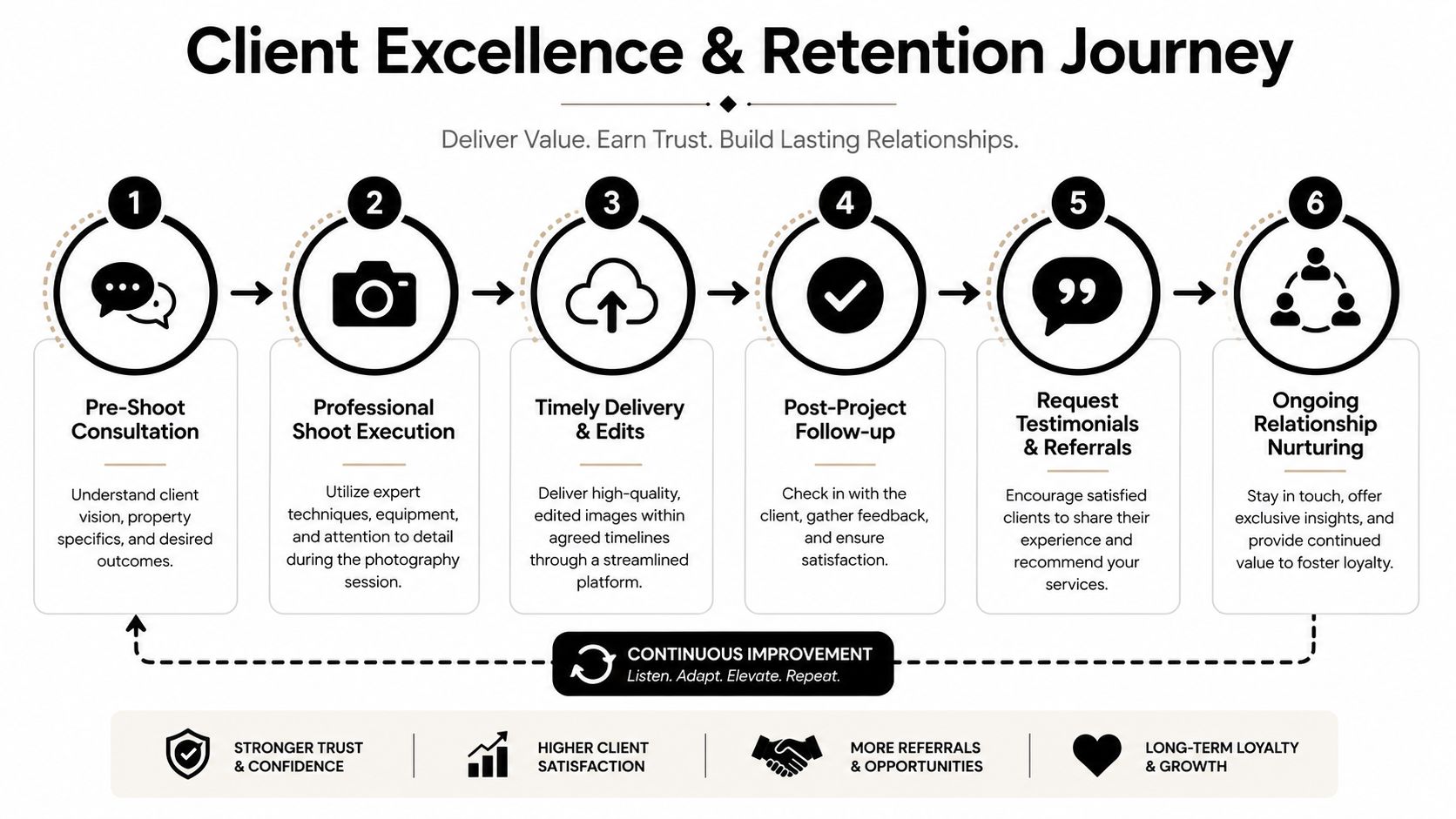
The shoot, the edit, and the gallery matter, but retention comes from the full experience. Clients remember whether you were prepared, whether the production ran smoothly, whether the images arrived as promised, and whether communication stayed clear when details changed.
Run a clean client experience
A repeatable workflow keeps you from improvising on every project. Confirm the brief. Verify access and readiness. Note priority spaces and required deliverables. On site, work in a way that respects the property, the client's staff, and the schedule.
After the shoot, delivery should feel organized. Use a clean gallery or transfer method. Label files logically. Keep the handoff simple enough that a marketing manager, architect, or broker can use the work immediately.
If expectation-setting is an issue in your workflow, managing client visual expectations is a useful reference point before you tighten your delivery process.
Turn each finished job into momentum
The post-delivery window is where many referrals are won or lost. Follow up while the project is still fresh. Ask whether the client got what they needed. If they're happy, ask for the next small step that helps the business.
A straightforward retention sequence works well:
- Send a check-in: ask if the files met the intended use
- Request feedback: learn what mattered most to the client
- Ask for a testimonial or review: only after you know they're satisfied
- Invite referrals: mention the kinds of projects you're taking on next
- Stay visible: share occasional relevant updates, not constant self-promotion
Good service gets praise. A deliberate follow-up process turns that praise into reviews, referrals, and repeat assignments.
The system starts to compound. The website supports outreach. Outreach wins projects. Projects generate proof and trust. Trust produces referrals and repeat work. That's how you stop rebuilding demand from scratch every month.
Conclusion Your System for Sustainable Client Growth
The photographers who struggle longest usually aren't short on talent. They're short on structure.
Learning how to get real estate photography clients isn't about finding one trick that suddenly fills the calendar. It's about building a business that makes sense from the outside. A focused niche. A portfolio that speaks to the right buyer. A website that qualifies interest. A digital footprint that helps local prospects find you. Outreach that is personalized and tracked. Partnerships that create recurring opportunities. Proposals that sell value. Delivery that turns clients into advocates.
That system matters more than any single tactic.
If you only do outreach, you'll keep starting from zero. If you only polish the website, you'll wait too long for inbound work. If you only chase one-off listing shoots, you'll stay vulnerable to price pressure. The stronger model combines passive discovery, active prospecting, relationship-building, and retention.
That's also how you move upmarket. Premium clients don't appear because you want better work. They appear when every part of your business signals that you're built for it.
Stay consistent. Refine the portfolio. Tighten the process. Keep the pipeline active even when you're busy. That's how a photography business becomes stable, selective, and far less dependent on luck.
If your firm needs architectural imagery, commercial property photography, or brand-focused visual content in Atlanta, Jimmy Clemmons Photographer provides design-forward photography for architects, developers, commercial teams, and built-environment brands seeking polished, purposeful images.