
You're probably here because you need care soon, but you also want to know what kind of place you're walking into. Maybe you need a new primary care location. Maybe urgent care is on your mind. Maybe you're helping a parent, spouse, or child and trying to figure out whether TownPark Medical Center will feel manageable or overwhelming.
That's a reasonable concern. A lot of medical visits don't feel difficult because of the medical issue alone. They feel difficult because the system is scattered. One building for the doctor, another for imaging, another for the lab, then a pharmacy stop on the way home. Even before the appointment starts, people are already tired.
TownPark Medical Center in Kennesaw stands out because it's built more like a healthcare hub than a small stand-alone clinic. For patients, that means fewer handoffs and fewer unknowns. For people who notice architecture and planning, it also means the building itself matters. The layout, the waiting areas, the flow from check-in to treatment, and the way services are grouped all shape how calm or stressful a visit feels.
Introducing a New Kind of Healthcare Hub
A common first-time patient scenario goes like this. You need routine care, but you also have a problem that may need imaging or quick follow-up. You want one place that feels organized, not a maze. You want staff to direct you clearly. You want to know whether the building is set up for real-life care, not just appointments on paper.
That's where TownPark Medical Center makes sense as a destination, not just a name on an insurance directory. It functions as a place where multiple kinds of outpatient care can happen in one setting. That matters because patients rarely experience health needs in neat categories. A primary care visit may turn into lab work. A painful injury may need urgent evaluation and medication support. A screening appointment may lead to same-day next steps.
Why integrated care feels different
When a center combines several services in one location, the patient experience usually changes in practical ways:
- Fewer separate trips: You're less likely to spend days moving between unrelated offices.
- Clearer handoff between teams: Staff can direct you from one service area to the next without making you start over.
- Less decision fatigue: You don't have to figure out every detail while also dealing with symptoms.
For many people, that's the actual value. Not luxury. Not branding. Just less friction.
TownPark also appeals to people who care about the built environment. Medical buildings tell you a lot before anyone says a word. A crowded entrance, poor signs, and disconnected departments create stress fast. A well-planned outpatient center does the opposite. It gives patients visual cues that say, “You can handle this visit.”
That's one reason healthcare spaces are often best understood visually, especially when someone documents construction and facility development with care, like the work seen in construction progress photography for healthcare and commercial spaces.
A good outpatient center doesn't just offer services. It helps patients move through those services without feeling lost.
If you're brand new to TownPark Medical Center, think of it as a place designed to reduce the mismatch between what patients need and how hard it is to get it.
The Vision and Scale of TownPark Medical Center
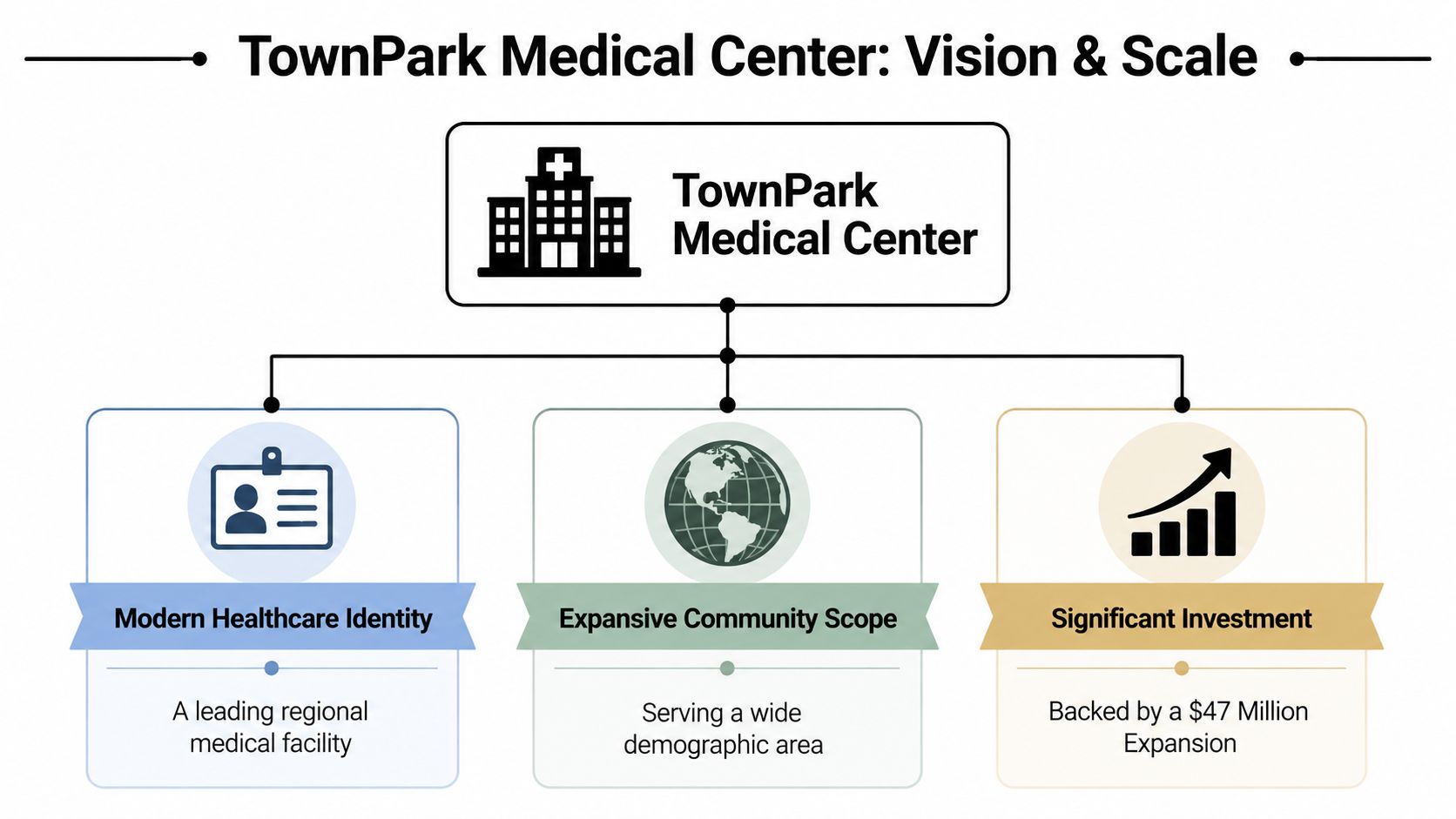
TownPark Medical Center carries the feel of a regional outpatient anchor, not a narrow single-purpose office. The clearest public sign of that scale is Kaiser Permanente's announced $47 million expansion of the medical center in Kennesaw, as reported by The Atlanta Journal-Constitution's coverage of the TownPark expansion.
That figure matters because it tells patients something simple and concrete. This isn't a stopgap site or a lightly equipped clinic. It's a facility that received substantial investment because of its importance, its capacity, and the role it plays in care delivery.
What that scale means for patients
A large outpatient center can still feel personal if it's designed well. What changes with scale is not just square footage. It's the ability to support more complete care in one destination.
Here's what that usually means in plain terms:
| What patients notice | Why it matters |
|---|---|
| More service lines in one building | You spend less time coordinating separate providers |
| Better operational flow | Check-in, diagnostics, treatment, and follow-up feel more connected |
| Stronger regional role | People can rely on the center for a broader range of non-hospital needs |
Published descriptions tied to TownPark note access to primary care, multiple specialties, infusion and chemotherapy, laboratory services, pharmacy support, and urgent care. Even if a patient only uses one or two of those services, the overall setup matters because a center built for breadth is often better prepared for changing needs.
A facility designed to be more than convenient
There's also a community angle. A center like this becomes part of how local care gets organized. It gives residents a fixed, known place for recurring outpatient needs. That kind of stability matters for working adults, families juggling multiple appointments, and older patients who prefer familiar routes and routines.
For design-minded readers, this is the point where architecture and operations overlap. A healthcare building at this scale has to communicate confidence from the outside before patients ever enter. The exterior identity, massing, and entry sequence shape expectations, much like the professional examples found in office building exterior photography.
Practical rule: When a medical center receives major capital investment, patients should expect a facility built to support more than quick in-and-out visits.
TownPark's scale signals that it was planned to handle complexity while staying outpatient-focused. That's a useful distinction. It aims to give patients substantial capability without the atmosphere of a sprawling hospital campus.
Comprehensive Services Under One Roof
A patient with a sore throat, a parent bringing in a child with a sprained wrist, and someone coming for breast imaging may all enter the same building for very different reasons. What matters is how quickly each person can move from check-in to answers. TownPark is organized around that patient path.
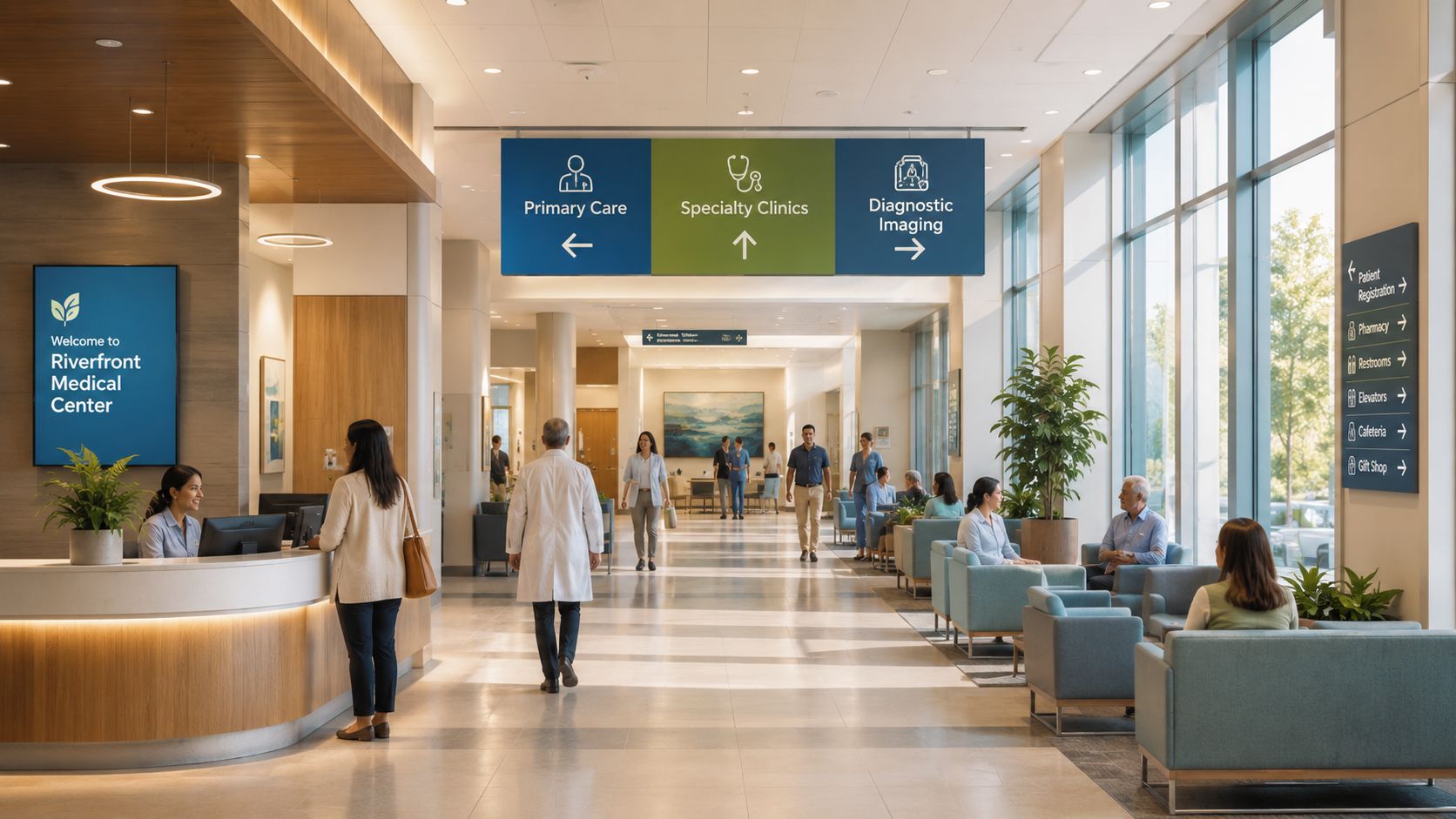
According to Medicai's overview of Kaiser Permanente TownPark's service mix, the facility brings together primary care, a wide range of specialties, urgent care for non-life-threatening problems such as fractures and sprains, plus on-site pharmacy, laboratory services, digital breast tomosynthesis, and full-field digital mammography.
That mix matters because healthcare often works like a chain. One visit leads to a test. A test leads to medication. A medication question leads back to a clinician. When those links sit in one place, the day becomes easier to handle.
How to read the service mix as a patient
Department names can blur together, especially if you are new to a large outpatient center. A simpler way to sort it is by purpose.
- Primary care: Your starting point for routine visits, preventive care, chronic condition follow-up, and first evaluation of new symptoms.
- Specialty care: The next step when a concern needs a more focused exam, treatment plan, or follow-up from a clinician with deeper subject expertise.
- Urgent care: A practical option for sudden but non-life-threatening problems that need prompt attention, including injuries like sprains or some fractures.
- Lab and pharmacy on site: These reduce the common back-and-forth of leaving one office, driving to another location, and trying to keep instructions straight.
- Breast imaging services: Patients who need screening or follow-up imaging can often stay within the same care setting instead of piecing together separate appointments across town.
For many patients, the advantage is not just convenience. It is clarity.
If a clinician orders a test, you are less likely to wonder where to go next. If treatment changes after that test, there is a better chance the next stop is close by. The building itself supports that logic. Spaces for evaluation, testing, and support services are grouped in a way that feels more like a coordinated medical hub than a loose collection of offices.
Why co-located care changes the actual experience
Consider a common outpatient scenario. Someone comes in after a fall with pain, swelling, and a lot of uncertainty. The first need is assessment. The second may be imaging or lab work. The third may be medication or follow-up instructions. In a scattered system, each step can become a separate errand.
At TownPark, those steps can stay connected. That lowers the mental load on patients and families, especially on stressful days when pain, worry, or time pressure make every extra stop feel harder.
This short video gives a little more context for what a modern, integrated medical environment can feel like in motion.
https://www.youtube.com/watch?v=3Wr9ZDYaf1E
When lab, imaging, urgent care, and pharmacy support sit close together, patients can move from question to answer with fewer interruptions.
For new patients, that is the main idea to keep in mind. TownPark offers a broad set of outpatient services, but the more useful point is how those services are arranged. The design supports quicker decisions, fewer handoffs, and a care experience that feels coordinated from room to room.
Planning Your Visit A Practical Guide
You pull into a medical campus a few minutes before your appointment. Your phone says you are in the right place, but one question still matters. Are you heading to a weekday clinic visit, or do you need the always-open urgent care area? At TownPark Medical Center, that distinction shapes the rest of the visit.
Kaiser Permanente lists TownPark Medical Center at 750 TownPark Ln NW in Kennesaw, Georgia, with weekday hours of 7 a.m. to 7 p.m. for the medical center, while the Advanced Care Center operates 24/7 for urgent care needs, according to Kaiser Permanente's TownPark facility page.
A first visit usually feels easier when you sort out the basics before you leave home. The building is designed to organize many services in one place, but good design still works best when you arrive knowing which door, service line, or appointment type you need.
A simple first-visit checklist
Use this short checklist like a pre-departure scan.
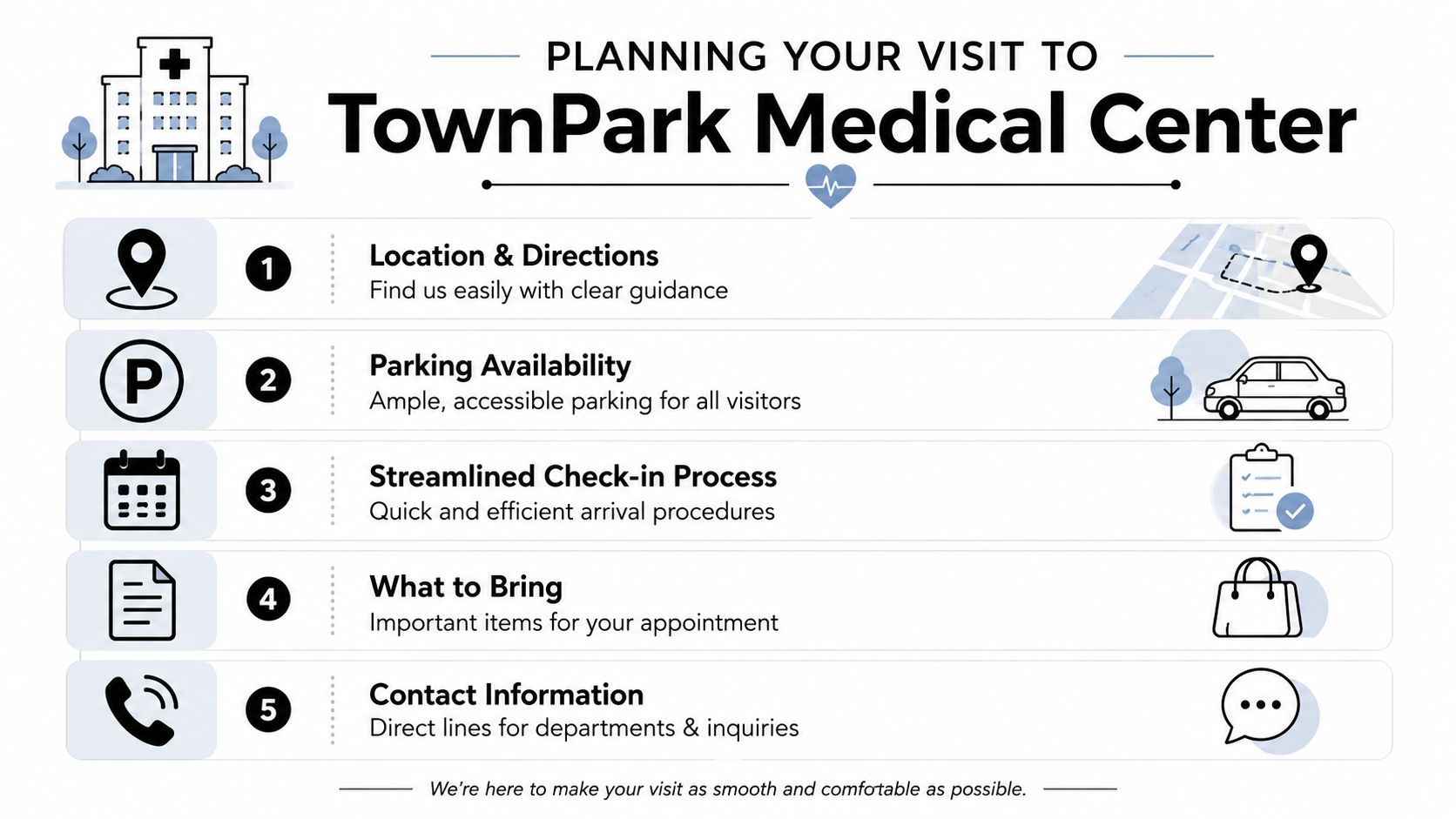
- Confirm your destination. TownPark includes the main medical center and the Advanced Care Center. Your appointment details should tell you which area you need.
- Check the time window. Scheduled visits should match the medical center's weekday hours. Urgent care follows the Advanced Care Center schedule.
- Bring the basics. Pack your ID, insurance card if needed, medication list, and any referral or appointment information.
- Give yourself extra arrival time. New patients often need a few extra minutes for parking, check-in, and finding the right desk.
- Keep your phone available. It helps with appointment confirmations, portal access, maps, and contact numbers.
What helps the arrival go smoothly
Parking and entry are often the first stress point, especially for someone who has never seen the campus in person. The practical approach is simple. Save the address before you leave, look closely at your appointment instructions, and ask for directions at the front desk instead of guessing once you walk in.
That matters because the arrival sequence is part of the care experience. In a well-planned outpatient building, parking, entrances, signs, and check-in areas work like the opening pages of a good guidebook. They should tell you where you are, where to go next, and what to expect.
Patients who care about design often notice these details right away. Professionals do too. Clear exterior approach lines, readable entry points, and calm arrival spaces are easier to appreciate through architectural and interior facility photography, especially if you want a better sense of how healthcare design supports orientation before a patient reaches the lobby.
Here's a compact planning table you can screenshot.
| Before you go | Why it helps |
|---|---|
| Save the address | Reduces last-minute driving stress |
| Confirm appointment type | Helps you check in at the right area |
| Bring your document list | Speeds registration and cuts repeat questions |
| Leave extra travel time | Gives you room for parking and finding your suite |
If you are unsure whether your situation fits urgent care or a scheduled clinic visit, call before you drive over. A quick confirmation can save time and frustration.
A Visual Tour Through Modern Healthcare Design
People often ask what a place like TownPark Medical Center feels like. That's a smart question. Medical care is emotional, and space affects emotion. A building can make you feel rushed, exposed, and unsure. It can also make you feel oriented and supported before the appointment begins.
TownPark's design value is easiest to understand as a sequence. You approach the building. You look for the main entry. You scan signs. You enter a lobby. You judge instantly whether the place feels legible. If the answers are clear, your stress drops.
What patients tend to notice first
A well-designed outpatient environment usually communicates in quiet ways:
- Light and openness: Brighter spaces often feel easier to read and less closed in.
- Logical circulation: Hallways and waiting areas should suggest where to go next.
- Material choices: Wood tones, softer seating, and controlled color palettes can make a clinical setting feel less harsh.
- Separation without isolation: Busy treatment zones can stay efficient while public areas still feel calm.
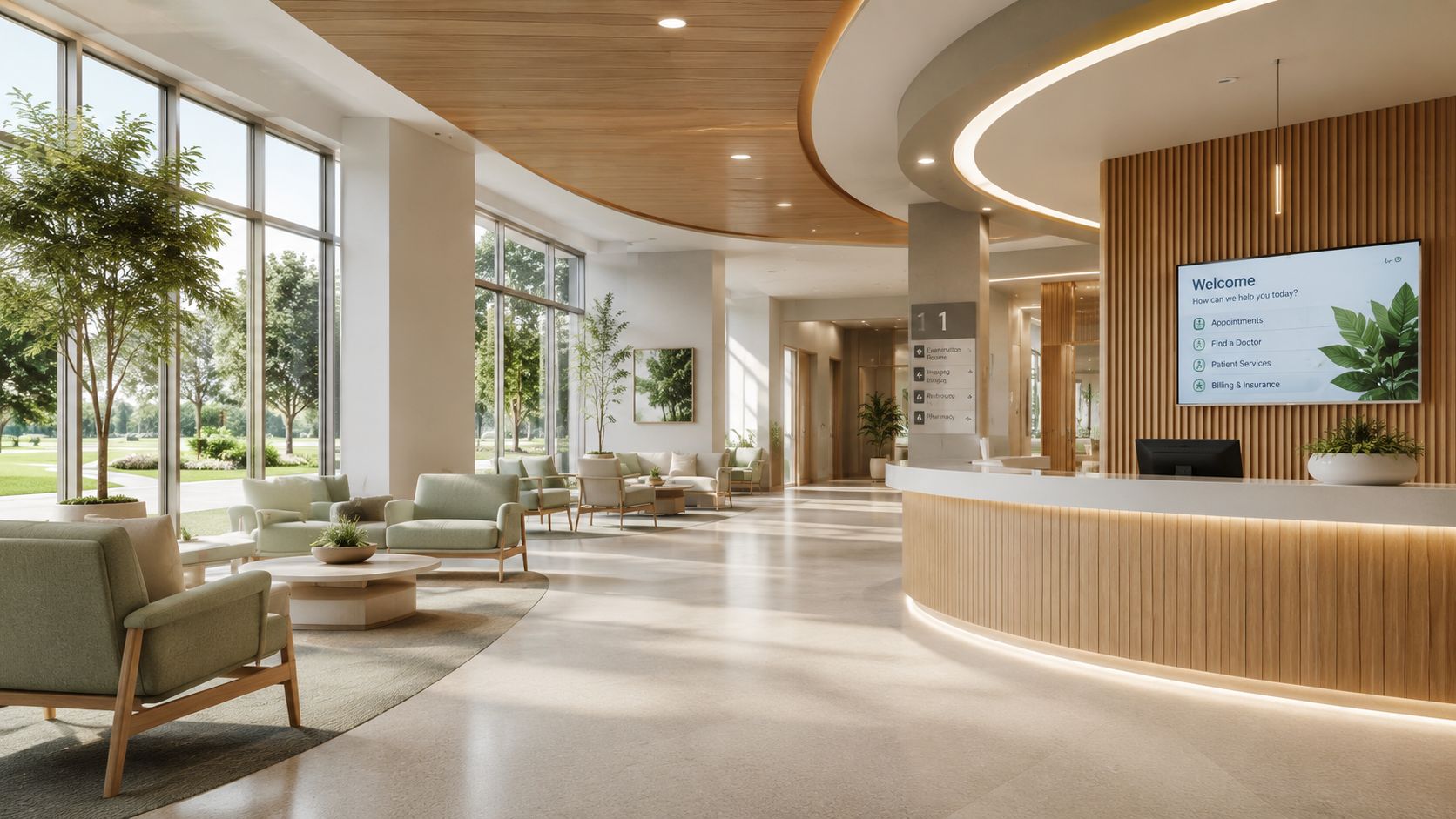
That waiting-area image tells an important story. Comfortable seating, warm finishes, and a cleaner visual rhythm signal that someone thought about the patient's idle moments, not just the treatment room.
Why design changes behavior
Patients behave differently when they feel oriented. They ask better questions. They're less distracted. Family members can focus on support instead of navigation. Staff also benefit when a building guides movement naturally instead of forcing constant verbal redirection.
For professionals in architecture, interiors, or healthcare planning, TownPark represents the kind of project where operational efficiency and patient comfort don't have to compete. The best medical environments do both. They reduce confusion while still looking dignified and human.
Good healthcare design isn't decoration. It's a wayfinding tool, a stress-management tool, and a trust-building tool at the same time.
If you enjoy looking closely at how interiors and circulation communicate purpose, architectural and interior photography that documents those details shows why strong images matter. They capture not just what a building looks like, but how it guides a person through it.
For a first-time visitor, that's the main point. TownPark Medical Center likely feels more manageable when you view it as a sequence of designed decisions: arrival, orientation, waiting, care, and exit. Each of those moments can either create friction or remove it.
Navigating Insurance and Patient Resources
TownPark Medical Center is a Kaiser Permanente facility, which is the first thing to understand before scheduling care. For many patients, that immediately raises a practical question: can I use this location with my plan, or do I need to confirm eligibility first?
The safest answer is to verify directly with Kaiser Permanente or through your member materials before the visit. Insurance rules can be confusing, and they often differ depending on whether you need routine care, specialty care, or urgent services. Even when a facility is the right place clinically, it's worth checking the administrative side early so you're not sorting it out at the front desk.
Questions to settle before your appointment
Use this short decision list if you're unsure where you stand:
- Are you already a Kaiser Permanente member? If yes, TownPark may fit naturally into your existing care network.
- Are you seeking urgent help or routine care? Access paths sometimes differ depending on the service.
- Did another clinician refer you? If so, keep the referral details with you.
- Do you need records, medication history, or test results available at check-in? Gather those before arrival if they aren't already in your health system record.
Administrative friction often comes from missing one small item. A forgotten member ID, an outdated medication list, or uncertainty about the appointment type can slow everything down.
Patient support goes beyond the bill
Insurance is only part of the experience. Patients also need practical support tools. In many systems, that means online portals for appointments and records, staff who can explain next steps, and guidance for follow-up care. Those resources matter because healthcare isn't just one visit. It's a chain of tasks.
If you're helping a family member, it also helps to write down a few things before the appointment:
| Bring or prepare | Reason |
|---|---|
| Current medication list | Helps clinicians confirm treatment safely |
| Symptom timeline | Makes the visit more focused |
| Referral or scheduling notes | Reduces check-in confusion |
| Questions in writing | Prevents forgetting concerns during the visit |
The best patient resource is preparation. A short written list of medications, symptoms, and questions often does more for a visit than trying to remember everything under stress.
If you're not sure whether TownPark is the right starting point for your situation, call before you go. Ask about the service you need, the documents to bring, and the best department for first contact. Clear information ahead of time usually makes the visit smoother than trying to solve each step after arrival.
Frequently Asked Questions for Patients and Families
You arrive with an older parent for a morning appointment. The building looks calm and well organized. The lobby is bright, the signs are readable, and the path from the entrance to registration feels more like a well-planned airport terminal than a confusing maze. Then the actual questions start. Where do you park next time? Who explains follow-up instructions in plain language? What happens if traffic makes you late?
Those are the questions that matter after the brochure language fades. Families want to know whether a medical center works well in real life, for people with jobs, caregiving duties, limited transportation, or ongoing treatment.
Public health research described in Milbank Memorial Fund's review of access barriers for underserved populations points to recurring obstacles such as transportation problems, limited primary care access, and administrative delays. The same review explains that support options like non-emergency medical transportation, mobile care services, and community health workers can improve access and trust. For patients considering TownPark, that is a useful lens. A well-designed facility should do more than look modern. It should help people get in, get care, and get home with less confusion.
What if getting there is the hardest part?
Distance on a map does not always match real effort. A center can be nearby and still be difficult to use if parking is unclear, drop-off areas are crowded, or check-in takes too long.
Ask practical questions before the visit:
- What arrival time gives me enough room for parking, registration, and finding the right department?
- Is there a simple drop-off option for older adults or patients with limited mobility?
- If I am running late, which number should I call right away?
These questions are part of care, not an extra detail. A patient-friendly campus should support the whole trip, from curb to clinic room.
What about language, health literacy, and respectful communication?
Good care should feel understandable. The building may be polished and efficient, but families still need clear explanations they can use at home.
Guidance summarized in the University of New Mexico's community health and cultural responsiveness overview highlights language-appropriate education, individualized care coordination, patient involvement in decisions, and support around referrals, social needs, and health literacy. In plain terms, patients should not have to decode medical language on their own.
It helps to ask:
- Can instructions be explained in the patient's preferred language?
- Will someone review medications, referrals, or next steps in plain words?
- Who should we contact if we get home and realize we do not understand the plan?
- How does the care team include the patient and family in decisions?
A strong center welcomes those questions and answers them clearly.
How can families tell whether the first visit went well?
Treat the visit like a test run. A hospital campus is a system of rooms, signs, people, and processes working together. If the design is thoughtful, it should reduce stress rather than add to it.
Look for simple signs. Was the route from entry to check-in easy to follow? Did waiting areas feel organized and calm? Did staff explain the next step before you had to ask? Once you got home, could you repeat the care plan without guessing?
A medically capable facility still needs to be easy to use. Families should judge both the treatment and the patient experience around it.
TownPark Medical Center stands out not only for the range of outpatient services it brings together, but also for the way its design can shape the visit itself. For patients, that means paying attention to access, clarity, and follow-through. For anyone interested in healthcare design, it also means noticing how space, signage, and workflow affect comfort and confidence.
If you need images that show how a medical facility, office building, or designed interior functions for the people using it, Jimmy Clemmons Photographer creates polished architectural and commercial imagery that captures both design intent and day-to-day experience.