
The problem usually shows up after the wall is closed, the trench is backfilled, or the schedule has slipped just enough for everyone to remember the sequence differently. A superintendent says the work was complete. A subcontractor says access was blocked. An owner wants proof, not a summary. At that point, blurry phone photos buried in a text thread are not documentation. They’re noise.
That’s why construction progress photography matters long before anyone needs to defend a decision. Done well, it creates a clear visual record of what was built, when it was built, and what conditions existed at each stage. Done exceptionally well, it does something more. It turns the build into a coherent narrative that serves operations, legal review, stakeholder communication, and future marketing without treating those goals as separate tasks.
An editor learns to ask two questions on every assignment: what happened, and what will matter later? That same discipline belongs on a job site. The strongest progress documentation isn’t just thorough. It’s intentional.
Beyond the Blueprint The Strategic Value of Visual Documentation
A week before a lender walkthrough, the owner asks for a clean visual summary of progress. On the same day, the architect wants confirmation that a facade transition was executed as detailed, and the contractor needs a dated image set that shows what was in place before the next trade covered it. One photo assignment now carries three different responsibilities. That is the point.
Construction progress photography has real value because a job site is always changing, and the decisions tied to those changes rarely stay in one lane. The same image may support quality review, settle a question about sequence, reassure a stakeholder, and later become part of a portfolio or investor package. If the coverage is careless, it fails all four. If it is planned well, it becomes a working asset for the entire project team.
Record keeping is only the starting point
Teams often treat progress photography like an administrative checkbox. That approach produces folders full of images and very little clarity.
Useful documentation is built around future use. It needs consistent viewpoints, accurate dates, readable context, and enough visual discipline to show where the condition sits within the structure. It also needs judgment. A photographer has to know when a wide overview is more useful than a dramatic angle, when a detail needs a scale reference, and when a repeated position matters more than novelty.
I approach these assignments with two priorities in mind. Protect the record. Preserve the intent.
The first is about evidence. The second is about authorship. A project is not only a sequence of installed materials. It is also a design idea taking physical form through structure, systems, skin, and finish. Good progress coverage shows both.
The strongest images carry operational and commercial value
An image that helps a superintendent verify field conditions can also help a developer explain momentum to investors. A carefully composed exterior progress frame can document envelope sequencing today and support leasing or awards submissions later. Those are different audiences, but they benefit from the same discipline. Clear framing, repeatable vantage points, legible detail, and a consistent visual standard.
That overlap is where the work becomes more strategic. Photography stops being a pile of site snapshots and starts functioning as project memory, risk control, and brand material at the same time. The business case is straightforward. Teams that already understand the ROI of professional photography usually recognize that construction imagery should meet the same standard.
Precision matters because the building changes fast
The useful frame is usually the one that answers a question before anyone asks it.
That means showing adjacency between trades, documenting conditions before they disappear, and returning to the same positions often enough that change is obvious without explanation. It means photographing structure, envelope, MEP rough-in, and finish work in a way that a project manager, architect, or owner can read quickly. A strong image does not just prove something was there. It shows where it was, how it related to the surrounding work, and what stage the project had reached.
This is also where a high-end editorial approach earns its place. Editorial discipline is not about making a job site look glamorous. It is about sequencing images so the build reads clearly from first site work to final detailing, with enough consistency that the record has both authority and narrative shape.
Construction documentation should read like the story of the build
Every project has turning points. Excavation gives way to structure. Structure gives way to enclosure. Mechanical systems disappear behind walls. Natural light starts to define rooms the way the drawings promised it would. Those moments deserve more than incidental coverage.
Strong visual documentation follows the arc of the project with intention. It reduces ambiguity, supports better communication, and captures the design logic that can get lost in the speed of construction. The result is more than proof. It is a precise visual history of how the building came together.
From Raw Site to Finished Structure Defining the Deliverables
A superintendent is asked a simple question during an OAC meeting. When was that penetration cut, what was behind the wall at the time, and how did the condition relate to the adjacent work? If the visual record is thin, the room starts relying on memory. If the record is built correctly, the answer is already on screen.
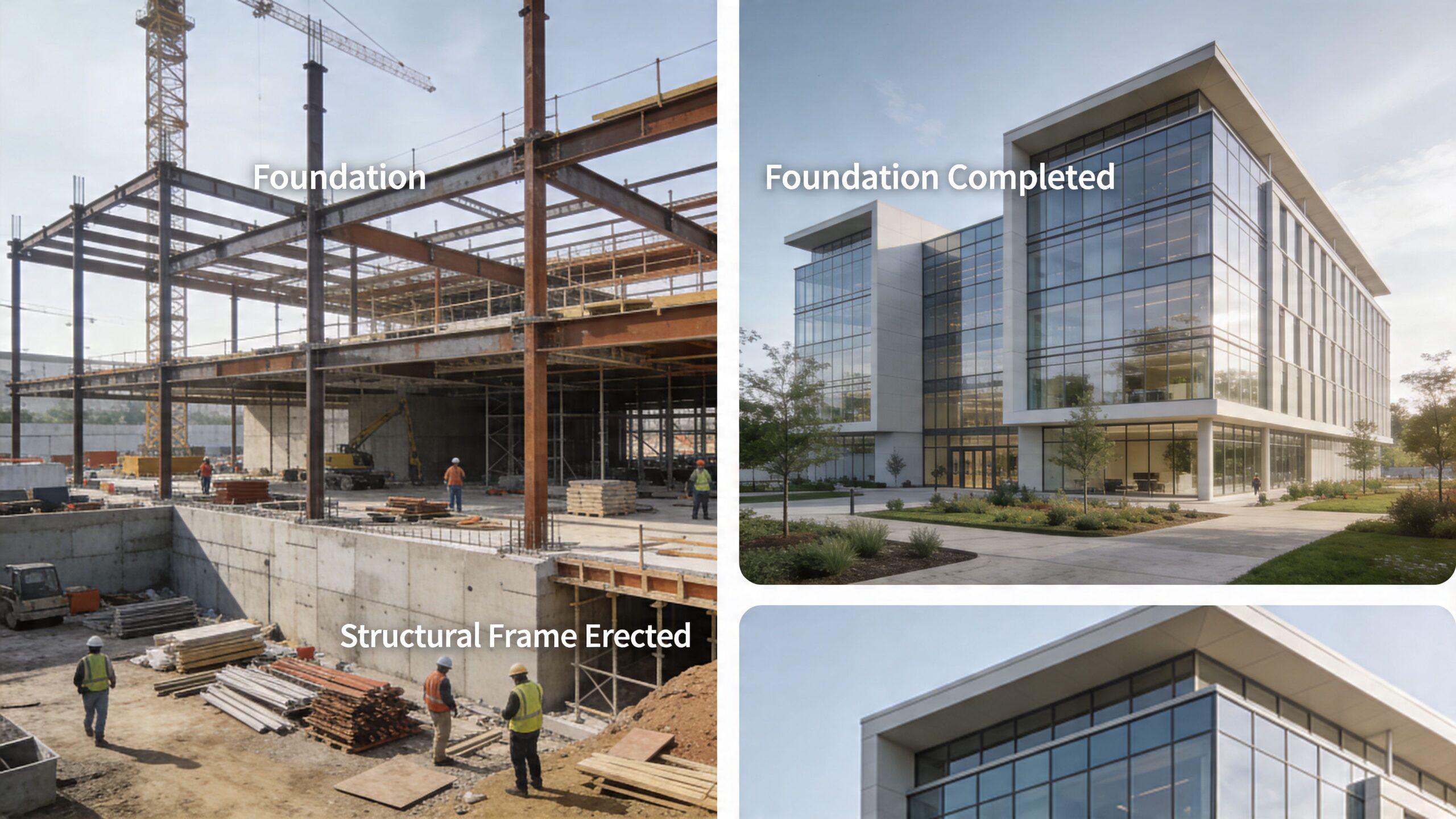
That is the core function of the deliverables. Construction progress photography is not one product. It is a set of visual tools, each suited to a different kind of decision, risk, and audience. The standard package usually includes high-resolution stills, time-lapse, and aerial drone imagery, but the value comes from assigning each format a clear role instead of collecting images for their own sake.
High-resolution stills for detail accountability
Still photography carries the heaviest load because it has to work under scrutiny.
These images need to answer practical questions fast. Where exactly was the work located? What had been completed around it? Was the condition temporary, concealed, or finished? A strong still frame gives that answer without forcing the viewer to guess at scale, orientation, or sequence.
Useful still coverage usually includes:
- Wide context views that place the work within the site, elevation, or floor plate
- Mid-range progress views that show coordination between trades and the relationship between adjacent assemblies
- Tight detail images of MEP rough-in, waterproofing, envelope interfaces, structural connections, and finish transitions
- Repeatable key views captured from the same position across site visits so changes read clearly over time
The trade-off is simple. The more useful an image needs to be later, the more disciplined it must be at the moment of capture. A technically acceptable photo can still fail if the camera height is wrong, the lighting obscures a penetration, or the composition buries the condition in clutter. On active sites, I often spend more time clearing the frame and finding the correct line of sight than pressing the shutter. That extra minute is what turns a record shot into usable evidence.
For contractors, stills support QA, closeout, and dispute prevention. For architects, they preserve design intent through phases when assemblies are exposed only briefly. For owners and developers, they create a readable record of progress that is far more convincing than a status report alone.
Time-lapse for momentum and sequence
Time-lapse serves a different purpose. It shows how the site behaved over time.
A good sequence can clarify crane picks, concrete operations, façade installation, weather delays, staging shifts, and the daily choreography of multiple trades working in constrained space. That matters because many project questions are really sequence questions. Teams are trying to establish what happened first, what overlapped, and how quickly conditions changed.
Here’s a useful example of the medium in action:
Time-lapse is not necessary on every job. It earns its keep on projects with long durations, public visibility, complex logistics, investor reporting needs, or schedule pressure where the chronology itself may later matter. It is less helpful when the site has limited vantage points, low visual change between intervals, or no clear stakeholder use beyond novelty.
Used well, time-lapse becomes more than a promotional extra. It gives teams a visual audit trail and gives marketing teams material that shows progress with authority rather than vague optimism.
Drone imagery for context and logistics
Drone coverage adds the views the ground cannot provide cleanly.
It is especially useful for large sites, roof work, grading, access routes, laydown areas, façade sequencing, and the relationship between the project and its surroundings. Aerial views can explain logistics in one frame that would take a dozen ground photographs to piece together. They can also reduce the need to place people in awkward or risky positions just to document routine conditions.
As Magic Lens explains in its overview of aerial photography in construction, drone imagery has become a valuable tool for surveys, inspections, and progress tracking because it combines speed, site coverage, and a perspective that is difficult to get any other way.
A drone image also has limits. It can show access and massing clearly, but it will not replace a well-made interior still when the issue is firestopping, coordination above ceiling, or finish quality at eye level. Good deliverables are built around those limits. They do not ask one format to do another format's job.
The strongest construction documentation packages combine stills for proof, time-lapse for sequence, and aerials for site context. Together, they create a visual record that supports operations in the moment and preserves the story of the build long after the temporary conditions are gone.
Creating a Visual Timeline The Cadence and Shot List
A superintendent calls three months after drywall is up. The question sounds simple. Was that penetration sealed before the wall was closed? If the archive has one blurry phone photo and no location context, the image is useless. If the job was photographed on the right days, from the right positions, with a consistent filing logic, the answer is on hand in minutes.
That is why cadence matters.
The most expensive gap in a progress archive usually happens just before work disappears. Excavation changes by the day. Steel can alter the reading of a site between one visit and the next. MEP rough-in may look chaotic in the field, but once walls and ceilings are closed, those conditions become the record everyone wishes they had. Construction progress photography works best when the schedule follows risk, speed, and concealment instead of a flat monthly routine.
Match frequency to what can disappear
Photograph the work more often when conditions are changing fast or about to be covered.
Framing often needs repeat views from the same corners because alignment, access, and structural relationships shift quickly. Rough-in needs disciplined coverage before drywall, ceilings, and insulation hide the evidence. Finish phases usually need fewer visits, but the standard for composition rises because the audience changes. Owners, architects, leasing teams, and future marketing staff all start using the same archive for different reasons.
Time-lapse can support that record when sequence matters, but it should be assigned carefully. It is useful for site turnover, crane work, envelope installation, and other operations where timing and progression may need to be reviewed later. It does not replace a still photographer who knows when to stop and document a detail that will matter in a dispute, a submittal review, or a publication spread.
Sample Construction Progress Shot List & Frequency
| Project Phase | Key Shots / Views | Recommended Frequency |
|---|---|---|
| Site prep | Property boundaries, existing conditions, grading progress, access roads, staging areas, utility work, overall site overviews | Weekly |
| Foundations | Excavation, formwork, reinforcing, embeds, waterproofing, underslab services, pre-pour conditions | Weekly and before each major pour |
| Structural framing | Column lines, beam connections, deck installation, stair cores, floor-by-floor wide views, repeat corner angles | Weekly or more often during active erection |
| MEP rough-in | In-wall and above-ceiling runs, risers, equipment rooms, penetrations, coordination zones, congested ceiling areas | Before concealment and at key coordination milestones |
| Building envelope | Sheathing, air barrier, flashing, window installation, façade progress, roof edge details, exterior elevations | Bi-weekly |
| Interior fit-out | Drywall progression, millwork, lighting, flooring, feature elements, major rooms, lobbies, corridors | Bi-weekly to monthly |
| Final completion | Clean architectural views, amenities, exterior approaches, signage, detail craftsmanship, day-to-night exteriors if needed | At substantial completion and final turnover |
That table is a starting framework.
A hospital needs a different visual priority than a school, a multifamily tower, or a manufacturing facility. On healthcare jobs, I usually spend more time on above-ceiling coordination, equipment spaces, and circulation logic. On a branded office or hospitality project, the finish sequence and design intent carry more weight near the end. The shot list should reflect what the team may need to prove later, what the architect wants preserved, and what the owner will want to show publicly.
Build a repeatable shot logic
A strong archive is built on repeatability. The camera should return to the same vantage points often enough that progress reads clearly across weeks and months, then break from that pattern only when the site presents something new that deserves coverage.
I use four layers:
- Establishing views from site corners, adjacent streets, rooftops, or upper floors that explain the project in context
- Zone-based coverage that follows a floor plan, grid line, or room sequence so interiors can be searched logically later
- Trade-specific details such as waterproofing transitions, penetrations, hanger layouts, firestopping, equipment setting, and façade interfaces
- Editorial frames that show labor, craft, material quality, and the architect’s intent as the building starts to read as architecture instead of assembly
That last category is often overlooked. It has real value. The same photograph that clarifies installation quality for a project team can later support an award submission, investor presentation, recruiting effort, or case study if it was made with enough care.
Consistency starts before the photographer arrives. A little planning around access, cleanup, and timing can improve the usefulness of every visit. This guide on preparing your project site for a professional photoshoot covers the practical steps that make repeat documentation more accurate and more usable.
Avoid two costly mistakes
One mistake is sparse coverage. The archive looks fine until a question lands on the one week no one photographed.
The other mistake is volume without structure. Thousands of files, random angles, no room tags, no floor labels, no clear sequence. That does not create certainty. It creates search work.
Selective completeness is the standard to aim for. Record every condition that is temporary, concealed, technically sensitive, or likely to be reviewed later. Repeat the major vantage points. Then add enough context that someone who was never on site can understand what they are looking at and where it sits in the build story.
When cadence should change
A schedule set at kickoff should not stay fixed out of habit. Adjust it when the job changes.
Increase coverage when multiple trades begin stacking work in the same area, when walls or ceilings are about to close, when lender draws or owner reviews are approaching, or when the project hits visible milestones such as dry-in, commissioning, and turnover preparation. Those are the moments when photography stops being simple record keeping and becomes a working project asset.
The strongest visual timelines do more than prove progress. They preserve intent, reduce uncertainty, and turn the life of a jobsite into a record people can use long after the temporary conditions are gone.
Navigating the Active Job Site Logistics Safety and Collaboration
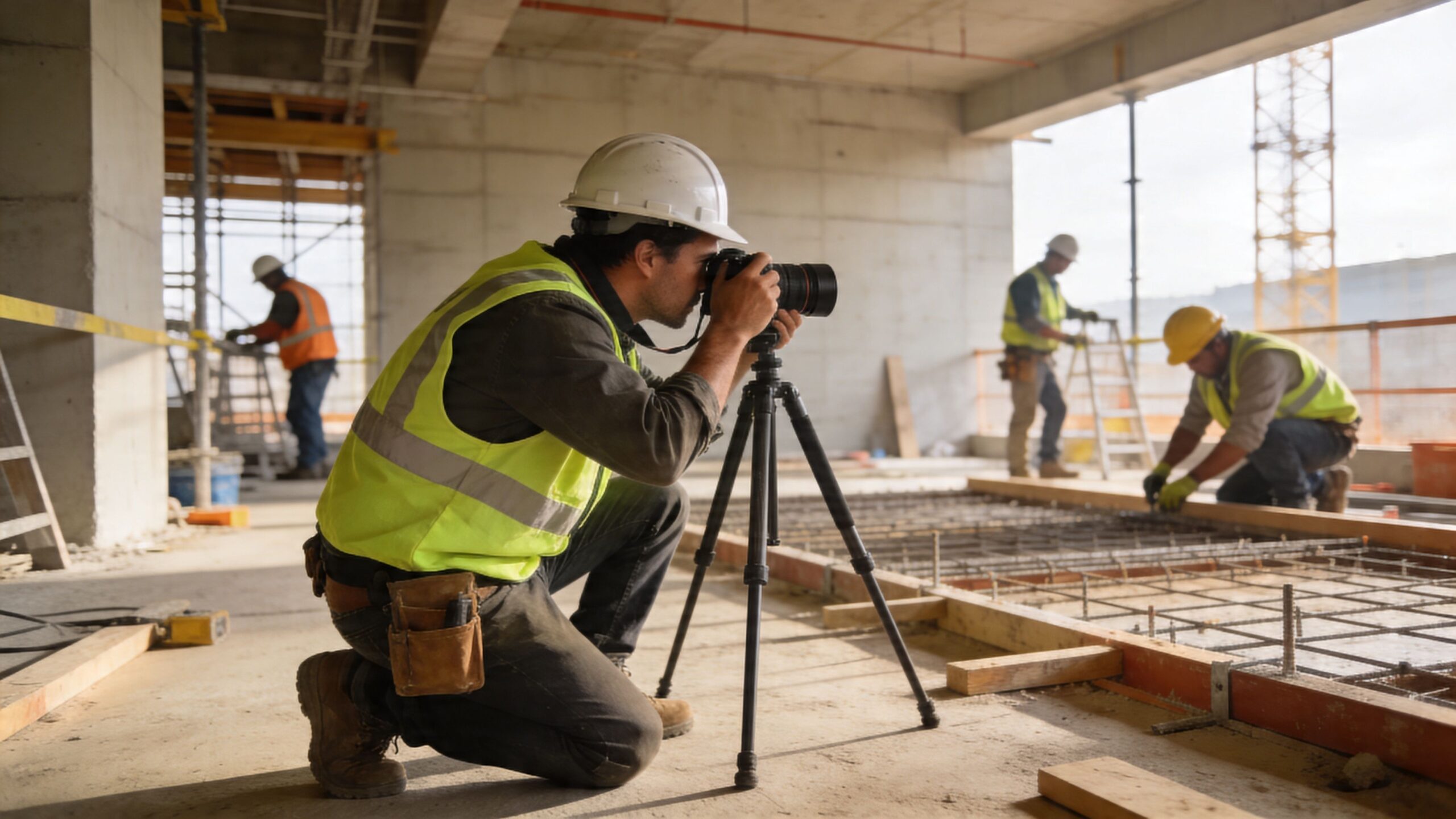
At 9:40 a.m., the slab pour is running, a lift is backing into position, and three trades are sharing the same piece of ground. That is not the moment for a photographer to improvise. Progress coverage on a live site only works when the person with the camera understands site operations, respects the chain of command, and can get the record without slowing the work.
Professionalism lowers risk for everyone
Good site photography starts before the first frame. PPE has to match site requirements. Sign-in, orientation, and access approval need to be handled correctly. The superintendent or site lead should know where the photographer is going, what needs to be covered, and which areas are off limits that day.
That discipline protects more than people. It protects the usefulness of the archive.
A rushed walk-through, poor coordination, or casual access can miss concealed work, interrupt a sequence, or create confusion about what was photographed and when. On a project with real money, real liability, and multiple stakeholders, that weakens the record. The job of progress photography is to reduce uncertainty, not add another variable.
Site etiquette is part of the craft
Crews notice immediately whether a photographer belongs on a job site. The good ones work with the rhythm of the build. They wait for the signalman to clear a path. They stay out of active lift zones. They do not block staging areas, material routes, or the crew that is trying to finish a time-sensitive installation.
A few habits make the difference:
- Coordinate before arrival so access limits, active work zones, and schedule constraints are clear
- Follow the communication chain through the superintendent, project manager, or safety lead
- Work around the trades without interrupting lifts, staging paths, or material movement
- Know when to hold position because some conditions cannot be photographed safely in real time
- Confirm priority areas early so concealed work and inspection-sensitive details are not missed
For teams planning a visit, practical steps to prepare your project site for a professional photoshoot can help the day run cleanly.
Collaboration produces a better record
The strongest progress images usually come from a short conversation, not from better equipment.
The superintendent knows where the schedule is tightening. The project engineer knows which assemblies will disappear behind drywall or above ceiling. The architect knows which moments still express the design intent, even in rough conditions. Bring those priorities together before the walk, and the photo set becomes more than proof that work happened. It becomes a strategic record of how the building came together, where decisions were made, and what conditions existed before they changed.
One question consistently sharpens coverage: what will be hidden by next week?
That question shifts the session away from generic update photos and toward images the team may need for coordination, owner communication, claims review, closeout, and future marketing. It is also where a high-end editorial approach earns its keep. The goal is not just to show activity. The goal is to preserve the sequence, protect the intent, and produce images that still carry meaning after the job site is gone.
From Capture to Cloud A Modern Asset Management Workflow
A progress photo has almost no value if the team can’t retrieve it fast.
That’s the unglamorous truth. Construction progress photography becomes powerful after capture, when the images are organized into a searchable system that preserves context. Without that structure, even strong photography dissolves into a folder problem.
A usable archive starts with naming discipline
The cleanest systems use consistent file names and a predictable folder structure.
A simple convention like ProjectName_YYYY-MM-DD_Area_View works because it sorts naturally and tells the truth at a glance. Teams can then mirror that structure in folders by date, building, level, or zone depending on how the project is managed.
Useful metadata should stay attached to the image whenever possible. At minimum, preserve capture date, time, and location context. If drone or mobile workflows include GPS information, don’t strip it away in delivery. In disputes, that metadata can matter as much as the picture itself.
Delivery should support decisions, not just download links
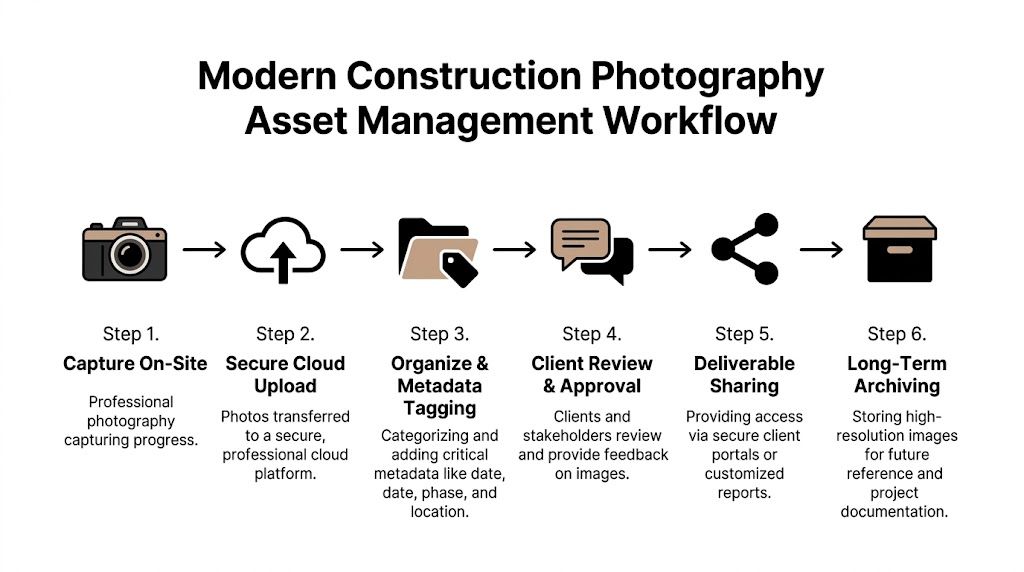
A modern workflow usually looks like this:
- On-site capture using still cameras, drones, time-lapse systems, or 360 tools
- Secure cloud upload to a centralized platform rather than scattered personal devices
- Tagging and organization by date, phase, location, and sometimes trade or milestone
- Client review through a private gallery or portal with clear navigation
- Distribution to stakeholders who need selected sets for reporting, QA, or marketing
- Long-term archiving for future claims, operations, and portfolio use
That process sounds basic. In practice, it’s where many projects either gain clarity or lose it.
360 and immersive records are changing expectations
Teams increasingly want more than flat folders of JPEGs. They want clickable history.
The integration of AI-driven 360° VR and immersive tech is a major trend in progress documentation. Industry reports from 2025 note 40% growth in VR construction tools, and pro-led VR has been shown to yield double the stakeholder engagement compared with automated capture in major markets like the US Southeast (Alpha Bravo on construction photography and immersive documentation).
That doesn’t mean every project needs an immersive workflow. It does mean expectations are shifting. Owners and project teams want to review spaces remotely, compare conditions spatially, and access imagery in ways that feel intuitive.
A strong archive answers three questions quickly: where was this taken, when was it taken, and what exactly am I looking at?
The photographer’s workflow affects legal value
Here, professional process matters more than aesthetics.
If files are renamed inconsistently, exported without metadata, or delivered in mixed batches with no logic, the record weakens. If images are grouped by phase and location, backed up properly, and delivered through a controlled system, the same archive becomes far more defensible.
The strongest visual records aren’t just beautiful and thorough. They’re organized so another person can trust them.
How to Hire a Construction Progress Photographer
Hiring well starts with a shift in mindset. Don’t hire for camera ownership. Hire for judgment under field conditions.
A photographer can have an impressive portfolio and still be the wrong fit for construction progress photography. The work demands technical consistency, site awareness, delivery discipline, and an understanding of what matters to contractors, architects, developers, and owners at different stages of the project.
What to ask before you book
Skip vague questions about “style” at the start. Ask operational questions first.
A serious candidate should answer clearly on points like these:
- Insurance coverage including general liability, and separate drone coverage if aerial work is part of the scope
- Flight compliance if drones are offered, including who pilots and how site approvals are handled
- Safety readiness such as PPE standards, site induction familiarity, and training relevant to active construction environments
- Project experience on comparable building types, scales, and phases
- Capture plan for repeat views, concealed conditions, milestones, and stakeholder-specific needs
- Asset management process including file naming, folder logic, metadata preservation, and cloud delivery
- Turnaround expectations for routine visits and priority requests
- Licensing terms covering who may use the images, where, and for what purpose
A weak answer usually sounds broad. A strong answer sounds procedural.
Look for signs of field intelligence
Portfolio quality matters, but not in the usual way.
You’re looking for evidence that the photographer can build a readable archive. Are the angles consistent across different visits? Do the images orient the viewer clearly? Are there both overview shots and technical detail shots? Can the photographer explain why a certain view was chosen, not just why it looks good?
That distinction matters. Construction imagery has to perform before it impresses.
A useful brief is specific
Most hiring problems start with a vague request. “Come photograph progress once a month” is not a brief. It’s a placeholder.
A stronger brief usually includes:
- Project basics such as location, building type, team members, and target schedule
- Primary purpose like QA documentation, owner reporting, dispute protection, marketing, or all of the above
- Required deliverables including stills, drone images, time-lapse, 360 capture, or edited reports
- Key milestones that must be documented before work is concealed
- Priority areas such as amenity spaces, equipment rooms, façade details, or public-facing elevations
- Site rules covering PPE, escorts, access windows, and safety protocol
- Delivery format for galleries, folders, naming conventions, and contact distribution
If you need a benchmark for the visual quality and discipline expected from a design-focused professional, review the standards represented by a commercial architectural photographer.
Understand the pricing models
Construction progress photography is commonly priced in three ways.
A per-visit fee fits shorter jobs or projects with irregular milestones. A monthly retainer works well when the site needs reliable recurring coverage. A full-project package makes sense when the client wants start-to-finish continuity across multiple deliverables.
The cheapest option often becomes expensive if the archive is inconsistent. The highest fee isn’t automatically the best value either. What matters is whether the proposal matches the project’s cadence, risk profile, and reporting needs.
Contract details that deserve attention
Before signing, confirm these points in writing:
- Image usage rights for internal reporting, marketing, editorial submission, and third-party sharing
- Delivery schedule for both routine updates and urgent milestone documentation
- Weather and access contingencies especially for drone and exterior sessions
- Archive duration and whether long-term retrieval is included
- Edit expectations so the team knows what level of processing and organization is being delivered
A smart hire gives you more than pictures. It gives you confidence that the record will hold up later.
Building More Than a Structure Building Your Legacy
Construction progress photography does more than prove a wall was framed or a façade was installed on time. It preserves the intelligence of the build.
The archive records decisions, sequencing, craftsmanship, and problem solving. It shows how architects translated intent into built form, how contractors managed complexity, and how the project team moved from uncertainty to completion. That record has practical value in the moment, but it also has lasting value after the ribbon cutting, when the only thing left from the process is what was captured well.
The strongest projects deserve more than scattered snapshots. They deserve visual documentation with enough rigor to protect the team and enough craft to honor the work. That combination is what turns construction progress photography from a compliance exercise into a strategic asset.
For developers, architects, and contractors, the payoff is unusually broad. Better alignment during the build. Stronger documentation when questions surface. Better material for future proposals, awards, leasing, and portfolio storytelling. One disciplined workflow can serve all of those needs if it’s designed correctly from the beginning.
And there’s a deeper reason to take it seriously. Every project is temporary while it’s underway. Trades move through, conditions change, and the evidence vanishes behind the next layer of work. A thoughtful visual record is the only way to keep that history intact. It becomes the memory of the project, but a memory you can verify.
If you're planning a project in Atlanta and want construction imagery handled with editorial precision, architectural sensitivity, and job-site discipline, Jimmy Clemmons Photographer can help document the story of your build from first phase to final finish.