
You’re usually at the same point when this question becomes urgent. The project is finally photo-ready, or close enough that leasing, investor relations, public relations, and the design team all want images now. The temptation is to treat photography like the last box to check.
That’s where large developments get mishandled.
A single listing can survive with fast coverage and basic wide shots. A campus, mixed-use district, multifamily community, hospitality property, or phased commercial development can’t. Those projects need a visual system. The photography has to show scale, design intent, tenant experience, circulation, materials, context, and the emotional logic of the place. It also has to work across signage, pitch decks, leasing pages, media kits, print collateral, and long-tail brand use.
Hiring Photographers for Large Developments isn’t just about finding someone with a good camera. It’s about choosing a specialist who can manage complexity, collaborate with multiple stakeholders, and produce images that still feel cohesive months later when the next phase opens.
Your Multi-Million Dollar Project Deserves More Than Snapshots
The steel is up. The punch list is shrinking. The outdoor areas look good in some areas and unfinished in others. Leasing wants exterior twilight shots. The architect wants clean compositions. Your investor team wants scale and polish. The GC wants construction progress documented without chaos in the frame.
That’s not a normal real estate shoot.

Most online advice about hiring photographers is built around single properties. It rarely addresses retainers, scaled teams, or the complexities of visual coverage across a large project. One source even notes that existing content overwhelmingly focuses on single properties and rarely addresses ongoing retainers, team scaling, or how high-end architectural imagery can boost sales by 20 to 30% in major markets via Evolve’s partner photography page.
What changes at development scale
A large development creates problems small-property advice doesn’t solve:
- Scope creep: One “quick shoot” turns into exteriors, interiors, amenity spaces, aerials, tenant-ready marketing, and progress documentation.
- Timing conflicts: The best light rarely lines up with site access, trade schedules, or final cleaning.
- Brand inconsistency: If different phases are photographed without a shared visual approach, the project starts to look fragmented.
- Stakeholder overload: Developers, architects, designers of outdoor spaces, brokers, and marketing teams often want different things from the same shoot.
Practical rule: If the images will be used by more than one department, photography is no longer a simple vendor task. It’s a strategic production.
That’s why the right approach starts before you review a portfolio. You need clarity on what the images are supposed to do in the market. Once that’s defined, the photographer becomes a creative and logistical partner instead of a last-minute expense.
Beyond the Blueprint Defining Your Photographic Goals
The first mistake developers make is shopping for a photographer before they’ve defined the assignment. If you don’t know what the images need to accomplish, you’ll compare photographers on style alone. That’s how teams hire someone who makes attractive images that don’t serve leasing, sales, or brand positioning.
That gap matters more now than ever. Since photography began, more images are now produced in two minutes than in the first twenty years of the medium, yet professional skill in composition and narrative still matters for commercial work, and architectural demand has held steady despite industry shifts according to the State of the Photography Industry 2025 report.
Documenting a property isn’t the same as marketing a development
A documentation mindset asks, “Did we photograph the lobby?”
A marketing mindset asks, “Does the lobby image communicate arrival, material quality, circulation, and the kind of tenant or buyer we want to attract?”
Those are different briefs. One creates coverage. The other creates persuasion.
For a luxury residential project, you may need quiet, editorial interiors that suggest privacy, craftsmanship, and routine. For a mixed-use district, you may need street-level energy, layered pedestrian movement, and context that makes the site feel connected to the city. For a corporate campus, the story may center on transparency, scale, and workplace culture.
Start with business use, not shot count
Before an RFP goes out, answer these questions internally:
Who is the audience
Investors, tenants, brokers, condo buyers, future clients, media, or municipal stakeholders.What decisions should the images support
Lease inquiries, sales conversations, design awards, press coverage, recruitment, or future business development.What stage are you photographing
Construction progress, substantial completion, soft opening, stabilized occupancy, or a phased campaign over time.Where will the images live
Website headers, brochures, presentation decks, ad placements, social, print, environmental graphics, or editorial submissions.
A strong brief changes what gets prioritized. If the main use is investor communications, context, massing, and site planning matter. If leasing is the priority, street activation, amenities, and experience matter more.
Build a narrative shot list
A good shot list doesn’t read like a room inventory. It reads like a sequence.
Use a progression like this:
- Context frames: Show the project in its urban or exterior setting.
- Approach images: Capture how a person arrives, enters, and orients.
- Hero views: Highlight the signature elevations, public spaces, or major design moves.
- Human-scale moments: Show texture, seating, circulation, and spatial comfort.
- Detail vignettes: Materials, joins, lighting, signage, and crafted decisions.
- Utility views: Vertical circulation, parking access, retail frontage, wayfinding, loading, shared spaces.
The strongest development photography usually works like a magazine feature. Each frame does its own job, but the full set tells a coherent story.
A creative brief that gets better results
Your brief doesn’t need agency jargon. It needs decisions.
Here’s a practical template your team can use:
| Brief element | What to define | Why it matters |
|---|---|---|
| Project objective | Leasing, investor deck, launch campaign, awards, archival use | Determines priority shots |
| Audience | Buyer, tenant, broker, media, stakeholder | Shapes tone and image selection |
| Visual tone | Editorial, polished corporate, design-forward, lifestyle-led | Keeps the work stylistically consistent |
| Key features | Façade, public realm, lobby, amenities, views, materials | Prevents missed priorities |
| Time sensitivity | Opening date, media deadline, phased completion | Affects schedule and staffing |
| Site constraints | Access limits, active trades, staging gaps, safety rules | Reduces shoot-day surprises |
Decide what not to shoot yet
In such cases, experienced teams save money.
If one wing still has temporary signage, unfinished landscaping, or vacant retail bays that will undercut the message, hold it for a later phase. It’s better to create a clean first campaign from the strongest parts of the project than to force extensive coverage before the property is ready to support it.
That discipline also helps your photographer plan around reality instead of promising magic in post.
How to Find and Qualify True Architectural Photographers
A developer hires a photographer after seeing a polished portfolio. The sample images look expensive, the call goes well, and the fee seems reasonable. Then the job hits real site conditions. One tower is open, another is still under wraps, retail signage is temporary, the grounds work is behind schedule, and marketing needs a usable first set now, not after final completion. That is where weak fit shows up fast.
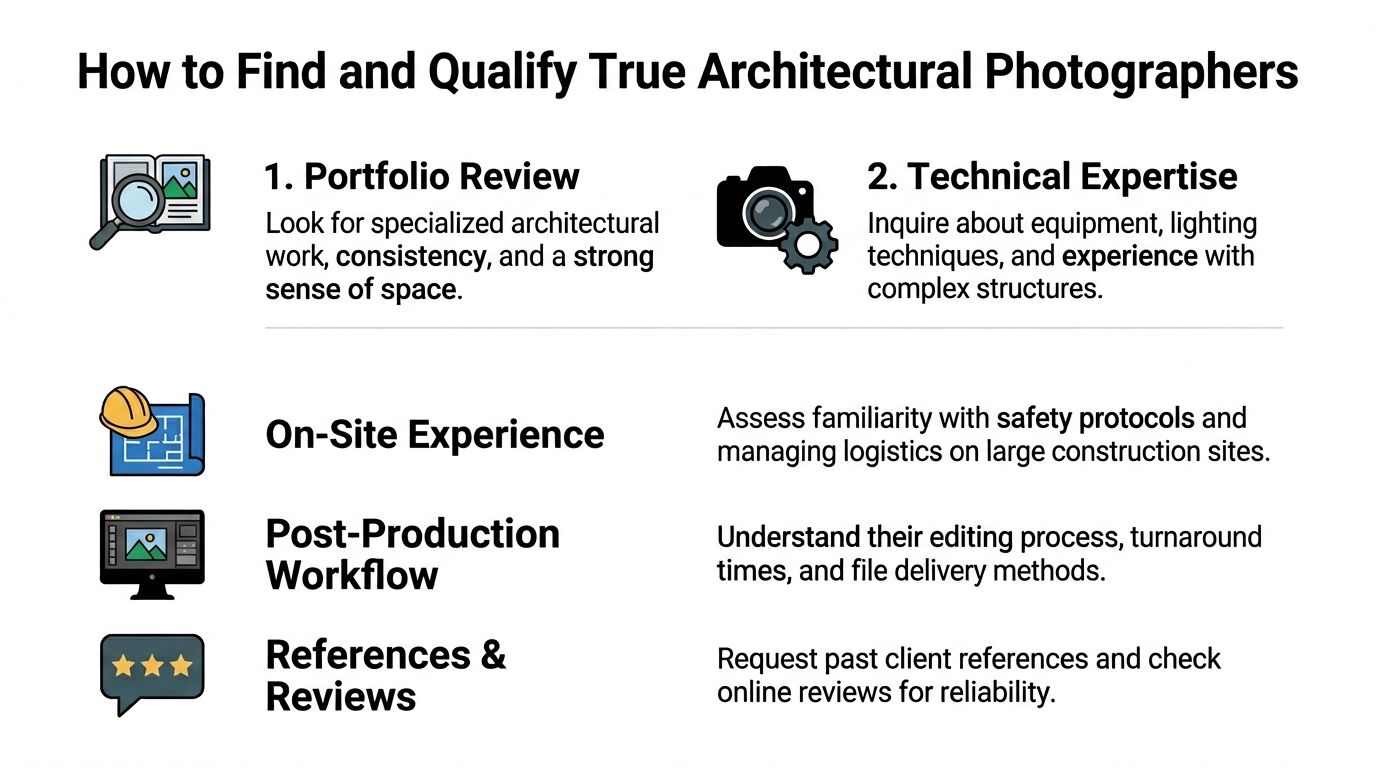
Large developments expose gaps that smaller shoots can hide. You need a photographer who can work across phases, hold visual consistency over months, coordinate with multiple stakeholders, and build a library that works for leasing, PR, investor communication, and long-term archive use.
Read the portfolio like a developer, not a fan
A strong portfolio should answer operational questions before it answers aesthetic ones.
Can the photographer control mixed lighting in amenity spaces without turning finishes muddy? Do verticals stay disciplined across lobby, corridor, unit, and exterior work? Is lens choice controlled enough that the architecture still feels true to scale? Can the photographer move from hero exteriors to leasing-focused interiors to small brand details without the set feeling fragmented?
Consistency matters more on a development than on a one-off building. You are not hiring for a single cover image. You are hiring for repeatable judgment across changing weather, changing access, and changing project readiness.
Editorial storytelling is the standard to look for. The portfolio should feel sequenced, with establishing views, transitional images, detail frames, and lived-in moments that support the identity of the place. If every image is a stand-alone trophy shot, the photographer may struggle when your marketing team needs a full campaign set instead of a handful of highlights.
What separates architectural photographers from real estate shooters
The difference is not status. It is process.
Real estate shooters are often built for speed and broad coverage. That can work for apartment turns, broker inventory, or quick listing updates. Large developments usually need something else. They need design fidelity, patience, tighter styling control, and a point of view that can support a premium brand position.
Look for these distinctions:
- Composition discipline: Strong architectural photographers build the frame around the design intent, circulation, and hierarchy of the space.
- Lighting control: They correct color contamination, manage reflections, and shape the room so materials read correctly.
- Timing judgment: They know when facade light, lobby activity, and skyline visibility are helping the image and when they are hurting it.
- Sequence thinking: They shoot in sets that can support brochures, websites, media outreach, awards submissions, and future phases.
- Restraint in post: They improve the scene without making the building look fictional.
You can see that kind of design-led, campaign-ready approach in commercial architectural photography work.
Use a qualification process, not instinct alone
For a large development, hiring on taste alone is expensive. The safer approach is to qualify photographers the way you would qualify any specialist consultant. Review the work, test the workflow, and check whether the person can handle complexity without adding friction to the project team.
A simple framework works well.
Portfolio contextualization review
Ask candidates to walk through two or three relevant projects in detail.
Do not stop at, “How did you make this image?” Ask what the client needed, what constraints existed on site, what was shot in one phase versus held for later, and how the final set was used. Good answers reveal planning, not just taste.
Useful questions include:
- What was the assignment objective for this project?
- Which stakeholders approved the shot list?
- What did you exclude because the site was not ready?
- How did you keep the work visually consistent across multiple shoot days?
- Which images performed different jobs in the campaign?
That conversation tells you whether the photographer understands development marketing or only image-making.
Technical and workflow audit
Strong photographers should be able to explain deliverables in plain language.
Ask about file types, color workflow, retouching standards, delivery structure, naming conventions, and revision process. Ask how they handle compositing for window views, reflective surfaces, amenity lighting, and exterior replacements when weather breaks the schedule. If the answers drift back to camera bodies and lenses, you still do not know whether they can deliver assets your design, leasing, and agency teams can use.
Ask direct questions:
- What final file formats do you deliver for print, web, and PR use?
- How do you handle mixed color temperatures in interiors?
- What is your retouching threshold before the image stops representing the project accurately?
- How do you organize files across phases so marketing teams can find them later?
- What is your backup plan if weather or site access cuts the day in half?
On a development assignment, workflow maturity saves money long after the shoot is over.
Reliability stress test
References should come from comparable projects. A glowing review from a restaurant owner or a residential broker does not tell you much about a phased mixed-use development.
Ask previous clients specific questions:
- Did the photographer arrive with a clear plan?
- Did they communicate schedule risks early?
- Were they effective with architects, property teams, stylists, and agency contacts in the same room?
- Did they deliver complete, organized files on schedule?
- Would you trust them to return six months later and match the original visual language?
A development shoot fails in plain sight. You still receive files. The problem is that they arrive late, miss key assets, vary in look from phase to phase, or create more post-production and coordination work for your team.
Questions worth asking in interviews
The interview should test judgment under real project conditions.
| Interview question | What you’re testing |
|---|---|
| How would you phase photography across a partially complete site? | Planning across milestones |
| What do you need from our team to keep the imagery consistent over multiple shoots? | Collaboration and process clarity |
| How do you decide when a space needs styling, people, or a cleaner architectural treatment? | Brand and editorial judgment |
| What usually causes delays on projects like this, and how do you prevent them? | Operational honesty |
| Who handles retouching, file organization, and version control after capture? | Post-production maturity |
Listen for concrete answers. Experienced photographers talk about access windows, sun path, temporary signage, union rules, loading docks, concierge coordination, and approval chains. Those details show they have worked on real projects at this scale.
Warning signs in candidate reviews
A few patterns should make you cautious:
- The pitch is gear-heavy: Tools matter, but they are not the deliverable.
- The portfolio jumps across unrelated genres: General skill does not guarantee fit for architecture and development marketing.
- The work looks overprocessed: Aggressive HDR, fake skies, and distorted rooms usually point to weak control on site.
- There is no clear feedback process: Large teams need organized review rounds and file management.
- Every project has the same visual treatment: Good photographers respond to the architecture instead of forcing a signature style onto every property.
The right hire often sounds measured. They ask sharp questions, speak clearly about scope and constraints, and understand that a large development is not one shoot. It is a visual program that has to hold together from first release through final stabilization.
Structuring Budgets and Contracts for Large Developments
The contract is where many development photo assignments either become smooth or become expensive. Most friction doesn’t come from the creative fee itself. It comes from unclear scope, undefined usage, extra retouching, delayed approvals, and fuzzy expectations about what “the shoot” includes.
That’s why budgeting needs to match the actual complexity of the assignment.
The U.S. photography industry employed nearly 292,000 people in 2025, and while the median hourly wage was about $20.44, specialized architectural photographers in top markets like Atlanta command $36 to $39 per hour or more, reflecting the higher value of specialized work for large projects according to IBISWorld’s industry employment data.
Choose the right pricing model for the scope
Different fee structures fit different project types.
A day rate works when the scope is still fluid and access conditions may change. A project fee works when the deliverables, schedule, and usage are clearly defined. A retainer or phased agreement works best when the development will be photographed over time, such as progress milestones, model units, amenities, and final completion.
For large developments, project fees or phased retainers usually create fewer disputes because everyone can see what’s included at each stage.
The line items that deserve attention
Developers often focus on the headline number and miss the parts that determine value.
These are the line items worth discussing in detail:
- Creative fee: Covers the photographer’s planning, shooting, and judgment.
- Assistants or crew: Useful when the property is large, time-sensitive, or needs lighting support.
- Travel and logistics: Especially relevant for regional assignments or multi-day schedules.
- Equipment rentals: Added when specialty needs arise.
- Post-production: Includes culling, color work, perspective correction, compositing, and retouching.
- Licensing: Defines how, where, and for how long the images can be used.
Sample Photography Budget Breakdown for a Large Development
| Line Item | Description | Estimated Cost Range (%) |
|---|---|---|
| Creative fee | Photographer time for planning, shoot execution, and visual direction | Varies by scope |
| Pre-production | Shot planning, site review, scheduling, access coordination | Varies by complexity |
| Crew support | Assistant, digital tech, stylist, or production support if needed | Varies by shoot size |
| Equipment and rentals | Specialty lighting, lifts, rental gear, or support tools | Varies by technical need |
| Travel and expenses | Transportation, lodging, parking, permits, meals where applicable | Varies by location |
| Post-production | Editing, proofing, retouching, file prep, revisions | Varies by image count and finish level |
| Licensing | Agreed usage rights across channels and duration | Varies by media use and term |
This kind of table helps teams compare bids without flattening everything into a single number.
Licensing is not boilerplate
The most misunderstood part of these projects is image usage.
Developers often assume that once they pay for a shoot, they own unlimited rights. Photographers often assume clients understand that licensing is separate from creation. Both sides get frustrated when that assumption goes unspoken.
A better approach is to define usage early:
- Who can use the images
- Which media are covered
- Whether use is term-limited or ongoing
- Whether architects, contractors, brokers, or consultants can also use the files
- Whether paid advertising is included
If you need a practical primer, architectural image rights and licensing is a useful reference point for understanding how these agreements typically work.
Broad usage rights usually cost more up front, but they often save money later because you won’t need to renegotiate every time the marketing team expands the campaign.
Contract language that prevents headaches
The best large-project agreements answer five questions before the shoot happens:
What is being photographed
Name phases, areas, and expected deliverables.When does the work happen
Include weather holds, client-caused delays, and reshoot conditions.What counts as final delivery
Define proofs, retouched selects, file formats, and delivery timelines.How are revisions handled
Specify review rounds and approval process.Who approves on site
One decision-maker saves hours of confusion.
A contract doesn’t need to be hostile to be clear. It just needs to reflect the actual complexity of a development assignment.
Mastering On-Site Logistics and Shoot Day Direction
At 6:10 a.m., the drone team is ready, the sun is breaking across the main facade, and the courtyard still has pallet wrap stacked behind the planters. By 7:00, leasing wants lifestyle shots in the club room, the superintendent needs one elevator, and the architect is asking whether we can wait for better weather on the west elevation.
That kind of pressure is normal on large developments. The shoot day is where planning either protects the budget or starts burning it.
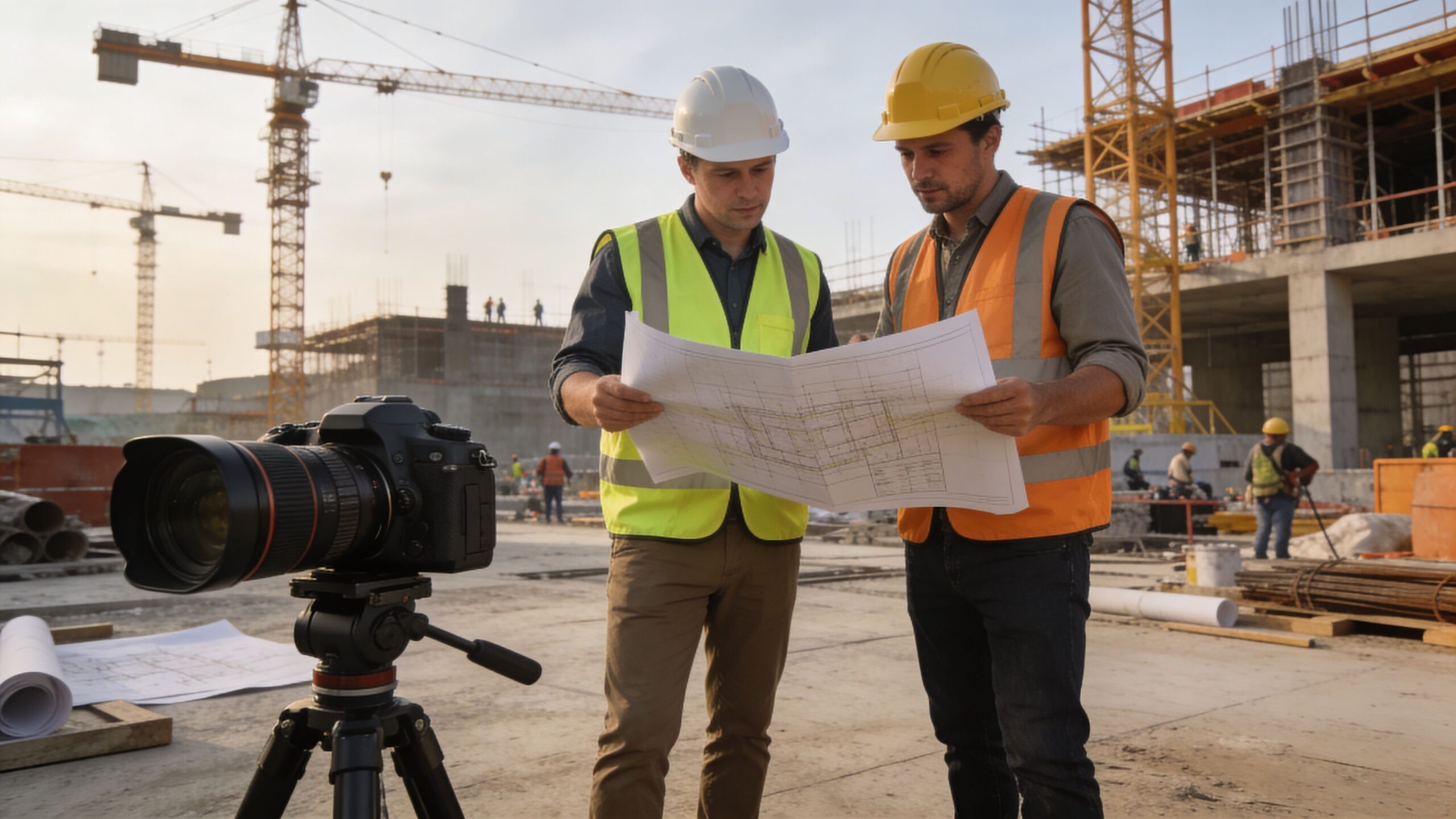
A strong shoot on a multi-phase property runs like a site operation, not a casual photo appointment. Access, staging, safety rules, active trades, loading routes, sun position, tenant activity, and approval authority all affect what gets captured and whether the final set feels polished enough for leasing, investor relations, and press use.
Before the first frame
Large developments rarely fail on camera. They fail in preparation.
If one tower is photo-ready, another still has punch-list work, and the amenity deck is waiting on furniture, the schedule has to reflect that reality. I would rather build a sequence around what is ready than spend the morning discovering that three promised locations are still full of tools, stickers, and temporary notices.
For teams that need a practical checklist, how to prepare a site for a photoshoot covers the kind of pre-shoot coordination that saves hours on set.
A pre-shoot walkthrough matters even more on phased developments. It helps determine which spaces can carry the campaign now, which should wait for a later round, and where temporary conditions need tighter framing instead of wide hero shots. That choice affects the story the images tell. If Phase One needs to signal momentum and credibility before the full master plan is complete, the photo plan should support that goal.
Build the day around light, access, and story
The best schedule follows conditions on site, not the order of the floor plan.
Start with the images that have the smallest margin for error. Sunrise and dusk exteriors, entry sequences, signature amenities, and views that depend on clean light should go first. Midday is often better used for interiors, architectural details, leasing moments, model units, and supporting images that give the marketing team options across channels.
A practical sequence often looks like this:
- Early exteriors and arrival views: Clean light, fewer vehicles, fewer distractions
- High-value amenities before resident traffic: Pools, lounges, fitness spaces, and rooftops read better before they fill up
- Primary interiors once engineering and housekeeping are clear: Better than stopping every ten minutes for fixes
- Occupied commons later in the day: Useful when some human presence adds scale and energy
- Detail work during flatter light: Materials, signage, millwork, and circulation shots hold up well when facade light is less dramatic
That rhythm keeps the crew productive if one zone slips behind schedule. It also protects the images that will carry the most business value.
One client lead should direct approvals
Large development shoots can attract too many decision-makers at once. The architect is protecting design intent. Leasing wants warmth and lifestyle. Construction wants to avoid showing unfinished areas. Ownership wants broad campaign utility.
All of those priorities are valid. They just cannot compete shot by shot in real time.
Assign one client lead with final authority on site. That person should know the campaign priorities, understand what is ready to show, and be able to approve framing, styling adjustments, and schedule changes quickly. Without that structure, the crew loses light, the photographer loses momentum, and the final set starts to feel scattered because each frame answered a different agenda.
What the photographer needs from your team
The photographer’s job is to solve visual problems fast. Your team can make that possible or slow it down.
Give the photographer:
- Clear access authority: Locked units, service corridors, rooftops, and vacant retail bays should not require a chain of calls
- A site contact who responds immediately: Someone who can answer practical questions and clear obstacles
- Permission to refine the space: Move furniture, remove bins, hide cords, straighten signage, and simplify surfaces
- Fast calls on imperfect conditions: Skip a room, substitute another angle, or return later
- A realistic safety framework: PPE rules, restricted zones, and lift access should be settled before cameras come out
On active sites, small delays add up fast. Waiting twenty minutes for a key, a freight elevator, or approval to move a chair can cost the exact light a facade needed.
A short visual reference can also help align expectations before the day gets busy.
Common obstacles and the right response
Every large site has friction. Good direction keeps those issues from defining the final gallery.
| Obstacle | Better response |
|---|---|
| Area not fully cleaned | Shift to another zone and return when housekeeping is finished |
| Construction clutter | Remove what is practical, then tighten framing or change camera height |
| Unfavorable weather | Prioritize interiors, details, and covered spaces. Hold hero exteriors for a better window |
| Missing furniture or styling gaps | Focus on architecture, materials, and circulation instead of forcing a lifestyle frame |
| Too many reviewers on site | Route all approvals through one client lead |
The calm shoot days are usually the most disciplined ones. From the outside, they look easy. On the ground, they are a series of fast decisions that protect light, schedule, and the story your development needs the images to tell.
From Capture to Campaign Managing Post-Production and Delivery
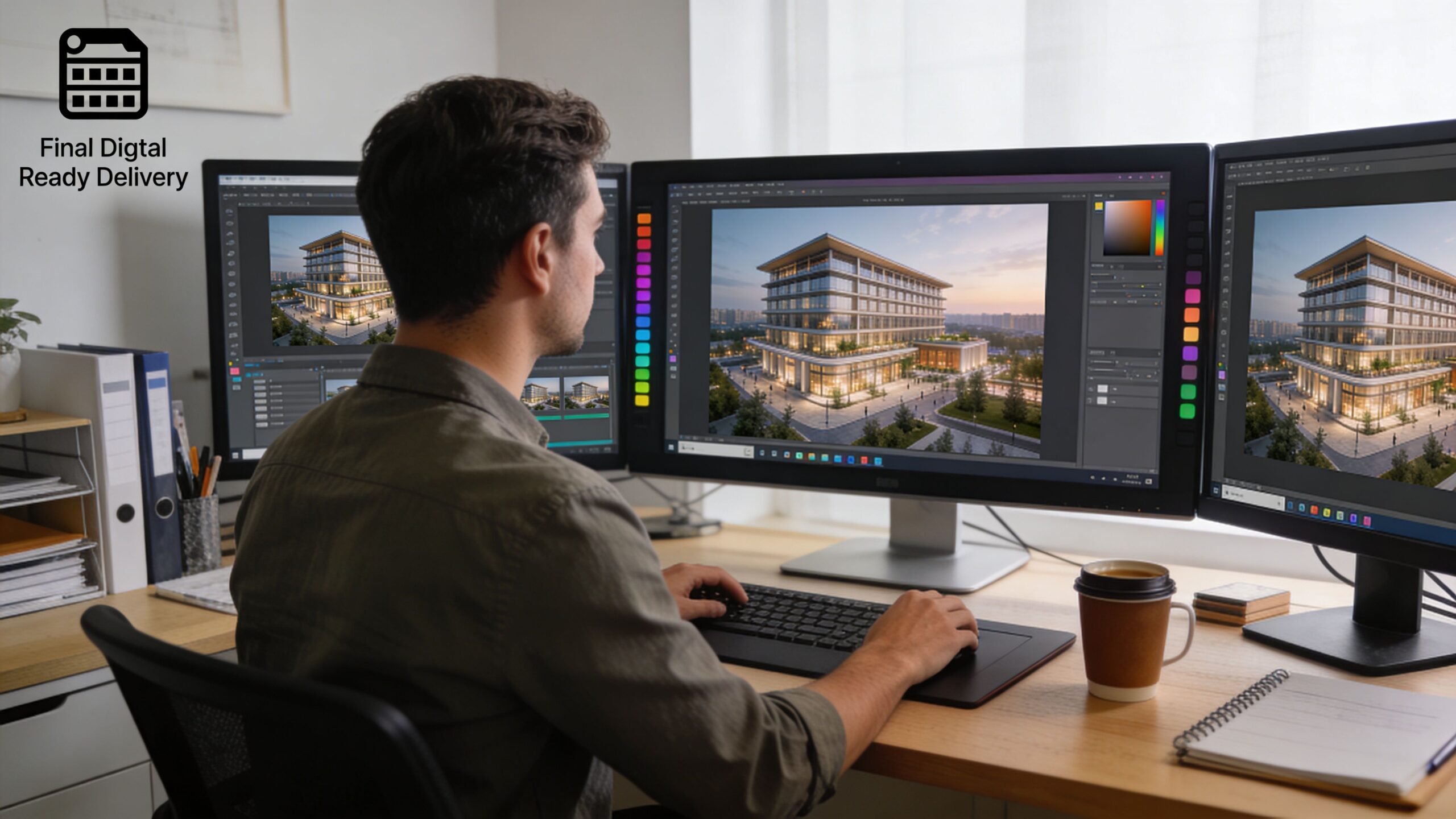
A lot of clients think the work is done when the cards come out of the camera. For architectural photography, that’s only the midpoint. The files still need selection, correction, retouching, organization, and delivery in formats your team can use.
That process matters because large developments rarely use images in just one place. The same set may feed print brochures, investor PDFs, a leasing microsite, press outreach, internal presentations, and environmental graphics.
What a professional post workflow should look like
Most polished assignments move through four stages:
Proof delivery
A gallery of initial selects or proofs for review.Client selection
Your team chooses finals based on campaign priorities, not just personal taste.Retouching
Perspective cleanup, color work, distractions removed, sky and window balancing where appropriate, and consistency across the set.Final export and packaging
Delivery in the agreed formats, naming structure, and resolution.
The review stage is where many teams lose time. If five people send separate notes, the retouching process gets expensive and messy.
How to give feedback that helps
The best feedback is consolidated, specific, and tied to use.
Use comments like:
- Use case: “This needs to lead the leasing page.”
- Priority adjustment: “Make sure the retail frontage feels more active.”
- Retouching direction: “Remove temporary signage and clean reflections on the glass.”
- Selection logic: “Choose the frame where the amenity deck feels connected to the skyline.”
Avoid comments like “make it pop” or “can we make this nicer.” Those don’t tell the retoucher what success looks like.
The clearest client feedback usually comes from one person who has already resolved internal disagreement before notes go back to the photographer.
What final delivery should include
Ask for a delivery package your internal teams can work with without confusion.
A solid package usually includes:
- High-resolution files for print and large-format use
- Web-optimized files for digital marketing
- Consistent file names tied to location or subject
- Color-managed exports appropriate for intended media
- A clean folder structure by phase, building, or asset type
If your development has multiple stakeholders, that organization matters as much as image quality. A beautiful file that no one can find in six months has limited value.
Understand the difference between correction and transformation
Basic post-production should improve clarity and consistency. It shouldn’t be expected to solve unfinished construction, poor staging, or a weak concept.
That’s why the earlier planning and on-site discipline matter so much. Retouching can refine. It can’t fully invent the kind of authenticity that makes built environments feel convincing.
For large developments, the best campaigns usually come from a clean chain of decisions. Strong brief. Right photographer. Well-run shoot. Organized review. Tight delivery.
FAQs for Hiring Development Photographers
Large projects raise a different class of questions than single-property shoots. These are the ones that come up most often when developers are trying to hire well and avoid expensive course corrections.
Frequently Asked Questions
| [object Object] | [object Object] | [object Object] |
|---|---|---|
| How early should we hire the photographer? | Earlier than most teams think. Bring the photographer in while you’re still defining milestones, marketing needs, and likely completion windows. That early involvement helps shape realistic shot planning and can surface issues like unfinished sightlines, landscape timing, or amenity spaces that won’t be camera-ready together. | Early coordination produces better scheduling and fewer missed opportunities. |
| Should we hire one photographer for the whole development or different people for different phases? | If visual consistency matters across leasing, investor, and brand use, one lead photographer or one tightly managed visual approach is usually stronger. Different specialists can work on the same project, but the risk is a fragmented image library with mismatched color, pacing, and composition. For very large assignments, a lead photographer can still scale with assistants or a production team. | Consistency usually matters more than novelty. |
| Do we need lifestyle imagery with people, or should the architecture stand on its own? | It depends on the purpose. If you’re targeting leasing, hospitality, or mixed-use activation, selective human presence can help communicate scale and experience. If the images are for architects, awards, or design documentation, cleaner spaces may be the better choice. The key is intention. Random people in a frame rarely help. Directed presence that supports the story often does. | Use people when they clarify use, not when they distract from design. |
One more practical question worth asking internally
Who will own the image library after delivery?
That isn’t only a legal question. It’s an operational one. Someone on your team should be responsible for file storage, naming consistency, approved usage, and distribution to architects, brokers, consultants, and internal departments. Without that handoff, even strong photography gets underused.
If you’re comparing photographers late in the process
Don’t default to whoever is merely available.
Late-stage hiring tends to produce rushed briefs, weak coordination, and coverage that doesn’t align with the campaign. If your timeline is compressed, simplify the scope and prioritize the most valuable scenes first. It’s better to make a strong first release from a focused shoot than to attempt total coverage and dilute the result.
What developers usually regret
They rarely regret hiring a photographer who asked difficult questions.
They regret hiring one who said yes to everything, arrived without a plan, and left them with a folder of images that looked competent but didn’t help the project move in the market.
If you need photography that treats a development like a brand asset rather than a quick listing, Jimmy Clemmons Photographer brings an editorial eye, architectural discipline, and on-site production experience to large-scale projects across Atlanta and the region.