

You’re usually asking what is architectural photography at a very specific moment. The project is finished. The contractor is gone. The styling is almost right. You’ve spent months or years solving layout, light, materials, circulation, budget, and code. Now the building has to speak for itself.
Many assume that means hiring someone to make clean pictures of walls, windows, and finishes. That’s part of it, but it’s not the whole job. A building is experienced in sequence. You arrive, approach, enter, turn, pause, look out, notice scale, feel light, register texture, and understand use. Photography has to translate that three-dimensional experience into a two-dimensional image without flattening the meaning out of it.
That’s why the strongest architectural photography doesn’t stop at documentation. It interprets intent. It shows how a space works, why a facade feels the way it does, how a lobby directs movement, and what a room says about the people who use it. In editorial work, that difference matters. A technically correct frame can be competent and forgettable. A technically correct frame with narrative tension can carry a project into a pitch deck, awards submission, hospitality campaign, or magazine feature.
There’s also a practical shift in the market. Industry reports from 2025 show a 25% growth in hybrid architectural-commercial shoots, blending building photography with human presence and brand storytelling to communicate value and trust more effectively for clients such as corporate teams and interior designers, as noted in Rick McEvoy’s discussion of architectural photography and narrative use. That aligns with what many clients now need: not just proof that a project exists, but evidence of what it feels like to occupy.
If you want the historical backdrop, the craft didn’t start as a lifestyle genre at all. It began as a way to record the built world, then evolved as the medium matured, a progression outlined in this look at the evolution of architectural photography.
More Than Buildings A Narrative Approach to Photography
A good architectural image is accurate. A great one is accurate and revealing.
The image has to carry your design intent
Architects and designers often know too much about a project to see it freshly. You remember the compromises, the VE decisions, the delayed millwork, the site constraints. The camera doesn’t care about any of that. It only records what’s in front of it, and that’s exactly why the photographer’s interpretation matters.
An exterior can show more than massing. It can establish how the structure sits on the site, whether it feels private or civic, restrained or expressive. An interior can do more than prove the furniture arrived. It can show hierarchy, rhythm, and how daylight moves through the plan.
Practical rule: If an image only says “this building exists,” it’s documentation. If it says “this building was designed this way for a reason,” it’s architectural photography.
Editorial thinking changes the outcome
Editorial photographers are trained to ask a slightly different question. Not just “What is here?” but “What matters here?” That shift changes framing, timing, styling, and sequence.
Sometimes the answer is formal. The architect wants the geometry to read with absolute clarity. Sometimes it’s atmospheric. The client needs to feel the calm of a hospitality space or the energy of a workplace. Sometimes it’s human. A building earns trust when viewers understand who it serves and how it supports them.
That’s why narrative matters in architectural photography. It’s not decoration layered on top of technical craft. It’s the reason the craft exists.
Sterile perfection rarely persuades
A flawless but lifeless image can satisfy a checklist and still fail in the market. Clients, editors, and juries respond to clarity, but they also respond to conviction. They want to see the design, yes, but they also want to understand the experience.
That may mean a silent, symmetrical frame. It may mean an occupied interior where scale becomes legible because a person is present. The right answer depends on the project, the audience, and where the images will live.
The Four Pillars of Architectural Imagery
Architectural photography isn’t one thing. It’s a group of related disciplines with different objectives, different constraints, and different audiences.
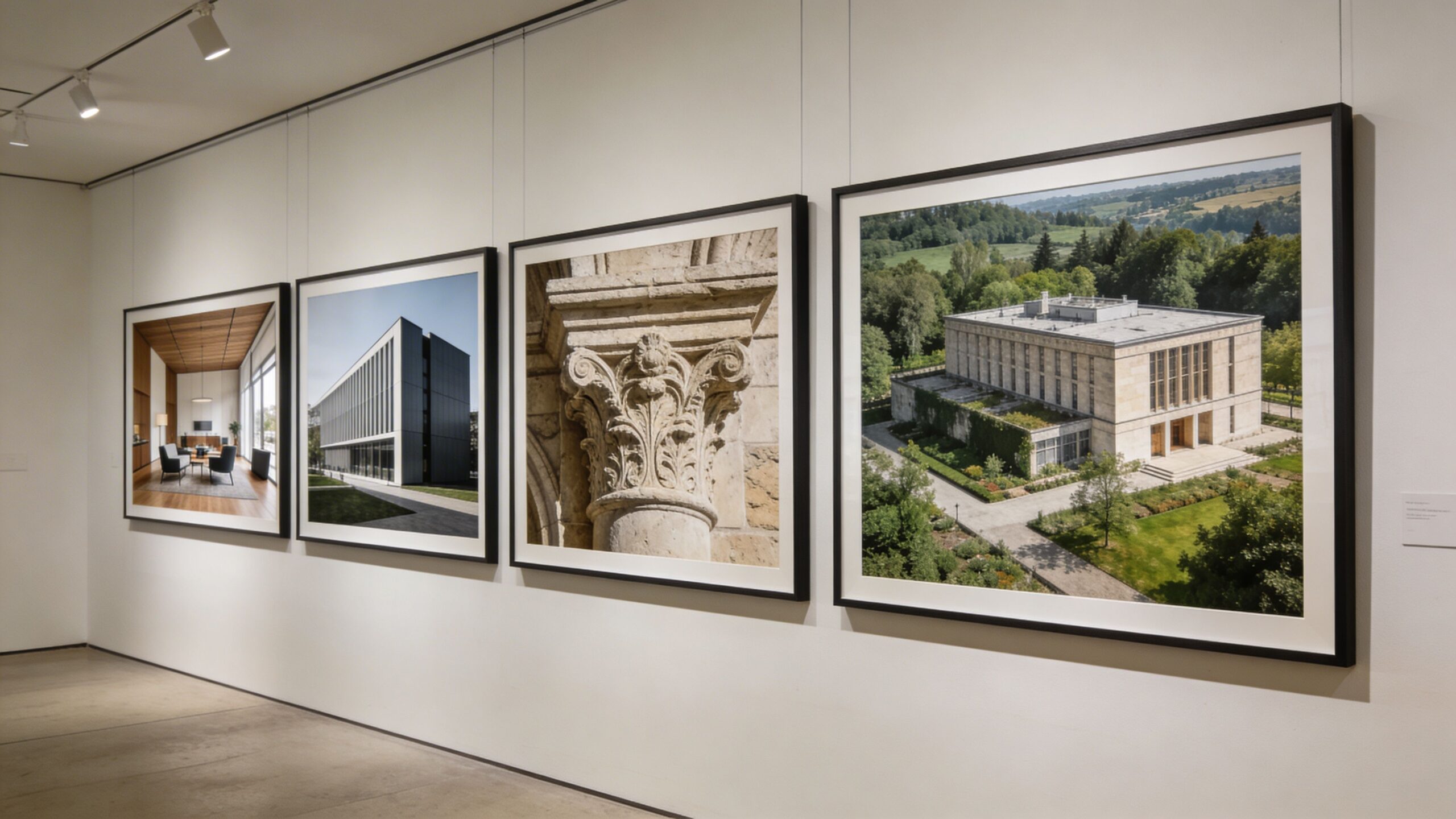
Exterior photography
Think of exterior work as portraiture for buildings. You’re finding the project’s public face and deciding how it should meet the world.
Light matters more than most clients expect. A facade that looks flat at midday can become sculptural when the sun moves lower and reveals depth in the cladding, recesses, fins, and overhangs. Weather also changes the story. Clean sun gives crisp geometry. Overcast light can soften contrast and emphasize material relationships.
The job is rarely just “get the whole building in frame.”
For exteriors, the photographer is usually balancing these priorities:
- Context: Show how the building sits on the site and relates to neighboring structures or terrain.
- Form: Clarify massing, silhouette, and proportion.
- Identity: Decide whether the hero image should feel inviting, monumental, quiet, or bold.
- Use: Reveal entries, circulation paths, and the way people encounter the project.
Interior photography
Interior work is closer to choreography. The photographer directs how the eye moves through the room.
A strong interior image doesn’t just include everything. It organizes information. It lets the viewer understand the hierarchy of the space, the relationship between foreground and background, and the role of light in shaping mood. That might mean shooting straight-on for symmetry, or slightly off-axis to reveal depth and adjacency.
Interiors also require more control. Window light, practical fixtures, reflections, mixed color temperatures, and styling details all compete for attention.
Good interior photography feels calm, even when the room itself was technically difficult to photograph.
Commercial architectural photography
Commercial work treats the building almost like a product. The structure is still the subject, but the images are built for marketing, leasing, recruitment, investor communication, hospitality promotion, or brand campaigns.
That changes the decision-making. A property manager may need images that emphasize amenities and circulation. A developer may want the project to feel premium and active. A corporate marketing team may need architecture, portraits, and environmental details to live together in one visual system.
This category often includes:
| Need | What the imagery should do |
|---|---|
| Website and brochures | Establish credibility fast |
| Leasing and sales materials | Highlight experience and differentiators |
| Brand campaigns | Connect the space to the company identity |
| Press kits | Provide publication-ready visuals with range |
Editorial architectural photography
Editorial work is the most story-driven version of the craft. It borrows from photojournalism without abandoning precision.
The building still has to read correctly, but the assignment often asks for more than isolated perfection. Editors may want a sequence. They may want a sense of life in the space. They may want details that reveal authorship or occupation, not just broad overviews.
That’s where editorial instincts become valuable. A corridor may matter because it creates a transition. A stair may matter because it reveals how the building unfolds. A person at the edge of the frame may matter because scale and use become instantly legible.
Which pillar fits your project
If you’re planning a commission, this quick filter helps:
- Awards submission: Favor exterior and interior work with strong formal clarity.
- Hospitality launch: Mix interiors with editorial storytelling and selective human presence.
- Developer marketing: Lean commercial, with a few dramatic hero frames.
- Magazine feature: Build an editorial sequence, not just a set of isolated standouts.
Most serious assignments borrow from more than one pillar. The important question isn’t what category sounds right. It’s what the images need to accomplish.
Mastering the Craft Key Techniques and Technologies
Technical precision isn’t a style preference in architectural photography. It’s the baseline. If the geometry is wrong, the material color is off, or the window light is blown out, the image stops serving the design.
Start with geometry
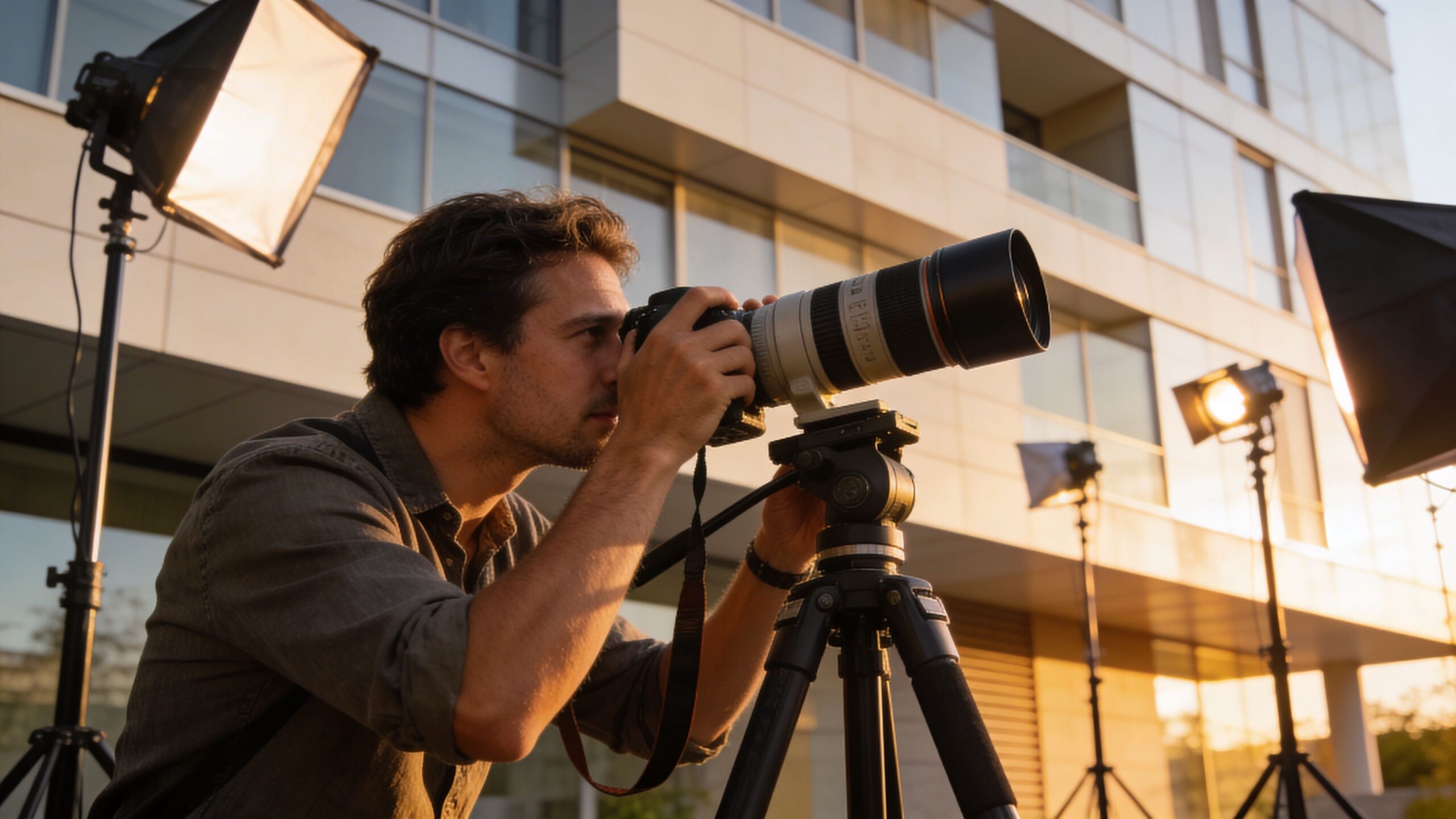
Precise vertical and horizontal alignment is critical in professional architectural work. Photographers typically use full-frame or medium-format cameras with at least 24MP and tilt-shift lenses so they can correct distortion optically rather than sacrificing quality in post-production. That matters because it prevents the keystone effect, where buildings appear to lean or fall backward, and helps the final image reflect the architect’s design intent, as explained in Imagen AI’s practical guide to architectural photography.
One-point perspective is especially powerful when a wall, corridor, facade, or room has a strong axis. The camera sensor stays parallel to the subject plane, and the image gains a calm, deliberate symmetry. Two-point perspective can be just as useful when you need to show volume and corner relationships, but it still has to feel controlled.
What doesn’t work is casual wide-angle shooting with the camera tilted upward and the assumption that software will fix everything later. It can’t. Not cleanly. You lose pixels, you distort proportions, and the building starts looking like an approximation of itself.
Why tilt-shift lenses matter
Tilt-shift lenses aren’t exotic accessories. They solve a practical problem.
A standard lens forces you into compromises. If you want the top of a tall building in frame, you often tilt the camera up. The lines converge. Then you correct in post, crop aggressively, and throw away resolution. A tilt-shift lens lets the camera stay level while the lens shifts the field of view upward.
That gives you three advantages:
- Cleaner verticals: The building reads as stable, not collapsing backward.
- Better file quality: You aren’t stretching and cropping as aggressively in editing.
- Truer proportions: Doors, windows, and facade elements keep their intended relationships.
For architecture firms, that’s not a technical footnote. It’s part of accurately representing the work.
Exposure is usually the main battle
Most architectural scenes contain hard contrast. Interior shadows sit next to bright windows. A lobby may include dark stone, reflective metal, and daylight pouring through glazing. The camera has to hold all of it.
The practical workflow often looks like this:
- Tripod first: Stability matters more than speed.
- Low ISO: Keep noise down and preserve detail.
- Controlled aperture: Many photographers work around f/8 to f/11, sometimes up to f/16, to keep foreground and background sharp.
- Bracketed RAW captures: Professionals often record 3 to 5 RAW exposures for high-contrast scenes so highlights and shadows can be merged cleanly.
That’s the quiet part clients rarely see. The final image may feel simple, but the capture is deliberate.
If you’re planning a site shoot, timing and light are part of the technical plan, not an afterthought. This guide on choosing the best light for a site shoot gives a good sense of how location, orientation, and schedule affect the result.
Lighting should support the architecture
Artificial lighting in architectural photography should be invisible in the final read. If viewers notice the flash before they notice the room, the image is overworked.
The point of supplemental lighting is usually one of three things:
- Balance a room where the window side and the interior side are too far apart.
- Shape a space so key materials or planes separate from each other.
- Clean up dead zones that the available light leaves muddy or flat.
The wrong approach is blasting a room evenly so every surface reaches the same brightness. That kills depth. Rooms need directionality. They need a believable relationship between bright areas and quiet ones.
Architectural lighting in photography should feel inevitable, not noticeable.
Low angles and close proximity can create drama
A lot of educational content in this field focuses on straight-on views, corner views, and distortion control. That foundation is necessary, but it can also produce portfolios where every project starts to look formally correct and emotionally interchangeable.
There’s a useful counterbalance. Photography forum data from 2023 to 2025 shows queries about low-angle techniques increased by 40%, yet only 15% of top guides cover them in depth, according to Fstoppers’ discussion of common architectural photography mistakes and overlooked approaches.
Low-angle and extreme proximity shots work when you want:
- Monumentality: A facade feels taller, heavier, or more assertive.
- Energy: Diagonals and edge tension create movement.
- Distinctiveness: The image separates itself from standard brochure coverage.
They don’t work when they become gimmicks. If perspective exaggeration starts misrepresenting scale or making the structure feel implausible, the image stops serving the project.
A short visual example helps here:
Retouching should remove distractions, not rewrite the building
Professional post-production is part of the craft. It isn’t cheating. It’s where the captured files become coherent final images.
Useful retouching often includes:
- Color correction: Neutralize mixed lighting and get materials believable.
- Perspective refinement: Fine-tune alignment after careful in-camera capture.
- Cleanup: Remove temporary distractions, dust, minor blemishes, or visual clutter.
- Window balancing: Keep exterior brightness believable while preserving interior readability.
What doesn’t work is aggressive manipulation that changes the architecture itself. If shadows lose all depth, skies look synthetic, or materials become too polished to feel genuine, the image starts reading as advertising illustration rather than photography.
Drones and alternate viewpoints
Aerial work can be valuable, but only when it reveals something the ground cannot. Site planning, roof form, building placement, circulation, and neighborhood relationship are all good reasons to use a drone. “Because it looks cool from above” usually isn’t enough.
One disciplined aerial frame is often more useful than a large batch of generic top-down views. The question is always the same: does the angle add understanding?
The Architectural Photography Project Lifecycle
A strong architectural shoot is won before the camera comes out. By the time the team arrives on site, the important decisions should already be made. What story matters, which spaces carry it, when the light supports it, and how the building should be experienced by someone who has never set foot there.
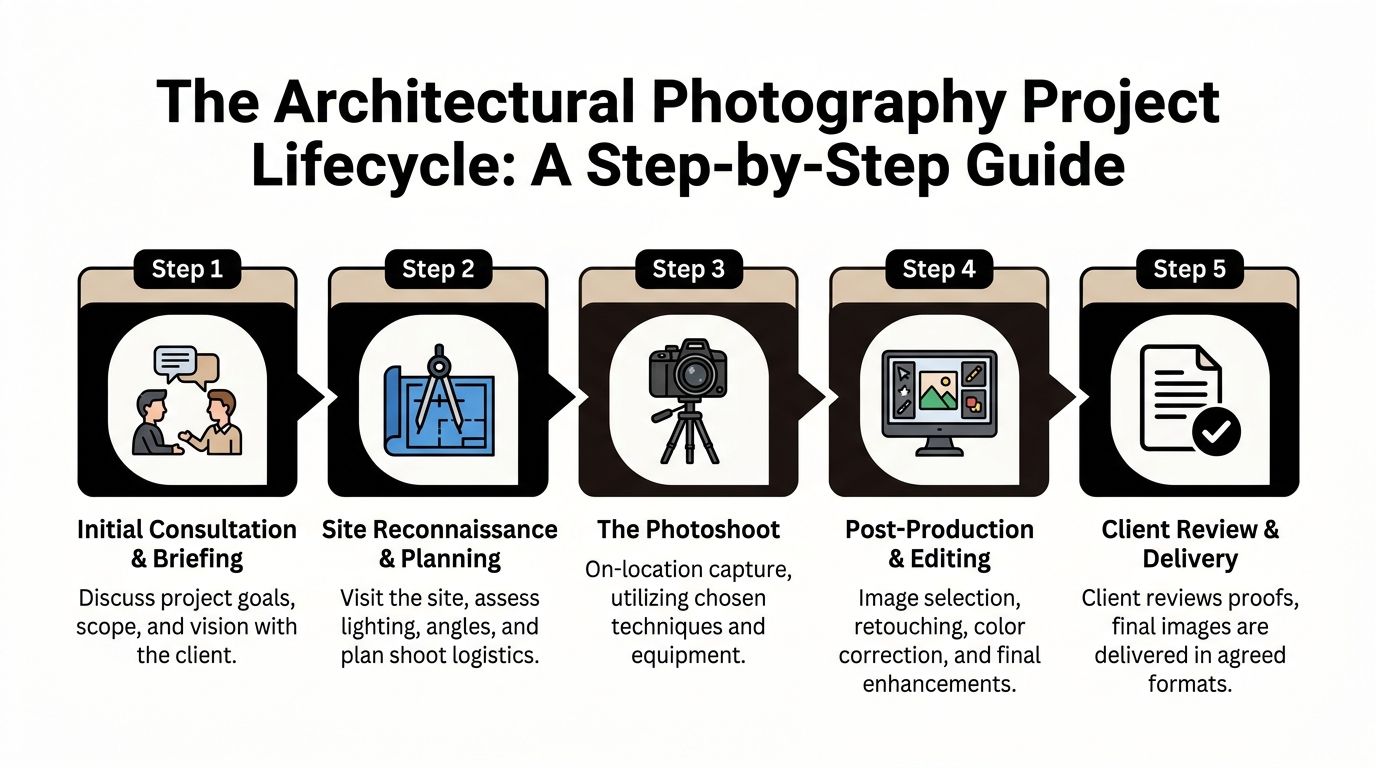
Step one and two define the result
The first conversation is not a scheduling call. It is an editorial brief.
Address, budget, and date matter, but they do not tell a photographer what the project is trying to say. Useful input includes floor plans, sun orientation, design priorities, publication targets, occupancy constraints, launch deadlines, and a clear sense of where the images will appear. A hospitality project headed to press needs different coverage than a workplace project built for proposals, leasing, and recruitment.
The scout comes next. Sometimes that means walking the site in person. Sometimes it means reviewing plans, phone snapshots, and satellite orientation before the shoot. Either way, the purpose is the same. Find the angles that explain the project, identify problem areas early, and avoid wasting production time solving preventable issues on set.
A disciplined pre-production process usually covers:
- Usage goals: Website, editorial features, awards submissions, print collateral, leasing materials, or a mix of uses
- Shot priorities: Hero exteriors, key interiors, circulation, material details, context, and any spaces that express the client brief clearly
- Styling and access: Who prepares the site, who approves changes, which rooms are available, and who handles final cleanup
- Timing: Which façades and interiors need morning light, late-day contrast, dusk atmosphere, or soft overcast conditions
The shoot itself is controlled, not improvised
Good architectural photography often looks slow from the outside. That pace is part of the work.
A chair shifts two inches. A reflection in glazing has to be managed. A practical light that felt harmless in person creates a hotspot in frame and suddenly needs attention. Camera height changes slightly, verticals settle, and the room starts to read the way the designer intended. Those decisions are small on set and large in the final image.
The trade-off is simple. Speed helps the schedule. Patience protects the work.
Occupied spaces add another layer. Offices, schools, hotels, and homes rarely offer perfect access for an entire day, so the shoot plan has to account for operations, privacy, and disruption. Some spaces should be photographed empty. Others benefit from restrained human presence because use explains scale, purpose, and atmosphere better than a pristine but lifeless frame.
The fastest shoot day usually produces the weakest edit.
Post-production turns coverage into a usable set
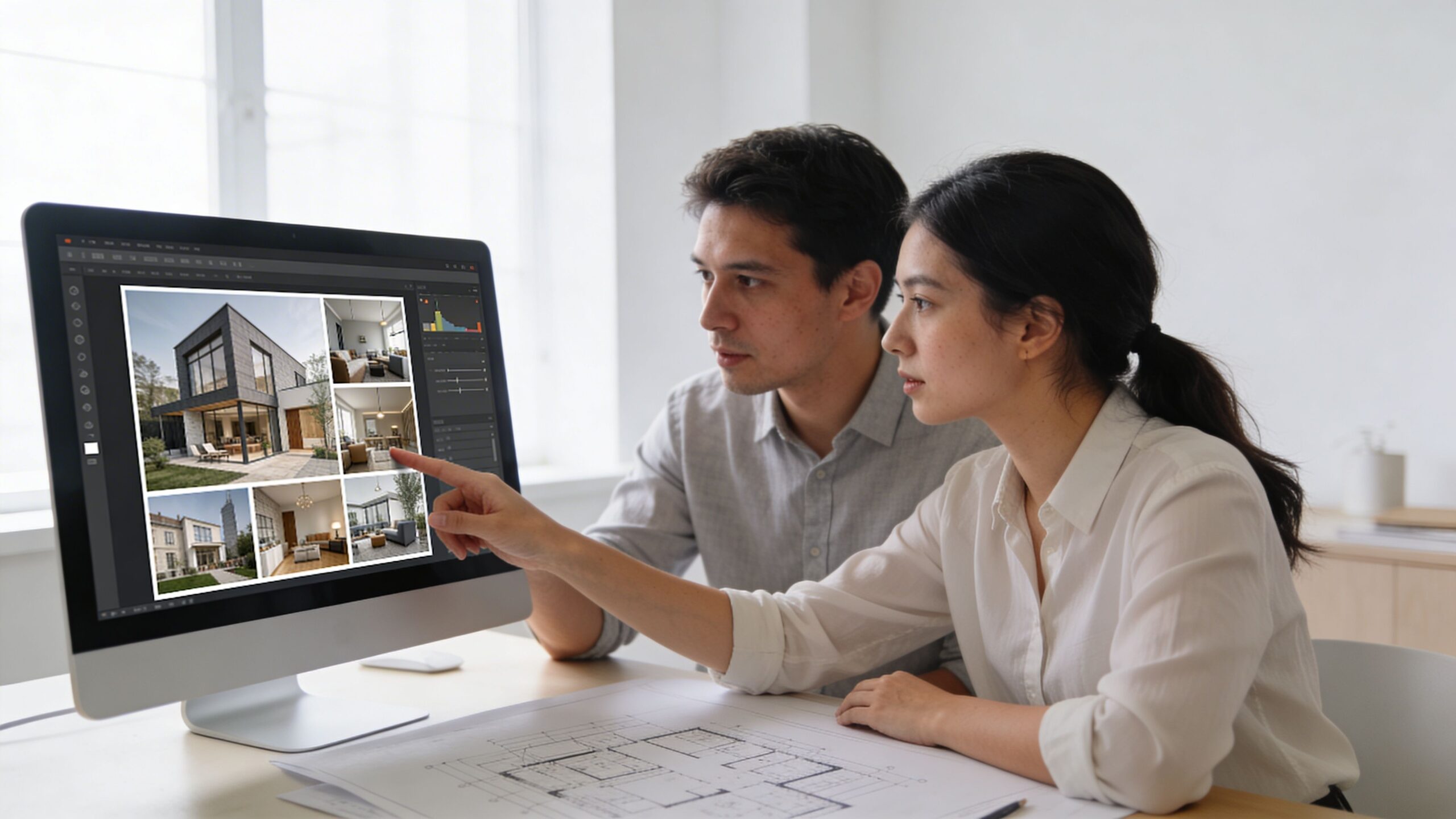
After capture, the job shifts from collecting frames to selecting the ones that deserve to represent the project. Editing is not just about picking the prettiest views. It is about building a set that shows the project clearly from broad context to defining details, with enough consistency to work across editorial, marketing, and submission needs.
Clients should clarify a few things before production wraps:
| Deliverable area | What to clarify |
|---|---|
| Image selection | Who makes the first edit and how proofs are reviewed |
| File formats | Web-ready exports, high-resolution files, and any print-specific needs |
| Licensing | Website use, awards submissions, editorial distribution, social, advertising |
| Turnaround | Initial proof timeline and final delivery schedule |
Some studios also handle scouting, lighting strategy, on-set direction, and final editing within the assignment. Jimmy Clemmons Photographer is one example of a studio that pairs architectural coverage with commercial brand imagery, which can help when a client needs both design documentation and broader campaign assets from the same production.
What clients can do to help
The best client contribution happens early, then becomes selective on shoot day.
Useful support includes a concise shot list, honest priorities, site access, and spaces that are ready to photograph. The less helpful version is constant real-time art direction after the brief has already been agreed upon. Architectural photography works best when the client shares project knowledge at the right moments and the photographer has enough room to solve composition, light, and sequencing with concentration.
Translating Vision into Value The ROI of Great Photography
Architectural photography is easy to treat as a finishing expense. That’s usually a mistake. For most firms, the images outlast the project team’s memory of the build and become the public record of the work.
A project may be visited by a few dozen, a few hundred, or a few thousand people in person. The photographs will likely be seen by far more decision-makers than that across websites, proposals, social channels, submissions, media kits, and presentations. In practical terms, the images become part of your business development infrastructure.
Strong images help clients understand quality faster
A prospective client doesn’t study a portfolio the way the design team does. They scan. They form an impression. They decide whether the work feels careful, expensive, inventive, calm, refined, or credible.
Photography shapes that judgment almost instantly.
Weak coverage creates friction:
- The spaces feel smaller or less resolved than they are.
- Materials look muddy or inconsistent.
- The project appears generic because every frame is obvious.
- The firm’s point of view disappears.
Strong coverage does the opposite. It clarifies the design, protects the perception of quality, and makes the firm easier to remember.
Awards, press, and pitches all depend on visual clarity
Jurors, editors, and marketing teams don’t experience the building firsthand. They evaluate the project through a limited set of frames. If those frames are technically clean but emotionally flat, the work may not separate itself from comparable submissions.
That’s where image strategy matters. A portfolio should include formal frames, yes, but it also benefits from a few pictures with tension and point of view. The same is true for project launches and press outreach.
One reason this matters now is that queries for low-angle techniques rose by 40% between 2023 and 2025, while only 15% of top guides covered them in depth, according to the earlier Fstoppers reference. That gap matters because dramatic but controlled low-angle and close-proximity images can give marketing materials a sharper identity when used selectively. Standard coverage proves competence. Distinctive coverage creates recall.
A client may never use the phrase “visual energy,” but they notice when one project feels alive and another feels interchangeable.
Narrative images are more versatile than record shots
A clean hero exterior is necessary. It isn’t sufficient.
The images that tend to work hardest over time are the ones that communicate more than shape. They show sequence, occupation, atmosphere, and design logic. Those pictures can move across media more effectively because they speak to more than one audience.
For example:
- An architect may care about proportion and facade rhythm.
- A developer may care about positioning and perceived value.
- A hospitality brand may care about mood and guest experience.
- An editor may care about story and visual variety.
Narrative-driven imagery can serve all four if it’s planned correctly.
The investment isn’t just in pictures
It’s in reusable assets with a long shelf life.
A disciplined shoot can support:
| Business use | Why it matters |
|---|---|
| Portfolio updates | Shapes first impressions of the firm |
| Awards submissions | Gives jurors a clear, persuasive visual case |
| Media outreach | Supplies publishable imagery with narrative range |
| Proposals and presentations | Helps prospects see your design philosophy quickly |
| Recruiting and culture | Shows the kind of work your firm produces |
That’s the core business case. Good architectural photography doesn’t just preserve a finished project. It keeps selling the thinking behind it.
Choosing Your Photographer A Guide for Architects and Designers
Hiring an architectural photographer is less like buying a commodity and more like selecting a translator. The question isn’t whether they can operate a camera. It’s whether they can read design intent and turn it into a consistent body of images.
Architectural photography has been a professional discipline for a long time. It became an established medium by the 1860s, and its roots go back to Nicéphore Niépce’s View from the Window at Le Gras, which captured buildings. Institutional efforts such as the French heliographic mission of 1851 helped formalize the role of photography in documenting cultural heritage, as outlined in Wikipedia’s history of architectural photography. That legacy still matters. The field has always been about more than pretty pictures. It has been about accurate, meaningful representation.
Read the whole portfolio, not the highlights
Any experienced photographer can show a few strong hero shots. The true test is consistency across a full project set.
Look for these signs:
- Technical discipline: Verticals are controlled. Color feels believable. Interiors don’t look muddy.
- Compositional intelligence: The photographer knows when to be symmetrical, when to create depth, and when to simplify.
- Range: They can shoot exteriors, interiors, details, and if needed, people in space.
- Restraint: The work doesn’t rely on gimmicks or over-processing.
If you want a reference point for what a service-oriented studio in this space looks like, review this commercial architectural photographer overview.
Ask process questions, not just gear questions
Gear matters, but process tells you how the assignment will proceed.
Useful questions include:
- How do you prepare for a project before shoot day?
- How do you decide which rooms or elevations need specific light?
- What’s your approach to styling, cleanup, and distractions in frame?
- How do you handle occupied spaces or live business environments?
- What does your editing process include, and what does it avoid?
- How is licensing structured for web, print, editorial, and awards use?
A photographer who answers these clearly usually runs a better production.
Evaluate fit, not just aesthetics
The right photographer should understand who the images are for. An editorial assignment, a hospitality launch, a developer marketing set, and an awards package don’t all need the same visual emphasis.
That’s why chemistry matters. The photographer should be able to listen to the design priorities, challenge weak assumptions when needed, and still work collaboratively under real-world constraints.
If the photographer only talks about their style and never about your audience, that’s a warning sign.
Common Questions from Design and Architecture Firms
How do you photograph an occupied space without disrupting operations
Preparation does most of the work. The client and photographer should decide in advance which areas can be photographed while active, which need temporary clearing, and what time windows create the least disruption. In offices and schools, early access often works best. In hospitality, the answer may be a staggered schedule tied to guest flow.
On site, the process stays disciplined. Work one zone at a time. Keep gear consolidated. Have one client contact who can help with access and quick decisions. The goal is to move carefully without turning the building into a production set.
Should our team be present on shoot day
Yes, but selectively.
A designer, architect, or marketing lead can be useful for confirming priorities, approving styling adjustments, and flagging project-specific details that matter. What doesn’t help is a crowded room with multiple people giving live composition notes. The most productive arrangement is usually one informed point of contact and enough trust for the photographer to work.
What’s the difference between licensing for our website, awards, and editorial use
Licensing defines where and how the images can be used. Website use is one category. Awards submissions may be another. Editorial distribution, advertising, print collateral, and third-party usage can all require different terms.
This should be discussed before the shoot, not after delivery. A clear agreement protects both sides. The client knows what’s included, and the photographer can price the assignment around actual usage rather than vague assumptions.
How much styling or cleanup should we handle before the shoot
More than you think, but less than perfection.
The site should be clean, functional, and free of obvious distractions before the photographer arrives. That includes cords, temporary signage, stray packaging, fingerprints on glass, and anything that reads as accidental clutter. Styling should support the design rather than compete with it.
The photographer can refine the frame, but the client’s preparation saves time and helps the shoot stay focused on image-making instead of basic cleanup.
Can architectural photography include people without becoming lifestyle photography
Absolutely. People can clarify scale, show how a space operates, and make a project feel inhabited without turning the assignment into a campaign shoot. The key is restraint. Human presence should support the architecture, not steal attention from it.
That usually means thoughtful placement, natural action, and wardrobe choices that don’t dominate the palette. When done well, people make the building more legible.
If you’re ready to create images that show not just what your project looks like, but what it means, Jimmy Clemmons Photographer works with architects, designers, developers, and brand teams on architectural imagery shaped by technical precision and editorial storytelling.