
A superintendent is standing in a conference room with a change order on the table, an owner on speakerphone, and three different versions of the same story. One subcontractor says the backing was installed. Another says it was never there. The architect remembers a site walk but not the exact wall. Everyone is certain. Nobody can prove it.
Here, construction progress photography stops being a courtesy and becomes a business tool.
The firms that treat progress photos as casual phone snapshots discover the weakness of that approach when the stakes rise. The image is blurry. The angle is useless. The room is unidentifiable. The file name says nothing. There is no timestamp anyone trusts, no sequence, no context, no narrative. The photo exists, but it does not help.
By contrast, a disciplined set of progress images can settle questions fast, clarify work in place, support remote decisions, and build a visual record that remains useful long after occupancy. That is why construction progress photos matter. Not because they are nice to have, but because they turn uncertainty into evidence and activity into a readable story.
An experienced architectural photographer brings something extra to this process. Not artistic flourish for its own sake, but control. Control of vantage point, lighting, consistency, scale, sequencing, and visual clarity. On a serious project, those choices affect whether an image is merely taken or whether it becomes usable for operations, claims, client updates, and later marketing.
Beyond the Blueprint A New Perspective on Project Insight
A set of drawings tells you what the project is supposed to become. A strong progress archive tells you what happened, where it happened, and when.
That distinction matters most when the work disappears. Rebar gets covered. Waterproofing gets buried. MEP coordination above the ceiling vanishes behind drywall. Once those moments are gone, memory replaces evidence unless someone documented them with intention.
Where ordinary site photos fail
Most jobs already have photos. That is not the same as having documentation.
A quick phone image from the field often lacks the one thing a future reviewer needs. Context. You may see a pipe, but not the room. You may see a wall, but not the penetration. You may see a detail, but not enough of the surrounding assembly to identify its location in the building.
The problem is rarely effort. It is discipline.
A strategic progress image answers several questions at once:
- What am I looking at: The frame identifies the condition clearly.
- Where is it: The composition includes enough surrounding information to place it in the project.
- When was it captured: The file is preserved with dependable metadata.
- Why does it matter: The photographer anticipates which moments will matter later, especially before coverup.
A visual chronicle of value
On high-end work, I think of progress photography as a visual chronicle of value. It records labor, craft, sequencing, problem-solving, and milestones that would otherwise be reduced to line items in a report.
That shift in mindset changes what gets captured.
Instead of generic walkthrough images, the record becomes selective and purposeful. You photograph slab prep before the pour. You document envelope conditions before finishes hide them. You isolate millwork details, facade transitions, lighting mockups, and specialty installations while they are still legible.
Key takeaway: The strongest progress photos do more than prove presence on site. They preserve decisions, workmanship, and conditions in a form other people can interpret quickly.
The language of architectural photography is helpful here. Composition is not cosmetic. It is what makes the image readable. Exposure is not style. It is what lets dark ceilings, bright openings, reflective finishes, and layered spaces hold useful detail in the same frame.
When owners, architects, contractors, and consultants need a project record they can trust, precision matters more than volume.
The Visual Diary Your Project's Single Source of Truth
A well-run progress archive functions like a visual diary for the entire build. It does not replace schedules, RFIs, meeting notes, or daily logs. It gives those records a visible counterpart.
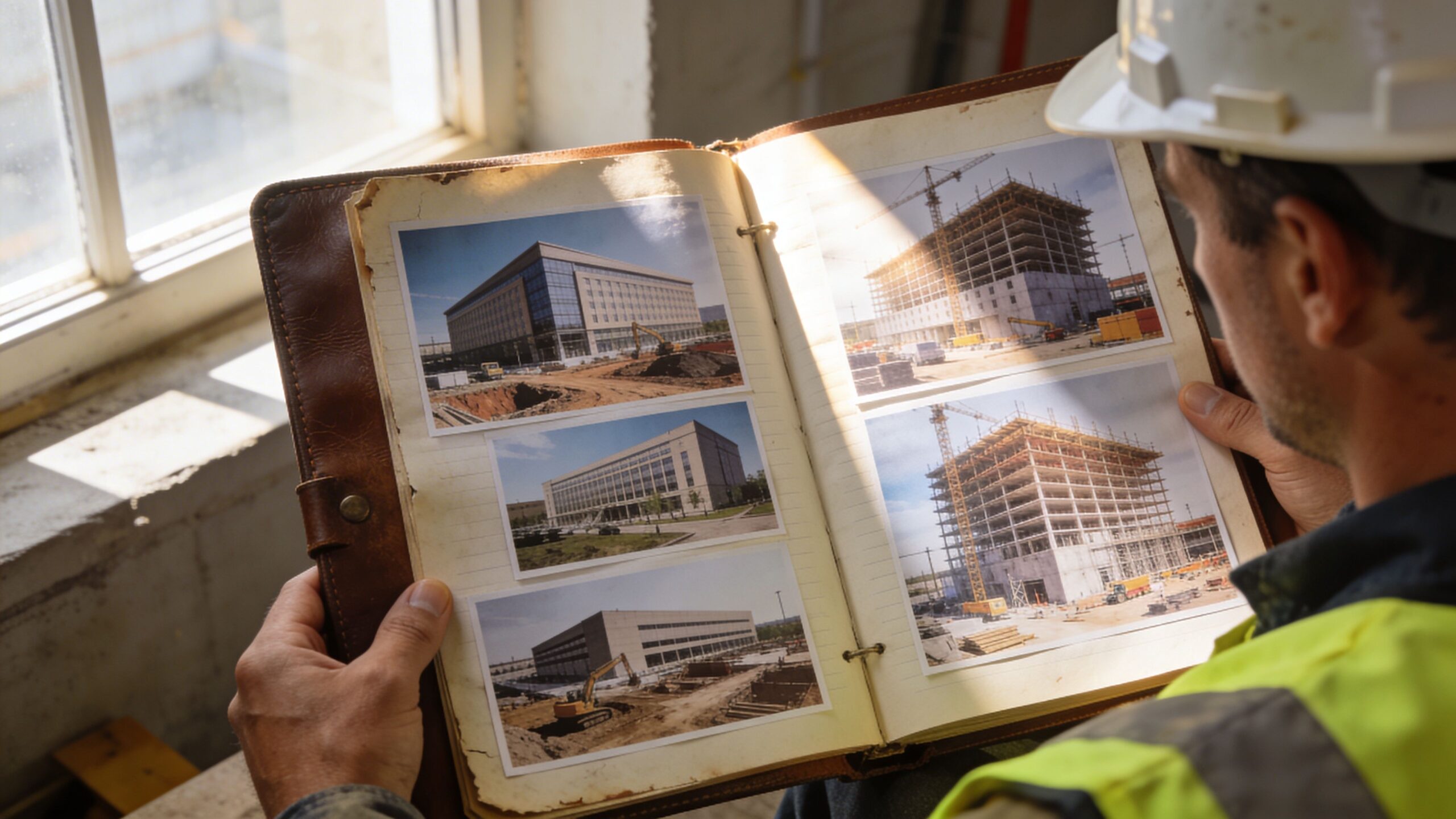
When the diary is built correctly, every phase becomes easier to verify. Excavation, structure, enclosure, rough-in, finishes, punch, and handover each gain a readable visual trail. If someone needs to know whether a condition was pre-existing, whether work was complete before another trade arrived, or how a design decision evolved, the answer is often visible in minutes.
Six jobs one archive should do
The most useful progress system is not just a folder of images. It serves several roles at once.
- Documentation: It records each phase in a chronology that others can audit later.
- Risk control: It captures issues while they are still fixable, not after they are hidden.
- Communication: It gives owners, architects, lenders, and consultants a common visual reference.
- Marketing pipeline: It creates authentic content from the first shovel in the ground to final reveal.
- Quality reinforcement: It makes workmanship visible and accountable.
- Return on investment: It reduces waste from confusion, repeat visits, and preventable rework.
That is why the term “single source of truth” fits. The archive does not eliminate disagreement, but it sharply narrows the room for speculation.
Why consistency beats volume
Teams may assume more photos automatically means better records. It usually means a harder search later.
Useful coverage depends on repeatable viewpoints, predictable naming, milestone logic, and clear subject priorities. The same stair core from the same corner over time is more useful than dozens of random images taken while walking by. The same corridor at framing, rough-in, drywall, and finish tells a coherent story. A different angle every time does not.
This is also where site preparation matters. Clean access, temporary lighting, safe vantage points, and a planned route improve the record before the first frame is made. Thoughtful preparation for documentation is not very different from preparation for finished architectural work, and many of the same principles apply in preparing a project site for a professional photoshoot.
The diary becomes operational memory
Projects are long. Teams change. People leave. Months later, the person trying to answer a question may not have been there when the work occurred.
A disciplined visual diary becomes institutional memory. It supports closeout, warranty conversations, facilities planning, renovation, and future tenant work. It also gives leadership a way to review a project with clarity rather than anecdote.
Practical tip: If a condition will soon be concealed, photograph it as though a stranger will need to understand it years later without your explanation.
That standard is much higher than “grab a few pictures.” It is also far more valuable.
Mitigating Risk and Winning Disputes with Visual Evidence
The fastest way to understand why construction progress photos matter is to look at what happens when they are missing.
According to OpenSpace’s summary of industry research, 70% of construction disputes stem from inadequate project documentation. The same source states that quality photo documentation cuts rework costs by an average of 25%, and that the Construction Industry Institute indicates 40% of rework stems from poor documentation of concealed building elements.
Those numbers explain a reality every contractor and owner already feels. Disputes grow in the gaps between memory and proof.
The image must answer a claim
Not every photo helps in a dispute. Some only show that someone was present on site that day.
A useful dispute image does more. It identifies the assembly, shows the condition in enough detail to evaluate it, and places that condition within the project. On a structural job, that may mean showing bar placement with enough surrounding context to identify grid lines or formwork relationships before the pour. On interiors, it may mean proving backing, blocking, firestopping, insulation, or rough-in locations before the wall is closed.
When a claim arrives, the burden is not merely to produce an image. The burden is to produce a convincing visual answer.
What gets documented before it disappears
The most expensive verification work often involves concealed conditions. Once covered, the only ways to check are invasive opening, delay, or argument.
Priorities usually include:
- Concealed systems: In-wall rough-ins, backing, firestopping, waterproofing layers, below-slab work.
- Edge conditions: Transitions where envelope, structure, and finish systems meet.
- Adjacent property conditions: Existing cracks, curb damage, facade conditions, access limitations.
- Material delivery and storage: What arrived, in what condition, and where it was staged.
- Milestone completion: Conditions that trigger inspection, payment, sequencing, or coverup.
The point is not to create anxiety on site. The point is to remove ambiguity later.
A camera is not a substitute for precision
There is a temptation to assume poor images can be rescued later in editing. They usually cannot. Post-production can improve exposure, color, and readability, but it cannot create missing evidence, missing context, or missing angles. That is the difference between refinement and fabrication, and it is worth understanding before relying on fixes such as using post-production to fix structural photos.
Key takeaway: The strongest legal and operational images are made at the right time from the right place. They are not manufactured later.
Why this is really an insurance function
Professional documentation often gets discussed as a line item. It should be evaluated more like an insurance function with operational upside.
A disciplined photo set can shorten arguments over completion dates, access interference, scope changes, inspector questions, and alleged omissions. It can also expose issues early enough to fix them before they become claims.
That matters because every unresolved factual dispute drags other costs behind it. Staff time, consultant review, delayed approvals, strained relationships, and possible rework all attach themselves to uncertainty. A reliable image record cuts into that uncertainty directly.
The camera does not win the argument by itself. But clear, timely, contextual images often decide which side has a credible record.
Enhancing Communication Across Stakeholder Teams
A good progress image can replace an email chain nobody wants to read.
Owners want confidence without constant site visits. Architects want to verify intent and field conditions. Lenders want orderly reporting. Developers want momentum they can see. Subcontractors want fewer misunderstandings about what was ready, what was blocked, and what changed.
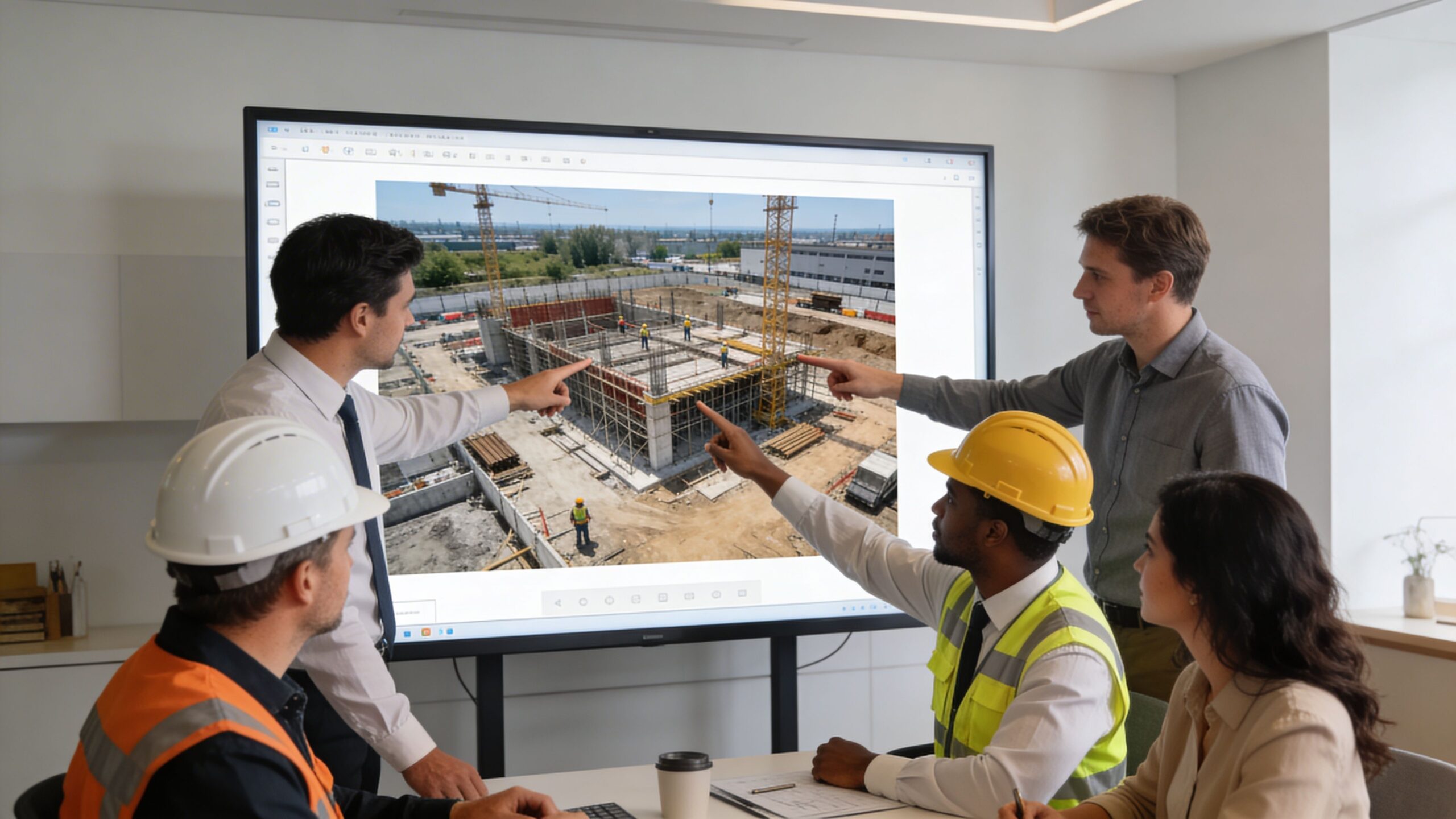
A clear image gives all of them a common reference point.
One frame can align an entire meeting
The best stakeholder updates are not photo dumps. They are curated visual reports.
If the issue is an MEP congestion point above a corridor ceiling, include a wide frame for location and a tighter frame for the exact conflict. If the owner needs to understand facade progress, pair elevation views with detail images that show installation quality and sequencing. If a school, hotel, or office client is trying to visualize readiness, show the route a user will experience rather than isolated fragments.
That curation changes the meeting itself. Instead of debating descriptions, teams discuss visible conditions.
A practical update set often includes:
- Overview images: Broad views that establish phase and location.
- Decision images: Tighter frames tied to a pending question.
- Milestone images: Photos that support billing, scheduling, or approvals.
- Exception images: Conditions needing action, clarification, or correction.
Remote stakeholders need legible evidence
A key operational benefit of progress photography is this: On a multi-use facility project, progress photography provided visual confirmation of critical installations before coverup and saved approximately $40,000 by eliminating destructive verification and rework, according to Reconstruct’s example. The same source notes that time-stamped imagery helps remote stakeholders stay informed and reduces the need for costly travel.
That example captures the primary advantage. Not convenience alone, but decision quality at a distance.
A blurry phone shot taken mid-conversation does not accomplish that. A carefully framed, time-stamped image that clearly shows the installation and its context does.
Here is a practical look at how teams can use visual monitoring in the field:
What works in weekly reporting
Communication improves when the image set is organized around the audience.
| Stakeholder | What they need to see | What usually wastes time |
|---|---|---|
| Owner | Milestones, risks, visible progress | Random site snapshots with no context |
| Architect | Field conditions, coordination issues, finish execution | Photos that are too tight or too dark to interpret |
| Contractor leadership | Sequence, productivity indicators, problem areas | Huge folders with no selection or captions |
| Marketing team | Clean milestone imagery, human activity, signature details | Utility shots that have no narrative value |
Practical tip: Every update should answer one simple question before it goes out. What decision, reassurance, or action should this image set support?
When teams adopt that standard, progress photos stop being passive records. They become communication infrastructure.
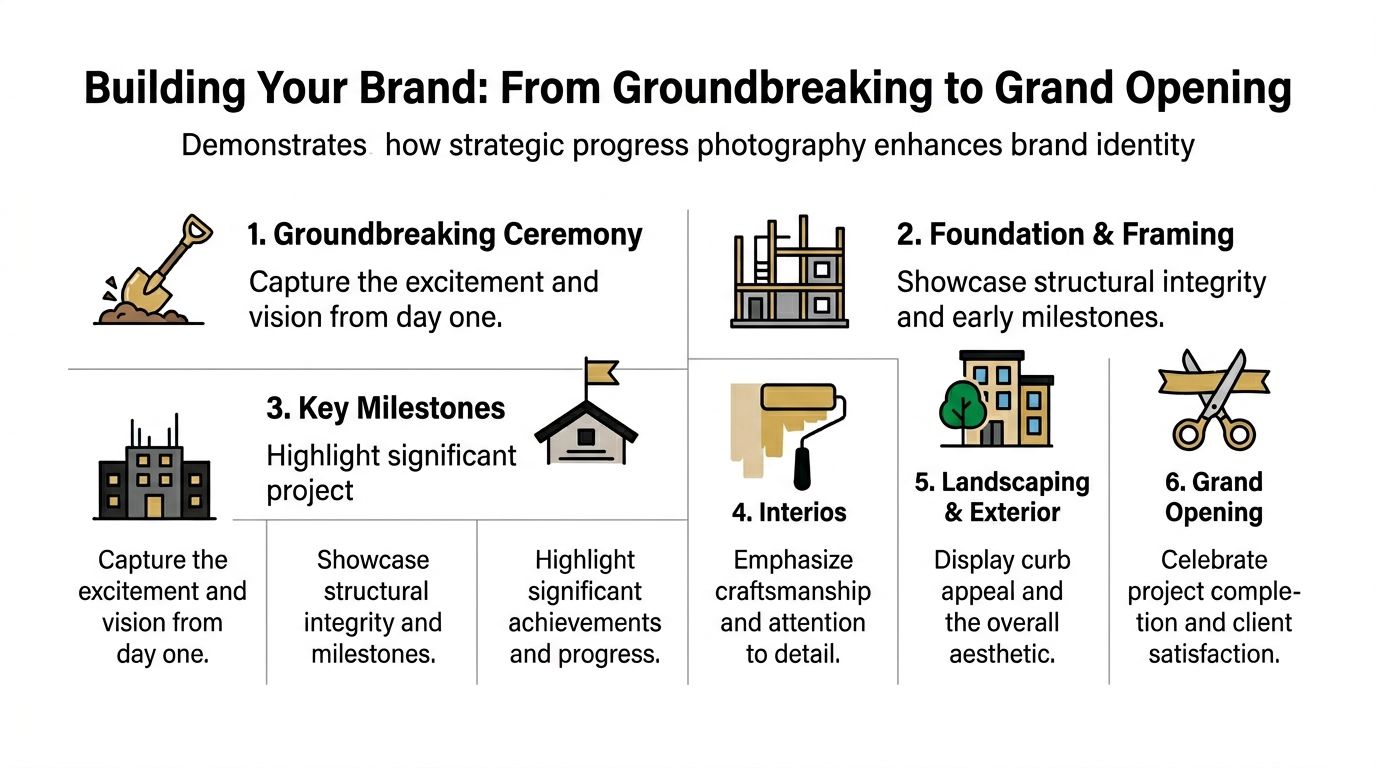
Building Your Brand from Groundbreaking to Grand Opening
Many firms separate documentation from marketing as if they belong to different worlds. In practice, the strongest visual brands are built from the same disciplined archive that protects the project.
The difference is not whether an image was taken during construction or after completion. The difference is whether the image was made with enough control, consistency, and visual intelligence to remain useful after the immediate reporting need has passed.
Documentation and storytelling are not opposites
A progress image can prove a milestone and still communicate craftsmanship.
Framing, light, lens choice, and timing determine whether the photo reads as noise or as a credible part of the project story. A concrete pour at dawn, a steel frame catching raking light, a curtain wall installation from the correct vantage point, or a millwork sequence before protection is removed can all serve two purposes. First, they document work in place. Later, they show capability, care, and execution.
That matters for architecture firms, general contractors, developers, schools, and design-build teams that win future work based on trust.
What becomes usable later
Not every progress image belongs in a proposal or case study. Some do.
The images with long-term value usually share a few qualities:
- Clarity of subject: The viewer immediately understands what matters in the frame.
- Sense of scale: The project feels substantial, not cropped into abstraction.
- Readable composition: Lines, structure, and activity guide the eye.
- Authentic moment: The work looks real, not staged beyond recognition.
- Sequence value: The image gains power when paired with earlier or later phases.
A before-and-after story is persuasive because it turns effort into visible transformation. Groundbreaking, framing, enclosure, interior finish, site completion, and opening-day imagery together create a narrative that no finished-only portfolio can fully provide.
The photographer’s eye changes the archive
The photographer’s eye changes the archive. Architectural craft matters in this context. A photographer trained to read buildings sees more than completion percentages.
That eye looks for the geometry of a stair tower under construction, the relationship between a facade module and the sky, the way temporary light reveals texture in unfinished concrete, or the exact angle that explains a lobby volume before finishes are complete. Those choices produce images that can serve technical, editorial, and brand purposes at once.
Key takeaway: The best progress archive is not throwaway documentation with a few hero shots added later. It is a continuous visual system that protects the job and strengthens the firm’s public story.
For high-end clients, that dual value is hard to ignore. You are already paying for the project to happen. The question is whether you are also capturing the evidence and narrative it creates.
Implementing a Professional Photo Documentation Strategy
A usable photo documentation strategy is built long before someone lifts a camera. It starts with scope, sequence, standards, and accountability.
The strongest systems are boring in the best way. They are repeatable. They tell teams what to capture, when to capture it, how to organize it, and who can retrieve it later.
Tie capture to milestones, not just the calendar
Weekly photos are fine until a critical condition is covered on day three.
Milestone-based capture is usually more reliable than a simple calendar cadence. Photograph before slab pours, before wall close-up, before ceiling closure, at key inspections, after major equipment placement, at facade milestones, and whenever another trade’s work will hide the condition.
This approach gives the archive structural logic. The image set follows construction reality, not convenience.
A disciplined plan usually includes:
- Core route views: Repeatable overview angles captured throughout the job.
- Concealed condition sets: Detailed images before coverup.
- Issue-driven captures: Special documentation tied to RFIs, field conflicts, or owner concerns.
- Milestone summaries: Curated sets for leadership, clients, and closeout records.
Metadata is part of the evidence
An excellent image with poor organization is still a weak record.
According to Projul’s guidance on construction progress photos, timestamped, geotagged photos in location-based software serve as indisputable forensic evidence, and projects using such systems see 40-50% faster dispute resolution because metadata-preserved images create an audit trail. The same source notes that Swinerton Builders avoided costly rework on a laboratory project by using progress photos to confirm backing installation during inspector queries.
That is the practical case for treating metadata as part of the capture itself, not as an optional extra.
What to standardize from day one
If a firm wants consistent value from progress photography, standardize the parts that often drift.
- Naming conventions: Building, level, room or grid, date, phase.
- Capture positions: Repeated vantage points for comparability over time.
- Subject priorities: Structure, envelope, rough-ins, specialty systems, finish-critical details.
- Storage rules: Centralized cloud access with permission controls and searchable folders.
- Selection logic: Separate raw field completeness from curated stakeholder reports.
Practical tip: If retrieval is slow, the system is incomplete. The point of documentation is not only capture. It is dependable access under pressure.
Decision Matrix DIY vs. Professional Progress Photography
There are projects where site staff can handle routine documentation well. There are also projects where that choice subtly shifts cost and risk elsewhere.
| Factor | DIY Approach (Site Staff) | Professional Photographer |
|---|---|---|
| Consistency | Varies by schedule pressure, individual habits, and staffing changes | Repeatable approach across phases and milestones |
| Visual clarity | Often adequate for simple snapshots, weaker in difficult light or complex spaces | Controlled exposure, composition, and readable context |
| Coverage planning | Reactive, usually driven by immediate site needs | Planned around milestones, concealed work, and stakeholder use |
| Metadata discipline | Depends on team habits and software compliance | Typically integrated into a formal workflow |
| Legal usefulness | Can be strong if rigorously managed, but often uneven | Stronger when images are intentional, contextual, and systematically organized |
| Stakeholder presentation | Functional but often uncurated | Better suited for owner updates, reports, and executive review |
| Marketing value | Limited. Images are rarely brand-ready | Many images can later support case studies, proposals, and launch content |
| Time cost | Pulls field staff away from supervision and coordination | Keeps project personnel focused on construction management |
This document does not argue against in-house effort. It is an argument for honest evaluation.
If the project is straightforward, internal capture may be enough. If the build is design-sensitive, litigation-prone, highly phased, owner-facing, or intended for later publication and marketing, professional support often produces a better record with fewer weak points.
For firms comparing options, the standard should not be “Can someone take photos?” It should be “Will the resulting archive stand up to claims review, executive scrutiny, client communication, and later brand use?” That is the level at which commercial architectural photography becomes part of project strategy rather than decoration.
The Future of Visual Data in Construction
The old assumption is that progress photos are static records. Useful in the moment, then archived and forgotten.
That assumption is fading.
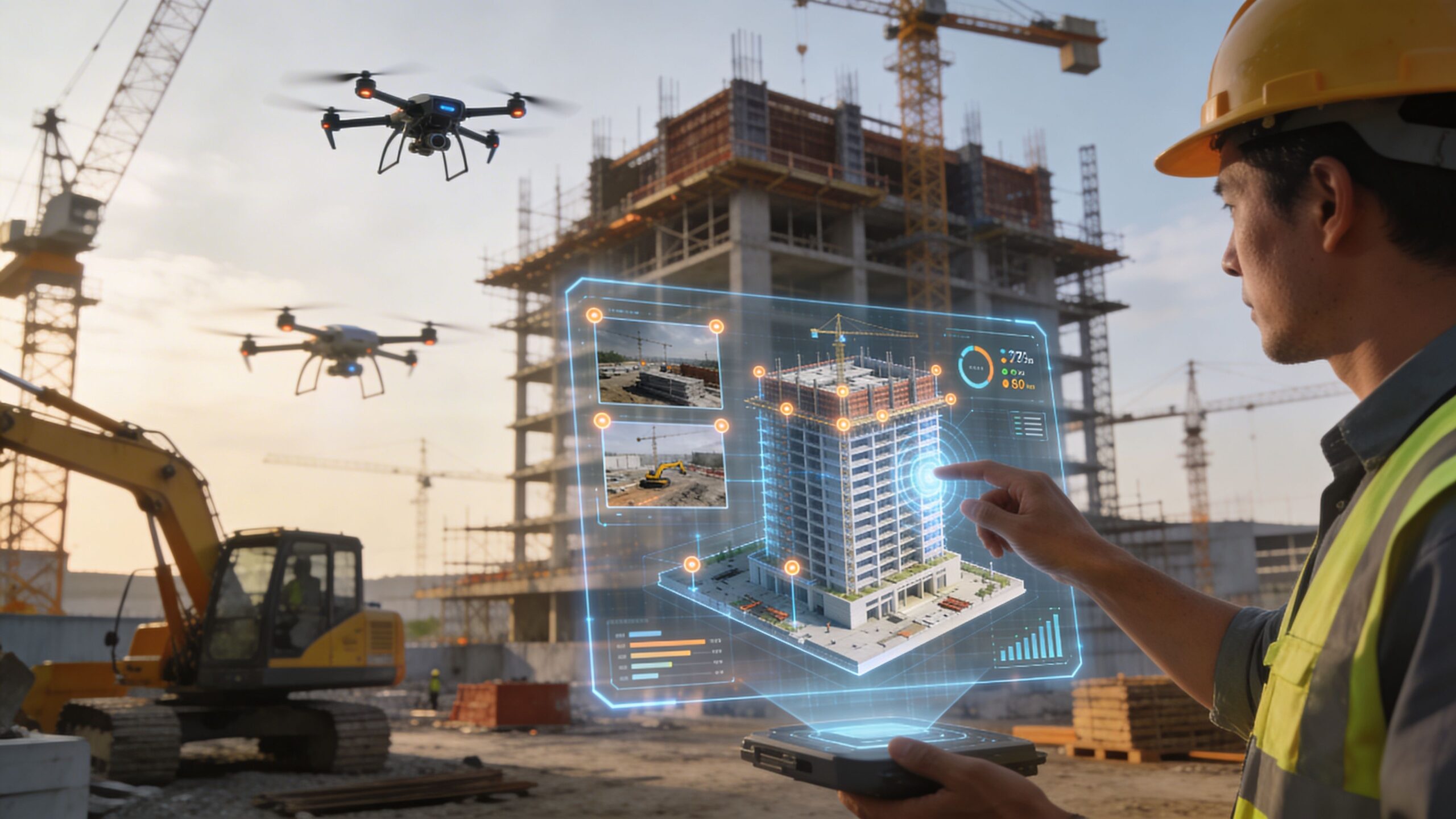
Construction teams are starting to treat images as structured data, not just pictures. That shift changes the long-term value of documentation.
From photos to searchable building intelligence
According to DroneDeploy’s discussion of photo management as hard data, emerging tools are turning photos into structured data. The same source notes that drones with LiDAR offer millimeter-accurate measurements, while AI-enhanced documentation can cut inspection times by enabling virtual walkthroughs. It also points to markets such as Denmark, where survey-grade as-builts are already mandated for utilities, making searchable visual records of buried or concealed elements critical for lifecycle management.
That matters because a building’s information needs do not end at substantial completion.
Facilities teams eventually need to know what sits behind finished walls, where utility paths run, how equipment was installed, and what conditions existed before later tenant work. A searchable photo archive can answer those questions far faster than rummaging through disconnected folders and incomplete memory.
What changes for owners and developers
For owners, this turns documentation into an asset-management tool. For developers, it creates a stronger handoff. For contractors, it expands the usefulness of the record beyond closeout.
A future-focused archive can support:
- Maintenance planning: Finding concealed systems without unnecessary demolition.
- Renovation decisions: Understanding existing conditions before design starts.
- Utility safety: Reducing the risk of accidental strikes during later work.
- Deconstruction and sustainability efforts: Identifying assemblies and materials with more confidence.
The craft still matters
Advanced software does not remove the need for careful image-making. It raises the standard for it.
AI can sort, tag, and compare. LiDAR can measure. Drones can capture large or difficult areas. But the usefulness of the resulting database still depends on whether the original images are legible, contextual, and consistently made.
Key takeaway: The future is not just more images. It is better images connected to systems that make them searchable, measurable, and useful across the life of the asset.
That makes today’s documentation decision more consequential than it first appears. You are not only creating a project record for this month’s report. You may be building a visual database that serves the property for years.
An Investment in Clarity Certainty and Craft
The strongest argument for progress photography is not aesthetic. It is operational.
A disciplined image record reduces uncertainty. It sharpens communication. It helps teams answer questions with evidence instead of recollection. It protects concealed work, supports remote review, strengthens reporting, and preserves a readable account of how the project came together.
That alone justifies the effort.
But the value runs deeper on complex projects. When progress photos are made with architectural discipline, they do more than document activity. They show the quality of execution. They reveal the logic of the design as it becomes real. They create a visual history that can support closeout, future renovations, and brand storytelling with the same archive.
For these reasons, construction progress photos matter. They give a complex project something every stakeholder needs and rarely has enough of. Clarity.
The trade-off is simple. Casual snapshots are cheap to collect and expensive to rely on. Intentional documentation takes more planning, but it produces a record that can hold up under scrutiny. On projects with design ambition, multiple stakeholders, concealed systems, and real financial exposure, that difference is substantial.
Good documentation is not about taking more pictures. It is about making the right images at the right time, in the right way, so they remain useful when the pressure is highest.
Construction always involves movement, change, handoffs, and risk. Photography cannot remove those realities. It can make them visible, legible, and manageable. And in modern construction, what the team can see clearly, it can usually manage better.
If your firm wants progress photography that does more than fill a folder, Jimmy Clemmons Photographer brings architectural precision, editorial discipline, and a design-forward eye to every stage of the build. From milestone documentation to polished visual storytelling, Jimmy creates images that protect the project, communicate progress, and elevate the finished brand.