
When you’re navigating architectural image rights and licensing, the whole game boils down to understanding one simple fact: two creators are involved. The architect designed the building, and you, the photographer, created the image. Untangling who owns what is the key to protecting your work, your clients, and your bottom line.
Architectural Copyright: A Tale of Two Owners
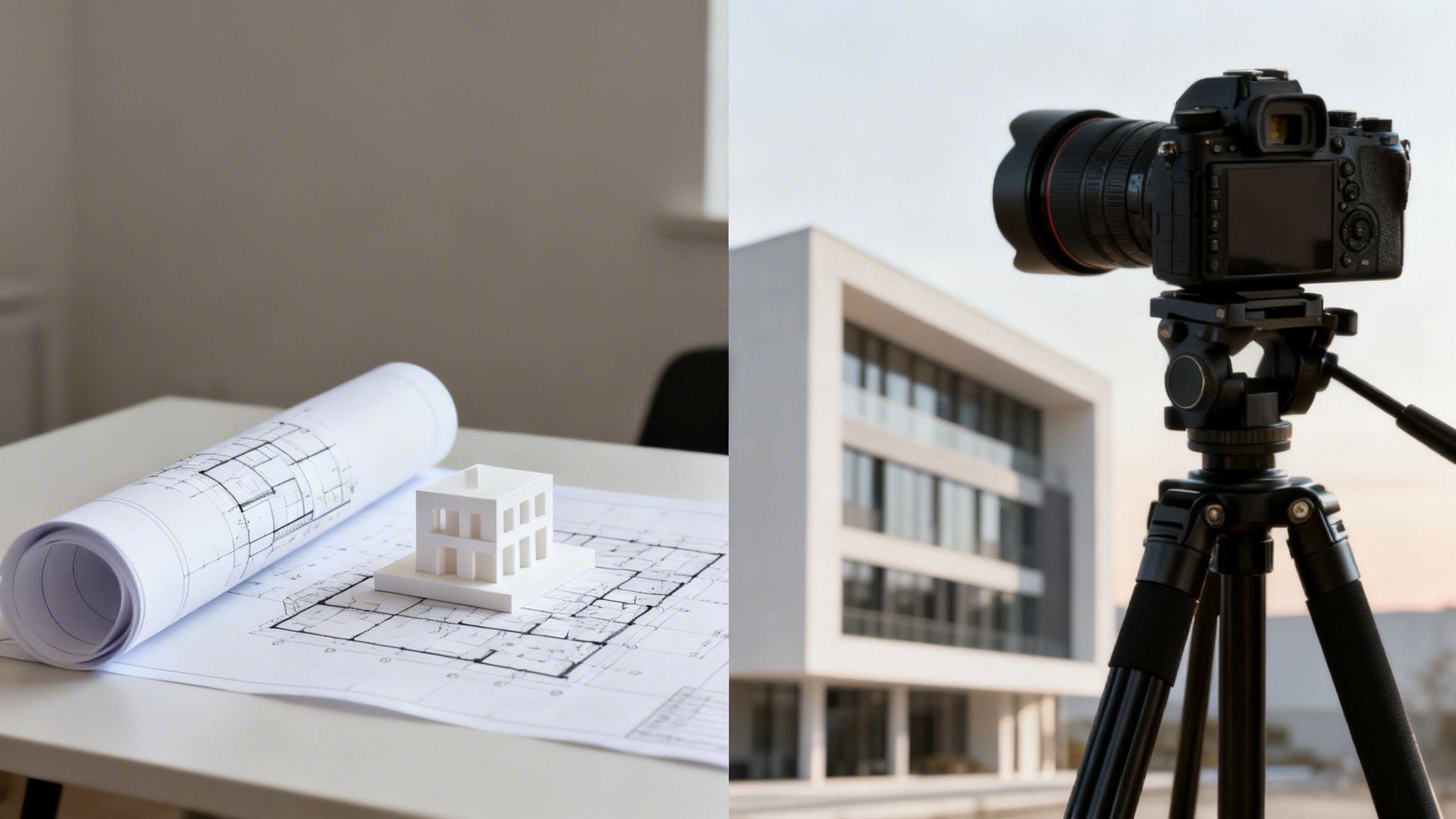
Let's clear up the biggest point of confusion right out of the gate. This isn't a single copyright issue; it's a dual-ownership system. Once you get your head around that, everything else about licensing your work falls into place.
Think of it this way: An architect's building is like a hit song. Your photograph is the remix. Both are distinct creative works, but your remix couldn't exist without the original song. You and the architect are two different artists, and both of you hold rights that need to be respected.
The Bedrock of Building Copyright
The rulebook for this is the Architectural Works Copyright Protection Act (AWCPA) of 1990. Before this act, architects had surprisingly little protection for their finished structures. The AWCPA was a game-changer, giving "architectural works" the same kind of copyright protection as a painting or a novel. This doesn't just mean the building itself; it includes the plans, drawings, and even 3D models.
This legal foundation is more important than ever, especially with the current boom in construction and design.
The number of licensed architects in the U.S. is on the rise. In 2022, there were nearly 120,000 licensed architects holding about 145,000 licenses—a 6% jump from the prior year. This growth fuels a fiercely competitive market where stunning imagery isn't just a nice-to-have; it's essential for winning awards and landing the next big project.
More projects mean more opportunities for us photographers. But it also means the stakes are higher for getting architectural image rights and licensing right from the start. A simple misunderstanding can sour a client relationship or, worse, land you in a legal mess.
Who Owns What?
So, in this dual-ownership world, let's break down who holds the keys to each asset. Getting this straight is the foundation of every contract and licensing agreement you'll ever sign.
To help clarify this, here’s a quick overview of how copyright ownership is split on a typical architectural shoot.
Architectural Copyright Ownership At A Glance
| Asset | Primary Copyright Holder | Key Consideration |
|---|---|---|
| The Building's Design | The Architect/Architectural Firm | The "overall form as well as the arrangement and composition of spaces and elements in the design" is protected intellectual property. |
| The Photograph | The Photographer | Your unique composition, lighting, and creative choices create a new, separate copyrighted work. |
| The Right to Use an Image | The Client (via license) | The client purchases a license from you. They do not own the image or the building design copyright. |
This table shows why your contract is so important. It defines exactly what rights you're granting the client to use your copyrighted work (the photo) of the architect's copyrighted work (the building).
This clear separation of rights is fundamental to running a sustainable photography business. As we touch on in our article about the evolution of architectural photography, understanding your creative ownership has always been what separates the pros from the hobbyists. Your camera doesn't just document a building—it creates a brand-new asset with its own unique value and legal standing.
Photographer's Rights Versus Architect's Design Rights
When we talk about architectural image rights and licensing, things can get complicated fast. It seems simple at first: the architect owns the building design, and you, the photographer, own the picture. But in practice, those two copyrights are tangled together, and understanding how they interact is key to working legally and profitably.
Imagine you're on a shoot for an engineering firm. They hired you to capture a gorgeous new corporate campus they helped bring to life. The building is the star, but your client needs photos for their marketing. This is where your rights as the photographer meet the architect's rights as the designer, and you need to know the rules of the road.
Legally speaking, your photograph is a derivative work. It’s a new piece of art, but it’s based on a pre-existing copyrighted work—the building itself. You absolutely own the copyright to your photograph. That protects all your creative decisions: the composition, the way you sculpted the light, the exact moment you clicked the shutter. But owning the photo doesn’t magically erase the architect's original copyright on the building design.
Public Sidewalks vs. Private Land
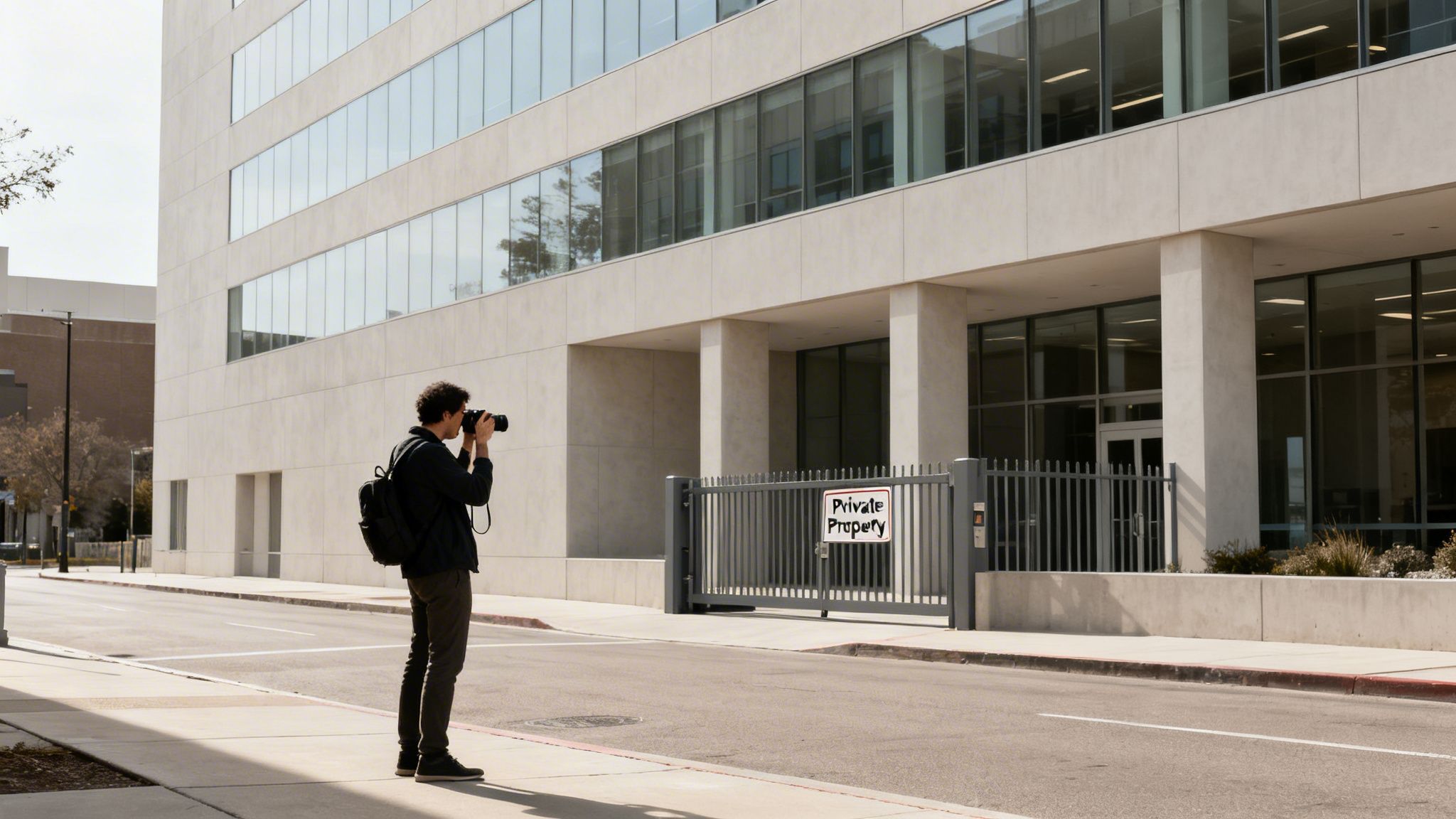
Where you physically stand when you take the photo changes everything. This is probably the most important factor in figuring out what you can do without asking for permission.
In the U.S., we have something called Freedom of Panorama. This doctrine generally allows you to photograph buildings from public property—like a street or sidewalk—and use those images for artistic or editorial purposes without getting a release.
The second your tripod hits private ground, though, the game changes completely.
Once you step onto private property—a corporate plaza, a gated community, or even just the front lawn of a house—Freedom of Panorama is out the window. Now you're playing by the property owner's rules, and you absolutely need their permission to be there and to shoot for any commercial purpose.
This isn't a small detail; it's a hard legal line. Using images taken on private land for a commercial project without a property release puts both you and your client in a very risky position.
The Derivative Work Dilemma
Let's go back to that corporate campus shoot. You take some stunning shots from the public street across the way. You own the copyright to those photos. You could sell them as fine art prints or license them to a magazine for an article on modern architecture—that's all considered editorial use.
But your client, the engineering firm, wants to use your shots in a brochure to land new projects. That’s commercial use, and this is where the architect’s rights snap back into focus. Because your photo (the derivative work) is being used to help sell a service, it could be seen as commercially profiting from the architect’s design (the original work).
This is the central challenge we all face. Even when you own the photo, using it commercially can be blocked by the architect’s underlying design rights.
The best way to handle this is to make it the client’s responsibility. Your contract should have a clause stating that the client guarantees they have secured all necessary permissions from the property owner and the architect for both the shoot and the planned use of the images. This clause protects you if a problem comes up later. Talking this through with your client before the shoot is just good business—it sets clear expectations and saves everyone from major headaches down the road.
Choosing Your Licensing Model To Maximize Your Income
The shoot is wrapped, the client loves the images, and the invoice is paid. A lot of photographers call it a day right there. But if you want to build a sustainable career in architectural photography, that's a huge mistake.
How you license your images is the difference between getting paid once for your work and creating an asset that pays you over and over again for years. This is where you have to get smart about your business.
We need to talk about the two main ways to license your work: Rights-Managed (RM) and Royalty-Free (RF). While "royalty-free" might sound great, it's a financial dead end for professional photographers. In our world, the RM model is the standard for a reason—it protects the value of your images and your business.
The Royalty-Free Trap
Imagine you just finished photographing a stunning new boutique hotel. You deliver 20 incredible images, and the hotel pays your fee, which includes a flat rate for an RF license. They're ecstatic. Why wouldn't they be? They can now use those photos anywhere, forever, without ever paying you another dime.
They splash them on their website, in magazine ads, on social media, and across every booking site on the internet.
A few months go by. The architect who designed the building calls you, wanting to use the photos for their portfolio and an important award submission. Then the interior designer asks for them for their own website. Finally, a major travel magazine wants to run a feature on the hotel and needs one of your best shots for the cover.
Under that RF license, you earn exactly $0 from all of this new interest. That initial flat fee was all you'll ever see for that work. You've effectively given away every future opportunity to profit from those images.
The Rights-Managed Advantage
Now, let's run that exact same scenario, but this time, you do it the right way with a Rights-Managed (RM) license. This model treats each of your images as a valuable piece of property, where you grant specific permissions for specific uses.
You shoot the same hotel, but this time you license the images to the client for one year, specifically for use on their website and social media. Your initial creative fee reflects that limited scope.
Here’s how that one shoot starts making you more money:
- Initial Client (The Hotel): They get their images for web and social for one year. When that year is up, if they want to continue using them, they pay a renewal fee.
- Second Client (The Architect): The architect reaches out. You draw up a new license just for them, allowing the use of five images on their website and for award submissions for two years. That’s new, separate income.
- Third Client (The Interior Designer): The designer wants three of the interior shots for their online portfolio. You issue another unique license, generating another revenue stream.
- Fourth Client (The Magazine): A magazine cover is a high-value placement. You negotiate a premium, one-time-use license for their print and digital editions, commanding a much higher fee.
With the RM model, one photoshoot just turned into four separate paydays. You’ve maintained control over your work, protected its value, and ensured you’re paid fairly every single time it’s used.
A comparison of the two models makes the choice pretty clear.
Rights-Managed (RM) vs. Royalty-Free (RF) Licensing
| Feature | Rights-Managed (RM) | Royalty-Free (RF) |
|---|---|---|
| Payment Structure | Fee per use (usage, duration, territory) | One-time flat fee |
| Usage Control | High. You specify exactly how images can be used. | None. Client can use images almost anywhere, forever. |
| Exclusivity | Can be offered, often for a premium fee. | None. You can't guarantee who else is using the image. |
| Earning Potential | Unlimited. Can be licensed to multiple clients. | Capped. Income ends after the initial sale. |
| Value Perception | High. Reinforces images as valuable, unique assets. | Low. Commoditizes images as a one-off product. |
| Best For | Professional commercial and architectural photography. | Stock photo sites, non-exclusive, low-budget uses. |
Ultimately, RF licenses treat your work like a disposable commodity, while RM licensing establishes it as a valuable, income-generating asset.
This isn't just theory; it's how successful architectural photographers build their businesses. A single shoot that initially brings in $2,000 can easily turn into $4,000 or more over time, all from the same set of files. For example, an architect might renew their one-year license for $1,000, and then the project’s general contractor could license those same images for their own marketing for another $1,000—all pure profit. You can read real-world case studies on Fstoppers that break this down even further.
By adopting an RM strategy, you're not just a photographer anymore; you're managing intellectual property. This mindset is what separates amateurs from professionals, maximizes your income, and reinforces the true value of your work. It's a key part of understanding the ROI of professional photography and building a business that lasts.
Drafting An Ironclad Licensing Agreement
We all want to build great, trusting relationships with our clients. But when it comes to your images—your assets—trust alone isn’t a business strategy. Your licensing agreement is the single most important document you’ll ever create. It’s the playbook that prevents confusion and protects your bottom line.
Think of it this way: your agreement is a clear instruction manual for your photos. It tells everyone involved—you, your client, and anyone else who might want to use the images down the line—exactly what they can and can’t do. Getting this right from day one is non-negotiable.
Let's break down the essential components you need to build a contract that protects your work and serves your clients fairly.
The Four Levers of Every License
Every license you grant is built on four core components. These are the levers you can pull to perfectly match the client’s needs while protecting the long-term value of your photography. Nail these four, and you’ve built a solid foundation.
- Scope of Use: How and where can the images be used? This needs to be specific. Is it for their website only? Or does it include social media, print brochures, and paid advertising?
- Duration: How long does the license last? Common terms are one, three, or five years. A perpetual, unlimited license should be rare and carry a significant price tag.
- Territory: Where in the world can the images be shown? Is it for a local magazine, national use, or is it global? For anything on the internet, "global" is the default.
- Exclusivity: Is your client the only one who can use these images (exclusive)? Or can you license them to other parties, like a vendor or publication (non-exclusive)? Exclusive rights are worth more and should be priced that way.
When you define these four levers clearly, there’s no room for guessing games. The client knows exactly what they paid for, and you keep control over any use that falls outside the original agreement.
Defining the Scope of Use
This is where the real work happens. "Web use" is simply too vague. A strong agreement gets specific. Does "web use" mean their own website, their social media channels, and paid digital ads? What about third-party platforms like ArchDaily or a developer’s portfolio? Each of these represents a different value.
A critical point to include here is that the license is non-transferable. This is huge. It means your client can't just hand the photos over to a third party, like the interior designer or landscape architect on the project. If they want the images, they need to come to you and secure their own license.
Let's walk through a common scenario. An architect hires you to shoot a new office building. They need images for their online portfolio and for submitting to industry awards.
A Clear Clause Looks Like This:
"Client is granted a license for use of the specified images on their company website (clientwebsite.com), their direct social media channels (Instagram, LinkedIn), and for print and digital submissions to industry awards for a period of two (2) years."
That’s crystal clear. If that architect later wants to give an image to a magazine for a feature story or run a paid ad campaign, it falls outside this scope. That opens the door for a new conversation and an additional licensing fee, protecting your ability to earn from your work. If you are a commercial architectural photographer, mastering this level of detail is fundamental to running a sustainable business.
Setting Duration, Territory, and Exclusivity
These terms work hand-in-hand with the Scope of Use to create the complete picture.
- Duration: A one-year license is a great starting point for many commercial clients. It creates a natural reason to check in, see if they need to renew, and keep the relationship going.
- Territory: Since most architectural work ends up online, a "global" or "worldwide" territory is pretty standard. The internet has no borders. For a local business's print ad, however, you could easily limit the territory to a specific city or state.
- Exclusivity: Most clients will want an exclusive license for the images of their own project, and that's perfectly normal. It just means you won't license the exact same photos to their direct competitor. But you should always retain the right to use the images for your own self-promotion.
This final point is crucial. Your contract absolutely must have a "Promotional Use" or "Portfolio Use" clause. This gives you, the photographer, the explicit right to use the images on your own website, social media, and in your print portfolio to attract new business. Without it, you could be in the absurd position of being unable to show off your own best work.
Here is the rewritten section, crafted to sound like an experienced human expert:
Protecting Your Work From Infringement In 2026
Let’s be honest: seeing your work used without permission isn’t just an annoyance. It’s theft, plain and simple. The internet is a double-edged sword; while it's never been easier for your work to get seen, it's also never been easier for it to get stolen.
Thankfully, the days of stumbling across an infringement by sheer luck are over. We now have powerful tools that have completely changed the game, making it possible to police our own work effectively.
How to Hunt Down Stolen Images
Your first line of defense is reverse image search. It’s a beautifully simple concept. You can take one of your photos, upload it to a service like Google Images or TinEye, and see where it appears across the web. In seconds, you can uncover unauthorized uses on company websites, blogs, and social media feeds you never knew existed.
But who has time to do that manually for every single photo? That's where specialized services come in.
I’ve seen photographers have incredible success with platforms like PIXSY. It’s built for creators. You upload your portfolio, and it automatically scours the internet for you. When it finds a match, it can handle the entire claims process, often on a contingency basis—meaning they only get paid if you do.
This kind of technology has tilted the scales back in our favor. It’s a big reason you hear about more lawsuits over architectural photo rights. Infringement is just so much easier to catch now, which puts serious pressure on businesses to get their licensing right from the start. The American Institute of Architects has some great discussions on how the legal side is adapting to this reality.
A Cautionary Tale: The Real Cost of "Borrowing" a Photo
I know a photographer who went through this firsthand. A major hotel group grabbed his shots of a new property and splashed them all over their international marketing materials, all without a license.
An automated tracking service flagged it, and the photographer filed a copyright claim. The result? A five-figure settlement. That's a massive bill for the hotel group, and far more than a proper license would have ever cost them. It was an expensive, embarrassing lesson, and one I see being learned more and more by everyone from big brands to small contractors who think it's okay to pull an image from a partner's website.
Your Legal Powerhouse: Copyright Registration
Finding stolen work is one thing. Having the legal muscle to do something about it is another. This brings me to the single most important step you can take to protect your business: registering your images with the U.S. Copyright Office.
This isn't just a piece of administrative busywork. It's a game-changer. Here’s why:
- The Right to Sue: You simply cannot file a lawsuit for copyright infringement in federal court unless your work is registered. Period.
- Statutory Damages: This is the big one. If you register your photos before an infringement happens (or within three months of their first publication), you can be awarded statutory damages. A court can award $750 to $30,000 per image—and up to $150,000 if the infringement was willful. You don't have to prove you lost a specific amount of money.
- Attorney's Fees: Timely registration also means you can potentially have the infringer pay for your legal fees if you win. This removes a huge financial barrier that stops many photographers from fighting back.
Without registration, you’re limited to suing for "actual damages," which means you have to prove exactly how much money you lost. It’s difficult, expensive, and often not worth the fight. Registration turns your copyright from a passive right into a powerful, enforceable asset. Proper licensing is always the goal, but when that fails, being prepared is your only real option.
Your Architectural Image Licensing Questions Answered
I get asked about image rights all the time. The rules can seem tricky, full of exceptions and what-ifs, but they don't have to be. Let's clear up the questions I hear most from photographers and clients so you can approach every project with confidence.
Do I Need a Property Release to Photograph a Building
This one comes down to two simple things: where your feet are planted and how the final images will be used. If you're on a public sidewalk, the U.S. concept of "Freedom of Panorama" generally lets you shoot a building's exterior for your portfolio or for editorial use without needing a formal release.
But the moment you step onto private property—even an unfenced front lawn or a corporate plaza—you need permission. And for any commercial use, like a company's advertising campaign or marketing materials, a signed property release from the building owner isn't just a good idea; it's an absolute must. Think of it as your insurance policy; it's always the safest bet.
Can I Post Client Project Photos on My Portfolio
Yes, but only if your contract says so. The right to showcase your work is the lifeblood of your business—it's how you land your next project.
You have to spell this out in your agreement with a "Promotional Use" or "Portfolio Use" clause. This clause gives you the specific right to use the images for your own self-promotion, like on your website, social media, or in a print book. Without it in writing, you could find yourself in a bind, potentially violating an exclusive license you gave your client. Always, always get it in writing.
What if a Third Party Wants to Use My Photos
When this happens, it’s a great opportunity, and it's exactly why you should license your work on a Rights-Managed (RM) basis. Your primary contract with your client should make it crystal clear that the license is non-transferable.
That simple term is powerful. It means your client can't just hand off the photos to the architect, a subcontractor, or a magazine. When a third party asks for the images, your client's job is to send them straight back to you. You then get to negotiate a brand new license with that third party, tailored to their specific use. This not only protects the value of your work but also creates more revenue from a single shoot.
Think of it as a core principle of architectural image rights and licensing: you hold the keys to your work. Each new user needs their own key, and you, the photographer, are the only one who can hand it out. This keeps your images from being passed around freely and ensures you're paid fairly for every single use.
Who Gets the Architect's Permission for the Shoot
Typically, the client hiring you is responsible for getting all the necessary permissions from both the property owner and the original architect. They’re the ones with the existing relationships and are commissioning the project in the first place.
That said, you should always confirm these permissions are locked down before you even show up. I protect myself by including a clause in my contract where the client "warrants"—or formally guarantees—that they've secured all the rights needed for both the shoot and how the images will be used. This clause is your shield if an ownership issue pops up later. For big commercial jobs, it's smart to ask for a copy of the written permission.
This flowchart breaks down the critical path to follow if you discover your work has been used without authorization, from the moment of discovery to potential legal action.
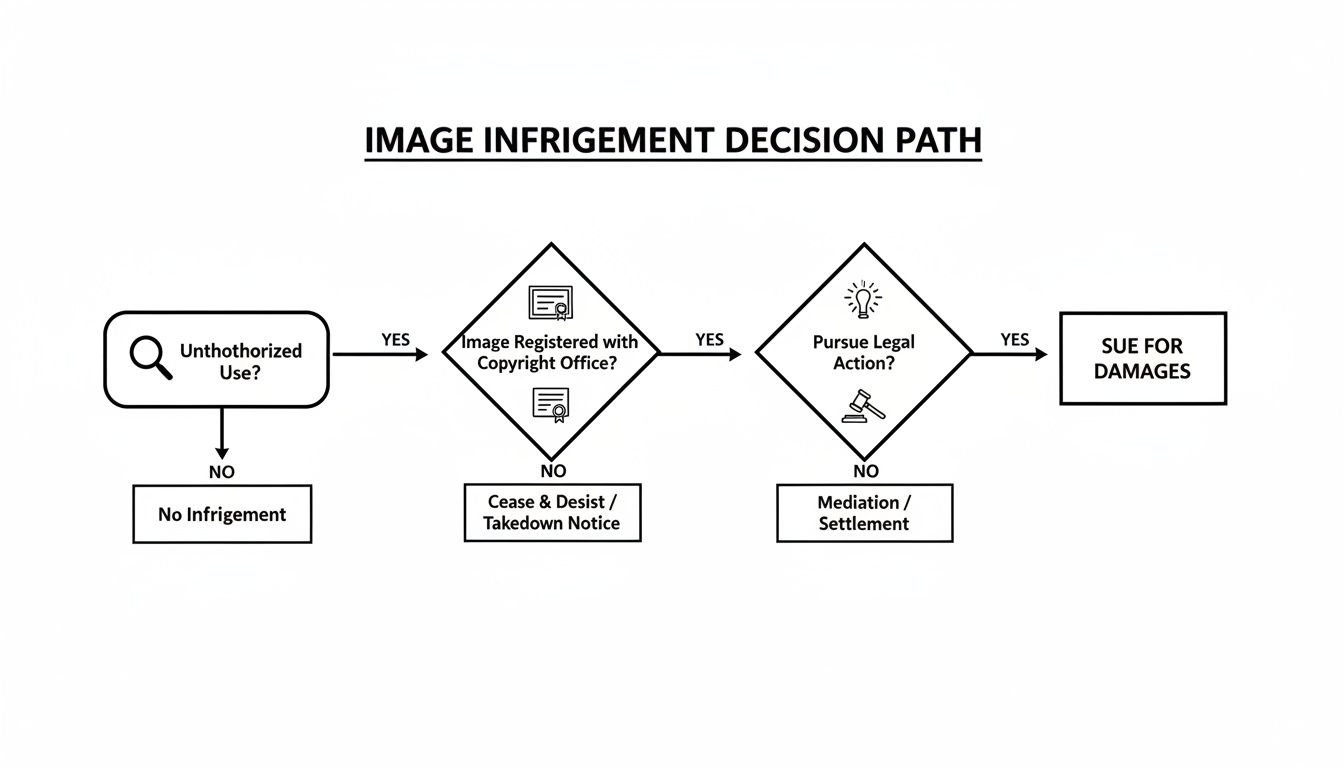
As you can see, registering your copyright is the move that truly empowers you to defend your work and seek real damages for infringement.
Whether you're documenting a new build or capturing an interior renovation, having a trusted photography partner who understands these complexities is essential. At Jimmy Clemmons Photographer, we bring an editorial eye and business-minded approach to every project, delivering compelling visuals while navigating the nuances of licensing to protect all parties. Learn more about how our tailored approach can elevate your brand by visiting https://jimmyclemmons.com.