

A project can look flawless in a presentation deck while the firm behind it remains difficult to understand. The images show a refined interior, carefully controlled daylight, and a strong design concept, but they don't reveal whether the practice is dependable, collaborative, or capable of delivering the same standard across assignments. At the same time, a corporate portrait library may communicate professionalism without giving prospective clients any reason to remember the firm's particular design point of view.
That tension explains why the question what is the difference between brand and corporate image matters to photographers, architects, developers, designers, and marketing teams. The distinction determines what a shoot should show, who each frame needs to persuade, and whether the final library builds recognition, trust, or both.
| Dimension | Brand Image | Corporate Image |
|---|---|---|
| Primary subject | A specific brand, product, service, or project | The organization behind its offerings |
| Main audience | Customers and prospects evaluating a particular offer | Customers, employees, investors, media, suppliers, regulators, and the public |
| Typical associations | Style, quality, personality, relevance, and experience | Credibility, culture, ethics, reliability, leadership, and capability |
| Visual priority | Distinctive positioning and aesthetic fit | Consistent evidence of organizational substance |
| Photography examples | A campaign for a flagship project or service | Team portraits, workplace documentation, leadership, and process imagery |
When Visual Content Meets Two Different Audiences
A design practice commissions a shoot for a newly completed workplace. The marketing team wants sweeping interiors that make the project feel memorable, editorial, and unmistakably theirs. The managing director wants portraits, working-session images, and details that show how the practice collaborates with clients. One assignment now has to sell a specific project and reinforce confidence in the organization responsible for it.
Those are related aims, but they aren't identical. The first belongs mainly to brand image, the associations attached to that project, service, or market offer. The second contributes to corporate image, the wider impression stakeholders form of the firm itself.
One location, two visual jobs
For the project-facing story, I might prioritize the geometry of a stair, the rhythm of a facade, or the way reflected light moves through a public space. The composition needs a clear point of view. It should help an audience associate the service with architectural precision, visual sophistication, and narrative quality.
For the organization-facing story, the camera may move closer. A project architect reviewing drawings, a team member coordinating with a contractor, or a principal listening during a client meeting can provide evidence of behavior and expertise. These frames don't replace the hero images. They answer a different question: what will it be like to work with this firm?
Practical rule: A project image earns attention. An organizational image helps explain whether that attention should become trust.
Confusing the two goals usually creates one of two weak outcomes. The shoot may produce beautiful but generic interiors that could belong to any firm, or it may document staff and process so heavily that the specific service disappears. A better brief assigns both roles before the camera is raised, then gives each role an appropriate composition, level of polish, and selection priority.
Defining Brand Image And Corporate Image Clearly
Brand image is the set of perceptions, meanings, and associations audiences attach to a specific brand, product, or service. It develops through advertising, customer experience, word-of-mouth, visual identity, editorial coverage, and cultural context. For a photography service, those associations might include architectural precision, an editorial sensibility, or a design-led approach.
Corporate image is the overall impression stakeholders form of the organization behind those offerings. That audience is wider than the customer evaluating one service. It can include employees, investors, journalists, regulators, suppliers, and the general public. Academic literature describes corporate image as the outside world's view of an organization, while distinguishing it from corporate identity, which concerns what the organization is and how it behaves, as outlined in this academic discussion of brand, corporate image, and identity.
The unit of analysis changes the question
Brand image asks:
- Does this service feel relevant to the intended client?
- Does the visual style appear distinctive?
- Does the project communicate the promised quality?
- Does the audience understand what makes the offer different?
Corporate image asks:
- Does the organization appear reliable?
- Do its people seem capable and credible?
- Does its conduct support its stated values?
- Can stakeholders recognize consistency across projects and interactions?
A firm can therefore have a strong corporate image while separate services carry different reputations. It may be viewed as technically capable, ethical, or forward-thinking, while one market offer feels more established than another. The reverse can also happen. A popular service can attract attention even when the organization behind it is relatively unknown.
Identity isn't the same as image
This distinction matters during visual planning. A brand guideline describes intended identity, such as the colors, typography, tone, and photographic treatment an organization chooses. Image is the perception held by audiences after they encounter those signals alongside real experiences. The firm can guide image through communication, but it can't fully control how stakeholders interpret or remember it.
For a photography-led business, the working translation is simple. Use brand imagery to clarify how a particular offer is perceived. Use corporate imagery to show how the organization operates and what people can reasonably expect from it.
Comparing Scope, Control, And Formation Processes
Brand image and corporate image diverge most clearly in scope, audience, control, formation, and visual purpose. A brand campaign can target a defined market with tightly controlled messages. Corporate image develops across a broader set of relationships, including customers, suppliers, employees, opinion leaders, government officials, and the public, as described in research on stakeholder formation of corporate image.
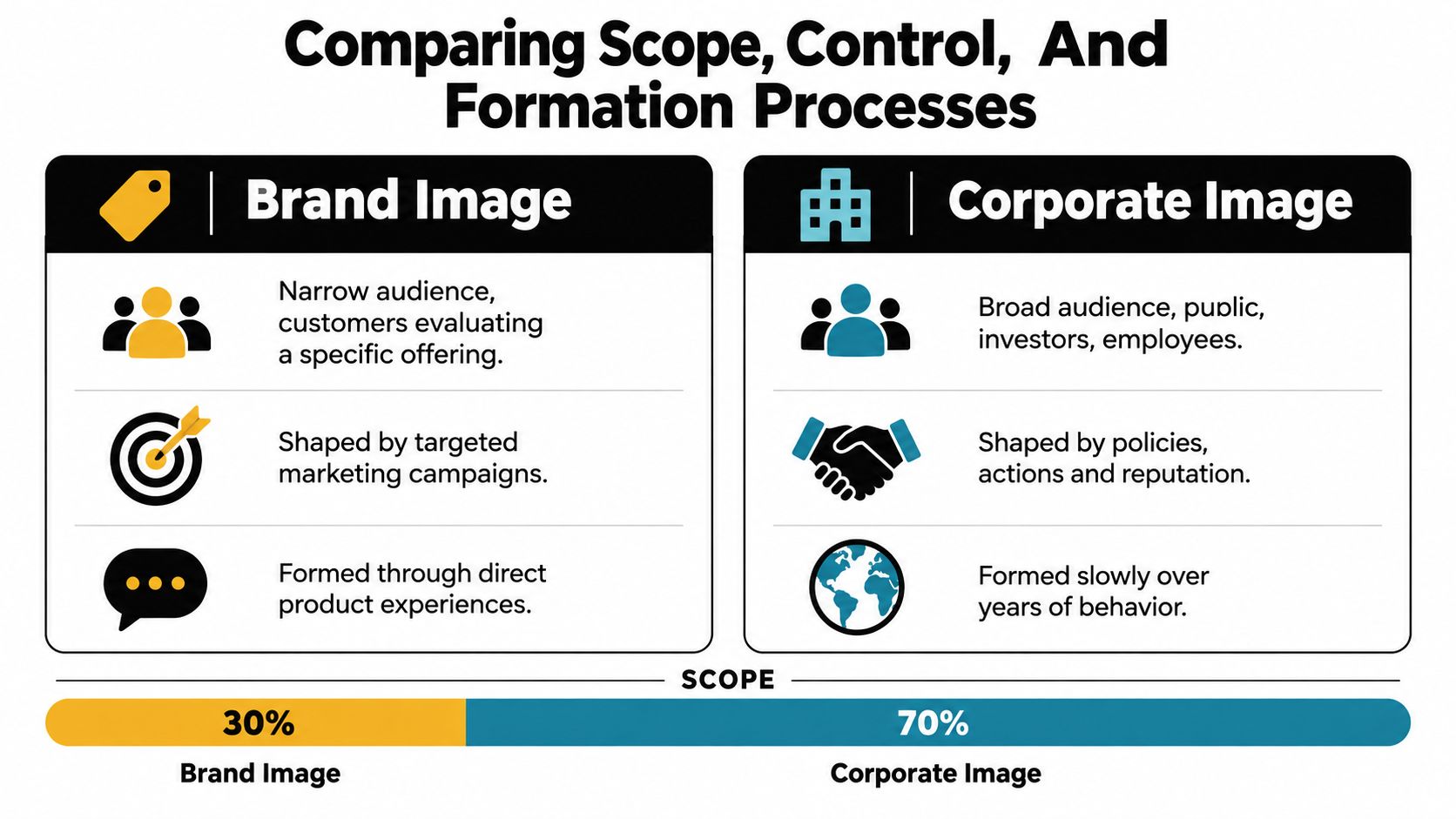
| Dimension | Brand Image | Corporate Image |
|---|---|---|
| Scope | Narrower, focused on one offer | Broader, focused on the organization |
| Audience | Primarily customers and prospects | Multiple stakeholder groups |
| Main inputs | Campaigns, service experience, recommendations, and editorial coverage | Policies, leadership, culture, operations, conduct, and communications |
| Degree of control | More directly influenced by planned marketing | Influenced but not fully controlled |
| Time pattern | Can shift with a campaign or experience | Builds through repeated organizational behavior |
| Photographic translation | Distinctive project and service imagery | Evidence of people, process, consistency, and capability |
Control is the important trade-off
Brand image gives a creative team tighter control. The photographer can select a location, direct the scene, shape the light, and edit toward a defined personality. That control is useful when the brief needs a recognizable visual position.
Corporate image is less controllable because stakeholders combine planned communication with direct and indirect experiences. A polished leadership portrait may support confidence, but it can't compensate for poor responsiveness or inconsistent delivery. Corporate photography works best when it records credible evidence rather than attempting to manufacture a complete reputation in a single session.
Brand image can be art-directed. Corporate image must also be earned.
The distinction changes the shot list. For a service campaign, select images for relevance, memorability, and differentiation. For corporate communication, select images that help stakeholders verify professionalism, expertise, culture, and operational discipline. Both may use the same exposure standards and compositional care, but they serve different questions.
How Photography Translates Each Concept Visually
Photography turns an abstract perception into something an audience can inspect. In architecture and design, that translation depends on what the frame proves. A carefully controlled interior can position a service as refined, while a genuine working portrait can make the organization feel more capable and approachable.

Build brand image through specificity
Start with the offer. If the subject is an architectural service, photograph the characteristics that make that service recognizable: disciplined geometry, material transitions, controlled perspective, or a relationship between structure and light. Avoid relying only on wide establishing views. A close detail of a junction, threshold, handrail, or reflected surface can carry more positioning value when it expresses the firm's way of seeing.
Brand-focused photography often benefits from:
- A defined visual point of view: Choose camera height, lens behavior, and lighting that support the intended personality.
- Project-specific evidence: Show details that belong to the actual commission rather than generic luxury.
- Narrative sequencing: Combine overview, human scale, material detail, and contextual frames so the audience understands the experience.
- Selective post-production: Keep color, contrast, and perspective consistent without removing the qualities that make the place believable.
A flagship project image should feel aspirational, but aspiration needs an identifiable subject. Generic premium imagery may look polished and still fail to create a memorable association.
For teams planning a campaign around people, products, and spaces, commercial brand photography can be structured around the particular service promise rather than a general request for attractive images.
Build corporate image through evidence
Corporate-image photography asks you to widen the frame. Photograph the people who create the work, the environments where decisions happen, and the details that demonstrate process. Environmental portraits can connect employees to the workplace. Leadership images can show presence without turning every subject into a formal headshot. Process frames can reveal collaboration, care, and technical discipline.
The camera still needs direction. Authenticity doesn't mean leaving every variable uncontrolled. It means directing real people through credible activity, using accurate captions, and avoiding scenes that promise a culture or capability the organization can't support.
The video below offers another visual reference for how spaces, people, and presentation can work together in corporate communication.
A useful library includes both polished campaign frames and grounded organizational material. The first makes the offer distinctive. The second gives the wider corporate image something substantial to stand on.
Why Measuring Both Separately Reveals Strategic Gaps
A single “overall brand” score can hide the reason a prospect hesitates. A firm may be trusted but indistinguishable, or visually distinctive but uncertain as a delivery partner. Those conditions require different creative decisions, so combining them into one measure leads to the wrong investment.
Research on corporate-image scale construction produced 32 attributes grouped into seven categories, showing why corporate perception normally needs a wider diagnostic instrument than a product or service brand measure, according to this research on corporate-image measurement.
Measure the association, then the organization
For a service brand, ask respondents or internal stakeholders to assess associations such as:
- Recognition: Do they identify the service or studio?
- Aesthetic fit: Does the visual language suit architecture, commercial work, or editorial assignments?
- Perceived quality: Do the images suggest the required level of craft?
- Distinctiveness: Does the offer stand apart from alternatives?
- Relevance: Does the portfolio make the intended commission feel understood?
Corporate-image measurement needs a different set of signals:
- Reliability: Does the organization appear dependable from brief through delivery?
- Professionalism: Are communication and production standards clear?
- Expertise: Do people see evidence of technical capability?
- Responsibility: Does the organization appear ethical and considered?
- Stakeholder confidence: Would different audiences feel comfortable associating with it?
That separation produces a more useful dashboard. Strong corporate credibility with weak brand differentiation points toward sharper positioning, more memorable project stories, and a more deliberate visual signature. Strong brand image with weak corporate trust points toward process evidence, case material, testimonials, team representation, or a closer review of the actual client experience.
Use signals that lead to decisions
Teams can complement formal research with actionable brand health signals, especially when they need a practical way to monitor recognition, sentiment, consistency, and audience response. The value isn't the score itself. The value is knowing whether the next shoot should make the offer more distinctive or make the organization more believable.
A photography brief should reflect that diagnosis. Don't commission another hero campaign if the actual objection concerns responsiveness or proof. Don't fill the website with internal documentation if prospective clients still can't tell what makes the service visually different.
Aligning Visual Strategy With Overall Business Goals
The strongest visual systems don't force brand and corporate image into the same frame every time. They connect them through shared standards. A project campaign can carry the firm's visual point of view, while team portraits, workplace scenes, and leadership communications show that the organization can deliver what the campaign promises.

Create one system with different assignments
A practical visual strategy can use four connected layers:
- Signature project imagery establishes the brand association. It should express the service's distinctive eye through composition, light, and detail.
- Human representation connects the offer to real people. Environmental portraits and working interactions make expertise visible.
- Operational evidence documents the standards behind the promise. Drawings, material decisions, site coordination, fabrication, or review processes can all serve this role when photographed accurately.
- Consistent publishing rules keep the library coherent. Captions, crops, color treatment, file selection, and usage rights should support the same level of care across web, proposals, recruitment, and editorial placements.
The approach described in visual branding guidance is useful here because visual consistency isn't limited to a logo or color palette. It includes the repeated choices that make a firm recognizable while leaving enough flexibility for different projects and audiences.
Let the evidence carry the promise
A project photograph should not claim more than the project can support. A portrait should represent the person and their role accurately. A workplace image should show a real environment rather than a staged setting that conflicts with how the organization operates.
This balance protects both images. Brand content gains credibility because it connects to real capability. Corporate content gains energy because it isn't reduced to formal headshots and generic office scenes. The same art direction can guide both, but the editorial question changes from “What should this offer feel like?” to “What does this organization really do?”
Why Polish Alone Cannot Replace Authentic Trust
Premium photography can make a company look capable before anyone has spoken with it. That influence is useful, but it has limits. A beautifully lit headquarters, a confident portrait, or a meticulously styled project doesn't prove that the organization communicates well, honors commitments, or delivers consistently.
Reputation research makes the trust problem difficult to ignore. The 2025 Axios Harris Poll reporting cited by PRSA found that 77% of U.S. adults believed companies often charge higher prices while providing lower-quality products or services, while 46% of companies experienced a reputation decline during the year, as reported in this discussion of the polling and reputation pressures.
The visual promise can create a higher standard
When imagery looks highly controlled, viewers may inspect the organization more closely. If a firm presents an immaculate culture but clients encounter disorganized communication, the contrast can make skepticism sharper. Generic stock-style scenes create a similar problem because they communicate atmosphere without offering evidence.
For built-environment firms, useful corporate imagery should show:
- Real spaces: Photograph completed environments with accurate perspective and honest material color.
- Authentic teams: Direct people into natural, credible interactions rather than asking them to perform a fictional workplace.
- Construction and production detail: Show the decisions, coordination, and craft that support the finished result.
- Leadership behavior: Capture listening, reviewing, explaining, and collaborating, not only ceremonial portraits.
- Delivered outcomes: Connect design claims with the spaces and details the organization produced.
Authenticity is not the absence of direction. It is direction applied to something real.
The same principle shapes a credible brand storytelling approach. A story becomes persuasive when the images, captions, people, and operating experience point in the same direction. Visual polish should clarify substance, not conceal its absence.
Choosing Where To Invest Visual Resources
The decision is less about choosing brand image or corporate image than identifying the current perception gap. Ask whether prospects fail to understand why the offer is different, or whether they understand the offer but remain uncertain about the organization behind it.
When credibility is the problem, invest in evidence. Build a portrait library, document real collaboration, photograph leadership in context, and show the operational details that support reliability. Review the website and proposal system at the same time, because strong photographs lose force when the surrounding information is vague or inconsistent.
When differentiation is the problem, invest in a sharper visual position. Revisit the project selection, create a more deliberate art direction, and photograph the details that reveal how the firm thinks. A collection of attractive interiors isn't enough if every competitor's portfolio uses the same angles, tonal treatment, and language.
A practical allocation test
Use the next commission to answer three questions:
- What should the audience remember? This identifies the brand-image assignment, such as a distinctive spatial quality, service specialty, or design attitude.
- What should the audience believe? This identifies the corporate-image assignment, such as dependable collaboration, technical expertise, or responsible delivery.
- What evidence will support both? This determines whether you need a hero frame, an environmental portrait, a process detail, or a sequence combining all three.
The same logic applies beyond architecture. A commercial property team may need project imagery for leasing and operational documentation for stakeholder confidence. An exhibition program may require both a memorable public-facing identity and a dependable production story, which is why teams sometimes study specialist resources such as Stand Builders Sydney when planning physical brand experiences.
Jimmy Clemmons Photographer creates architectural imagery, commercial brand content, and professional portraits that connect built environments with the people and standards behind them. Visit Jimmy Clemmons Photographer to plan a visual library that strengthens brand distinctiveness while giving your corporate image credible evidence.