
You're likely looking at a familiar problem. The light is moving, the client wants the glass clean, the signage true, and the brief calls for a specific aperture while you hold a shutter speed long enough to smooth water, soften clouds, or keep motion in a lobby from turning chaotic. You need exposure control, but you can't afford to trade away edge quality or color accuracy just to work faster.
That's where the variable neutral density filter review question gets practical. A variable ND filter can save time and reduce the pile of glass in your bag. It can also introduce exactly the kind of defects that are unacceptable in architectural and commercial work. For high-end stills, convenience only matters if the file still holds up under scrutiny.
The Professional's Need for Exposure Control
Architectural photography rarely gives you the luxury of static light. Exterior facades shift as clouds pass. Interiors with daylight windows can change by the minute. A branded hospitality space may need warm practicals, neutral wall color, and a controlled sense of motion in one frame.
In those situations, the attraction of a variable ND is obvious. The early Tiffen Variable ND showed why the category became popular. It offered an approximate 2 to 8 stop range by rotating the outer ring, creating a practical alternative to carrying several fixed filters, especially when changing light or shutter-speed control mattered, as described in this Tiffen Variable ND review at Digital Photography School.
For working photographers, that convenience is real. If the brief requires a certain aperture for depth of field, or a slower shutter for controlled motion, a VND gives you a quick way to adjust exposure without rebuilding the setup.
Where convenience helps
A VND earns its place when speed matters more than absolute optical purity.
- Changing exterior light: You can react quickly when sun and cloud cover keep shifting.
- Mixed-use assignments: A single threaded filter can move from exterior details to lobby work without digging through a pouch of separate NDs.
- Video capture on architecture jobs: Shutter consistency matters, and a rotating filter is often the fastest way to hold it.
That said, the professional question isn't whether a VND is useful. It's whether it stays clean enough for the assignment.
Practical rule: In architectural work, exposure control is only valuable if it preserves straight lines, neutral surfaces, and even corners.
Good planning still beats any filter. Before I even think about filtration, I want the light itself working for the image. That's why shoot timing matters as much as gear choice. This guide on choosing the best light for a site shoot gets at the bigger truth: the less force you apply in camera, the cleaner the final file tends to be.
How a Variable ND Filter Actually Works
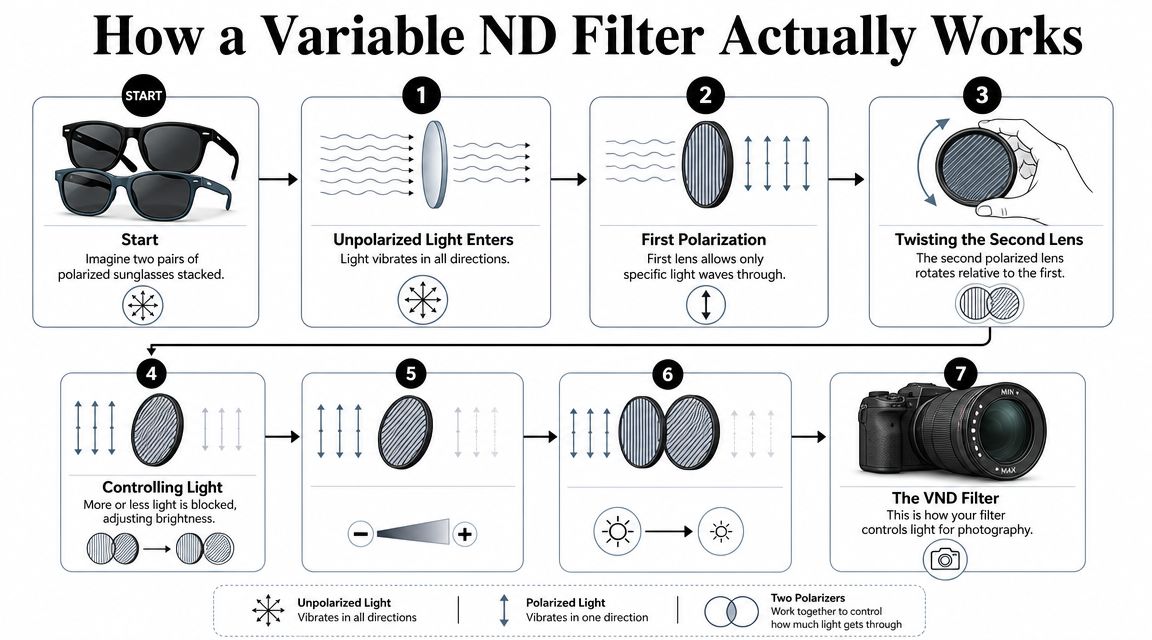
A variable ND seems simple from the outside. Rotate the ring, get less light. The mechanism is more involved than that, and understanding it explains both the benefits and the problems.
The sunglasses analogy
The easiest way to understand a VND is to think of two polarized lenses stacked together. Rotate one against the other and the amount of transmitted light changes. That's the basic idea.
In practice, a VND is typically more complex than just two simple layers. A detailed explanation from The-Digital-Picture's review of variable neutral density filters describes a design built around a pair of polarizers with quarter-wave plates. The rotation of one polarizer relative to the other changes light transmission, and that's what gives the filter its variable effect.
Why that matters in the field
The same design that makes a VND flexible also makes it vulnerable. Because the filter relies on polarization behavior, it can become uneven as you push it through more demanding conditions, especially with wide-angle lenses and scenes that contain large bright areas.
That's why better VNDs are often split into narrower working bands instead of trying to do everything with one filter. The same review notes two common market ranges: 2 to 5 stops for overcast days or interiors, and 6 to 9 stops for bright sunlight. That split matters because one filter usually can't cover every condition equally well without compromise.
What a working photographer should take from the mechanism
A VND is best understood as a rotating exposure control tool, not as a perfect substitute for neutral glass.
Three practical implications follow from the design:
Range matters more than marketing breadth
A filter with a narrower usable band is often more dependable than one that promises a huge range.Wide-angle use is where problems show up fastest
The filter has to handle light entering from many angles across the frame, and that's where unevenness can start to appear.You're paying for behavior, not just density
Its value is whether the filter stays neutral, even, and predictable throughout its intended range.
The smartest VND purchase is usually the one with the most disciplined range, not the one with the biggest claim on the box.
VND vs Fixed ND Filters A Professional's Choice
For architecture and commercial stills, this isn't a philosophical debate. It's a tool choice tied directly to the assignment. A VND solves one problem very well. Fixed ND filters solve a different set of problems better.
The basic trade-off
A variable ND gives you speed. You thread it on, rotate to taste, and keep moving. That's useful when weather shifts, when video is part of the shot list, or when the pace on site doesn't allow repeated filter changes.
A fixed ND gives you consistency. There's no rotating polarization mechanism to introduce its own behavior. If your goal is maximum image integrity for a carefully composed still, fixed glass usually gives you a cleaner starting point.
VND vs. Fixed ND Filter Decision Matrix
| Factor | Variable ND (VND) | Fixed ND |
|---|---|---|
| Speed on location | Fast to adjust without removing the filter | Slower because you swap filters |
| Flexibility | Good for changing light and hybrid stills/video work | Best when you know the exact density you need |
| Optical predictability | Can vary across the rotation range | More consistent from frame to frame |
| Wide-angle reliability | More likely to show unevenness or corner issues | Safer choice for critical wide compositions |
| Color neutrality | Depends heavily on design and tuning | Often easier to keep consistent in a controlled kit |
| Best fit | Fast-moving assignments, video, changing conditions | High-end stills, exacting architectural files, long-exposure work |
When a VND makes sense
A VND is a strong tool when the assignment rewards agility.
- Exterior video clips for developers or hospitality groups
- Hybrid days where stills and motion are both required
- Location work where changing light forces constant exposure adjustment
- Situations where maintaining aperture or shutter speed matters more than having the purest optical path
When fixed ND is the better answer
If I'm shooting a premium interior or a hero exterior for a brochure spread, I want the least amount of uncertainty in front of the lens. Fixed ND filters are often the better choice when the frame includes critical edge detail, repeating geometry, or surfaces where subtle color shifts will be obvious.
A buyer's guide at Digital Camera World on the best variable ND filters notes a point many working photographers already know from experience: if you need more than one strength, three regular ND filters may be preferable because they avoid VND-specific artifacts.
That's a useful dividing line. If your day is controlled and the still image is the priority, fixed ND often wins. If the day is fluid and speed is part of the deliverable, a VND can justify its compromises.
How to Decode a Variable ND Filter Review
Most variable neutral density filter review content gets stuck on the easiest things to publish. Stop range. Price. Build feel. Maybe a few flattering outdoor photos. That's not enough if you're buying for architecture.
The useful review is the one that answers a harder question: What does this filter do to the image at the points where professionals use it?

Start with measured performance
One of the clearest signs of a serious review is empirical testing instead of repeated product copy. In a PPA comparison of PolarPro variable ND filters, reviewers found that a filter marked as 6 stops measured 5.6 stops, while one marked as 9 stops measured 7.3 stops. The same source also notes that some ND products can deviate by as much as 3/4 of a stop from labeled density.
That matters because exposure planning falls apart when the markings aren't trustworthy. In architecture, where ambient light, strobe balance, and window values often have to align precisely, “close enough” can become wasted time.
What to look for in a review
A review is worth your time when it includes evidence in at least these areas:
- Measured density: Does the tester verify the light reduction, or just repeat the ring markings?
- Behavior across the range: Does the filter stay usable only in the middle, or throughout most of its stated band?
- Corner integrity: Are there sample files that show the frame edges, not just center crops?
- Color behavior: Do neutral walls, concrete, glass, and white ceilings stay believable?
- Wide-lens testing: Has the filter been used on the kind of focal lengths architectural photographers use?
Red flags that should slow you down
A review should make you cautious if it leans on broad praise without difficult sample scenarios.
| Weak review sign | Why it matters |
|---|---|
| Only center-frame examples | Edge issues stay hidden |
| No images at stronger settings | The most problematic part of the range goes untested |
| No mention of measured output | Labeled density may not reflect reality |
| Lifestyle language over test method | You learn how it feels, not how it performs |
If a review never shows where the filter starts to fail, it isn't a buying guide. It's product copy with photos.
The best reviews don't try to prove a filter is perfect. They map its safe operating zone. That's what a professional needs.
Selection Criteria for Architectural Photography
Architectural photographers should evaluate a VND differently than general enthusiasts do. The question isn't just whether the filter darkens the scene. The question is whether it preserves a file that can survive client review, retouching, print reproduction, and side-by-side comparison with existing brand assets.
Wide-angle performance comes first
For this genre, wide-angle behavior is the decisive test. A critique at Fstoppers on variable ND use in photography points directly to the issue: corner darkening and cross-pattern artifacts become significant on wider lenses, often forcing cropping or correction. For architectural work, the key question is whether a filter stays optically clean and neutral on a 16 to 24mm lens.
That's the range where many interior and exterior compositions live. If a VND breaks down there, its usefulness shrinks fast.
Color neutrality isn't optional
Commercial architecture often carries brand obligations. A hotel lobby's brass finish, a retailer's wall tone, a university's signature color, or the cool neutrality of a curtain wall system can't drift casually. If the filter adds a cast or changes character as you rotate through the range, that inconsistency becomes a post-production problem on every file.
That doesn't mean a VND must be perfect. It means its behavior must be predictable enough that you can correct it cleanly and consistently, or avoid the problematic settings entirely.
Clean exposure is easier to fix than contaminated color. If a filter shifts tone unpredictably, it costs more time than it saves.
Build quality matters more than spec sheet hype
A professional filter should thread smoothly, seat securely, and rotate with enough resistance that it doesn't drift during use. Thin mounts can help with vignetting, but sloppy machining creates its own problems. On location, the small frustrations are the ones that steal time. Binding threads, uneven rotation, or poorly marked stop positions all slow down a set.
I'd also pay attention to how the filter integrates with the rest of your lens kit. If your interior work depends on a preferred focal length range, the filter needs to behave on those lenses first. This resource on the best lens for interior design photography is a useful reminder that lens choice and filter behavior can't be separated. A filter that behaves acceptably on a normal focal length may become unusable once you move wider.
The selection checklist I'd use
Test on your widest working lens first
Don't evaluate the filter on a flattering focal length and assume it will hold up indoors.Prefer disciplined stop ranges
A narrower, cleaner range is more useful than a broad range with obvious artifacts.Look for neutral rendering on real materials
White walls, brushed metal, wood tones, and glass reveal filter behavior quickly.Judge the edges, not the center
Architecture lives in the corners. If the corners collapse, the filter fails the assignment.Treat convenience as secondary
Speed matters, but image integrity decides whether the file is deliverable.
A Practical Testing Method for Your VND
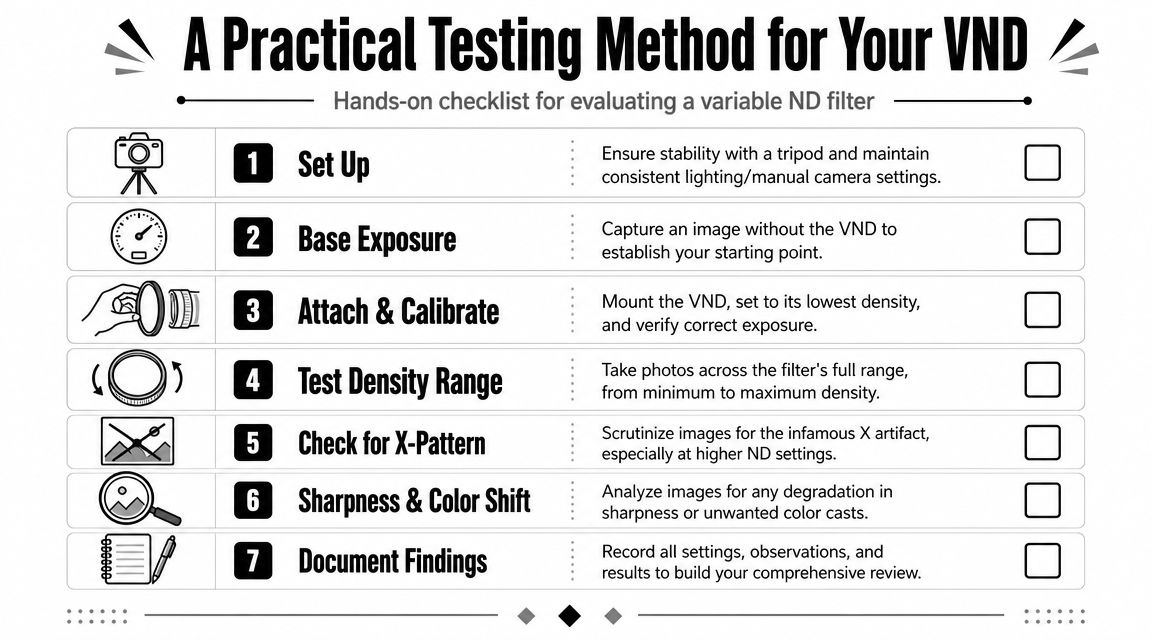
Reviews are helpful, but they don't replace a controlled test with your own camera, your own lenses, and your own standards. The goal isn't to write a laboratory report. The goal is to know exactly where your filter is safe to use on a paid job.
Build a repeatable test scene
Use a tripod. Lock the camera to manual settings. Keep the light consistent. Include a subject with straight lines, neutral surfaces, and edge detail. A white wall, a window frame, shelving, tile lines, or a printed grid all work well.
Capture a baseline frame with no filter attached. Then mount the VND and work through its usable range in small increments, checking each frame rather than assuming the ring markings tell the whole story.
A useful framework for choosing the right range comes from the earlier buyer guidance at Digital Camera World: 2 to 5 stops often suits interiors with windows or overcast exteriors, while 6 to 9 stops is better for bright sunlight or long exposures. The same source argues that if you need both ranges regularly, carrying several fixed NDs may be the cleaner answer, as noted earlier.
What to evaluate in each frame
Don't just look at exposure. Look at what the filter is doing to the image structure.
- Corners: Check for darkening or uneven density.
- Center-to-edge consistency: See whether the exposure stays even across the frame.
- Color shift: Watch white, gray, and beige surfaces carefully.
- Sharpness: Compare fine detail with and without the filter.
- Usable rotation range: Note the point where the image starts to degrade.
After the technical check, test it in a scene that resembles your actual work. A daylight interior, a glass-heavy lobby, or an exterior with bright sky will show far more than a tabletop object ever will.
Here's a useful visual walkthrough before you run your own test:
Keep notes like a working pro
Document the lens, focal length, filter setting, and your observations. You're building your own operating map.
That record pays off later because you won't have to rediscover the filter's weak points on site. And if a frame needs help, this article on using post-production to fix structural photos is a useful reminder of where editing can rescue a file and where it can't. Exposure can be managed. Major optical unevenness is a much uglier repair.
Know your safe settings before the client arrives. Testing after the fact is expensive.
The Final Verdict A Tool Not a Mandate
A VND belongs in the professional conversation, but not as a universal answer. It's a convenience tool with real value when light changes quickly, when video is part of the job, or when maintaining a chosen aperture or shutter speed matters more than absolute optical purity.
For architectural and high-end commercial stills, the standard is higher. Wide-angle performance, even corners, and neutral color matter more than fast adjustment. If a variable ND compromises those, fixed ND filters remain the stronger choice.
The practical position is simple. Buy a VND only if you understand where it works, where it breaks down, and how that lines up with your assignments. The best filter isn't the one with the broadest claim. It's the one you've tested enough to trust.
Professionals don't need every tool to do every job. They need each tool to do its actual job well.
If you need polished architectural imagery that holds up under client scrutiny, Jimmy Clemmons Photographer creates design-focused commercial photography with careful exposure, clean composition, and a strong understanding of how built spaces need to look in final delivery.