

A project is finished. The concrete is clean, the glazing is perfect, the lighting designer nailed the evening mood, and the interiors finally feel the way they did in the renderings. Then the marketing team posts a rushed phone photo, a few uneven wide shots, and a shaky walkthrough. Online, the building looks flatter, smaller, and less resolved than it does in person.
That gap costs more than pride. It affects leasing conversations, investor presentations, award submissions, press coverage, and how a firm is remembered when the next project is on the line. For architects, developers, hospitality groups, and brand teams, real estate photography and video isn't just a listing expense. It's part of the asset itself.
The built environment has to be translated. Materials need to read correctly. Lines need to stay true. The sequence from arrival to lobby to suite needs to feel intentional. A strong visual package does that work. A weak one forces the viewer to guess.
From Blueprint to Brand Asset
A lot of commercial projects get photographed as if they were ordinary listings. That's the first mistake.
A speculative office development, boutique hotel, mixed-use property, or architect-designed residence doesn't need a batch of basic coverage images. It needs a controlled visual narrative that shows scale, circulation, craftsmanship, tenant appeal, and brand position. If the photography treats every room the same, the project loses its hierarchy. If the video drifts through the building with no point of view, the viewer leaves with no memory of what mattered.
Why commercial clients need a different standard
Architects want fidelity. Developers want persuasion. Brand managers want consistency across every touchpoint. Those goals overlap, but they aren't identical.
A portfolio shoot for an architecture firm has to respect proportion, finish, and light quality. A leasing campaign needs images that help a prospect understand convenience, prestige, and use. A hospitality brand needs the property to feel inhabitable, not just documented. The same building can require multiple visual treatments depending on who will use the assets and where they'll appear.
Practical rule: If the visuals only answer "what does it look like," they're incomplete. Strong commercial visuals also answer "why does this place matter" and "who is it for."
Visuals that keep working after launch
The strongest shoots keep paying off long after a ribbon cutting or listing date. The exterior hero image becomes a website banner. Interior vignettes move into a capabilities deck. Drone footage supports leasing outreach. A carefully edited short film helps a project team pitch the next commission.
That's why design-savvy clients treat real estate photography and video as a brand asset library, not a one-day production. Good imagery doesn't just record a project. It gives the project a public voice.
What a Professional Visual Package Includes
A high-end visual package is built like a toolkit. Every asset has a job. Some images establish the building in its context. Others isolate details that prove the project was executed well. Video adds movement, pacing, and atmosphere that still photography can't carry on its own.
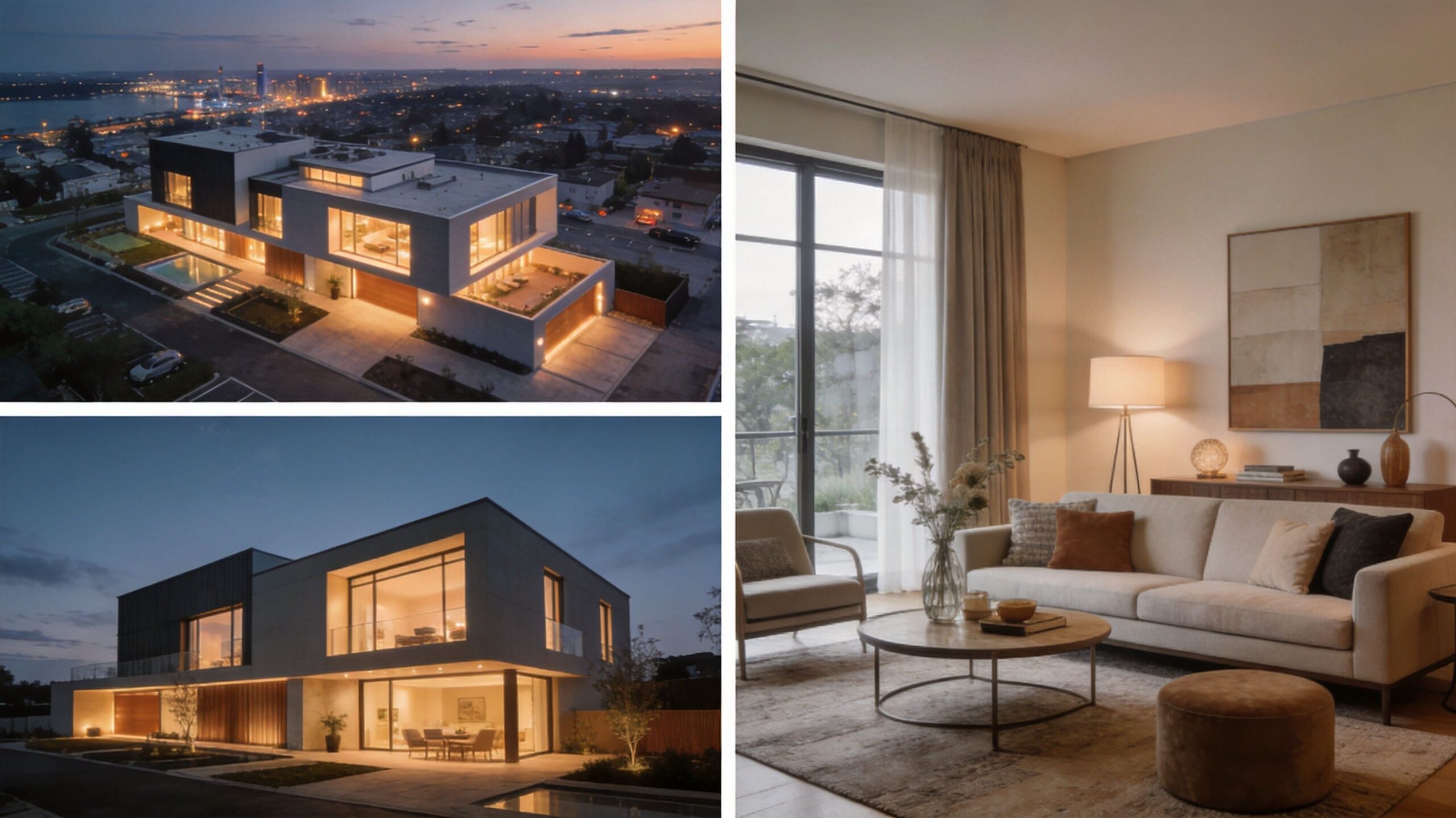
The business case starts with attention. Listings with high-quality professional photos receive 61% more views, and that advantage is tied to image quality. DSLR cameras can capture over 14 stops of dynamic range, compared with about 10 stops on a smartphone, which matters when a scene includes bright windows and darker interiors. The same source notes that 98% of homebuyers in 2026 are projected to start their search on mobile devices, where the first image does most of the filtering work (FastExpert on why professional photos and videos matter).
Still photography that does more than document
The core image set usually includes several distinct categories:
- Hero exteriors that establish presence. These are the frames used on homepages, brochures, pitch decks, and press placements.
- Editorial interiors that show flow and proportion. These aren't just wide shots. They reveal how spaces connect and where the design intent lives.
- Detail vignettes that highlight joinery, materials, fixtures, lighting, and furniture decisions.
- Twilight images that trade clinical description for mood, warmth, and brand character.
- Aerials that place the property in context, which is especially useful when access, amenities, topography, or urban surroundings are part of the value proposition.
A rushed MLS-style package often misses these distinctions. It covers rooms. It doesn't build a narrative.
Video can take several forms
Not every client needs the same film.
A simple walkthrough may work for basic leasing or sales support. A branded film is different. It uses motion, pacing, and selective detail to make the project feel intentional. For a developer, that might mean showing arrival sequence, amenities, circulation, and neighborhood relationship. For an architect, it may mean emphasizing geometry, material transitions, and daylight behavior. For a hospitality client, it may lean on atmosphere and guest experience.
The best property video doesn't try to show everything. It chooses what the audience needs to feel first.
Add-ons that make sense when the project calls for them
A professional package can also include components that serve specific goals:
- Drone footage for context, massing, and site relationship
- Twilight coverage when lighting design is part of the story
- Vertical clips for social platforms and paid campaigns
- 3D capture or virtual touring when remote review matters
- Lifestyle direction when the project needs a human layer
The right mix depends on the audience. A luxury condominium launch, a multifamily lease-up, and an architecture firm portfolio update may all involve the same building shell, but they rarely need the same final package.
Calculating the ROI of High-End Visuals
Commercial clients usually ask the right question. Not "how many photos do we get," but "what does this help us accomplish?"
That's the right lens. Visuals should be judged by whether they improve the way a project is perceived, remembered, and acted on.
Residential data makes the point clearly. Properties with professional photography sell for between $3,000 and $11,000 more than comparable homes, and they sell 32% faster, averaging 89 days on market versus 123 days with amateur photos. Drone photography strengthens the effect further, helping properties sell 68% faster (Visually Sold real estate photography statistics). Commercial decision-makers don't need to treat those numbers as a one-to-one translation. They do show the same underlying truth: strong visuals reduce friction and improve perceived value.
Where commercial ROI actually shows up
For developers and property teams, ROI often appears in places that don't fit neatly inside a residential sales metric.
- Leasing support: better visuals help prospects understand the property before a tour, which improves the quality of the conversation.
- Capital and investor communication: boards, lenders, and partners respond better to a polished asset package than to inconsistent site snapshots.
- Brand consistency: the same image library can support web, social, PR, OMs, signage, and internal presentations.
- Future business: architects, builders, and designers win work with past project imagery. If the documentation is weak, the work is harder to sell.
A polished project library also keeps a team from reinventing the wheel every time marketing needs an image. That's part of the return.
Strong visuals don't expire after one campaign
One reason premium visuals justify their budget is reuse. A day of disciplined production can feed months or years of communications. A hero exterior may become a cover slide in a development pitch. Interior frames may support awards submissions or editorial outreach. Drone clips can appear in multiple rounds of tenant marketing.
For a more detailed breakdown of that thinking, this perspective on the ROI of professional photography aligns with what many commercial teams learn after they've outgrown generic listing media.
A short film can also carry more weight than a static gallery when the project depends on experience and sequence.
Good visuals don't just help people notice a property. They help the right people understand it faster.
The Three-Phase Production Workflow
High-end real estate photography and video doesn't happen because someone shows up with a good camera. It happens because the work is planned, executed, and refined with discipline. The clients who get the best results are usually the ones who understand that production has stages, and each stage solves a different problem.
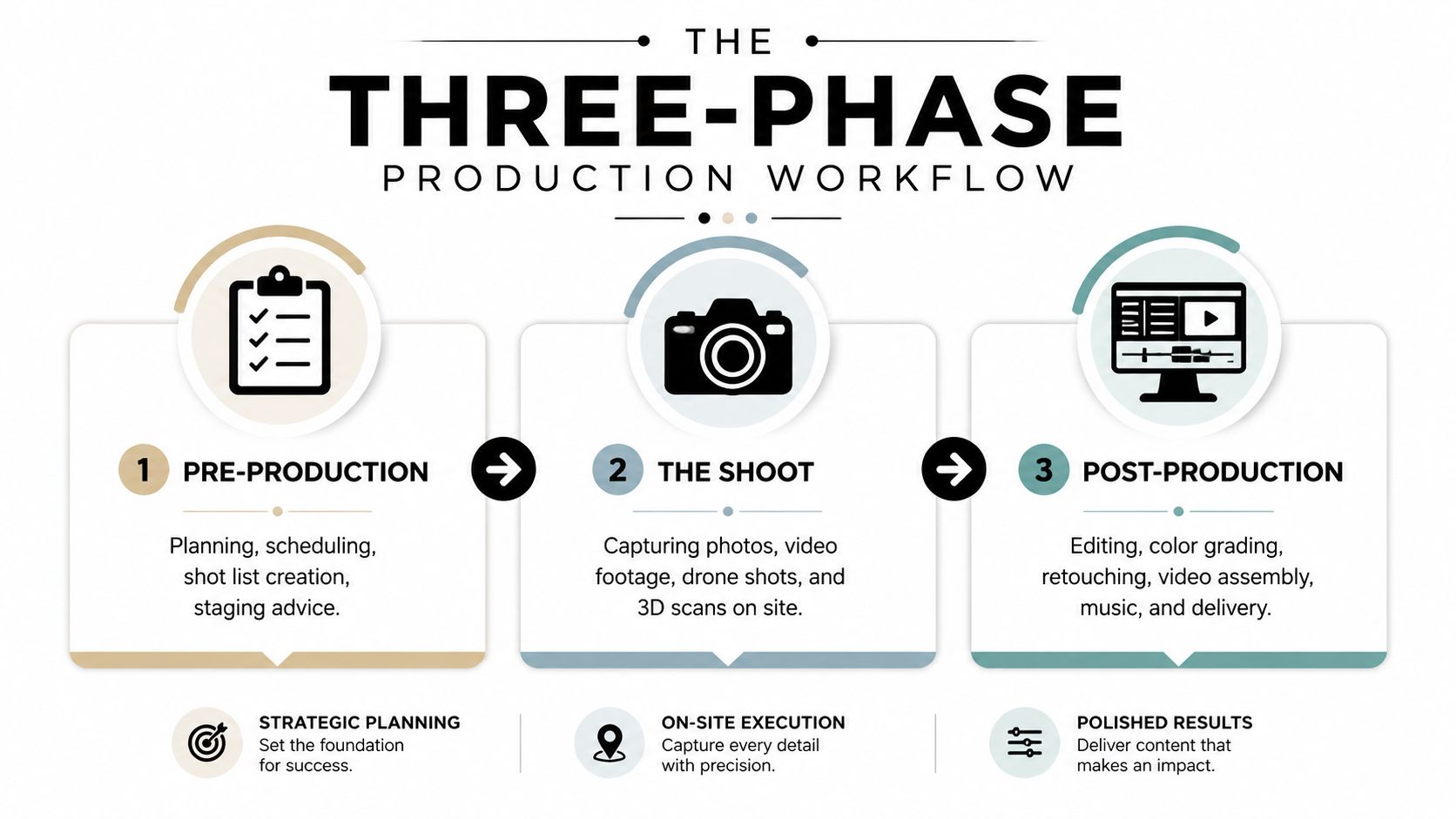
Pre-production shapes the outcome
Before cameras come out, the project needs a point of view.
That starts with a conversation about use. Is the asset package meant for leasing, investor relations, editorial submission, an architect's portfolio, or a hospitality relaunch? The answer changes the shot list. A leasing team may need amenity-driven coverage and aerial context. An architect may care more about composition, line control, and how materials transition under natural light.
A useful pre-production checklist usually includes:
- Shot priorities: identify essential spaces, signature moments, and details that support the story.
- Timing: choose the right time of day for façades, courtyards, glazing, and views.
- Styling decisions: confirm whether the project should feel lived-in, pristine, active, or purely architectural.
- Site readiness: coordinate cleaning, staging, furniture alignment, landscaping, and access.
- Hybrid planning: if both stills and motion are needed, the route through the property has to work for both.
This stage is where most avoidable problems are prevented. If the team waits until shoot day to decide what matters, the visuals usually feel generic.
The shoot is controlled, not casual
On site, precision matters. Architectural work is unforgiving. Verticals have to stay clean. Reflections need to be managed. Mixed lighting has to be shaped, not merely tolerated. Furniture placement that looked fine in person may need to shift inches for the frame to feel balanced.
For motion, the same discipline applies. Professional video walkthroughs shot in 4K at 60fps on a stabilized gimbal can increase viewer dwell time by 40 to 50%, and the difference isn't just resolution. It's control of movement, pacing, and continuity from one space to the next (HomeJab on what makes a great real estate photographer).
A polished shoot often involves trade-offs that clients don't see at first glance:
- Wide enough versus too wide: show the room accurately without making it feel distorted.
- Natural light versus shaped light: preserve atmosphere while keeping finishes readable.
- Empty space versus human context: decide whether people help the story or distract from the design.
- Coverage versus selectivity: more frames aren't always better if they dilute the strongest ideas.
A clean composition usually comes from what was removed, not just what was included.
Post-production is where raw capture becomes usable
Many clients underestimate the craft.
Post-production isn't about slapping on a preset. It's where exposures are blended, color is corrected, distractions are retouched, lens issues are corrected, and the entire set is brought into a consistent visual language. The same source notes that automated bracketing and tone mapping are used to balance scenes with more than 15 stops of dynamic range, which is one of the clearest differences between professional and amateur output.
For video, post-production includes more than assembly. It involves selecting the right takes, balancing motion, refining color, cleaning transitions, adding titles if needed, and exporting versions for different platforms. A film meant for a presentation screen isn't delivered the same way as a vertical social cut.
Collaboration matters in all three phases
The best commercial shoots feel collaborative without becoming chaotic.
Clients should expect to review goals before the shoot, stay available for decisions during production, and give clear feedback during proofing. Photographers should direct the process without turning it into a mystery. That's how a project stays on brand and still benefits from professional judgment.
Understanding Your Final Deliverables
Once production is complete, the useful question isn't "where are the files?" It's "which versions are built for which job?" A commercial shoot usually produces a set of deliverables designed for different platforms, stakeholders, and levels of quality control.
Common deliverables and their strategic use
| Deliverable | Typical Format | Primary Use Case |
|---|---|---|
| Hero still images | High-resolution JPEG or TIFF | Website headers, brochures, print collateral, press kits |
| Web gallery images | Web-optimized JPEG | Property websites, portfolio pages, email campaigns |
| Detail and vignette selects | High-resolution JPEG or TIFF | Award entries, editorial placement, design presentations |
| Drone stills | High-resolution JPEG | Site context, leasing decks, investor materials |
| Brand film | 4K video file | Homepage features, presentations, launch campaigns |
| Short social edits | Vertical or square video clips | Instagram, LinkedIn, paid social, teasers |
| Walkthrough edit | Horizontal video file | Leasing follow-up, remote review, sales support |
| Slideshow or presentation exports | Compressed video or image sequence | Meetings, trade events, internal reviews |
Why format matters
A print-ready file and a website file shouldn't be the same export. Large TIFFs or full-resolution JPEGs preserve quality for magazines, signage, and high-end collateral. Web-optimized JPEGs load faster and are easier for digital teams to deploy. If a client receives only one universal set, someone on the marketing side usually ends up making avoidable compromises.
Video needs the same discipline. A horizontal edit may look excellent on a website banner or conference screen but feel awkward on mobile social. That's why smart packages often include multiple aspect ratios and runtimes. The core footage is the same. The usage isn't.
Questions worth asking before delivery
A lot of friction disappears when file expectations are clear upfront.
- Licensing scope: where can the assets be used, and by whom?
- Naming conventions: will the files arrive in a way that a marketing team can efficiently sort?
- Platform versions: are there separate exports for web, print, social, and presentation use?
- Archive policy: how long will the files remain available for re-download?
- Selection workflow: will the client review proofs, or will finals be curator-selected?
A strong deliverable package saves time after the shoot. A weak one shifts the production burden onto your internal team.
For commercial clients, the cleanest outcome is a library that can move directly into design, leasing, PR, and portfolio workflows without additional translation.
How to Choose the Right Visual Partner
A polished portfolio can be misleading. Almost every photographer can show a few attractive frames. The essential question is whether they can produce a consistent, technically controlled set under the conditions your project presents.
That matters more in architectural and commercial work than in almost any other category. Buildings don't forgive shortcuts.
Start with line control and consistency
One of the fastest ways to judge professional discipline is to look at verticals, horizontals, and lens behavior. Wide-angle architectural photography often goes wrong when a photographer relies on broad coverage without correcting non-rectilinear distortion. According to Imagtor's discussion of angles and focal length in real estate photography, a vertical tilt of more than 2 degrees can drop buyer trust by 35%, while true professionals use tools and methods that keep alignment to sub-0.5° accuracy.
Those numbers matter because they point to something clients can inspect. Look at door frames, window mullions, corners, and façade lines. If they lean, bow, or feel unstable, the photographer may not have the technical control your project deserves.
Match the photographer to the assignment
A hospitality launch, a school campus, and a corporate headquarters don't ask for the same instincts.
Use a selection framework like this:
- Relevant portfolio depth: ask whether they've photographed projects with similar materials, scale, and stakeholder expectations.
- Lighting judgment: check whether daylight, practical fixtures, and exterior views are handled cleanly.
- Compositional restraint: strong work feels deliberate, not over-wide or over-processed.
- Production professionalism: can they coordinate access, timing, styling, and post without creating confusion?
- Understanding of design intent: do they photograph space as architecture, not just as square footage?
If you're evaluating specialists in this category, reviewing the standards of a commercial architectural photographer can help clarify what a more design-literate approach looks like.
Ask better questions than price and turnaround
Price matters. Turnaround matters. Neither should be the first filter.
Ask how the photographer handles mixed lighting, reflective surfaces, and occupied spaces. Ask how they plan for both stills and motion on the same day. Ask how they protect straight lines, preserve material color, and keep a full image set cohesive. Ask who handles retouching and how revisions are managed.
The best visual partner behaves less like a vendor and more like a production collaborator. That's usually the difference between media that merely fills a gallery and media that strengthens the project's position in the market.
Your Pre-Shoot Success Checklist
The shoot goes better when the client team treats preparation as part of the production, not a separate administrative task. Good planning protects the budget and improves the final work.
What to prepare before the camera arrives
Use this checklist to keep the day efficient and the results aligned with your goals:
- Define the primary use case: decide whether the assets are for leasing, investor communication, awards, editorial, web, or a mix.
- Build a must-have shot list: identify signature spaces, exterior angles, details, amenities, and any views or relationships to context that can't be missed.
- Ready the site fully: cleaning crews, grounds touch-ups, furniture styling, bulb checks, and removal of temporary signage should happen before call time.
- Assign one decision-maker: someone needs authority to answer framing, access, and styling questions on site.
- Share brand references: mood boards, previous campaigns, architectural drawings, and launch materials help align the tone.
- Coordinate access and timing: elevators, locked suites, rooftops, amenity spaces, and tenant approvals can stall a day if no one has planned them.
Don't treat video as an add-on
Many teams still plan the photography first and ask for motion once the day is underway. That's exactly where projects lose quality. Video boosts engagement by 403%, but many shoots fail because they never plan for integrated hybrid deliverables such as subtle dolly moves paired with editorial stills (YouTube discussion of a key workflow gap in hybrid shoots).
Ask these questions before the schedule is locked:
- How will stills and motion be sequenced on site?
- Which spaces deserve cinematic movement rather than static coverage?
- Will the styling hold up for both formats?
- Are there sound, occupancy, or lighting conditions that change the video plan?
A practical prep resource like how to prepare your project site for a professional photoshoot can help internal teams avoid the usual last-minute issues.
Small fixes that save the final gallery
These details seem minor until they show up in every frame:
- Remove temporary clutter: cords, bins, paper notices, delivery carts, and leftover construction items.
- Check reflective surfaces: mirrors, stainless steel, glazing, and glossy stone reveal problems fast.
- Standardize lighting: mismatched bulbs and partial outages make color correction harder and rooms feel unsettled.
- Finish the edges: door positions, chair angles, bedding lines, and tabletop styling shape whether the space feels premium.
Preparation doesn't make the shoot less creative. It gives the creativity room to work.
If your project needs imagery that respects design intent and performs across marketing, leasing, editorial, and brand channels, Jimmy Clemmons Photographer brings an editorial eye to architecture, commercial spaces, and visual storytelling. The studio works with developers, architects, design firms, and brand teams to create purposeful photography and video that feels as refined as the spaces themselves.