

You've built a portfolio you're proud of and a services page that reads like everyone else's. A developer opens it on a phone between meetings, skims a paragraph about passion, scans a list of file formats, and closes the tab without a reason to email you. That costs work you were qualified to win, and the fix is mostly editing.
A photography services description is a trust document before it's a sales page. Architects, developers, contractors, and school facilities directors read it to answer three things: can you photograph what we built, will the files work in our systems, and who is allowed to publish what. Every other part of the page supports those three questions.
What follows is the drafting order I'd use, the keyword placement that keeps the page findable without flattening the prose, the tone swaps that separate a credible studio from an interchangeable one, five templates by client type, and the rights and delivery terms most pages omit and most buyers end up asking about by email.
The Seven Parts and Their Drafting Order
A design or construction buyer should be able to scan the page and see what you photograph, what the project involves, and what happens after the shoot. These seven parts answer those questions in a practical order.
| Component | Question It Answers | Sample Line |
|---|---|---|
| Headline | What is this and who is it for? | Architectural and commercial photography for design-led buildings |
| Service summary | What do you deliver, and where? | Architectural images and corporate brand content for commercial projects |
| Specialties | Which projects do you handle best? | Sweeping exteriors, refined interiors and portraits with authentic expression |
| Process | How does a shoot run from brief to delivery? | Brief, site planning, photography and professional editing |
| Deliverables | What files and formats arrive? | Edited images prepared for the agreed uses and formats |
| Pricing cues | What changes the cost and what is included? | Project scope, time on site and editing requirements |
| Call to action | What should the client do next? | Send a project brief for a scope call |
Draft the page in this sequence, then write the headline once the scope and audience are clear.
Name the client type, then write the headline last. Put the discipline and intended buyer in one line. A headline that promises architectural photography should match the work shown and the services described below it.
Write a short service summary that states the subjects you photograph, the clients you serve and the locations you cover. Keep it concise enough that the specialties remain easy to find on a phone. Avoid promising a service area or project type you cannot support.
List three to five specialties, each tied to work you can show. For architectural clients, that might include exteriors, interiors or spaces photographed to reveal form, light and detail. Commercial photography can also cover products, people and spaces for brands. A specialty without a relevant example makes the offer harder to assess.
Describe the process in four stages: brief, planning, shoot and edit. Use steps that reflect the service you are offering. Buyers need to understand how the project moves from the initial scope to edited images, especially where site access and coordination affect the shoot.
State deliverables in terms the buyer can use. Name the file formats, orientations, delivery timing and editing scope you can commit to. Keep those terms consistent with the agreed project uses. Vague promises create follow-up questions; overly specific promises can constrain a project before its requirements are known.
Give pricing cues through the factors that set scope, such as the number of spaces, time on site and editing depth. Commercial and architectural assignments differ, so a single figure can give the wrong impression before the project is defined. Describe what affects the estimate and what the client should provide to request one.
Close with one clear call to action. Ask the buyer to send a project brief or request a scope call. One focused next step is easier to act on than several competing options.
Keep the page aligned with the proposal that follows it. A photography proposal template can help structure the project document, while meta description length and CTA templates can guide the search snippet and closing prompt. The page and proposal should describe the same scope, deliverables and project terms.
Practical rule: each part should answer its question clearly, without promising more than the work and project terms support.
Where to Place Your Keyword Without Stuffing
Use the exact phrase photography services description where a reader or a search engine expects a label, then let related terms carry the rest of the page. That single rule prevents the two failure modes: a page that never states what it is, and a page that repeats the phrase until it reads like it was written for a crawler.
| Location | Placement Rule | Example Use |
|---|---|---|
| Page title | Keyword at the start, used once | Photography Services Description for Architectural Clients |
| Meta description | Keyword once, within the first 100 characters | Architectural and commercial photography for design-led buildings, with a clear next step |
| Opening paragraph | Keyword once, within the first 100 words | This page explains how to write a photography services description for design-led clients |
| Section headings | Related terms only, never exact repeats | Architectural Photography Scope |
| Image alt text | Describe what is visible; keyword only if accurate | Exterior of a two-story civic building at dusk |
| Call to action | Keyword optional | Send a project brief for a scope call |
Start with the title. Front-loading the phrase means a buyer sees the category before the brand, which matters when the page is competing with a dozen similar tabs. The meta description gets one use inside the first 100 characters, because most of it gets truncated after that and the phrase shouldn't be the part that gets cut.
The opening paragraph earns its single use by stating what the page covers, which is also the sentence a skimming reader needs. Headings should vary: architectural photography scope, commercial shoot process, delivery files. Those reflect how design firms search and keep the page from reading as a single repeated string.
Alt text deserves its own discipline. Describe what a viewer sees, and add the keyword only when the image shows the service. When you're publishing on a platform that strips or regenerates alt text, this guide to optimizing alternative text for Notion blogs covers the mechanics. The call to action rarely needs the phrase at all; "send a project brief" already tells the reader what service they're requesting.
Read the finished page aloud before publishing. When the phrase starts to sound like a chant, replace the repetitions with plain nouns such as "this page" or "the service description" and keep the meaning intact.
Tone Choices That Earn Architectural and Commercial Trust
Two lines, same service. "Stunning photos of your building" against "Documentary images of the finished building, with materials and daylight as built." The first claims a result the buyer can't verify. The second describes a method they can check, and that difference is the whole game when your reader is an architect who will compare the image against the wall they specified.
| Vague Line | Stronger Line | Why It Works |
|---|---|---|
| Stunning photos of your building | Documentary images of the finished building, with materials and daylight as built | Buyers verify claims, so specifics build trust |
| We make your space look amazing | We document spatial flow, daylight and detailing room by room | Architects judge by what they can see and check |
| Creative vision for every project | Shot list agreed in advance, covering sightlines, time of day and lens choice | A written plan signals control on site |
| Fast, affordable turnaround | Delivery timing stated in writing, with any rush option listed separately | Commercial teams plan around fixed dates |
| Trusted by top brands | Project types and the roles served, described without naming clients | Credibility stays intact without naming third parties |
Why Specific Beats Superlative
Every superlative asks the buyer to take something on faith, and design and construction buyers are trained not to. Replace adjectives with nouns and verbs that describe the work: sightlines, circulation, materials, shot list, bracketing, edge margin. A line about a scouting visit that maps daylight direction and access constraints tells a project manager you've worked on occupied sites. A line about creative vision tells them nothing they can plan around.
The founder's view that great photography is crafted rather than caught is a tone claim that only lands when the page shows the craft: the scouting step, the lighting plan, the editing pass. Say it once, back it with method, and leave it alone.
Where Polish Starts to Cost You
Credibility outranks visual drama when the image has to survive a planning discussion, a publication fact-check, or a client's portfolio page. AI is now part of that conversation. RIBA's 2025 AI report found 59% of surveyed architecture practices reporting AI use on at least occasional projects in 2025, up from 41% in 2024, with early-stage visualisation among the most common uses, and it raises unresolved questions about whose data trains those systems, what gets excluded, and how use is acknowledged or compensated.
That's why the tone section shouldn't claim more polish than you can defend. A buyer who reads "every image is enhanced" doesn't know whether the sky was replaced, the view composited, or the lighting invented.
In architecture and commercial work, the question is rarely "is it beautiful" but "is it true, and can I prove it."
Keep editing claims out of this section and put them where the authenticity standard is defined in full, next to your rights terms. Tone sets the expectation; terms enforce it.
Five Industry Templates to Adapt
The same seven parts work for every buyer, but the lead changes. Here's the structure I'd adapt from, with the plan fragments a buyer scans.
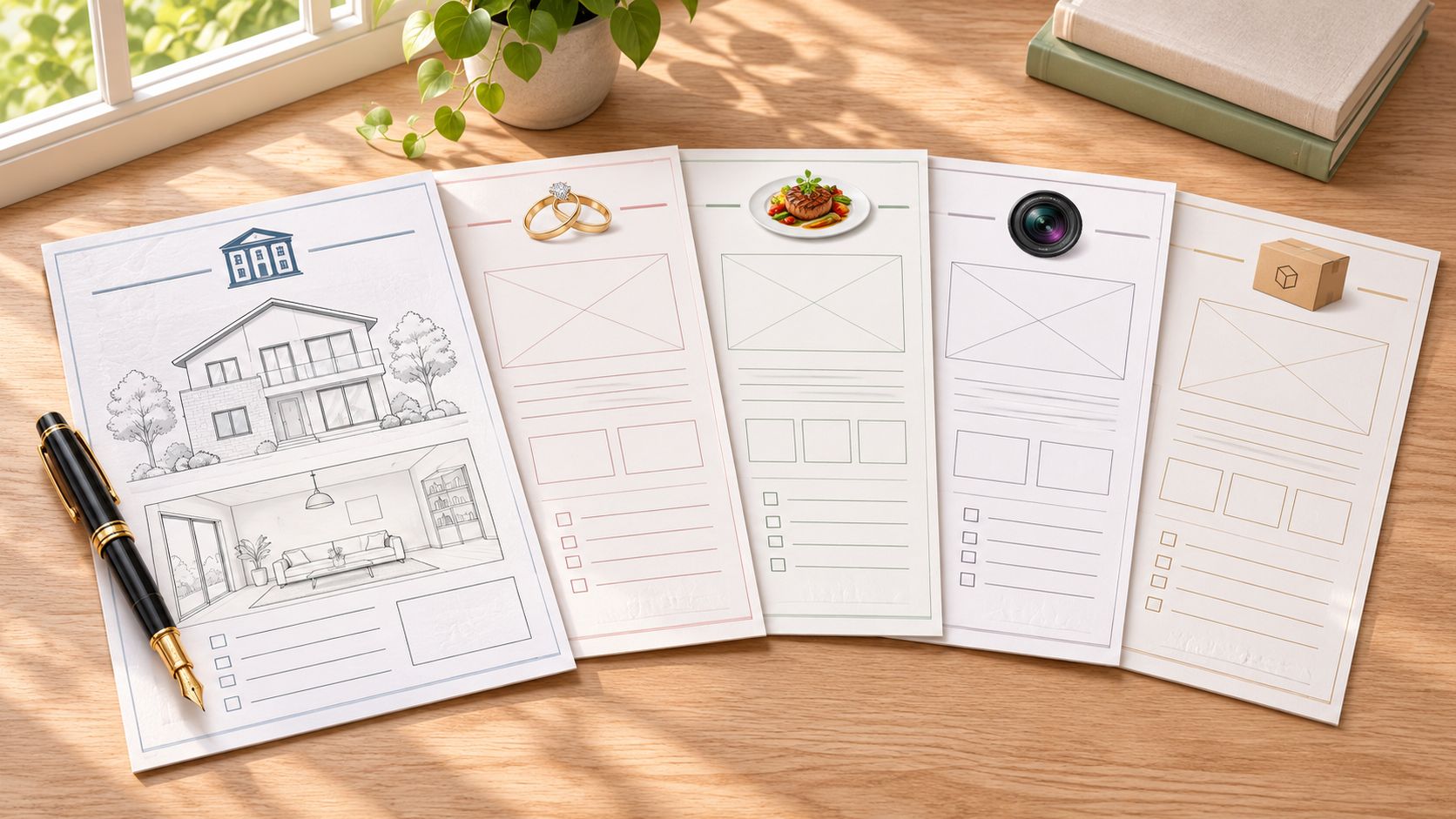
Each template below gives one opening sentence, three specialty bullets in the same order (what you shoot, how you handle the site, what the client receives), and one closing line. Keep the bullets parallel so a buyer who reads two of your pages can compare them at a glance.
Architecture Firms
Open with the discipline: architectural photography for firms that need a finished building to look like the drawings that promised it.
- Exteriors: sweeping elevations, form and massing, shot at the hour when the facade reads correctly.
- Interiors: refined rooms documented for light, material and detail rather than styled into something the building isn't.
- Detail sets: tight frames of junctions, finishes and stair geometry for presentation boards and award submissions.
Close with: "Pricing cue: scope follows the number of spaces, hours on site and editing depth; the final figure follows the project brief."
Developers and Property Managers
Lead with context and amenity coverage, because the buyer is leasing square footage, not admiring architecture.
- Exterior context: the building against its street, skyline and approach, so a prospect recognises it before arrival.
- Amenity coverage: lobby, rooftop, shared work areas, fitness and parking, photographed as a sequence a tenant would walk.
- Site and aerial views: supplied where access and local rules allow, with delivery timing stated for lease or sale campaigns.
The closing line names the campaign deadline, then repeats the pricing cue with the scope drivers.
Corporate Brand Teams
Open with commercial brand content covering products, people and spaces, and state usage terms plainly in the same paragraph.
- Products: clean, evenly lit frames plus contextual shots that show scale and use.
- People: portraits built on authentic expression and flattering light rather than stiff poses.
- Spaces: workplaces and hospitality environments photographed as staff and visitors experience them.
Close by naming the licensed uses and the approval path, then the standard pricing cue.
Contractors and Construction Companies
Lead with progress documentation and completed-project galleries, and address site access before anyone asks.
- Progress sets: repeatable camera positions so month-over-month images line up.
- Completed galleries: the finished work, cleaned and lit, shot before the punch list walk-through.
- Site planning: safety orientation, escort requirements and the hours that avoid trades on the critical path.
Close with the cadence you can hold (monthly, milestone-based) and the same scope drivers.
Colleges and Private Schools
Lead with campus spaces and the people who use them, since the audience is prospective students and their parents.
- Campus spaces: quads, libraries, labs and residence halls across a full academic day.
- Classrooms in use: students and faculty working, photographed with releases in place.
- Expansion summaries: new and renovated buildings documented as a set the advancement office can reuse.
Close by noting that final scope follows the brief, priced on spaces, hours and editing depth. Our own focus sits in architectural photography and corporate brand content, so these templates reuse the same core and change the lead rather than inventing a new service each time.
Rights, Authenticity and Delivery Terms to State
Start with copyright, because it's the term buyers most often misread. An original photograph is protected the moment it's fixed in a tangible medium, and registration isn't required for protection to begin, as the U.S. Copyright Office explains for photographers. The owner generally holds the exclusive rights to reproduce, distribute, adapt and publicly display the image.
Delivery of files doesn't decide any of that. A download link is not a license, so the page should say which permissions come with the fee: intended media, territory, duration and permitted uses. A developer running a campaign for eighteen months across paid social and a sales office has different needs from a magazine running one feature, and both need it written down.
Editing Tiers to Name
Separate four levels and say which ones you perform on images of built work:
- Documentary capture: what was there, corrected for exposure, color and perspective only.
- Conventional retouching: dust, scuffs, temporary signage, sensor artifacts, distractive elements removed without altering the building.
- Compositing: skies, views, lighting or people combined from multiple frames, disclosed whenever it happens.
- Generative alteration: anything invented or materially changed by a generative tool, which I'd keep off images of built work altogether.
State whether skies, views, lighting, people or setting elements are composited, and whether generative tools touch the files. State whether source files and edit notes are available on request, because architects and editors ask, and a one-line answer saves a week of email. When the terms get specific, this walkthrough of licensing a photo for commercial use covers the language a contract needs.
The Delivery System
List the files rather than promising "high resolution":
- Masters: retouched, full-resolution, in a stated color space.
- Web-ready derivatives: sized for the CMS and social platforms the client uses.
- Crop variants: vertical, square and wide, for responsive layouts and press.
- Naming and metadata: consistent filenames, captions and a usage note with each batch.
What the page is really promising: your team can publish these images without rebuilding the asset library.
Close the section with a plain note that these terms are a starting point and that the wording should be reviewed before signing. That honesty does more for trust than a wall of legal text nobody reads.
Run the Editing Checklist Before You Publish
Check the page against the work you can deliver before it goes live, then review it whenever your services or crew change.
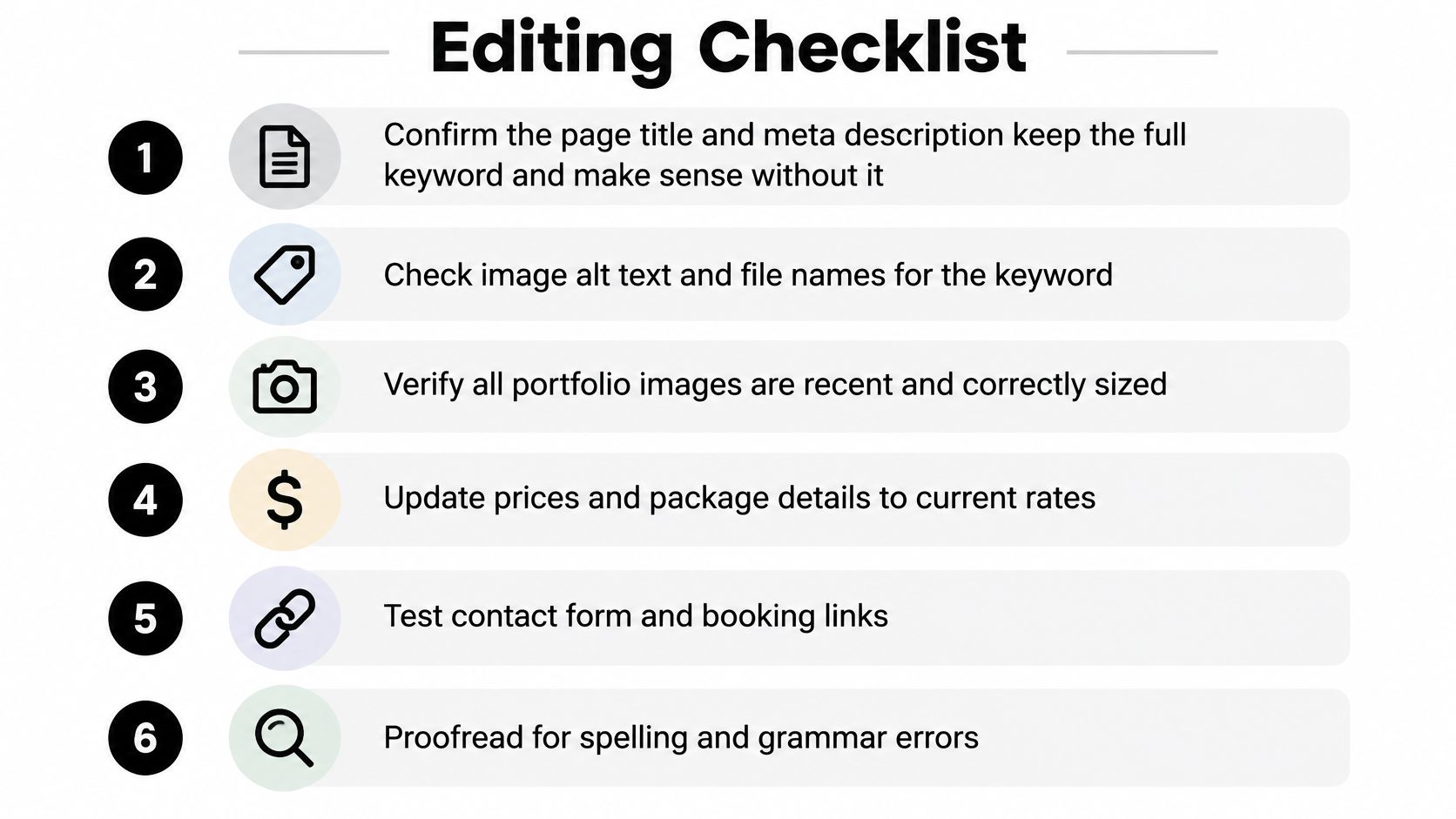
- Title and meta description: Keep the full keyword, but make sure both lines still read naturally without it.
- Specialties: Check that each listed service has a relevant portfolio example you can share.
- Process steps: Describe the work your crew performs, including scouting and editing where applicable.
- Deliverables: Compare the page with your actual file types, orientations and naming conventions.
- Pricing cues: Explain which project factors affect cost without publishing a figure that may quickly become outdated.
- Rights and editing terms: Make the page consistent with the terms in your client-facing contract.
- Alt text: Write a description for each sample image that identifies visible content and relevant details of the space.
- Call to action: Include one clear request near the end, such as asking the reader to send a project brief.
What Buyers Need After Publishing
Alt text helps people using assistive technology understand the image, and it gives search engines useful context. Write concise, specific descriptions for sample images, and keep photographer-written descriptions separate from copy the client has approved for publication.
Check that the delivery details on the page match what the client will receive: responsive crops, vertical, square and wide versions, organized filenames and metadata. If materials, finishes or daylight must be represented accurately, identify those requirements in the project notes rather than relying on a caption. Explain what professional editing includes and where it stops. A clear discussion of managing client visual expectations before the shoot helps align the brief with the final images.
After publishing, track which page details appear in enquiries and project briefs. Use that feedback to clarify what buyers still need to know, rather than adding more adjectives.
A services page should help an architect, developer or contractor assess fit before making contact. Jimmy Clemmons Photographer focuses on architectural photography and corporate brand content, with professional editing among its specialties. A clear brief, defined deliverables and stated usage terms give buyers practical grounds to request a project scope.