

If you're the person responsible for a Colorado shoot and you don't live there, the first mistake usually happens before anyone packs a case. The brief starts with a familiar idea: dramatic backdrop, clean building shots, maybe a leadership portrait or two outside, and a few lifestyle frames that make the place feel active. On paper, it sounds straightforward.
Then the actual variables show up. A site that looked easy on a scout deck has punishing midday contrast. A mountain property that seemed accessible in reference images isn't practical on your preferred schedule. The sunny, crisp visual identity everyone wants can turn into clipped highlights, dark facades, reflective snow glare, and rushed timing if the production plan was built like a tourism itinerary instead of a commercial assignment.
That's the difference with photography in colorado. For a brand team, architect, developer, hotel group, or editorial client, the challenge isn't just finding a beautiful location. It's executing a controlled shoot in an environment that changes quickly and punishes loose planning. Colorado can deliver extraordinary commercial imagery, but it rewards teams that treat light, weather, access, and scheduling as production decisions, not background details.
Planning Your Professional Colorado Photography Shoot
A common scenario goes like this. An out-of-state marketing director is launching a new property, campus update, resort renovation, or office relocation. The internal team has a mood board full of peaks, glassy facades, warm timber interiors, and bright blue sky. The assumption is that Colorado does a lot of the visual work for you.
It doesn't.
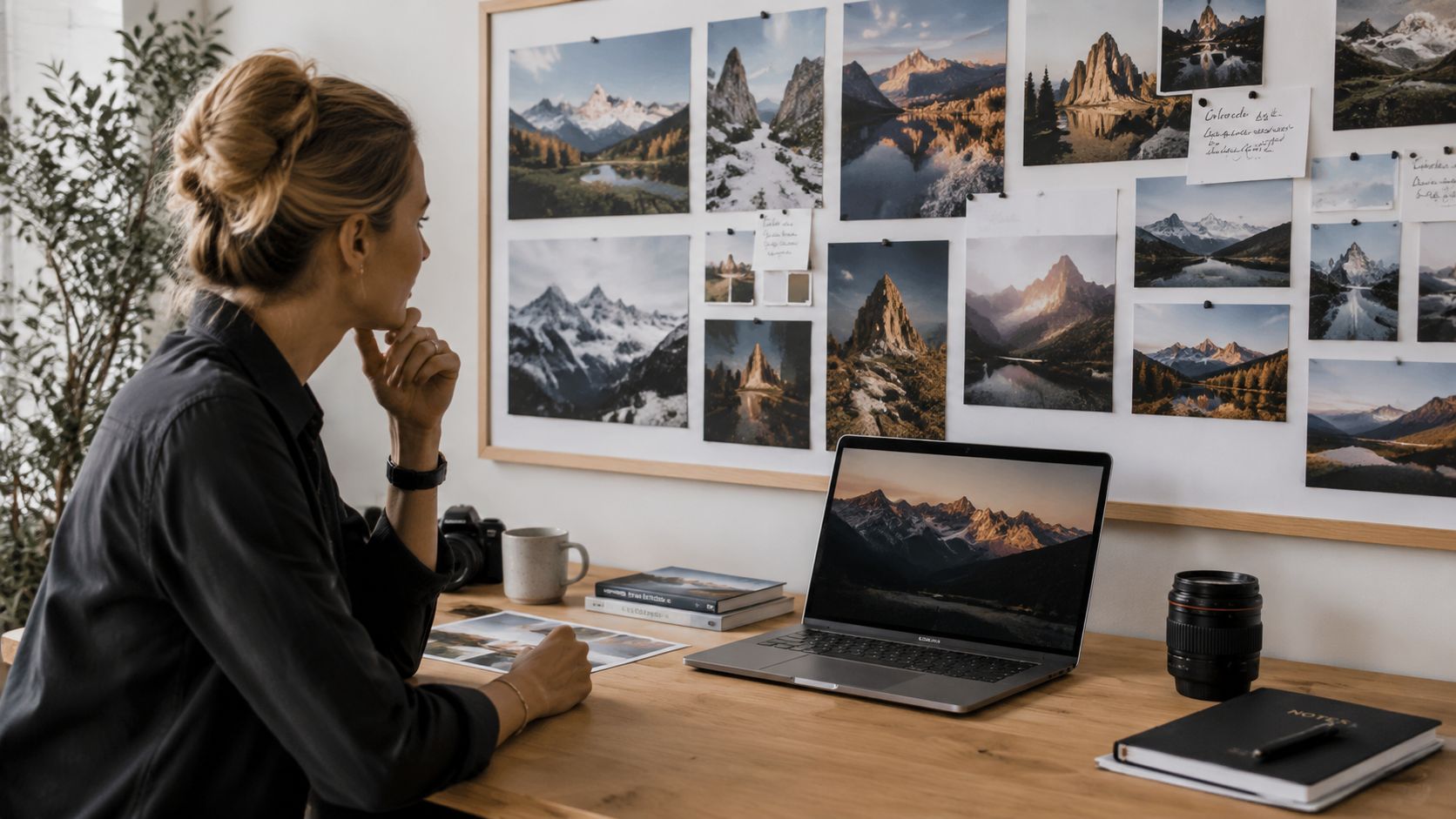
What works in Colorado is precision. A commercial shoot here needs the same discipline you'd bring to a publication feature or a flagship brand campaign. The building has to read correctly. Window views have to hold detail. Team portraits need consistency. Travel, access, and weather decisions need backup options built in before the first call sheet goes out.
What clients often assume
The early assumptions are usually reasonable, but incomplete:
- Scenic means easy: A dramatic setting doesn't simplify production. It often makes exposure, scheduling, and crew movement more demanding.
- Sunny means ideal: Clear skies can create hard-edged shadows, blown exterior surfaces, and difficult mixed-light interiors.
- Reference images equal reality: A beautiful location photo may show what is possible, not what is repeatable on your specific day.
The better planning mindset
Treat the assignment like a managed production, not a destination shoot. That changes the questions immediately.
Ask what the images need to do. Are they selling leasing value, supporting a design award submission, updating investor materials, refreshing a hospitality brand, or feeding a long-term content library? The answer affects timing, crew size, styling, talent needs, weather tolerance, and whether the priority is a hero exterior, occupancy story, or clean documentation.
Practical rule: In Colorado, the most expensive mistake usually isn't bad photography. It's arriving with the wrong assumptions about access, light, and timing.
Before shoot day, site teams should also handle the practical details that save hours on set, from cleaning and decluttering to signage decisions and parking control. A solid project site photoshoot preparation checklist often does more for final image quality than another piece of gear.
Finding Your Colorado Photography Partner
A strong portfolio isn't enough. For commercial photography in colorado, you need evidence that the photographer can solve problems specific to the state: contrast-heavy exteriors, fast weather changes, difficult access windows, and the visual demands of buildings that sit inside grand natural surroundings without getting visually swallowed by them.
The right partner isn't just making attractive frames. They're reducing uncertainty.
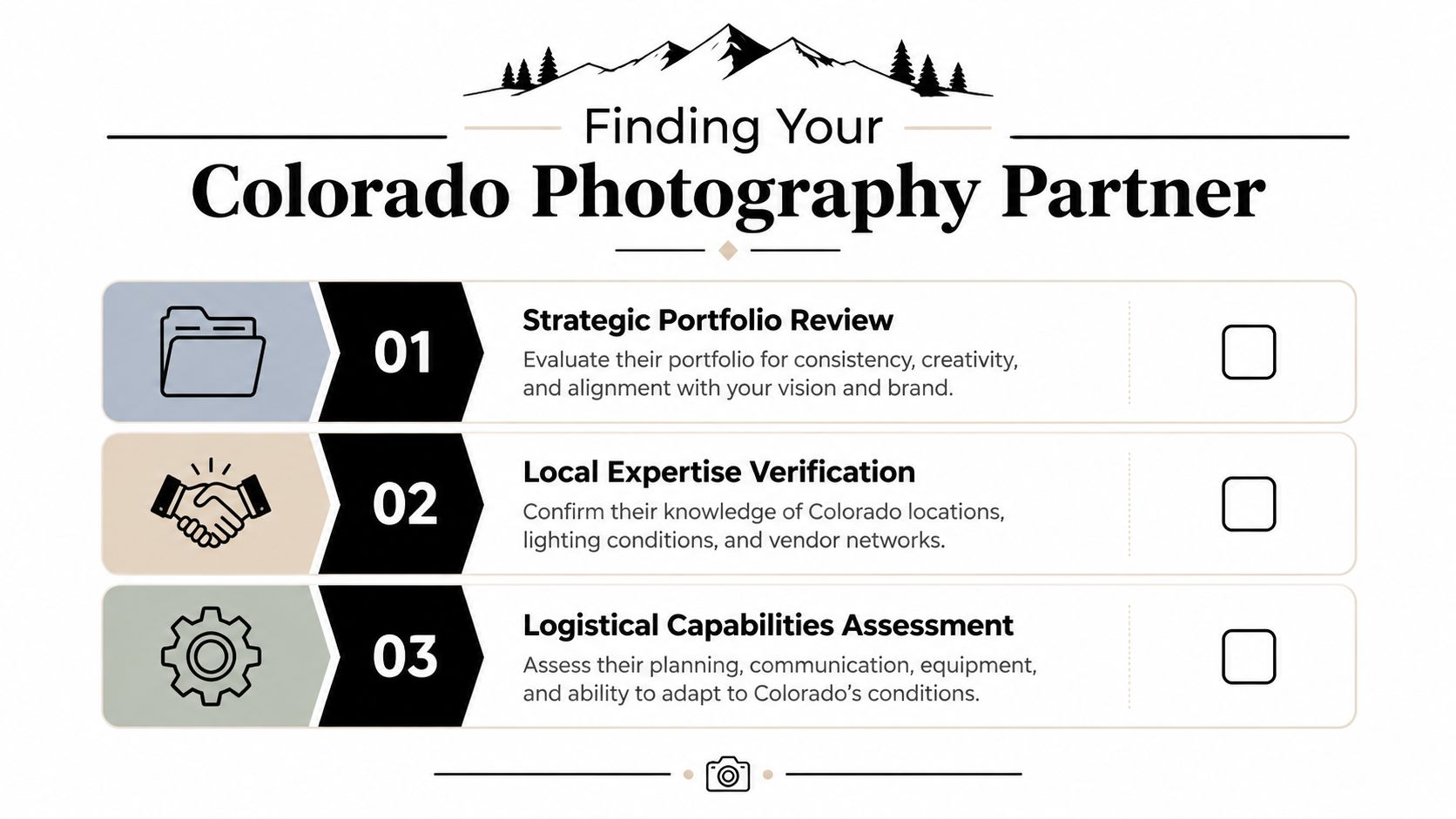
Read the portfolio like a client, not a fan
A lot of Colorado portfolios lean heavily on scenic drama. That can be useful, but it doesn't answer the questions a developer, architect, or brand manager has.
Look for these signals:
- Exterior control in hard light: Can the photographer hold sky detail without flattening the building?
- Interior discipline: Do window views feel believable, or are they either blown out or unnaturally dark?
- Composition under pressure: Are the lines clean, verticals controlled, and framing intentional even in tight or high-up locations?
- People integrated well: If the assignment includes staff, guests, or executives, do they support the architecture instead of distracting from it?
For team and portrait work, details matter more than many clients realize. A Colorado headshot guide identifies three professionalism issues that hurt the final result: mismatched backgrounds and lighting styles, over-standardizing people into “clones,” and cropping group photos into faux headshots in this Denver headshot quality guide. That's useful because it shows how a seasoned photographer thinks. They aren't only chasing flattering light. They're managing consistency, individuality, and downstream usage.
Ask questions that reveal process
Most vetting calls stay too general. "Have you shot in Colorado before?" isn't enough. Ask questions that force the photographer to describe how they think.
Here are better ones:
How do you build a weather contingency plan for this site?
You want a real answer. Not "we'll keep an eye on it."What does your schedule do with harsh midday light?
An experienced commercial shooter should talk about sequencing, interior priorities, shaded elevations, or alternate setup windows.How do you handle interiors with strong exterior views?
Listen for exposure blending, controlled lighting, and restraint.What happens if access changes the morning of the shoot?
The answer should include backup angles, alternate coverage priorities, and call sheet flexibility.How do you keep portraits and architecture visually aligned?
This matters for hospitality, education, real estate, and corporate brand work.
Vet local capability, not just talent
Colorado projects often reward photographers who already think in terms of terrain, drive times, changing conditions, and municipal friction. That doesn't mean the photographer must live there, but they do need a credible operating method and the right support.
A quick comparison helps.
| What to check | Weak answer | Strong answer |
|---|---|---|
| Location prep | "We'll scout when we get there" | "We'll pre-scout digitally, confirm access, and prioritize must-have angles" |
| Timing | "Sunrise and sunset are best" | "We'll assign each elevation and interior zone to the light that supports it" |
| Logistics | "We'll stay flexible" | "We'll build primary and fallback plans into the schedule" |
| Team imagery | "We can grab some portraits too" | "We'll predefine background, light direction, and framing for consistency" |
If you're comparing vendors, include one call with a photographer whose practice is specifically built around architecture and brand imagery, such as a commercial architectural photographer. The point isn't geography alone. It's whether the photographer can function like an extension of your production team.
A Colorado specialist should make you feel calmer after the call, not more dazzled.
Strategic Pre-Production for Colorado Shoots
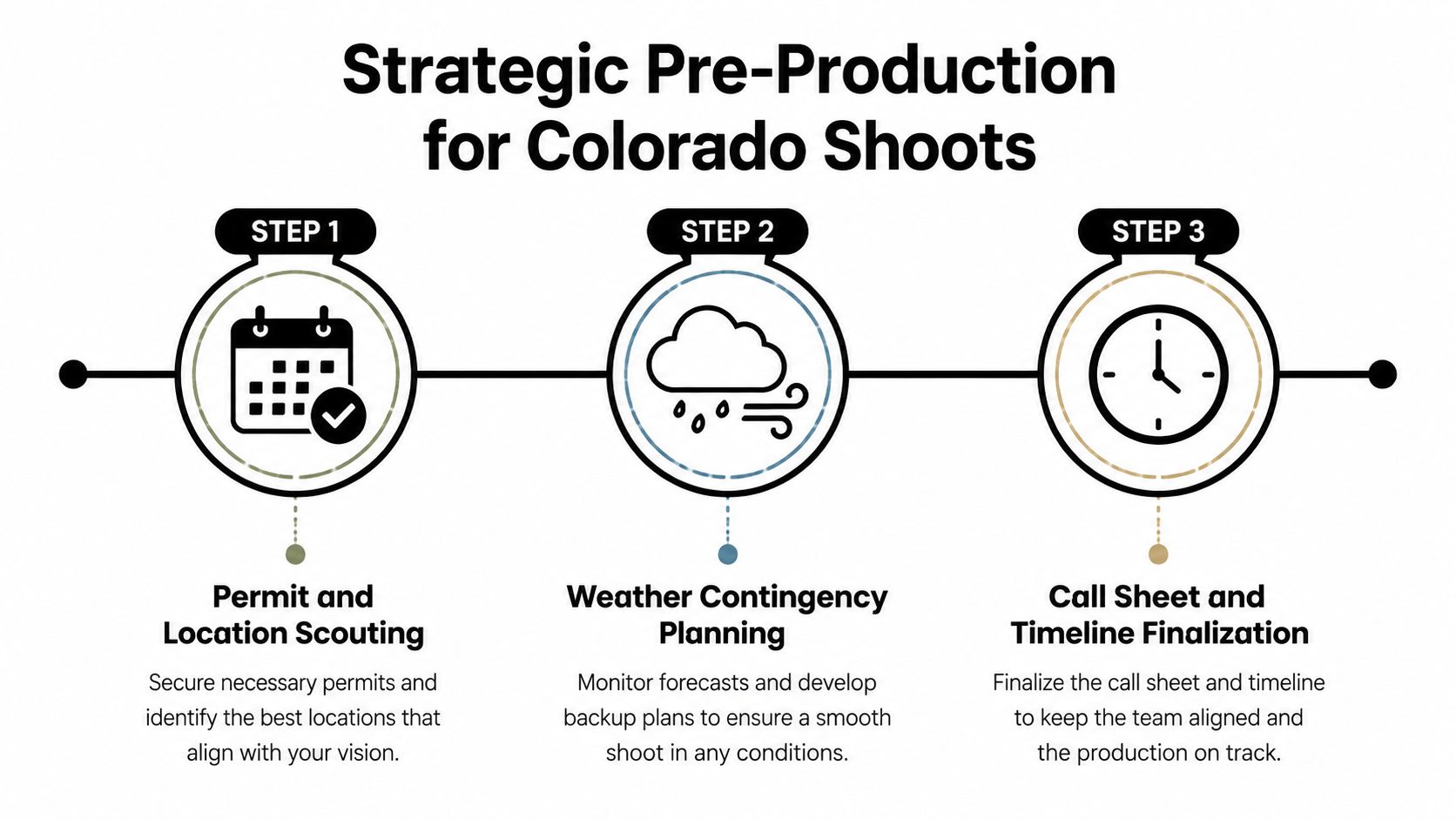
Pre-production is where Colorado shoots are won or compromised. The state gives you strong visual material, but it also forces trade-offs early. Season affects access. Access affects schedule. Schedule affects light. Light affects whether the final image feels premium or merely opportunistic.
Start with access, not aesthetics
Clients usually begin with look and feel. Production should begin with what's workable.
A major gap in typical Colorado coverage is winter and shoulder-season access. Guidance for photographers often highlights places such as Rocky Mountain National Park for summer greenery and wildflowers, the San Juan Mountains for fall aspens, and Great Sand Dunes in spring and fall for milder conditions in this Colorado seasonal photography guide. That's useful creatively, but for commercial work the bigger issue is reliability. A location can be visually ideal and still be operationally wrong for your schedule, crew, client approvals, or talent logistics.
For architecture and hospitality assignments, ask these first:
- Can the site be reached predictably at your intended call time?
- Will snow, closures, or limited parking affect crew efficiency?
- Does the season support the brand story you need?
- Will the surroundings help the building read clearly, or overpower it?
Seasonal trade-offs that matter
Each season offers a different visual and operational profile.
| Season | Often useful for | Main risk |
|---|---|---|
| Summer | Green landscapes, active hospitality scenes, easier movement at many sites | Crowds, bright overhead sun, compressed timing on busy properties |
| Fall | Aspen color, warmer material palette, strong editorial appeal | Short visual peak, inconsistent conditions from area to area |
| Winter | Clean air, dramatic contrast, strong resort identity, fewer distractions | Snow glare, difficult access, cold-sensitive logistics |
| Shoulder season | Lower traffic, transitional mood, more availability | Unpredictable surfaces, inconsistent vegetation, unstable weather patterns |
None of these are automatically right. A developer documenting a multifamily property may need landscaping at its fullest. A resort brand may need snow presence. An architecture firm may prefer a season that simplifies the site and lets the massing read cleanly.
The right season is the one that supports both the story and the schedule.
Build a scouting workflow that doesn't trust old reference material
Colorado punishes assumptions. A field report on a failed outdoor photography expedition warns against assuming that one year's June conditions will match another year's June conditions, and against treating online trip reports or highlight images as representative of an entire route in this field planning cautionary article. That lesson applies directly to commercial production.
Use reference images carefully. They are proof of potential, not proof of current conditions.
A better scouting method looks like this:
Digital scout first
Use Google Earth, site plans, and sun-tracking tools such as PhotoPills or Sun Surveyor to understand orientation, horizon obstructions, and likely light windows.Verify current conditions
Confirm roads, staging, parking, construction activity, snow, vegetation, and any active restrictions close to the shoot date.Cross-check visual assumptions
If a scenic overlook or approach road is central to the concept, verify it with current local information rather than old image searches.
Here's a useful visual summary before call sheets are locked.
Permits and jurisdiction need early attention
Navigating land access often causes shoots to lose time. Colorado assignments can cross public land, municipal property, resort-controlled access areas, campus rules, private roads, or mixed-use developments with layered approval. The permit question isn't just "Do we need one?" It's "Who has authority over this exact slice of the shoot, and what triggers additional requirements?"
A clean pre-production process usually includes:
- Ownership mapping: Identify every property owner or controlling entity involved in the intended angles.
- Public land review: Check whether your shoot touches National Forest land, municipal parks, rights-of-way, or restricted zones.
- Usage alignment: Make sure the planned activity matches the permit language. Architecture only, crewed commercial content, portraits, and video often create different requirements.
- Site-specific restrictions: Drone limitations, loading rules, parking windows, and guest disruption rules matter more than most clients expect.
If permit questions are unresolved, don't finalize the creative around those angles. Build the shot plan around secured access first.
Mastering Colorado's Light and Unpredictable Weather
Colorado light is gorgeous when it cooperates with the subject. It's punishing when the schedule ignores it. For commercial work, that distinction matters more than the postcard version of "great natural light."
The state's visual identity is shaped by harsh midday sun, snow glare, and high-altitude contrast, which is why commercial methods such as HDR for interiors with views and scheduling exteriors for the blue hour are especially useful, as noted in this Colorado Plateau photography overview.
Why the light feels harder here
At many Colorado locations, especially high-altitude sites and open properties, the sun doesn't wrap softly for long. It cuts. That creates three immediate issues for business-use imagery.
First, facades can split into extreme bright and dark zones. Second, interior spaces with windows become difficult to render naturally. Third, any person placed into the scene has to sit inside a lighting strategy, not just stand where the background looks nice.
For clients, this is why a photographer may push exterior hero shots early or late, then use the middle of the day for interior coverage, detail vignettes, or controlled portrait setups.
A practical schedule model
A strong day in Colorado often looks less romantic than clients expect, and more effective.
- Early window: Hero exteriors, aerials if relevant and permitted, wide establishing views
- Midday: Interiors, tighter architectural details, amenity spaces, staff portraits in controlled areas
- Late window: Secondary exteriors, arrival sequences, terrace scenes, lifestyle frames
- Blue hour: Signature building exteriors where glazing, signage, and interior glow matter
That schedule isn't rigid. It's responsive. But it reflects a truth that clients appreciate once they see the files: the best-looking images rarely come from treating every hour as equally useful.
Bad weather planning isn't pessimism. It's production discipline.
Weather plans should be creative, not defensive
Most teams think of weather contingency as a backup date. That's part of it, but not enough. A real weather plan also includes a backup sequence.
If cloud cover kills the view, the shot list may pivot toward materiality, interior atmosphere, and occupancy moments. If wind makes exterior styling impractical, the team may move to quieter elevations and defer loose props or lifestyle frames. If a storm front improves the sky late in the day, the schedule should have enough flexibility to capitalize on it.
For clients trying to align marketing, operations, and creative, a photographer's judgment matters immensely. If you'd like a clearer sense of how timing affects surfaces, interiors, and team portraits, this guide on choosing the best light for a site shoot is a useful reference point.
Crafting a Purposeful Colorado Shot List
A weak shot list is a list of spaces. A strong one is a list of outcomes.
That difference matters in photography in colorado because the environment can seduce everyone into overshooting scenery and undershooting business value. You don't need ten versions of the same mountain-adjacent facade if what the campaign really needs is one hero exterior, one leasing image, one editorial opener, one clean twilight, and a set of supporting assets for web, print, vertical social, and proposals.
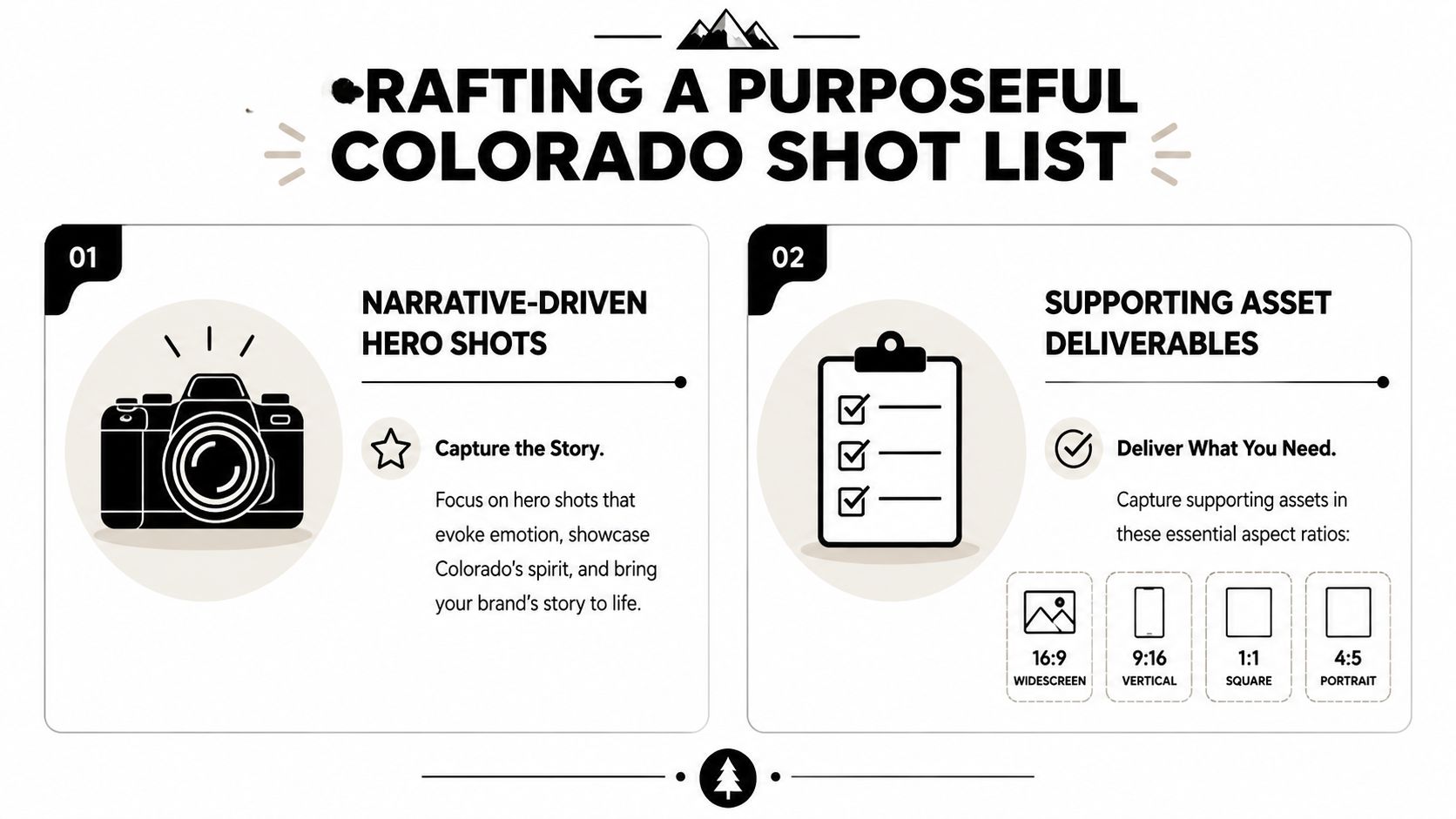
Build the list around story roles
Think in image roles, not just camera positions.
A sample commercial shot list for a Colorado property might include:
Hero exterior
The flagship image. The building reads clearly, the setting feels intentional, and the composition has room for cover use or campaign cropping.Framed vista
An interior or semi-interior image where the architecture organizes the view. This is often stronger than a standalone scenic view because it ties place to design.Environmental vignette
Materials, furnishings, or branded details interacting with local light. In these moments, timber, stone, glass, metal, or textiles can anchor the regional story without cliché.Arrival sequence
Entry, drop-off, signage, circulation, or hospitality threshold. Important for operators and real estate teams because it shows experience, not just form.People-in-place image
Staff, residents, guests, students, or executives used sparingly and with purpose.
Don't let inspiration images write the schedule
Reference decks are useful, but they often contain someone else's lucky moment. A recurring field mistake in Colorado is assuming conditions will repeat year to year, or that online highlight images represent an entire route or location, as discussed in the earlier field-planning source. The commercial lesson is simple: write the shot list from verified current conditions, not visual wishcasting.
A better client review process separates images into three buckets:
| Shot category | How to treat it |
|---|---|
| Must-have | Core deliverables tied to business goals |
| High-value | Important if conditions support them |
| Opportunistic | Nice to capture if time, weather, and access align |
That ranking prevents the schedule from collapsing under aspiration.
Some of the strongest Colorado images aren't the widest. They're the frames where the building and the environment are in agreement.
Example of a useful narrative sequence
For a mountain hospitality property, a purposeful sequence might start with a dawn exterior that establishes location without overpowering the architecture. Mid-morning could move inside for lobby, restaurant, and suite views while exterior light is less flattering. Late day might return to terraces and circulation spaces where the sun gives form to materials. Blue hour finishes the story with the building glowing into its natural surroundings.
For a campus, office, or civic project, the order may be different. The key is that each image earns its place. It either explains the project, supports marketing use, or expands the story in a way the client can effectively deploy.
On-Set Execution and Post-Production Insights
Once the crew is on site, the job shifts from planning to judgment. During this stage, clients can either help the work or accidentally slow it down. The most useful client presence on set is calm, decisive, and aligned to priorities. If weather shifts, light changes, or an exterior goes flat, the team needs room to adapt without relitigating the entire brief every half hour.
That flexibility isn't a compromise. It's how strong work gets made in places where conditions move quickly. If the photographer changes the sequence, condenses a portrait setup, or pushes a signature exterior later, that's usually in service of the final image set, not a departure from the plan.
What clients can do on set
A few habits make a noticeable difference:
- Keep one decision-maker available: Too many live approvals slow momentum.
- Protect the priority list: If time tightens, preserve the must-have frames.
- Clear the frame fully: Cars, cords, bins, temporary signs, and uneven styling cost more in post than they do to remove before capture.
- Trust small resets: Moving furniture, adjusting blinds, killing a mixed light source, or waiting for a cloud edge often makes the image.
Why post-production is part of the craft
Colorado files often need thoughtful finishing, not heavy-handed rescue. The goal is to retain the credibility of the place while controlling the extremes that the camera records less gracefully than the eye.
That may include exposure blending for interior window views, color correction to remove unwanted blue cast from snow or reflected sky, perspective refinement, and selective balancing so materials read accurately for architects, designers, and marketers. Good post doesn't make the image fake. It makes the image faithful to the experience the client wanted documented.
There's also a longer view worth remembering. The Denver Public Library preserves more than 2,000 original glass plates, negatives, and photographs of Colorado dating from around 1865 to 1940 in its historic image resources, documenting a long arc of the state's development in the library's historic Colorado image collection overview. That's a useful reminder that today's commercial and architectural photography isn't disposable. It becomes part of the visual record of how places were designed, built, used, and remembered.
When the assignment matters, quality and precision aren't luxuries. They're part of the record.
If you're planning a commercial, architectural, or brand-focused shoot in Colorado and need a photographer who can help align creative goals with real production constraints, Jimmy Clemmons Photographer offers architectural imagery, commercial brand content, and professional portraits with a process built around location planning, lighting control, on-set direction, and polished editing.