
In 2026, real estate photography averages about $229 per base order, with standard residential shoots typically costing $150 to $300. Premium or multi-service packages can exceed $1,000 in major markets.
An agent preparing a listing usually faces a deceptively simple choice. One photographer offers a low base fee and a fast gallery. Another quotes more for controlled lighting, careful composition, aerial coverage, and images that make the architecture feel intentional. The cheaper option may be perfectly adequate for a straightforward property. It may also leave the agent paying again for video, twilight images, retouching, or brand content that wasn't included.
That distinction matters because real estate photography is usually priced per listing, not by the hour. A single rate rarely tells you what the assignment will cost across a full year, or whether the images are meant only for an MLS listing or for a developer's website, brochures, social channels, press materials, and advertising.
I approach pricing from an Atlanta architectural photography perspective, where the work can range from efficient broker coverage to carefully produced imagery for builders, designers, and commercial property teams. The useful question isn't only, “How much is real estate photography?” It's what visual outcome are you buying, how often will you need it, and what rights will your team require after delivery?
Introduction to Real Estate Photography Pricing Today
The modern listing-photo business developed relatively recently. A Northwest Multiple Listing Service history of real estate photography notes that brokers once had limited ways to upload additional JPEGs, while real-estate photography from the late 1800s through the 1940s represented only a small part of many photographers' work. Over time, listing imagery became a specialized commercial service rather than a minor sideline.
That history explains the current pricing model. Photographers aren't selling time inside a house. They're selling a repeatable production process, including preparation, composition, exposure control, editing, delivery, and the practical rights to use the finished images.
For a standard U.S. residential assignment, published 2026 rate guides place the national average at about $229 per base order, with a common range of $150 to $300 for smaller homes. Premium or multi-service packages can exceed $1,000 in major markets, particularly when the property and marketing objective require more than still photography. These benchmarks come from the 2026 real estate photography pricing guide.
The quote depends on the assignment
An Atlanta agent listing a conventional home may need a clean set of interior and exterior images delivered for the MLS. A developer marketing a finished community needs something else, possibly a library of images that supports sales materials, web design, public relations, and future campaigns. A hospitality group may need photographs that communicate atmosphere, service, and guest experience rather than document rooms.
Those jobs can involve similar cameras and lenses, but they don't carry the same planning, direction, editing, or licensing requirements. A national average is useful as an orientation point, not as a complete budget.
Who should use this pricing framework
Agents and brokers can use it to compare base coverage with recurring listing spend. Builders and developers can use it to separate individual property documentation from a larger content program. Architects, interior designers, commercial property managers, and marketing teams can use it to identify when a photography quote should include creative direction and usage rights.
The practical aim is clarity. Before accepting a quote, identify the property type, the intended audience, the deliverables, the schedule, and the lifespan of the images. Those details make a low quote easier to evaluate and a higher quote easier to justify.
How Real Estate Photography Pricing Really Works
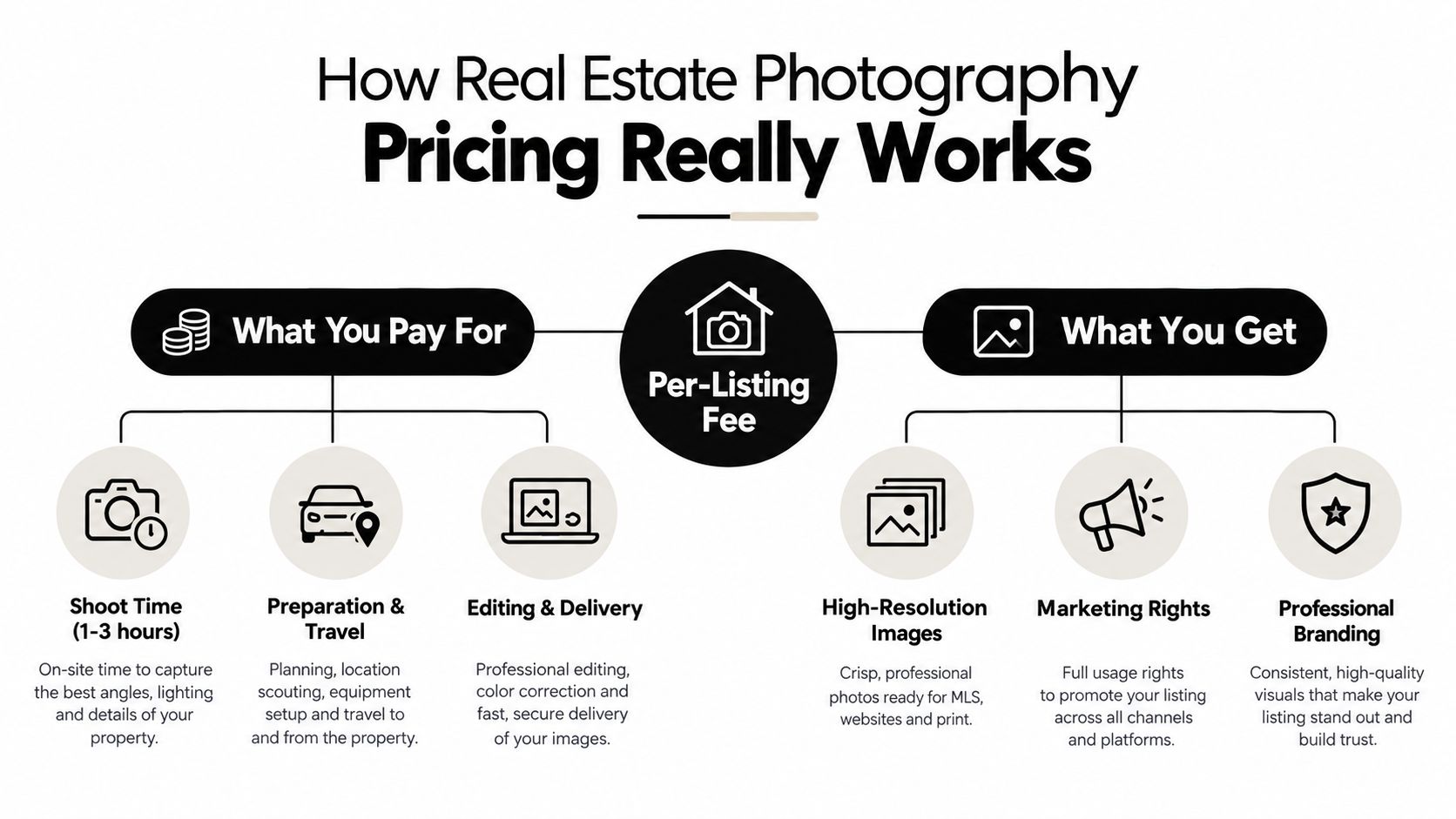
A per-listing fee is the starting point, not the whole explanation. Most proposals combine a defined base service with optional work, so read the quote as a production map rather than a single number.
Start with the base coverage
A standard package commonly establishes the essentials:
- Property coverage: Interior and exterior views, with the photographer selecting angles that explain the layout and emphasize meaningful features.
- Capture process: Camera setup, exposure decisions, tripod work where appropriate, and management of difficult contrast between windows, interiors, and shaded exteriors.
- Post-production: Color correction, exposure balancing, perspective adjustments, and delivery of finished files.
- Basic usage: An understanding of where the client may publish the images, usually tied to the listing or property marketing.
The exact contents vary, so don't assume that “standard photography” includes every image or every form of use. Ask whether the quote covers all rooms, exterior details, detail photographs, image delivery, and any retouching beyond ordinary correction.
Separate production time from visible shoot time
The photographer's presence at the property is only one part of the job. Travel, parking, equipment preparation, client communication, file backup, image selection, editing, and delivery all contribute to the fee. A photographer who spends less time on-site may still spend substantial time building a consistent final gallery.
Two properties with similar square footage can therefore receive different quotes. One may be staged, uncluttered, and filled with even natural light. Another may require more careful lighting, furniture adjustments, difficult color matching, or additional attention to architectural lines.
Practical rule: Compare the finished deliverables and permitted uses, not just the number of minutes the photographer expects to spend inside the property.
Read add-ons as separate decisions
Drone imagery, twilight coverage, video, virtual tours, rush delivery, staging assistance, and expanded licensing can all sit outside the base order. They should appear as distinct line items so you can decide whether each one supports the property's marketing objective.
For a more direct example of how a photographer may organize services and fees, review this photographer price list. The useful habit is to request a written scope before comparing bids. A quote that clearly separates included coverage from optional production is easier to approve, revise, and reuse.
What Drives the Cost of a Real Estate Shoot
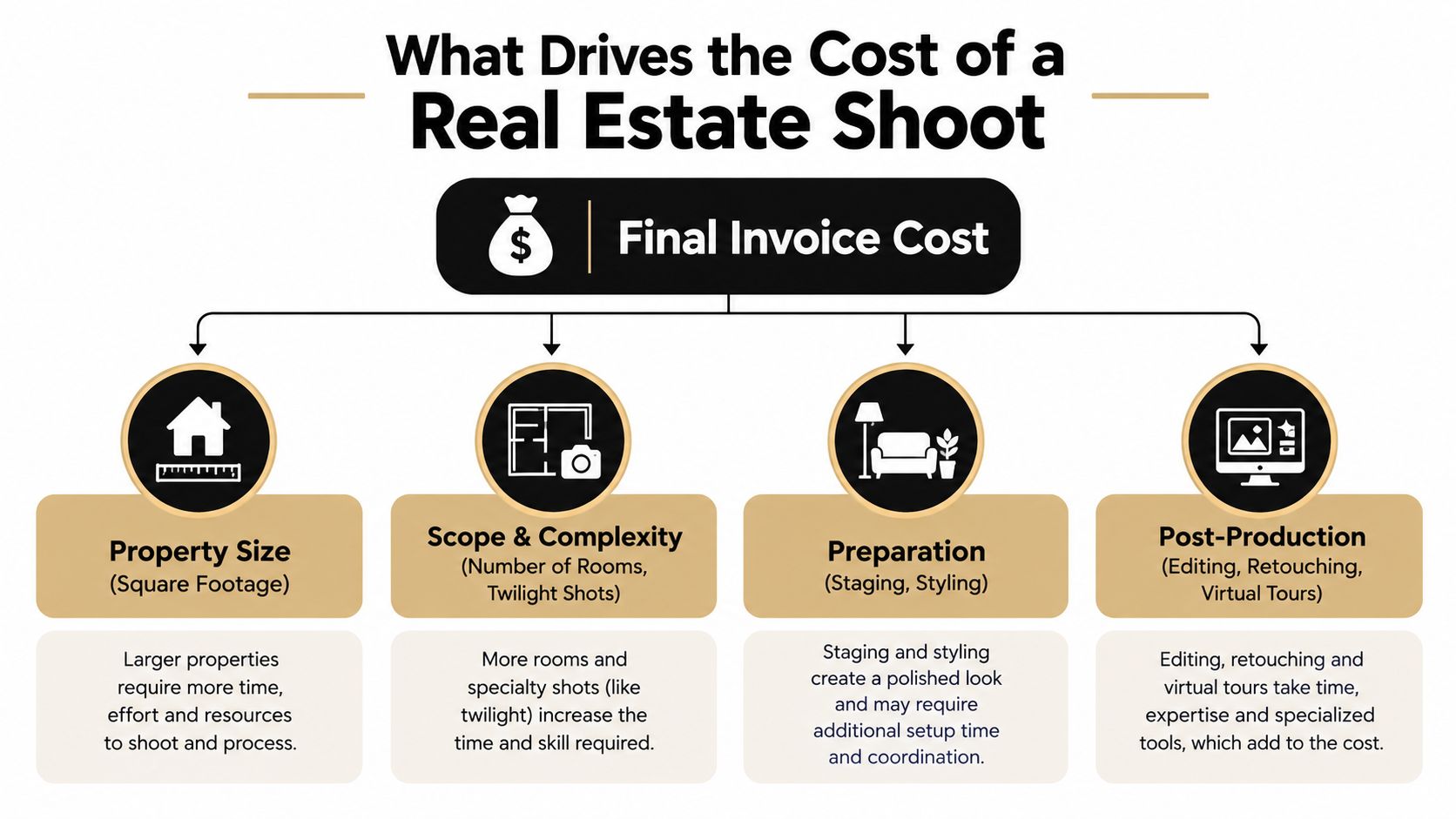
Property size is one of the strongest pricing variables because it affects both capture time and post-production. Guidance from Photographers Ranked's 2026 pricing guide places small homes under 1,500 square feet around $125 to $250, mid-size homes around $175 to $375, and large or luxury properties around $500 to $1,200 or more, depending on region and package depth.
The same guide describes a typical increase in edited image volume, from roughly 15 to 25 images for smaller homes to 50 or more for luxury listings. The total fee rises as the job expands, but the effective price per final image can fall because travel, setup, and software are fixed overheads shared across a larger assignment.
Size changes more than the shot list
A larger property doesn't just add rooms. It adds transitions between spaces, more decisions about which views deserve final delivery, and more opportunities for inconsistent color or exposure. Wider lenses may need more disciplined placement, while mixed lighting can require careful balancing from room to room.
Luxury properties also tend to contain details that deserve deliberate treatment, such as millwork, stone, custom lighting, and outdoor living areas. Those details can make the images more persuasive, but they take judgment to photograph well.
Preparation determines efficiency
A clean, styled property allows the photographer to concentrate on composition. Clutter, unresolved furniture placement, personal objects, uneven lighting, and unfinished exterior areas shift time toward correction or compromise.
Preparation can include staging coordination, a pre-shoot walkthrough, moving small objects, and deciding which spaces should be prioritized. Heavy cleaning and extensive furniture moving shouldn't be assumed to fall within ordinary photography coverage. Clarify responsibilities before the appointment.
Complexity appears in the final gallery
Twilight photographs, aerial views, video, virtual tours, and difficult interiors add more than extra files. They introduce additional capture conditions, equipment, editing decisions, scheduling constraints, or third-party requirements.
Post-production also varies in intensity. Basic correction differs from detailed retouching, object removal, window replacement, or image compositing. Teams exploring workflow options may find AI photo editing features useful for understanding how automated tools can fit into an editing process, but automation doesn't replace a consistent visual standard or a photographer's judgment about what should remain truthful to the property.
Travel and usage rights belong in the quote
A property outside the photographer's normal service area may involve travel time, mileage, tolls, or a longer production day. Commercial and editorial uses can also require broader licensing than a single listing publication.
Ask whether the client receives permission to use the images on a website, in paid advertising, on social media, in printed material, or across future projects. The rights may be as important as the file resolution.
Real Estate Photography Packages and Price Ranges by Property Type
A listing shoot and a property campaign serve different jobs. An agent marketing a compact condo may need efficient still coverage. A builder launching several homes may need a repeatable visual system, video, aerial work, and image rights that continue after the first listing goes live. Pricing should follow the total visual budget, listing volume, and intended outcome, not only the fee for one appointment.
Published guidance places standard residential photography broadly around $110 to $500 per listing, with many market references clustering near $200 to $300. The same pricing discussion identifies Atlanta standard shoots around $225 to $375, while coastal markets can reach $375 to $600 or more. These figures are reference points rather than universal rate cards. Review the deliverables, turnaround, and usage terms behind every quote. See this real estate photography pricing analysis for the regional comparison.
| Package Tier | Typical Property | Edited Images | Common Add-Ons | Price Band |
|---|---|---|---|---|
| Standard residential | Smaller home or condo | Roughly 15 to 25 | Exterior details, basic aerial option | About $125 to $250 |
| Expanded residential | Mid-size family home | More extensive room coverage | Drone, twilight, video | About $175 to $375 |
| Large or luxury | Estate, custom home, or high-end listing | 50 or more may be appropriate | Aerial, twilight, video, enhanced retouching | About $500 to $1,200 or more |
| Full-service visual package | Property marketing beyond stills | Defined by campaign scope | Video, aerial, creative direction, broader usage | Commonly $450 to $800 or more |
Residential listing coverage
A small condo usually benefits from efficient coverage that shows flow, light, finishes, and shared amenities without repetitive frames. A larger family home may need more room coverage and exterior context. Image count should explain the property rather than fill a quota.
Drone work earns its place when land, setting, roofline, access, or outdoor amenities affect the buying decision. Twilight coverage can serve a home whose exterior architecture and lighting carry much of its character. These should be selected for the marketing task, not added because a package has room for them.
Luxury and large-estate work
Large and luxury assignments require stronger editorial selection. More files do not automatically produce a better listing. The photographer should establish a visual hierarchy, lead with the strongest approach, build a coherent interior sequence, and reserve detail frames for features that distinguish the property.
Video and aerial work can turn a listing appointment into a coordinated production. Scheduling, weather, movement through the property, music or voiceover decisions, and post-production need defined scope. Creative direction also matters when the images must support a builder's identity across multiple homes.
Commercial, hospitality, and architectural projects
A commercial property, hotel, restaurant, model home, or architecture portfolio is not merely a larger residence. The client may need photographs for leasing, investor presentations, brand campaigns, press coverage, or a design portfolio. The brief should identify audiences, deliverable formats, locations, talent or staff, styling, and licensing.
A single listing fee becomes a content-production budget when the same visual system serves a project, a development, or a recurring stream of listings. The quote should account for creative direction, production coordination, and how long the client needs to use the images.
Marketing teams extending still photographs into short social videos can evaluate tools such as TikTok content tool pricing, provided the output fits the brand and the license terms for the source images are clear.
For commercial-specific scope, compare this commercial real estate photography pricing resource. An agent handling 5 to 10 listings per month can spend thousands per year on visuals alone, before drone, video, or expanded editing. That volume may justify a consistent relationship, but only when service level, turnaround, scheduling, and usage rights are defined. A lower per-listing fee is not useful if it produces inconsistent galleries or leaves campaign content unavailable for later use.
Understanding ROI and How to Evaluate a Photography Quote
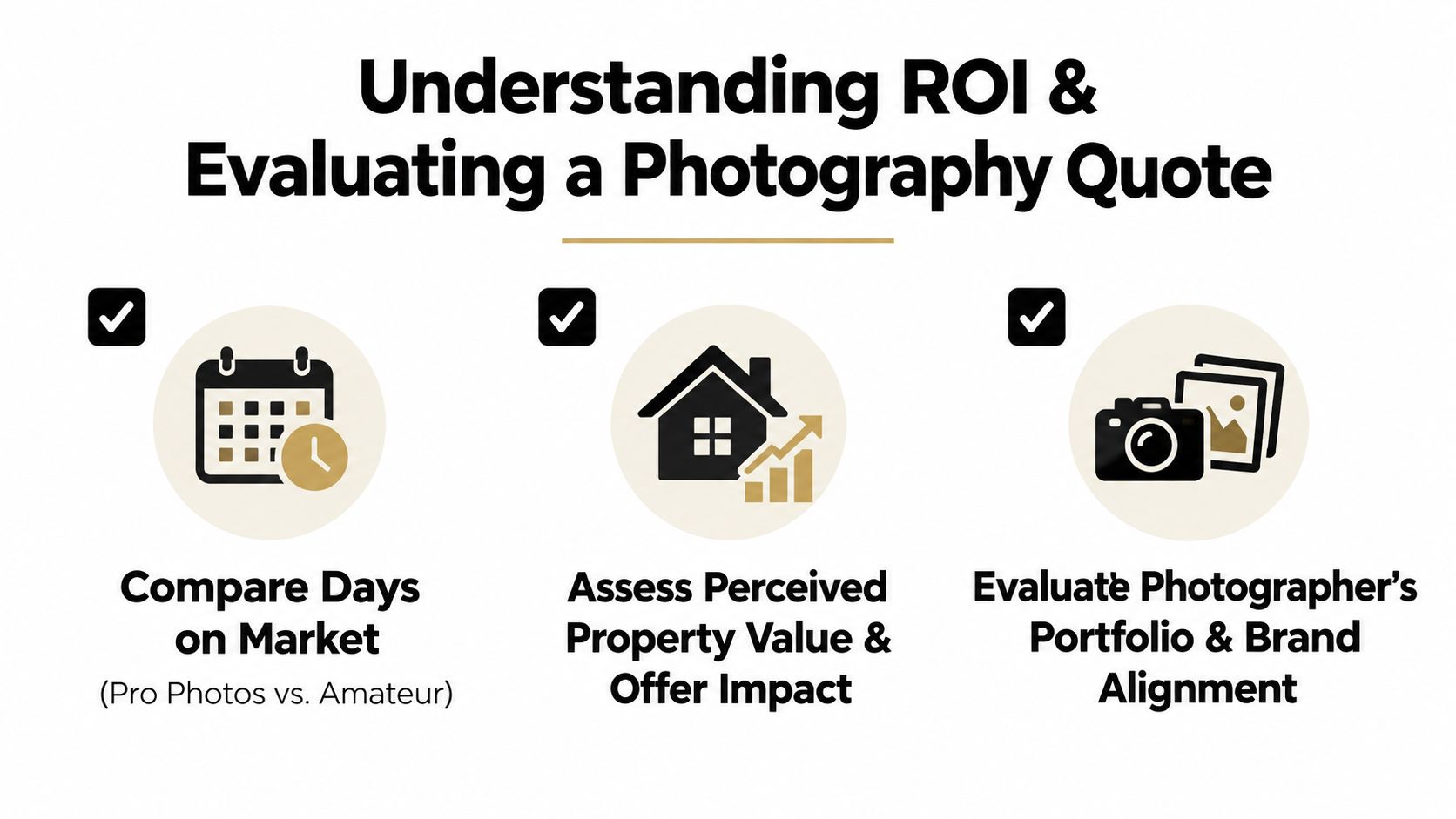
A photography quote should be judged against the job the images need to perform. For a residential agent, that may mean presenting the property clearly online and giving buyers enough visual information to decide whether to schedule a visit. For a developer, the images may need to support a campaign long after a single unit is sold.
Evaluate the intended return
Don't promise a fixed sales result from photography. Too many variables affect a property campaign, including pricing, condition, location, timing, agent strategy, and buyer demand. Instead, evaluate whether the images improve the quality and consistency of the marketing asset you control.
A strong gallery can clarify floor-plan relationships, reveal craftsmanship, establish a credible first impression, and give a brand reusable material. Those benefits matter even when they can't be reduced to one guaranteed performance number.
Use the ROI of professional photography as a framework for thinking about photography as a business asset rather than a disposable listing fee.
Check the proposal line by line
A useful quote answers practical questions before the shoot:
- Coverage: Which rooms, exterior areas, amenities, and details are included?
- Deliverables: How many edited images will arrive, in which file formats, and through what delivery system?
- Editing: Does the service include ordinary color correction only, or detailed retouching and object removal?
- Timing: What is the normal turnaround, and is rush delivery available?
- Reshoots: What happens if weather, construction status, access, or a significant property issue prevents useful coverage?
- Usage: Can the client use the images for MLS, websites, advertising, social channels, print, press, and future campaigns?
- Direction: Will the photographer help shape the shot list, staging, lighting, and visual sequence?
A low price with narrow usage rights may be less useful than a higher fee that gives a developer a durable image library. Conversely, a standard listing doesn't need a campaign-level license if the images will only support one sale.
Know when the job changes category
The assignment becomes a content-production engagement when the client needs multiple audiences, multiple channels, recurring locations, coordinated video, creative direction, or an image library with long-term usage. At that point, price the work around production scope and business use, not an edited-image count.
A listing photograph documents a property. A production builds a visual system around the property.
That distinction helps prevent under-scoping. It also makes the quote more honest for everyone involved.
How to Hire the Right Real Estate Photographer in Atlanta and Beyond
Start with the portfolio, but don't stop at the portfolio. Look for work that resembles your property and your intended use. A photographer may produce attractive interiors yet lack experience with exterior architecture, occupied commercial spaces, hospitality environments, or construction-stage documentation.

Send a useful brief
Give the photographer enough information to quote the actual assignment:
- Property details: Address, approximate size, property type, number of structures, and notable exterior features.
- Purpose: MLS listing, lease marketing, portfolio, sales campaign, website, press, or social content.
- Priority spaces: Identify rooms, amenities, finishes, views, or brand elements that need special attention.
- Access: Include occupancy, staging status, parking, access instructions, construction activity, and any restrictions.
- Deliverables: State the desired stills, aerials, twilight frames, video, virtual tour, or detail imagery.
- Schedule: Share the target shoot date, launch date, and any weather or construction deadline.
- Usage: Explain where the images will appear and whether multiple organizations or future campaigns will use them.
This brief reduces vague comparisons. It also lets the photographer identify whether the property needs a quick listing workflow or a more deliberate location and lighting plan.
Test the working process
Ask how the photographer handles mixed interior lighting, reflective surfaces, vertical lines, window views, occupied rooms, and color consistency. Review a complete gallery rather than only selected hero images. A polished first frame means little if the rest of the sequence feels uneven.
For Atlanta assignments, also confirm travel boundaries, weather contingencies, parking, access to dense neighborhoods, and delivery expectations for regional work. A photographer with architectural experience should be comfortable discussing location scouting, lighting design, on-set direction, and how the final images will function together.
A conversation about file naming, archive practices, revision policy, and licensing can reveal more than a low introductory quote.
The visual difference between ordinary coverage and design-forward imagery often comes from decisions made before the camera is raised. A clear brief gives the photographer room to make those decisions without guessing at the client's priorities.
A short overview of the production approach can help clients understand what happens on location:
Making Smart Budget Choices for Your Next Listing or Portfolio Shoot
The right budget follows the outcome. A standard residential listing calls for disciplined coverage, reliable editing, and clear delivery. A luxury property may justify additional exterior context, twilight work, aerial imagery, or video because the architecture and setting need more room to communicate.
A developer, hospitality group, architecture firm, or commercial property manager should make a different calculation. If the photographs will appear across a website, leasing materials, social content, press submissions, brochures, and future campaigns, the client is buying an adaptable visual library. The brief should account for creative direction, production planning, deliverable formats, and usage rights from the beginning.
Use a simple decision filter
- Choose base listing coverage when the primary need is a clean, timely MLS gallery.
- Add targeted services when one property feature, such as a view, exterior design, or evening atmosphere, needs stronger emphasis.
- Commission a broader production when several channels, audiences, locations, or future campaigns depend on the images.
- Plan recurring volume carefully when multiple listings will require consistent style, scheduling, delivery, and brand treatment.
The cheapest quote isn't automatically economical, and the largest package isn't automatically responsible spending. Compare the fee with the property's scale, the market context, the number of assignments, and the value of having images that remain useful beyond the initial listing.
Pricing becomes much easier to understand once the deliverable has a defined job. Match the scope to that job, document the rights, and ask for a quote that separates essential coverage from optional production.
Jimmy Clemmons Photographer provides Atlanta-based architectural imagery, commercial brand content, and professional portraits with location scouting, lighting design, on-set direction, and polished editing. To plan a listing, development, hospitality, or portfolio assignment around its real visual goals, visit Jimmy Clemmons Photographer and request a focused project consultation.