
You're probably dealing with one of these jobs right now.
A designer wants a hotel lobby photographed before guests check in. A developer needs a twilight exterior that still shows outdoor lighting cleanly. A marketing team wants executive portraits, behind-the-scenes clips, and a few social cutdowns from the same half-day production. In every one of those situations, the conversation about lighting isn't a gear argument. It's a business decision.
Choose the wrong system and the problems pile up fast. Setup drags. The client loses confidence because they can't see where the image is going. Reflections get harder to control. Motion gets softer than you want. Or the files are clean enough, but the crew spent the day fighting a kit that was built for a different kind of assignment.
When considering continuous light vs strobes, the question isn't which one is better in the abstract. It's which one helps you work faster, direct the set more confidently, and deliver the kind of image the job requires.
The Lighting Choice That Defines the Shoot
On a commercial set, lighting sets the rhythm before the camera does.
Architectural work usually rewards precision. You're balancing practical fixtures, daylight spill, window detail, and the way surfaces reflect each other. Corporate portraiture often asks for something different. The subject may be uncomfortable. The client may want to approve the look on the monitor in real time. Product photography sits somewhere in between, especially when the art direction depends on tiny shifts in highlight shape.
That's why this choice matters so much. Continuous light gives you immediate feedback. You can see the shadow line move as you raise a softbox, feather a strip light, or flag off a reflection. The set becomes collaborative because everyone can read the light live. Clients tend to relax when they can understand the image before the shutter fires.
Strobes solve a different problem. They give you authority over the environment. When the room is too bright, when the windows need discipline, when the subject won't stay perfectly still, or when the file needs to look crisp without pushing ISO harder than you want, flash still earns its place.
Here's the part less experienced photographers often miss. The “best” choice isn't tied to taste. It's tied to constraints.
A few of the constraints that usually decide the job are straightforward:
| Job pressure | Continuous light usually helps when | Strobes usually help when |
|---|---|---|
| Client collaboration | The client wants to see the look develop live | The client cares most about final polish, not live preview |
| Ambient control | The space is already manageable | The location is bright or mixed and needs stronger control |
| Motion | The subject is mostly static | You need cleaner motion freezing |
| Hybrid capture | You're shooting both stills and video | The shoot is stills-first |
| Set pace | Frequent visual tweaks matter | Repeatable, efficient exposures matter more |
Most lighting mistakes don't come from bad taste. They come from choosing a tool that fights the pace and demands of the assignment.
A polished final image starts with that decision. So does an efficient day on set.
Understanding the Core Technology Flash vs Glow
The simplest way to understand continuous light vs strobes is this. One system stores energy and releases it in a punch. The other glows the whole time.
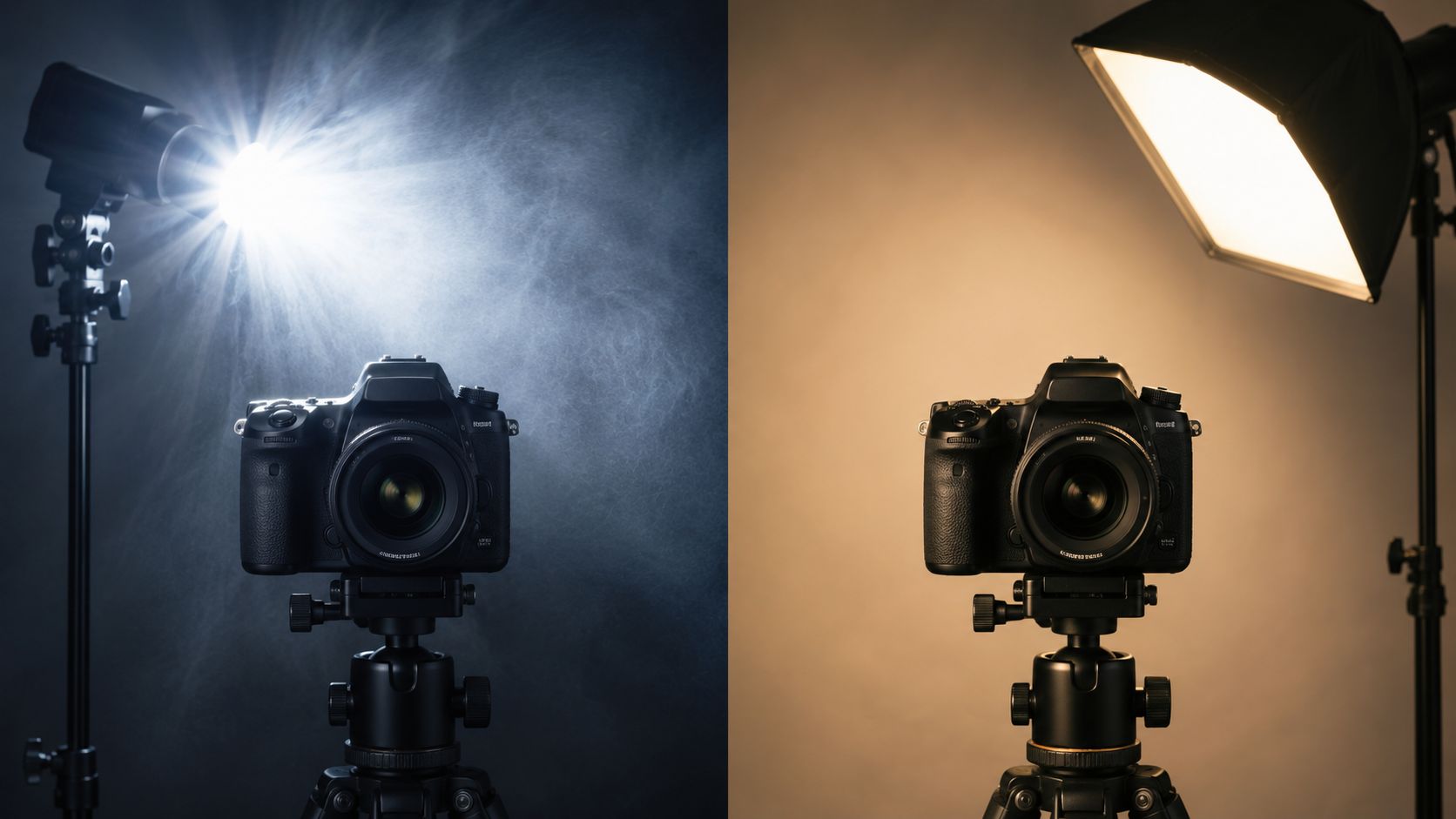
How strobes actually work
A strobe isn't just a bright lamp that turns on briefly. It stores energy in capacitors, then dumps that energy almost instantly through a xenon flash tube. That's the reason flash behaves the way it does in real shooting. The burst is extremely short.
A useful historical benchmark is that strobe lighting commonly works with a flash duration around 1/1,000 s to 1/10,000 s or faster, while continuous lights remain on constantly in a what-you-see-is-what-you-get workflow, as described in this explanation of strobe vs continuous photo studio lights.
That one technical difference drives almost everything people notice in practice. Strobes can freeze movement better, deliver more concentrated output, and let the camera record the flash rather than the full clutter of the ambient environment, depending on how you expose the scene.
How continuous lights behave on set
Continuous fixtures, especially modern LED systems, work like a controlled, always-on source. The benefit is obvious the moment you step onto set. You don't need to imagine what the key light is doing. You can see it.
That matters more than beginners realize. On an interior shoot, moving a flag an inch can clean up a cabinet reflection. On a portrait set, turning the subject's face a few degrees can transform the jawline and eye light. Continuous fixtures make those adjustments easier to judge in real time.
For photographers refining their broader lighting craft, a solid grounding in artificial lighting in photography usually makes the trade-offs between these systems much clearer.
Practical rule: Strobes are built to deliver energy in a brief hit. Continuous lights are built to let you shape the scene while seeing the result continuously.
Why the technology changes the workflow
This isn't only about output. It's about decision-making speed.
With continuous light, the set is visually legible. The photographer, assistant, stylist, and client can all evaluate the same thing at the same time. With strobes, you often judge from a mix of modeling light, meter readings, experience, and test frames. That's not worse. It's just a different style of working. It rewards photographers who can previsualize and build methodically.
If you understand that distinction, the rest of the comparison becomes much easier.
Performance Breakdown A Head-to-Head Comparison
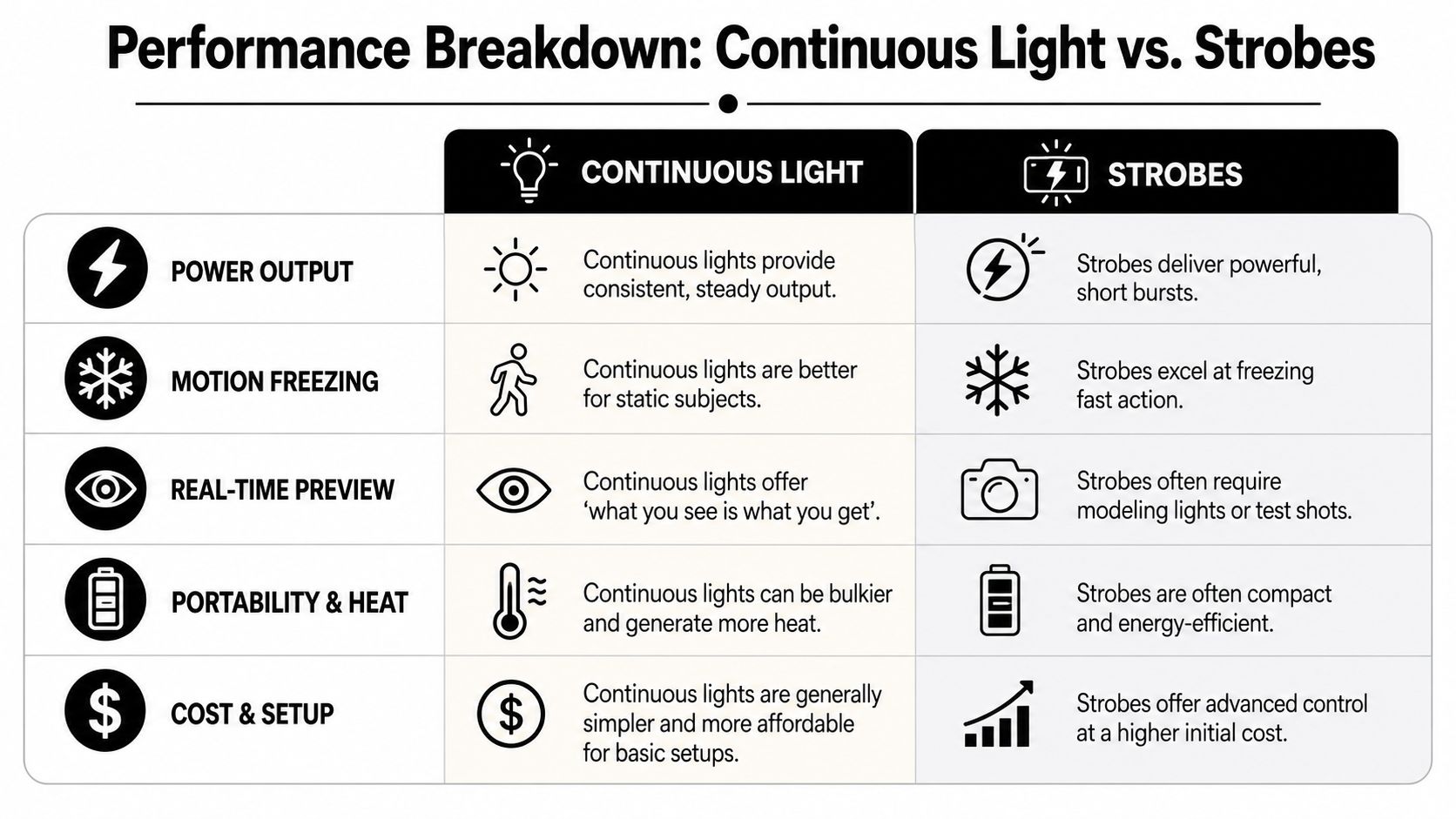
A lighting decision earns its keep when the schedule tightens, the client is watching the monitor, and the location refuses to cooperate. That is where the gap between continuous light and strobes becomes obvious.
Power output and ambient control
Strobes still own this category on working sets.
They give you more headroom to shape the frame instead of accepting what the room or weather gives you. On a commercial interior with large windows, that often means keeping the view outside, holding texture in materials, and staying at an aperture that flatters the space. On an exterior job near sunset, it means adding definition without dragging the shutter so far that every practical light blooms and every moving branch turns soft.
A useful way to plan for that is to assess the location before the truck is loaded. My own rule is simple. If ambient light is likely to change faster than the crew can adapt, I want flash in the kit. That same location-planning mindset matters in choosing the best light for a site shoot, especially for architecture and mixed-light environments.
Continuous fixtures can make a polished still image. They just ask for more concessions once you need separation from daylight or stronger control over spill. Those concessions usually show up as higher ISO, wider apertures, longer shutter speeds, or more time spent flagging and refining a setup that a strobe could solve faster.
Motion freezing
Flash solves a problem before it turns into retouching.
That matters for obvious subjects like splash work or active portraits, but it also matters for quieter assignments. A jacket settling during an executive portrait, a hand shifting on a product, or a stylist making a final adjustment to fabric can all look slightly loose under continuous light if shutter speed drops too far. Strobes keep edges cleaner and reduce the number of frames that are almost right.
If the subject can stay still and the set is controlled, continuous light is fine. If the pace of the shoot depends on getting the frame clean in fewer takes, strobes usually return that time.
Color and consistency
Both systems can look excellent. The failure points are different.
With strobes, consistency usually comes down to how stable the pack or head performs across power settings and how carefully the setup is repeated from frame to frame. With LEDs, the bigger issue is often mixed sources. One fixture may look neutral on its own, then go muddy next to practical lamps, window light, or another LED panel that is not matched as closely as the spec sheet suggests.
Clients rarely describe this as a color-management issue. They describe it as, "Why does the paint look different in this angle?" or "Why does the wood tone shift between frames?" That is a production problem first and a post problem second.
Preview and communication
Continuous light has a real advantage here, especially on collaborative sets.
Art directors, stylists, and clients can read the scene immediately. They can judge reflections, shadow density, and how a surface is taking light before the frame is made. That tends to reduce the stop-start rhythm of test, review, adjust, repeat. On interior and hospitality shoots, where small reflection changes can save a frame or ruin it, that live preview can speed up approvals in a way spec sheets never capture.
Strobes can still run efficiently with strong modeling lights and solid tethering. They just demand more confidence from the crew and a little more trust from the client while the lighting is being dialed in.
Hybrid capability
Continuous light alters the business case in this regard.
If the same production day includes stills, motion clips, interviews, and behind-the-scenes content, LEDs reduce gear changes and keep the set moving. That can matter more than pure output. A marketing team usually values one lighting setup that covers multiple deliverables if the image quality meets the brief and the crew does not lose an hour swapping systems.
That does not make continuous light a replacement for flash. It makes it a stronger choice for productions where efficiency across formats matters as much as maximum control in a single frame. On stills-only jobs, I still choose based on the look and the constraints of the location. On hybrid jobs, the broader production schedule often decides for me.
Choosing the Right Light for the Job Use Case Scenarios
Real jobs decide this debate better than spec sheets do.
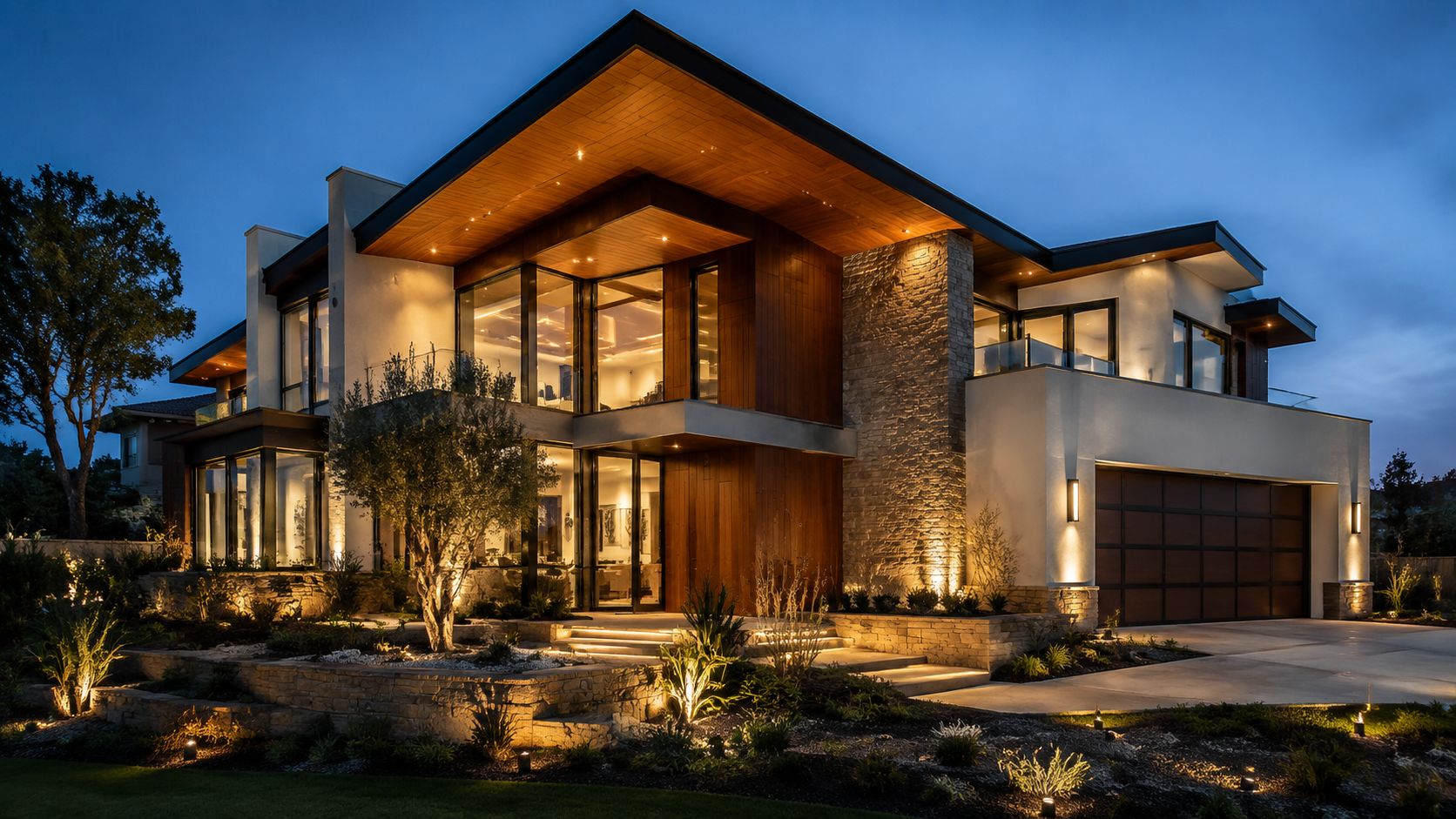
Architectural exterior at twilight
Twilight exterior work is a control problem. You're balancing the sky, outdoor lighting, interior glow, signage, and often a short window where everything aligns. In that setting, strobes usually make more sense when the goal is to shape a foreground element, add structure to an entry sequence, or keep a key architectural detail from sinking into flatness.
The reason isn't romance. It's repeatability. You need quick, intentional bursts of light that don't force the entire scene into a long, glowing wash. Strobes also tend to fit better into a compositing workflow where separate frames are built carefully for windows, exterior fixtures, and feature areas.
For teams planning location strategy, choosing the best light for a site shoot starts with this exact question. Do you need to reveal the scene, or control it?
Refined hotel or residential interior
Interiors can go either way.
If the space is layered with practicals, sconces, lamps, and warm finishes, continuous light can be a pleasure to use. You can watch reflections in glass, metal, and polished stone as they happen. That makes it easier to adjust flags and diffusion with precision. On a carefully styled interior, that live preview can save a lot of second-guessing.
But when the room has bright windows, deep corners, or surfaces that need crisp tonal separation, strobes usually give the cleaner file. You can keep the camera settings where you want them and shape the room without letting the ambient spill dictate the whole image.
A useful rule is simple. If the room already looks close to right and needs sculpting, continuous can work beautifully. If the room needs authority, bring flash.
Corporate leadership portraits
People often perform better under continuous light.
That's not because the light itself is better. It's because the set can feel calmer. The subject sees where the light falls, the client can understand the direction immediately, and the photographer can coach small posture changes without the interruption of repeated flash bursts. For executives who don't enjoy being photographed, that can improve the flow of the session.
There's a limit, though. If you need tack-sharp files, stronger ambient suppression, or more polished separation from a bright office environment, strobes are still hard to beat.
Nervous subjects usually respond to clarity. Continuous light gives them a readable set. Strobes give the photographer more authority over the final frame.
Commercial product photography
Product work depends on surface behavior.
For matte objects, continuous light can be excellent because you can see gradient transitions and shadow edge quality in real time. For reflective products, that visibility is also useful, but the need for cleaner files often pushes the decision toward strobes, especially when the concept needs deep depth of field or stricter control over ambient contamination.
In practical terms, many product photographers mix approaches. They may sketch the light with LEDs, then switch to flash once the geometry is locked in. That's often smarter than treating the systems like rival camps.
Beyond the Bulb Modifiers and On-Set Workflow
The light source is only part of the decision. The ecosystem around it affects the whole day.
Modifier compatibility and shaping tools
A powerful head is useless if you can't shape it efficiently. Most commercial photographers live inside a world of softboxes, strip banks, grids, scrims, reflectors, flags, cutters, and diffusion fabrics. The question isn't only whether a fixture is bright. It's whether it accepts the modifiers you already trust and whether those modifiers behave well with that source.
Strobes often slot neatly into established still-photo workflows because many systems are designed around familiar light-shaping tools and the expectation of rapid setup changes. Continuous lights can do the same, but some fixtures become awkward once you add larger modifiers, especially on tighter location sets.
Heat, fan noise, and working conditions
At this point, practical reality shows up fast.
A stills-only crew may tolerate fan noise or a hotter fixture if the image quality and control justify it. Video crews often won't. Small hospitality rooms, offices, and residential interiors also change the equation. A loud or heat-heavy fixture can affect comfort, communication, and pacing, particularly when clients or talent are standing in the lit area for a long time.
Continuous systems often bring more awareness of heat and noise because they remain on for the entire setup. Strobes sidestep some of that by delivering light only when needed.
Power management and pace
The way a set moves depends on how the lights are powered and reset.
With strobes, you think about recycle time, battery management, sync reliability, and whether the next frame is ready at full output. With continuous fixtures, you think about battery duration, AC access, cable routing, and whether the fixture can stay on at the output level you need without creating other headaches.
That changes the crew rhythm:
- Strobe workflow usually favors deliberate exposures, repeatable camera settings, and stronger ambient control.
- Continuous workflow often favors live adjustment, collaborative review, and faster visual experimentation.
- Hybrid productions need everyone to know which mode the set is in, because the pace and expectations shift.
Good workflow isn't about moving faster at all costs. It's about removing delays that don't improve the image.
The strongest crews build their process around the assignment, not around loyalty to one type of fixture.
Budgeting and Building Your Kit When to Buy Rent or Hybridize
A client books a stills campaign for Monday, asks for a short video cut on Tuesday, and wants the same visual style in both. The lighting decision is no longer a gear preference. It is a budgeting decision that affects setup time, crew size, rental spend, and how confident the client feels on set.
The buying question is simple. Buy the tools you use every month. Rent the tools that solve occasional high-pressure problems.
Buy for frequency, rent for spikes
Ownership pays off when the light earns its place in regular production. For photographers shooting executives, branded interiors, behind-the-scenes coverage, and smaller product setups, continuous lights often justify themselves because they cover both stills and motion and are easy for clients to read in real time.
Strobes make better financial sense as rentals when the assignment is less frequent but more demanding. Large spaces, bright window-heavy interiors, midday exteriors, and tightly controlled commercial portraits can all require output that is expensive to own and expensive to keep current.
A good kit plan starts with boring questions, because those are the questions that protect profit. How often will this light go out the door? Can one person move it safely? Does it need assistants to work efficiently? Will it fit the jobs that pay your invoices? A practical reference point is this real estate photography gear guide, because location assignments reveal weak stands, awkward cases, slow setups, and underpowered heads fast.
The hybrid kit question
Hybrid kits are easier to justify now than they were a few years ago. Continuous fixtures have become more useful for commercial teams that need stills, video clips, and client-friendly review on the same call sheet. Strobes still hold their ground when the brief demands cleaner files at lower ISO, tighter control over ambient, or more punch through large modifiers.
That is why I rarely advise building an all-or-nothing kit from day one. A stills-first photographer usually gets better return by owning a dependable strobe setup, then adding one or two continuous fixtures for motion, scouting, and collaborative previews. A hybrid shooter with regular video work often benefits more from owning solid continuous lights and renting flash packs for the jobs where ambient control and output decide the result.
The point is not technical purity. The point is keeping capital tied to tools that book work.
What usually works best
For working commercial photographers, the strongest buying pattern is often a split system:
- Own continuous lights if they serve daily production, video add-ons, and client review.
- Own strobes if your core revenue comes from stills work that demands speed, consistency, and strong ambient control.
- Rent specialty units for oversized spaces, high-output daylight fights, or jobs with unusual power and rigging needs.
- Standardize modifiers and grip so the kit feels unified even when the heads change.
That approach protects cash flow, keeps your package flexible, and avoids the common mistake of overspending on capability that looks impressive on paper but rarely leaves the case.
Frequently Asked Questions for Production Teams
Can you mix strobes and continuous lights on the same set
Yes, but only when you have a clear reason. Mixed sets can work well when one source handles the hero exposure and the other fills a secondary role, such as maintaining a practical mood or giving video coverage between still setups. The challenge is consistency. Color mismatch and timing issues show up quickly if the sources aren't chosen carefully and tested under the actual room conditions.
Does High-Speed Sync make strobes behave like continuous light
Not really. High-Speed Sync changes how the flash works with faster shutter speeds, which can help in bright conditions, especially outdoors. It doesn't turn a strobe into a constant source and it doesn't erase the usual flash trade-offs around power and efficiency. It's a useful feature, not a category replacement.
Are LED strobes the best compromise
Sometimes, but the answer depends on the assignment. LED-based flash systems can be appealing because they promise some of the preview benefits of continuous light with flash capability layered in. In practice, I'd still judge them by the same standards as anything else. Can they control ambient when the job gets difficult? Can they produce the look consistently? Can the crew work confidently with them all day?
Which one do clients usually prefer on set
Clients usually prefer the system that makes the process feel understandable and well-managed. Marketing teams often respond well to continuous light because they can see the image build live. Design and architecture clients often care more about whether the final frame looks disciplined and polished, even if the process is more technical behind the scenes.
If I can only start with one system, what should it be
Start with the system that matches the jobs you shoot most often, not the jobs you hope to shoot someday. If you regularly create both stills and video, continuous light is the more versatile first step. If your work depends on stronger ambient control and premium still-image quality, start with strobes and expand deliberately.
If you need photography that balances technical control with efficient on-set collaboration, Jimmy Clemmons Photographer brings that discipline to architectural, commercial, and portrait assignments throughout Atlanta and the surrounding region. The studio handles lighting design, location work, and polished final delivery with a workflow built for design firms, developers, brands, and editorial clients.