
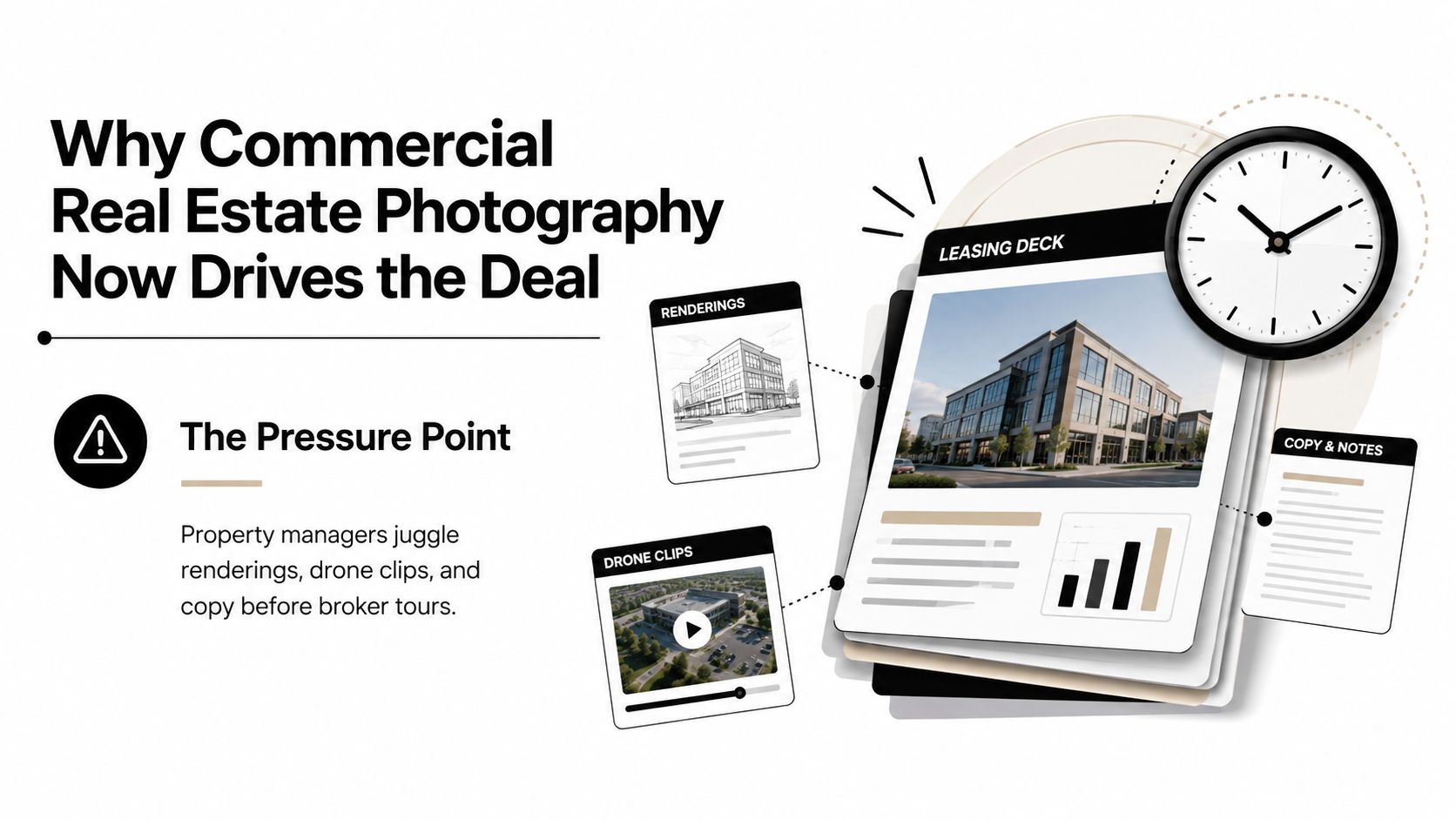
A property manager can spend weeks preparing a commercial space, then discover the marketing package still feels unfinished the night before a broker tour. The leasing deck needs a strong exterior, the available suite needs a clear sense of scale, the amenities need to feel active without looking staged, and the website needs crops that work on both desktop and mobile. Add drone footage, renderings, floor plans, and listing copy, and the photography quickly becomes the visual system holding the campaign together.
Commercial real estate photography now sits inside that system, not outside it. The work has to show what a property is, who it serves, how it feels to occupy, and what condition it's in. A polished image can attract attention, but a well-scoped production also protects the accuracy of the property story.
Why Commercial Real Estate Photography Now Drives the Deal
The deadline is familiar. A property manager is assembling a leasing deck while a broker prepares for a tour. The latest renderings are in one folder, drone clips are in another, and the listing copy still needs a hero image. A phone snapshot might fill the gap, but it won't establish the building's scale, finish quality, or position in the market.
That matters because the first property interaction often happens online. Industry reporting says 74% of buyers start their property search online, and listings with professional photos receive 61% more views and can sell 50% faster than listings without strong visuals, according to Framing What's Next 2026. Those figures aren't a promise that photography alone closes a transaction. They do show why weak imagery can reduce the number of qualified people who reach the next step.
The listing comes before the tour
A tenant representative may compare several offices from a broker portal before recommending a site visit. An investor may review an offering package before committing time to a property tour. A hospitality group may judge a venue's arrival sequence, public spaces, and guest areas through a digital presentation long before anyone walks through the lobby.
The image has a specific job at each stage:
- The exterior establishes recognition: It shows the building's arrival experience, surrounding context, and architectural presence.
- The interior explains usability: Wide frames reveal circulation and volume, while tighter views communicate finishes and amenities.
- The detail frame supports positioning: Materials, lighting, furniture, and branded features help distinguish a property from comparable inventory.
- The aerial frame adds context: A drone view can clarify access, parking relationships, neighboring uses, and the asset's place within its surroundings.
The market has also moved beyond stills alone. The same industry report notes that about 22% of home listings include virtual tours and 82% of agencies use drones, evidence that richer visual formats have become familiar in property marketing Framing What's Next 2026. Commercial clients should treat those formats as decisions tied to the property and audience, not automatic upgrades.
Practical rule: Hire the visual package for the decision you need a prospect to make. A still image may sell design quality, while a walkthrough may clarify circulation and a drone view may explain location.
Photography supports velocity because it gives brokers and prospects usable material at the moment they're deciding whether to engage. It also gives asset managers a consistent library for websites, investor materials, social campaigns, signage, and leasing-center displays. The photographer's task is therefore broader than recording rooms. It's to create a coherent set of evidence that makes the next conversation easier.
Defining Commercial Real Estate Photography and the Assets It Covers
Commercial real estate photography is a production discipline for documenting and marketing income-producing, public-facing, and professionally occupied properties. It serves offices, retail centers, industrial facilities, hospitality venues, multifamily communities, medical spaces, schools, and mixed-use developments.
The audience separates this work from ordinary residential listing photography. A commercial assignment may serve a broker, tenant representative, developer, general contractor, architect, property manager, interior designer, or institutional marketing team. Each audience needs a different kind of proof. A broker needs clear, persuasive marketing images. A contractor may need progress documentation. An architect may need controlled views that explain design intent and material relationships.
The asset categories
A useful scope begins by identifying what the property needs to communicate.
Ground-level exteriors show approach, entrances, facade materials, signage, landscaping, and the relationship between the building and its surroundings. They're often the first frames used in a listing or leasing deck.
Aerial photography and video add geographic context. They can show a campus, roofline, parking layout, nearby access points, or a development's relationship to adjacent properties. Aerial work requires more than sending a drone upward. The flight plan, weather, light direction, surrounding obstacles, and intended crop all affect the result.
Tenant-ready interiors document the spaces a prospect could occupy. These frames need accurate verticals, believable proportions, controlled reflections, and enough visual information to support a leasing decision.
Amenity and lifestyle coverage gives public spaces a reason to matter. A fitness room, roof terrace, lobby, restaurant, conference suite, or courtyard needs to look usable rather than merely empty and clean.
Progress and construction imagery has another purpose. It records phases, materials, installation quality, and site conditions. The photographer may work from drawings, lease-line plans, schedules, or a contractor's documentation brief rather than a finished marketing concept.
| Commercial Asset Types | Typical Deliverables |
|---|---|
| Office and medical | Exterior hero frames, lobby and suite interiors, amenities, detail images, vertical social crops |
| Retail and mixed-use | Street presence, storefronts, circulation, tenant areas, aerial context, twilight views |
| Industrial and logistics | Building exterior, loading areas, warehouse volume, office components, site access, progress documentation |
| Hospitality | Arrival sequence, lobby, guestrooms, food and beverage spaces, amenities, lifestyle imagery, video |
| Multifamily | Community exterior, model units, shared amenities, streetscape, aerials, walkthroughs |
| Construction and adaptive reuse | Progress stills, material details, design documentation, finished architectural frames, short-form video |
The same property can require several visual languages over its life. A ground-up development may need factual progress images during construction, precise architectural views at completion, and warmer lifestyle content during leasing. The brief should identify the audience and the decision before anyone chooses a lens.
The Business Value of Professional Property Imagery
Professional imagery creates value only when the client puts it to work. The strongest set isn't a folder of attractive photographs. It's a planned collection mapped to the marketing funnel, from first impression to tour request and from leasing campaign to long-term asset communication.
Published industry benchmarks report that professional photos generate 61% more views, while listings can sell 50% faster than those without strong visuals, as documented in Framing What's Next 2026. The useful question isn't whether one photograph causes a deal to move faster. The useful question is where better imagery increases the chance that a prospect keeps evaluating the property.
Match the frame to the marketing surface
A listing platform needs a decisive first image. The hero frame should identify the property quickly and provide a reason to continue scrolling. A frontal exterior may work for a recognizable building, while a lobby or amenity view may better represent an office repositioning campaign.
A website needs more range. The homepage may use a wide exterior or a controlled interior, while individual pages can rely on suites, amenities, access points, and detail photographs. The content management system may crop images differently from a broker portal, so the photographer should capture compositions that survive both wide and vertical formats.
Social campaigns need tighter storytelling. A vertical crop of a terrace, lobby detail, or tenant-ready suite can communicate one idea quickly. A set of images can also support a sequence, such as arrival, shared space, work area, and neighborhood context.
Print brochures and investor decks demand files with enough resolution and tonal control for larger reproduction. They also need images that leave room for headlines, map overlays, captions, or financial information. A frame that looks excellent edge to edge may be awkward once a designer places text over it.
Measure usefulness, not just beauty
The market for this service reflects how many surfaces now depend on property imagery. One market estimate projects the global real estate photography service market at approximately $46.8 billion in 2025, rising to $82.5 billion by 2034 at a 6.5% CAGR, while another estimate places the United States market at $268.3 million in 2026, according to Sector Data Insights. These projections describe market expansion, not guaranteed returns for any individual shoot.
A better brief assigns each deliverable a job:
- Hero stills earn attention on listing pages and campaign headers.
- Amenity images help prospects understand the experience beyond the leased square footage.
- Aerials explain context that ground-level frames can't show.
- Short video communicates movement, sequence, and atmosphere.
- Detail photographs support design, finish, and brand positioning.
The investment performs poorly when the client commissions attractive images without deciding where they'll appear. It performs better when the photographer, broker, and marketing team build the shot list around the property's sales argument.
Inside the Production Process from Scouting to Retouching
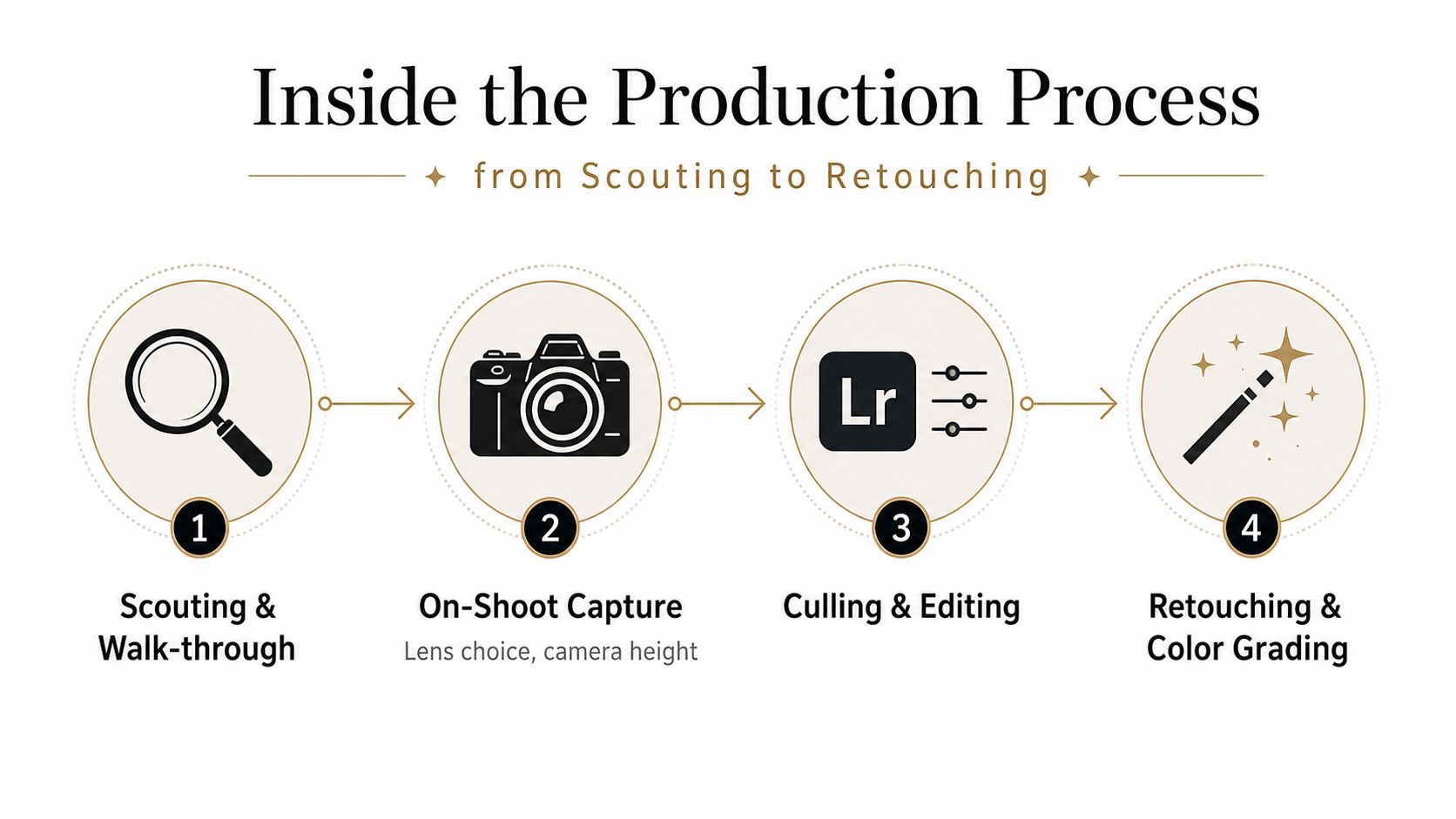
A commercial shoot starts before the camera comes out of the bag. The photographer needs to understand the property, the audience, the access restrictions, the intended deliverables, and the condition of the space. A rushed walk-through often leads to duplicated angles, missed amenities, and images that don't support the leasing plan.
Scouting and capture
During the walk-through, I look for sightlines that explain the floor plan rather than making rooms appear large. Camera height affects how furniture, counters, windows, and ceiling planes relate to one another. Lens choice controls how much context enters the frame, but an ultra-wide lens can make a narrow room feel misleading if the perspective isn't managed carefully.
Floor plans and lease-line drawings help identify the spaces that matter commercially. In an occupied office, the brief may prioritize vacant suites, shared amenities, and circulation without exposing confidential work areas. At a construction site, the priority may be a repeatable view that documents progress from phase to phase.
Interior scenes create a technical problem because bright windows and darker finishes can exceed a camera sensor's usable range. Practical guidance commonly starts with a three-shot bracket at -2, 0, and +2 EV, while high-contrast rooms may need five frames or wider spacing for HDR blending, as described in this exposure bracketing guide.
Lighting, staging, and post-production
Many interiors measure around 10 to 16 stops of dynamic range, while cameras commonly capture roughly 12 to 14 stops, according to HDR bracketing guidance from Photo Founder. Multiple exposures can bridge that gap. The photographer may blend bracketed frames, add controlled strobe, or use a hand-blended approach that keeps windows, fixtures, and shadow areas believable.
Staging is operational, not cosmetic. Remove personal documents, bins, temporary signs, loose cables, and distracting maintenance items. Straighten furniture, align chairs, check blinds, and coordinate finishes. Don't move secured equipment, tenant property without permission, or anything that could affect safety.
Retouching should correct the photograph without changing the property's meaning. Typical work includes vertical alignment, consistent color across mixed light sources, subtle reflection control, clean skies when appropriate, and exports for web, print, listing portals, and social formats. For a deeper look at structural corrections, see using post-production to fix structural photos.
Accuracy matters more than spectacle. A brightened room is useful. A room that appears vacant, finished, or materially different from reality can damage trust.
The final delivery should reflect the original scope. That may mean a curated still set, high-resolution print files, web-sized versions, vertical crops, aerial media, and a short video sequence. A good pipeline makes those outputs intentional instead of treating them as leftover exports.
Pricing Expectations and a Client Prep Checklist
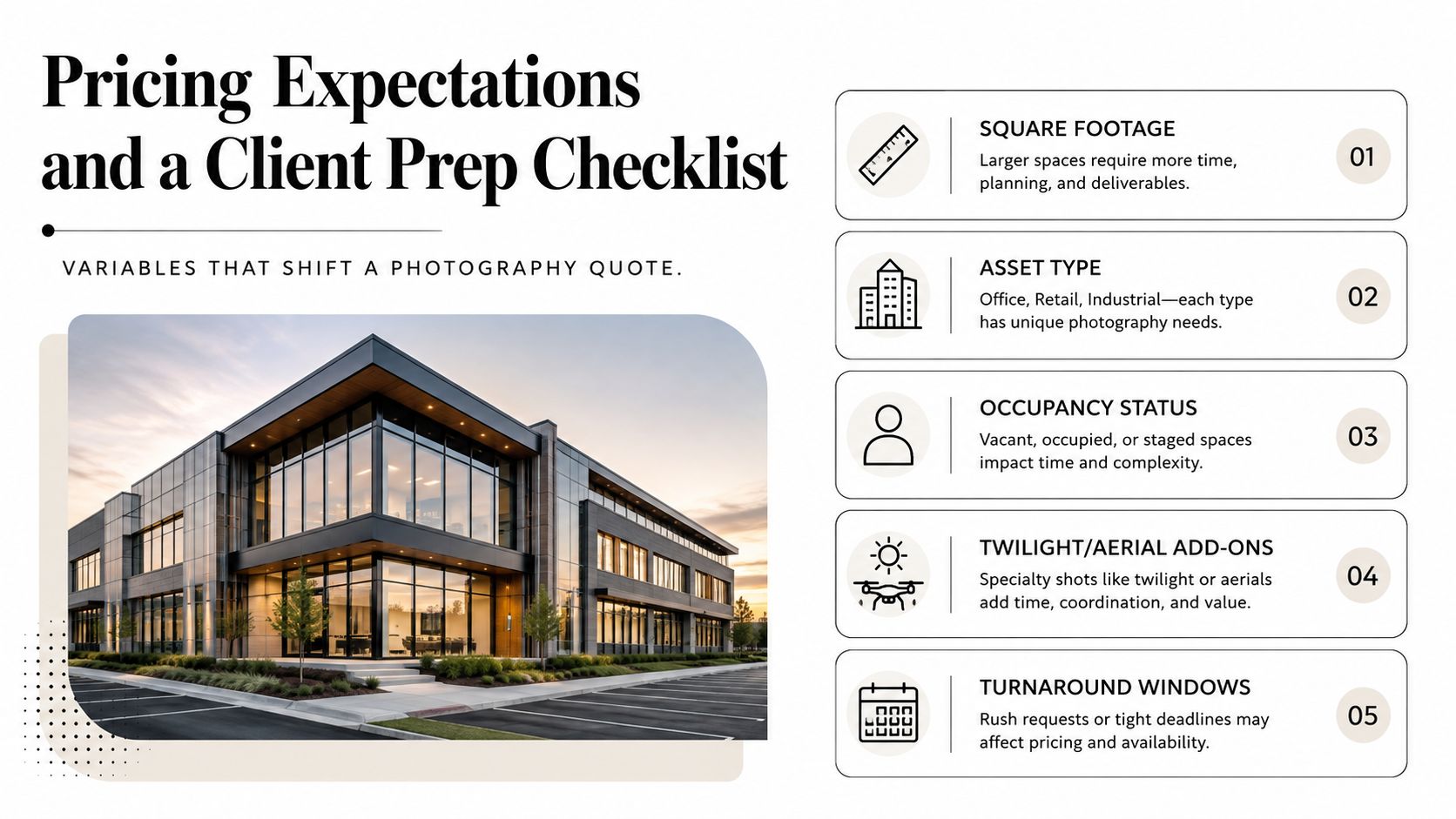
Commercial photography quotes vary because commercial assignments vary. A vacant retail shell, an occupied office tower, a hotel with coordinated lifestyle scenes, and a construction site don't require the same crew time, equipment, access plan, or post-production.
The main cost variables are square footage, asset type, occupancy status, aerial or twilight requirements, and turnaround window. A broader assignment may also include video, virtual staging, floor plans, 3D tours, or licensing for multiple internal teams. Those should appear as separate scope items so the client can see what the budget buys.
A single-image license and a complete marketing bundle aren't interchangeable. One may cover a limited use, while the other may include a full still library, motion, aerials, alternate crops, and broader property marketing rights. Ask how the images can be used, by whom, and for how long before approving the quote.
The week-of-shoot checklist
Preparation reduces wasted time and prevents avoidable retouching. A property manager can circulate a simple checklist:
- Confirm access: Provide keys, codes, escorts, loading instructions, roof access details, and contact information for decision-makers.
- Notify tenants: Explain the schedule, identify areas that won't be photographed, and secure permission for any occupied-space coverage.
- Control the building: Shut off fans, screensavers, distracting televisions, and temporary HVAC noise where practical.
- Coordinate lighting: Replace failed bulbs, confirm lighting overrides, and decide whether the property should show its normal operating color or a designed lighting scene.
- Clear the frame: Remove trash, cleaning carts, loose paperwork, construction debris, and temporary signs.
- Resolve signage: Confirm which tenant names, leasing signs, wayfinding elements, and construction notices should remain visible.
- Plan vehicles and parking: Move unnecessary cars and reserve a clear position for exterior compositions.
- Walk the site: Complete a final inspection with the photographer before capture begins.
Construction status deserves special attention. If a property is unfinished, the images should show the intended marketing stage without hiding conditions that affect a tenant's decision. For practical preparation guidance, use this project-site photoshoot checklist.
The controllable factor is readiness. A clean, accessible, coordinated property gives the photographer more time to refine composition and lighting instead of solving problems that the site team could have handled beforehand.
Portfolio Case Studies from the Atlanta Studio
A finished space can still photograph as incomplete. On one Atlanta assignment for a contractor, the subject was a newly completed model unit in a Class A mid-rise. The rooms were ready for marketing, but construction dust remained in corners, trim paint looked inconsistent in places, and afternoon light crossed the interiors at competing color temperatures.
The first scouting pass made the problem obvious. Shooting immediately would have produced distracting window contrast and forced the edit to carry too much of the burden. The team rescheduled for golden hour, when the skyline could contribute to the story without overpowering the interiors.
Model unit with a skyline problem
The exterior-facing rooms needed to feel bright while preserving the view. A five-bracket composite gave the edit enough material to balance the windows with the room, while careful staging kept the unit from looking sterile. The photographer concentrated on frames that showed the relationship between living areas, glazing, finishes, and the city beyond.
The delivery included hero stills for the leasing deck, vertical crops for social use, twilight exteriors, and a short looping clip. The client didn't just receive a set of room photographs. They received assets that could support distinct placements across the campaign.
Adaptive reuse with mixed fixture color
A second Atlanta assignment involved an adaptive-reuse loft photographed for a design firm. The space had load-bearing columns that could have read as obstacles, but scouting revealed that they created a natural rhythm through the room. The compositions used those columns to organize the frame and show depth without making the loft feel artificially wide.
A two-light setup preserved the warmth of the existing ambient light while adding shape to darker areas. The challenge wasn't to make every surface neutral. It was to unify mismatched fixture temperatures while keeping the texture of brick, wood, and metal intact.
Retouching refined the color relationship rather than flattening the space into a generic commercial look. The final bundle included architectural stills, vertical social crops, a twilight exterior, and a short looping clip, giving the design firm both portfolio material and campaign-ready content.
The strongest frame usually comes from a decision made before the shutter is pressed. Scouting reveals what should anchor the composition, while lighting and editing protect that idea.
These assignments show why commercial work needs a brief built around use. The contractor needed a finished unit to feel marketable and credible. The design firm needed the loft's structure and material character to remain visible. Different properties, different audiences, and different visual arguments.
FAQs on Deliverables, Compliance, and Bundled Media
What should a standard delivery include?
A practical package may include high-resolution stills, web-ready copies, horizontal and vertical crops, aerial media, and short-form video. The exact file formats should match the client's publishing tools and the designer's workflow. Don't assume that one export works equally well for a broker portal, a website hero, a printed brochure, and a social post.
Are aerials and video automatically included?
No. Drone photography, aerial video, walkthroughs, 3D tours, and social reels require separate planning, capture, editing, and usage decisions. Recent order data from HomeJab identifies video walkthroughs as the most purchased add-on at 16.4%, followed by aerial photo and video at 14.2%, 3D tours at 11.0%, and social reels at 1.7%, as reported in HomeJab's 2025 real estate photography trends.
The practical choice depends on the asset:
- Still photography works well for finishes, composition, suite identity, and print.
- Video walkthroughs help prospects understand sequence and circulation.
- Aerial media clarifies site relationships and location.
- 3D tours support remote exploration of complex interiors.
- Social reels create short, reusable campaign moments.
What about occupancy, construction, and editing?
The property's condition should guide the visual treatment. Don't remove construction debris if doing so would imply a completion status the building hasn't reached. Don't photograph tenant workspaces without permission, and don't rely on retouching to conceal occupancy, renovation, or access limitations.
AI-assisted editing and sky replacement also need a defined policy. Enhancements should preserve the property's material truth, and the client should know which changes are corrective and which are representational. Usage rights should identify the property, the campaign, the internal teams, and the approved duration rather than leaving licensing vague.
A bundled production is often more useful than a stills-only booking because the marketing team can plan one visual story across listing pages, investor materials, social channels, and leasing presentations. Commercial real estate photography and videography services can be scoped around those deliverables instead of treating motion as an afterthought.
Jimmy Clemmons Photographer creates architectural stills, commercial interiors, exteriors, aerial content, and coordinated video for Atlanta property teams, developers, designers, and contractors. Share a floor plan, rent roll, property brief, or upcoming leasing deadline with Jimmy Clemmons Photographer, and request a scoped visual package that accounts for occupancy, construction status, access, and every channel where the images need to work.