
You've delivered the finished images, the client loves them, and then the marketing director asks whether they can also use the photographs for a national campaign. A second request follows, this time for extra retouching, more crops, and another round of revisions. The original quote covered “photography and edited images,” so every new request becomes a negotiation you started without clear terms.
That situation is common in architectural and commercial work. A photography proposal template isn't just a polished pricing sheet. It's the document that defines what you'll photograph, what the client will receive, how the images may be used, and where the assignment ends. Proposal libraries and platforms consistently frame photography proposals as structured business documents covering scope, deliverables, payment terms, and client approval, with major platforms reporting repeated real-world use of their templates, including one listing used 8,204 times and rated 4.1 out of 5 across 16 reviews (PandaDoc's photography proposal template).
Why a Photography Proposal Template Matters for Commercial Work
A commercial client once asked for “a full set of finished architectural images” for a newly completed property. The phrase sounded reasonable until the project manager requested exterior views, detail shots, alternate compositions, social crops, dusk versions, and images of several spaces that hadn't been accessible on the scheduled day. The proposal had named the project but hadn't defined the location count, final image count, or access assumptions. The photographer had sold a shoot, but the client believed they'd bought an open-ended visual library.
That's where margin disappears. A developer may need images for a property website, a design firm may want portfolio use, and a brand team may plan paid advertising or out-of-home placement. Those uses aren't interchangeable, and neither are the production requirements behind them. Shoot duration, locations, final edited images, turnaround, usage rights, and cancellation terms all need a place in the document because each variable affects crew, equipment, post-production, and licensing value.
The cost of vague language
Weak proposals usually fail. They don't create an argument on signing day. They create one after the client has seen the work and begins treating every reasonable-sounding request as included.
Common margin leaks include:
- Unbounded deliverables: “Edited images” doesn't define how many images, in what format, or at what resolution.
- Unclear revisions: “Client revisions included” can turn a color correction into a new creative direction.
- Broad usage: “Commercial use” may be interpreted as permission for web, print, social, advertising, packaging, and future campaigns.
- Missing logistics: If access, weather, styling, or operating hours change, the proposal offers no agreed response.
A reusable template removes decision fatigue. You don't have to rebuild the business terms for every inquiry, and the client can compare the assignment details without searching through scattered emails. The proposal creates a paper trail when a marketing team, project manager, and outside agency each remember the brief differently.
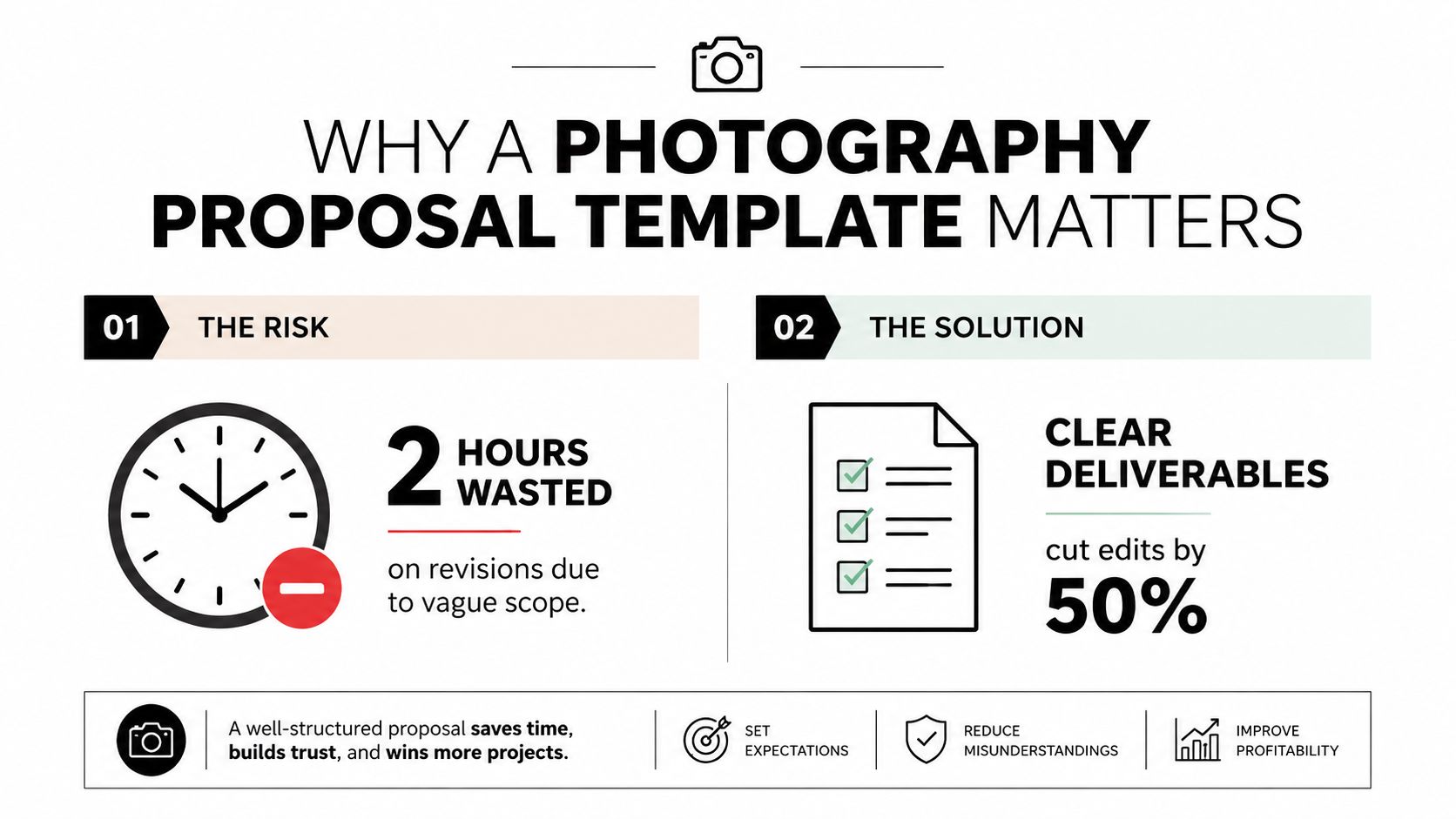
A strong template doesn't make the document colder. It gives you room to write a focused opening that shows you understand the property, campaign, or brand, while the later sections protect the work. The rest of this guide treats the proposal as a working production document, built for the decisions architectural and commercial clients make.
Essential Sections Every Photography Proposal Template Should Include
Clients read a proposal in a predictable order. They want to know who understands the assignment, what will happen, what they'll receive, what it costs, and what they need to approve. Put the persuasive context first, then make the commercial terms impossible to misunderstand.
Start with context, not credentials
The cover letter should identify the client, project, location, and intended outcome. A developer needs to see that you understand the property's design and marketing purpose, not receive a biography before the assignment has been defined. A short project overview then translates the brief into a practical plan, such as documenting exterior architecture, key interiors, material details, and the spaces most important to the campaign.
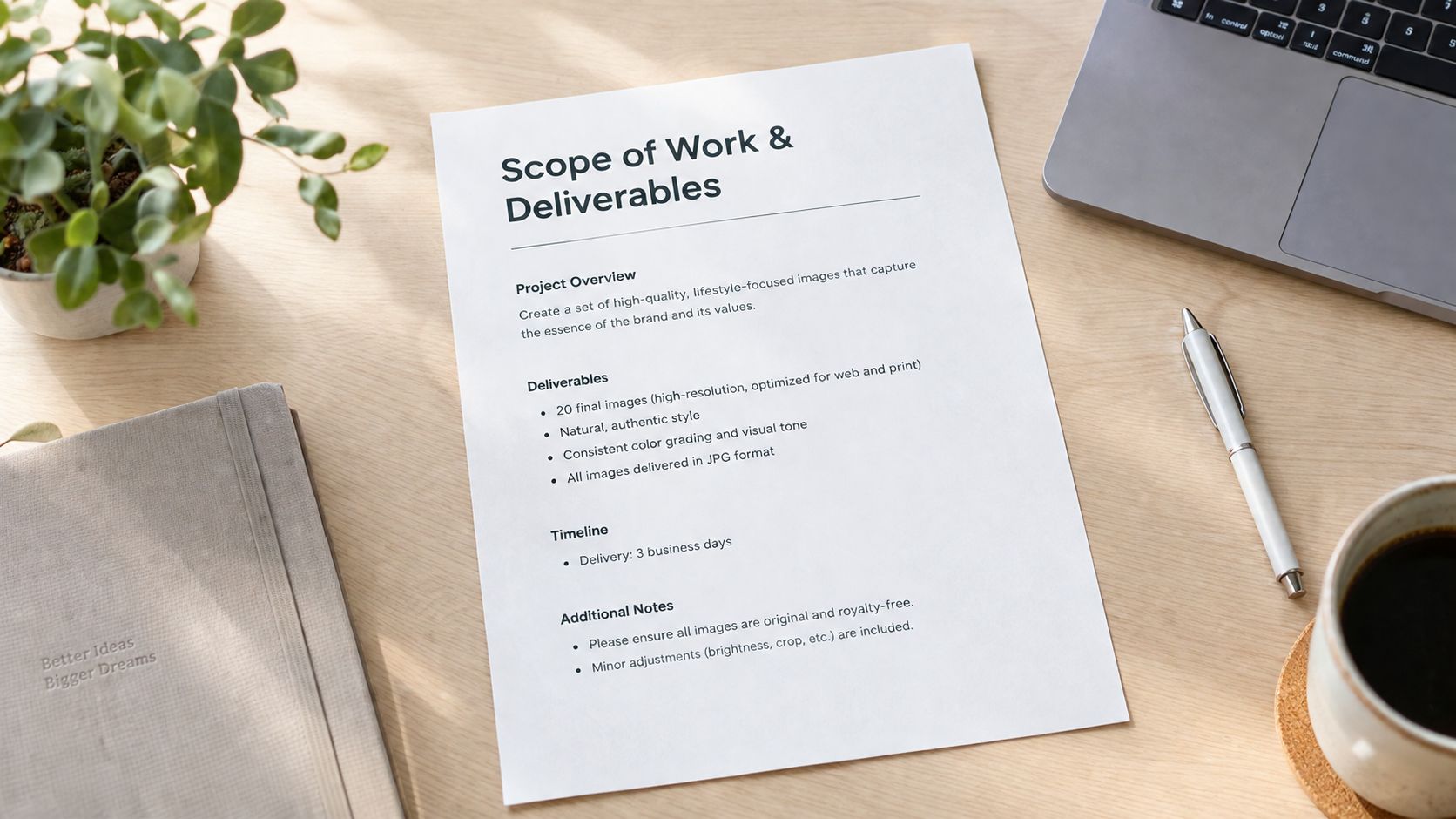
The scope of work follows. Define shoot days, locations, photographic approach, crew, styling or talent assumptions, and the client contact responsible for approvals. Deliverables should state the final image count or selection method, file types, resolution, delivery platform, and expected turnaround.
| Proposal section | Client question it answers | Risk if missing |
|---|---|---|
| Cover letter | Do you understand our project? | The proposal feels generic |
| Project overview | What are we trying to achieve? | Different stakeholders expect different outcomes |
| Scope of work | What production is included? | Extra time and locations become disputed |
| Deliverables | What exactly will we receive? | “Finished images” becomes unlimited |
| Licensing and usage | Where may we use the images? | Unpaid or overbroad usage |
| Timeline | When do planning, shooting, and delivery happen? | Missed launch expectations |
| Fees and payment | What are we paying, and when? | Cash-flow and approval delays |
| Revisions and reshoots | What happens when feedback changes? | Free post-production or repeat shoots |
| Cancellation | What happens if plans change? | Lost production time |
| Signatures | Who approved the terms? | No clear record of acceptance |
Put the licensing paragraph where it can't be overlooked
The licensing section deserves special attention because it often determines the long-term value of the assignment. State the client, territory, media, duration, exclusivity, and whether third-party agencies or affiliates may use the images. Then add the approval block, payment schedule, and cancellation language. A signature at the top won't protect an undefined license buried in an email chain.
Photography business systems increasingly pair proposals with inquiry forms, contracts, invoices, and planning documents. That workflow reflects how a proposal functions in practice, it's the first controlled handoff from sales to production, not an isolated presentation document (HoneyBook's photographer business template kit). Draft the scope and licensing language first, then tailor the cover letter around those confirmed terms.
Writing Scope of Work and Deliverables That Protect the Shoot
A scope should be readable by an architect, project manager, or marketing director in one pass. Avoid relying on production shorthand. Write the assignment as a series of observable commitments, then attach a boundary to each one.
Start with the physical assignment:
Scope example: “One scheduled shoot day at the approved property, covering the exterior, lobby, primary public areas, and selected interior details identified during the planning call.”
Then define what “finished” means:
- Final images: “Delivery of an agreed image selection, professionally color-corrected and retouched for architectural presentation.”
- Resolution and format: “High-resolution JPEG files suitable for approved print and digital applications, delivered through a password-protected gallery or agreed file-transfer service.”
- Location count: “The fee covers the named property and the areas reasonably accessible during the scheduled production window.”
- Crew and styling: “Client provides access, site readiness, required personnel, and any styling or talent identified in the brief.”
- Weather and access: “Exterior work depends on safe access and workable conditions. Delays caused by restricted access, construction activity, or weather may require rescheduling or additional production time.”
- Overtime: “Time beyond the scheduled hours requires client approval and is billed as an additional production charge.”
The point isn't to fill the page with defensive language. It's to make the handoff measurable. “A selection of images” should be replaced with a defined count, a gallery-selection process, or a clearly described editorial method.
Separate correction from new work
Your revision clause should distinguish post-production adjustments from a changed brief. A retouch might correct a distracting object, blend exposures, or refine a selected image. A reshoot means returning to the property because the client changed the composition, styling, access, or creative direction after capture.
Include a defined number of revision rounds. Guidance for creative proposals commonly treats two to three included revision rounds as standard, while stressing that the proposal should explain what counts as a revision and what constitutes a new direction (creative proposal guidance from The Blue Mango). State that additional revisions, new crops, alternate selections, or reshoots are quoted separately. For location permissions and related paperwork, connect the proposal to appropriate location release forms rather than assuming verbal access is sufficient.
End the deliverables section with the licensing handoff: “Requests for additional media, territory, duration, formats, or campaign use require written approval and an updated license.” That single sentence prevents a delivered image from becoming an unpriced asset.
Pricing, Licensing, and Payment Terms in the Template
Commercial pricing works best when the proposal separates production, post-production, and usage. Clients can understand what they're buying, and you can reduce scope without cutting the value of the work itself.
| Pricing structure | Best for | Photographer advantage | Client concern |
|---|---|---|---|
| Day rate | Location work with changing shot priorities | Protects time when the brief evolves | Final cost may feel less predictable |
| Project rate | Defined locations and deliverables | Makes approval easier and rewards efficient planning | Scope must be tightly defined |
| Usage-based licensing | Campaigns with distinct media or territories | Connects price to commercial value | Requires clearer marketing plans |
A day rate fits an active construction site, a large property, or a project where the client is still refining priorities. A project rate suits a defined architectural package with agreed locations, production hours, and final images. Usage fees can sit on top of either structure when the photographs will appear in paid campaigns, out-of-home placements, multiple markets, or other expanded applications. A practical licensing explanation should distinguish the capture fee from the rights granted, as detailed in this guide to licensing a photo for commercial use.
Build line items the client can approve
Use plain labels rather than one unexplained total:
- Photography production: shoot fee for the agreed schedule.
- Assistant and equipment: crew support, lighting, specialty equipment, or additional production resources.
- Post-production: culling, color correction, architectural perspective work, and standard retouching.
- Advanced retouching: composites, extensive object removal, sky replacement, or complex cleanup.
- Image licensing: approved media, territory, duration, exclusivity, and client entities.
- Usage extension: a separately priced renewal or expansion of the original license.
Payment terms should match the work's risk. Request a deposit when the client signs to reserve the production date, then define when the balance is due, such as on delivery or approval. Licensing invoices may use agreed business terms, including net-15 where appropriate, and a late-fee clause should appear in straightforward language rather than as an afterthought.
Include a kill fee for cancellations after the date has been reserved or production has begun. The proposal should state what the client owes if the shoot is cancelled, postponed beyond the agreed planning window, or made impossible by conditions within the client's control. You're not punishing the client. You're accounting for blocked time, preparation, crew coordination, and lost availability.
Tailoring the Proposal for the Client and Sending It Fast
The strongest proposal usually isn't the cheapest one. It's the one that makes the client's decision feel easy because the document reflects the brief they sent.
A reusable template should take less than an hour to tailor once your base language is sound. Start with the client's website and campaign materials. Note the words they use for their brand, audience, spaces, and channels, then mirror those terms without copying marketing language awkwardly. If the brief names a property, development, hotel, school, or product line, use that name throughout the cover page and project overview.
Make relevance visible
Match the deliverables to the stated channels. Web, print, social, paid media, and out-of-home use can require different image selections, crops, resolutions, or licensing terms. Reference the exact location and campaign purpose, and quote a phrase from the brief in your own summary so the client can see that you understood the request.
Light personalization is enough:
- Address the correct contact by name.
- Mention the specific property or campaign.
- Include one relevant portfolio link, not a broad archive.
- Explain one production choice tied to the brief.
- Keep your standard terms, but remove irrelevant sections.
Speed matters because the client's urgency begins at inquiry, not when you open your proposal software. Proposal benchmarks place average win rates around 43% to 45%, while top performers reach 65% to 75% or higher; the same benchmark reports that proposals sent within 24 hours of an inquiry are twice as likely to close (SendPro's proposal statistics). Those figures support a fast workflow, but they don't justify sending a careless generic PDF.
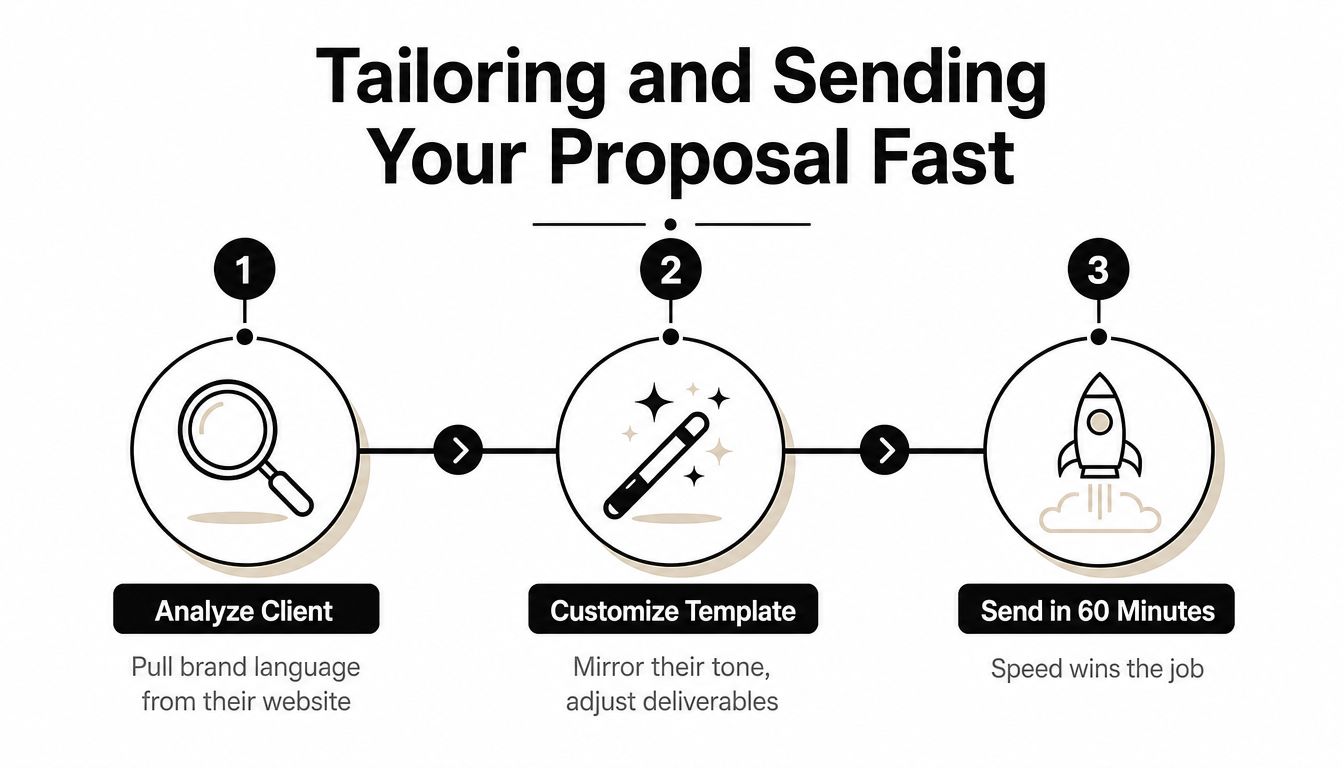
Respond within four working hours, deliver the proposal within 48 hours, and follow up once after three days. Treat those as operating targets, not promises you make before understanding the scope. A short discovery call can prevent a rushed estimate from creating a larger correction later.
Negotiation Moves Clients Make and How to Respond
Many photographers prepare a pricing sheet for the negotiation they hope to have. Commercial clients often negotiate something else entirely. They challenge the day rate, expand usage, reduce the budget, ask for retouching only, or request payment terms that shift the financial burden onto the photographer.
The answer isn't to defend every line emotionally. It's to let the proposal separate the pieces of value so you can trade scope without giving away labor.
Hold the rate by changing the package
“Can you drop the day rate if we reduce the hours?”
Respond by reducing the deliverables or defining a shorter production window, not by lowering the value of the reserved day. “I can revise the package for the shorter schedule and reduce the included image selection. The day rate remains unchanged, and overtime stays outside the base scope.”
“We'll need global usage too.”
Treat global usage as an expanded license. “The current proposal covers the named territory and media. I can add worldwide rights as a separate licensing line so the production fee stays clear.”
“Our budget is half your number.”
Ask what outcome matters most, then remove line items. Offer fewer locations, a smaller final selection, narrower usage, or less post-production. A smaller assignment can be profitable. A full assignment at half the price usually isn't.
“We already shot this internally. Can you just retouch it?”
Define the condition of supplied files, required color consistency, perspective work, and review process before quoting. Retouching isn't automatically simple because someone else pressed the shutter.
“Can we pay on net-60?”
Treat extended terms as a commercial concession with a cost. You can counter with a deposit, a separate licensing invoice, or a revised fee that reflects the longer collection period.
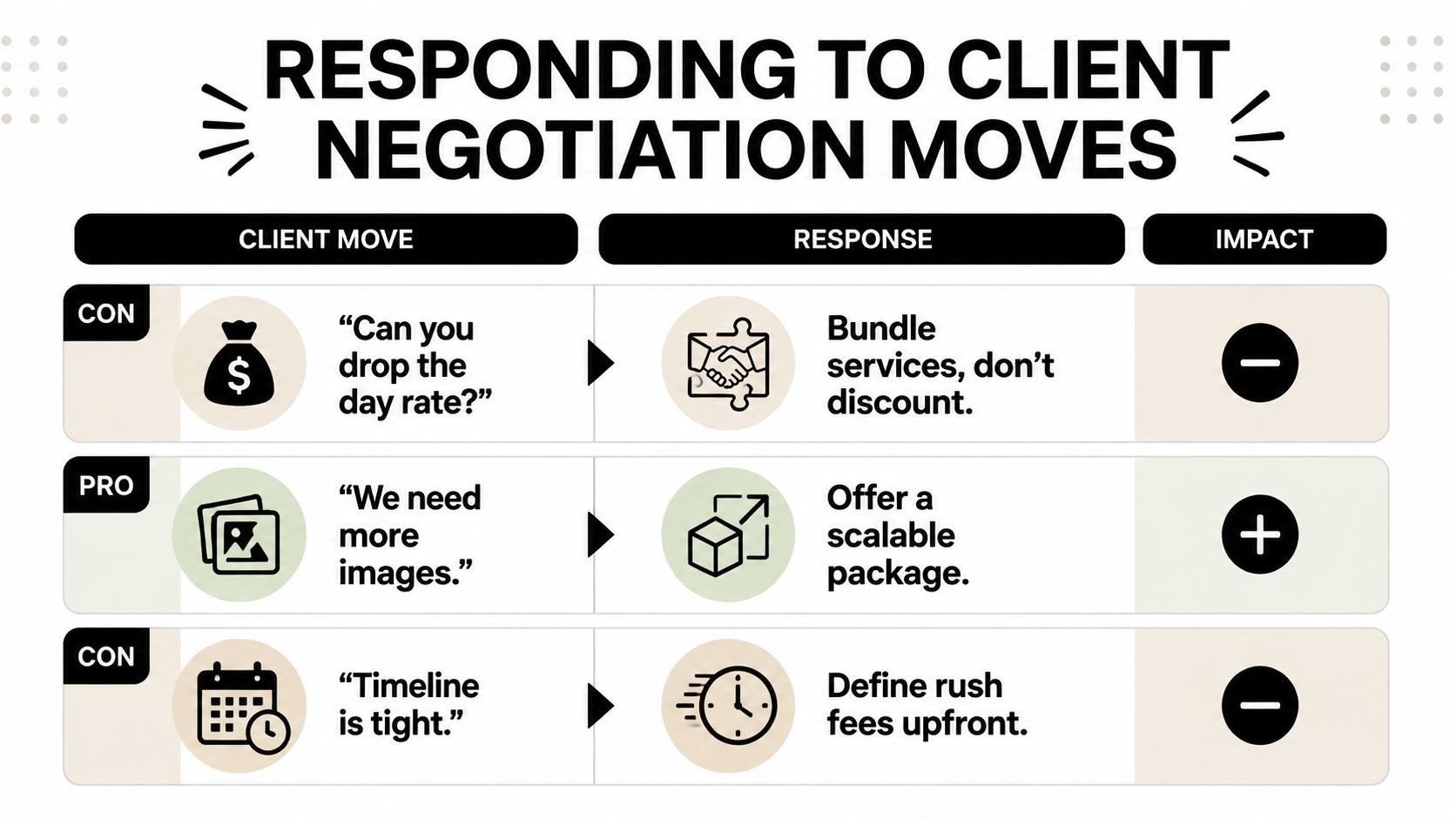
Negotiation rule: Give ground on deliverables, territory, timing, or service level. Don't quietly give away the production work.
The template should already contain revision limits, usage boundaries, overtime language, and cancellation terms. When those clauses are present before negotiation, your response sounds like normal project management rather than a new restriction invented to protect your margin.
The following video offers another practical perspective on handling client negotiation around photography assignments.
Annotated Template Checklist You Can Reuse on the Next Job
Keep this checklist beside your keyboard before opening the proposal file. A useful template stays short enough to print while catching the omissions that turn into unpaid work, usage disputes, or reshoot time.
The proposal flow
- Cover summary: Name the client, project, location, and intended outcome. Use a specific opening: “Prepared for ___, project ___, location ___.”
- Project overview: Restate the brief in the client's language and connect the visual approach to the business need.
- Scope and deliverables: State shoot days, locations, image selection, file format, resolution, delivery method, and included post-production. Cue: “Includes ___ scheduled shoot day(s), ___ location(s), and ___ final image(s).”
- Shoot logistics: Record access, site readiness, contact person, parking, permits, styling, talent, weather, and overtime assumptions. Use a dedicated photo shoot checklist to confirm production details before the shoot.
- Creative direction: Identify visual priorities, reference images, lighting approach, and must-have views. Put the brief in writing rather than leaving it as a verbal promise.
- Pricing and licensing tiers: Separate production, crew, equipment, post-production, and usage. Cue: “Day rate: $___ | Usage: ___ months, ___ territory | Rush: $___.”
- Timeline and milestones: List consultation, planning, shoot, first delivery, feedback, and final approval. Keep culling, editing, and revisions as separate stages so the client can see where decisions affect timing.
- Revision and approval process: State included rounds and distinguish a revision from a new creative direction. Name the person responsible for consolidating feedback.
- Cancellation and reshoot terms: Explain reserved-date charges, postponement, access failures, weather decisions, and client-caused reshoots.
- Signatures: Include names, roles, dates, and approval of scope, fees, and licensing. A verbal “we're good to go” does not define the agreement.
- Client summary page: End with a one-page recap of the shoot, deliverables, rights, payment schedule, and next action. Make it easy for a marketing director to forward internally.
The final quality check
Read the proposal aloud. Confirm usage dates, territory, media, image count, revision limits, and payment milestones. Remove placeholder pricing, attach the sample image set, check every client name and project title, then send the final document within 48 hours of the discovery call when the scope is sufficiently clear.
A template earns its place by answering questions before they reach your inbox. Keep the language direct, show exactly what the client is approving, and record every concession as a change to scope rather than an untracked discount.
Jimmy Clemmons Photographer creates architectural imagery, commercial brand content, and professional portraits through careful planning, location scouting, lighting design, and polished editing. Visit Jimmy Clemmons Photographer to discuss a commercial assignment and build a visual production plan with scope, deliverables, and usage terms that match the work.