
A strong corporate team photograph can influence credibility before a prospect reads a single line of copy. Research summarized through Wageningen University found that employee photographs can increase trust toward unfamiliar online retailers, while a classic Princeton University study found that observers formed trustworthiness judgments in about 100 milliseconds. A team image, then, isn't office decoration. It's an immediate signal about accountability, professionalism, and whether the people behind the brand feel real. Research on employee photographs and online trust
The most effective corporate team photo ideas make the workplace part of the story. They connect people to architecture, materials, light, and the visual language customers already associate with the company. The right concept depends on the team's culture and space, but every shoot should be judged by five practical standards: authenticity, spatial context, subject direction, lighting control, and asset versatility.
The ten concepts below are designed as a system, not a collection of poses. A cohesive shoot can include one dependable formal group portrait, environmental leadership images, and candid or movement-based frames for recruiting, social content, proposals, and editorial use. For architecture-led brands, professional location scouting, lighting design, direction, and editing from Jimmy Clemmons Photographer can help the people and the building read as one deliberate image.
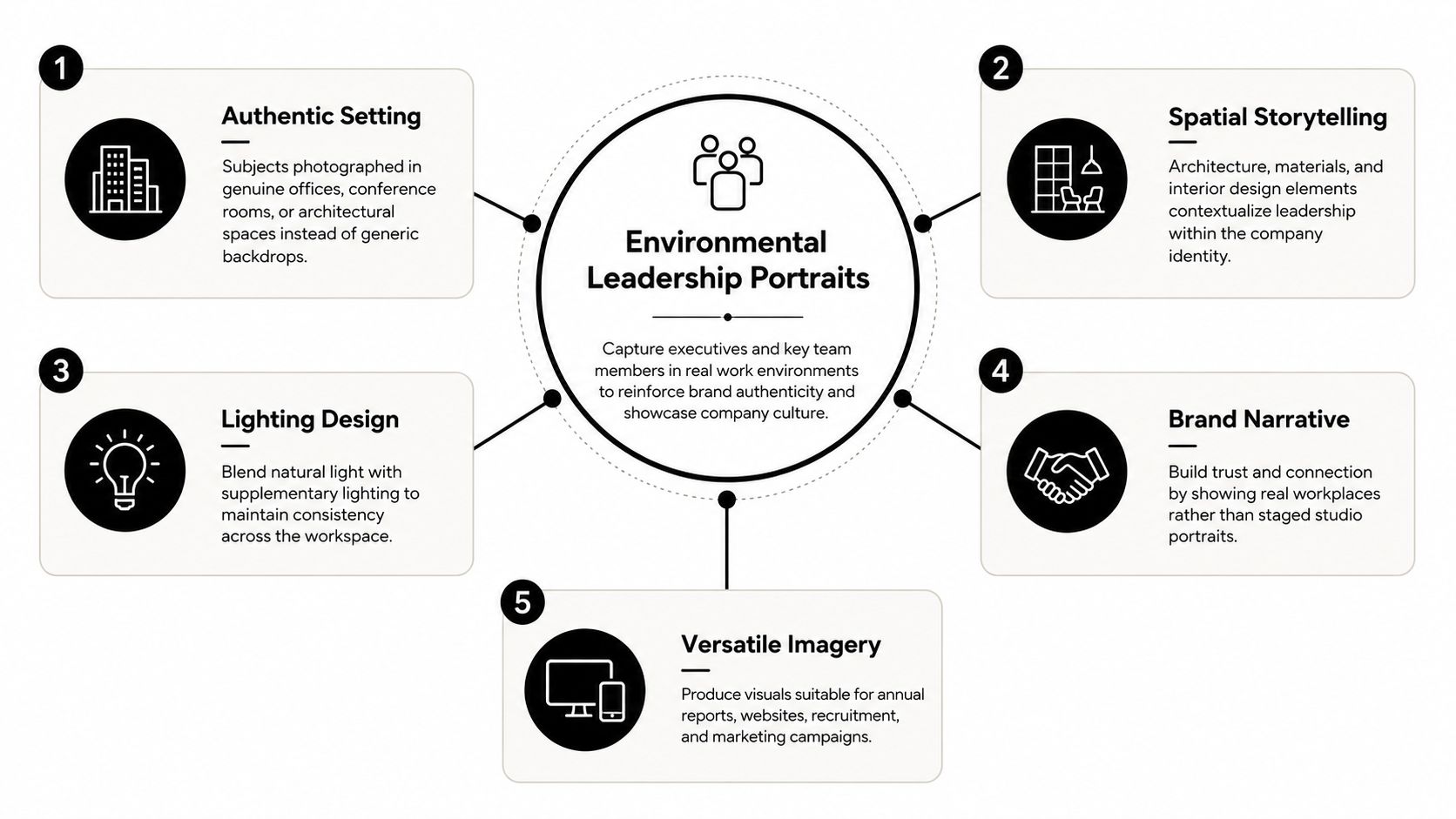
1. Environmental Leadership Portraits
Leadership portraits become more persuasive when the setting explains something about the company. Place executives and key team members inside the actual office, studio, conference room, or project environment instead of isolating them against a generic background. A principal photographed beside material samples communicates a different identity from a software executive positioned within a collaborative workspace, even if both portraits use the same camera and lighting.
The environment should support the subject, not compete with them. Architecture supplies useful framing through window grids, stair rails, ceiling planes, stone surfaces, and strong lines. A modern headquarters can give an IBM-style leadership portrait a sense of scale, while an architecture firm's studio can show the desks, models, drawings, and materials that shape its practice.
Build the portrait around the space
Scout before the shoot. Look for clean backgrounds, controlled daylight, practical depth, and surfaces that reflect the brand's palette. Arrive early to see how sunlight moves through the room, then add supplementary light where faces need separation from the architecture.
Practical rule: Show enough of the workplace to establish context, but not so much that the executive becomes a small figure in an interior photograph.
Direct subjects to use the space naturally. Ask a leader to review plans, stand beside a conference table, or look toward a colleague between frames. Capture both composed portraits and restrained candid moments, giving the marketing team options for leadership pages, proposals, press materials, and social profiles. The strongest frame often preserves posture and eye contact while allowing the surroundings to remain recognizably real.
2. Minimalist Unified Background
Minimalism works when the company needs its people to read as a single, confident unit. A neutral wall, solid color, textured surface, or architectural plane removes visual noise and directs attention to faces, posture, clothing, and expression. This is especially useful for law firms, consultancies, technology companies, and professional services teams that need a polished image for an About page or annual report.
A blank background isn't automatically refined. A flat white wall can look lifeless if the light is uneven or the group is arranged like a lineup. Choose a surface with subtle character, such as concrete, plaster, timber, ribbed paneling, or a carefully controlled brand color. A wall with dimension adds depth without introducing distracting objects.
Make repetition feel intentional
Consistency matters more than elaborate posing. Keep camera height, subject distance, framing, and light direction stable across the series. For an office-wide employee portrait library, the same visual treatment lets new hires sit naturally beside existing staff instead of looking like they came from unrelated shoots. A standardized approach is central to effective employee photography.
Use negative space deliberately. Leave room for copy when the image is intended for a website banner, but don't place every person in the exact center of the frame. Stagger shoulders, vary small angles, and maintain a clear hierarchy without making the image feel rigid. Confident posture, relaxed hands, and engaged eyes will do more than a complicated pose.
3. Environmental Team Portraits in Architecture
An environmental team portrait treats the building as an active part of the composition. The people shouldn't merely stand in front of an attractive interior. They should occupy its visual structure, interact with its materials, and reinforce the way the company works within that space.
An architecture firm might position principals along a studio's material palette, with drawings and models providing context without becoming clutter. A real estate team could use a lobby, development, or finished property to connect its people with the environments it creates and represents. A technology company might use a collaboration area whose geometry and transparency reflect its working culture.
Let architectural hierarchy guide people
Begin by identifying the room's dominant features. Is the strongest element a long corridor, a curved stair, a double-height void, a structural grid, or a wall of glass? Place subjects where they complement those forms. Don't obscure the feature that makes the location valuable, and don't force people into a space merely because it looks impressive from one angle.
Wide-angle lenses can reveal architecture, but they also exaggerate distance and may distort people near the edges. Keep important faces away from extreme corners, then test the frame from several camera positions. Light the architecture and the team as one scene. If the room is dramatic but faces fall into shadow, the photograph will advertise the building while weakening the brand's human message.
The best result balances people, place, and purpose. Viewers should understand where the team works and why that environment belongs to the company.
4. Geometric Group Formations
A conventional group photograph often fails because people are arranged according to convenience rather than composition. Geometric formations solve that problem by using lines, angles, repetition, and spacing to create a visual structure that feels designed. The arrangement can suggest precision for a consultancy, order for an architecture practice, or measured collaboration for a technical team.
Start with the location's dimensions. A corridor, staircase, window wall, or long conference table can provide alignment guides. Arrange subjects along those lines rather than placing everyone parallel to the camera. Diagonal rows, staggered grids, and triangular groupings create depth while keeping faces visible.
Design the formation before people arrive
Make a quick diagram or mark positions during the location scout. Use steps, platforms, seated rows, or varied standing heights to prevent one face from disappearing behind another. Keep the lighting broad and consistent across the formation, especially when the group extends through a large space.
A higher camera angle can clarify a geometric pattern, but it may reduce facial connection if the angle becomes too steep. A straight-on camera position preserves eye contact, while a higher viewpoint emphasizes organization and spatial rhythm. Decide which message matters more before directing the group.
Ask everyone to angle their shoulders consistently toward the camera or toward a central axis. Small differences in direction can make a precise formation look accidental. The final image should feel orderly without becoming mechanical, so allow modest variation in expression and stance.
5. Layered Depth Portraits
Layered portraits place team members across foreground, middle ground, and background planes. The result has more dimensionality than a single row and makes the viewer move through the photograph. Offices with glass partitions, doorways, split levels, open studios, and connected meeting areas offer natural opportunities for this approach.
A design firm could place a project lead near the camera, collaborators around a worktable, and additional team members deeper in the studio. A leadership group might occupy different positions around a conference room, allowing the architecture to create separation rather than forcing everyone shoulder to shoulder.
Control focus instead of relying on blur
Depth only helps when viewers can understand the hierarchy. Use aperture deliberately, from approximately f/2.8 to f/5.6 where appropriate, to control how much of each plane remains sharp. A shallow depth of field can emphasize one subject, but it may make supporting faces unreadable. For a team portrait intended to represent everyone equally, a smaller aperture and careful spacing are often safer.
Test focus points before the final arrangement. Make sure subjects in different layers have enough separation from one another and from busy backgrounds. Wider lenses can increase the sense of space, but people near the edges may appear stretched, so keep key figures within the more stable central areas of the frame.

6. Candid Team Narrative Series
One group portrait can identify a team, but a sequence can explain how that team works. A candid narrative series documents collaboration, presentation, review, problem-solving, and quieter moments of concentration. It gives the brand a wider visual vocabulary for careers pages, case studies, culture content, and editorial storytelling.
Start by deciding what the series should communicate. A consulting team may need images of discussion, analysis, and presentation. A construction or design firm may need people reviewing drawings, walking a site, or examining materials. A technology team might be photographed during sprint planning, testing, or a product review. The activity must be plausible, because staged gestures become obvious when the series is viewed together.
Arrive early and observe how people naturally occupy the space. Begin with a longer lens and minimal interruption, then introduce light direction once the team has settled. Suggest an action rather than micromanaging every hand and expression. Ask a project lead to explain a real decision, have colleagues review an actual board, or let a presenter address the group.
“Authenticity usually appears after people stop performing for the camera.”
Vary the edit between focused, energetic, wide, and close frames. A well-sequenced set should include different roles and relationships, not only the most senior people. A short visual story often gives a company more usable content than a single overworked group photograph.
7. Movement and Diagonal Composition
Movement adds energy without requiring a casual or exaggerated style. Arrange people along a diagonal corridor, stair line, sightline, or wall plane, then use turned shoulders, forward leans, and varied depth to create a sense of direction. This approach suits startups, creative studios, consulting teams, and design practices that want a photograph to suggest momentum.
A walking image can work as a website hero, but it needs more direction than “walk toward the camera.” Establish who leads, where the group starts, how quickly they move, and what they should discuss. A shallow V formation keeps the team connected while allowing the architecture to pull the viewer into the frame.
Keep energy controlled
Subtle movement is usually more usable than theatrical action. Ask subjects to shift weight, turn toward a colleague, or take a measured step. Shoot from an angle that strengthens the diagonal rather than flattening it into a horizontal line. Place key figures at strong compositional points, then protect enough space around each person to prevent the group from collapsing into a crowded mass.
Use lead-in lines from floors, walls, rails, or ceiling elements. If the location has no useful diagonals, create one through spacing and camera position. A successful image feels active because the composition moves the eye, not because everyone is running or laughing.
8. Reflective and Transparency Techniques
Glass, mirrors, polished stone, and reflective floors can turn a standard team portrait into a layered architectural image. Reflections may show people more than once, place the team behind a transparent partition, or create a relationship between the direct subjects and the space around them. The technique works particularly well for technology companies, agencies, modern headquarters, and brands that value openness.
Reflection is difficult to control. Clean every surface before the team arrives, then test the angle from the viewer's position. A reflection that looks subtle from one side may become a distracting duplicate from another. Place subjects with intention so direct faces and reflected faces support each other instead of competing.
Light for the surface and the people
Uncontrolled light sources often appear in glass. Move strobes, flags, and subjects until reflections become part of the design. A polarizing filter can help manage some reflections, though it won't solve every angle or surface problem. Check that important reflected figures remain visible and sufficiently sharp.
Transparency should be a compositional device, not a slogan. If the glass wall is central to the company's architecture, let it frame the team. If it doesn't add meaning, use a simpler setup. The strongest reflective images appear effortless because the photographer has solved the technical problems before the final group steps into position.
9. Vertical Stack and Staircase Positioning
Stairs provide height, rhythm, and built-in separation. They're one of the most reliable settings for a large group because each person can occupy a different visual level. A law firm may use formal entrance steps, an architecture studio may use stepped platforms, and a corporate leadership team may work across a tiered conference space.
Safety comes before composition. Check footing, surface condition, handrails, lighting, and the amount of room subjects need to enter and leave. Don't place anyone where a small shift could create a fall, and don't sacrifice a clear face for a more dramatic arrangement.
Use height to create flow
Arrange people so faces remain visible and the staircase lines lead through the frame. Height can influence placement, but it shouldn't create an unintended hierarchy unless that hierarchy is part of the brief. Key figures can occupy strong focal points, while supporting members fill the ascending or descending rhythm.
Test the camera angle before calling everyone in. A low viewpoint may make the stairs imposing but hide upper faces. A high viewpoint may improve visibility while reducing the sense of architectural scale. Light each elevation consistently, watching for shadows from railings, overhangs, or people standing above one another.
Keep posture and eye direction coherent. Everyone doesn't need an identical stance, but the group should look directed rather than randomly distributed across steps.
10. Elevated Aerial Perspective
A high-angle view changes a team portrait from a conventional group photograph into a study of pattern and space. A mezzanine, balcony, stair landing, or office platform can provide the necessary height. In some locations, an aerial setup may be appropriate, but safety, permissions, privacy, and the practical environment should determine whether a drone is suitable.
This concept works best when the group is arranged deliberately. Use circles, grids, arcs, or lines that echo the floor plan, furniture, lighting pattern, or architectural structure. Make sure every participant remains visible, and decide whether the photograph should prioritize faces, body arrangement, or the relationship between people and place.
Protect readability from above
A wide-angle lens can include the whole team and its context, but test how quickly faces become too small. Light from above or use the existing overhead pattern carefully to avoid harsh shadows across eyes and faces. If the team stands on a dark floor beneath bright ceiling fixtures, adjust the lighting or location before the final arrangement.
A platform or ladder may provide a useful viewpoint when no mezzanine exists, but it must be stable and safely positioned. The photographer should also consider how subjects will look upward, since raised chins and closed eyes can weaken the image.
For projects where the building itself is central to the story, Atlanta aerial photography can extend the same spatial thinking beyond a single interior frame. The aerial perspective should serve the brand narrative, not exist merely because the angle looks unusual.
Comparison of 10 Corporate Team Photo Ideas
| Style | 🔄 Implementation Complexity | ⚡ Resource & Time | ⭐ Expected Outcomes | 📊 Ideal Use Cases | 💡 Key Advantages / Tips |
|---|---|---|---|---|---|
| Environmental Leadership Portraits | Medium–High, location scouting & scheduling | Moderate–High, on-site lighting, prep | High authenticity and brand context ⭐⭐⭐⭐ | Corporate teams in architecturally significant spaces; real estate; interior design | Builds trust through real settings; scout in advance; use architecture to frame |
| Minimalist Unified Background | Medium, lighting consistency critical | Low–Moderate, simple backdrops, consistent lighting | Clean, timeless, cohesive identity ⭐⭐⭐⭐ | Executive portraits; corporate identity; boards | Creates uniform brand look; avoid sterile feel with strong composition |
| Environmental Team Portraits in Architecture | High, architectural composition expertise needed | High, advanced lighting, angles, prep time | Distinctive, editorial-quality imagery ⭐⭐⭐⭐⭐ | Architecture, real estate, design firms; hospitality | Make architecture a character; position subjects to interact with space |
| Geometric Group Formations | Medium–High, precise coordination & composition | Moderate, space planning, staging time | Memorable, structured visual impact ⭐⭐⭐⭐ | Modern corporates, design-forward teams, marketing assets | Plan geometry in advance; use elevated angles and negative space |
| Layered Depth Portraits | High, precise focus and layering control | High, expert photographer, time-intensive setup | Sophisticated, three-dimensional editorial look ⭐⭐⭐⭐⭐ | Multi-level offices, editorial corporate imagery, design firms | Control DOF carefully; separate layers clearly; test focus points |
| Candid Team Narrative Series | Medium–High, direction without staging | High, longer shoot & heavier post-production | Authentic, emotionally engaging series ⭐⭐⭐⭐ | Storytelling, social content, recruitment, culture showcases | Establish narrative arc; shoot discreetly; curate edits for flow |
| Movement and Diagonal Composition | Medium, compositional skill and subtle direction | Moderate, planning and rehearsal time | Dynamic, energetic, contemporary feel ⭐⭐⭐⭐ | Startups, innovation-focused firms, creative agencies | Use architectural diagonals; vary heights and subtle motion for momentum |
| Reflective and Transparency Techniques | Very High, complex technical execution | High, pristine surfaces, specialized lighting, filters | Highly distinctive, modern and layered imagery ⭐⭐⭐⭐⭐ | Design-forward orgs, tech, architecture, brands emphasizing transparency | Scout glass/mirrors; use polarizers; manage reflections and lighting meticulously |
| Vertical Stack and Staircase Positioning | Medium, logistics and safety planning | Moderate, requires stairs/tiers and safety prep | Naturally dimensional, magazine-style portraits ⭐⭐⭐⭐ | Firms with prominent staircases (law, architecture, hospitality) | Prioritize safety; arrange by height for visibility; ensure even lighting |
| Elevated Aerial Perspective | High, equipment/permits and vantage planning | High, elevated platforms, drones, or mezzanine access | Unique, pattern-driven imagery with strong visual impact ⭐⭐⭐⭐⭐ | Tech, design firms, organizations with spacious facilities; standout marketing | Scout elevation points; use wide-angle; confirm visibility and permissions |
Turn One Shoot Into a Consistent Brand Library
The most useful corporate team photo ideas rarely produce only one photograph. Choose a combination that gives the company a dependable foundation, clear environmental context, and enough human variation for different channels. A formal unified-background group image can serve corporate communications and official pages. An environmental or architectural portrait can show where the company works and what it values. A candid or movement-based series can carry culture, recruiting, social, and editorial messaging.
Hybrid and remote organizations need the same system, even when people can't stand in one room. Recent corporate photography coverage points toward environmental portraits, candid collaboration, and editorial storytelling, while also identifying the operational challenge of representing people photographed in different locations and on different schedules. A consistent crop, lighting direction, color treatment, and retouching standard can make distributed portraits feel related without pretending the team shares a single physical workplace. Coverage of corporate photography trends for hybrid teams
Authenticity matters because audiences increasingly question whether branded imagery is truly human. A 2024 global survey of more than 30,000 adults found that 98% agreed authentic images and videos are vital in establishing trust in a brand, 90% wanted to know whether an image was made with AI, and 76% said it had become difficult to tell whether an image was real. Getty Images employee survey findings support a practical response: build an editorially consistent library from real people, real spaces, and repeatable production standards.
Before the shoot, confirm the intended uses and crops. A wide group image may need room for website copy, while a vertical portrait may work better for mobile recruiting content. Align clothing colors with brand standards without forcing identical outfits, remove distracting objects, plan accessible movement through the location, and confirm that stairs, platforms, glass, and raised viewpoints can be used safely.
During production, scout the architecture and available light, establish a fixed lighting approach where consistency matters, direct subjects with clear but relaxed instructions, and capture both the primary group portrait and supporting frames. During post-production, match color temperature, contrast, skin tone, crop logic, and retouching across the set. Avoid aggressive filters that make authentic imagery feel manufactured.
Professional efficiency matters as a company grows. One market report projects the global professional headshot photography service market to increase from USD 1.13 million in 2026 to USD 2.14 million by 2035, with a projected 6.57% CAGR. The same report says corporate clients account for 42% of bookings, and standardized headshots appear in more than 61% of internal directories and team websites. A separate analysis estimates the broader commercial photography services market at about USD 15.2 billion in 2024, rising to USD 28.7 billion by 2033, with corporate photography representing roughly 28% of market share. These projections make the production lesson clear: batch refreshes, consistent camera profiles, fixed lighting diagrams, and delivery in multiple useful aspect ratios can reduce reshoots and extend asset life. Market context for professional headshot services and commercial photography
The strongest corporate team photo ideas are the ones your team can execute naturally and reuse consistently across its visual identity. Select the structure that fits the brand, then build enough variation around it to show real people, real work, and the character of the spaces they occupy.
Jimmy Clemmons Photographer provides Atlanta-based architectural imagery, commercial brand content, environmental team portraits, location scouting, lighting design, on-set direction, and professional editing. Visit Jimmy Clemmons Photographer to plan a cohesive team photo library that connects your people, workplace, and brand standards across web, recruiting, proposals, and editorial content.